The objective of a just-in-time inventory system is to totally eliminate all inventories.
Vertical analysis always involves comparing financial statement elements over a span of
time.
Product costs are reported on the income statement above gross margin.
For a manufacturing company, both direct labor costs and indirect labor costs are
classified as product costs.

Increases in long-term asset balances indicate cash outflows to purchase assets.
To reduce its total batch-level costs, a company should produce its products in large
batches.
Depreciation expense will appear on the schedule of cash payments for selling and
administrative expenses.
With respect to cost variances, managers seek to achieve actual costs that are higher
than standard costs.
A static budget is one that shows estimated revenues and costs at multiple activity
levels.
Only variable costs are relevant for decision making.
For a mixed cost, total cost increases in direct proportion to volume.
Working capital is current assets minus current liabilities.
Wayans Company has a contribution margin ratio of 60%. This means that its variable
costs are 60% of sales.
When selecting the high and low observations under the high-low method of analyzing
mixed costs, the selection should be based on the dependent variable (cost).
No contribution margin is provided by selling one unit of a product at a price of $35 if
variable production costs are $20, variable general and administrative costs are $5, and
fixed costs are $10 per unit.
Hurst Company’s standard variable materials cost per unit was $8. The actual materials
cost per unit on production of 10,000 units was $8.22. Based on this information, Hurst
Company incurred an unfavorable variable materials price variance of $2,200.
Interest expense is not included in the selling and administrative budget because a
company cannot estimate interest expense until it prepares the cash budget and makes
borrowing projections.

For 2014, Street Corporation reported net income of $400,000 and net cash flows from
operating activities of $550,000. Which of the following could not have been a reason
why Street’s net cash flows from operating activities were greater than its net income?
A. Increase in accrued liabilities from the beginning of the year to the end of the year
B. Increase in accounts payable from the beginning of the year to the end of the year
C. Loss on the sale of equipment
D. Increase in accounts receivable
In which of the following industries would a job-order cost system most likely be used?
A. Oil refinery
B. Small appliances manufacturer
C. Construction of cell towers
D. Beverage manufacturer
The following information is for a product manufactured and sold by Richards
Corporation:
Sales price per unit, $70
Variable cost per unit, $40
Total fixed costs, $600,000
Last year, Richards earned a profit of $30,000.
Required:
(a) How many units did Richards sell last year?
(b) Richards’ managers are considering decreasing the sales price to $60 in an effort to
increase market share. Also, the company wants a profit of $60,000. How many units
would it have to sell at the lower selling price to achieve this target?
For 2013, Winchester Company sold 80,000 units at a selling price of $20 per unit.
Variable cost per unit was $15, and Winchester’s net income for the year was $40,000.
What was the amount of Winchester’s fixed costs?
A. $360,000
B. $440,000
C. $1,160,000
D. $400,000

Financial reporting standards require that joint costs:
A. Be treated as a period cost and expensed immediately.
B. Be assigned to the product produced in the largest quantity.
C. Be assigned to the product with the highest sales value.
D. Be allocated to the two or more joint products.
Which of the followings statements is correct regarding direct and indirect costs?
A. Direct costs cannot easily be traced to a cost object, whereas indirect costs can be
easily traced to a cost object.
B. Direct costs can be easily traced to a cost object, whereas indirect costs cannot be
easily traced to a cost object.
C. Direct costs are always relevant to a particular cost decision, whereas indirect costs
are never relevant to a cost decision.
D. Direct costs are never relevant to a particular cost decision, whereas indirect costs
are always relevant to a cost decision.
The best objective when faced with limited resources is to maximize:
A. the gross profit per unit of the constraining resource.
B. the contribution margin per unit of the constraining resource.
C. production of the product with the highest selling price.
D. production of the product with the highest customer demand.
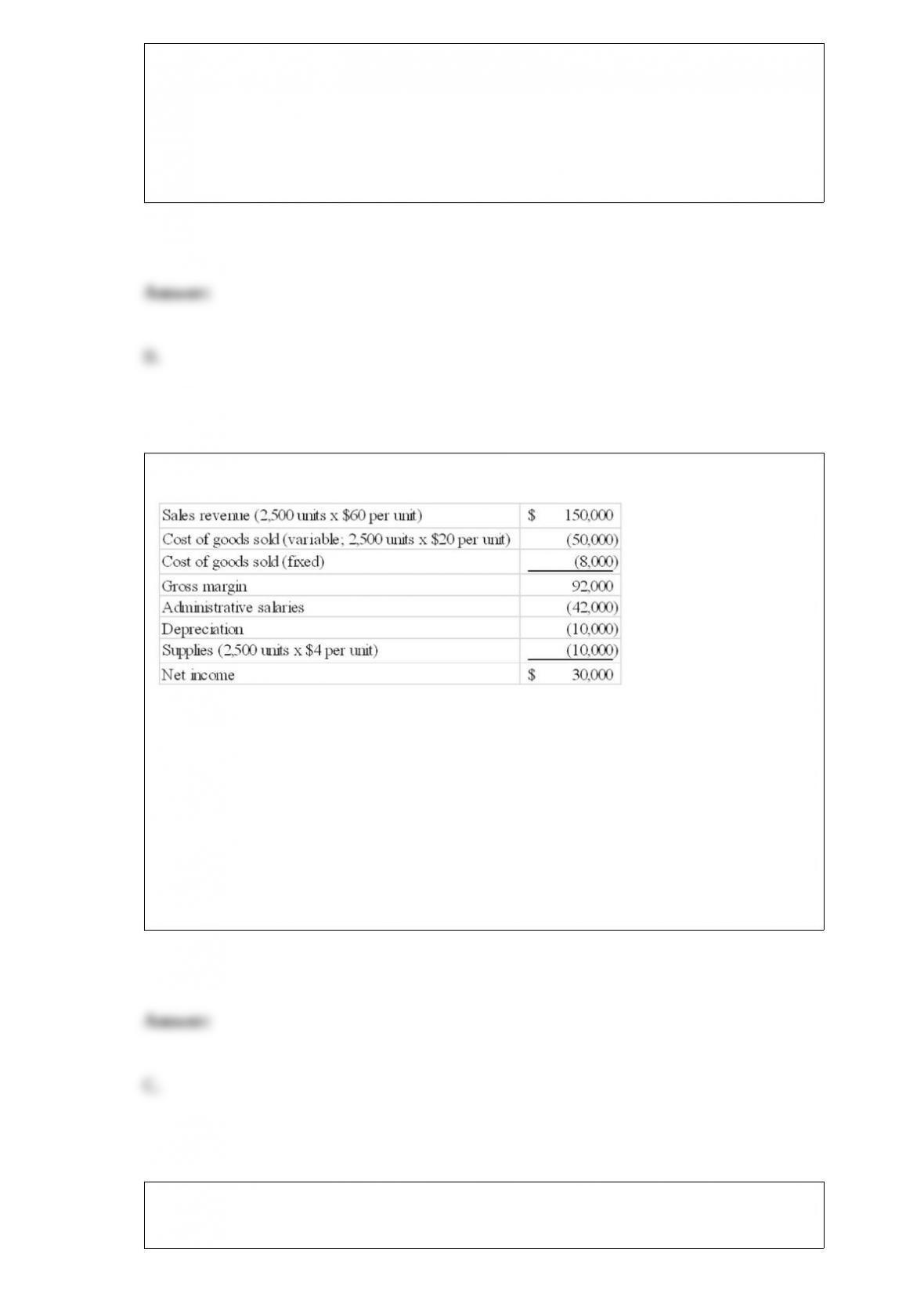
The following income statement is provided for Vargas, Inc.
What is this company’s magnitude of operating leverage?
A. 3.07
B. 0.33
C. 3.00
D. 1.67
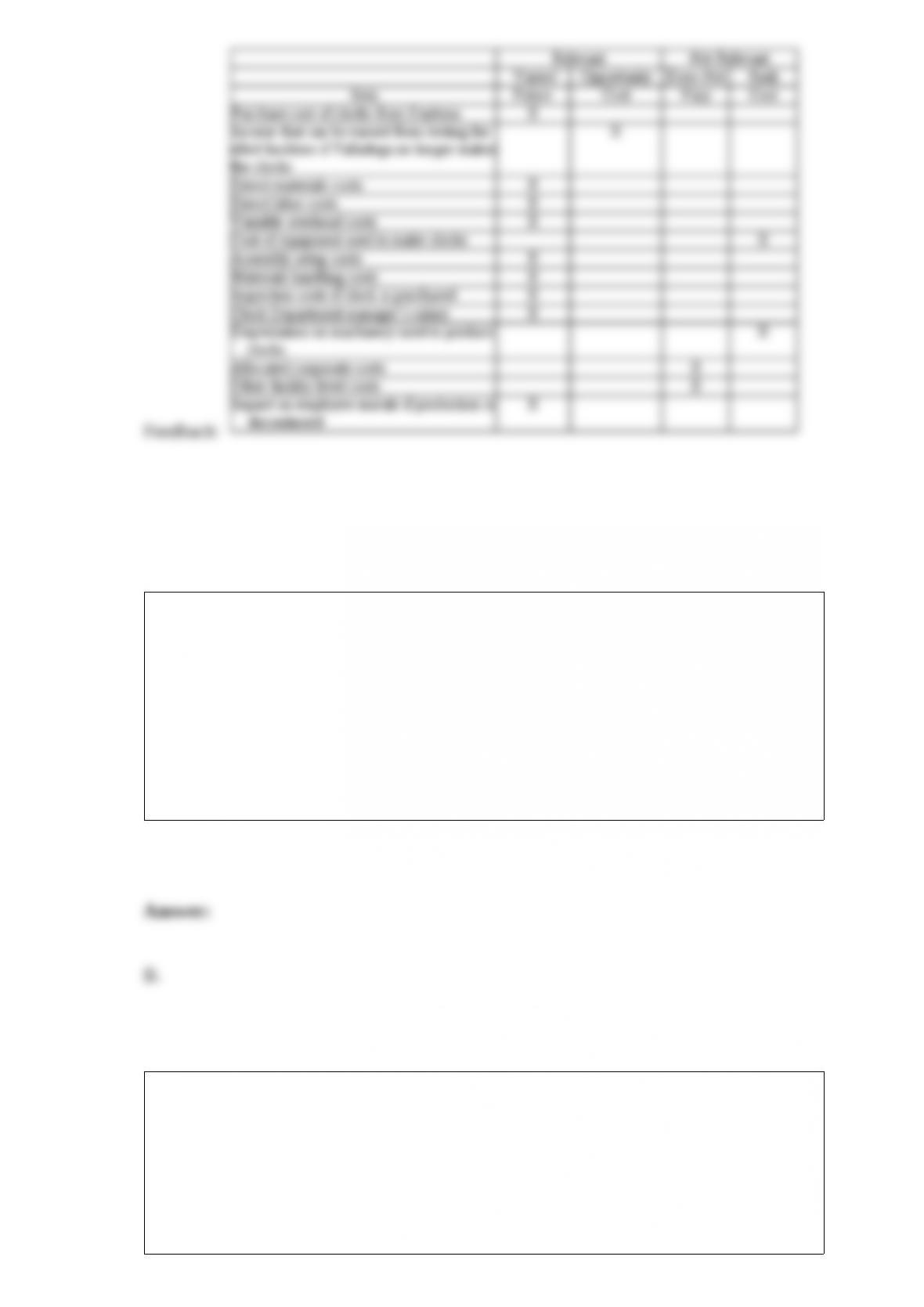
Talladega Company manufactures an electric clock radio. The company expects
production of 5,000 units this year. Currently, Talladega produces the clock used in the
product. Talladega has received an offer from Daytona, Inc., to supply the clock. If
Talladega discontinues production of the clock, the company will be able to eliminate
its product-level costs because no other products along the same line are produced by
the company. However, due to its concern for quality, the company will have to inspect
each clock. Various costs and items are described below:
Required:For each item in the table, place a check mark or X in the column that best
describes the item in the context of the described outsourcing decision. A cost varies if
the amount of the cost or the incurrence of the cost differs between the two alternatives:
continuing to make the clocks or purchasing the clocks from Daytona.
Increasing automation in a manufacturing facility will likely:
A. increase the number of direct labor hours and decrease overhead costs.
B. decrease the number of direct labor hours and increase overhead costs.
C. decrease the number of direct labor hours and decrease overhead costs.
D. None of these answers is correct.
As of December 31, 2013, Gant Corporation had a current ratio of 1.29, quick ratio of
1.05, and working capital of $18,000. The company uses a perpetual inventory system
and sells merchandise for more than it cost. On January 1, 2014, Gant collected $5,200
of accounts receivable. As a result of this transaction, Gant’s working capital will:
A. Increase.
B. Decrease.
C. Remain the same.
D. Cannot be determined.
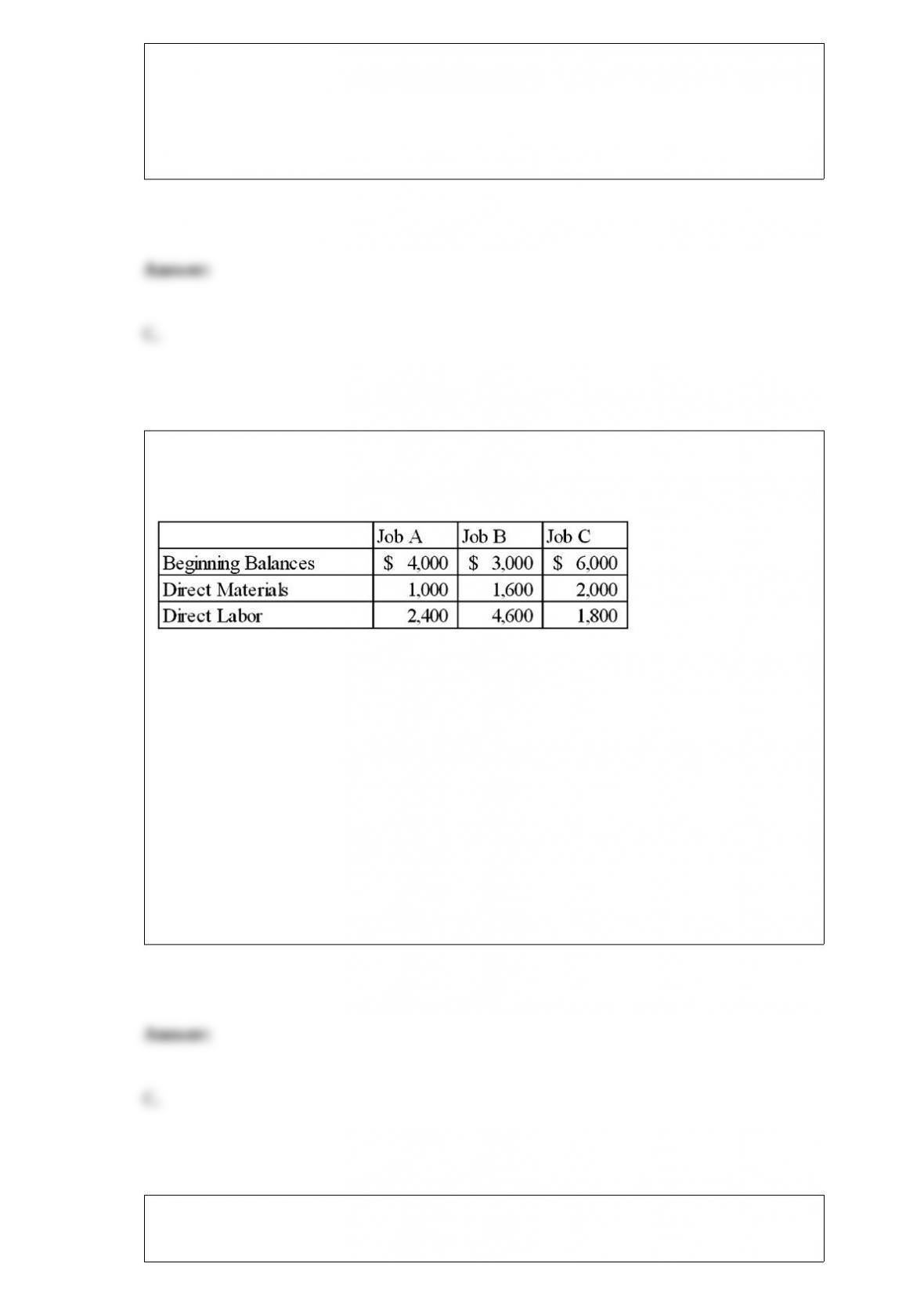
Needham Company uses a job order cost system. During the month of September, the
company worked on three jobs. The job order cost sheets for the three jobs contained
the following information at the end of September:
The company applies overhead at 120% of direct labor cost.
If Job B was sold for $16,000, what was the amount of gross margin for this job?
(Ignore any consideration of over- or underapplied overhead.)
A. $6,800
B. $5,880
C. $1,280
D. $14,720
Which manager is usually held responsible for materials usage variances?

A. Production supervisor
B. Marketing manager
C. Purchasing agent
D. None of these answers is correct.
An investment that costs $20,000 will produce annual cash flows of $5,000 for a period
of 6 years. Further, the investment has an expected salvage value of $3,000. Given a
desired rate of return of 12%, the investment will generate a (Do not round your PV
factors and intermediate calculations. Round your answer to the nearest whole dollar.):
A. positive net present value of $2,077.
B. negative net present value of $2,077.
C. positive net present value of $22,077.
D. positive net present value of $557.
Joint products are:
A. easily traced to products.
B. similar products that result from a common process.
C. different products that result from a common process.
D. different products that are combined to create a single product.

The process of dividing a total cost into parts and assigning it to cost objects is known
as:
A. cost tracing.
B. cost division.
C. cost allocation.
D. None of these answers is correct.
Hough Company manufactures a wide variety of products. A high proportion of its
indirect costs are batch-level costs, such as acquiring materials, moving materials
within the factory, and setting up machines. Hough uses direct labor hours to assign
indirect costs to all of its products. How is this use of a traditional product costing
system likely to affect the costs of Hough’s high-volume and low-volume products?
A. All of its products are undercosted.
B. Its low-volume products are overcosted.
C. All of its products are overcosted.
D. Its high-volume products are overcosted.
In vertical analysis, each item is expressed as a percentage of:
A. Total assets on the balance sheet.
B. Total cash on the balance sheet.
C. Total current assets on the balance sheet.
D. None of these answers is correct.
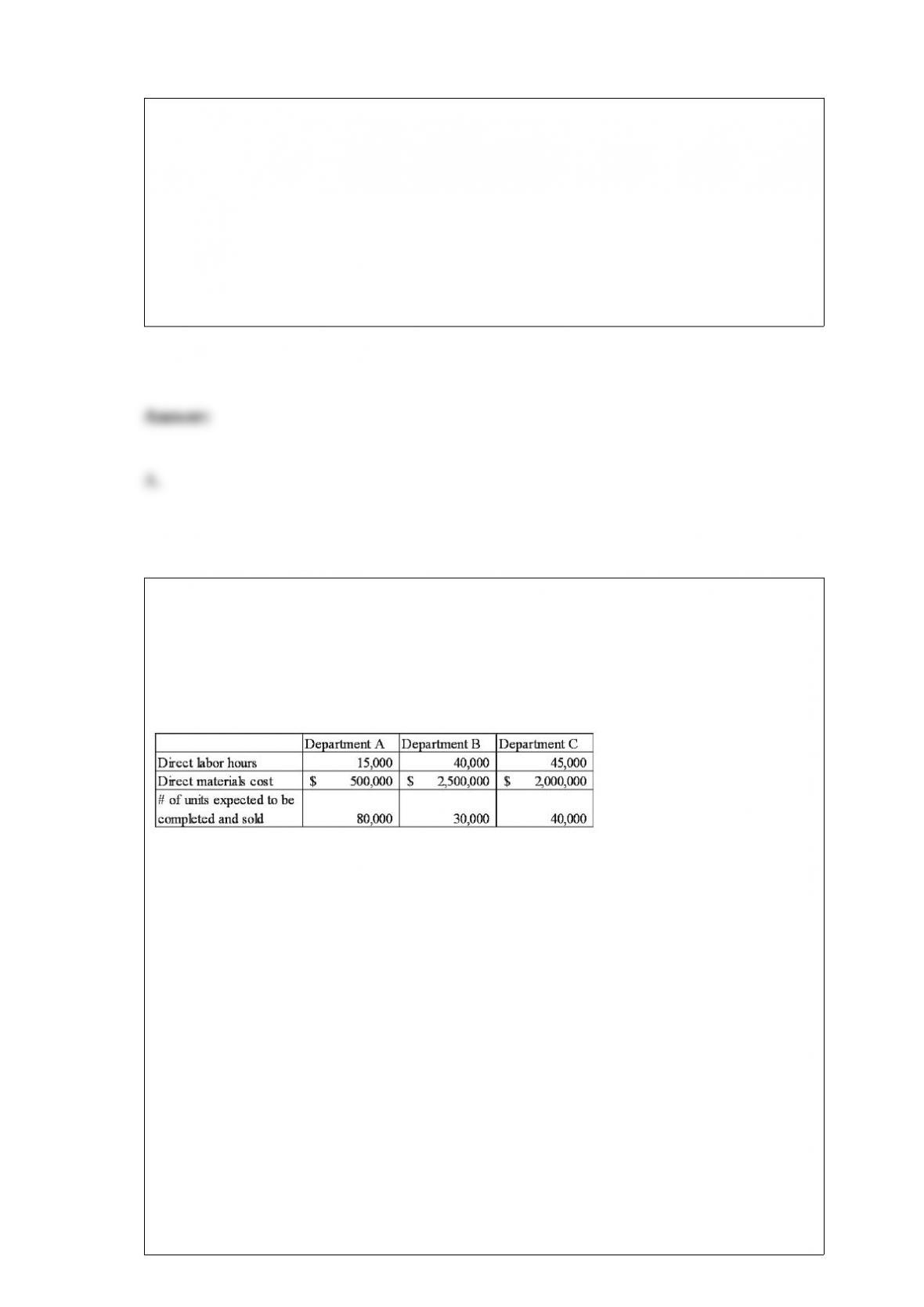
The following information was gathered for Company J, a manufacturing company
with three departments, A, B, and C:
Manufacturing supplies cost is expected to be $300,000. Possible cost drivers are direct
labor hours, direct materials cost, and number of units completed and sold. The three
departments have varying amounts for these items.
Based on this information, indicate whether each of the following statements is true or
false.
If number of units completed and sold is selected as the cost driver, the allocation rate
for manufacturing supplies cost would be $2 per unit.
If direct labor hours is selected as the cost driver, the manufacturing supplies cost
allocated to Department B would be $100,000.
The manufacturing supplies cost allocated to Department C would be unaffected by the
choice of the cost driver.
If the amount of bonuses to department managers is based on income after all expenses,
the manager for Department A would prefer that direct materials cost be selected as the
cost driver.
If the amount of bonuses to department managers is based on income after all expenses,
the manager for Department B would prefer that direct labor hours be selected as the
cost driver.
Describe the format of an income statement prepared using the contribution margin
approach.
Indicate whether each of the following statements about a cash budget is true or false.
Indicate whether each of the following statements about a cash budget is true or false.
A cash budget helps managers to anticipate cash shortages and excess cash balances.
The cash budget has two main sections: a cash deficit section and a financing section.
The total cash available is calculated by adding cash receipts and the ending cash
balance.
Cash payments may include outflows for inventory, selling and administrative
expenses, and depreciation.
Cash inflows and outflows indicated on the cash budget are reported on a company’s
pro forma statement of cash flows.
Company N manufactures machines to customer order. Why would the use of a process
cost system not be appropriate for N?
Indicate whether each of the following statements about job-order cost systems is true
or false.
In a job-order cost system, the costs of a job are accumulated on a job cost sheet.
Materials requisition forms are prepared by the company’s purchasing department to
order raw materials from a supplier.
A materials requisition form is a source document used in preparing a job cost sheet.
A materials requisition form is usually prepared and delivered electronically.
A manufacturer’s production department is responsible for preparing job cost sheets.
Indicate whether each of the following statements is true or false.
Some forms of financial statement analysis involve identifying changes in the same
item for the same company over a period of time.
Some forms of financial statement analysis involve comparing operations of different
companies in the same industry.
Vertical analysis is also called trend analysis.
Vertical analysis refers to studying the behavior of individual financial statement items
over several periods.
Horizontal analysis could be done using changes in the absolute dollar amount of an
item or trends in percentages.
Discuss the regulation of financial accounting, and compare to the level of regulation of
managerial accounting information.
The assumptions underlying cost-volume-profit analysis seldom are entirely valid. How
does that affect the usefulness of the technique?
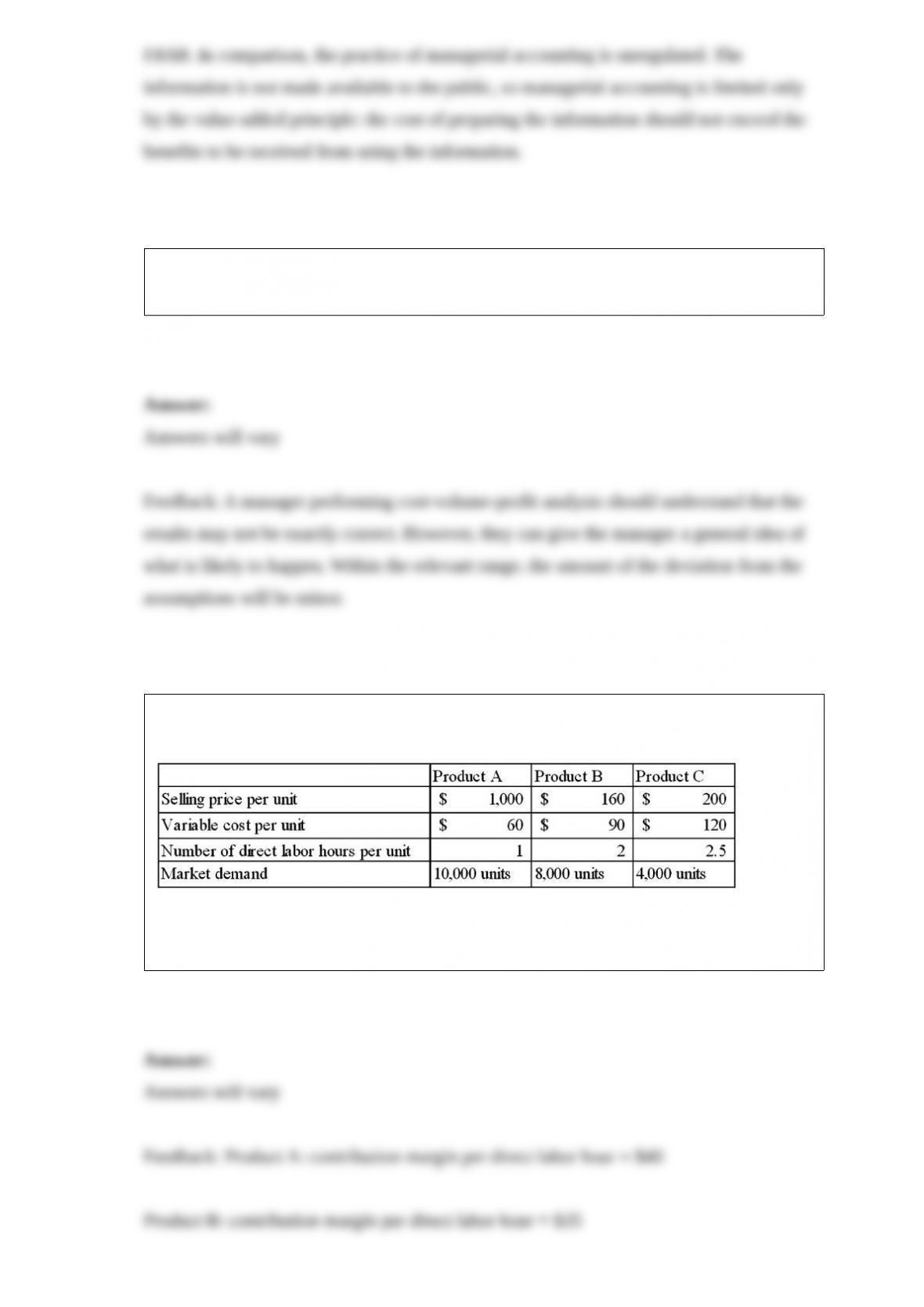
Bland Company makes three different products, Products A, B, and C, for which the
company has accumulated the following information:
Assuming that Bland has 15,000 direct labor hours available, which product(s) should
the company make and sell, and what will be its total contribution margin for the year?