1) edmondson inc. produces and sells a single product. the selling price of the product is
$200.00 per unit and its variable cost is $50.00 per unit. the fixed expense is $205,500
per month.
the break-even in monthly unit sales is closest to:
a.4,110
b.2,169
c.1,028
d.1,370
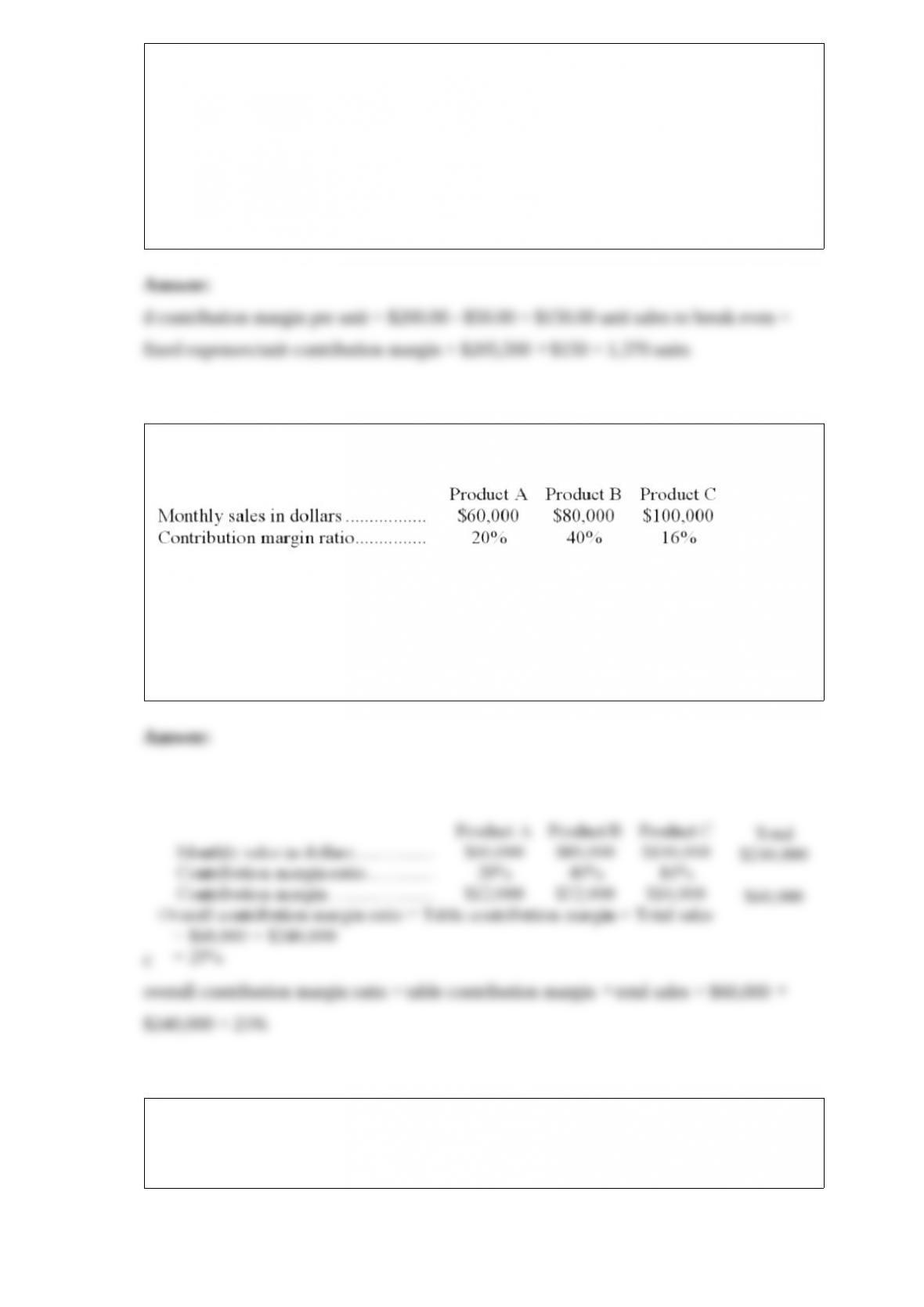
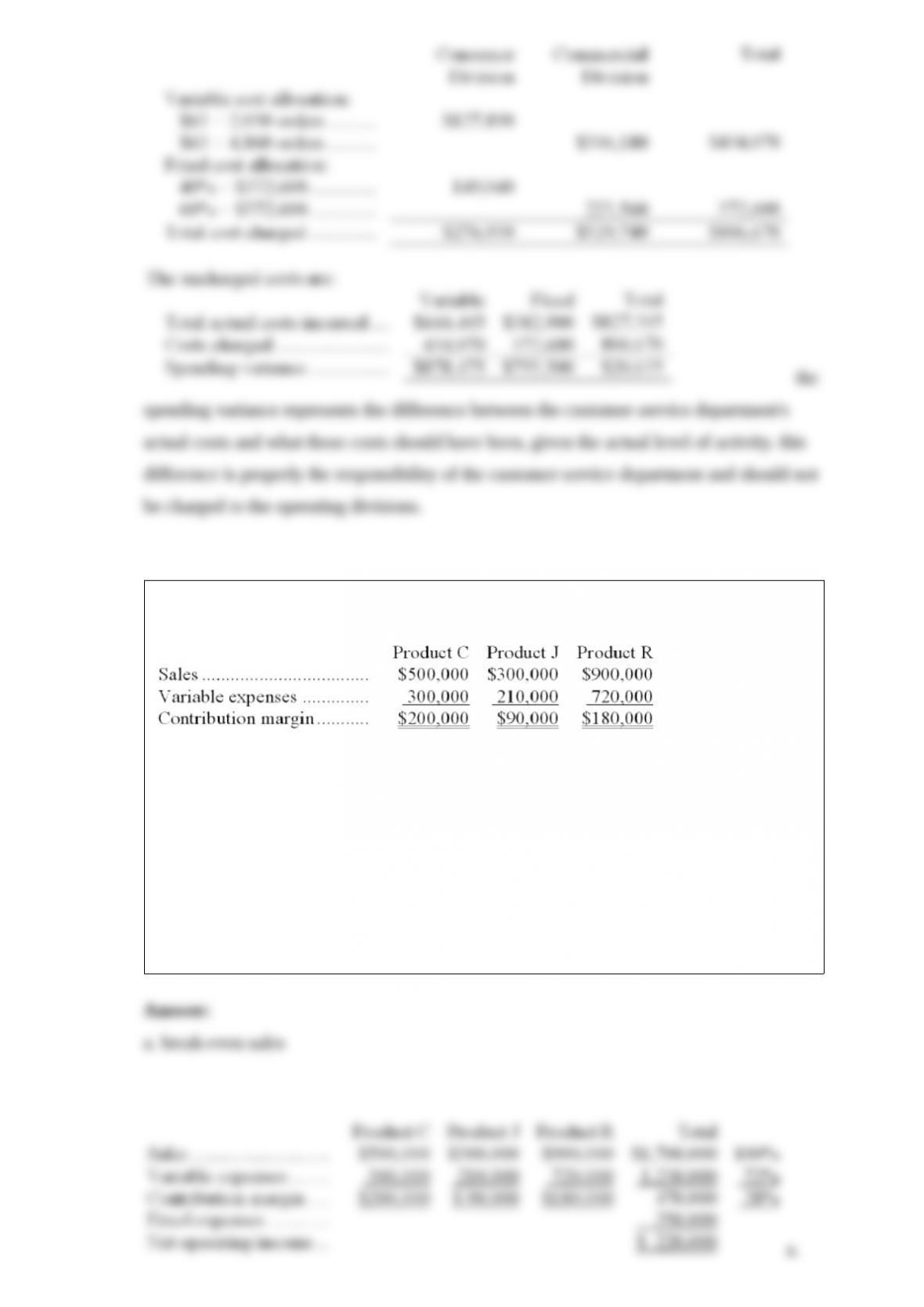
2) fletcher company has three products with the following characteristics:
the overall contribution margin ratio for the company as a whole is (to the nearest tenth
of a percent):
a.25.3%
b.75.0%
c.25.0%
d.28.5%
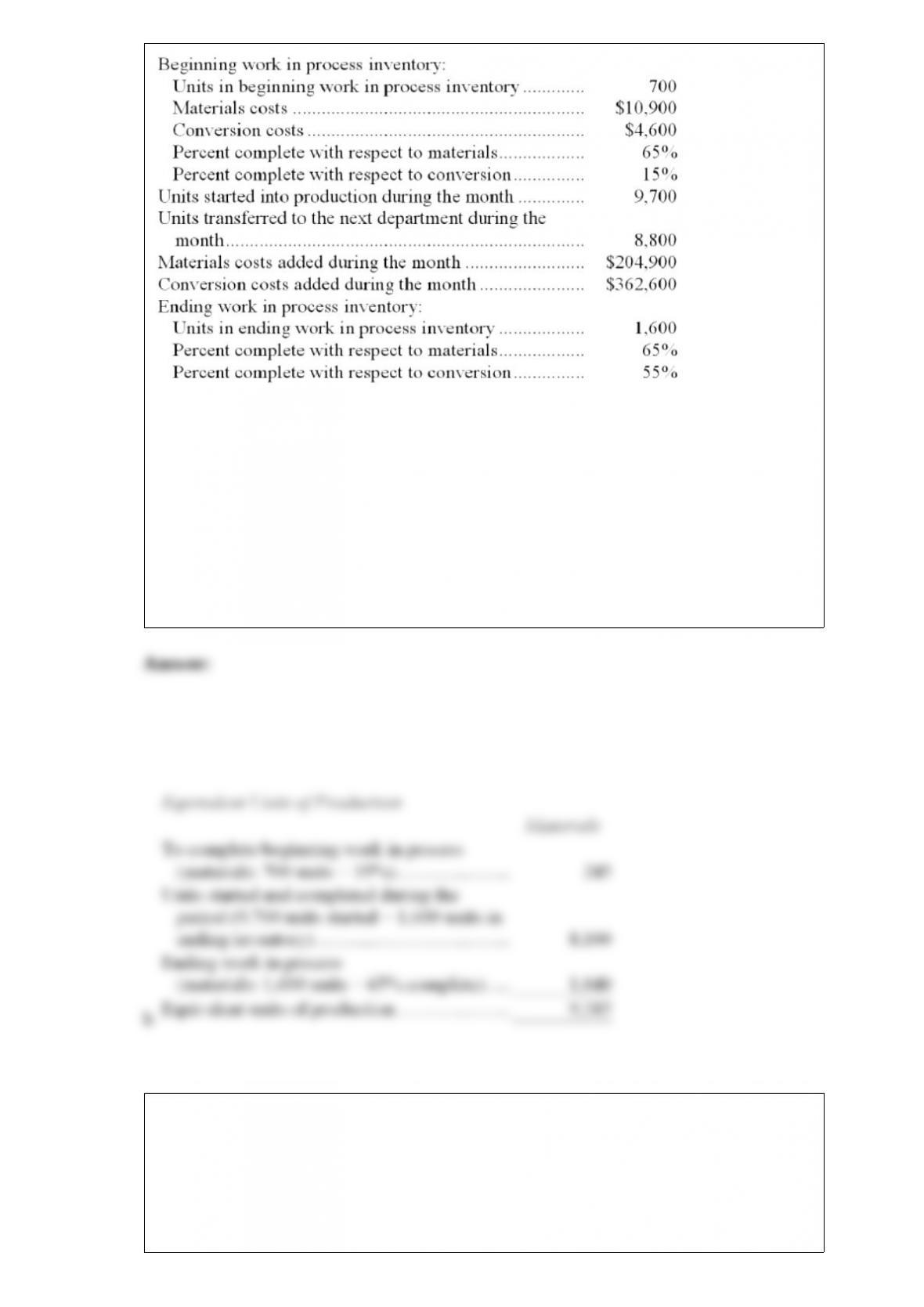
3) moulgadi corporation uses the fifo method in its process costing system. data
concerning the first processing department for the most recent month are listed below:
note: your answers may differ from those offered below due to rounding error. in all
cases, select the answer that is the closest to the answer you computed. to reduce
rounding error, carry out all computations to at least three decimal places.
what are the equivalent units for materials for the month in the first processing
department?
a.1,040
b.9,385
c.10,400
d.8,100
4) jarratt inc., a manufacturing company, has provided the following data for the month
of september. the balance in the work in process inventory account was $21,000 at the
beginning of the month and $24,000 at the end of the month. during the month, the
company incurred direct materials cost of $69,000 and direct labor cost of $31,000. the
actual manufacturing overhead cost incurred was $54,000. the manufacturing overhead
cost applied to work in process was $58,000. the cost of goods manufactured for
september was:
a.$158,000
b.$154,000
c.$151,000
d.$155,000
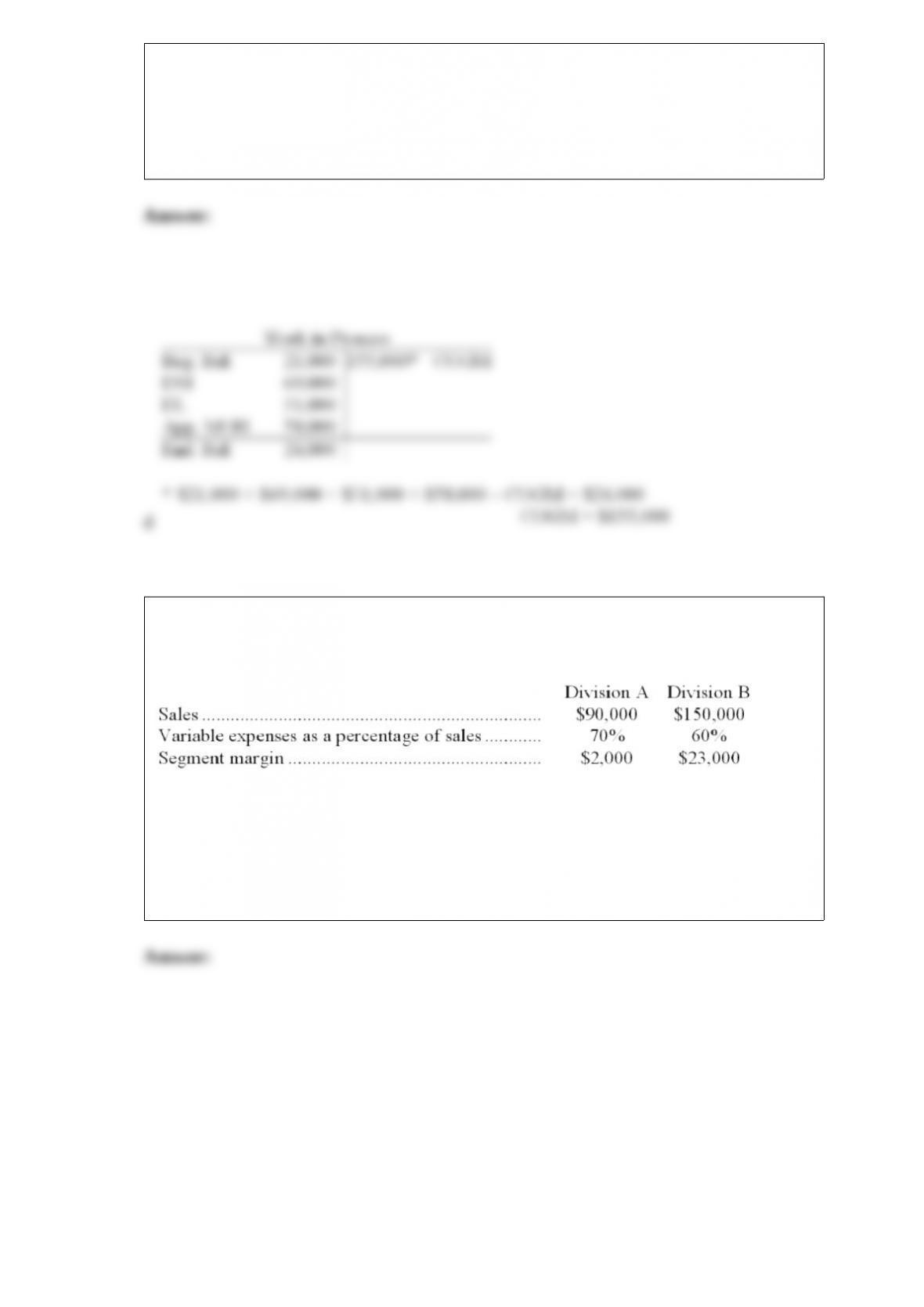
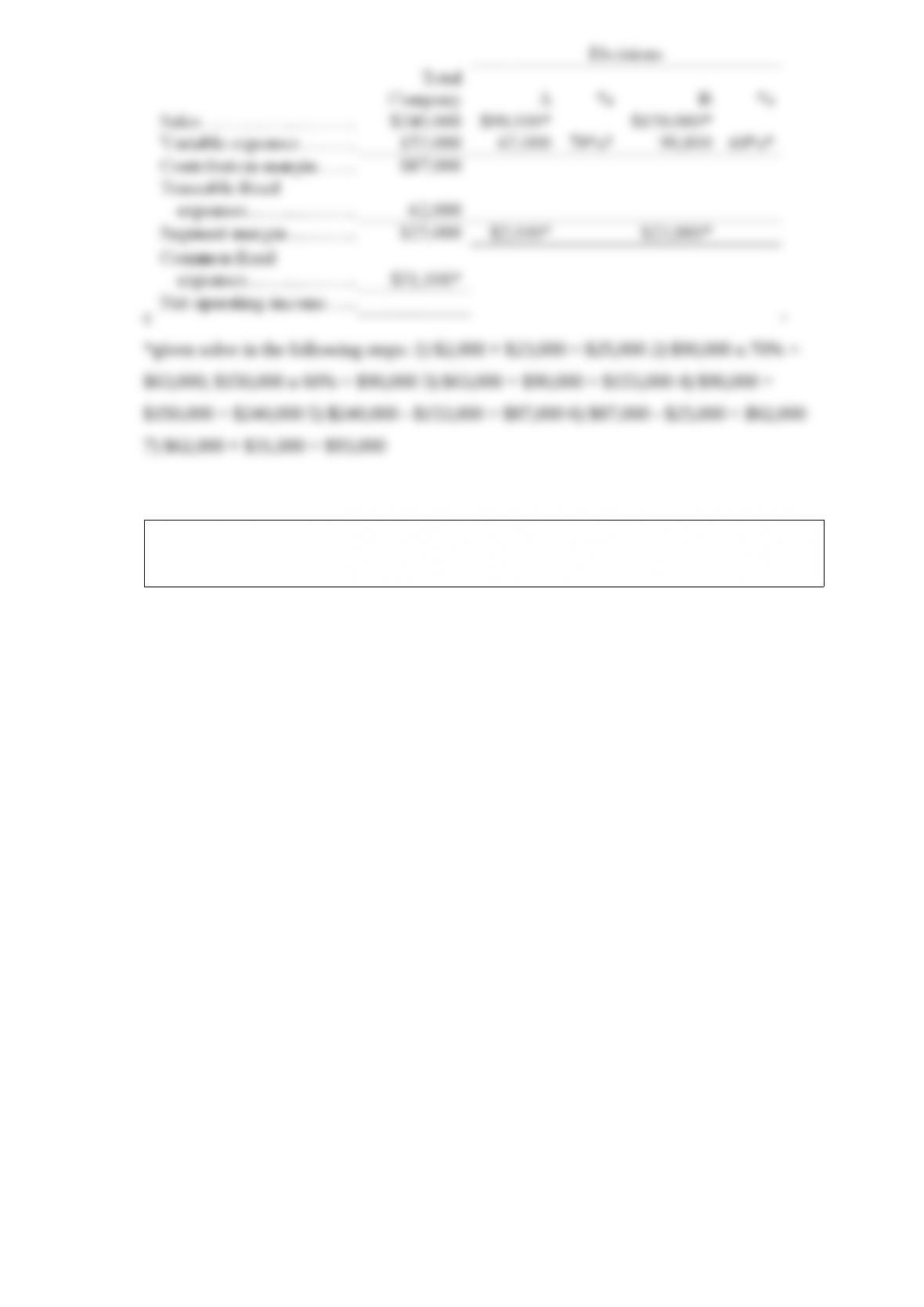
5) denner company has two divisions, a and b, that reported the following results for
october:
if common fixed expenses were $31,000, total fixed expenses must have been:
a.$31,000
b.$62,000
c.$93,000
d.$52,000
6) financial statements for larkins company appear below:
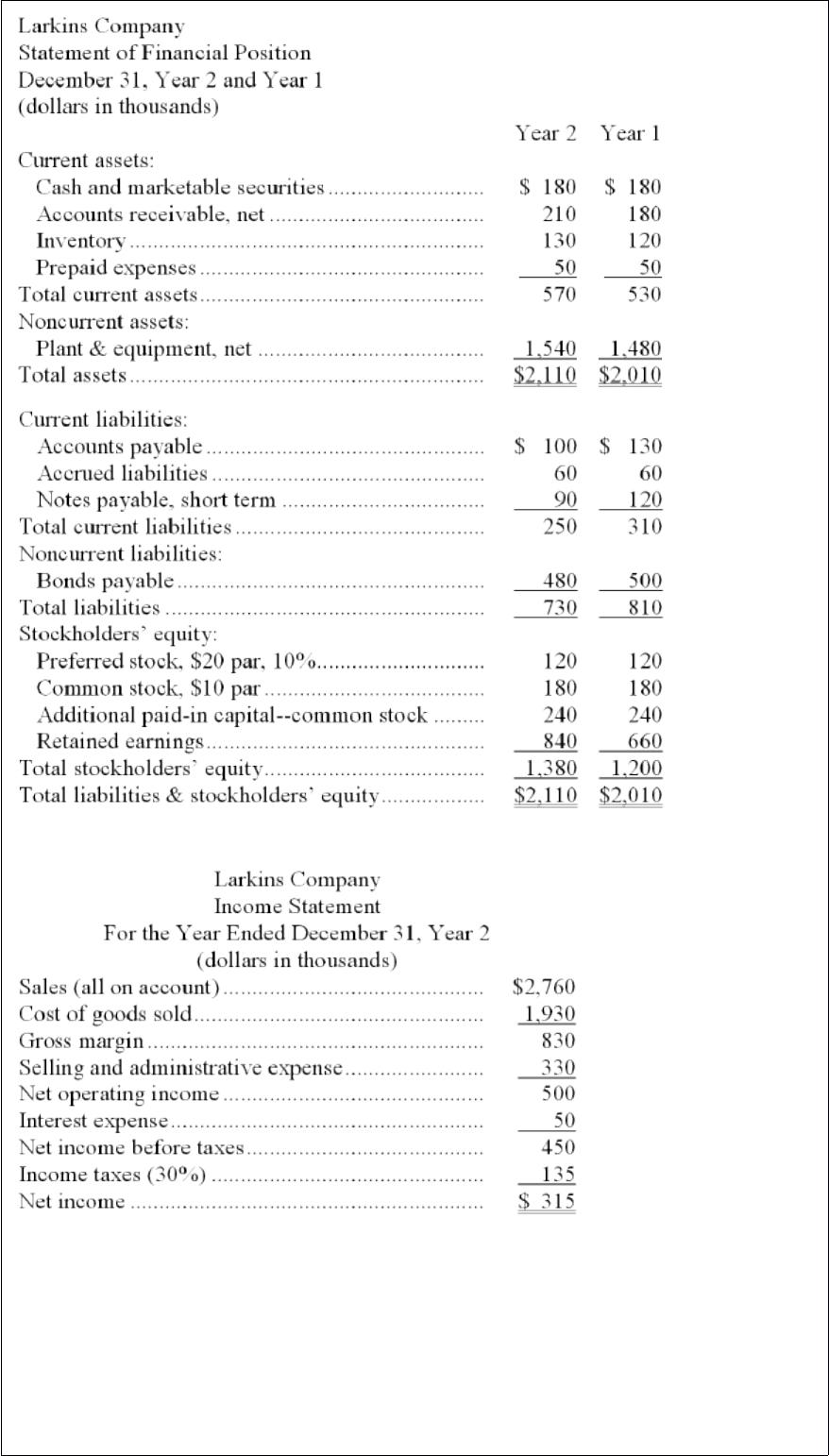
dividends during year 2 totaled $135 thousand, of which $12 thousand were preferred
dividends. the market price of a share of common stock on december 31, year 2 was
$150.
larkins company’s book value per share at the end of year 2 was closest to:
a.$10.00
b.$23.33
c.$70.00
d.$76.67
7) (ignore income taxes in this problem.) henry wants to send his son to computer
school which will start one year from today. payments of $2,000 are due at the end of
each of the next two years. what lump-sum will henry have to invest now at 12% per
year in order to have $2,000 at the end of each of the next two years?
a.$4,240
b.$3,380
c.$1,594
d.$2,508
8) servantez manufacturing corporation has a standard cost system in which it applies
manufacturing overhead to products on the basis of standard machine-hours (mhs). the
company’s cost formula for variable overhead is $9.50 per mh. during the month, the
actual total variable overhead was $51,300 and the actual level of activity for the period
was 5,700 mhs. what was the variable overhead rate variance for the month?
a.$2,850 favorable
b.$300 unfavorable
c.$2,850 unfavorable
d.$300 favorable
9) the capital budgeting method that divides a project’s annual incremental net operating
income by the initial investment is the:
a.internal rate of return method
b.the simple rate of return method
c.the payback method
d.the net present value method
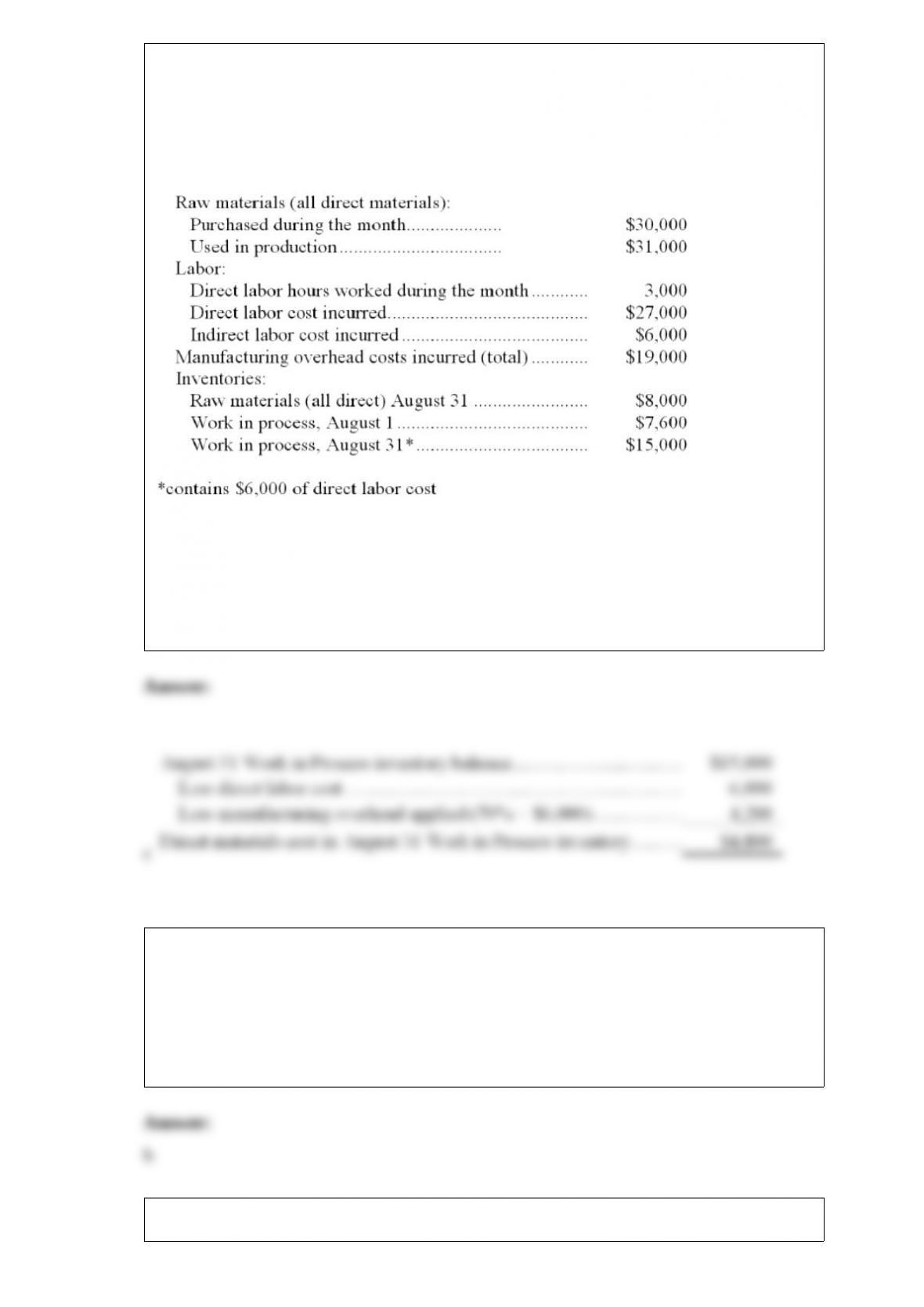
10) loraine company applies manufacturing overhead to jobs using a predetermined
overhead rate of 70% of direct labor cost. any underapplied or overapplied overhead
cost is closed to cost of goods sold at the end of the month. during august, the following
transactions were recorded by the company:
the amount of direct materials cost in the august 31 work in process inventory account
was:
a.$10,200
b.$9,000
c.$4,800
d.$4,200
11) if a company has a high current ratio but a low acid-test ratio, one can conclude
that:
a.the company has a large outstanding accounts receivable balance
b.the company has a large investment in inventory
c.the company has a large amount of current liabilities
d.the company’s financial leverage is very high
12) guasson corporation uses the weighted-average method in its process costing
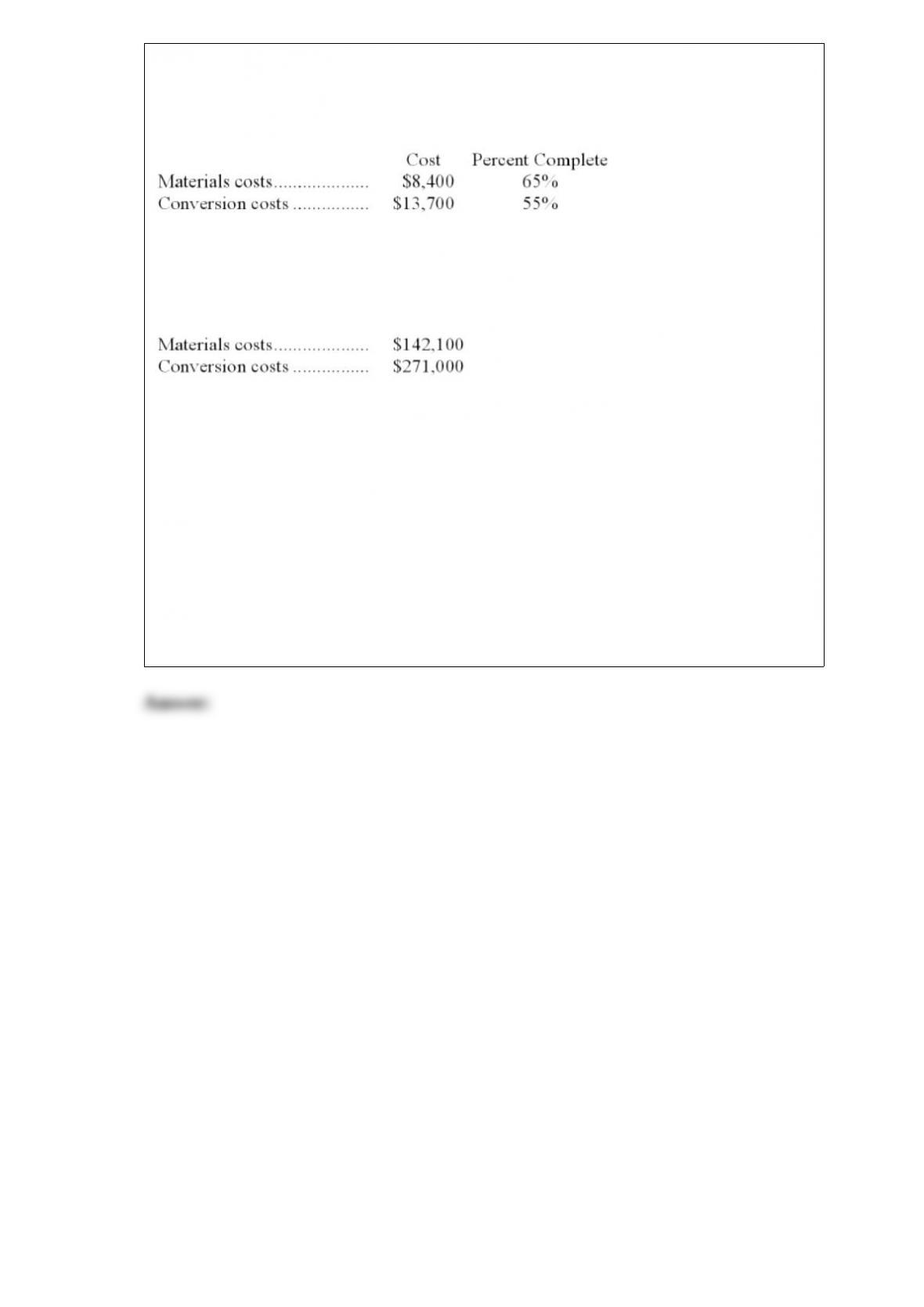
system. this month, the beginning inventory in the first processing department consisted
of 500 units. the costs and percentage completion of these units in beginning inventory
were:
a total of 6,400 units were started and 5,800 units were transferred to the second
processing department during the month. the following costs were incurred in the first
processing department during the month:
the ending inventory was 85% complete with respect to materials and 50% complete
with respect to conversion costs.
note: your answers may differ from those offered below due to rounding error. in all
cases, select the answer that is the closest to the answer you computed. to reduce
rounding error, carry out all computations to at least three decimal places.
the total cost transferred from the first processing department to the next processing
department during the month is closest to:
a.$413,100
b.$389,650
c.$463,549
d.$435,200
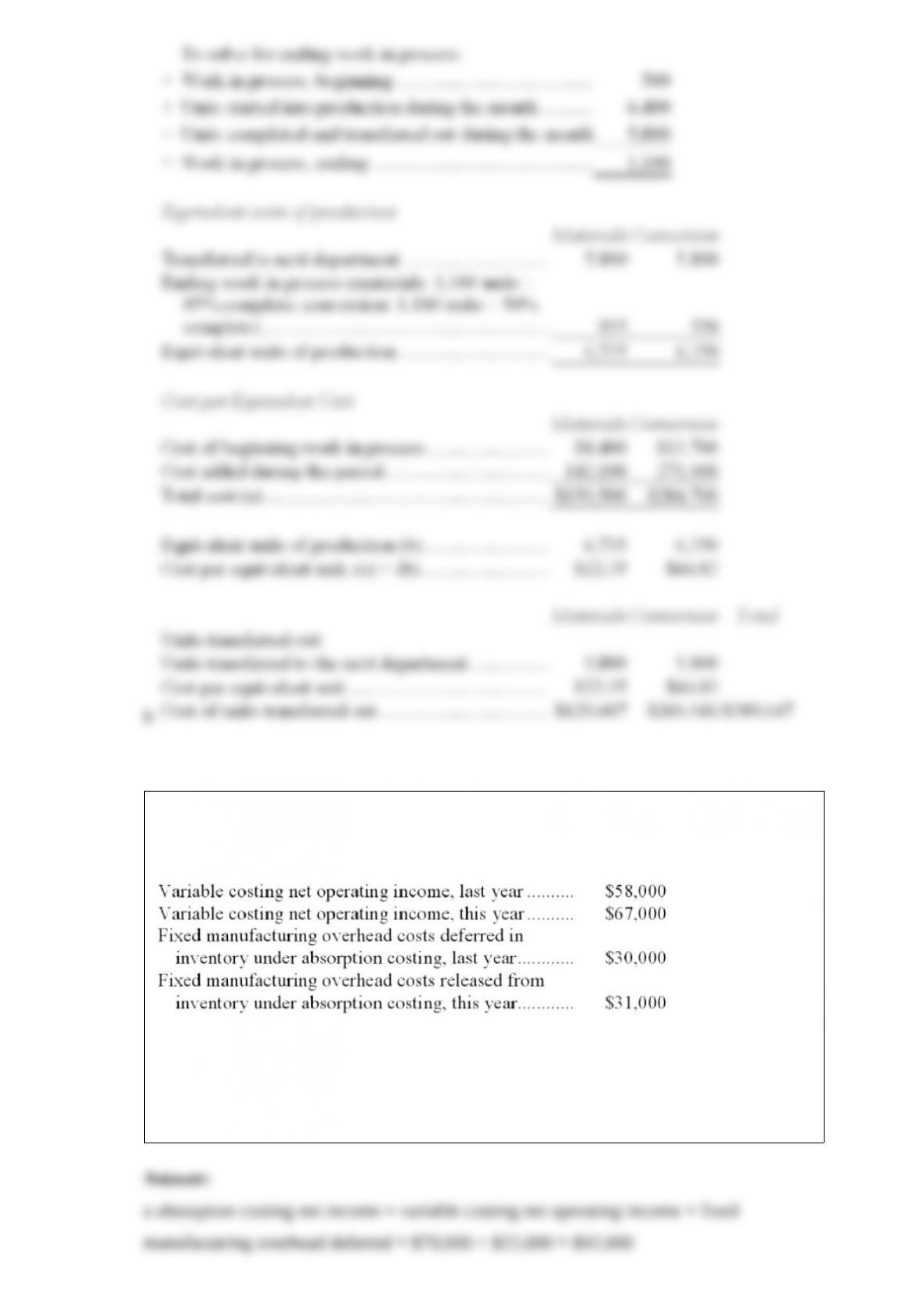
13) botwinick corporation manufactures a variety of products. the following data
pertain to the company’s operations over the last two years:
what was the absorption costing net operating income this year?
a.$92,000
b.$58,000
c.$79,000
d.$61,000
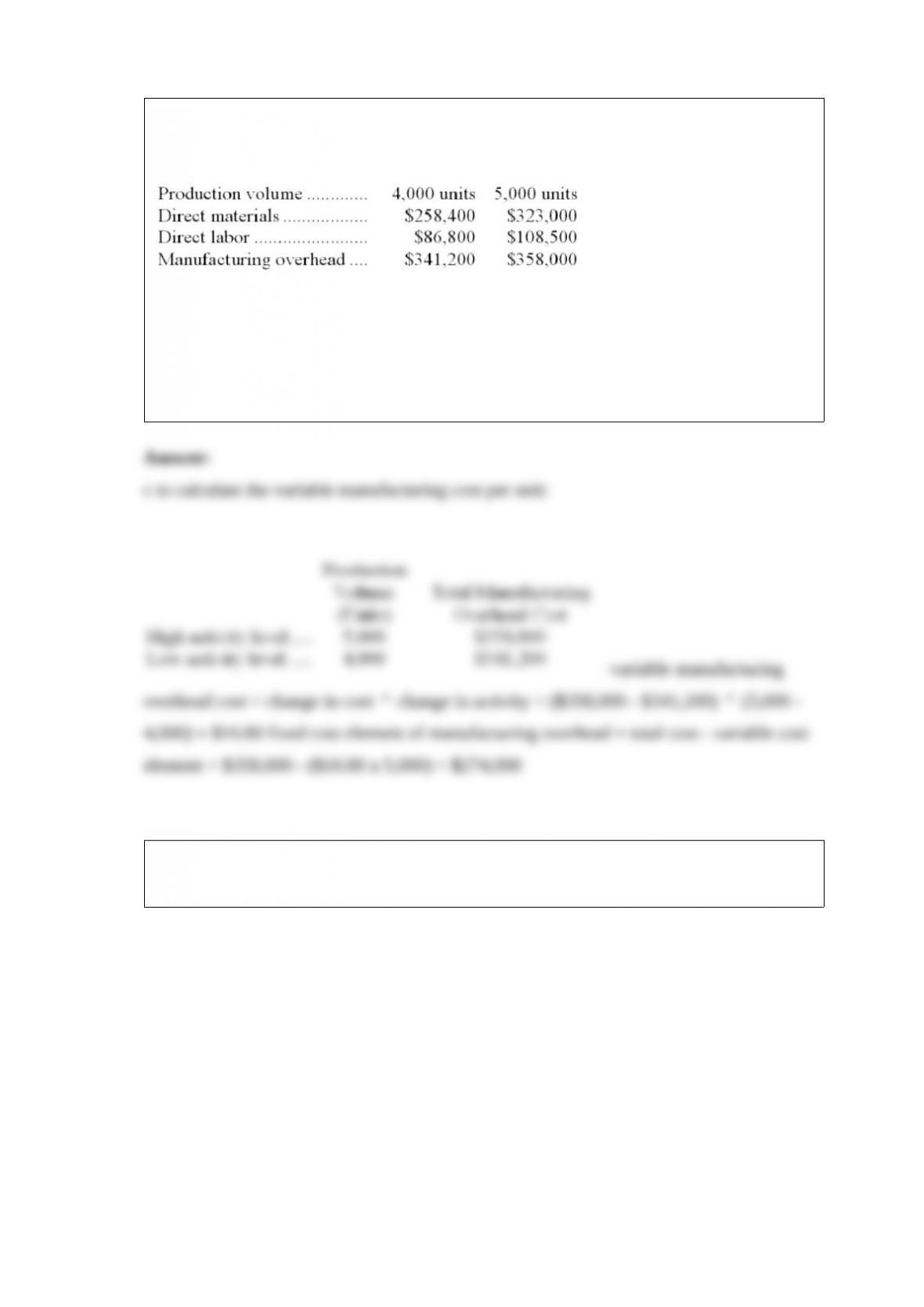
14) dabbs corporation has provided the following production and total cost data for two
levels of monthly production volume. the company produces a single product.
the best estimate of the total monthly fixed manufacturing cost is:
a.$737,950
b.$686,400
c.$274,000
d.$789,500
15) financial statements for oram company appear below:
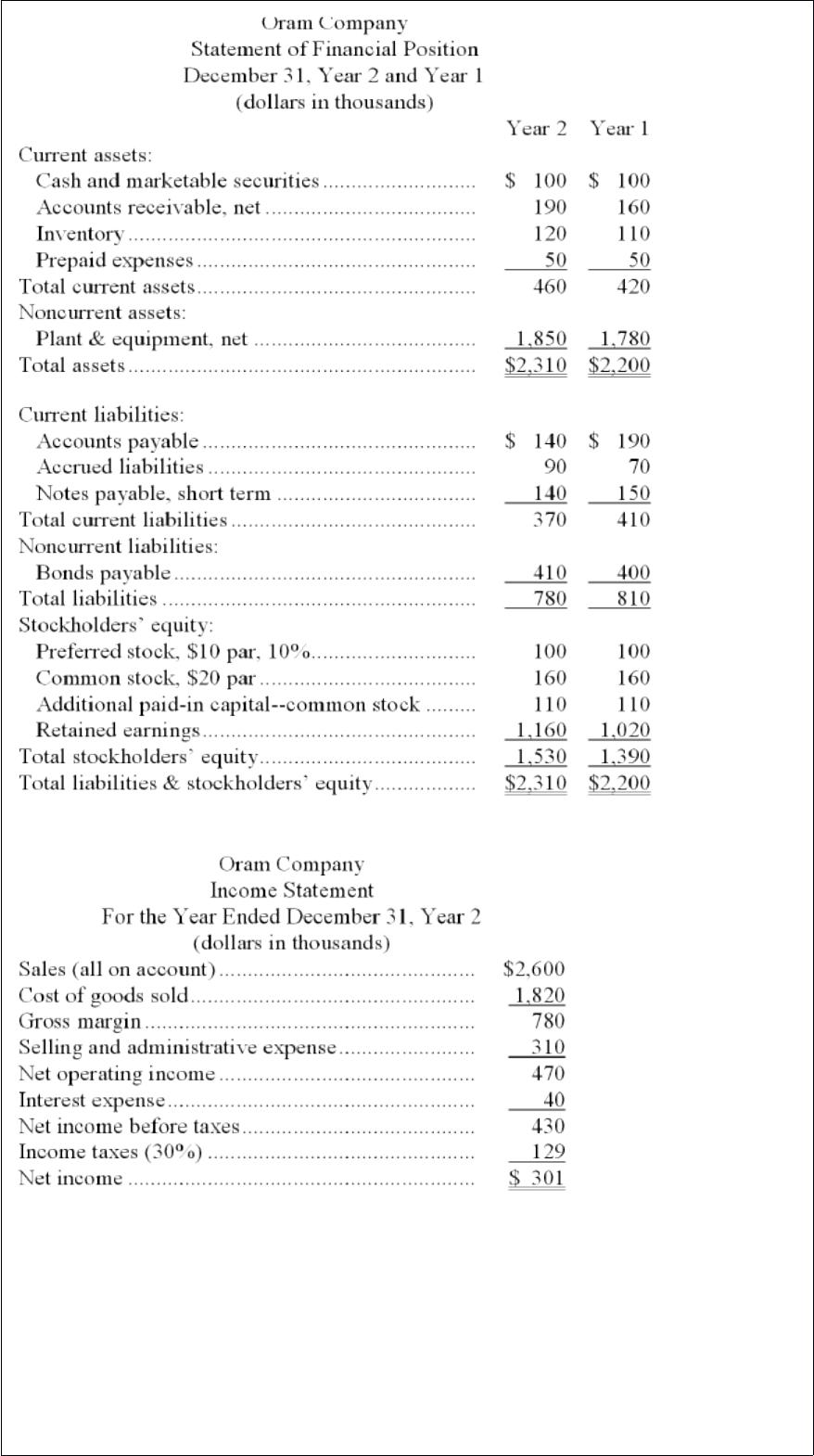
dividends during year 2 totaled $161 thousand, of which $10 thousand were preferred
dividends. the market price of a share of common stock on december 31, year 2 was
$610.
oram company’s average sale period for year 2 was closest to:
a.23.1 days
b.16.1 days
c.35.1 days
d.24.6 days
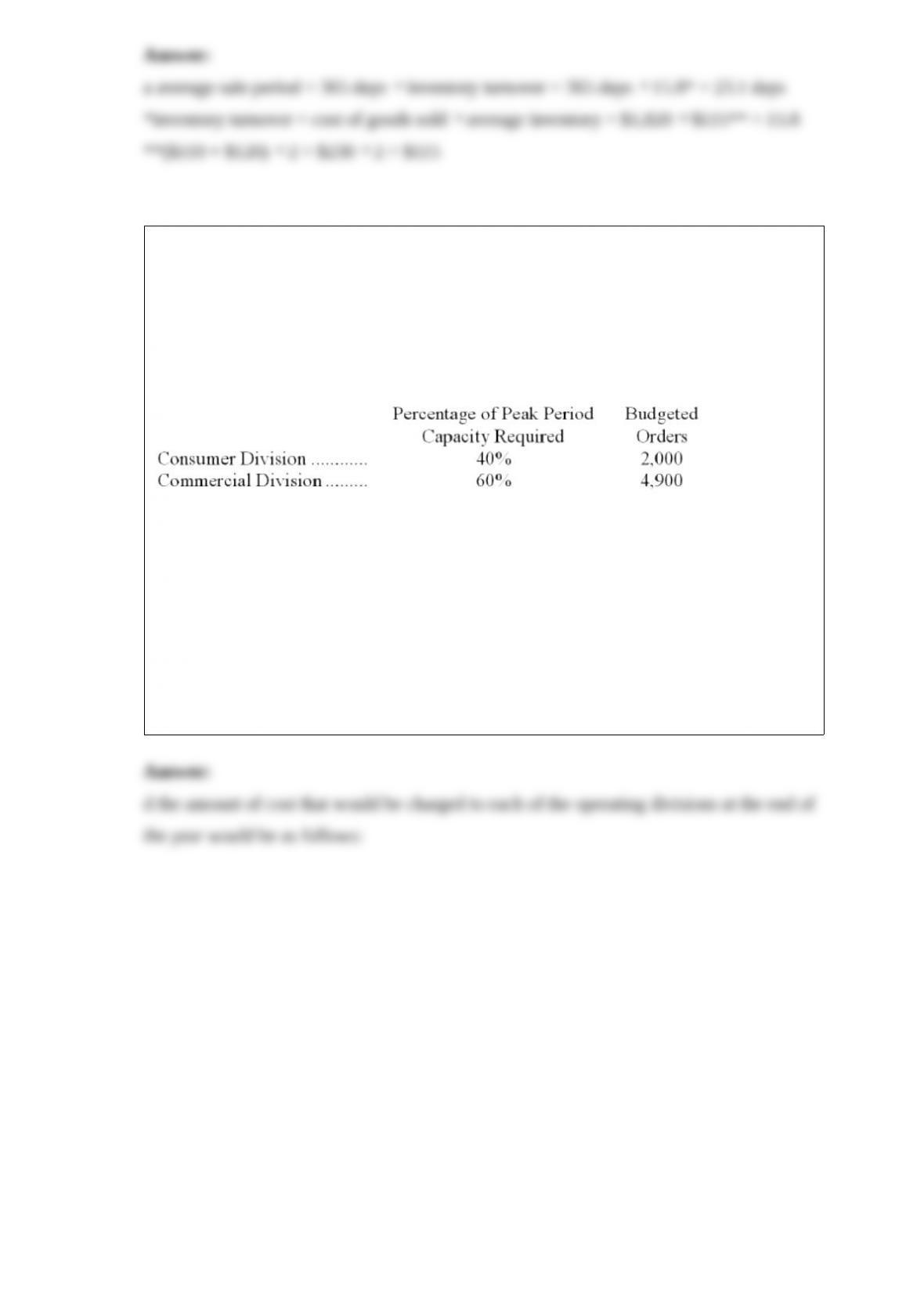
16) auchmoody corporation has two operating divisions-a consumer division and a
commercial division. the company’s customer service department provides services to
both divisions. the variable costs of the customer service department are budgeted at
$63 per order. the customer service department’s fixed costs are budgeted at $372,600
for the year. the fixed costs of the customer service department are determined based on
the peak period orders.
at the end of the year, actual customer service department variable costs totaled
$444,405 and fixed costs totaled $382,900. the consumer division had a total of 2,030
orders and the commercial division had a total of 4,860 orders for the year. for
performance evaluation purposes, how much actual customer service department cost
should not be charged to the operating divisions at the end of the year?
a.$10,300
b.$0
c.$10,335
d.$20,635
17) the following monthly budgeted data are available for the international company:
budgeted net operating income for the month is $220,000.
required:
a. calculate the break-even dollar sales for the month.
b. calculate the margin of safety.
c. calculate the operating leverage.
18) altona corporation’s vice president in charge of marketing believes that every 3%
increase in the selling price of one of the company’s products would lead to a 5%
decrease in the product’s total unit sales. the product’s absorption costing unit product
cost is $13.50. the variable production cost is $7.80 per unit and the variable selling and
administrative cost is $2.30 per unit.
the product’s price elasticity of demand as defined in the text is closest to:
a.-2.29
b.-2.24
c.-1.31
d.-1.66
19) the management of polcyn corporation would like to investigate the possibility of
basing its predetermined overhead rate on activity at capacity rather than on the
estimated amount of activity for the year. the company’s controller has provided an
example to illustrate how this new system would work. in this example, the allocation
base is machine-hours and the estimated amount of the allocation base for the upcoming
year is 71,000 machine-hours. in addition, capacity is 86,000 machine-hours and the
actual activity for the year is 64,100 machine-hours. all of the manufacturing overhead
is fixed and is $4,579,500 per year. for simplicity, it is assumed that this is the estimated
manufacturing overhead for the year as well as the manufacturing overhead at capacity
and the actual amount of manufacturing overhead for the year.
required:
a. determine the underapplied or overapplied overhead for the year if the predetermined
overhead rate is based on the estimated amount of the allocation base.
b. determine the underapplied or overapplied overhead for the year if the predetermined
overhead rate is based on the amount of the allocation base at capacity.
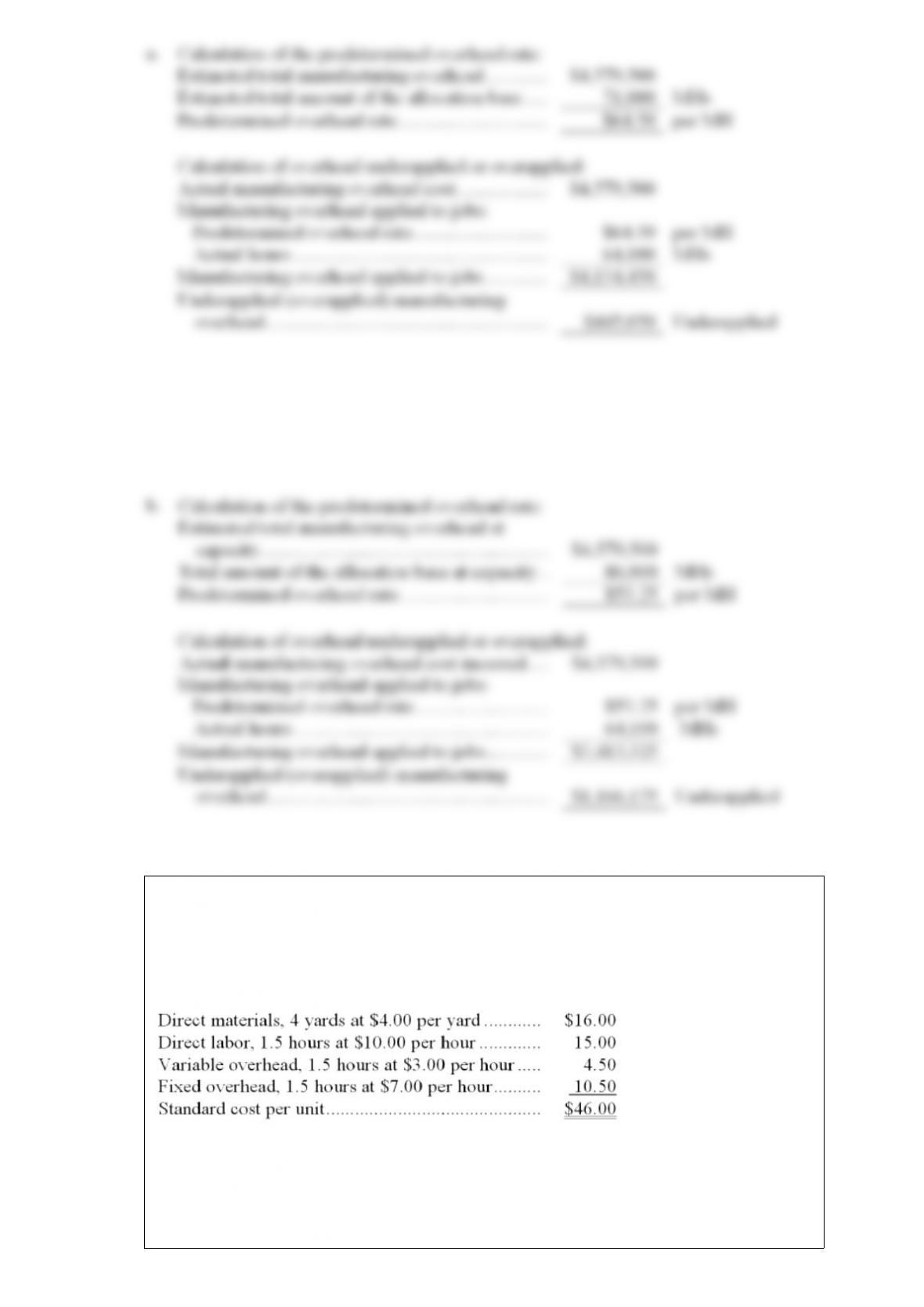
20) the moore company produces and sells a single product. a standard cost card for the
product follows:
standard cost cardper unit of product:
the company manufactured and sold 18,000 units of product during the year. a total of
70,200 yards of material was purchased during the year at cost of $4.20 per yard. all of
this material was used to manufacture the 18,000 units. the company records showed no
beginning or ending inventories for the year.
the company worked 29,250 direct labor-hours during the year at a cost of $9.75 per
hour. overhead cost is applied to products on the basis of standard direct labor-hours.
the denominator activity level (direct labor-hours) was 22,500 hours. budgeted fixed
manufacturing overhead costs as shown on the flexible budget were $157,500, while
actual fixed manufacturing overhead costs were $156,000. actual variable overhead
costs were $90,000.
required:
a. compute the direct materials price and quantity variances for the year.
b. compute the direct labor rate and efficiency variances for the year.
c. compute the variable overhead rate and efficiency variances for the year.
d. compute the fixed manufacturing overhead budget and volume variances for the year.