1) Determining cost pools and realistic cost driver rates is a relatively complex process.
2) To perform cost-volume-profit analysis, a company must be able to separate costs
into fixed and variable components.
3) The 80/20 rules states that the top 20% of customers generate 80% of revenues.
4) Variance analysis explains the difference between planned costs and actual costs by
evaluating differences between standard prices and actual prices and budgeted
quantities and actual quantities.
5) In the beyond budgeting approach, targets are developed based on stretch goals tied
to peers, competitors, and key global benchmarks.
6) When management implements their own ideas without involving employees, goal
congruence may not occur.
7) Benchmarking requires that organizational members first look to the best practices of
other organizations for guidance on improving and then understand their current
operations and approaches to conducting business.
8) Traditional cost systems use actual departments or cost centers for defining cost
pools to accumulate and redistribute costs.
9) Management accounting must gather relevant and reliable performance information
to administer intrinsic rewards.
10) Companies should avoid high cost-to-serve customers because they are
unprofitable.
11) To create the Balanced Scorecard, first measures are identified and then translated
into objectives.
12) The objective to reduce product development cycle time can be measured by the
number of products delivered on time.
13) All of the following are true of market-based transfer prices EXCEPT that they:
A) may lead to goods/services being purchased externally
B) provide an independent valuation
C) exist for all transferred products and services
D) provide the proper economic incentives
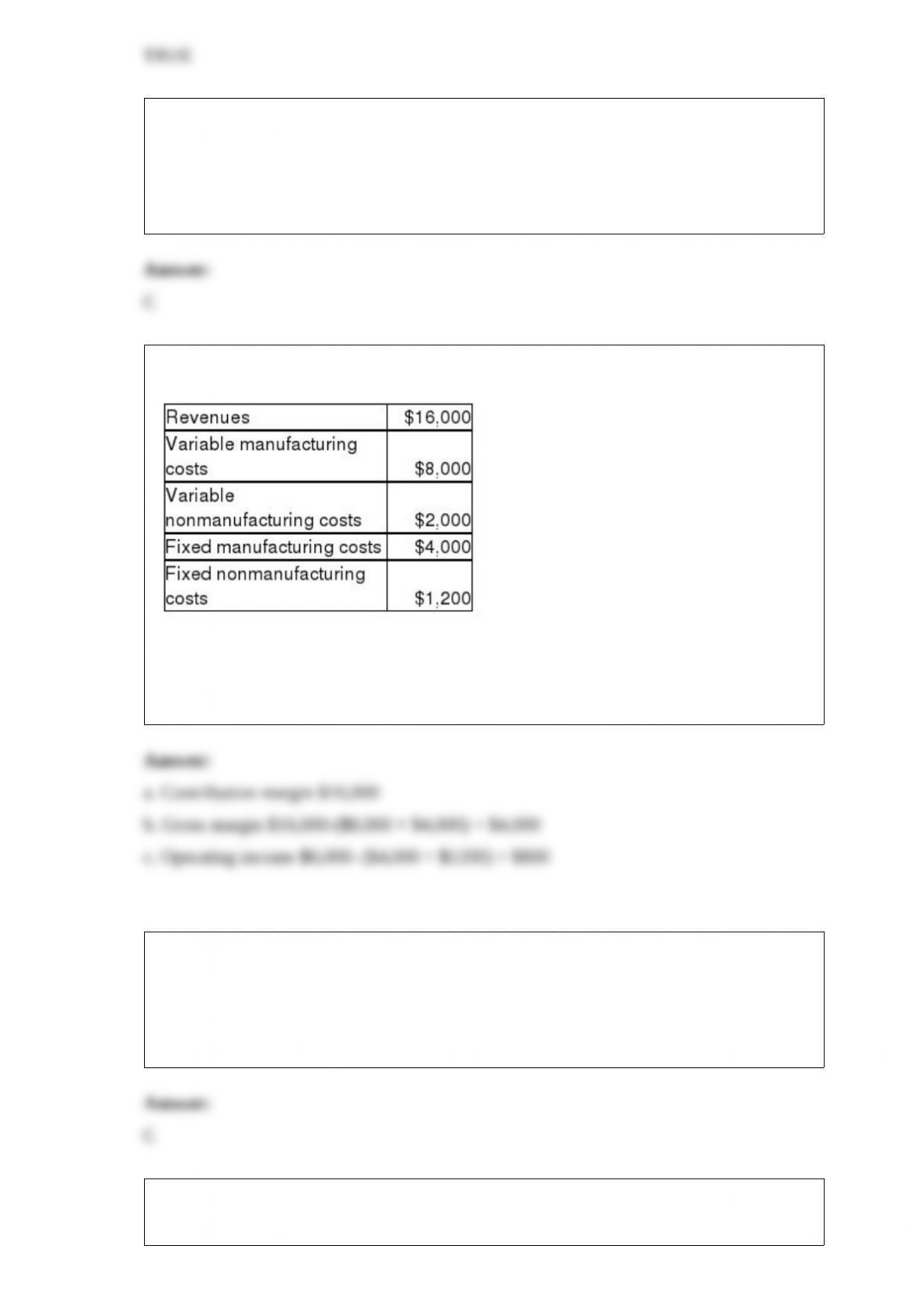
14) Alistar’s Best reported the following for 2011:
Required:
a. Compute the contribution margin.
b. Compute the gross margin.
c. Compute the operating income.
15) A quarterly report disclosing declining market share information is MOST useful to:
A) a front-line employee
B) the manager of operations
C) the chief executive officer
D) the accounting department
16) _________ mean(s) that the organization will attempt to reach much higher goals
with the current budget.
A) Traditional budgeting
B) Stretch goals
C) The beyond budgeting approach
D) Budget slack
17) The return-on-investment ratio is an example of a Balanced Scorecard’s measure of
the:
A) internal perspective
B) customer perspective
C) learning and growth perspective
D) financial perspective
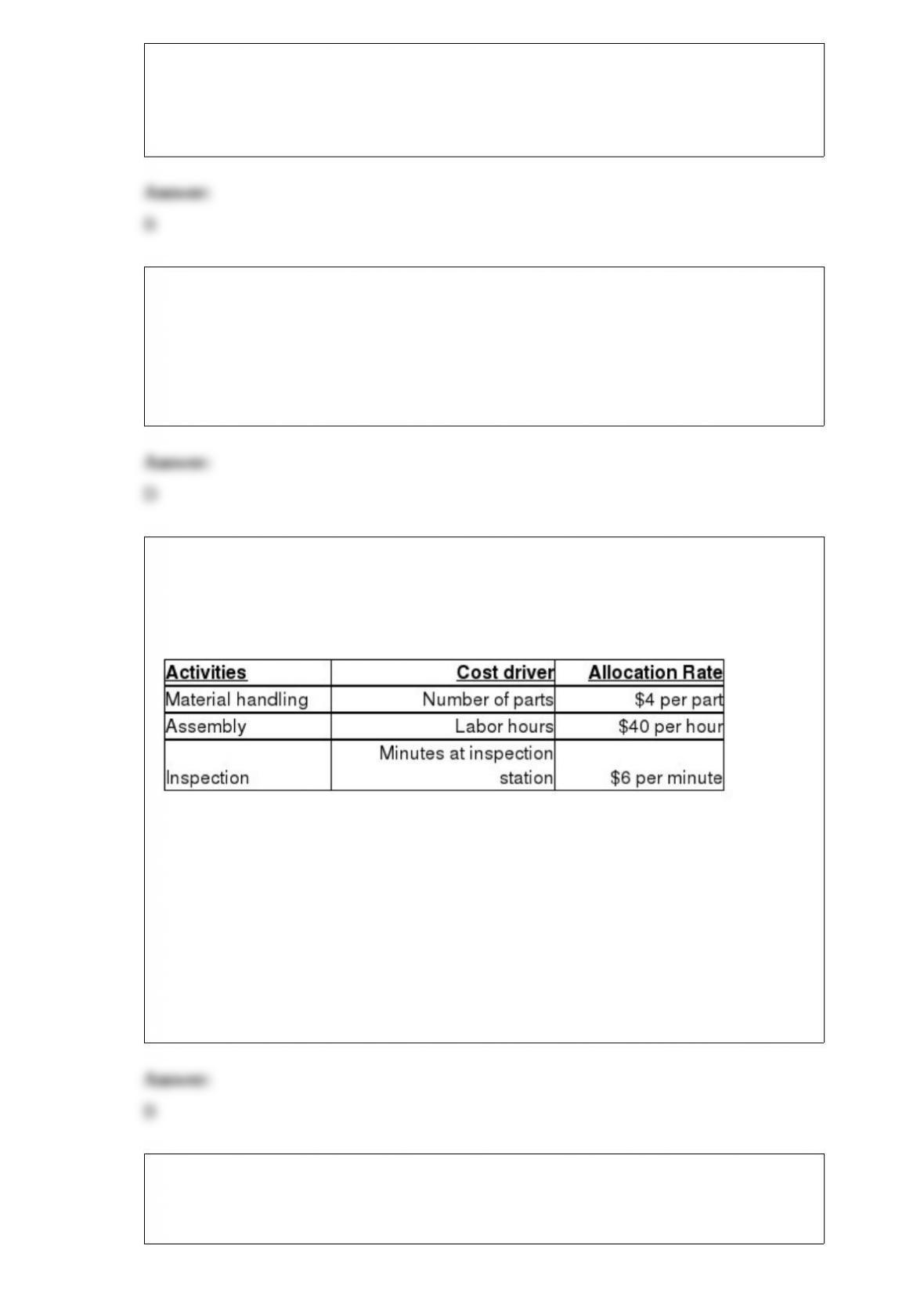
18) Merrill, Inc. manufactures remote controls. Currently the company uses a
plant-wide rate for allocating manufacturing overhead costs. The plant manager
believes it is time to refine the method of cost allocation and has the accounting
department identify the primary production activities and their cost drivers:
The current traditional cost method allocates overhead costs based on direct labor hours
using a rate of $400 per labor hour.
What are the manufacturing overhead costs per remote control assuming an
activity-based costing method is used and a batch of 50 remote controls are produced?
The batch requires 100 parts, 6 direct manufacturing labor hours, and 2.5 minutes of
inspection time.
A) $8.00 per remote control
B) $13.10 per remote control
C) $48.00 per remote control
D) $655.00 per remote control
19) Sanchez & Ryan, Inc, sells a single product. This year, 20,000 units were sold
resulting in $130,000 of sales revenue, $60,000 of variable costs, and $17,500 of fixed
costs.
The number of units that must be sold annually to achieve $52,500 of profits is:
A) 20,000 units
B) 15,000 units
C) 10,000 units
D) 5,000 units
20) _______ helped develop the Plan-Do-Check-Act (PDCA) cycle.
A) Hawthorne
B) Deming
C) Carnegie
D) Ford
21) Information is relevant in a MACS if:
A) it can be applied in a flexible manner
B) it is inaccurate
C) it is inconsistent
D) it is late
22) Which of the following does NOT need to be considered when evaluating a
make-or-buy decision?
A) savings from an alternative use of the production equipment
B) the original cost of the production equipment
C) the quality of the supplier’s product
D) the reliability of the supplier’s delivery schedule
23) When deciding to accept a one-time-only special order from a wholesaler,
management should do all of the following EXCEPT:
A) analyze product costs
B) consider the impact of the special order on future prices of their products
C) determine whether excess capacity is available
D) verify past design costs for the product
24) Management accounting information is BEST described as:
A) providing a signal that something is wrong
B) identifying and helping to explain what is wrong
C) simply summarizing information, but giving no indication that anything is wrong
D) measuring overall organizational performance
25) The focus of ABC systems is on:
A) long-term decisions
B) short-term decisions
C) make-or-buy decisions
D) special-pricing decisions
26) In the service sector, ________ rather than machines usually represent(s) the
capacity constraint, which underscores the importance of budgeting even in
nonmanufacturing organizations.
A) people
B) knowledge
C) familiarity with processes
D) potential for sales
27) In ________, equipment is organized to accommodate the production of a specific
product.
A) a process layout
B) a product layout
C) cellular manufacturing
D) low-volume production
28) Management accountants are MOST likely to feel outside pressure to influence the
numbers favorably when the information is used for:
A) budgeting
B) compensation and promotions
C) continuous improvement
D) product costing
29) Profit sharing Knight Medical Devices makes devices and equipment that it sells
to hospitals. The organization has a profit-sharing plan that is worded as follows:
The company will make available a profit-sharing pool that will be the lower of the
following two items:
1> 40% of income before taxes in excess of the target profit level, which is 18% of net
assets, or
2> $14 million.
The individual employee is paid a share of the profit-sharing pool equal to the ratio of
that employee’s salary to the total salary paid to all employees.
Required
(a) If the company earned $90 million of earnings before taxes and had net assets of
$200 million, what would be the amount available for distribution from the
profit-sharing pool?
(b) Suppose that Bob Knight’s salary was $136,000 and that total salaries paid in the
company were $50 million. What would Bob’s profit share be?
30) The five stages in the process of keeping an organization in control are:
A) planning, implementing, measuring, evaluating and correcting
B) planning, executing, monitoring, evaluating and correcting
C) budgeting, implementing, monitoring, evaluation and feedback
D) budgeting, executing, measuring, feedback and evaluation
31) Splashdown Corporation manufactures water toys. It plans to grow by producing
high-quality water slides at a low cost that are delivered in a timely manner. There are a
number of other manufacturers who produce similar water slides. Splashdown believes
that continuously improving its manufacturing processes and having satisfied
employees are critical to implementing its strategy.
Splashdown’s value proposition is:
A) product innovation and leadership
B) complete customer solutions
C) employees recognizing customer needs
D) lowest total cost
32) The financing section of the expected cash flow statement includes:
A) cash flows from retail sales
B) dividends paid
C) amounts paid for advertising costs
D) cash outflows for asset acquisitions
33) Products M5 and A8 each are assigned $100.00 in overhead costs by a traditional
costing system. An activity analysis revealed that although production requirements are
identical, M5 requires 45 minutes less setup time than A8.
According to an ABC system, M5 uses a disproportionately:
A) smaller amount of unit-level costs
B) larger amount of unit-level costs
C) smaller amount of batch-level costs
D) larger amount of batch-level costs
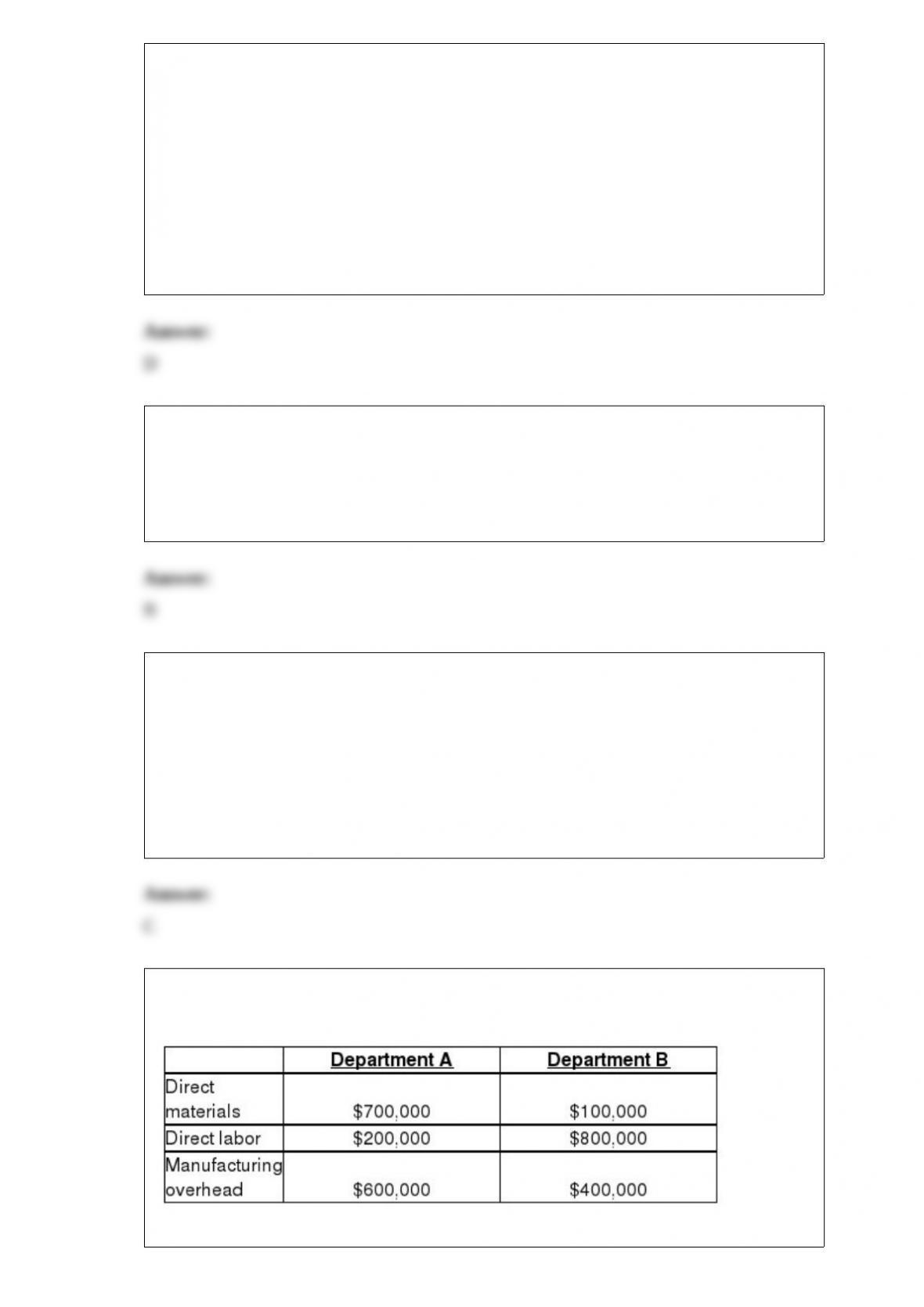
34) Apple Valley Corporation uses a job order cost system and has two production
departments, A and B. Budgeted manufacturing costs for the year are:
The actual material and labor costs charged to Job #432 are as follows:
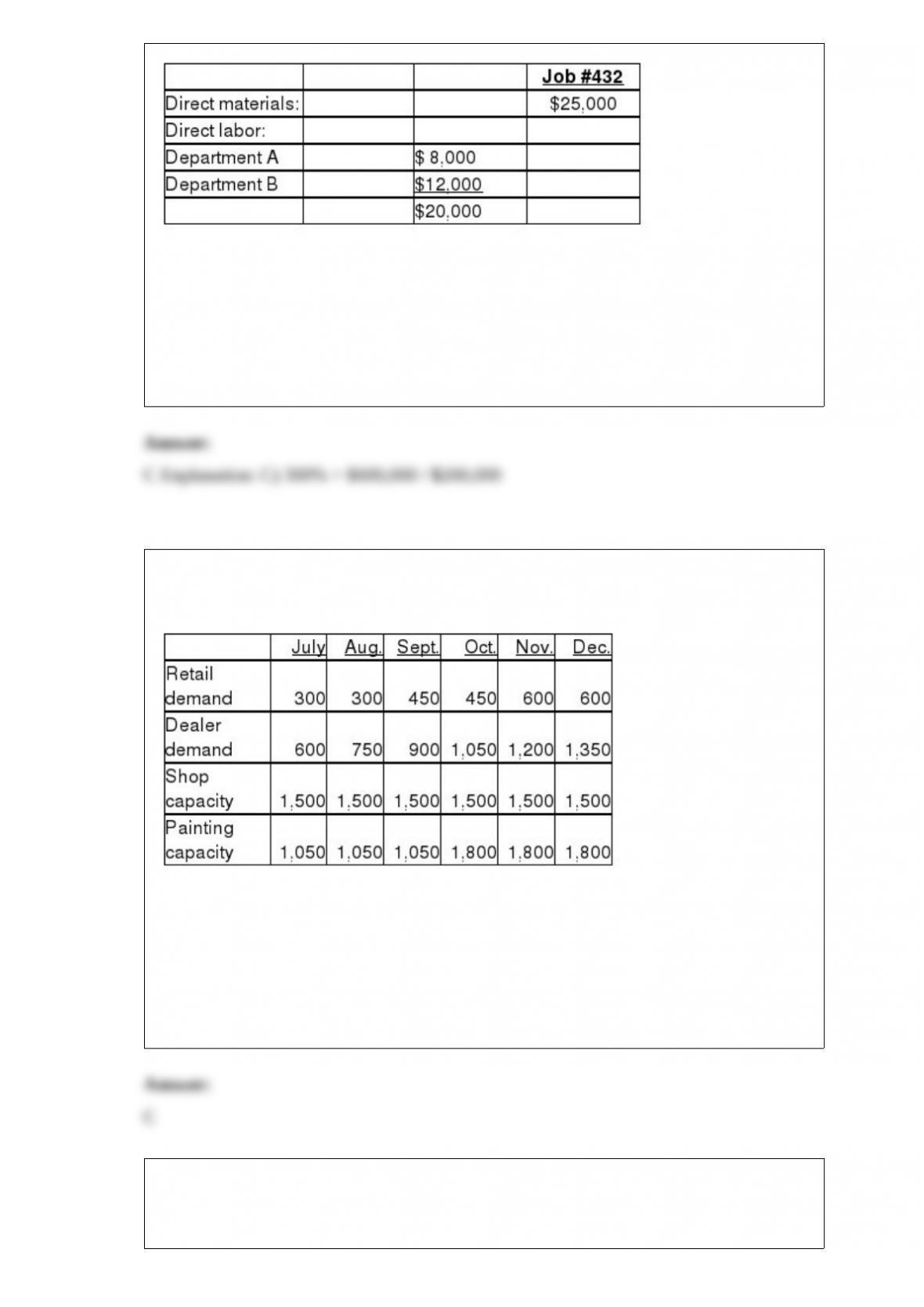
Apple Valley applies manufacturing overhead costs to jobs on the basis of direct labor
cost using departmental rates determined at the beginning of the year.
For Department A, the manufacturing overhead cost driver rate is:
A) 33% of direct labor costs
B) 66% of direct labor costs
C) 300% of direct labor costs
D) None of the above is correct
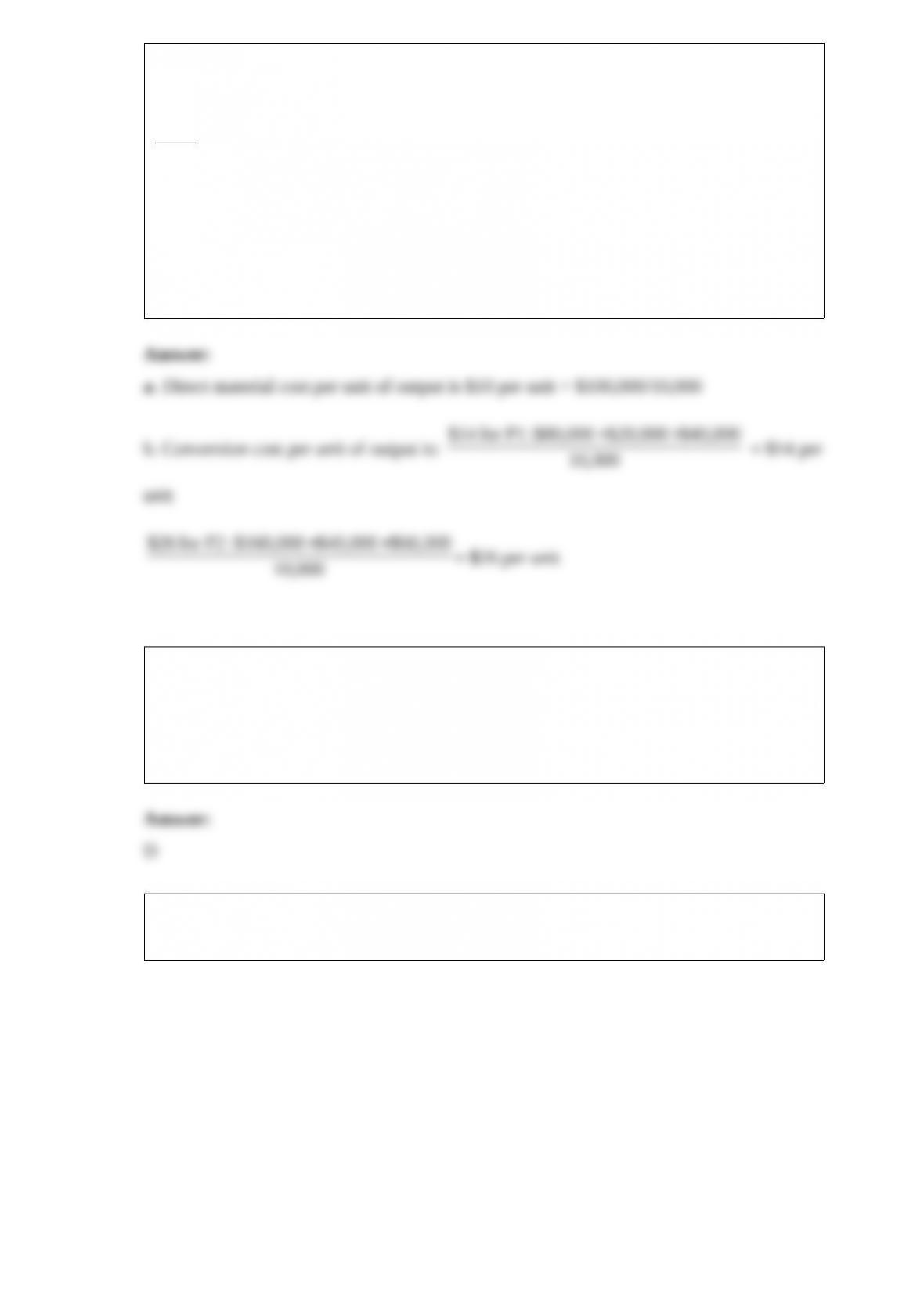
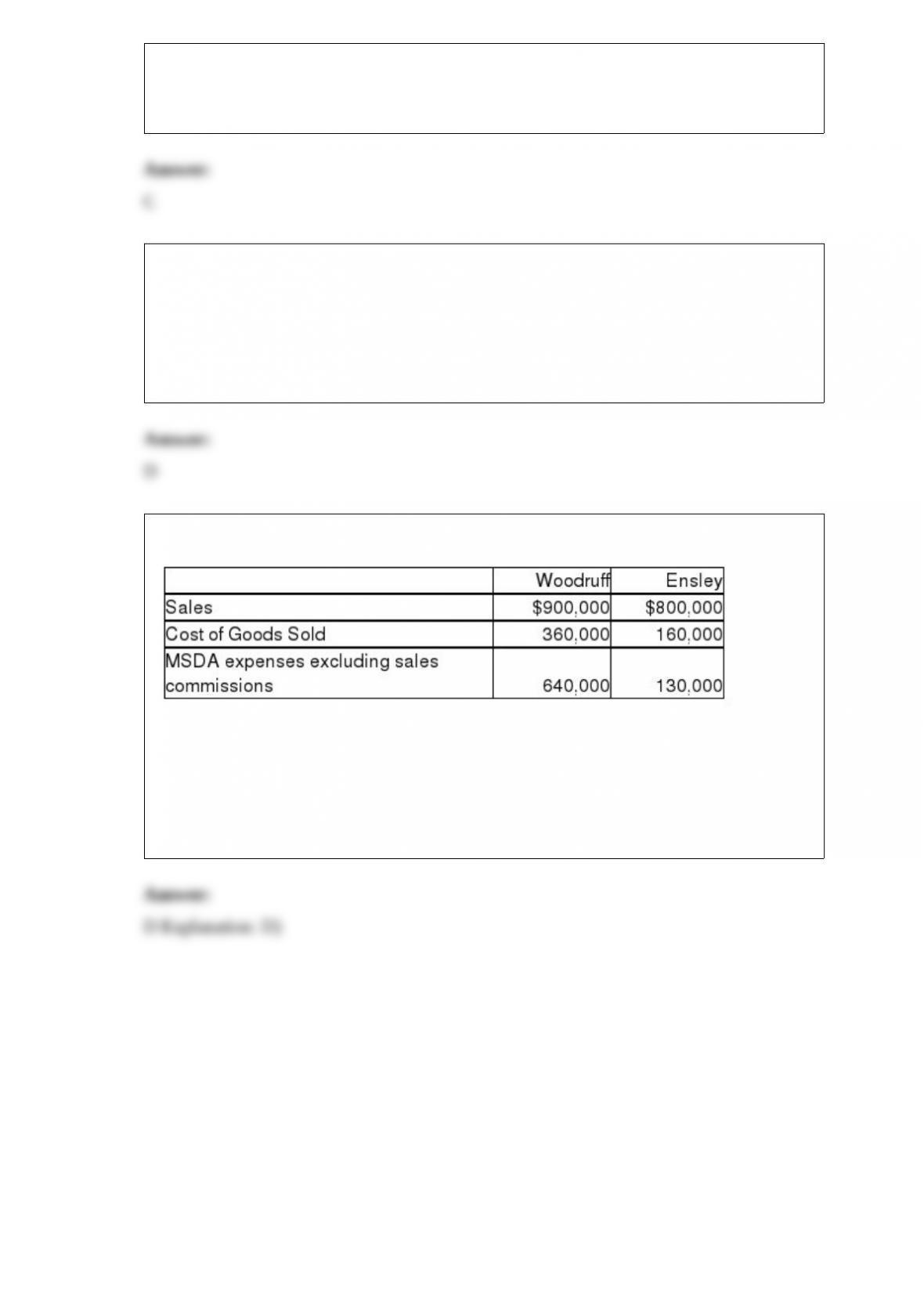
35) For the next six months, Kurtz Company projects the following information (in
units).
Demand drives production for that month and cannot be carried over from one month to
another. Retail customers are satisfied first.
In November, production appears to be limited by:
A) short-term capacity
B) intermediate-term capacity
C) long-term capacity
D) total demand
36) Roland Company uses a manufacturing process that has two distinct stages: P1 and
P2. Raw material is consumed in P1 at the beginning of the process. No additional
material is required in the second stage of the process (in P2). The following
information pertains to the production of 10,000 units of output in March 2012:
Assume all units are completed at the end of March. Assume all costs are added in
March.
P1P2
Direct materials$100,000$ 0
Direct labor$ 80,000$160,000
Equipment maintenance$ 20,000$ 40,000
Plant depreciation$ 40,000$ 60,000
Required:
a. Determine the direct material cost per unit of output.
b. Determine the conversion cost per unit of output for Stage P1 and Stage P2.
37) Which of the following is an implicit environmental cost?
A) direct costs of modifying technology and processes
B) costs of cleanup and disposal
C) fines levied by government agencies
D) costs of legal counsel and administration
38) The management accountant for the Martino Organics has prepared the following
segmented income statement for the most current year.
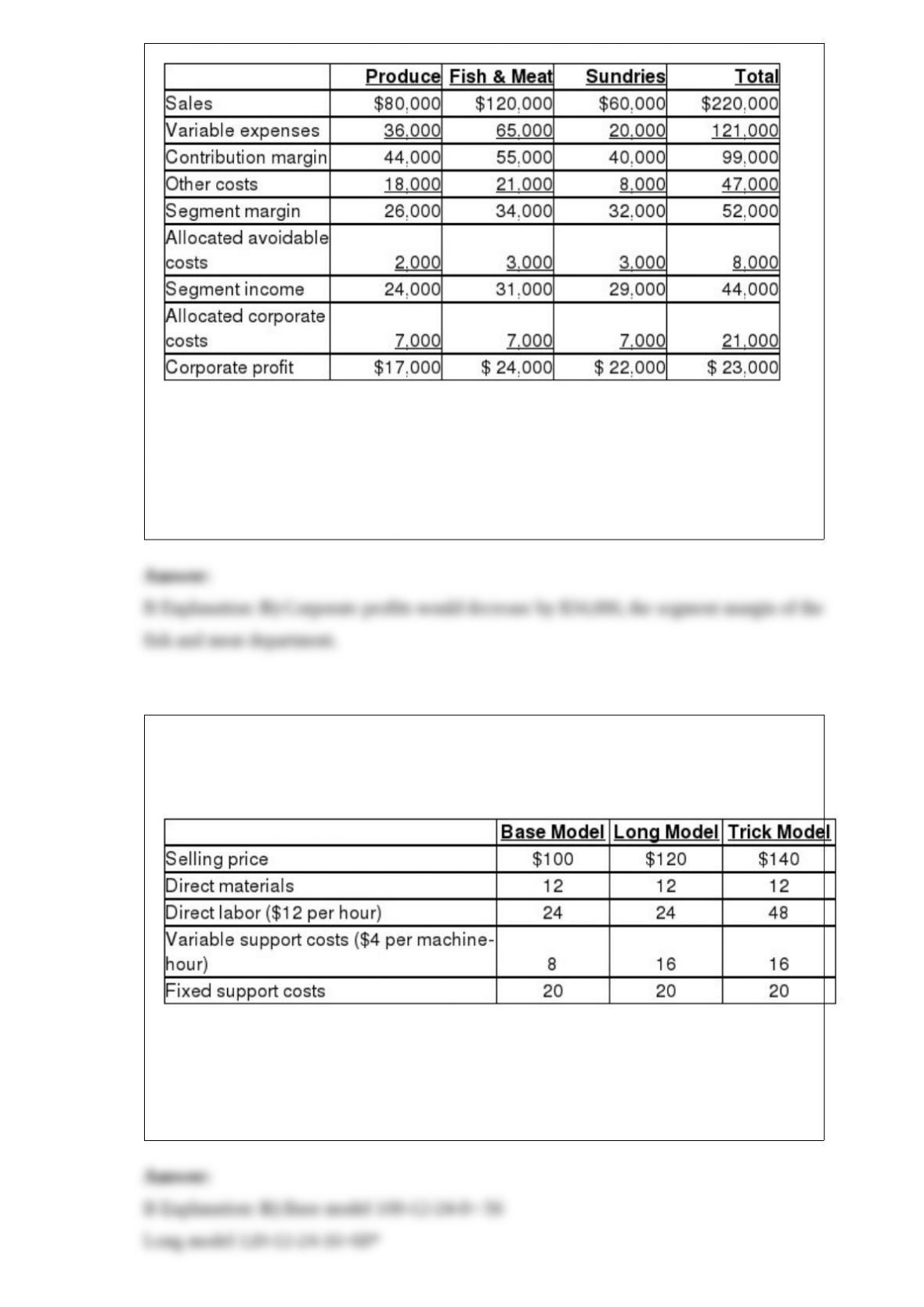
If the Fish & Meat department had been discontinued, the short-term effect on corporate
profits would be a decrease of:
A) $55,000
B) $34,000
C) $31,000
D) $24,000
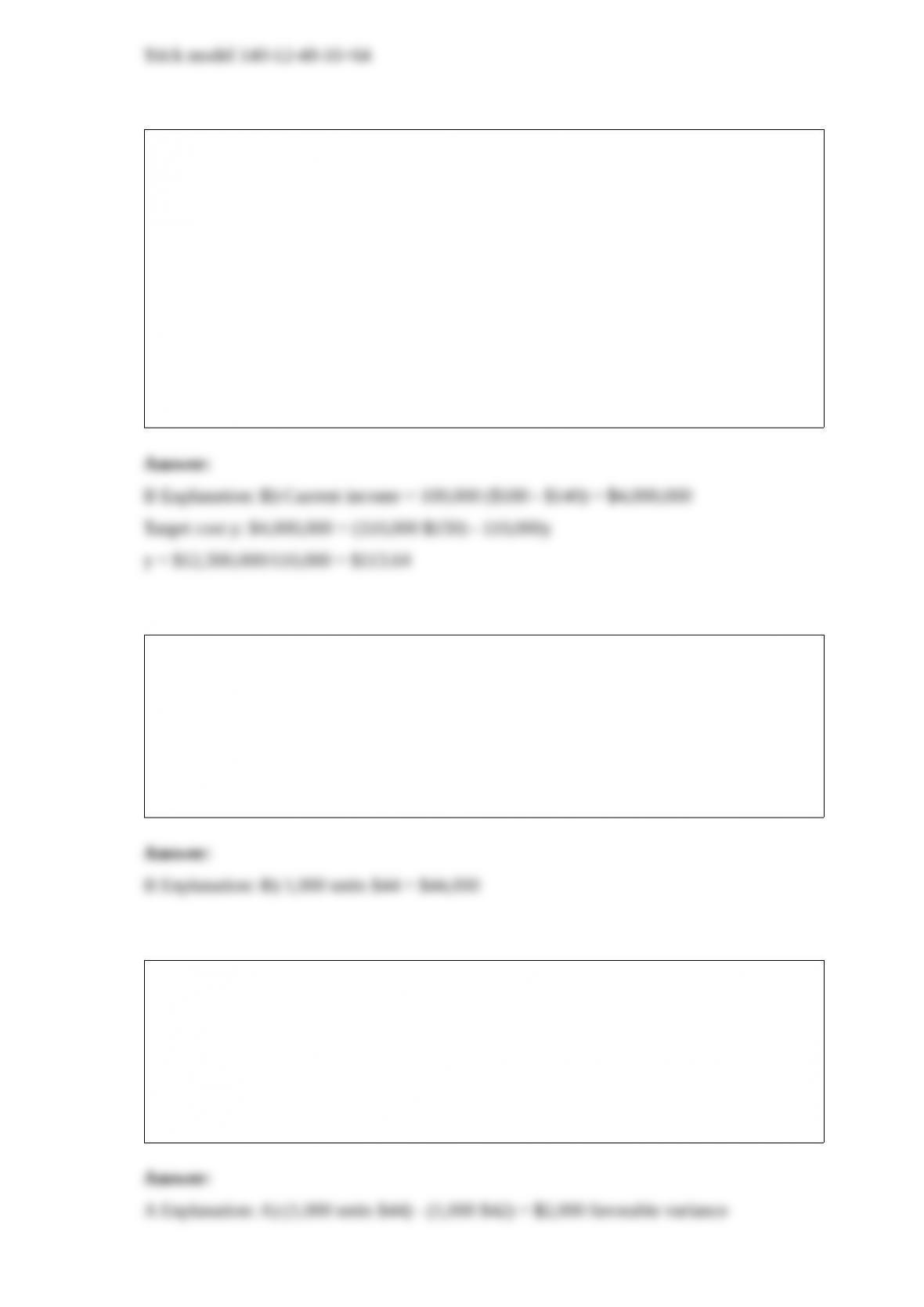
39) Narly Skateboards manufactures three different product lines, Base, Long, and
Trick. Considerable market demand exists for all models. The following per unit data
apply:
Which model has the greatest contribution margin per unit?
A) base model
B) long model
C) trick model
D) both the base model and the long model
40) Dennis’ TV currently sells small televisions for $180. It has costs of $140. A
competitor is bringing a new small television to market that will sell for $150.
Management believes it must lower the price to $150 to compete in the market for small
televisions. Marketing believes that the new price will cause sales to increase by 10%,
even with a new competitor in the market. Dennis’ sales are currently 100,000
televisions per year.
What is the target cost per unit if the company wants to maintain its same profit margin
in total dollars before the change and Marketing is correct?
A) $112.50
B) $113.64
C) $123.34
D) $140.00
41) An organization planned to use $44 of material per unit of activity but it actually
used $42 of material per unit of activity, and it planned to make 1,200 units but it
actually made 1,000 units. The flexible budget amount for materials is:
A) $42,000
B) $44,000
C) $48,000
D) $49,400
42) An organization planned to use $44 of material per unit of activity but it actually
used $42 of material per unit of activity, and it planned to make 1,200 units but it
actually made 1,000 units. The flexible budget variance for materials is:
A) $2,000 favorable
B) $14,000 unfavorable
C) $16,400 unfavorable
D) $2,400 favorable
43) Costs that cannot be changed by any decision made now or in the future are:
A) fixed costs
B) indirect costs
C) avoidable costs
D) sunk costs
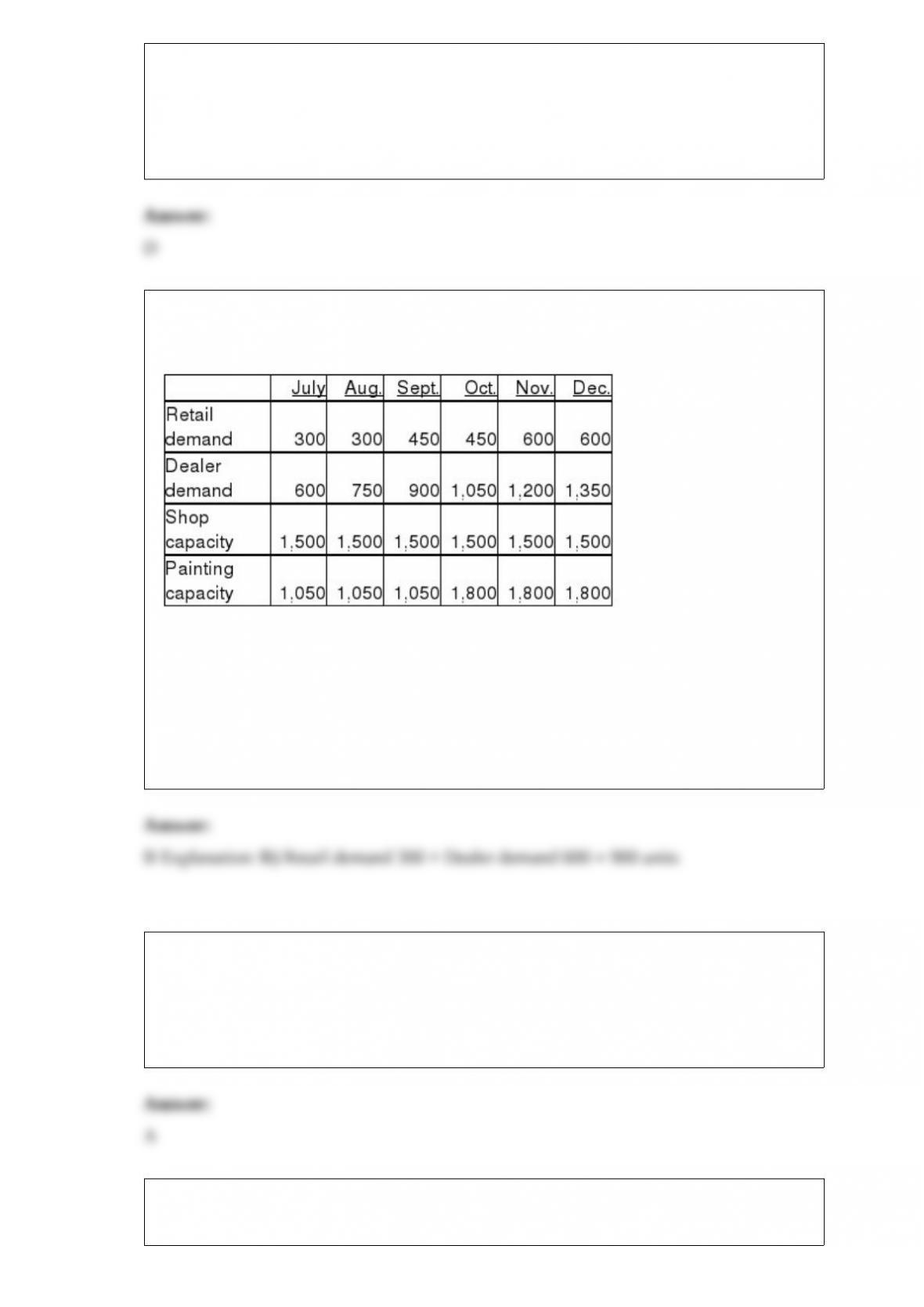
44) For the next six months, Kurtz Company projects the following information (in
units).
Demand drives production for that month and cannot be carried over from one month to
another. Retail customers are satisfied first.
The production for July is projected to be:
A) 300 units
B) 900 units
C) 1,050 units
D) 1,500 units
45) Process costing:
A) allocates conversion costs
B) results in different costs for different jobs
C) is commonly used by general contractors who construct custom-built homes
D) assigns costs to unique jobs based on a overhead cost driver
46) Which of following are risks of outsourcing the production of a part?
A) poor quality
B) late delivery
C) unscheduled price increases
D) All of the above are risks of outsourcing.
47) In the manufacture of cans of beans, all of the following would likely be allocated
to a cost object except:
A) utilities
B) supervisory labor
C) depreciation on equipment used to can multiple products
D) beans
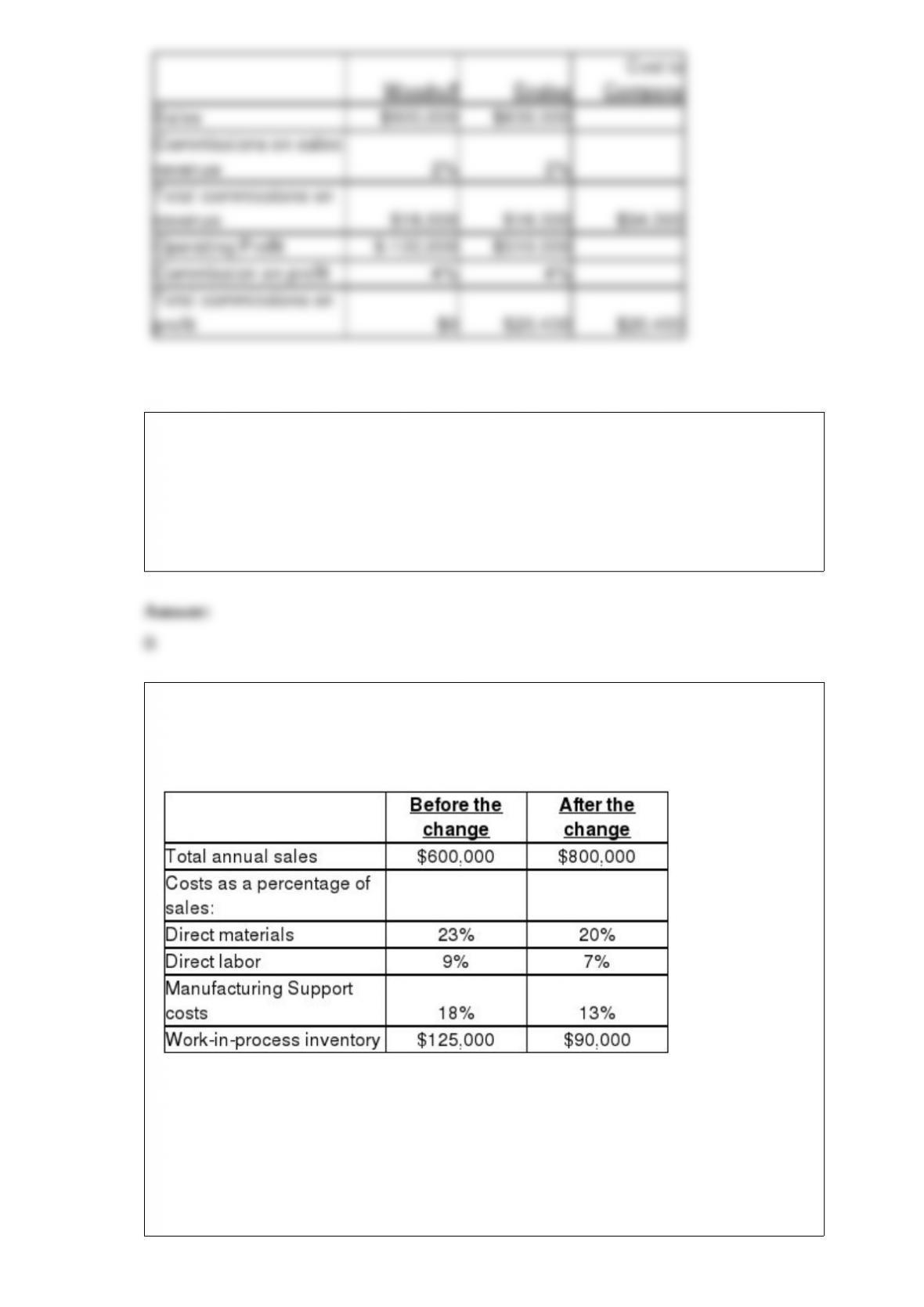
48) Omega Company has the following two customers:
If the company pays a 4% sales commission based on customer profit, this will
encourage a salespersons’ efforts to sell to:
A) Woodruff, an unprofitable customer
B) Woodruff, a profitable customer
C) Ensley, an unprofitable customer
D) Ensley, a profitable customer
49) Successful implementation of the Balanced Scorecard:
A) may be completed by one important member of the senior management team, such
as the chief financial officer
B) involves everyone in the organization knowing and understanding the strategy
C) should not begin until data are collected for all scorecard measures
D) starts with a process to acquire a new data collection system
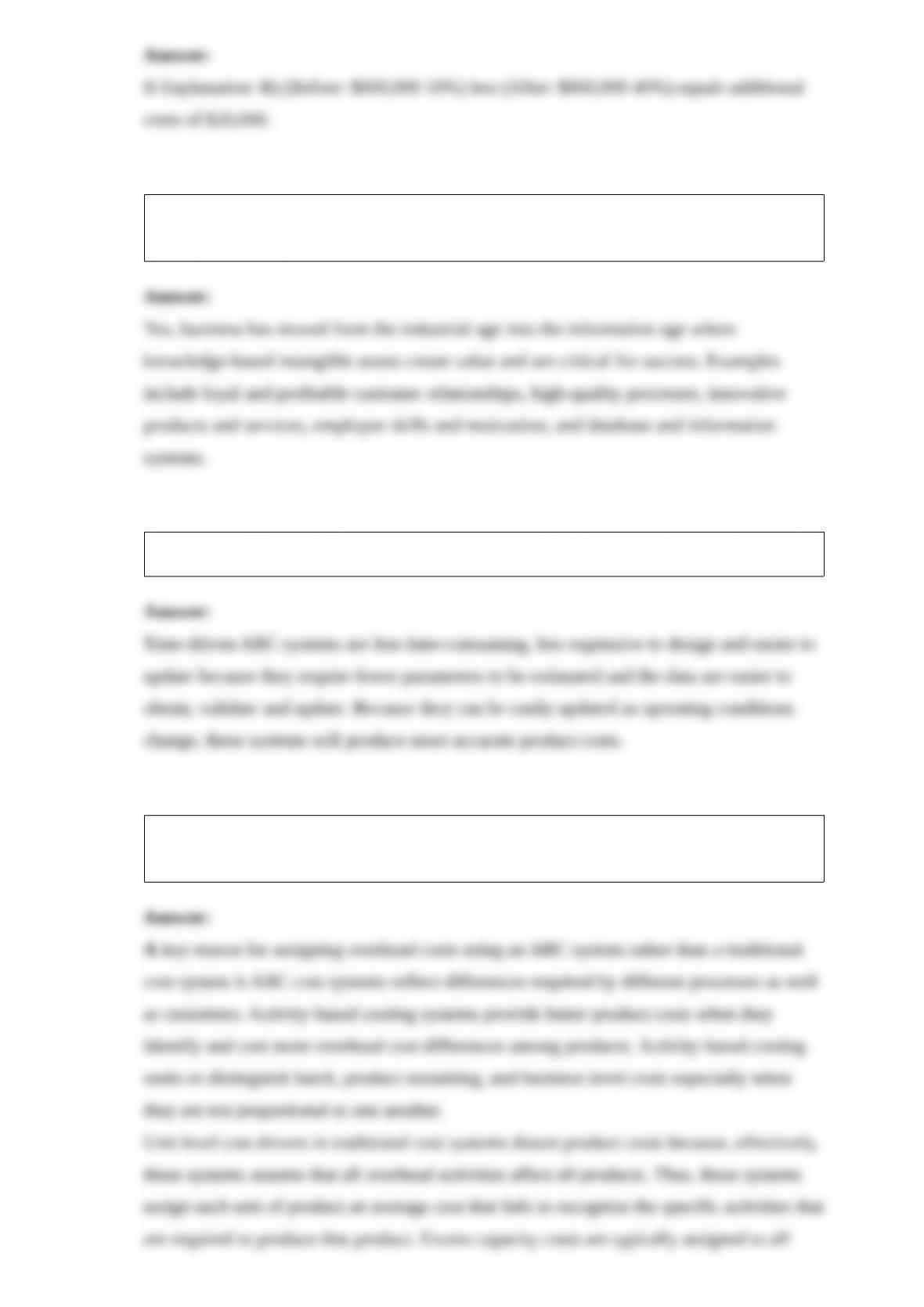
50) Umberger Manufacturing, Inc., is considering reorganizing its plant into
manufacturing cells. The following estimates have been prepared to evaluate the
benefits from the reorganization:
Inventory carrying costs are estimated to be 10% per year.
As a result of the layout reorganization, incremental manufacturing costs are projected
to:
A) increase by $84,000 annually
B) increase by $20,000 annually
C) decrease by $20,000 annually
D) decrease by $16,500 annually
51) Give at least two examples of intangible assets. Are intangible assets critical for
success? Explain.
52) Discuss the advantages of a time-based ABC system.
53) Explain how activity-based costing systems can provide more accurate product
costs than traditional cost systems.
54) Discuss the 80-20 rule and the 40-1 rule.
55) What role has the increasingly competitive business environment played in the
development of management accounting?