It can be expected that companies selling perishable goods have a higher inventory
turnover than companies selling nonperishable goods.
Product costs can be classified as one of three types: direct materials, direct labor, or
overhead.
The book value of an asset when using double-declining-balance depreciation is always
greater than the book value from using straight-line depreciation, except at the
beginning and the end of the asset’s useful life, when it is the same.
An unfavorable variance is recorded with a debit.

The clerk who has access to the cash in the cash register should not have access to the
cash register tape or file.
Each adjusting entry affects only one or more income statement account and never cash.
Amortization is the process of allocating the cost of natural resources to periods when
they are consumed.
The method most likely to produce the most precise line of cost behavior is the scatter
diagram.
When expenses exceed revenues, there is a net loss and the Income Summary account
would have a credit balance.
Employers can use a wage bracket withholding table to compute federal income taxes
withheld from each employee’s gross pay.
The cost of fees for insuring the title and any accrued property taxes are included in the
cost of land.

External users of financial statements are generally uninterested in segment information
to understand a company’s business activities.
Profitability is the ability to generate positive market expectations.
The statement of cash flows explains the difference between the beginning and ending
balances of cash and cash equivalents.
Cash flow amounts and their timing should be considered when planning and analyzing
operating activities.
A net loss occurs when revenues exceed expenses.
A break-even point can be calculated either in units or in dollars.
Another name for relevant cost is unavoidable cost.
Revenues are increases in equity from a company’s earning activities.
Profit margin can also be called return on sales.
Process cost accounting systems are used only by companies that manufacture physical
products; meaning that companies and other organizations that provide services to their
customers do not use process cost accounting.
Equivalent units of production are always the same as the total number of physical units
finished during the period.

When preparing the operating section of the statement of cash flows using the indirect
method, nonoperating gains are added to net income.
Salvage value is an estimate of an asset’s value at the end of its benefit period.
Much of managerial accounting is directed at gathering useful information about costs
for planning and control decisions.

Companies are allowed to use FIFO for financial reporting and LIFO for tax reporting,
according to IRS requirements.
A transfer agent keeps stockholder records and prepares official lists of stockholders
and dividend payments.
In ranking choices with the break-even time (BET) method, the investment with the
highest BET measure gets the highest rank.
A buyer did not take advantage of a supplier’s credit terms of 2/10, n/30, and instead
paid the invoice in full at the end of 30 days. By not taking the discount the buyer lost
the equivalent of 18% annual interest on the amount of the purchase.
Generally, the ordering of accounts in a trial balance typically follows their
identification number from the chart of accounts, that is, assets first, then liabilities,
then owner’s capital and withdrawals, followed by revenues and expenses.
All necessary numbers to prepare the balance sheet can be found in the balance sheet
columns of the work sheet including ending owner’s capital.
In a period of rising purchase costs, FIFO usually gives a lower taxable income and
therefore, yields a tax advantage.
In process cost accounting, all labor that is applied exclusively in a single production
department is considered to be direct labor.
Predetermined overhead rates are necessary because cost accountants use periodic
inventory systems.
An overstatement of ending inventory will cause an overstatement of assets and an
understatement of equity on the balance sheet.
A company’s cost of inventory was $317,500. Due to phenomenal demand the market
value of its inventory increased to $323,000. This company should write up the value of
its inventory according to the consistency principle.
The main difference between the income statement of a manufacturer and a
merchandiser is that the merchandiser includes cost of goods manufactured rather than
cost of goods purchased.
An interest rate is also called a discount rate.
Long-term investments include:
A.Investments in bonds and stocks that are not readily marketable.
B.Investments in marketable stocks that are intended to be converted into cash in the
short-term.

C.Investments in marketable bonds that are intended to be converted into cash in the
short-term.
D.Only investments readily convertible to cash.
E.Investments intended to be converted to cash within one year.
Assets created by selling goods and services on credit are:
A.Accounts payable.
B.Accounts receivable.
C.Liabilities.
D.Expenses.
E.Equity.
Companies can use stock dividends:
A.To keep the market price of the stock affordable.
B.To provide evidence of management’s confidence that the company is doing well.
C.To increase total equity.
D.Both A and B.

E.All of these.
A remittance advice is:
A.An explanation for a payment by check.
B.A bank statement.
C.A voucher.
D.An EFT.
E.A cancelled check.
A debit is used to record:
A.A decrease in an asset account.
B.A decrease in an expense account.
C.An increase in a revenue account.
D.An increase in the balance of an owner’s capital account.
E.An increase in the balance of the owner’s withdrawals account.

With on-line systems, all information storage should be off-line to protect the data.
A plan that shows the expected cash inflows and cash outflows during the budget
period, including receipts from loans needed to maintain a minimum cash balance and
repayments of such loans, is called a(n):
A.Capital expenditures budget.
B.Operating budget.
C.Rolling budget.
D.Cash budget.
E.Income statement.
The adjusted trial balance contains information pertaining to:
A.Asset accounts only.
B.Balance sheet accounts only.
C.Income statement accounts only.
D.All general ledger accounts.
E.Revenue accounts only.
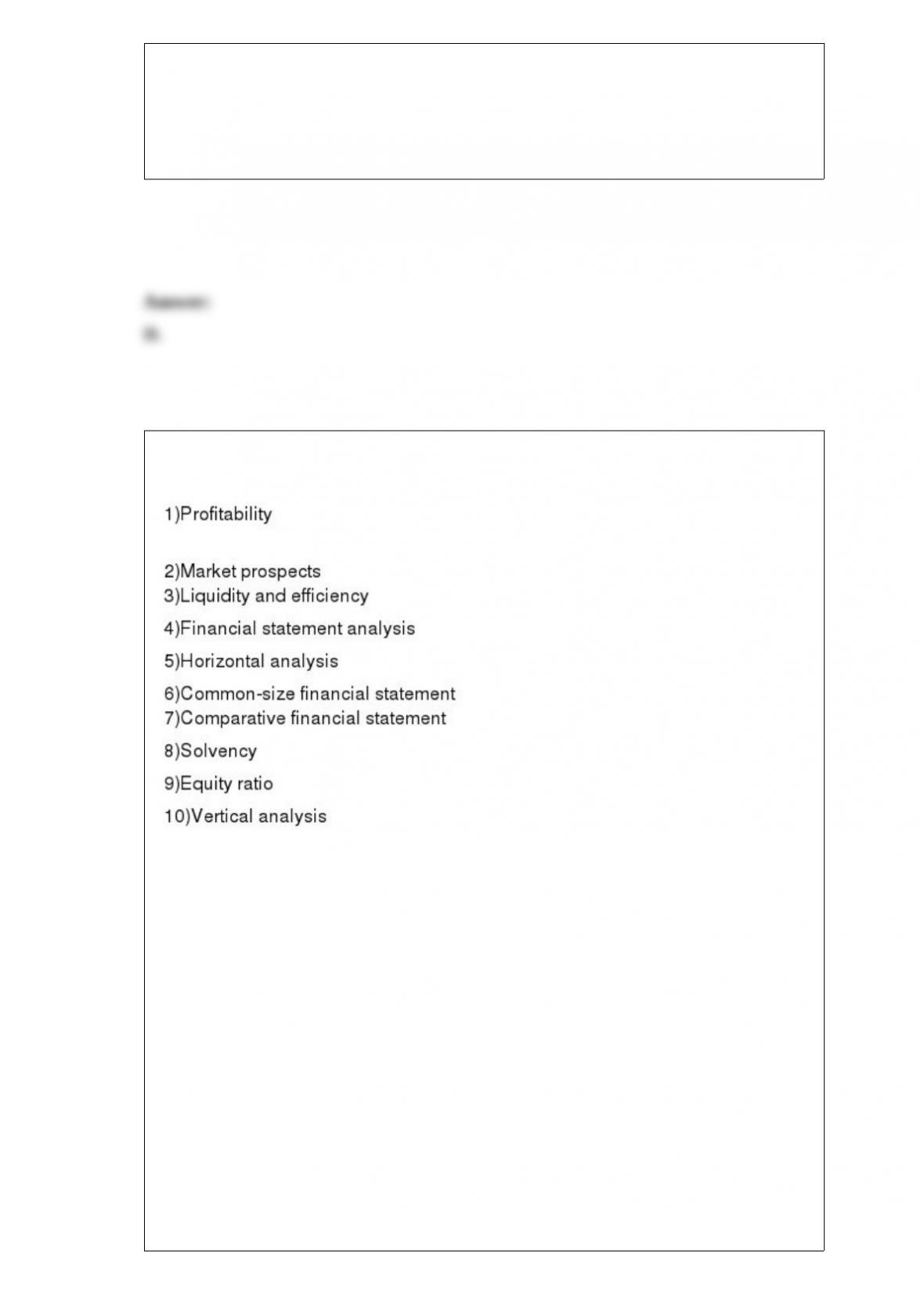
Match each of the following terms with the appropriate definitions.
A) A statement with data for two or more successive accounting periods placed in
side-by-side columns, often with changes shown in dollar amounts and percents.
B) Examination of financial data across time.
C)The availability of resources to meet short-term obligations and to efficiently
generate revenues.
D) The comparison of a company’s financial condition and performance to a base
amount.
E)The application of analytical tools to general-purpose financial statements and related
data for making business decisions.
F) A company’s ability to generate positive market expectations.

G)A company’s ability to generate future revenues and meet long-term obligations.
H) The portion of total assets provided by equity, computed as total equity divided by
total assets.
I) A company’s ability to provide financial rewards sufficient to attract and retain
capital.
J) A statement where each amount is expressed as a percent of a base amount to reveal
the relative importance of each financial statement item.
Accounts receivable information for specific customers is important because it reveals:
A.How much each customer has purchased on credit.
B.How much each customer has paid.
C.How much each customer still owes.
D.The basis for sending bills to customers.
E.All of these.
The quality of receivables refers to:
A.The creditworthiness of sellers.

B.The speed of collection.
C.The likelihood of collection without loss.
D.Sales turnover.
E.The interest rate.
When originally purchased, a vehicle had an estimated useful life of 8 years. The
vehicle cost $23,000 and its estimated salvage value is $1,500. After 4 years of
straight-line depreciation, the asset’s total estimated useful life was revised from 8 years
to 6 years and there was no change in the estimated salvage value. The depreciation
expense in year 5 equals:
A.$ 5,375.00.
B.$ 2,687.50.
C.$ 5,543.75.
D.$10,750.00.
E.$ 2,856.25.

Pepsi’s accounts receivable turnover was 9.9 for this year and 11.0 for last year. Coke’s
turnover was 9.3 for this year and 9.3 for last year. These results imply that:
A.Coke has the better turnover for both years.
B.Pepsi has the better turnover for both years.
C.Coke’s turnover is improving.
D.Coke’s credit policies are too loose
E.Coke is collecting its receivables more quickly than Pepsi in both years.
The right of common shareholders to protect their proportionate interest in a
corporation by having the first opportunity to buy additional proportionate shares of
common stock issued by the corporation is called a:
A.Preemptive right.
B.Proxy right.
C.Right to call.
D.Financial leverage.
E.Voting right.
A record in which the effects of transactions are first recorded and from which
transaction amounts are posted to the ledger is a(n):

A.Account.
B.Trial balance.
C.Journal.
D.T-account.
E.Balance column account.
The hurdle rate is often set at:
A.The rate the company could earn if the investment were placed in the bank.
B.The company’s cost of capital.
C.10% above the IRR of current projects.
D.10% above the ARR of current projects.
E.The rate at which the company is taxed on income.
Within an organizational structure, the person most likely to be evaluated in terms of
controllable costs would be:
A.A payroll clerk.
B.A cost center manager.
C.A production line worker.

D.A maintenance worker.
E.All of these.
A company has net income of $250,000, net sales of $2,000,000, and total assets of
$1,500,000. Its return on total assets equals:
A.12.5%.
B.13.3%.
C.16.7%.
D.75.0%.
E.600.0%.
The general journal provides a place for recording:
A.The transaction date.
B.The names of the accounts involved.
C.The amount of each debit and credit.
D.An explanation of the transaction.

E.All of these.
At the beginning of the recent period, there were 900 units of product in a department,
one-third completed. These units were finished and an additional 5,000 units were
started and completed during the period. 800 units were still in process at the end of the
period, one-fourth completed. Using the weighted average method, the equivalent units
produced by the department were:
A.5,000 units.
B.5,900 units.
C.6,100 units.
D.5,500 units.
E.6,700 units.
The flexibility principle of accounting information systems requires that the:
A.Benefits from an activity outweigh the costs of the activity.
B.System report useful, understandable, timely, and pertinent information for effective
decision making.

C.System aid managers in controlling and monitoring business activities.
D.System be able to adapt to changes in the company, business environment, and needs
of decision makers.
E.System conform with a company’s activities, personnel, and structure.
Becker Corporation paid cash dividends totaling $75,000 during its most recent fiscal
year. How should this information be reported on Becker’s statement of cash flows?
A.In operating activities as a source of funds.
B.In investing activities as a source of funds.
C.In investing activities as a use of funds.
D.In financing activities as a source of funds.
E.In financing activities as a use of funds.
Companies report the cost of stock options on the:
A.Statement of Cash Flows
B.Balance Sheet.
C.Statement of Retained Earnings.
D.Income Statement.

E.C & D.
A document in a job order cost accounting system that is used to record the costs of
producing a job is a(n):
A.Job cost sheet.
B.Job lot.
C.Finished goods summary.
D.Process cost system.
E.Units-of-production sheet.
Which of the following costs would not be classified as factory overhead?
A.Property taxes on maintenance machinery.
B.Expired insurance on factory equipment.
C.Wages of the factory janitor.
D.Metal doorknobs used on wood cabinets produced.
E.Small tools used in production.

Information to prepare the statement of cash flows usually comes from (a) comparative
balance sheets, (b) current income statement, and (c) additional information.
Stritch Company is trying to decide how many units of merchandise to order each
month. The company’s policy is to have 20% of the next month’s sales in inventory at
the end of each month. Projected sales for August, September, and October are 30,000
units, 20,000 units, and 40,000 units, respectively. How many units must be purchased
in September?
A.14,000.
B.20,000.
C.22,000.
D.24,000.
E.28,000.
Select the correct statement from the following:
A.Profit margin reflects a company’s ability to produce net sales from total assets.
B.Total asset turnover reflects the percent of net income in each dollar of net sales.
C.Return on total assets can be separated into gross margin ratio and price-earnings
ratio.
D.High returns on total assets are desirable.
E.Return on total assets analysis is beneficial in evaluating a company but is not useful
for competitor analysis.
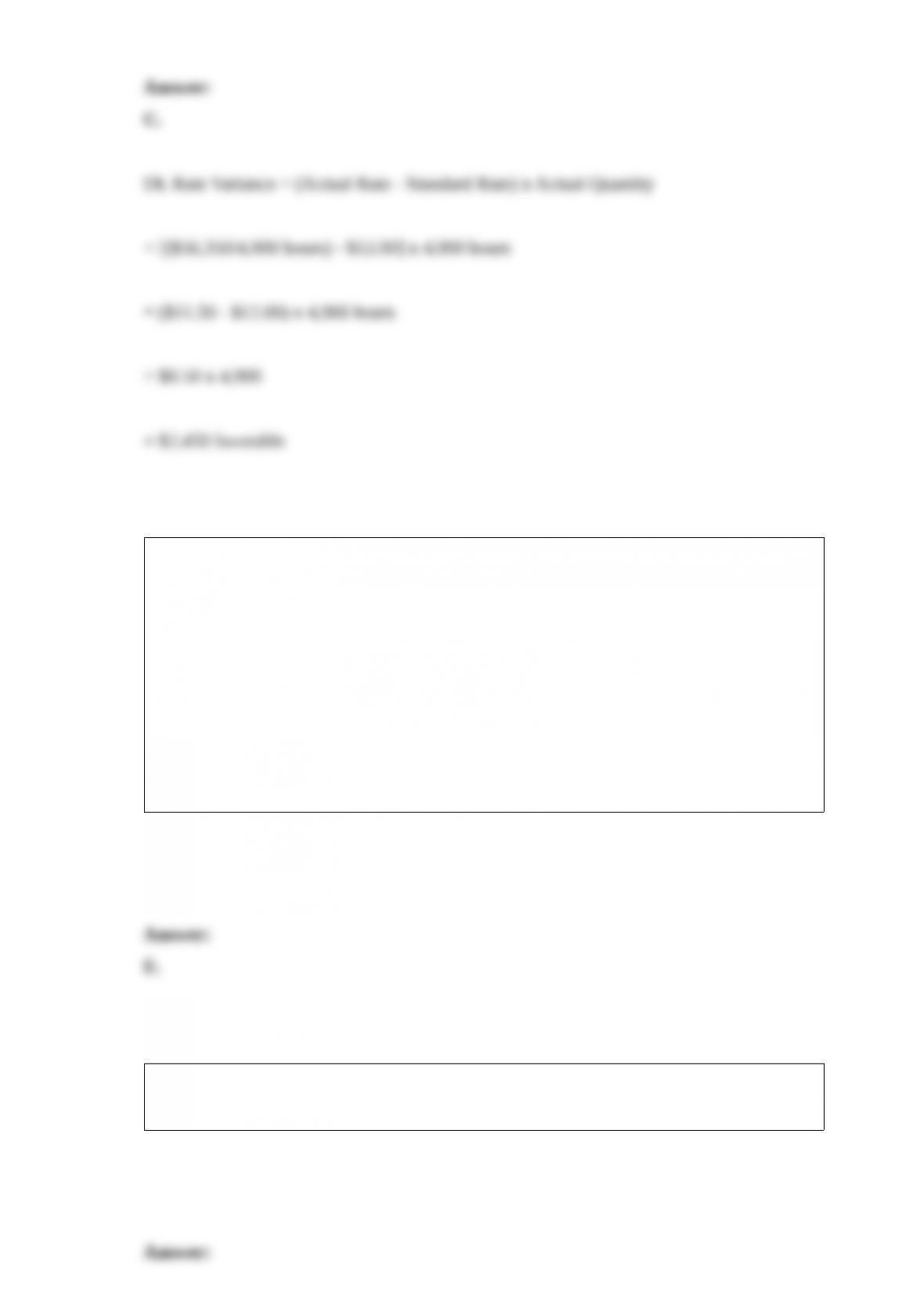
A company has determined that its standard costs to produce a single unit of output is as
follows:
During the latest month, the company purchased and used 58,000 pounds of direct
materials at a price of $1.00 per pound to produce 10,000 units of output. Direct labor
costs for the month totaled $56,350 based on 4,900 direct labor hours worked. Variable
manufacturing overhead costs incurred totaled $15,000 and fixed manufacturing
overhead incurred was $10,400.
Based on this information, the direct labor rate variance for the month was:
A.$1,200 favorable
B.$3,650 favorable
C.$2,450 favorable
D.$3,650 unfavorable
E.$1,200 unfavorable
External users of accounting information include:
A.Shareholders.
B.Customers.
C.Creditors.
D.Government regulators.
E.All of these.
Investments in equity securities where the investor has a controlling influence are
accounted for using the ________________________________.
Della’s Donuts has revenues of $83,000 and expenses of $64,000. Calculate its net
income.
The owner’s claim on assets is called __________________.
The manufacturing statement is also known as ____________________________.
The stockholders’ equity section of a company’s year-end balance sheet follows:
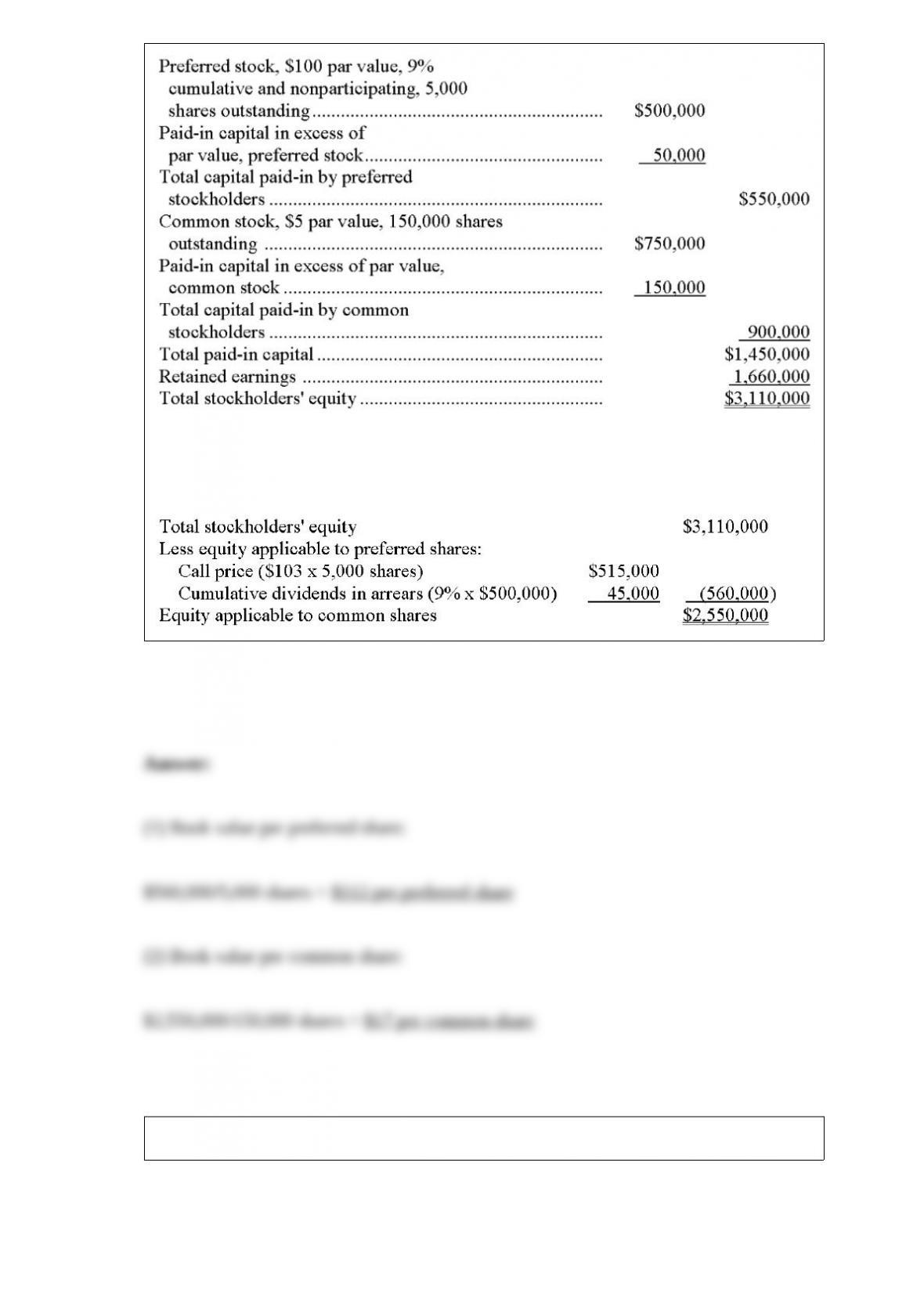
The preferred stock has a call price of $103 per share plus dividends in arrears. Only
one year of dividends are in arrears. Calculate the book value per (1) preferred share,
and (2) common share.
__________ is the defining of the ideas, goals and actions of an organization.
A company enters into an agreement to make 5 annual year-end payments of $3,000
each, starting one year from now. The annual interest rate is 6%. The present value of
an annuity factor for 5 periods, 6% is 4.2124. What is the present value of these five
payments?
Probably the most important section of the statement of cash flows in analyzing the
financial performance of a company’s ongoing business is the ____________ section.
The debt ratio, the equity ratio, pledged assets to secured liabilities, and times interest
earned are all ___________________ ratios.
What is the purpose of a good financial statement analysis report? What are the key
components?
A merchandising company’s ___________ begins with the purchase of merchandise and
ends with the collection of cash from merchandise sales.
An analysis of Hamilton Company’s cash flows revealed that net cash used in investing
activities was $52,000 and net cash used in financing activities was $38,000. These uses
led to an overall decrease in the company’s cash position of $10,000. Provide an
analysis of this company’s overall cash performance.
With respect to cycle time, companies strive to reduce non-value added time in order to
improve ___________________________.
A corporation had current year net income of $2,375,000. It paid preferred dividends of
$80,000 cash and had 500,000 weighted-average shares of common stock outstanding.
Calculate the corporation’s earnings per share.
A company reported net income of $478,000 and paid $5,500 in preferred cash
dividends during the current year. The company had 100,000 common shares issued,
and 10,000 common shares in treasury. The year-end market price per common share
was $43.05. Calculate the company’s price-earnings ratio.
How is the current ratio calculated? How is it used to evaluate a company?