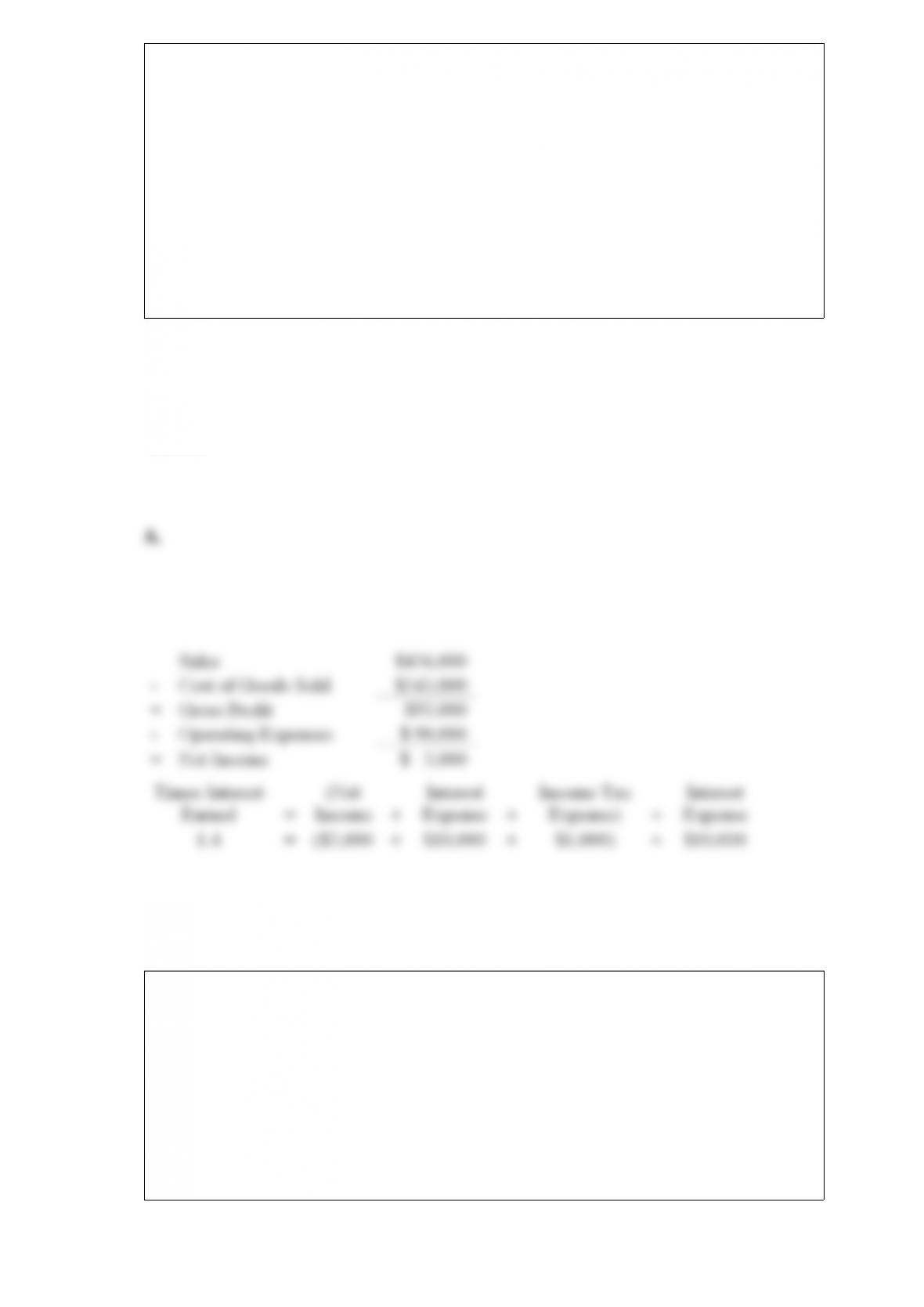
Company X has net sales revenue of $436,000, cost of goods sold of $343,000, and all
other expenses of $90,000. If interest expense is $10,000 and income tax expense is
$1,000, the times interest earned ratio is closest to
A. 1.4.
B. .33.
C. 1.3.
D. .40.
Answer:
Accounts Payable
A. has a normal credit balance.
B. is increased by a debit.
C. is an asset.
D. is increased when a company receives cash from customers.
Answer:
A company lends its supplier $150,000 for 3 years at a 6% annual interest rate. Interest
payments are to be made twice a year. Each interest payment will be for:
A. $9,000.
B. $13,500.
C. $4,500.
D. $27,000.
Answer:
Your company owned equipment with a book value of $120,000 that was sold during
this accounting period for $30,500 in cash, and purchased new equipment for cash of
$148,000. Your company would record:
A. a debit of $148,000 and a credit of $30,500 to the cash account for a net cash inflow
of $117,500.
B. a debit of $148,000 and a credit of $89,500 to the cash account for a net cash inflow
of $58,500.
C. a debit of $30,500 and a credit of $148,000 to the cash account for a net cash outflow
of $117,500.
D. a debit of $89,500 and a credit of $148,000 to the cash account for a net cash
outflow of $58,500.
Answer:
At the beginning of the first quarter, your company borrows $20,000 for four years at
8% interest and has to repay $5,000 of principal each year. Interest is paid at the end of
the second and fourth quarters, and the principal is due at the end of the year.
Use the information above to answer the following question. A company pays $9,000 in
interest on notes consisting of $6,000 of interest that was accrued during the last
accounting period and $3,000 of interest that accumulated during this accounting period
that has not yet been accrued on the books. The journal entry for the interest payment
should:
A. debit Interest Expense $9,000 and credit Cash $9,000.
B. debit Cash $9,000 and credit Interest Payable $9,000.
C. debit Interest Expense $3,000, debit Interest Payable $6,000, and credit Cash $9,000.
D. debit Interest Payable $6,000, debit Accrued Interest $3,000, and credit Cash $9,000.
Answer:
Which of the following scenarios could explain the journal entry below?
A. The company buys $10,000 of equipment for $4,000 in cash and $6,000 on credit.
B. The company receives $4,000 in cash and $6,000 in notes payable for selling 10,000
of equipment.
C. The company buys $10,000 of equipment, for $4,000 cash and a promise to cancel
$6,000 of debt owed to it.
D. The company sells $10,000 of equipment, for $4,000 in cash and pays off $6,000 it
owes on the equipment.
Answer:
Which of the following would appear in the debit column of an adjusted trial balance?
A. Service revenue.
B. Dividends declared.
C. Accumulated depreciation.
D. Unearned revenue.
Answer:
In order to calculate shrinkage:
A. both periodic and perpetual inventory systems are needed.
B. a periodic inventory system is more effective.
C. a perpetual inventory system requires an occasional count of actual inventory.
D. it does not matter which system one uses.
Answer:
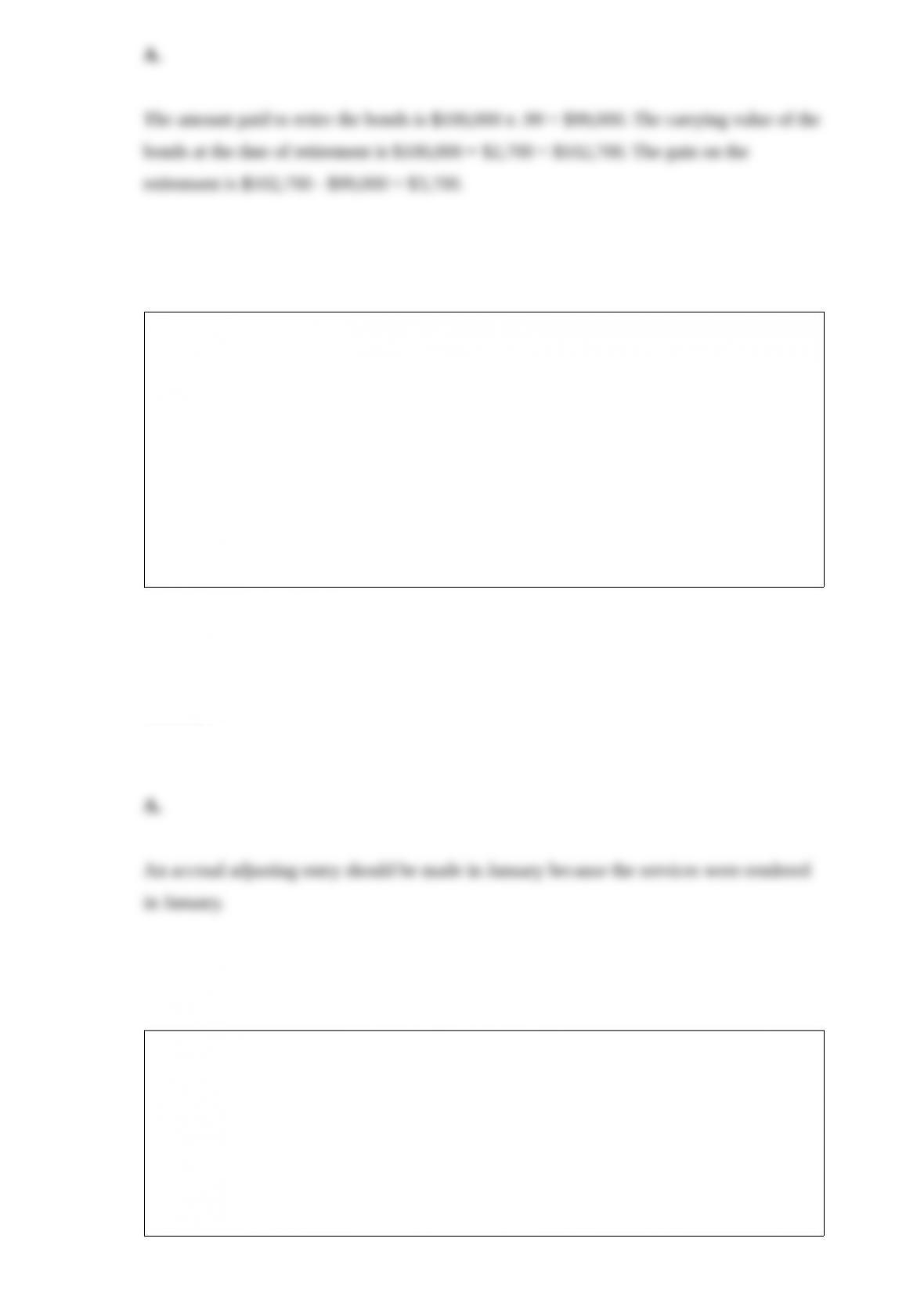
A company has bonds outstanding with a face value of $100,000. The unamortized
premium on these bonds is $2,700. If the company retired these bonds at a call price of
99, the journal entry to record this retirement is:
A. Option A
B. Option B
C. Option C
D. Option D
Answer:
A company billed a client for services rendered in January. The payment was received
partially in January, and the balance in February. When should the entry be made to
record the service revenue?
A. January.
B. February.
C. Split between January and February.
D. At the end of the year with an adjusting entry.
Answer:
McBean Company has outstanding 10 million shares of $2 par value common stock and
1 million shares of $4 par value preferred stock. The preferred stock has a 7% dividend
rate. The company declares $600,000 in total dividends for the year. Dividends in
arrears are $30,000. Compute the amount of dividends to be distributed to:
a. preferred shareholders
b. common shareholders
Answer:
Which of the following is not one of the four main external users of financial
statements?
A. Creditors
B. Investors
C. Government
D. Managers
Answer:
A company purchases $23,000 of supplies in the current month and promises to pay for
them next month. How would the company record a liability for the supplies?
A. This liability is not a recognized liability until the payment is due.
B. $23,000 would be journalized as a credit to Accounts Payable.
C. $23,000 would be journalized as a debit to Accounts Payable.
D. $23,000 would be journalized as a debit to Prepaid Expenses.
Answer:
For each of the following transactions, indicate how each will affect the elements of the
accounting equation by answering increase, decrease, or no effect.
a. The company uses the direct write-off method and writes off specific receivables that
have been identified as uncollectible.
b. The company uses the allowance method and records the bad debts expense for the
year.
c. The company receives a 1-year promissory note from a customer in payment of his

account because he needs additional time to pay.
d. The company receives a payment from a customer on his account which had been
previously written off as worthless.
e. The company accrues interest earned on the note received in (c).
Answer:
If you wish to examine how one aspect of a business is doing relative to other aspects of
the business at the current time, you are most likely to use:
A. time-series analysis.
B. ratio analysis.
C. horizontal analysis.
D. cross-sectional analysis.
Answer:
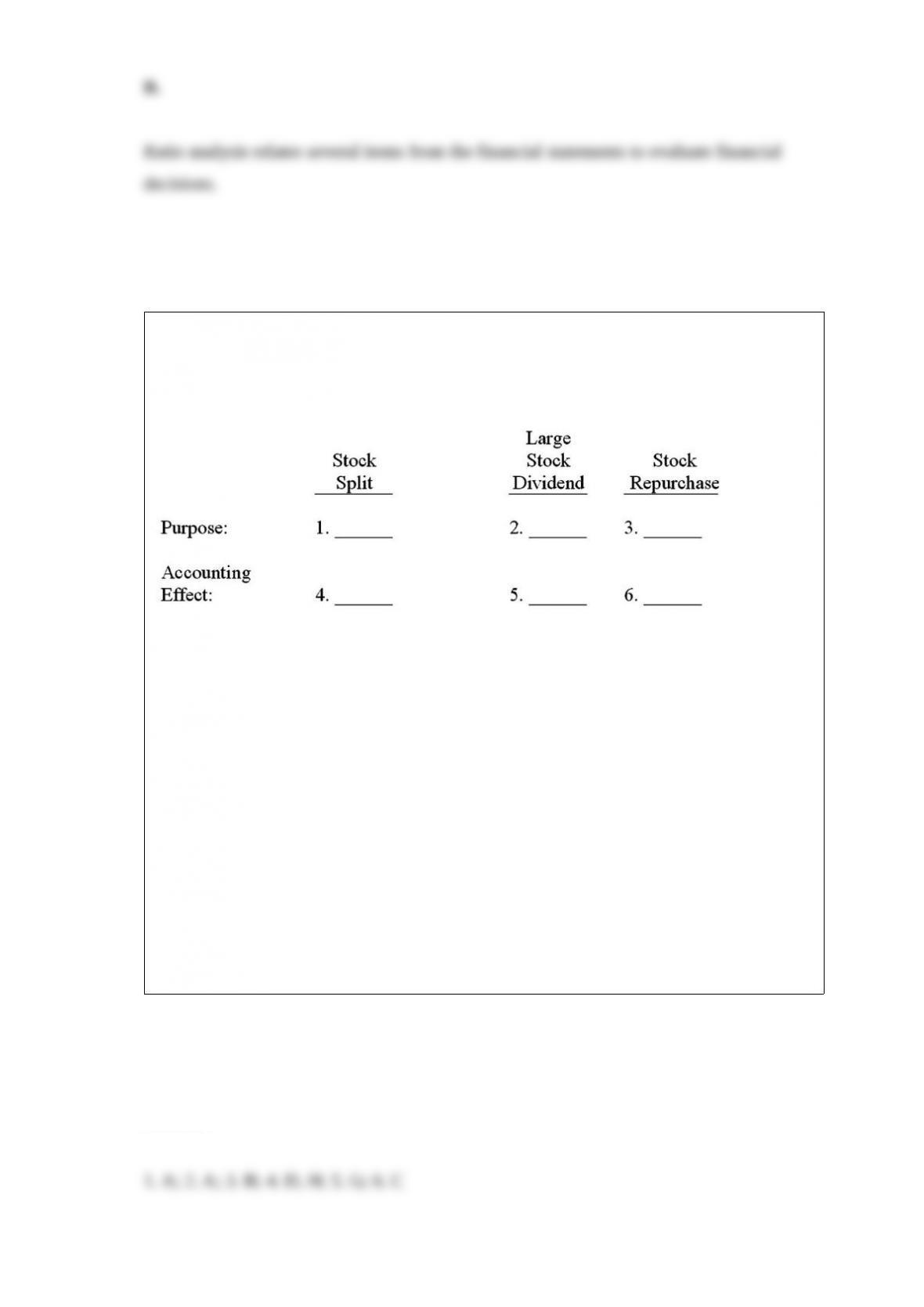
Choose the appropriate letter to match the description with the purpose and accounting
effect of the type of stock transaction. Some letters will appear in more than one
column and not all letters will necessarily be used. Some blanks will require more than
one letter.
A. To reduce market price of the stock.
B. To signal to investors that the company’s stock is worth buying.
C. Reduces stockholders’ equity.
D. Changes par value per share.
E. Changes additional paid-in capital.
F. Changes liabilities.
G. Reduces retained earnings.
H. Does not require a journal entry.
Answer:
Which of the following describes the order in which the financial reports or disclosures
would normally be issued by public companies?
A. (1) annual report, (2) Form 10-K, (3) Press release announcing annual earnings.
B. (1) Form 10-K, (2) annual report, (3) Press release announcing annual earnings.
C. (1) Press release announcing annual earnings, (2) Form 10-K, (3) annual report.
D. (1) Press release announcing annual earnings, (2) annual report, (3) Form 10-K.
Answer:
The new CEO of a company takes over on December 10, 2013. He is promised a
significant bonus for every percent he can increase net income in 2014 over 2013
results.
Which of the following actions would not be considered unethical?
A. Overstating the cost of machinery purchased in 2014.
B. Prepaying 2014 expenses in 2013.
C. Deferring 2014 expenses to 2015 and accruing revenues in 2014 that don’t exist.
D. Recording 2014 revenue as unearned revenue.
Answer:
A company had total assets of $650,000 and total liabilities of $300,000 at the end of
2014. For the year 2014, the company had the following transactions:
a) Recorded services provided to customers on account for $25,000.
b) Recorded $3,000 of supplies purchased from a supplier on account.
Consider each item independently.
What effect will transaction (a) have on the net profit margin and debt-to-assets ratios?
A. Net profit margin will increase and debt-to-assets will decrease.
B. Net profit margin will decrease and debt-to-assets will increase.
C. Both ratios will decrease.
D. Both ratios will increase.
Answer:
Which of the following ratios does not use total revenue in its calculation?
A. Net profit margin.
B. Asset turnover.
C. Return on equity.
D. Fixed asset turnover.
Answer:
If the double-declining balance method were used to depreciate a building that has a
10-year useful life and a residual value equal to 10% of the building’s original cost,
what depreciation rate would be used?
A. 9%
B. 10%
C. 18%
D. 20%

Answer:
The main purposes of internal controls do not include:
A. prevention of error, theft, and fraud.
B. promotion of operational efficiency.
C. ensuring compliance with laws and regulations.
D. providing more favorable financial information.
Answer:
The following information is available for a company for the current year:
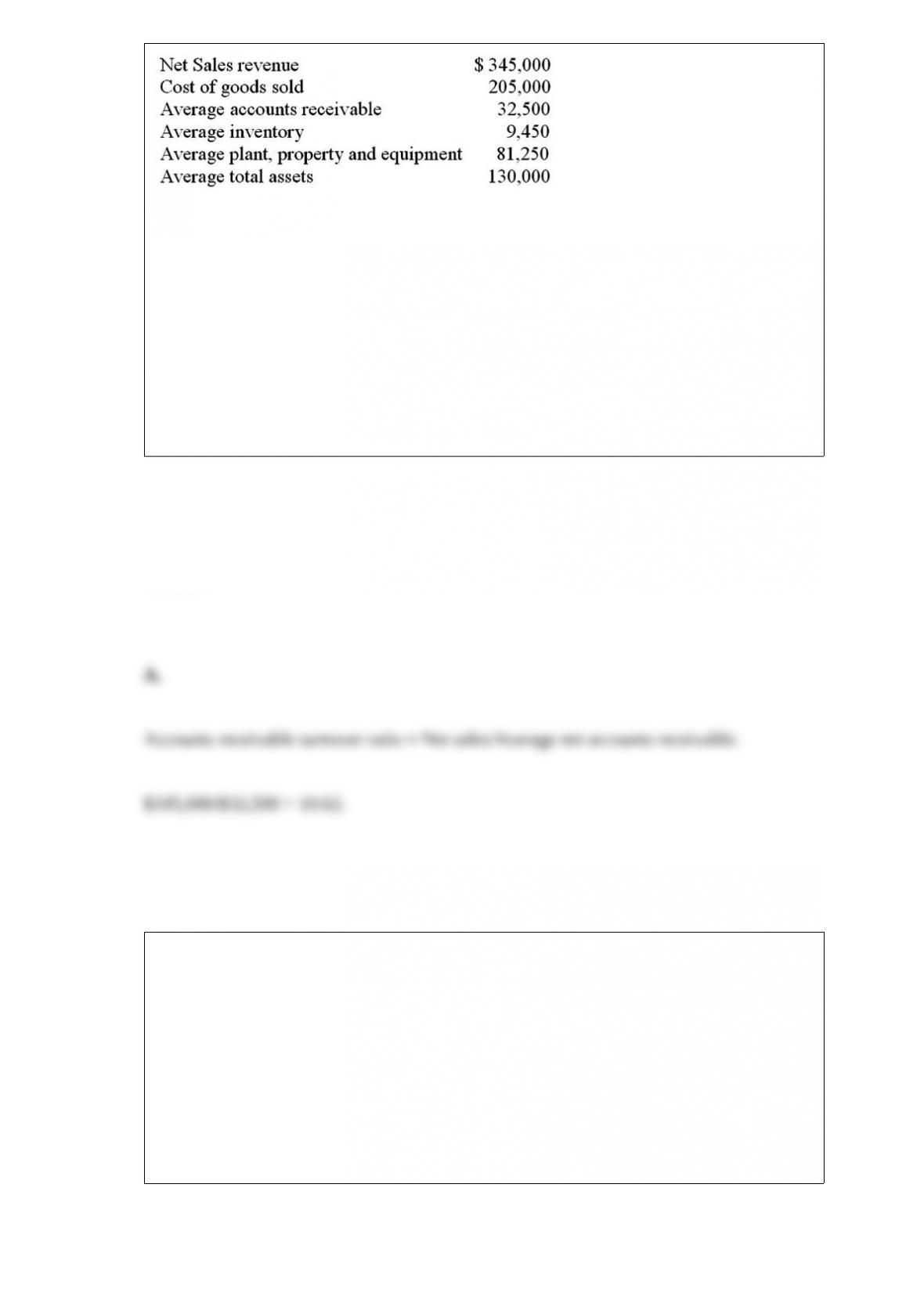
Use the information above to answer the following question. Which of the following is
closest to the company’s accounts receivable turnover ratio for the current year?
A. 10.62
B. 4.0
C. 4.3
D. 6.31
Answer:
A company issues $20 million in new stock. The company later uses this money to
acquire a building. What is the resulting effect of these transactions on the accounts?
A. Building increases, and Contributed Capital increases.
B. Building increases, and Contributed Capital decreases.
C. Cash increases, Building increases, and Contributed Capital increases.
D. Cash decreases, Building increases, and Contributed Capital decreases.
Answer:
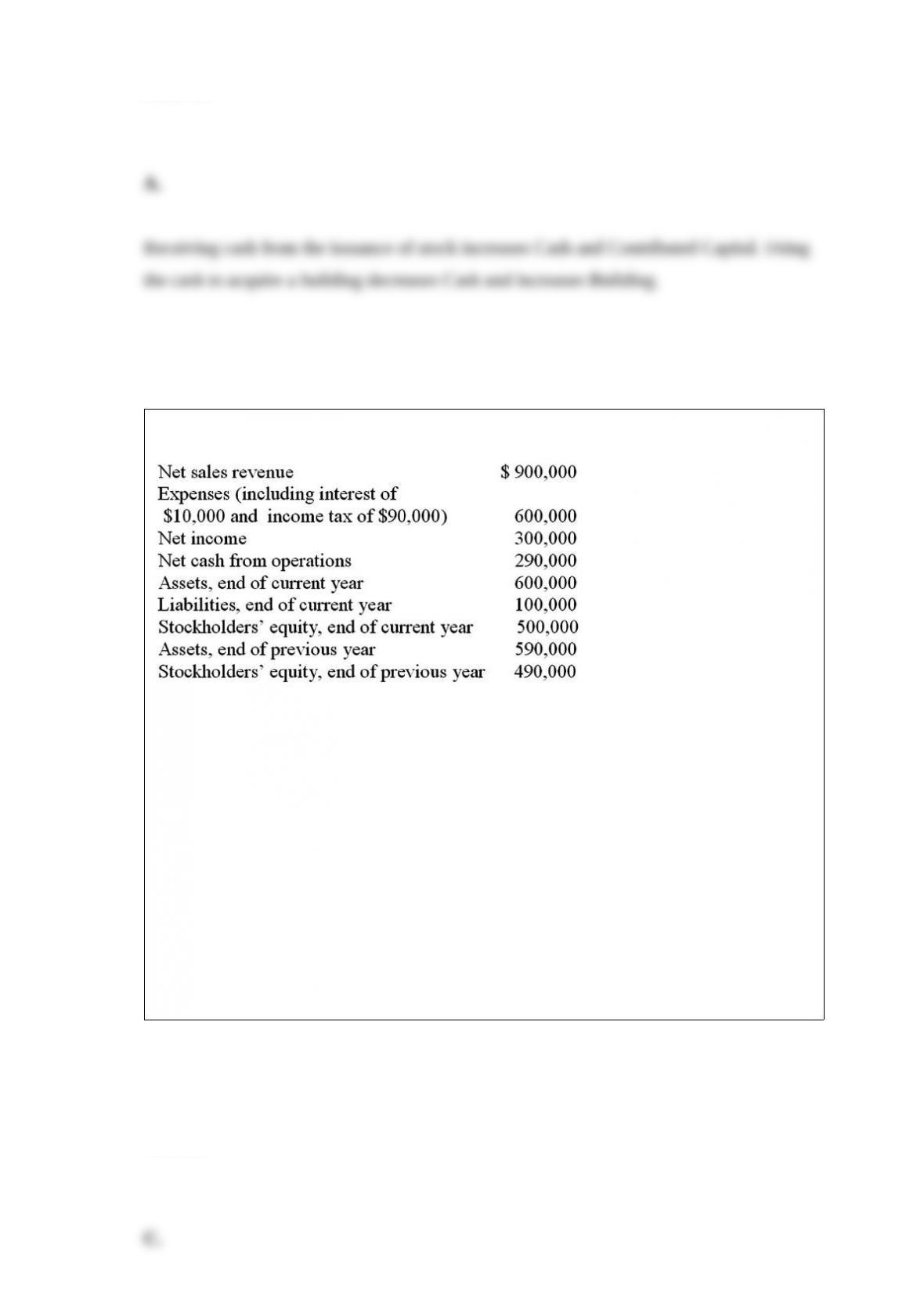
The following information is taken from the financial statements of B. Darin Company:
In addition, there was an average of 40,000 shares of common stock outstanding and
the current market price of the stock is $15 per share.
Use the information above to answer the following question. Which of the following is
closest to the company’s debt to assets ratio for the current year?
A. 0.20
B. 0.67
C. 0.17
D. 0.33
Answer:

A corporate bond with a face value of $1,000 is issued at 107. This means that the bond
actually sold for:
A. $107, and the stated interest rate was higher than the market interest rate.
B. $1,070, and the stated interest rate was higher than the market interest rate.
C. $107, and the stated interest rate was lower than the market interest rate.
D. $1,070, and the stated interest rate was lower than the market interest rate.
Answer:
During the year, a company that uses the allowance method concludes that $6,844 of
specific customer accounts will not be collected. These are written off by:
A. debiting Accounts Receivable and crediting Allowance for Doubtful Accounts for
$6,844.
B. debiting Accounts Receivable and crediting Bad Debt Expense for $6,844.
C. debiting Bad Debt Expense and crediting Accounts Receivable for $6,844.
D. debiting Allowance for Doubtful Accounts and crediting Accounts Receivable for
$6,844.
Answer:
Which of the following factors would not necessarily contribute to a going-concern
problem?
A. Excessive reliance on debt financing.
B. Loss of key personnel without comparable replacement.
C. Inadequate maintenance of long-lived assets.
D. Declining profit margins.
Answer:

For a manufacturer, inventory turnover refers to how many times:
A. during the period the company replaces the raw materials inventory.
B. the company buys and sells its inventory of finished goods.
C. the company produces its goods and delivers the inventory to customers.
D. the company orders raw materials.
Answer:
What is the amount due on the maturity date of a $5,000, 3-month, 10% note
receivable?
A. $5,125
B. $5,500
C. $6,500
D. $5,000
Answer:

Choose the appropriate letter to match the term and the explanation. Not all
explanations will be used.
TERM
_____ 1/ Net realizable value
_____ 2/ Percentage of credit sales method
_____ 3/ Allowance for doubtful accounts
_____ 4/ Principal
_____ 5/ Write-off
_____ 6/ Aging of accounts receivable
_____ 7/ Credit terms
_____ 8/ Factoring
EXPLANATION
A. How much money you can expect to earn over a period of time selling your goods.
B. The length of the credit period and any discounts offered for prompt payment.
C. A method of estimating uncollectible debts by forecasting the probability of not
collecting late accounts.
D. Selling accounts receivable to another company for immediate cash.
E. The account in which the estimated amount of accounts receivable expected to be
uncollectible is recorded.
F. Also known as accounts receivable, net
G. A method of estimating uncollectible debts by looking at the historical average of
credit sales not collected.
H. The amount of money lent.
I. Credit that a company receives when one good is exchanged for another.

J. The interest earned by money over a period of time.
K. When a company increases the amount of accounts receivable by adding the interest
earned as accounts age without being collected.
L. The process of removing specific customers’ accounts deemed uncollectible.
Answer:
Deferred expenses (prepaid expenses) are initially recorded as assets, but over time are
expected to become
A. liabilities.
B. other assets.
C. revenues.
D. expenses.
Answer:
What would happen to the net profit margin ratio if the company recorded depreciation
at the end of 2015 for depreciation of $500 on one of its assets?
A. Net profit margin would increase indicating an improvement in performance.
B. Net profit margin would decrease indicating less control over expenses.
C. Net profit margin would not change.
D. Net profit margin would have decreased in 2015 without this journal entry.
Answer:
To calculate the company’s income tax expense for the current period, it is necessary to
know:
A. the company’s operating revenue and tax bill from prior periods.
B. the company’s income before income taxes and the company’s tax rate.
C. the company’s operating expenses and revenue.
D. the company’s revenues, expenses, and dividends.
Answer: