
Which of the following is not classified as a variable period cost?
a. Sales commissions
b. Packaging for delivery
c. Depreciation on delivery trucks
d. All of these answer choices are variable period costs.
A 10 percent decrease in sales volume will result in
a.A 10 percent decrease in total variable cost.
b.A 10 percent decrease in per unit variable cost.
c.A 10 percent increase in total variable cost.
d.A 10 percent increase in per unit variable cost.
On the breakeven graph, if sales price and variable cost remain constant and fixed costs
decrease, the fixed cost line will
a. Shift to the right.
b. Shift to the left.
c. Shift upward.
d. Shift downward.
A category of costs that include all the costs associated with the general management of
the company is referred to as
a. Indirect costs.
b. General and administrative costs.
c. Selling costs.
d. All of these answer choices are correct.
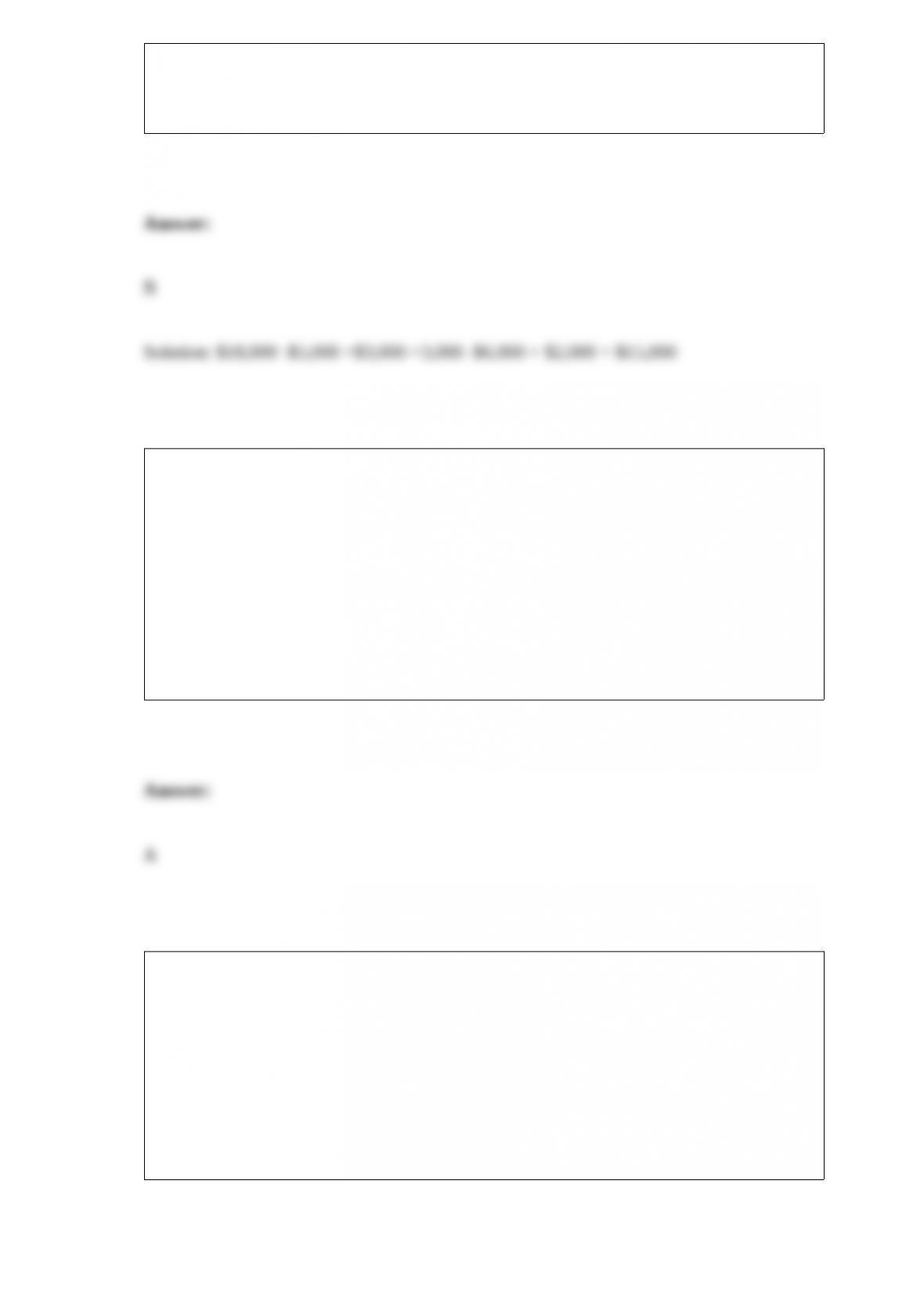
Monroe’s Industries reported net income of $18,000 and paid cash dividends of $2,000.
Changes in balanced sheet accounts for the year were as follows:
Based on the above information, what is the amount of net cash provided by
operations?
a. $1,000
b. $15,000
c. $21,000
d. $30,000
Total cost is a combination of fixed and variable costs. The algebraic equation, where T
= total costs, v = variable costs, x = units produced, and f = fixed costs, for total cost is:
a.T = v(x) + f
b.T = v + f
c.T = v(x) – f
d.T = f(x) + v
An example of a discretionary fixed cost is
a.Research and development costs.
b.Lease on warehouse space.
c.Sales commissions.
d.All of these answer choices are correct.

What is really needed to measure a segment ‘s performance is an income statement that
highlights
a. Variable versus fixed costs.
b. Product versus period costs.
c. All the elements under the segment manager ‘s control.
d. None of these answer choices are correct.
Total budgeted manufacturing overhead flows to the
a. Ending inventory and cost of goods sold budget.
b. Production budget.
c. Cash budget.
d. All of these answer choices are correct.
Answer the following questions regarding the calculation of cash flows provided by
operating activities, using the direct method.
a. How is the cash flows provided by operating activities calculated using the direct
method?
b. What are the major activities that generate cash flows from operations?
c. Explain how to determine the actual cash payments made to suppliers when using the
direct method.
Willow Industries reported total operating expenses of $160,000 on the income
statement. During the year, accounts payable decreased by $8,000, accrued liabilities
decreased by $4,000, and prepaid expenses increased by $1,000. Depreciation expense
totaled $6,000. Walker uses the direct method to determine the net cash provided by
operating activities on the statement of cash flows. What is the amount of operating
expenses adjusted to a cash basis?
a. $143,000
b. $149,000
c. $165,000
d. $162,000
On a common-size balance sheet, notes receivable is shown as a percentage of
a. Total liabilities.
b. Current liabilities.
c. Total stockholders’ equity.
d. Total assets.
The Theory of Constraints was developed to maximize the performance of a value
chain. According to the theory, five steps are required to maximize and improve the
performance of a value chain.
Required:
a. List the five steps.
b. Define the two terms bottleneck process and throughput contribution. Indicate how
these terms are related to the theory of constraints.
If the actual average wage rate is $4.50 per direct labor hour, but the standard wage rate
is $4.70 per direct labor hour,
a. The direct labor efficiency variance will be favorable.
b. The direct labor efficiency variance will be unfavorable.
c. The direct labor rate variance will be favorable.
d. The direct labor rate variance will be unfavorable.
Which of the following is a use of cash?
a. Purchasing equipment for cash
b. Purchasing supplies on account
c. Declaring a stock dividend
d. All of these answer choices are uses of cash
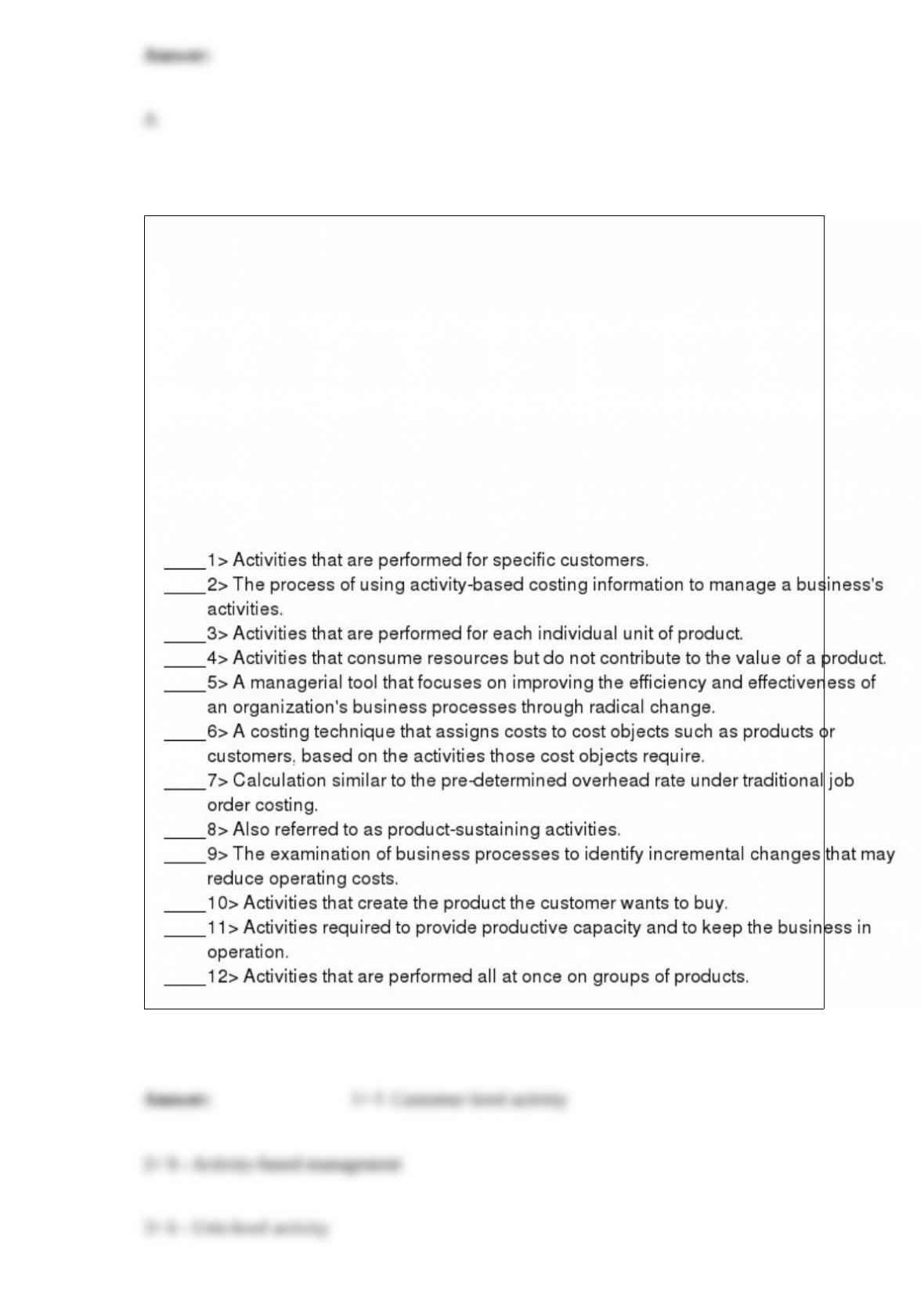
Match the following terms to the appropriate statements by placing the letter to the left
of each statement. a. Activity-based costing g. Non-valued-added allocation
b. Activity-based management h. Organizational-level allocation
c. Activity rate i. Process improvement
d. Batch-level activity j. Product-level activity
e. Business process reengineering k. Unit-level activity
f. Customer-level activity l. Value-added activity
Prepare a common-size balance sheet and income statement and use it to analyze a
company’s performance.
Once managers realize that leading, lagging, financial and nonfinancial measures need
to be monitored, they must identify the key performance indicators that measure
successful progression toward the organization’s goals. The key to using these measures
to drive performance is to understand the cause-and-effect relationships they represent.
Required:
List five reasons why companies use key performance indicators.
Customers typically have expectations for how quickly they should receive a product
they have ordered. All other things held equal, they would prefer as short a wait as
possible. However, different businesses perform different tasks between an order’s
placement and its shipment.
Required:
Discuss three measures that can help managers monitor their delivery processes.
Include how each measure is different between two types of businesses.
Gant Wholesale Company has $2,000 in cash, $7,000 in accounts receivable, $12,000
in inventory, and $3,000 in prepaid expenses. Liabilities totaled $20,000, with $6,000
current and $14,000 long-term. What is Gant’s acid-test ratio?
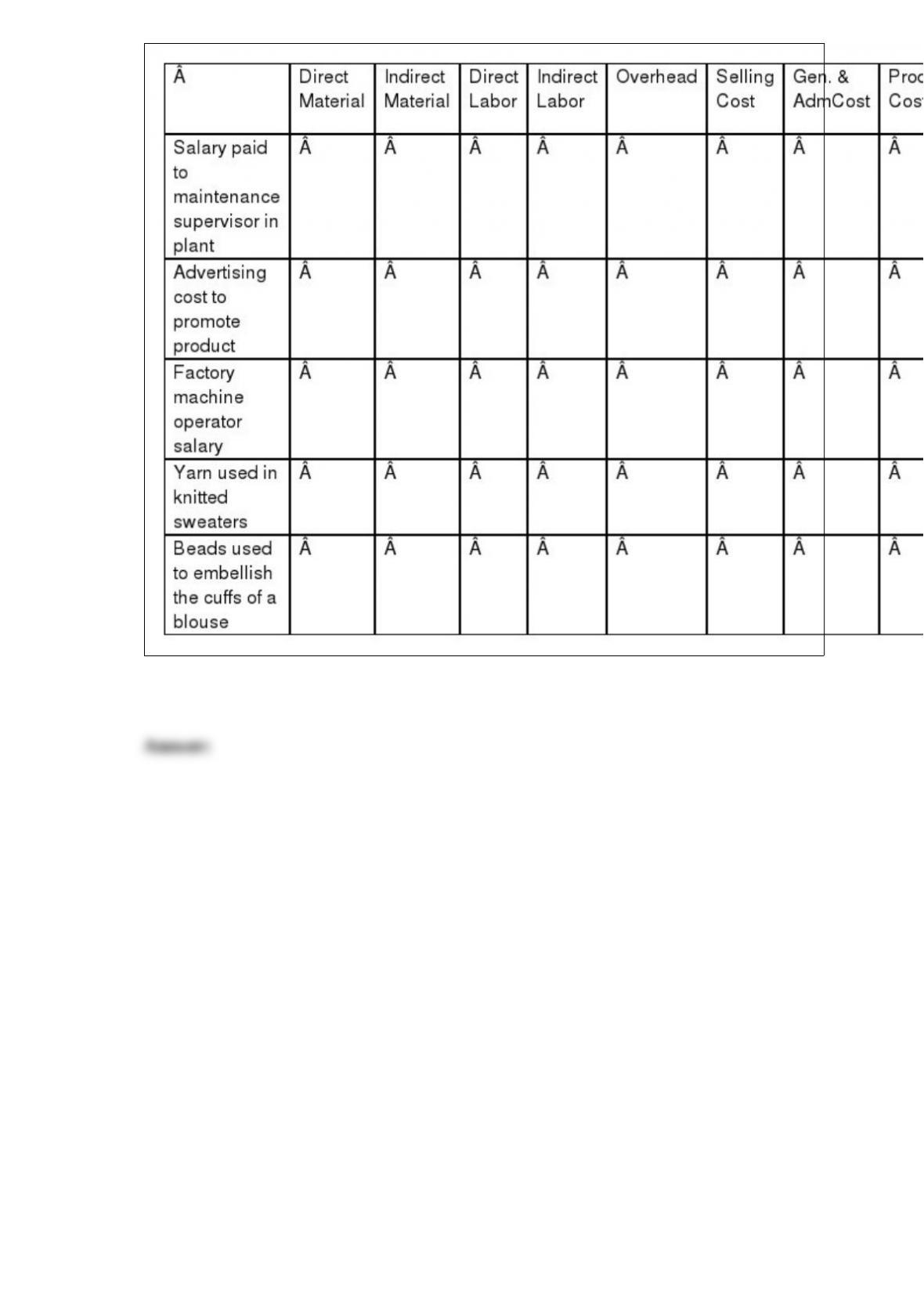
Complete the table below by placing an “X” under each heading that classifies the cost
(Items may be under more than one classification).
Marshall Industries has sales of $600,000 and net operating income of $30,000.
Marshall ‘s average operating assets total $200,000. What is the company ‘s return on
investment? Show your work.