
1) users of financial reports include all of the following except
a.creditors
b.government agencies
c.unions
d.all of these are users
2) on january 1, 2004, mill corporation purchased for $304,000, equipment having a
useful life of ten years and an estimated salvage value of $16,000. mill has recorded
monthly depreciation of the equipment on the straight-line method. on december 31,
2012, the equipment was sold for $56,000. as a result of this sale, mill should recognize
a gain of
a.$0
b.$11,200
c.$27,200
d.$56,000
3) not adjusting the amounts reported in the financial statements for inflation is an
example of which basic principle of accounting?
a.economic entity
b.going concern
c.historical cost
d.full disclosure
4) during 2012, vaughn corporation sold merchandise costing $3,000,000 on an
installment basis for $4,000,000. the cash receipts related to these sales were collected
as follows: 2012, $1,600,000; 2013, $1,400,000; 2014, $1,000,000.
if expenses, other than the cost of the merchandise sold, related to the 2012 installment
sales amounted to $180,000, by what amount would vaughns net income for 2012
increase as a result of installment sales?
a.$ 220,000
b.$ 355,000
c.$ 400,000
d.$1,420,000
5) on february 10, 2012, after issuance of its financial statements for 2011, house
company entered into a financing agreement with lebo bank, allowing house company
to borrow up to $6,000,000 at any time through 2014. amounts borrowed under the
agreement bear interest at 2% above the bank’s prime interest rate and mature two years
from the date of loan. house company presently has $2,250,000 of notes payable with
first national bank maturing march 15, 2012. the company intends to borrow
$3,750,000 under the agreement with lebo and liquidate the notes payable to first
national. the agreement with lebo also requires house to maintain a working capital
level of $9,000,000 and prohibits the payment of dividends on common stock without
prior approval by lebo bank. from the above information only, the total short-term debt
of house company as of the december 31, 2012 balance sheet date is
a.$0
b.$2,250,000
c.$3,000,000
d.$6,000,000
6) keck co. had 450 units of product a on hand at january 1, 2012, costing $21 each.
purchases of product a during january were as follows:
a physical count on january 31, 2012 shows 600 units of product a on hand. the cost of
the inventory at january 31, 2012 under the lifo method is
a.$14,100
b.$13,350
c.$12,750
d.$12,300
7) lester company received a seven-year zero-interest-bearing note on february 22,
2012, in exchange for property it sold to porter company. there was no established
exchange price for this property and the note has no ready market. the prevailing rate of
interest for a note of this type was 7% on february 22, 2012, 7.5% on december 31,
2012, 7.7% on february 22, 2013, and 8% on december 31, 2013. what interest rate
should be used to calculate the interest revenue from this transaction for the years ended
december 31, 2012 and 2013, respectively?
a.0% and 0%
b.7% and 7%
c.7% and 7.7%
d.7.5% and 8%

8) confectioners, a chain of candy stores, purchases its candy in bulk from its suppliers.
for a recent shipment, the company paid $1,800 and received 8,500 pieces of candy that
are allocated among three groups. group 1 consists of 2,500 pieces that are expected to
sell for $0.15 each. group 2 consists of 5,500 pieces that are expected to sell for $0.36
each. group 3 consists of 500 pieces that are expected to sell for $0.72 each. using the
relative sales value method, what is the cost per item in group 3?
a.$0.477
b.$0.225
c.$0.720
d.$0.540
9) which of the following is not a method of disclosing pertinent information?
a.supporting schedules
b.parenthetical explanations
c.cross reference and contra items
d.all of these are methods of disclosing pertinent information.
10) contreras corporation acquired a patent on may 1, 2012. contreras paid cash of
$35,000 to the seller. legal fees of $900 were paid related to the acquisition. what
amount should be debited to the patent account?
a.$900
b.$34,100
c.$35,000
d.$35,900
11) leonard corporation reports the following information:
correction of overstatement of depreciation expense
in prior years, net of tax$ 215,000
dividends declared160,000
net income500,000
retained earnings, 1/1/12, as reported2,000,000
leonard should report retained earnings, 12/31/12, at
a.$1,785,000
b.$2,125,000
c.$2,340,000

d.$2,555,000
12) what is the relationship between current liabilities and a company’s operating cycle?
a.liquidation of current liabilities is reasonably expected within the company’s operating
cycle (or one year if less)
b.current liabilities are the result of operating transactions
c.current liabilities can’t exceed the amount incurred in one operating cycle
d.there is no relationship between the two
13) when calculating the cost ratio for the retail inventory method,
a.if it is the conventional method, the beginning inventory is included and markdowns
are deducted
b.if it is the lifo method, the beginning inventory is excluded and markdowns are
deducted
c.if it is the lifo method, the beginning inventory is included and markdowns are not
deducted
d.if it is the conventional method, the beginning inventory is excluded and markdowns
are not deducted
14) wave, inc. follows ifrs for its external financial reporting. the statement of cash
flows reports changes in cash and cash equivalents, which of the following is not
considered cash or a cash equivalent under ifrs?
a.coin
b.bank overdrafts
c.commercial paper
d.accounts receivable
15) in a statement of cash flows, payments to acquire debt instruments of other entities
(other than cash equivalents) should be classified as cash outflows for
a.operating activities
b.investing activities
c.financing activities
d.lending activities
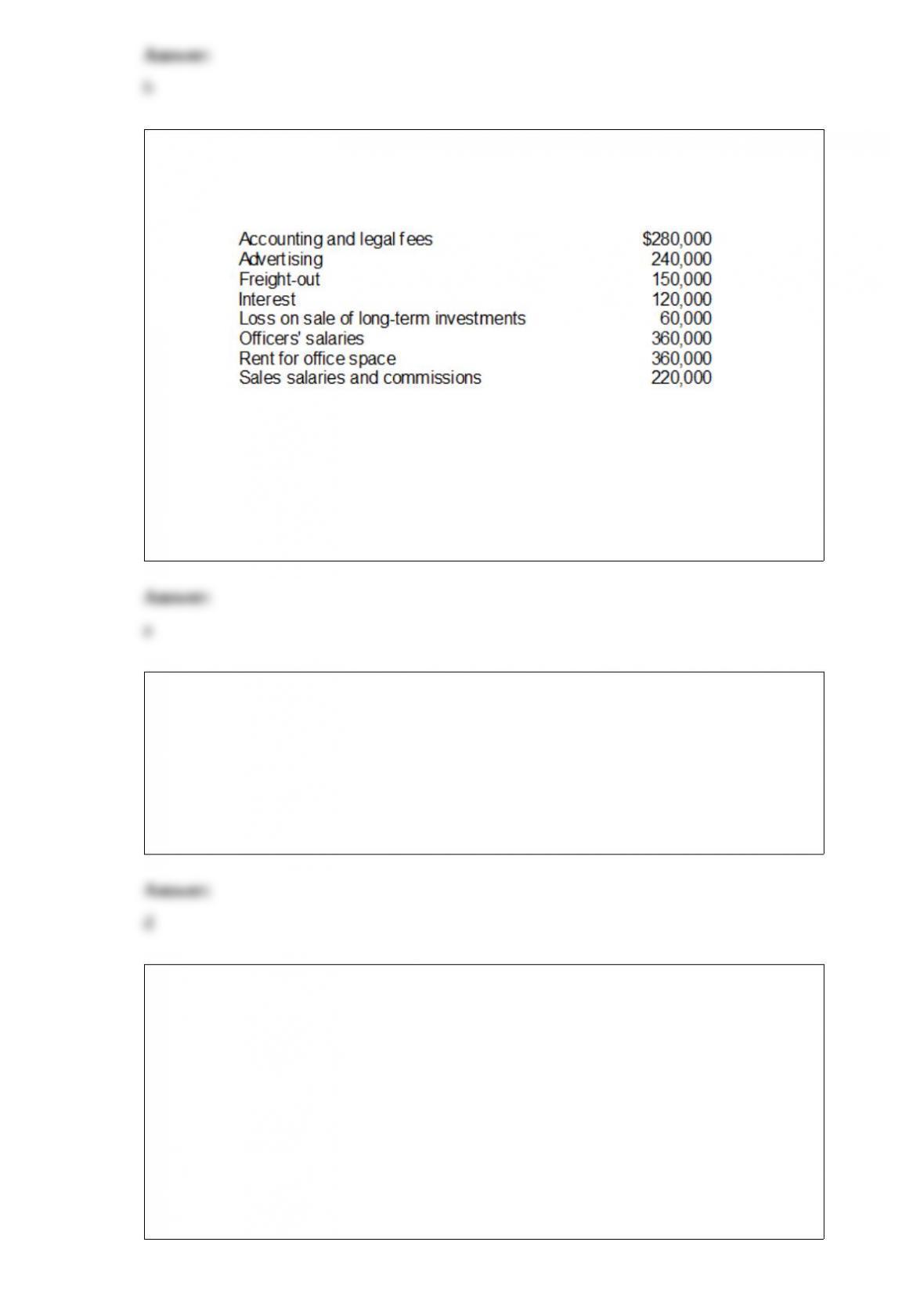
16) perry corp. reports operating expenses in two categories: (1) selling and (2) general
and administrative. the adjusted trial balance at december 31, 2012, included the
following expense accounts:
one-half of the rented premises is occupied by the sales department.
how much of the expenses listed above should be included in perry’s general and
administrative expenses for 2012?
a.$820,000
b.$880,000
c.$940,000
d.$1,000,000
17) elkins corporation uses the perpetual inventory method. on march 1, it purchased
$20,000 of inventory, terms 2/10, n/30. on march 3, elkins returned goods that cost
$2,000. on march 9, elkins paid the supplier. on march 9, elkins should credit
a.purchase discounts for $400
b.inventory for $400
c.purchase discounts for $360
d.inventory for $360
18) indicate and explain whether each of the following independent situations should be
treated as a temporary difference or a permanent difference.
(a)for accounting purposes, a company reports revenue from installment sales on the
accrual basis. for income tax purposes, it reports the revenues by the installment-sales
method, deferring recognition of gross profit until cash is collected.
(b)pretax accounting income and taxable income differ because 80% of dividends
received from u.s. corporations was deducted from taxable income, while 100% of the
dividends received was reported for financial statement purposes.
(c)estimated warranty costs (covering a three-year warranty) are expensed for
accounting purposes at the time of sale but deducted for income tax purposes when
paid.
19) which of the following methods of amortization is normally used for intangible
assets?
a.sum-of-the-years’-digits
b.straight-line
c.units of production
d.double-declining-balance