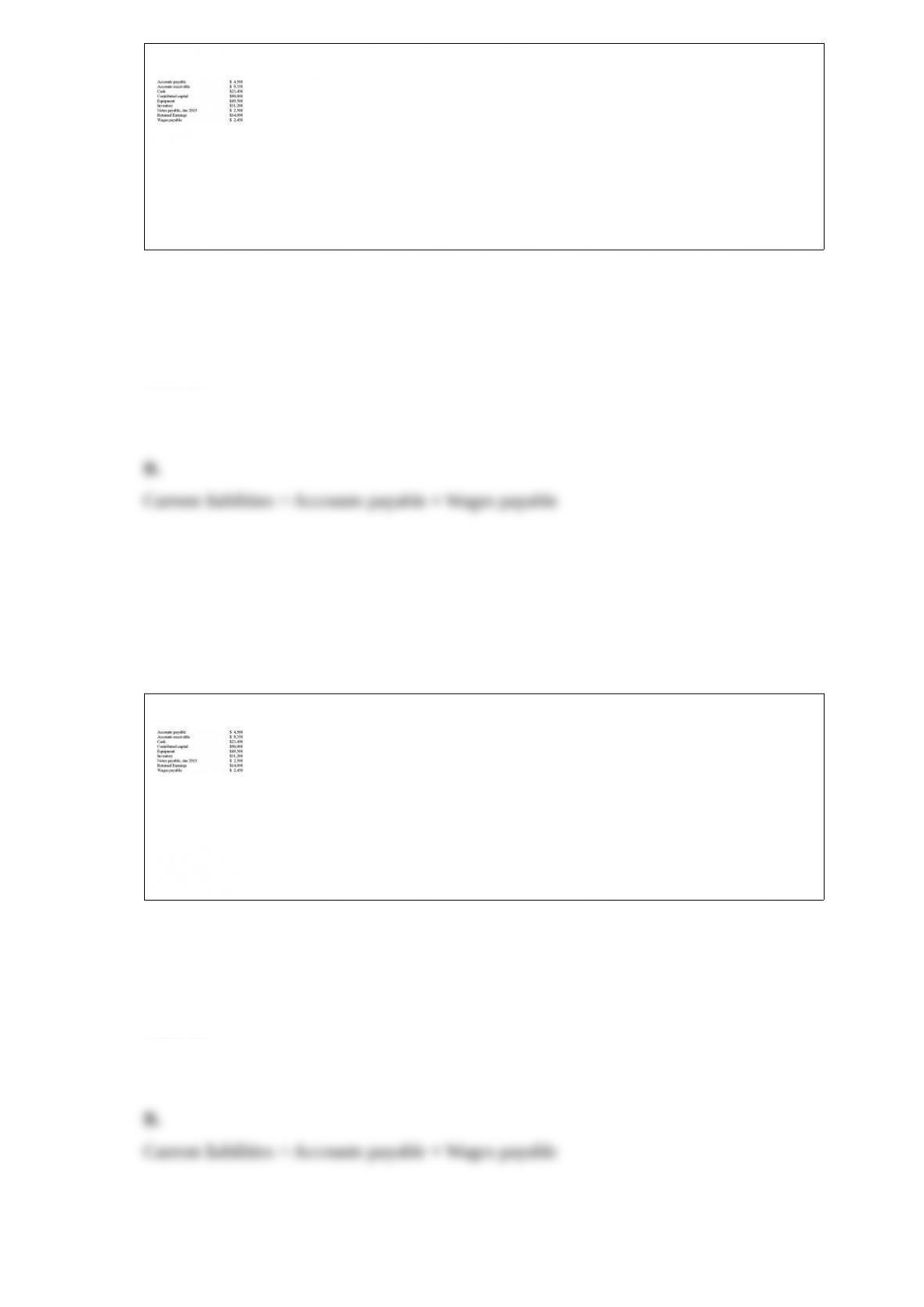
A company reported the following information at December 31, 2013:
What is the amount of current liabilities on the classified balance sheet?
A. $9,450
B. $6,950
C. $113,540
D. $4,500
Answer:
A company reported the following information at December 31, 2013:
What is the amount of current liabilities on the classified balance sheet?
A. $9,450
B. $6,950
C. $113,540
D. $4,500
Answer:
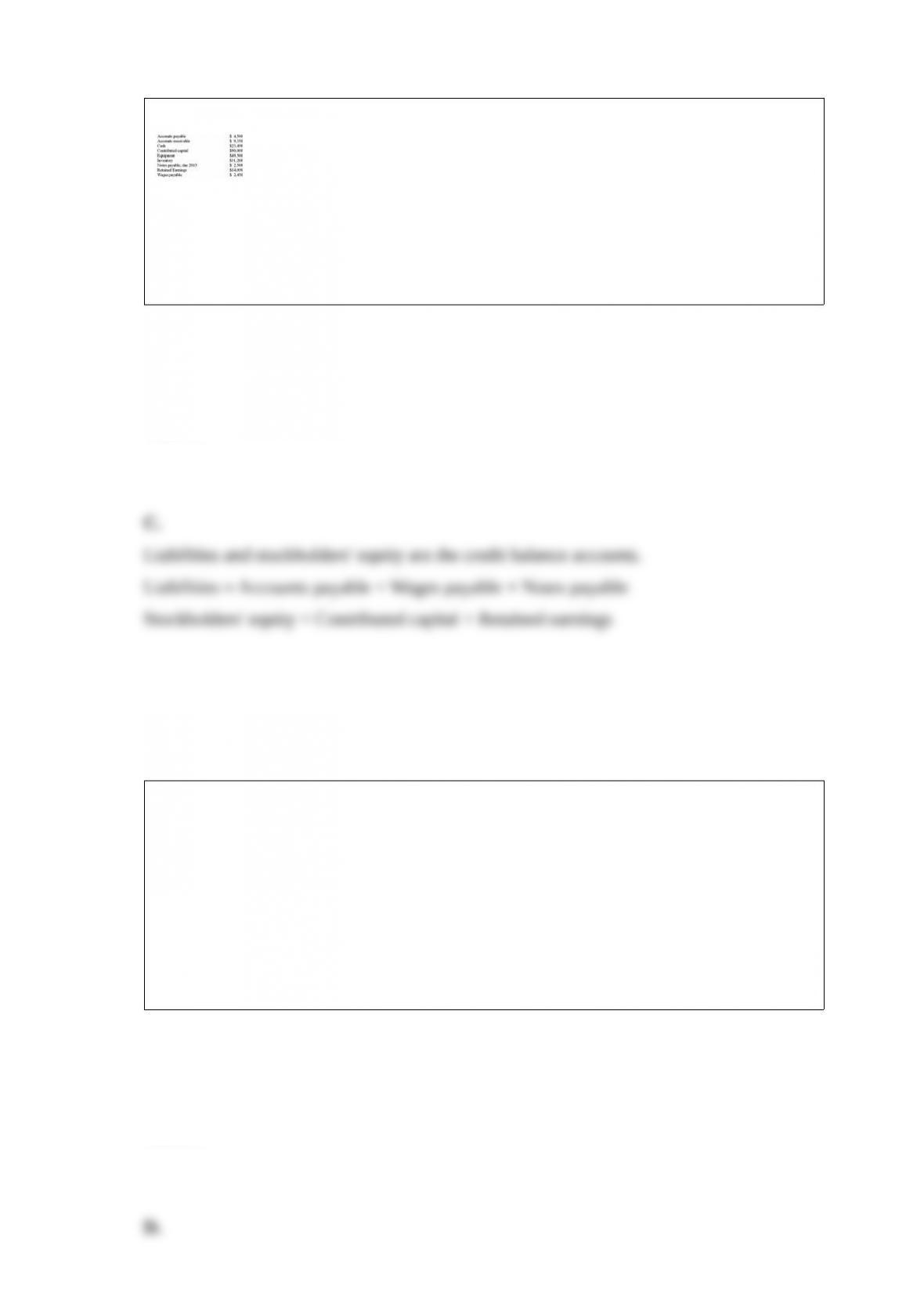
A company reported the following information at December 31, 2013:
What is the total of the CREDIT balance accounts?
A. $111,040
B. $104,090
C. $113,540
D. $108,590
Answer:
Which of the following is a ANSWER: TRUE statement?
A. Conservatism requires accountants to intentionally understate assets.
B. Separate entity assumption in accounting requires that the financial activities of the
owners of a company be reported on the company’s balance sheet.
C. The cost principle states that recording activities at cost will result in the balance
sheet representing the ANSWER: TRUE value of the company.
D. A transaction is recorded in accounting if it has a measurable financial effect on the
assets, liabilities or stockholders’ equity of a business.
Answer:
Which of the following is a ANSWER: TRUE statement?
A. Conservatism requires accountants to intentionally understate assets.
B. Separate entity assumption in accounting requires that the financial activities of the
owners of a company be reported on the company’s balance sheet.
C. The cost principle states that recording activities at cost will result in the balance
sheet representing the ANSWER: TRUE value of the company.
D. A transaction is recorded in accounting if it has a measurable financial effect on the
assets, liabilities or stockholders’ equity of a business.
Answer:
Which account would be increased by a debit?
A. Retained earnings
B. Accounts receivable
C. Contributed capital
D. Notes payable
Answer:
Which account would be decreased by a credit?
A. Cash
B. Accounts payable
C. Contributed capital
D. Retained earnings
Answer:
The classified balance sheet for a company reported current assets of $1,623,850, total
liabilities of $799,540, contributed capital of $1,000,000 and retained earnings of
$130,260. The current ratio was 2.5.
What is the total amount of noncurrent assets?
A. $493,590
B. $824,310
C. $649,540
D. $305,950
Answer:
The classified balance sheet for a company reported current assets of $1,623,850, total
liabilities of $799,540, contributed capital of $1,000,000 and retained earnings of
$130,260. The current ratio was 2.5.
What is the total amount of current liabilities?
A. $649,540
B. $4,059,625
C. $771,920
D. $799,540
Answer:
Which of the following is a FALSE statement?
A. Total Assets are $1,929,800.
B. Total Stockholders’ equity is $1,130,260.
C. Long-term liabilities are $130,260.
D. The amount of current assets is 2.5 times the amount of current liabilities.
Answer:
Which of the following is a FALSE statement?
A. Total Assets are $1,929,800.
B. Total Stockholders’ equity is $1,130,260.
C. Long-term liabilities are $130,260.
D. The amount of current assets is 2.5 times the amount of current liabilities.
Answer:
A company purchased land costing $27,000 by making a 25 percent cash down
payment and signing a 90-day note for the balance. The entry to record this transaction
would
A. Increase total assets.
B. Decrease total liabilities.
C. Decrease contributed capital.
D. Increase retained earnings.
Answer:
Each account is assigned a number and this listing of all accounts is called a
A. trial balance.
B. journal.
C. ledger.
D. chart of accounts.
Answer:
Which of the following would decrease stockholders’ equity?
A. Stock issued for cash.
B. Repayment of notes payable.
C. Land purchased for cash.
D. Dividends paid to owners.
Answer:
A Company has $15,000 of retained earnings, $26,000 of assets, and $6,000 of
liabilities. How much is contributed capital?
A. $17,000
B. $15,000
C. $5,000
D. $35,000
Answer:
Stockholders’ equity in a corporation consists of:
A. long-term assets.
B. current assets plus long-term assets.
C. assets plus liabilities.
D. contributed capital plus retained earnings.
Answer:

Typical cash flows from investing activities include:
A. payments to purchase property and equipment.
B. repayment of loans.
C. proceeds from issuing notes payable.
D. receipts from cash sales.
Answer:
On January 1, Kirk Corporation had total assets of $850,000. During the month the
following activities occurred:
– Kirk Corporation acquired equipment costing $6,000, promising to pay cash for it in
60 days.
– Kirk Corporation purchased $3,500 of supplies for cash.
– Kirk Corporation sold land which it had acquired 2 years ago. The land had cost
$15,000 and it was sold for $15,000 cash.
– Kirk Corporation signed an agreement to rent additional storage space next month at a
charge of $1,000 per month.
– The financial vice president of Kirk Corporation purchased a new vehicle for cash of
$35,000.
What is the amount of total assets of Kirk Corporation at the end of the month?
A. $859,500
B. $856,000
C. $821,000
D. $806,000
Answer:
Which of the following statements is ANSWER: TRUE?
A. Asset and liability accounts have a normal debit balance.
B. To debit an account means to increase it.
C. Contributed capital and retained earnings have a normal credit balance.
D. To credit an account means to decrease it.
Answer:
Which of the following statements is ANSWER: TRUE?
A. Asset and liability accounts have a normal debit balance.
B. To debit an account means to increase it.
C. Contributed capital and retained earnings have a normal credit balance.
D. To credit an account means to decrease it.
Answer:
Which of the following statements is ANSWER: TRUE?
A. Asset and liability accounts have a normal debit balance.
B. To debit an account means to increase it.
C. Contributed capital and retained earnings have a normal credit balance.
D. To credit an account means to decrease it.
Answer:
Which of the following would cause a trial balance to be out of balance?
A. A transaction was recorded twice.
B. A transaction was not recorded.
C. A transaction was posted to the wrong accounts.
D. Only the credit of a transaction was recorded.
Answer:
When accounts receivable are collected:
A. Stockholders’ equity increases.
B. Total assets increase.
C. Total assets decrease.
D. The amount of total assets is unchanged.
Answer:
The requirement that transactions be recorded at their exchange price at the transaction
date is called the
A. conservatism exception.
B. separate entity assumption.
C. cost principle.
D. monetary unit assumption.
Answer:
The following changes occurred in the year 2013: Assets decreased by $3,500 and
liabilities increased by $2,800.
What is the amount of the change in stockholders’ equity in the year 2013?
A. $5,750 increase.
B. $700 decrease.
C. $6,300 decrease.
D. $550 increase.
Answer:
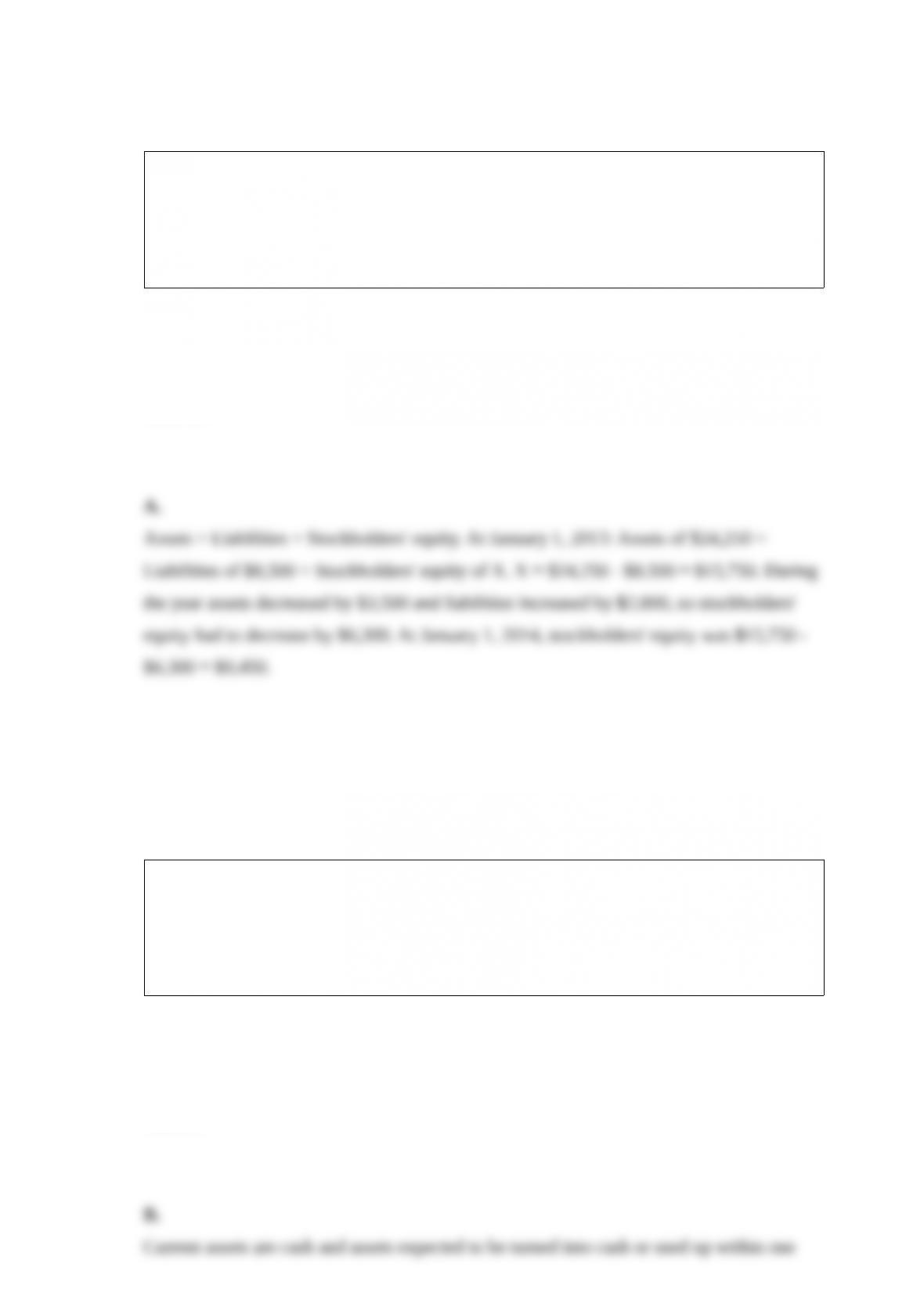
What is the amount of stockholders’ equity at January 1, 2014?
A. $9,450
B. $15,750
C. $15,050
D. $14,450
Answer:
Which of the following would not be classified as a current asset?
A. Cash
B. Accounts payable
C. Supplies
D. Inventory
Answer:
Which of the following would be classified as a long-term liability on the balance sheet
at December 31, 2013?
A. Accounts payable, 30-day account.
B. Notes payable, due November 2014.
C. Notes receivable, matures April 2015.
D. Mortgage payable, due January 2016.
Answer:
Which of the following would be classified as a long-term liability on the balance sheet
at December 31, 2013?
A. Accounts payable, 30-day account.
B. Notes payable, due November 2014.
C. Notes receivable, matures April 2015.
D. Mortgage payable, due January 2016.
Answer:

Selected accounts for Moonbills Corporation appear below.
Instructions: For each account, indicate the following:
(A) In the first column at the right, indicate the nature of each account, using the
following abbreviations:
Asset A, Liability L, Stockholders’ Equity SE.
(B) In the second column, indicate the normal balance by inserting dr (for debit) or cr
(for credit).
Answer:
Prepare a classified balance sheet for Purrfect Pets, Inc., using the following data for
June 30, 2013.

Answer:
Stockholders contribute $10,000 cash to a company. The company uses $5,000 to buy
new equipment and $3,000 to pay off accounts payable. Show the effect of these
transactions on the basic accounting equation. Then, show the journal entries that would
be used to record the transactions.
Answer:
The balance sheet for Purrfect Pets, Inc., as of June 30, 2013, is shown below.
During July 2013, stockholders contribute $300,000 cash for additional ownership
shares. The company pays $550,000 in cash and borrows $150,000 from a bank to buy
some new stores.
a) Show the effects of these transactions on the basic accounting equation.
b) Journalize these transactions.
c) Show the new balance sheet as of July 31, 2013, after these transactions have
occurred, assuming there was no other July activity.

Answer:
During the month, a company enters into the following transactions:
– Buys $4,000 of supplies on account.
– Pays $5,000 cash for new equipment.
– Pays off $3,000 of accounts payable.
– Pays off $1,500 of notes payable.
a) Analyze the effect of these transactions on the basic accounting equation.
b) Journalize these transactions.
Answer:

CheapBooks Incorporated (CI) had the following business activities, for which you are
to prepare journal entries. Reference each journal entry to the transaction number,
shown below.
1) Stockholders invest $25,000 cash in the corporation.
2) CI purchased $400 of office supplies on credit.
3) CI purchased office equipment for $7,000, paying $2,500 in cash and signing a
30-day note payable for the remainder.
4) CI paid $200 cash on account for office supplies purchased in transaction 2.
5) CI purchased two acres of land for $10,000, signing a 2-year note payable.
6) CI sold one acre of land at one-half of the total cost of the two acres, receiving the
full amount or $5,000 in cash.
7) CI made a payment of $5,000 on its 2-year note.
Answer:
If a purchase of supplies for $400 was mistakenly recorded as a credit to Supplies, but
the cash paid for the supplies was correctly recorded, what would be the effect on the
accounting equation?
Answer:
On January 1, 2013, NWK, Inc.’s assets were $300,000 and its stockholders’ equity was
$140,000. During the year, assets increased $15,000 and liabilities decreased $10,000.
What was the stockholders’ equity on December 31, 2010?
Answer:
On March 3, 2013, your company pays $4,000 to acquire supplies. Should this be a
recognized accounting transaction? If so, what accounts are affected and by how much
each?
Answer:
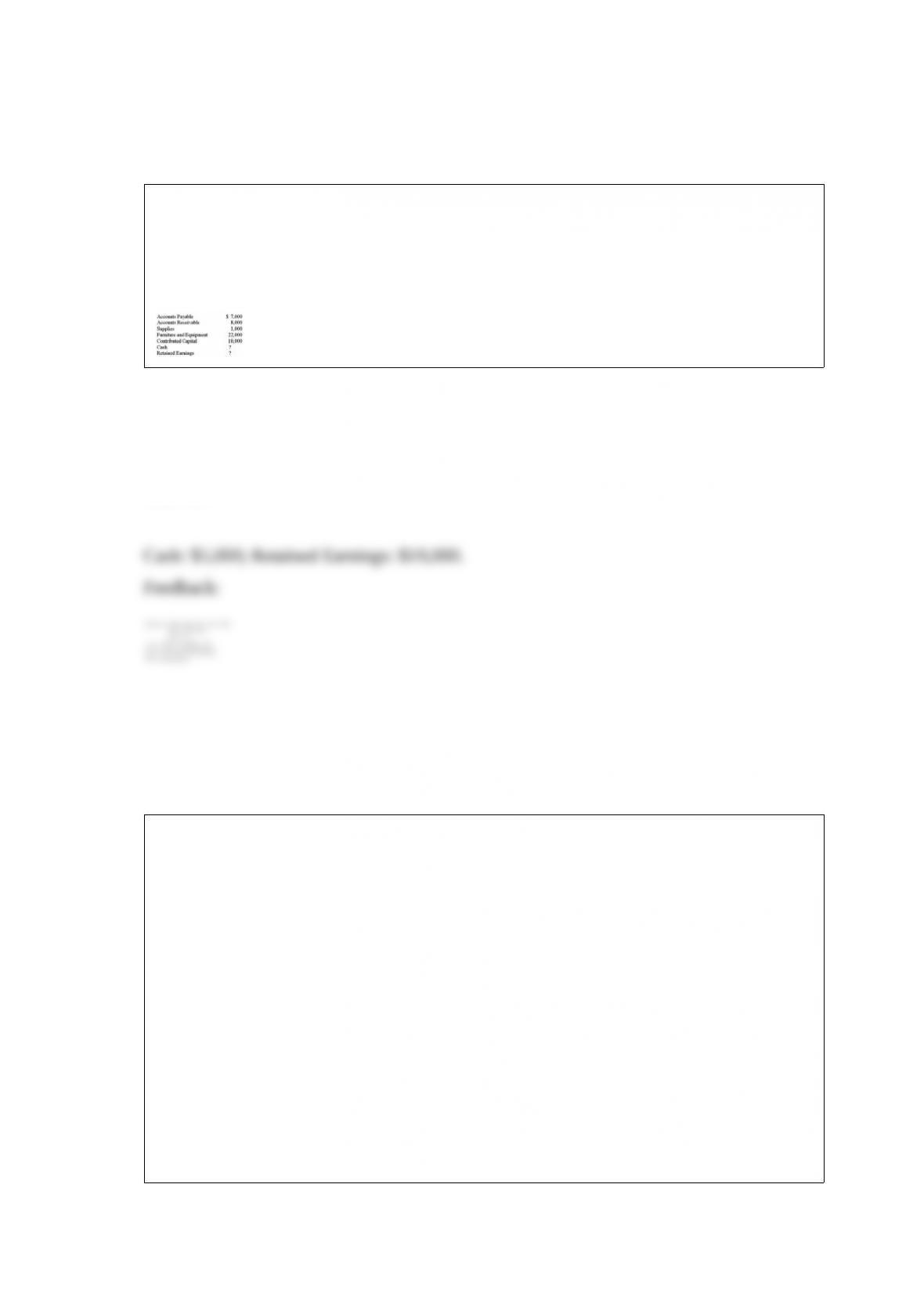
Use the following information as of December 31, 2013, to calculate the amounts of
cash and retained earnings. The company’s total assets are $36,000. This company
doesn’t have any other accounts.
Answer:
For each of the following, indicate how the line item would be categorized on a
classified balance sheet.
CA (current asset)
LTA (long-term asset)
CL (current liability)
LTL (long-term liability)
SE (stockholders’ equity)
____ 1/ Property and Equipment
____ 2/ Contributed Capital
____ 3/ Supplies
____ 4/ Retained Earnings
____ 5/ Accounts Receivable
____ 6/ Accounts Payable

Answer:
Match the term and the explanation. There are more explanations than terms.
_____ 1/dr
_____ 2/cr
_____ 3/Classified balance sheet
_____ 4/Contributed capital
_____ 5/Accounting equation
_____ 6/Transaction
_____ 7/Accounts payable
_____ 8/Journal entry
A. The account credited when cash is received in exchange for stock issued.
B. Another name for stockholders’ equity or shareholders’ equity.
C. An exchange or event that has a direct impact on a company’s balance sheet.
D. A balance sheet that has not yet been publicly released.
E. When a company becomes included in the Fortune 500.
F. A method of recording a transaction in debit/credit format.
G. A transaction that is triggered automatically merely by the passage of time.
H. The abbreviation for an item posted on the left side of a T-account.
I. The expression that assets must equal liabilities plus stockholders’ equity.
J. The value of a company’s public relations campaign.
K. Amounts owed to suppliers for goods or services bought on credit.
L. An event that has no effect on the balance sheet and is not recorded in the financial
statements.
M. Liabilities divided by assets.
N. A balance sheet that has assets and liabilities categorized as current vs. long-term.
O. The abbreviation for an item posted on the right side of a T-account.
Answer:

For each of the following, indicate how the event would most likely be categorized.
EE (external exchange)
IE (internal event)
NT (no transaction)
____ 1/A company sells $2 million in goods for immediate payment.
____ 2/The company uses up office supplies.
____ 3/The stock market rises 10% and the value of a company’s stock increases.
____ 4/A company pays cash to an inventor for the legal rights to produce a new
product.
____ 5/Management promises to pay workers an overtime bonus as required by their
union contract.
____ 6/A company uses up supplies to manufacture a product.
____ 7/A company receives $1 million in orders but no down payments.
Answer:
Listed below are components of several transactions. In the blank to the left indicate
whether a debit (dr) or credit (cr) would be required to record the component of the
transaction.
_____1/ Increase in Cash.
_____2/ Increase in Accounts Payable.
_____ 3/ Decrease in Notes Payable.
_____4/ Increase in Inventory.
_____ 5/Increase in Contributed Capital.
_____ 6/ Decrease in Property and Equipment.
Answer:

Match the term and the explanation. There are more explanations than terms.
_____ 1/Duality of effects
_____ 2/Journal entry
_____ 3/Posting
_____ 4/Conservatism
_____ 5/Debit
_____ 6/Chart of accounts
_____ 7/T-account
_____ 8/Credit
_____ 9/Cost principle
A. A journal entry that lowers the balance of the account.
B. When journal entries are copied to the appropriate T-account.
C. The concept that a company must keep separate accounts by time period.
D. A simplified version of an account in the General Ledger.
E. The mechanism used to record each transaction in the General Journal.
F. When a company’s balance sheet has been verified by an outside auditor.
G. The concept that any transaction must have at least two effects on the accounting
equation.
H. When a dollar value is assigned to an item recorded in the accounting system.
I. Compares balance sheet items from two different time periods.
J. An amount that is posted on the left side of a T-account or ledger.
K. The principle that a company should use the least optimistic measure, when
uncertainty exists.
L. Assets are initially recorded at the amount paid to acquire them.
M. A journal entry that raises the balance of the account.
N. A balance sheet where assets appear on the top, liabilities in the middle and
stockholders’ equity appears on the bottom.
O. An amount that is posted on the right side of a T-account.
P. A summary of account names and numbers.
Answer:

Match the term and the explanation. There are more explanations than terms.
_____ 1/Duality of effects
_____ 2/Journal entry
_____ 3/Posting
_____ 4/Conservatism
_____ 5/Debit
_____ 6/Chart of accounts
_____ 7/T-account
_____ 8/Credit
_____ 9/Cost principle
A. A journal entry that lowers the balance of the account.
B. When journal entries are copied to the appropriate T-account.
C. The concept that a company must keep separate accounts by time period.
D. A simplified version of an account in the General Ledger.
E. The mechanism used to record each transaction in the General Journal.
F. When a company’s balance sheet has been verified by an outside auditor.
G. The concept that any transaction must have at least two effects on the accounting
equation.
H. When a dollar value is assigned to an item recorded in the accounting system.
I. Compares balance sheet items from two different time periods.
J. An amount that is posted on the left side of a T-account or ledger.
K. The principle that a company should use the least optimistic measure, when
uncertainty exists.
L. Assets are initially recorded at the amount paid to acquire them.
M. A journal entry that raises the balance of the account.
N. A balance sheet where assets appear on the top, liabilities in the middle and
stockholders’ equity appears on the bottom.
O. An amount that is posted on the right side of a T-account.
P. A summary of account names and numbers.
Answer:
On June 30, a company purchased 1 year of insurance coverage which started
immediately, paying cash of $2,400. Choose theTRUE statement.
A. On June 30, cash would be debited for $2,400.
B. On the Income Statement for the year, insurance expense will be $1,200.
C. On the Balance Sheet at the end of the year, prepaid insurance will be $2,400.
D. On the Balance Sheet at the end of the year, prepaid insurance will be a non-current
asset.
Answer:
The allowance method for uncollectible accounts is used for accounts receivable but not
for notes receivable.
Answer:
If a company uses $100 million in cash to pay off debt, its stockholders’ equity will rise
$100 million.
Answer:
Which of the following is notTRUE of the Income Statement of a company that was
formed 10 years ago?
A. Reports a Net Loss for the year if expenses are more than revenues.
B. Reports the financial effects of activities that have occurred since the company’s
inception.
C. Reports the amount of the increase in stockholders’ equity this year as a result of the
company’s operations.
D. Reports Net Income which is not an account in the ledger.
Answer:
A company has net income of $148,000 and a net profit margin ratio of .087.
Which of the following is not aTRUE statement?
A. A net profit margin ratio of .087 means that 8.7 cents of profit or net income is made
for each dollar of sales.
B. The amount of sales revenue for this period is $1,700,000 (rounded to the nearest
hundred thousand).
C. A higher net profit margin ratio this year than last year indicates an improvement in
controlling expenses.
D. If income from operations is less than net income, this means that the company had
no non-operating revenue.
Answer:
Which of the following isTRUE about terms 2/10, n/30?
A. A 2% discount is given if the invoice is paid in 10 days; the full amount is due in 30
days.
B. A 10% discount is given if the invoice is paid in 2 days; the full amount is due in 30
days.
C. The discount period is 30 days.
D. The credit period is 10 days.
Answer:
Which one of the following statements regarding the accrual and cash basis of
accounting isTRUE?
A. Using the accrual basis of accounting, if payment is received before delivery of a
good or service, a revenue is recorded at the time the payment is received.
B. Using the accrual basis of accounting, if payment is received after delivery of a good
or service, an asset is recorded at the time the good or service was delivered.
C. Using the cash basis of accounting, if payment is received before delivery of a good
or service, net income is affected when goods or services are delivered.
D. Using the cash basis, if payment is received after delivery of a good or service,
unearned revenue is recorded.
Answer:
Income tax expense would be found on the income statement of a corporation, but not
on the income statement of a sole proprietorship.
Answer:
If inventory is sold with terms of FOB destination, goods in transit belong to the seller.
Answer:
Which of the following is notTRUE regarding the quick ratio?
A. If a company has more current assets than liquid assets, the current ratio will be
larger than the quick ratio.
B. A high quick ratio suggests a high ability to pay current liabilities.
C. Liquid assets include cash and cash equivalents, short-term investments, and net
accounts receivable.
D. A quick ratio greater than 1 implies a company could not pay all of its current
liabilities.
Answer:
A company incurred $5,000 in wages for employees for the year. $4,500 of these wages
were paid by the end of the year. Choose theTRUE statement.
A. Wages payable on the income statement will be $4,500.
B. Wages expense on the income statement will be $500.
C. Wages expense on the balance sheet will be $5,000.
D. Wages payable on the balance sheet will be $500.
Answer:
Which of the following statements regarding periodic versus perpetual inventory
systems isTRUE?
A. Perpetual inventory systems are inferior for determining optimal times to reorder
merchandise.
B. Periodic inventory systems require a greater investment in technology to implement
them.
C. Perpetual inventory systems may assist in determining inventory lost due to
shrinkage.
D. Periodic inventory systems allow sales personnel to provide more immediate
information regarding availability of inventory.
Answer:
The retained earnings account has a beginning balance of $321,975 and an ending
balance of $356,413. Net income is $40,251. Which of the following statements
isTRUE?
A. $5,813 would be subtracted when determining cash flows from financing activities.
B. $40,251 would be added when determining cash flows from financing activities.
C. $34,438 would be added when determining cash flows from financing activities.
D. $321,975 would be added when determining cash flows from operating activities.
Answer:
The closing process includes a transfer of the Dividends Declared account balance to
the Retained Earnings account.
Answer:
Which of the following statements isTRUE of a multiple-step income statement?
A. It groups all revenues together.
B. It reports a different amount of net income than a single-step income statement.
C. It includes expenses that would not appear on a single-step income statement.
D. Net income is probably not the number that investors and creditors care most about.
Answer:
A company has outstanding 10 million shares of $2 par common stock and 1 million
shares of $4 par preferred stock. The preferred stock has an 8% dividend rate. The
company declares $300,000 in total dividends for the year. Which of the following
isTRUE if the preferred stockholders only have a current dividend preference?
A. Preferred stockholders will receive the entire $300,000, and they must also be paid
$20,000 before the end of the current accounting period. Common stockholders will
receive nothing.
B. Preferred stockholders will receive $24,000 or 8% of the total dividends. Common
stockholders will receive the remaining $276,000.
C. Preferred stockholders will receive the entire $300,000, and they must also be paid
$20,000 sometime in the future before common stockholders will receive anything.
D. Preferred stockholders will receive the entire $300,000, but will receive nothing
more relating to this dividend declaration. Common stockholders will receive nothing.
Answer:
Companies within the same industry do not always use the same depreciation method,
but will use the same expected useful life for the same piece of equipment.
Answer:
Liquidity measures the ability of a company to meet its current financial obligations.
Answer:
The asset turnover ratio is directly affected by operating and financing decisions.
Answer:
External audits are conducted by Certified Public Accountants (CPAs) who are not
independent of the company.
Answer:
The adjusted trial balance is completed to check that debits still equal credits after the
income statement is prepared.
Answer:
Which of the following statements regarding the asset turnover ratio isTRUE?
A. The asset turnover ratio compares the amount of sales revenue for the period to the
book value of assets at the end of the period.
B. An asset turnover ratio must be less than 1.
C. The higher the ratio, the less efficiently the company is using its assets.
D. This ratio is not expressed as a percentage.
Answer:
Tax accounting and financial accounting use the same depreciation calculations and
there are no differences in the results between the two accounting systems.
Answer:
Which of the following statements regarding the calculation of cash flows from
operating activities under the direct method isTRUE?
A. When the direct method is used, each revenue and expense account on the income
statement is individually examined to calculate the cash flows from operating activities.
B. Noncash revenues and expenses must be included in cash flows from operating
activities when preparing a statement of cash flows using the direct method.
C. Depreciation is reported as a cash inflow in the cash flows from operating activities
when the direct method is used.
D. A loss on the sale of a long-term asset is subtracted in the cash flows from operating
activities when the direct method is used.
Answer:
A company has an asset account, Prepaid Insurance, with a balance of $3,750 at the
beginning of the month. The company used $980 of insurance during the month. Which
of the following statements isTRUE?
A. The company should credit Insurance Expense for $980 and debit Prepaid Insurance
for $980.
B. Retained earnings should decrease and stockholders’ equity should increase because
of this event.
C. The company should debit Insurance Expense for $980 and credit Prepaid Insurance
for $980.
D. Retained earnings and stockholders’ equity should increase because of this event.
Answer:
Issuing stock to obtain financing is called equity financing.
Answer:
Which of the following statements regarding repurchased stock isTRUE?
A. It is generally less costly for a company to give employees repurchased shares than
to issue new shares.
B. When a company records a stock repurchase, it is tracking a stockholder’s sale of
stock to another investor.
C. Treasury stock is reported on the balance sheet as an asset.
D. Treasury stock is repurchased stock that has been authorized but is not issued.
Answer:
You are pleasantly surprised to discover that a popular actress appears on The Tonight
Show wearing your company’s jeans. Later, your company’s sales increase by $500,000
as a result. When the actress appeared on TV, you would have recorded an asset because
the TV appearance was expected to bring future economic benefits to your company.
Answer:
Which of the following statements is notTRUE of a corporation?
A. A corporation is taxed as a separate legal entity.
B. A corporation has easy transferability of ownership.
C. A corporation may have the ability to raise large amounts of capital.
D. A corporation’s owners have unlimited liability.
Answer:
Your company issued bonds at a premium. Which of the following statements is
notTRUE?
A. The contra account, premium on bonds payable, is amortized each year by shifting
part of its balance to interest expense.
B. On the date of issuance, the stated interest rate was greater than the market interest
rate.
C. As the current date approaches the maturity date, the carrying value of the bond
approaches the face value of the bond.
D. The account used to record the premium has a normal debit balance.
Answer:
Which of the following isTRUE?
A. Credits increase both revenues and expenses.
B. Credits increase expenses and decrease revenues.
C. Credits increase revenues and decrease expenses.
D. Credits decrease both revenues and expenses.
Answer:
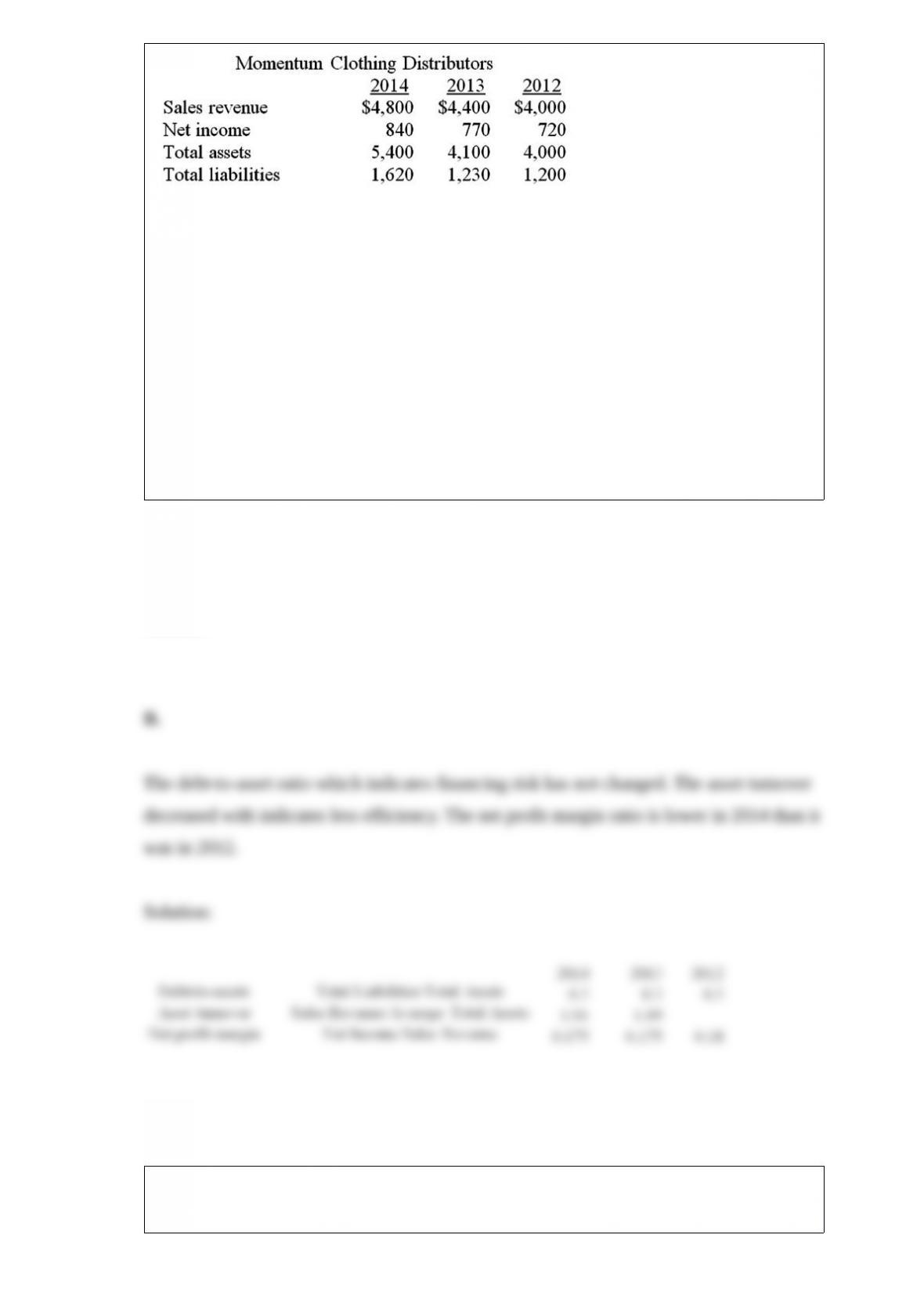
Refer to the summary financial information for Momentum Clothing Distributors.
Which of the following statements isTRUE?
A. The company’s level of financing risk was greater in 2014 than it was in 2013.
B. In comparison to 2013, the company became less efficient in 2014 in generating
revenues from its investment in assets.
C. Despite the increase in sales in 2014, the company controlled its expenses just as
well as it had in 2012.
D. The company’s level of financing risk was less in 2013 than it was in 2012.
Answer:
Interest and dividends from investments held by a company are reported as cash inflows
from investing activities on the statement of cash flows.
Answer:
On April 30, 2014, a three-year insurance policy was purchased with a cash payment of
$18,000. Coverage began immediately.
If Salaries payable were recorded on December 31, and these salaries were paid on the
following January 5, the entry on January 5 would be:
A. Debit to Salaries Expense and Credit to Cash.
B. Debit to Salaries payable and Credit to Cash.
C. Debit to Cash and Credit to Salaries Payable.
D. Debit to Cash and Credit to Salaries Expense.
Answer:
The intangible asset most frequently reported by U.S. businesses is:
A. goodwill.
B. trademarks.
C. patents.
D. licensing rights.
Answer:
Carrying insufficient quantities of inventory on hand:
A. would not affect the company’s profitability.
B. may result in lost sales.
C. has little effect on customer satisfaction.
D. will increase the costs of carrying inventory.
Answer:
A contingent liability:
A. is always a specific amount.
B. is an obligation arising from the purchase of goods or services on credit.
C. is an obligation not requiring a future payment.
D. is a potential obligation that depends on a future event.
Answer:
External audits are performed by:
A. Certified Management Accountants (CMAs).
B. Certified Financial Analysts (CFAs).
C. Certified Public Accountants (CPAs).
D. Certified Internal Auditors (CIAs).
Answer:
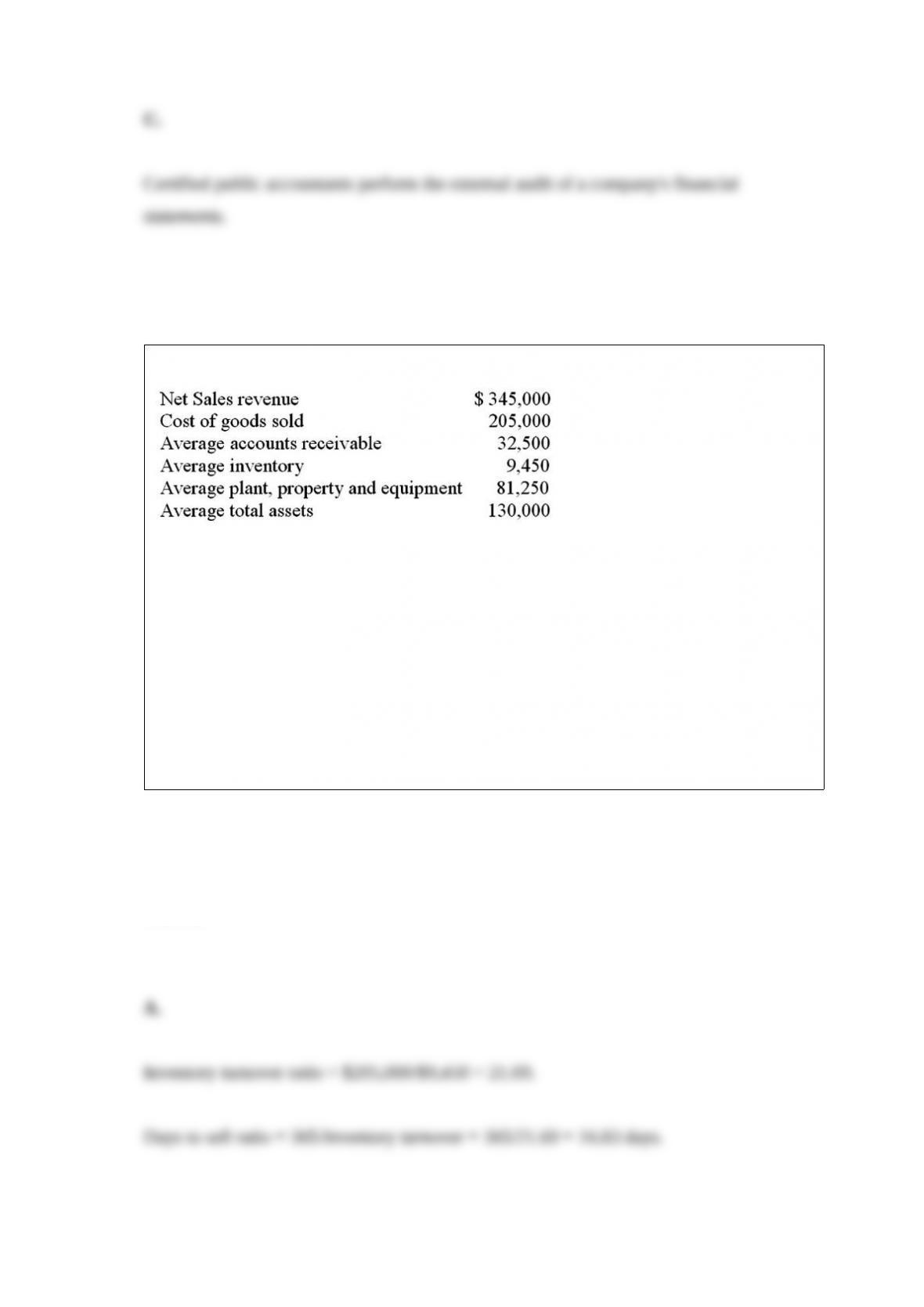
The following information is available for a company for the current year:
Which of the following is closest to the company’s days to sell ratio for the current
year?
A. 16.83
B. 79.18
C. 26.53
D. 34.37
Answer:
Which of the following is an activity in the operations of a manufacturer, but not in the
operations of a merchandising or service company?
A. Selling the good to consumers.
B. Receiving cash.
C. Selling the good to other firms.
D. Buying raw materials.
Answer:
The amount of retained earnings at the end of the year is
A. $15,000.
B. $11,000.
C. $12,000.
D. $1,000.
Answer:
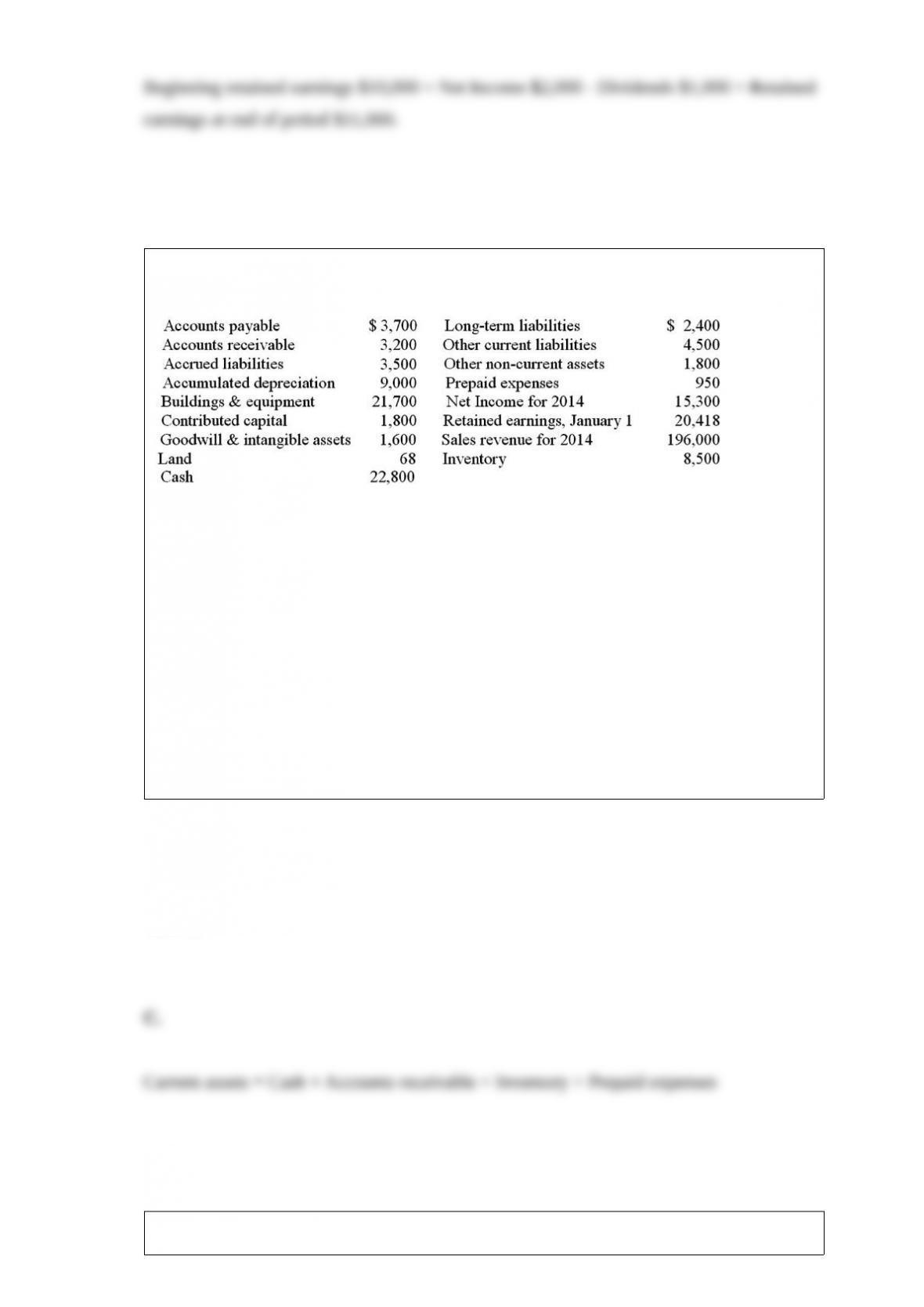
A retail clothing company began operations in 2014 with assets of $42,000. The
following additional data have been taken from the records as of December 31, 2014:
All accounts have normal balances.
What is the amount of current assets to be reported on the balance sheet at the end of
2014?
A. $26,950.
B. $34,500.
C. $35,450.
D. $51,618.
Answer:
An example of an accrued expense is
A. Services performed, but not yet billed.
B. Accumulated interest on a note payable.
C. Prepaid insurance.
D. Depreciation.
Answer:
When interest is calculated for periods shorter than a year, the formula to calculate
interest is:
A. I = P x R x T, where I = interest calculated, P = principal, R = annual interest rate,
and T = number of months.
B. I = P x R x T, where I = interest calculated, P = principal, R = annual interest rate,
and T = (number of months ÷ 12)
C. I = P x R x T, where I = interest calculated, P = principal, R = monthly interest rate,
and T = (number of months ÷ 12).
D. I = (MV – P)/T, where I = interest calculated, MV = maturity value, P = principal and
T = number of months.
Answer:
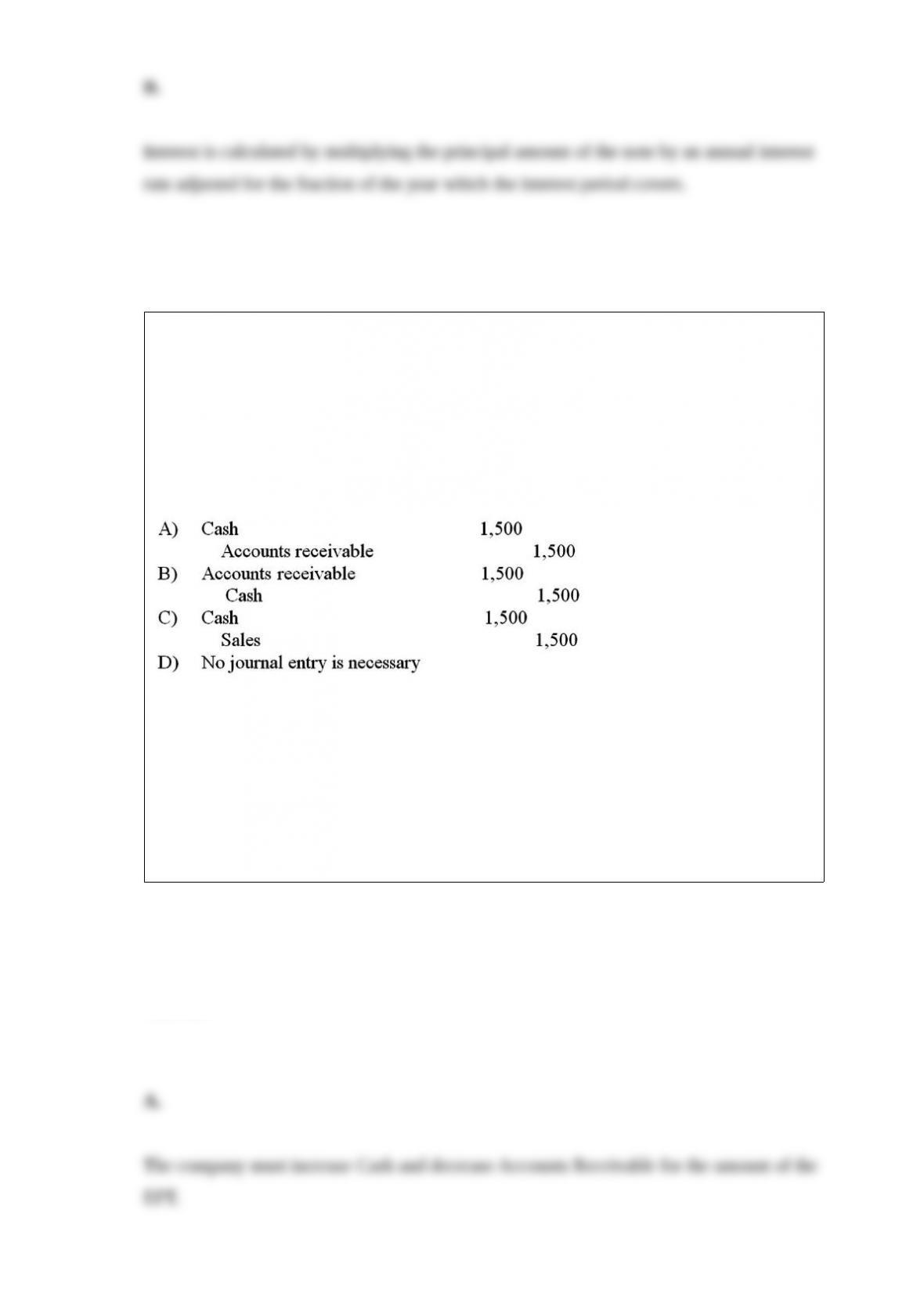
Flynn Company’s monthly bank statement showed the ending balance of cash of
$18,500. The bank reconciliation for the period showed an adjustment for a deposit in
transit of $1,500, outstanding checks of $2,000, a NSF check of $700, bank service
charges of $30 and the EFT from a customer in payment of the customer’s account of
$1,500.
Use the information above to answer the following question. What journal entry should
be recorded by Flynn Company for the EFT?
A. Option A
B. Option B
C. Option C
D. Option D
Answer:
Which of the following actions would be considered unethical?
A. A company does not distribute any of its profits to stockholders.
B. A company rounds the revenues and expenses that it reports on the income
statement.
C. An unintentional mistake made by a new accountant.
D. The cousin of one of the business owners is hired to perform the annual audit.
Answer:
A company’s comparative balance sheet show total assets for 2015 and 2014 as
$990,000 and $900,000, respectively. What is the percentage change to be reported in
the horizontal analysis?
A. Increase of 10%
B. Increase of 9%
C. Increase of 5%
D. Increase of 4%
Answer:
The following transactions occurred during July:
1. Received $800 cash for services rendered during July.
2. Received $5,000 from issuance of stock to investors.
3. Received $400 from a customer in payment of accounts receivable from the prior
month.
4. Billed customers for services performed in July, $3,500.
5. Borrowed $2,500 from the bank, giving a promissory note in exchange.
6. Received $1,000 from a customer for services to be performed next year.
What is the amount of Revenue for July?
A. $5,300
B. $5,700
C. $4,300
D. $7,200
Answer:

A high accounts receivable turnover ratio indicates:
A. the company’s sales are increasing.
B. a large proportion of the company’s sales are on credit.
C. customers are making payments very quickly.
D. the company is taking longer to sell inventory.
Answer:
In a common size balance sheet, each item on the balance sheet is expressed as a
percentage of:
A. Total assets.
B. Total liabilities.
C. Net income.
D. Total stockholders’ equity.
Answer:
A piece of equipment was acquired on January 1, 2013, at a cost of $22,000, with an
estimated residual value of $2,000 and an estimated useful life of four years. The
company uses the double-declining-balance method. What is its book value at
December 31, 2014?
A. $5,500.
B. $10,000.
C. $11,000.
D. $12,000.
Answer:
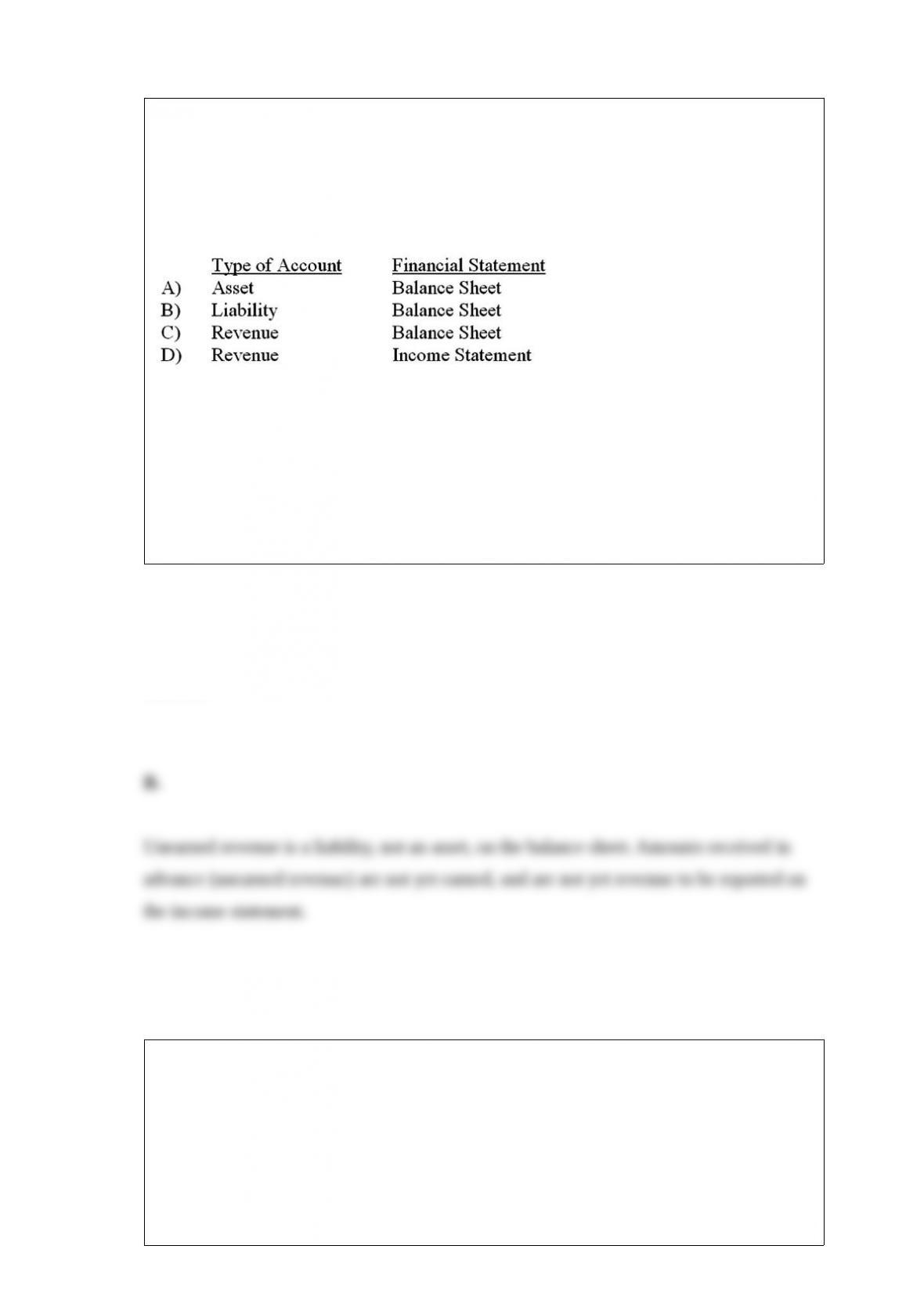
Time Warner is a publishing and communications company, specializing in magazines,
cable television operation, television program development, and other
telecommunication services. Its financial statements show $37,666 in an account called
“Unearned Subscriber Revenue,” which represents amounts that customers have paid in
advance of receiving magazines, cable television, and internet services. What type of
account is this and on what statement is it reported?
A. Option A
B. Option B
C. Option C
D. Option D
Answer:
In 2014, a company paid $4,500 which it owed from its 2013 income tax liability and
$30,000 for its 2014 tax liability. The company still owes $6,000 at year-end. How
much should the company report as cash paid for income taxes on its 2014 statement of
cash flows, using the direct method?
A. $34,500
B. $40,500
C. $30,000
D. $3,500
Answer:
At the end of last year, Cessa Company had total assets in the amount of $4,000,000
and total liabilities in the amount of $3,000,000. The company sold stock to new
stockholders for $1,000,000. As a direct result of this transaction, the:
A. the debt-to-assets ratio will decrease.
B. asset turnover will increase.
C. net profit margin will increase.
D. net profit margin will decrease.
Answer:
Which type of analysis could reveal that a company is relying heavily on debt
financing?
A. Common size statements.
B. Horizontal analysis.
C. The asset turnover ratio.
D. Trend analysis.
Answer:
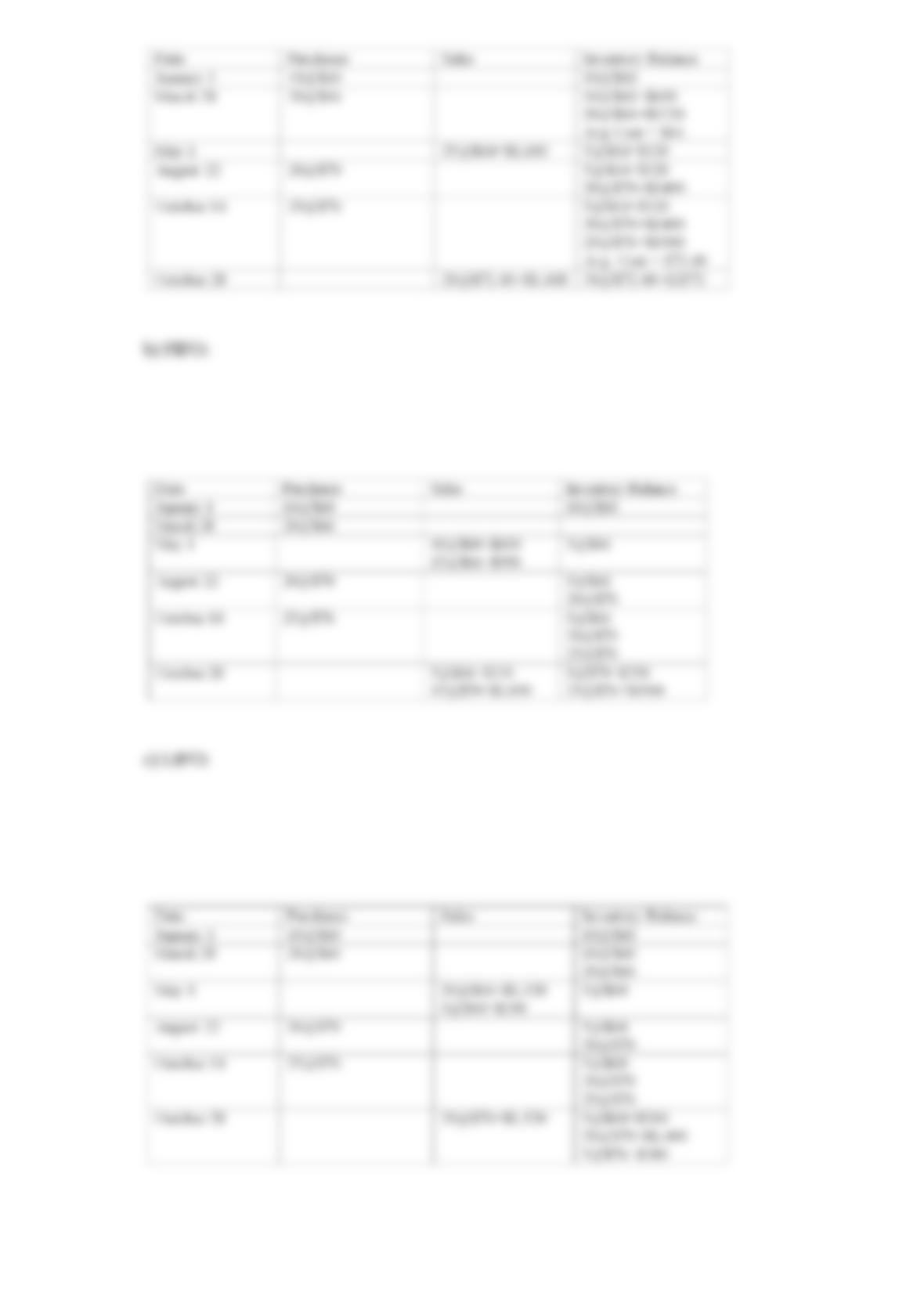
Given the following information for Maynor Company in 2014, calculate the company’s
ending inventory and cost of goods sold using the following inventory costing methods,
assuming the company uses a perpetual inventory system:
a) Weighted Average
b) FIFO
c) LIFO
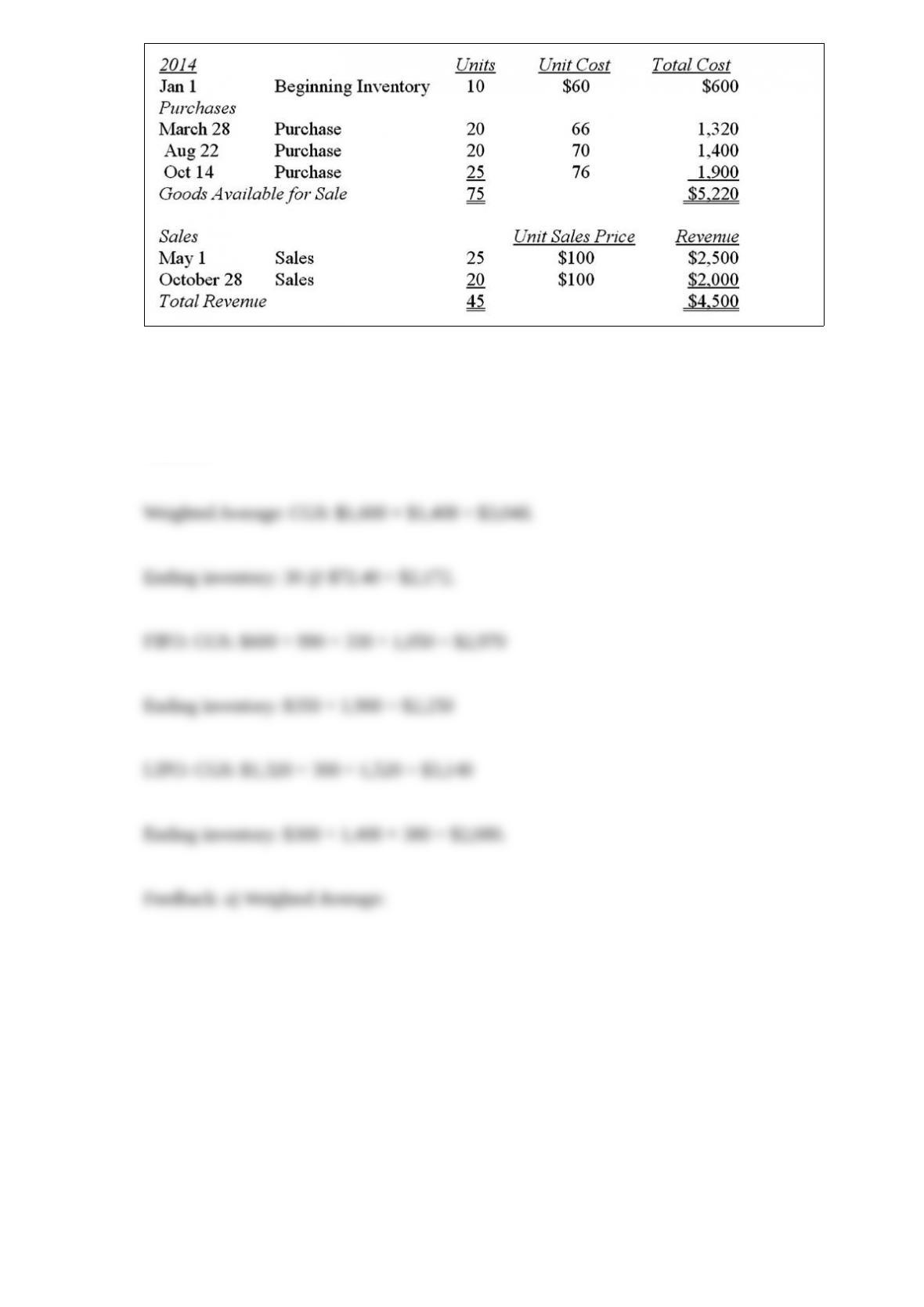
Answer:
On April 30, 2014, a three-year insurance policy was purchased with a cash payment of
$18,000. Coverage began immediately.
What is the amount to be reported on the balance sheet as Prepaid Insurance at
December 31, 2014?
A. $0
B. $14,000
C. $12,000
D. $16,000
Answer:
When a company records depletion on natural resources, it will have which of the
following effects?
A. Expenses increase.
B. Net income decreases.
C. Inventory increases.
D. Cash flow decreases.
Answer:
Park & Company was recently formed with a $5,000 investment in the company by
stockholders. The company then borrowed $2,000 from a local bank, purchased $1,000
of supplies on account, and also purchased $5,000 of equipment by paying $2,000 in
cash and signing a promissory note for the balance. Based on these transactions, the
company’s total assets are:
A. $7,000.
B. $9,000.
C. $10,000.
D. $11,000.
Answer:
Match the term and the explanation. There are more definitions than terms.
_____ 1/ cash basis
_____ 2/ net profit margin

_____ 3/ unadjusted trial balance
_____ 4/ prepaid expense
_____ 5/ unearned revenue
_____ 6/ revenue recognition policy
_____ 7/ Expense Recognition (Matching) principle
A. Reported when a company sells goods or services in the ordinary course of business
for more than it costs to produce.
B. Reporting expenses and revenue according to the time the underlying activities
occur.
C. A list of account balances when the accounts do not yet include all revenues and
expenses.
D. The concept that expenses should be reported at the same time as the related
revenue.
E. The principle that changes in assets must be matched by changes in liabilities and
equity.
F. Also known as net assets, this is the value of assets minus liabilities.
G. An asset account indicating a company has already paid a cost not yet incurred.
H. A company’s policy on when to report revenue in the financial statements.
I. Reporting expenses and revenues according to the time the money is paid or received.
J. A liability account indicating customers have already paid for services not yet
rendered.
K. A ratio that indicates the percent of each revenue dollar that is left over after
covering costs and expenses.
Answer:
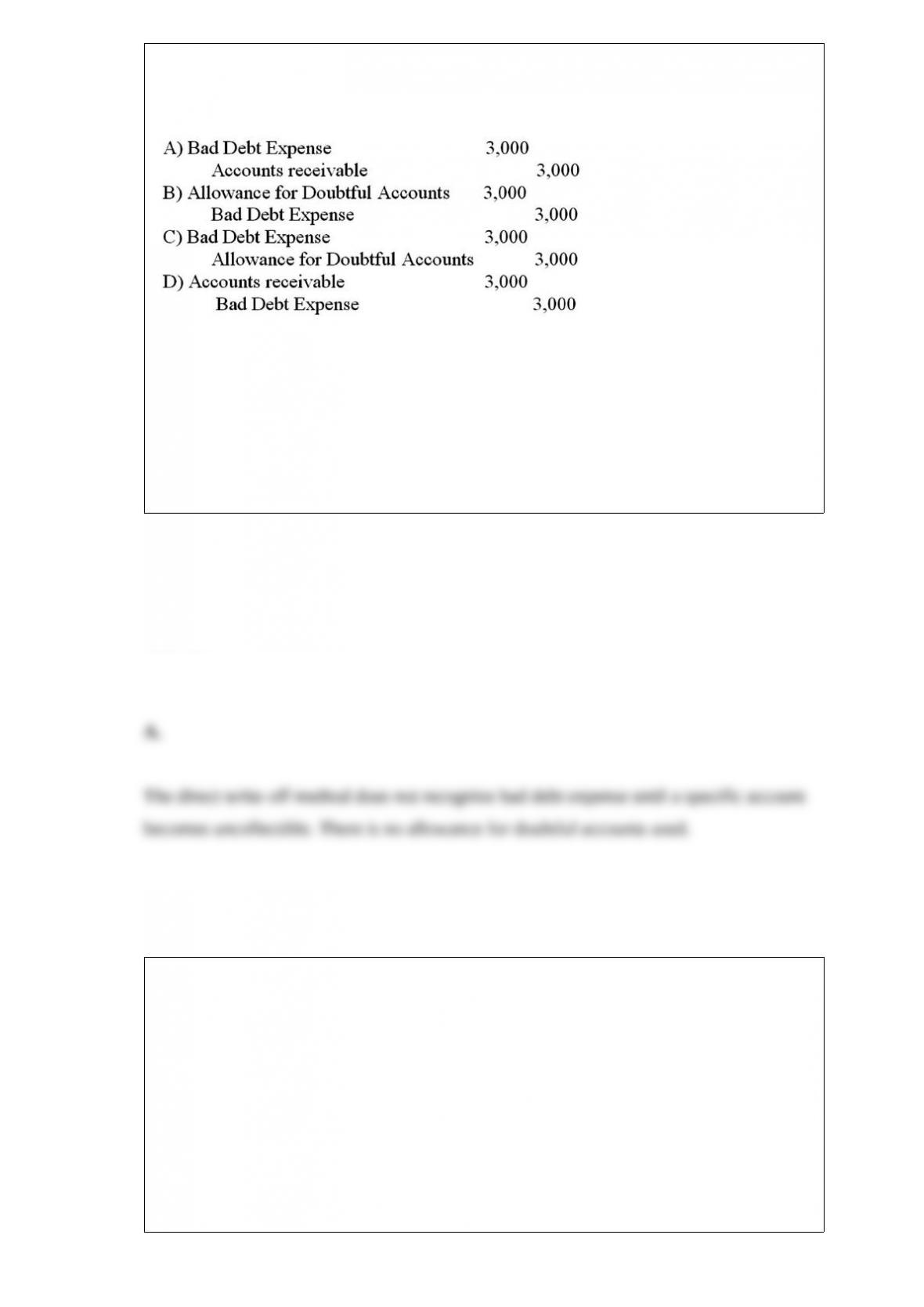
A company uses the direct write-off method and discovers a customer’s account in the
amount of $3,000 will not be paid because the customer has declared bankruptcy. What
is the journal entry that would be made to record this write-off?
A. Option A
B. Option B
C. Option C
D. Option D
Answer:
A company buys equipment for $48,000 and expects to use it for ten years and then sell
it for $6,000. Using the straight-line method, the company should report depreciation
for the equipment of:
A. $4,200 per year.
B. $8,400 per year.
C. $4,800 per year.
D. $9,600 per year.
Answer:
A company started the year with the following: Assets $100,000; Liabilities $30,000;
Contributed Capital $60,000; Retained Earnings $10,000. During the year the company
earned revenue of $5,000, all of which was received in cash, and incurred expenses of
$3,000, all of which was unpaid as of the end of the year. In addition, the company paid
dividends of $1,000 to owners. Assume no other activities occurred during the year.
What was the amount of net income for the year?
A. $2,000
B. $1,000
C. $3,000
D. $5,000
Answer:
Which of the following ratios is used to evaluate a company’s efficiency in using its
assets?
A. Current ratio.
B. Debt to assets ratio.
C. Return on assets ratio.
D. Asset turnover ratio.
Answer:
Which of the following would not be considered a contingent liability?
A. Products sold with a warranty.
B. Pending lawsuits.
C. Frequent flyer miles earned by passengers.
D. Advance ticket sales.
Answer:
Brief Respite, Inc., sold underwear made from a fabric that gave many of its customers
a serious rash. The customers are suing the company in a class action suit and Brief
Respite’s attorneys think it is probable that the case will cost the company $2 million,
although the verdict is not yet in. The company should:
A. not include this information in its annual report.
B. record a liability and a gain for $2 million.
C. only explain the situation in the notes to the financial statements.
D. record a liability and a loss for $2 million.
Answer:
Jim’s Gymnastics Training’s operations for the month of October are summarized as
follows:
– Provided $5,000 of training to students.
– Received $8,000 cash from studentsof which $4,000 is for training provided in
October (as billed above), $1,000 is for training to be provided in November, and
$3,000 is for training provided in September.
– Paid September’s gym rental bill of $1,000. Received October’s bill of $1,500 but did
not pay.
Prepare appropriate journal entries using the accrual basis of accounting.
Answer:
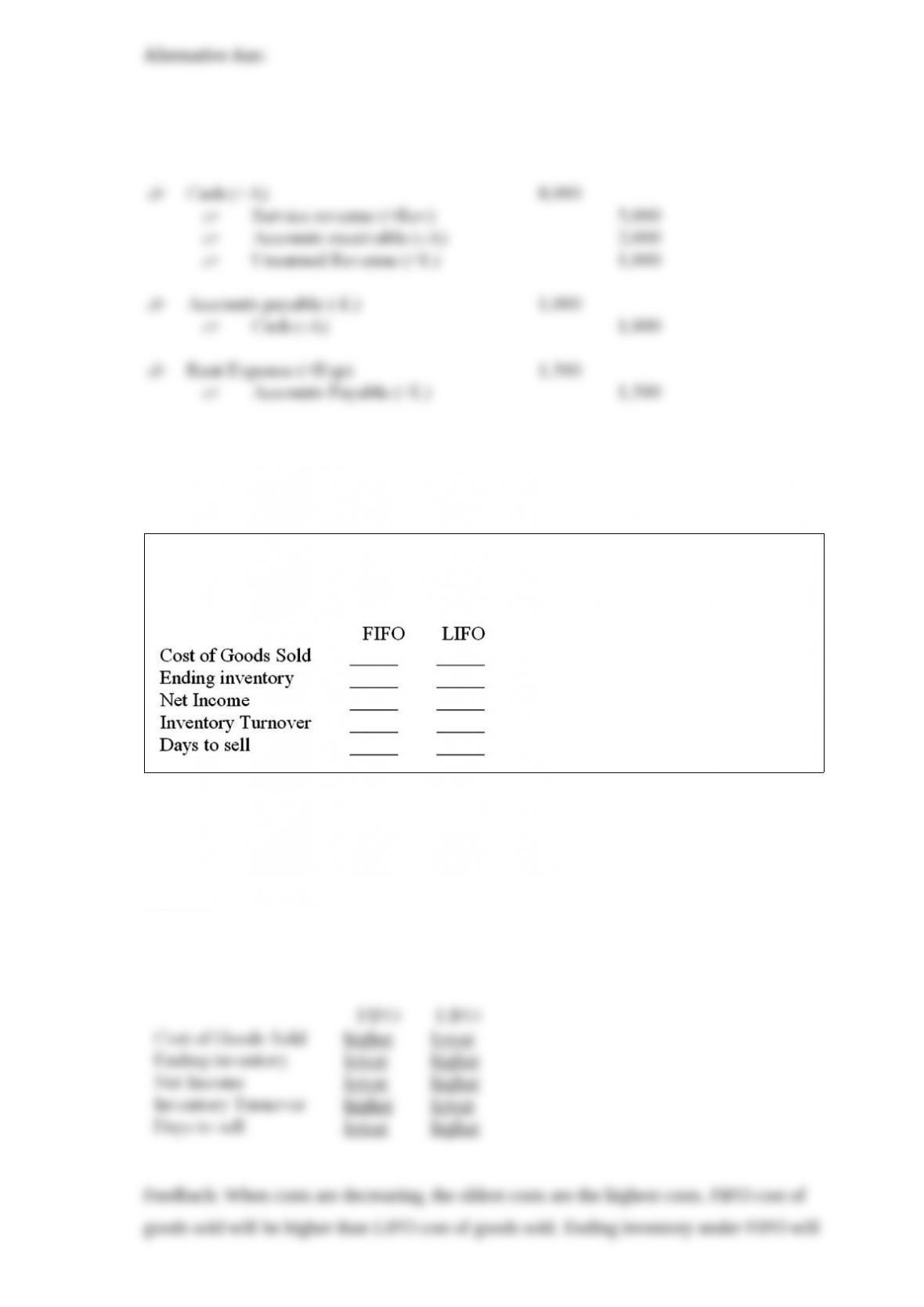
Fill in the blanks below with the words “higher” and “lower” to indicate which
inventory costing method causes the value to be higher and which causes it to be lower.
Assume that the cost of merchandise is decreasing.
Answer:

Answer:
Answer:
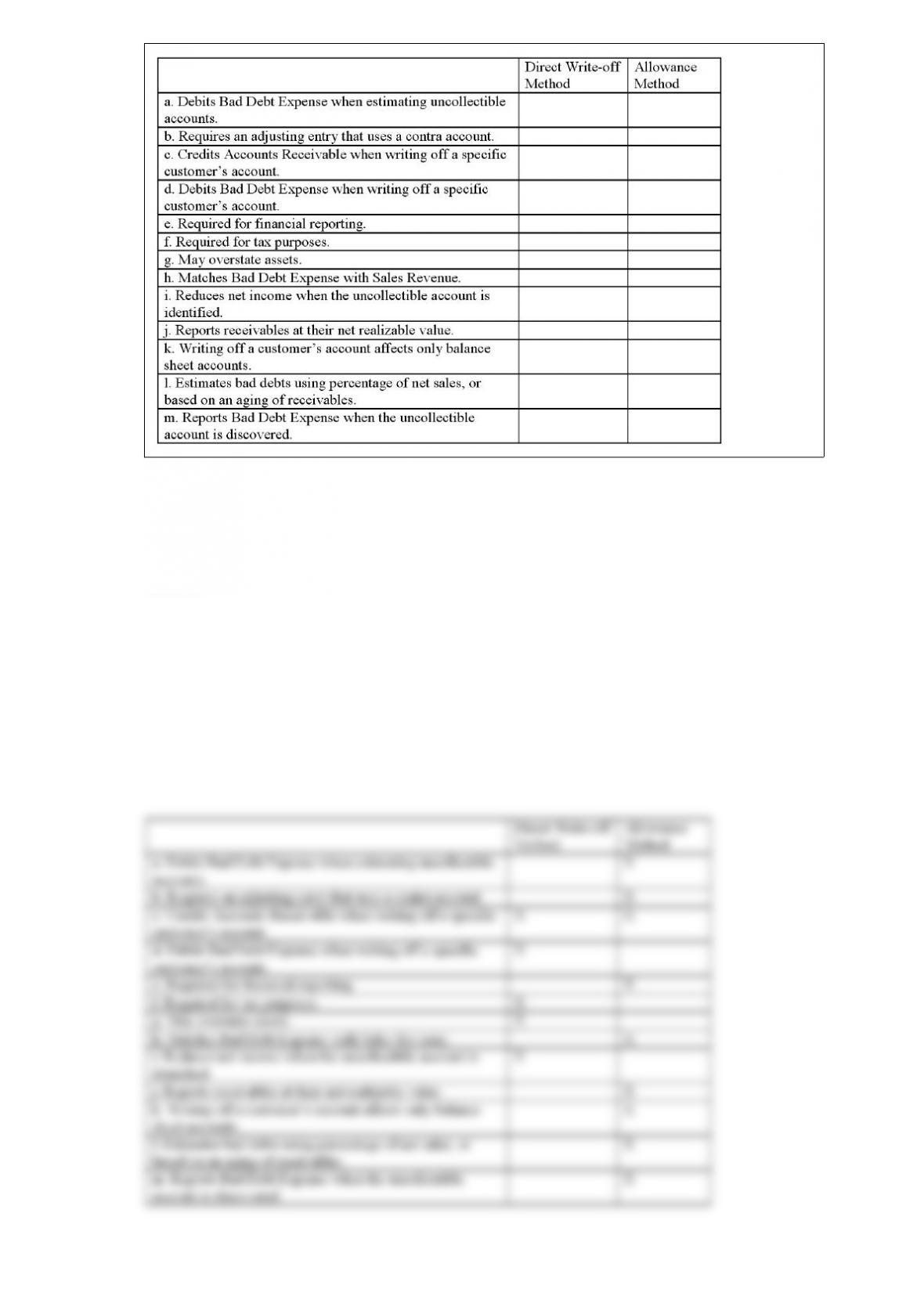
Indicate whether each of the following items is a characteristic of the Direct Write-off
Method or the Allowance Method by placing an “X” in the appropriate column. If an
item is a characteristic of both methods, place an “X” in both columns.
Answer:
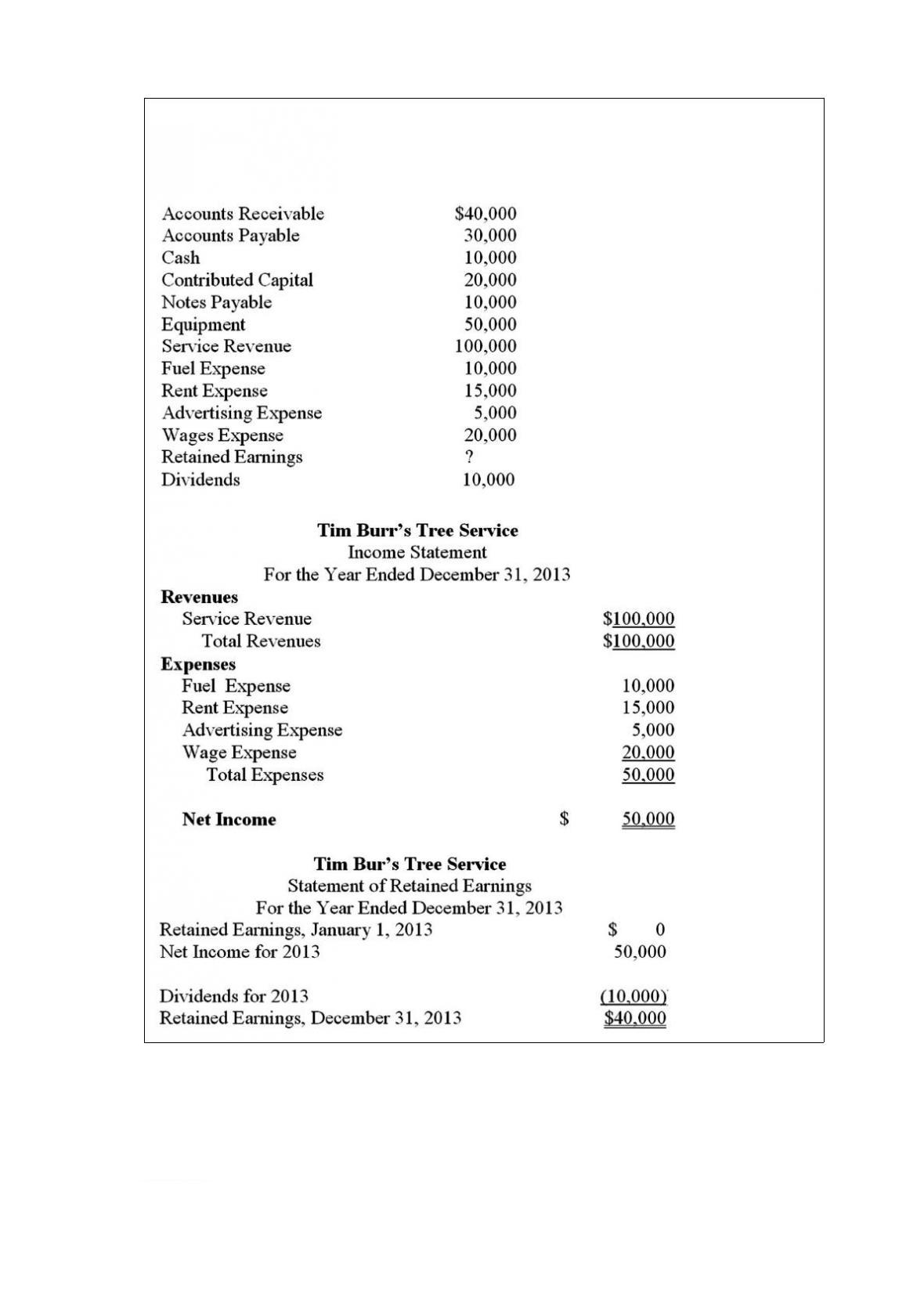
Following is a list of financial statement items and amounts for Tim Burr’s Tree Service
as of 12/31/13, the end of its first year in operation. Use this information to prepare the
Income Statement, Statement of Retained Earnings, and Balance Sheet.
Answer:
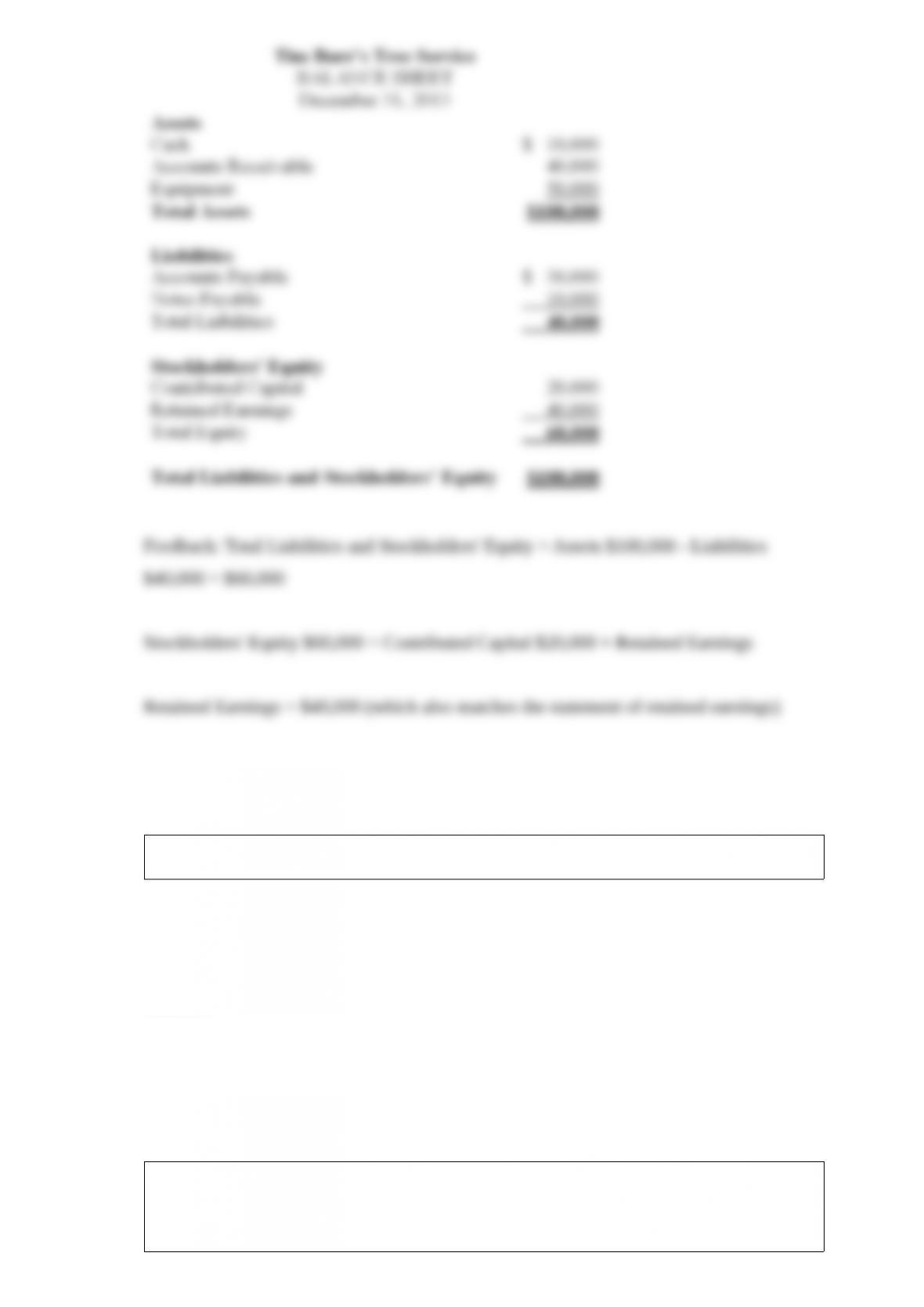
Answer:
The following merchandise transactions occurred during December for two different
companies: Rippen and Burnen. Both companies use a perpetual inventory system.
On December 3, Rippen Corporation sold merchandise on account to Burnen Corp. for
$480,000, terms 2/10, n/30. This merchandise originally cost Rippen $320,000.
On December 8, Burnen Corp. returned merchandise to Rippen Corporation for a credit
of $30,000. Rippen returned this merchandise to inventory at its original cost of
$20,000.
December 12, Burnen Corp. paid Rippen Corporation for the amount owed.
A) Prepare the journal entries to record these transactions on the books of Rippen
Corporation.
B) What is the amount of net sales to be reported on Rippen Corporation’s income
statement?
C) What is the Rippen Corporation’s gross profit percentage?
Answer:

You have received the bank statement for your company’s account and need to reconcile
it with your general ledger cash account. Your records show an ending balance for the
month of $12,722.40 while the bank’s records show an ending balance of $12,367.16.
The bank charged $8 in service fees and paid $26.05 in interest. All but three checks
written during the month were processed by the bank without incident during the
month. The three exceptions were:
1) Check #841 was correctly processed by the bank as $981.27 but was mistakenly
recorded by you as $781.27.
2) Check #853 for $64.57 had not yet been processed by the bank.
3) Check #855 for $683.46 had not yet been processed by the bank.
All but two of the deposits made during the month were processed by the bank without
incident. The two exceptions were:
1) A customer check for $307.95, which had been deposited during the month, was
returned NSF.
2) A deposit totaling $613.37 had not yet been processed by the bank.
Using the information provided above, prepare a bank reconciliation.
Answer:
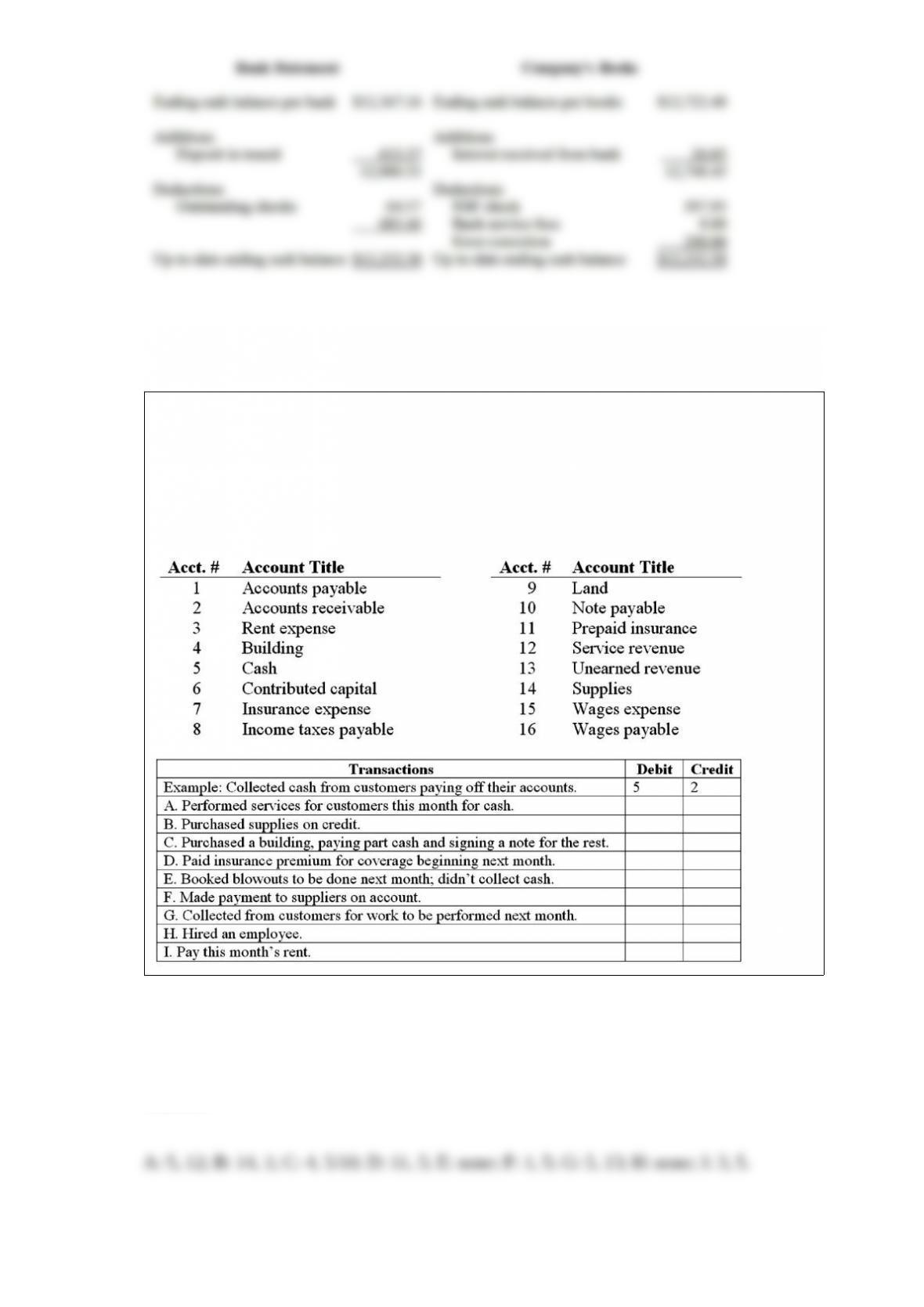
The following is a series of accounts for the Sprinkler Blowout Company, listed
alphabetically and numbered for identification. Following the accounts is a series of
transactions. For each transaction, indicate the account(s) that should be debited and
credited by entering the appropriate account number(s) to the right of each transaction.
If no journal entry is needed, write none after the transaction. The first transaction is
given as an example.
Answer:
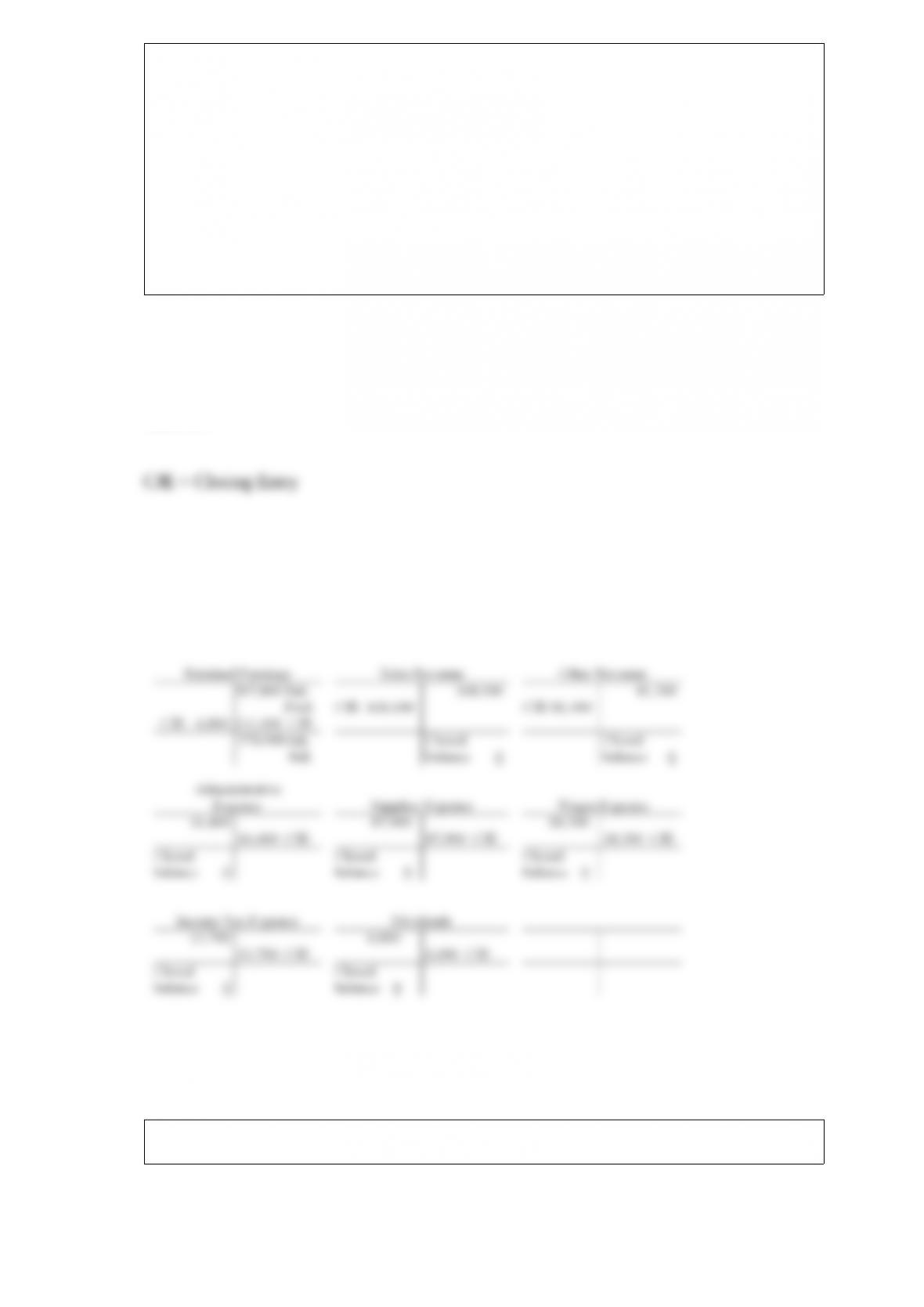
On December 31, 2014, Purrfect Pets had retained earnings of $267,800 before making
its closing entries. During 2014, the company had service revenue of $168,100 and
other revenue of $81,300. The company used supplies (mainly cat food and litter)
during the year which cost $87,900. Administrative expenses were $16,400 and wages
(paid in cash) were $18,300. Taxes were $13,700 and dividends declared and paid
totaled $6,000.
Prepare T-accounts for the income statement accounts, dividends declared, and retained
earnings at the end of the year before closing. Then, enter the closing journal entries in
the T-accounts and compute the ending balances of the T-accounts.
Answer:
Answer:
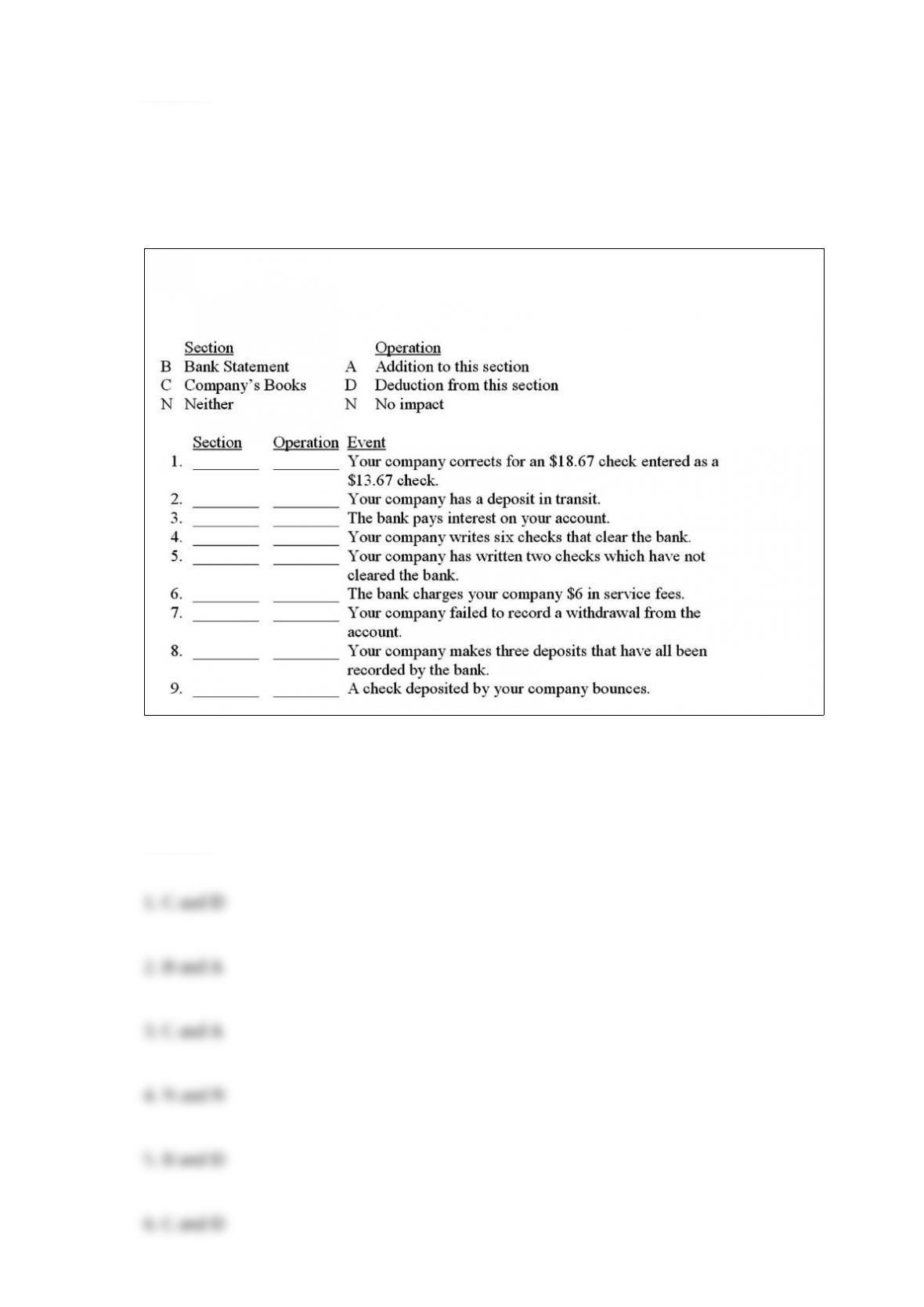
For each of the following events, match the event with the section of the bank
reconciliation in which it is listed, if at all, and indicate the operation performed.
Answer:
Answer:
Insert the appropriate letter A, D, or C into the correct blank to describe the type of
adjustment required at the end of April.
Entry Type
A Accrual adjusting entry
D Deferral adjusting entry
C Closing entry
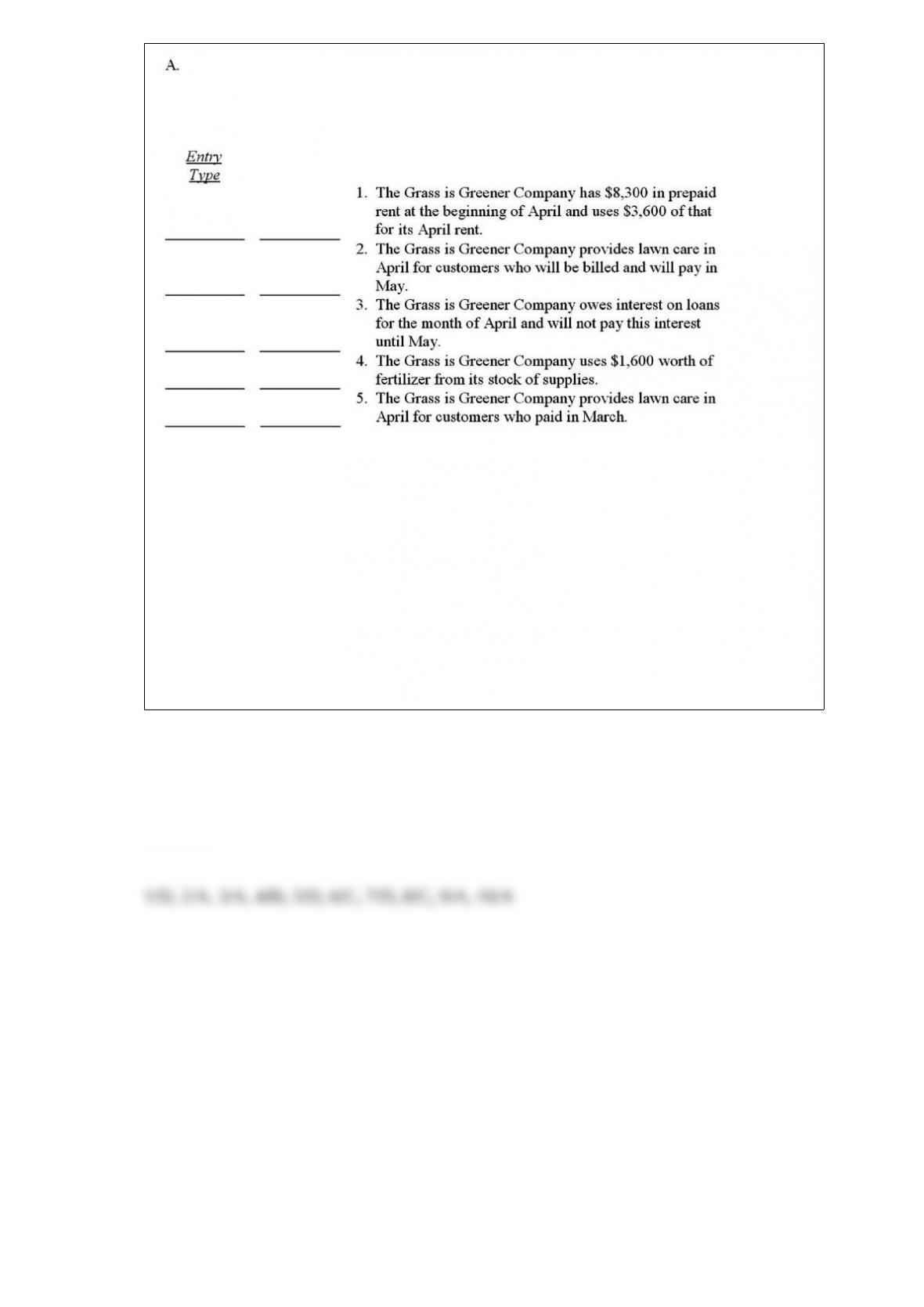
6/ The Grass is Greener transfers revenues of $50,000 and expenses of $32,000 to
retained earnings.
7/ The Grass is Greener makes an entry to reflect use of equipment.
8/ The Grass is Greener transfers dividends of $1,200 to retained earnings.
9/ The Grass is Greener records income taxes.
10/ The weekly payroll of $5,000 to be paid next week is recorded.
Answer: