The following selected data were taken from the books of the Bixby Box Company.
The company uses job costing to account for manufacturing costs. The data relate to
June operations.
A) Materials and supplies were requisitioned from the stores clerk as follows:
Job 405, material X, $7,000.
Job 406, material X, $3,000; material Y, $6,000.
Job 407, material X, $7,000; material Y, $3,200.
For general factory use: materials A, B, and C, $2,300.
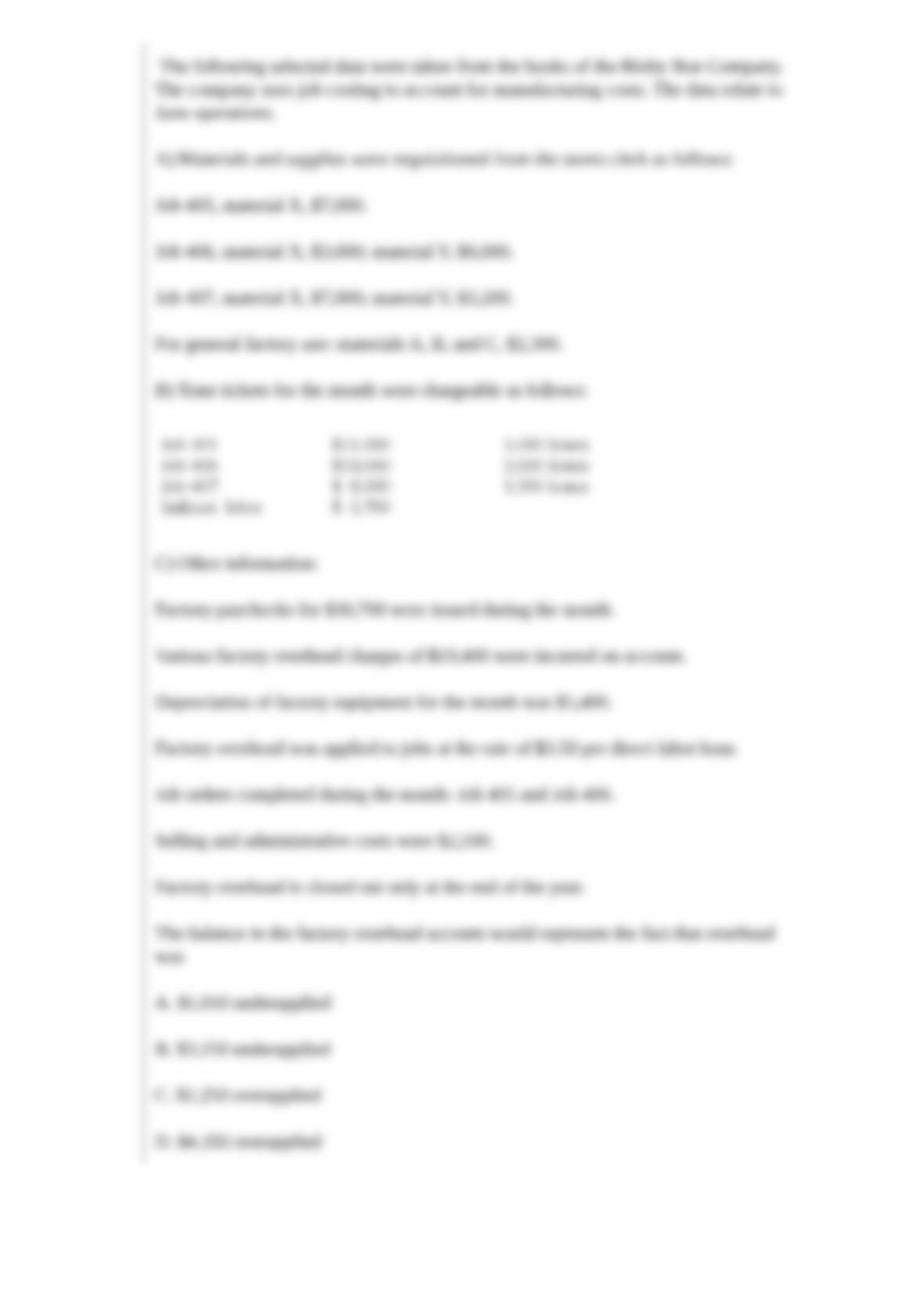
B) Time tickets for the month were chargeable as follows:
C) Other information:
Factory paychecks for $36,700 were issued during the month.
Various factory overhead charges of $19,400 were incurred on account.
Depreciation of factory equipment for the month was $5,400.
Factory overhead was applied to jobs at the rate of $3.50 per direct labor hour.
Job orders completed during the month: Job 405 and Job 406.
Selling and administrative costs were $2,100.
Factory overhead is closed out only at the end of the year.
The balance in the factory overhead account would represent the fact that overhead
was
A. $1,050 underapplied
B. $3,150 underapplied
C. $1,250 overapplied
D. $4,350 overapplied
Answer:
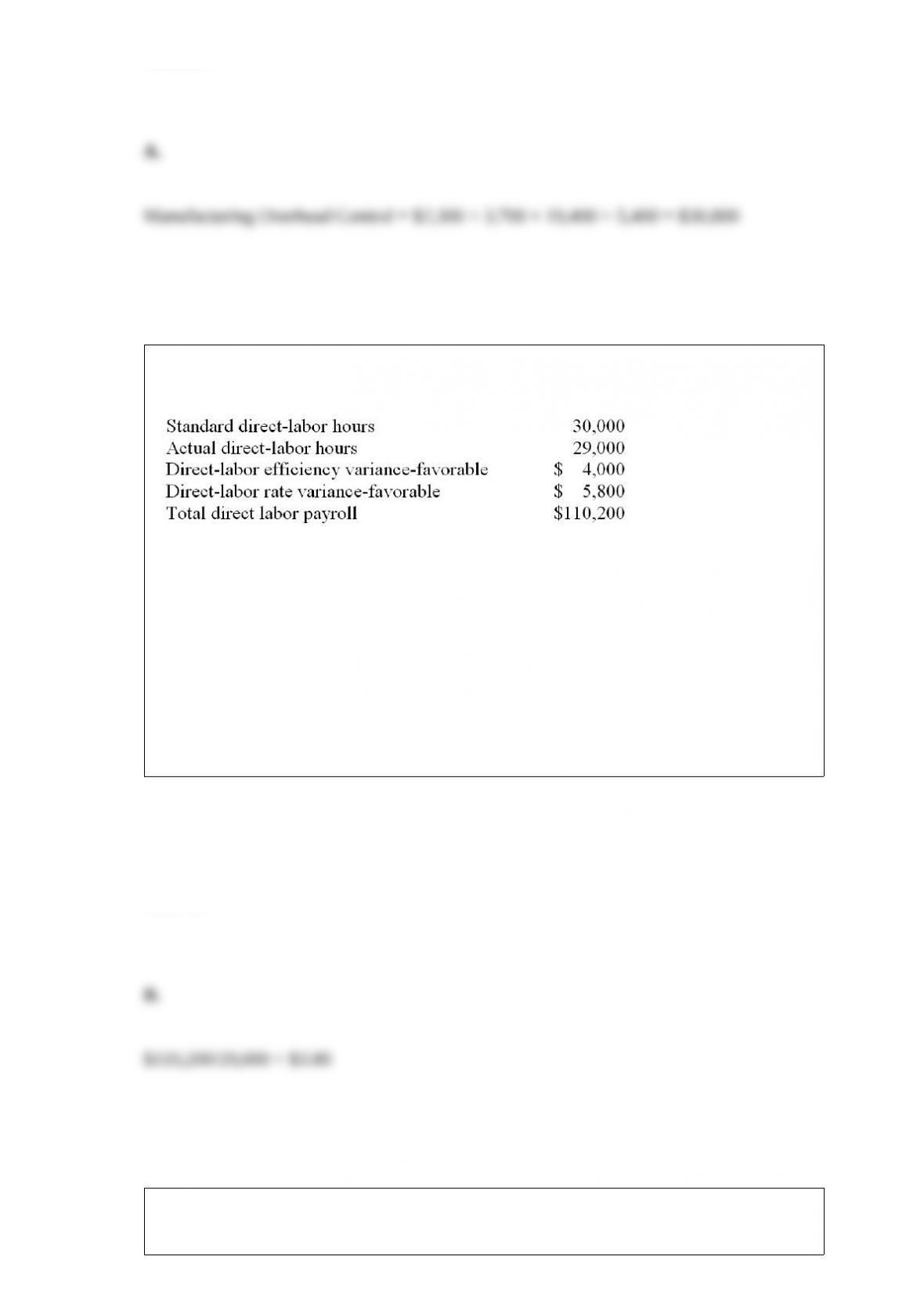
Data on Goodman Company’s direct-labor costs are given below:
What was Goodman’s actual direct-labor rate?
A. $3.60
B. $3.80
C. $4.00
D. $5.80
Answer:
Which of the following statements is (are) false regarding financial measures?

(A) In general, the use of multiple measures to evaluate performance is better than that
use of a single performance measure.
(B) Managers evaluated using multiple measures will most likely act differently than
managers evaluated using single measures.
A. Only A is false.
B. Only B is false.
C. Both A and B are false.
D. Neither A nor B is false.
Answer:
Inventoriable costs:
A. include only the prime costs of manufacturing a product.
B. include only the conversion costs of providing a service.
C. exclude fixed manufacturing costs.
D. are regarded as assets until the units are sold.
E. are regarded as expenses when the costs are incurred.
Answer:
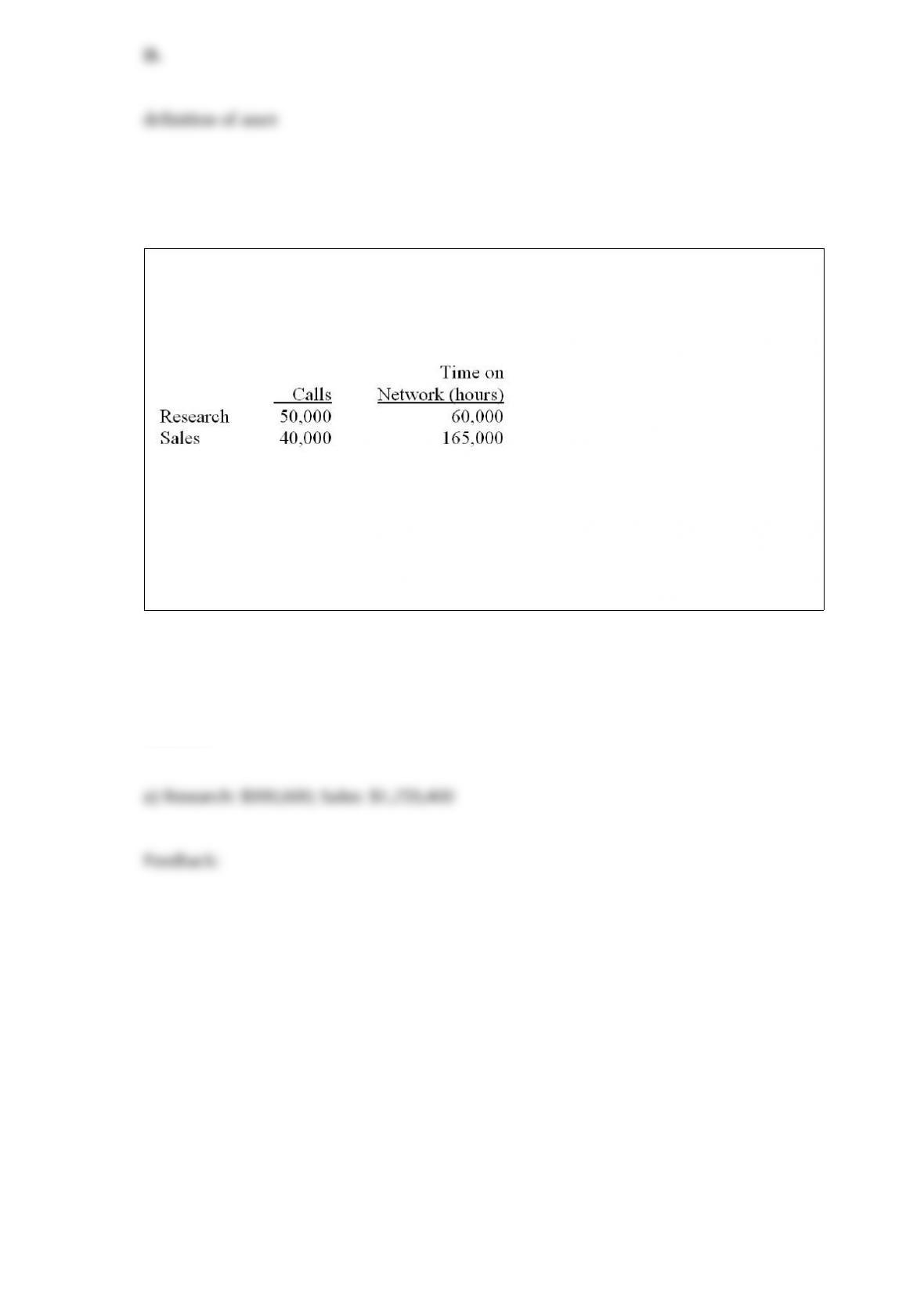
Tofte has two divisions, Research and Sales, that share the common costs of the
company’s communications network. The annual common costs are $2,250,000. You
have been provided with the following information for the upcoming year:
Required (use three decimal places in your calculations):
a) The cost accountant determined $1,350,000 of the communication network’s costs
were fixed and should be allocated based on the number of calls. The remaining costs
should be allocated based on the time on the network. What is the total communication
network costs allocated to each division?
Answer:
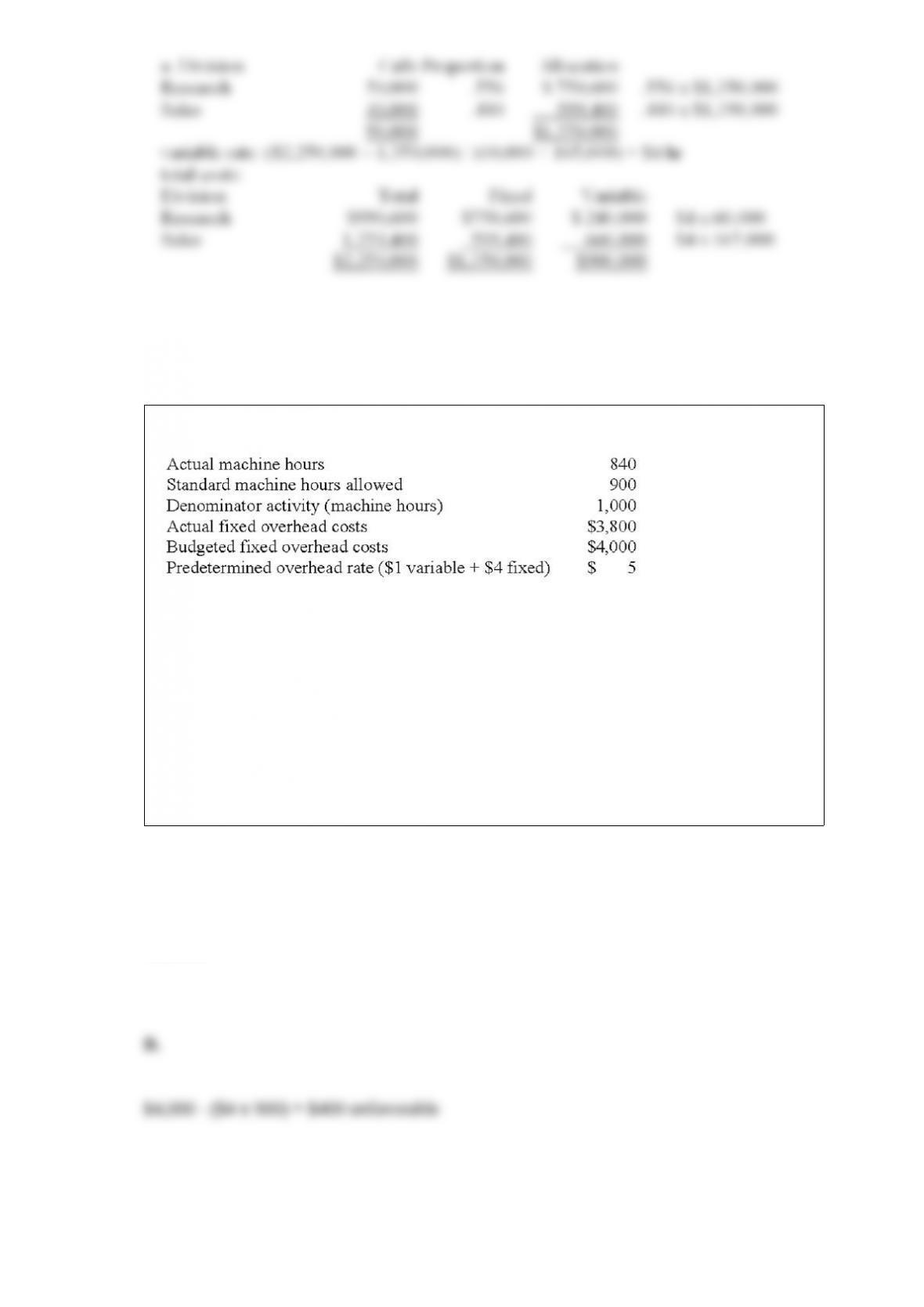
What is the production volume variance?
A. $200
B. $400
C. $300
D. $240
Answer:
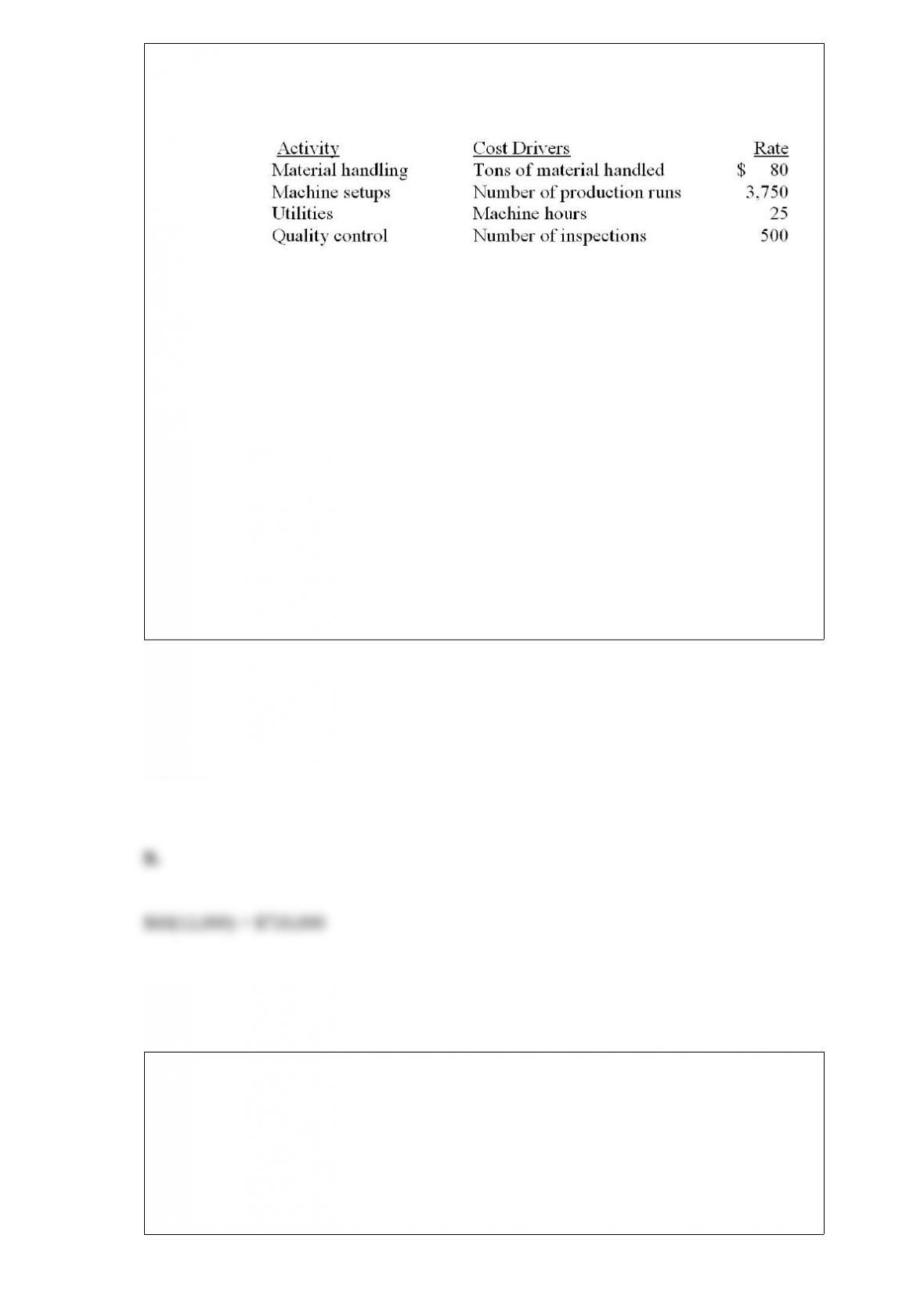
The LMN Company recently switched to activity-based costing (ABC) from the
department allocation method. The department method allocated overhead costs at a
rate of $60 per machine hour. The cost accountant for Department XZ has gathered the
following data:
During April, LMN purchased and used $100,000 of direct materials at $20 per ton.
There were eight (8) production runs using a total of 12,000 machine hours in April.
The manager of Department XZ needed 12 inspections. Actual overhead costs totaled
$820,000 for the month.
How much overhead costs were applied to the Work-in-Process Inventory during April
using traditional costing?
A. $536,000
B. $720,000
C. $736,000
D. $820,000
Answer:
Smelly Perfume Company manufactures and distributes several different products.
They currently use a plantwide allocation method for allocating overhead at a rate of $7
per direct labor hour. Cindy is the department manager of Department C which
produces Products J and P. Department C has $16,200 in traceable overhead. Diane is
the department manager of Department D which manufactures Product X. Department
D has $11,100 in traceable overhead. The product costs (per case of 24 bottles) and
other information are as follows:
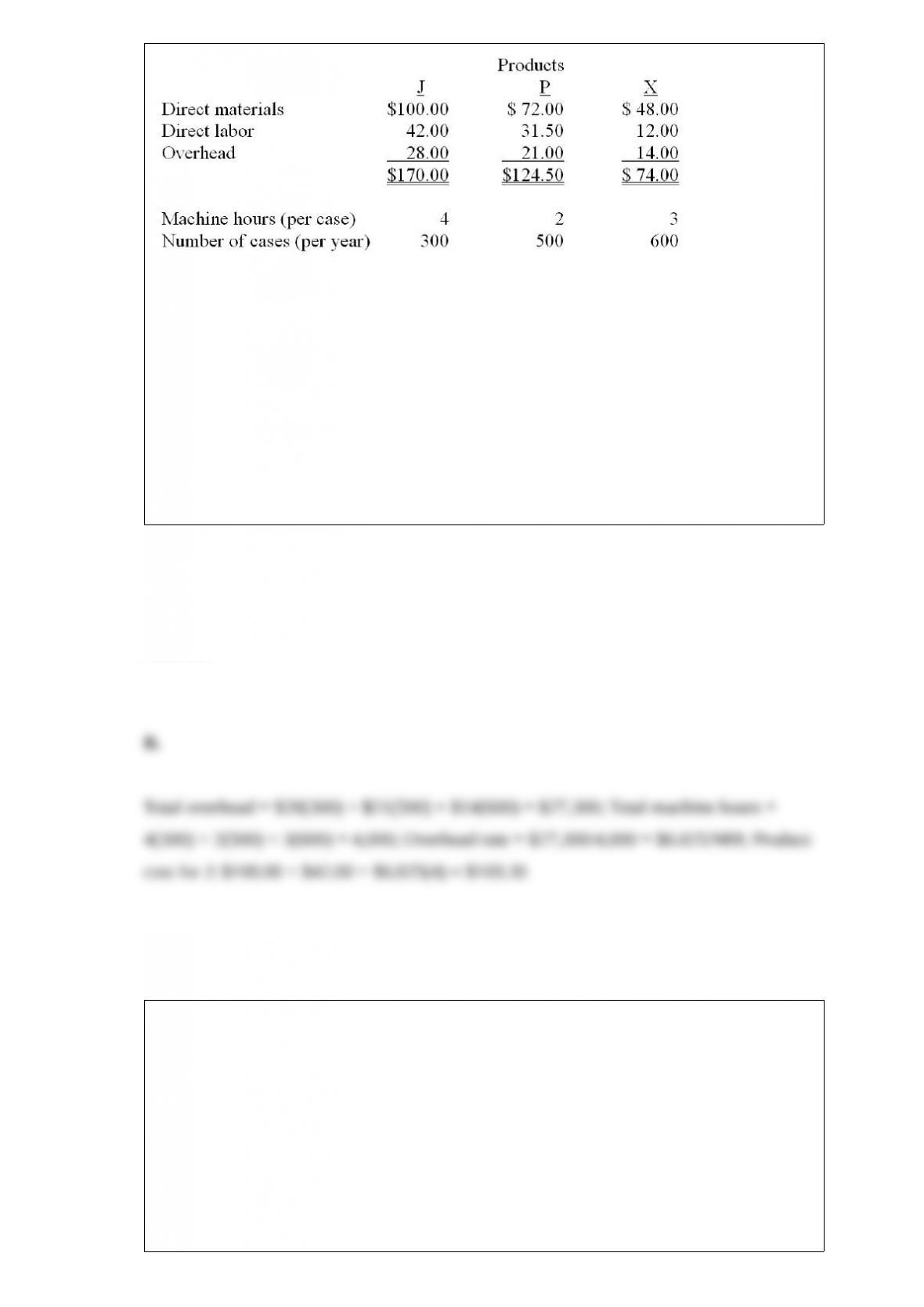
If Smelly changes its allocation basis to machine hours, what is the total product cost
per case for Product J?
A. $161.50
B. $169.30
C. $182.44
D. $183.36
Answer:
Which of the following statements is true?
A. One of the lessons learned from activity-based costing (ABC) is that all costs are
really a function of volume.
B. The primary purpose of the plant wide and department allocation methods is
allocating direct costs to specific products.
C. A problem with activity-based costing (ABC) is that it requires more recordkeeping
than other methods.
D. Direct cost allocations are required for the plant wide and department allocation
methods.
Answer:
The cost of the direct labor will be treated as an expense on the income statement when
the resulting:
A. payroll costs are paid.
B. payroll costs are incurred.
C. products are completed.
D. products are sold.
Answer:
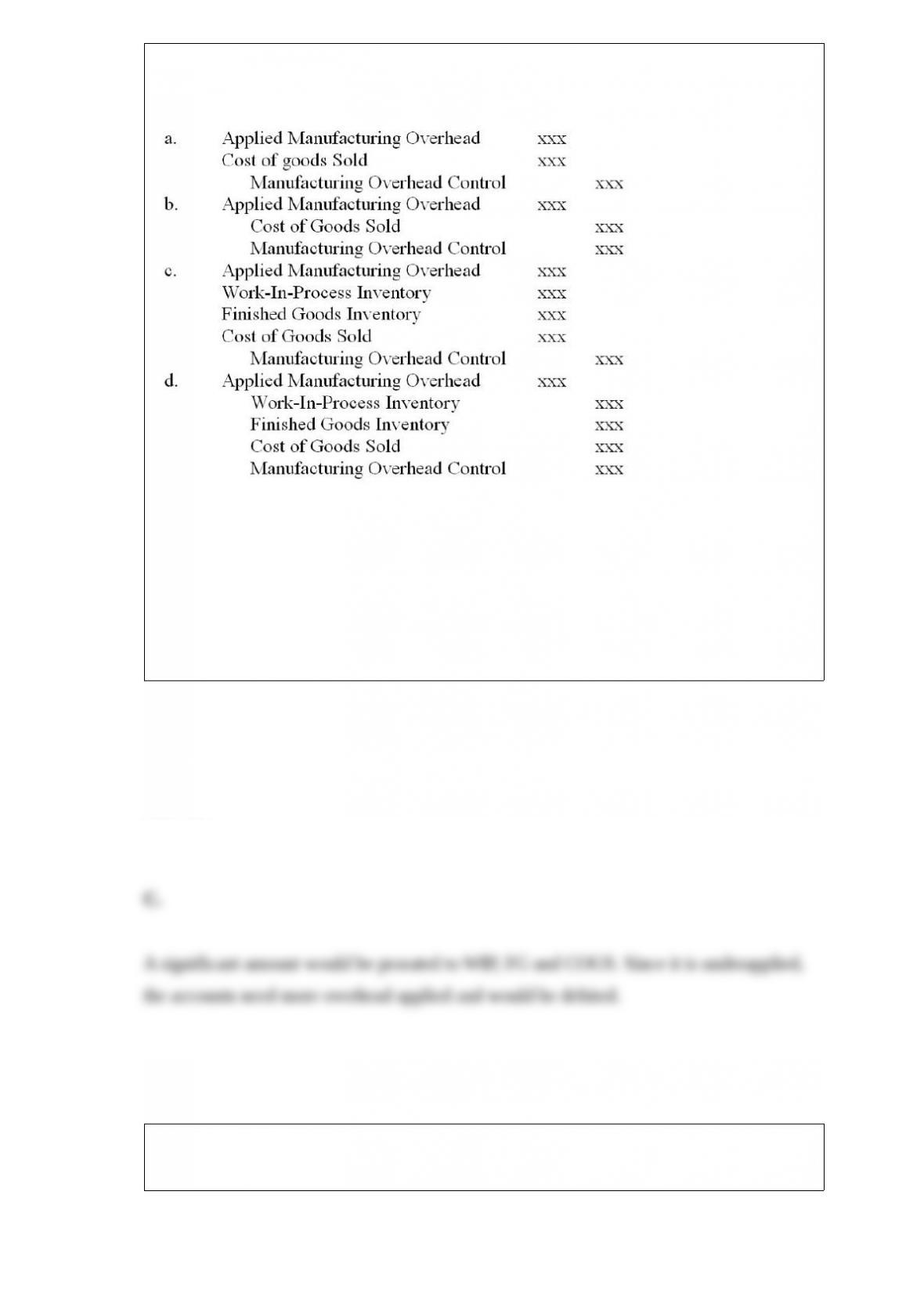
The journal entry to write-off a significant underapplied overhead balance at the end of
an accounting period is
A. a
B. b
C. c
D. d
Answer:
The following costs have been estimated based on sales of 30,000 units:
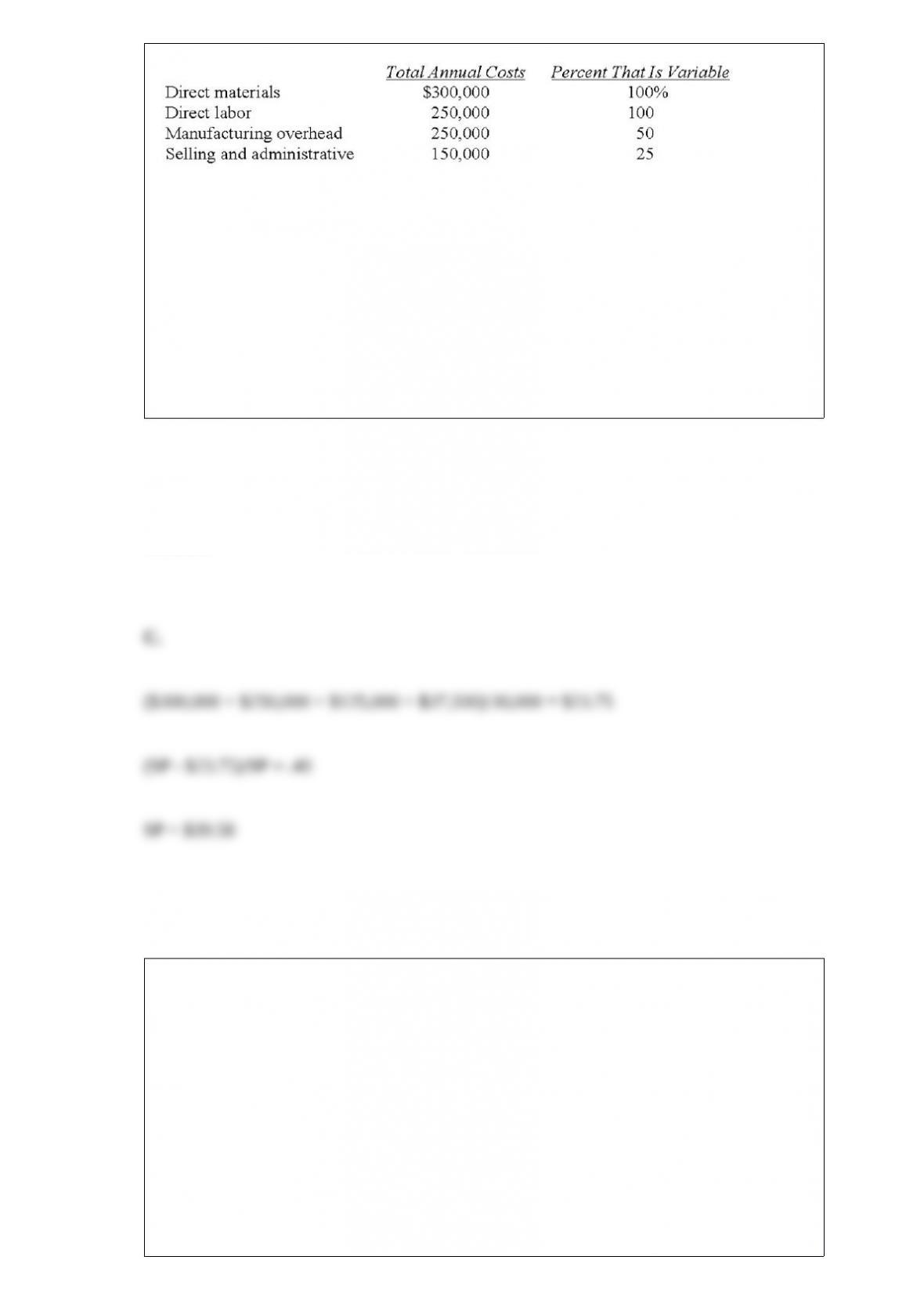
What selling price will yield a contribution margin of 40%?
A. $59.38
B. $43.75
C. $39.58
D. $33.25
Answer:
Department B had a beginning inventory of 400 units, 1/4 completed; an ending
inventory of 300 units, 2/3 completed, and received 900 units during the period from
Department A. What was the equivalent unit production of Department B, assuming
weighted-average process costing?
A. 800 units.
B. 900 units.
C. 1,100 units.
D. 1,200 units.
E. 1,400 units.
Answer:
Division A has variable manufacturing costs of $50 per unit and fixed costs of $10 per
unit. Division A is operating significantly below capacity, what is the optimal transfer
price of an internal transfer when the market price is $75?
A. $20
B. $25
C. $50
D. $60
E. $75
Answer:
Scottso Corporation applies overhead using an actual costing approach. Budgeted
factory overhead was $266,400, budgeted machine-hours were 18,500. Actual factory
overhead was $287,920, actual machine-hours were 19,050. How much overhead
would be applied to production?
A. $266,400.
B. $274,320.
C. $279,607.
D. $287,920.
Answer:
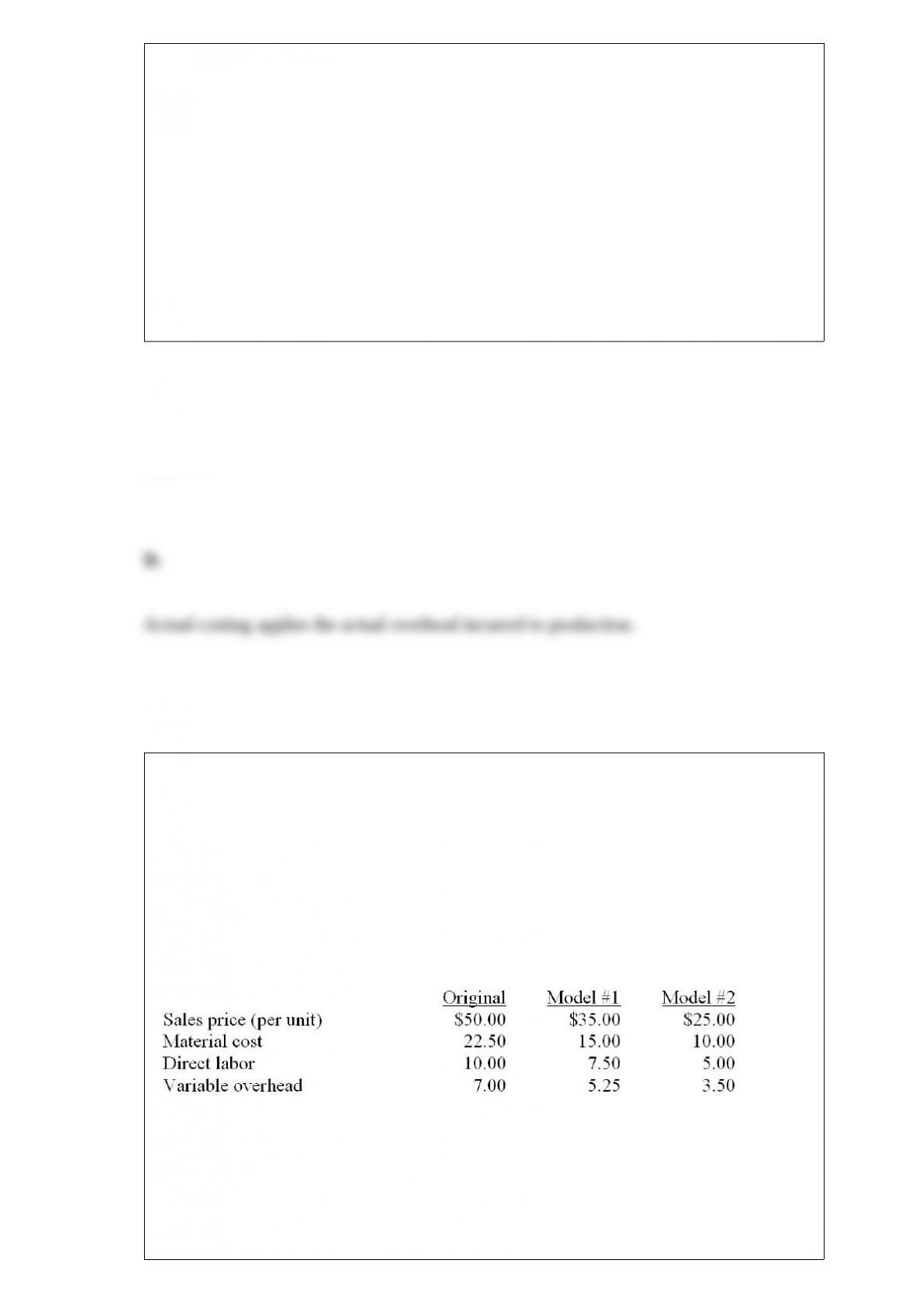
The sales manager of Jorgensen Sales is considering expanding sales by producing
three different versions of their product. Each will be targeted by the marketing
department to different income levels and will be produced from three different
qualities of materials. After reviewing the sales forecasts, the sales department feels that
70% of units sold will be the original product, 20% will be new model #1 and the
remainder will be new model #2.
The following information has been assembled by the sales department and the
production department.
The fixed costs associated with the manufacture of these three products are $250,000
per year.
Required:
(a) Determine the number of units of each product that would be sold at the break-even
point.
(b) Determine the break-even point if the sales estimates are instead 50% original
product, 30% model #1 and the remainder model #2.
Answer:
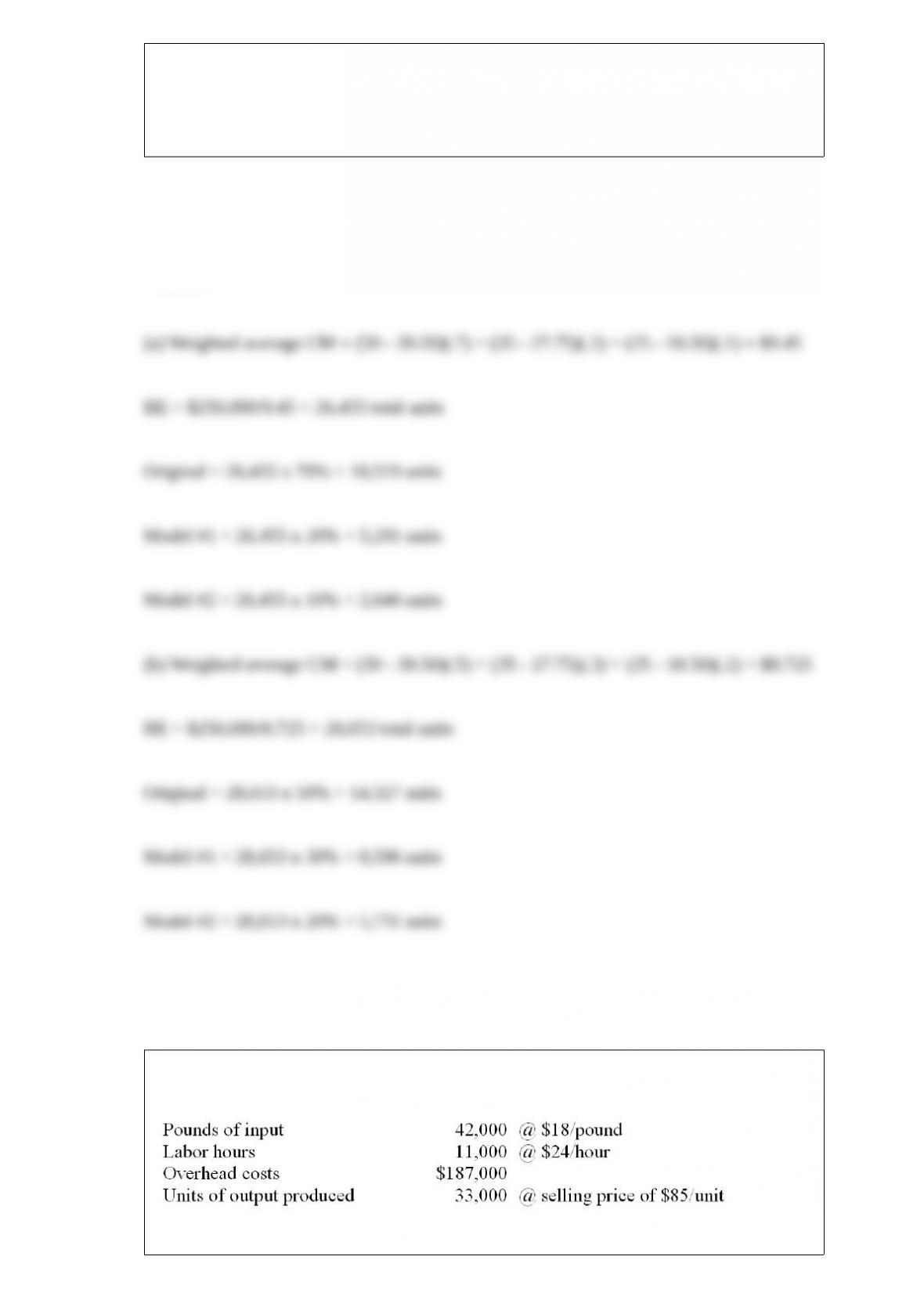
Melrose, Inc. has provided the following information for last year:
Required: Calculate the partial productivity for:
a) Metal
b) Labor
Answer:
Which of the following cost estimation methods finds the fixed portion of a mixed cost
before calculating the variable portion?
A. Scattergraph.
B. High-low method.
C. Account analysis.
D. Linear regression.
E. Engineering approach.
Answer:
The intercept of the flexible budget-line is total
A. sales.
B. variable costs.
C. fixed costs.
D. contribution margin.
E. assets.
Answer:
Which of the following would be a reasonable basis for assigning the materials
handling costs to the units produced in an activity-based costing (ABC) system?
A. Number of production runs per year
B. Number of components per completed unit
C. Amount of time required to produce one unit
D. Amount of overhead applied to each completed unit
Answer:
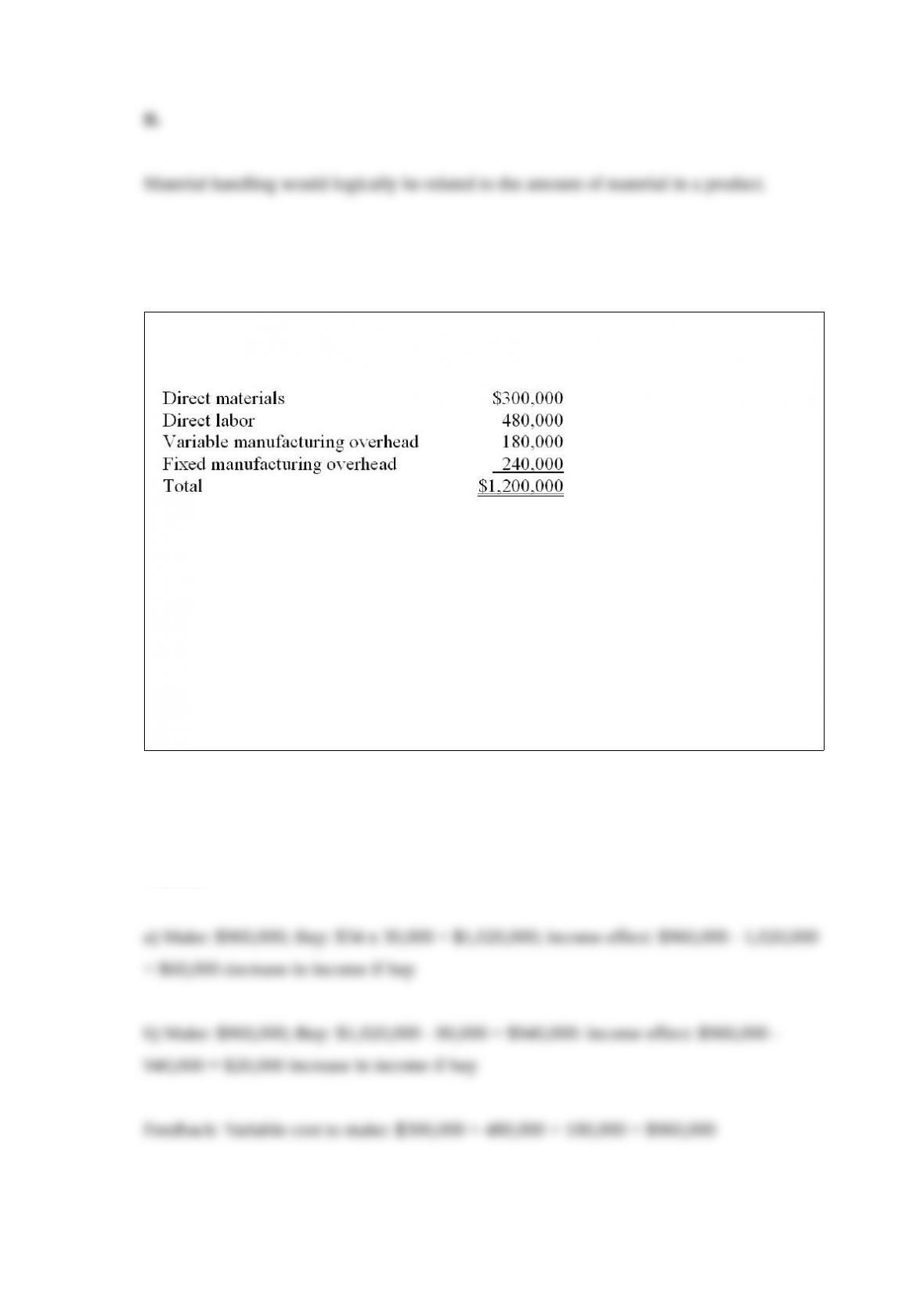
Tofte Industries manufactures 30,000 components per year. The manufacturing cost of
the components was determined to be as follows:
a) Assume that the fixed manufacturing overhead reflects the cost of Tofte’s
manufacturing facility. This facility cannot be used for any other purpose. An outside
supplier has offered to sell the component to Tofte for $34. If Tofte Industries purchases
the component from the outside supplier, the effect on income would be a
b) Assume Tofte Industries could avoid $80,000 of fixed manufacturing overhead if it
purchases the component from an outside supplier. An outside supplier has offered to
sell the component for $34. If Tofte purchases the component from the supplier instead
of manufacturing it, the effect on income would be a
Answer:
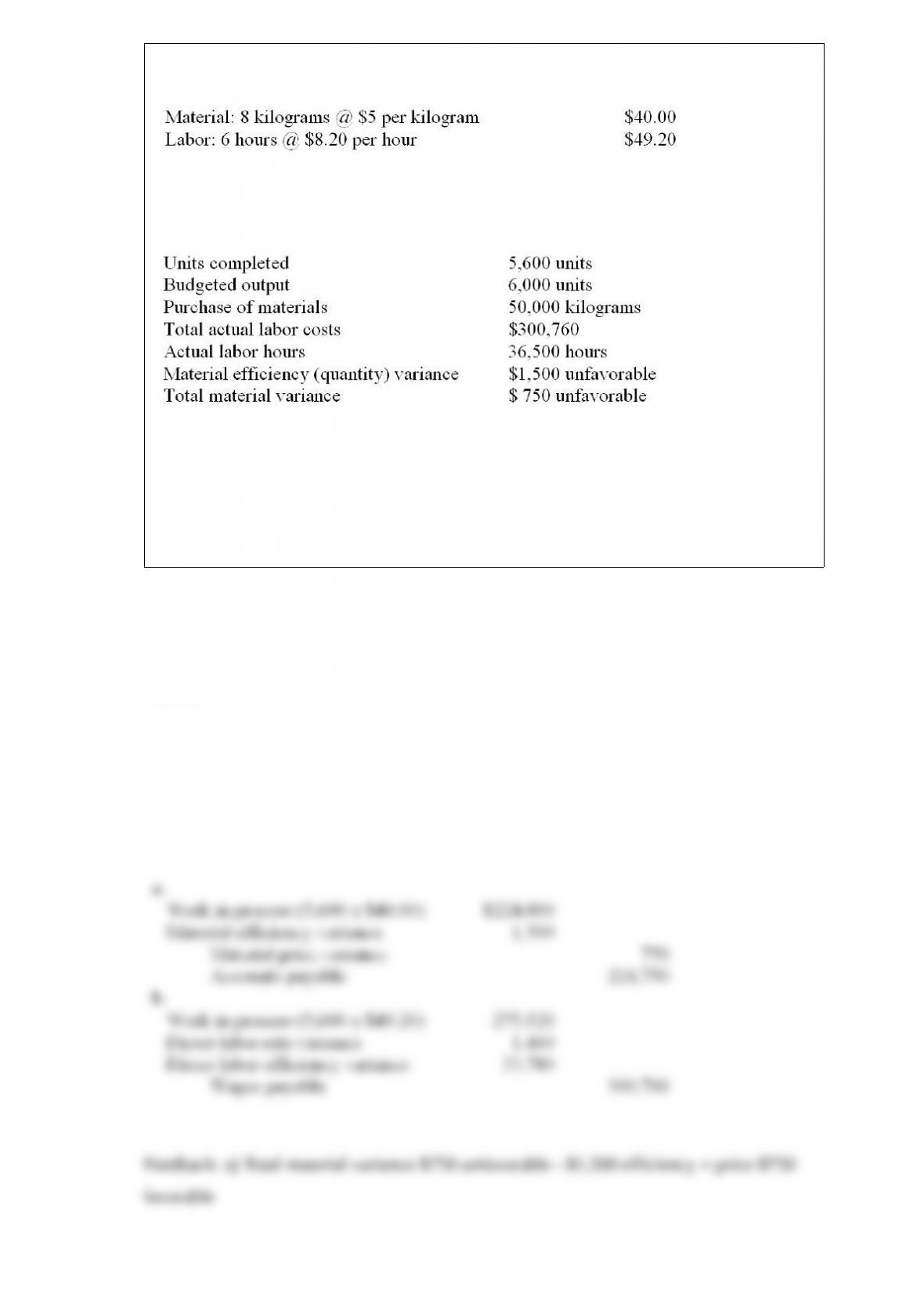
Dash Company adopted a standard cost system several years ago. The standard costs
for the prime costs of its single product are as follows:
The following operating data were taken from the records for November:
Required: Prepare the journal entries to record the following:
a) Purchase and use of direct materials (Assume materials are used as purchased and no
inventory is maintained).
b) Recognition of direct labor.
Answer:
A company which manufactures custom-made machinery routinely incurs sizable
telephone costs in the process of taking sales orders from customers. Which of the
following is a proper classification of this cost?
A. Product cost
B. Period cost
C. Conversion cost
D. Prime cost
Answer:
The journal entry to record requisitions of material for new jobs started during the
period is
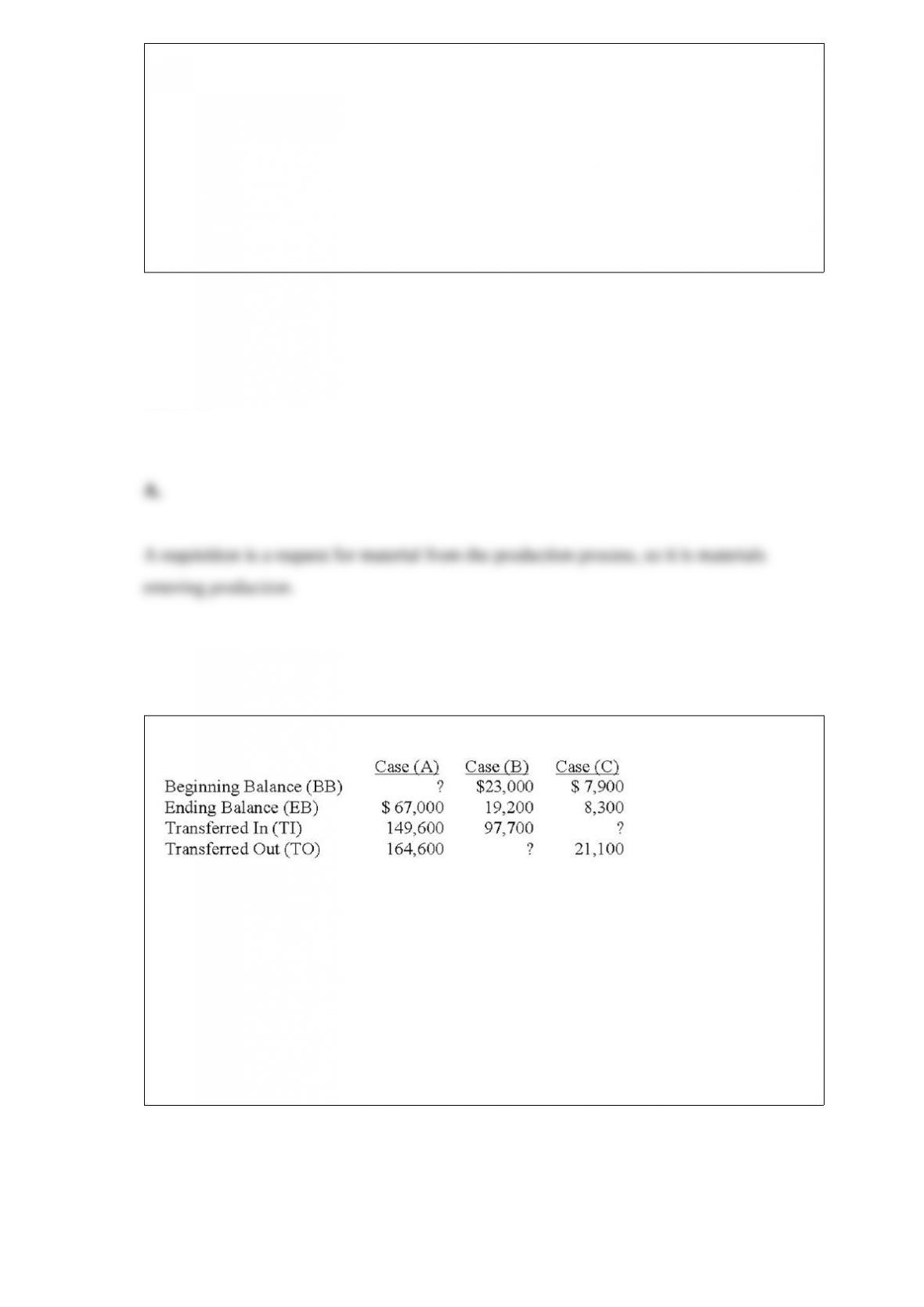
A. a
B. b
C. c
D. d
E. e
Answer:
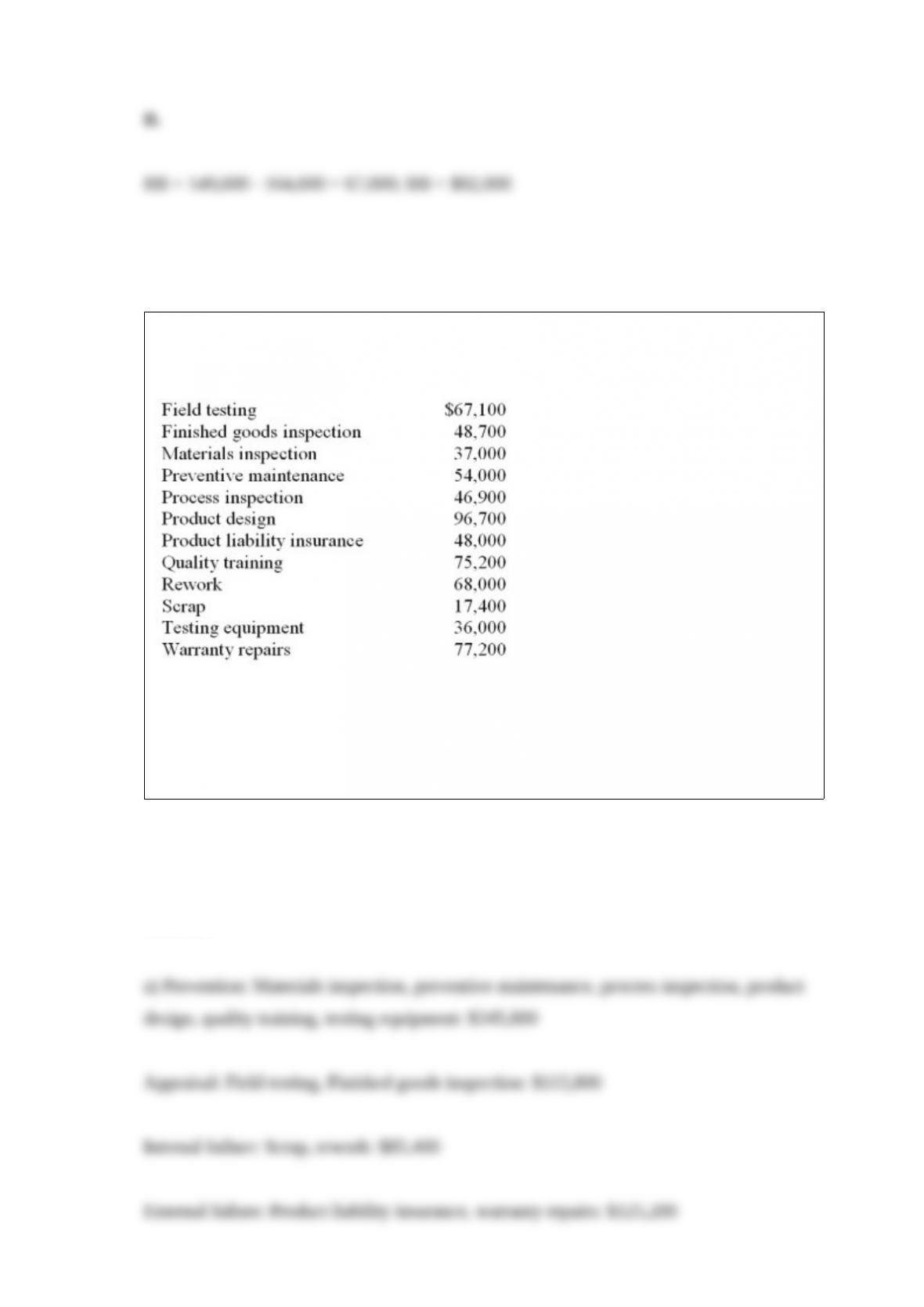
For Case (A) above, what is the Beginning Balance (BB)?
A. $52,000
B. $82,000
C. $67,000
D. $97,600
Answer:
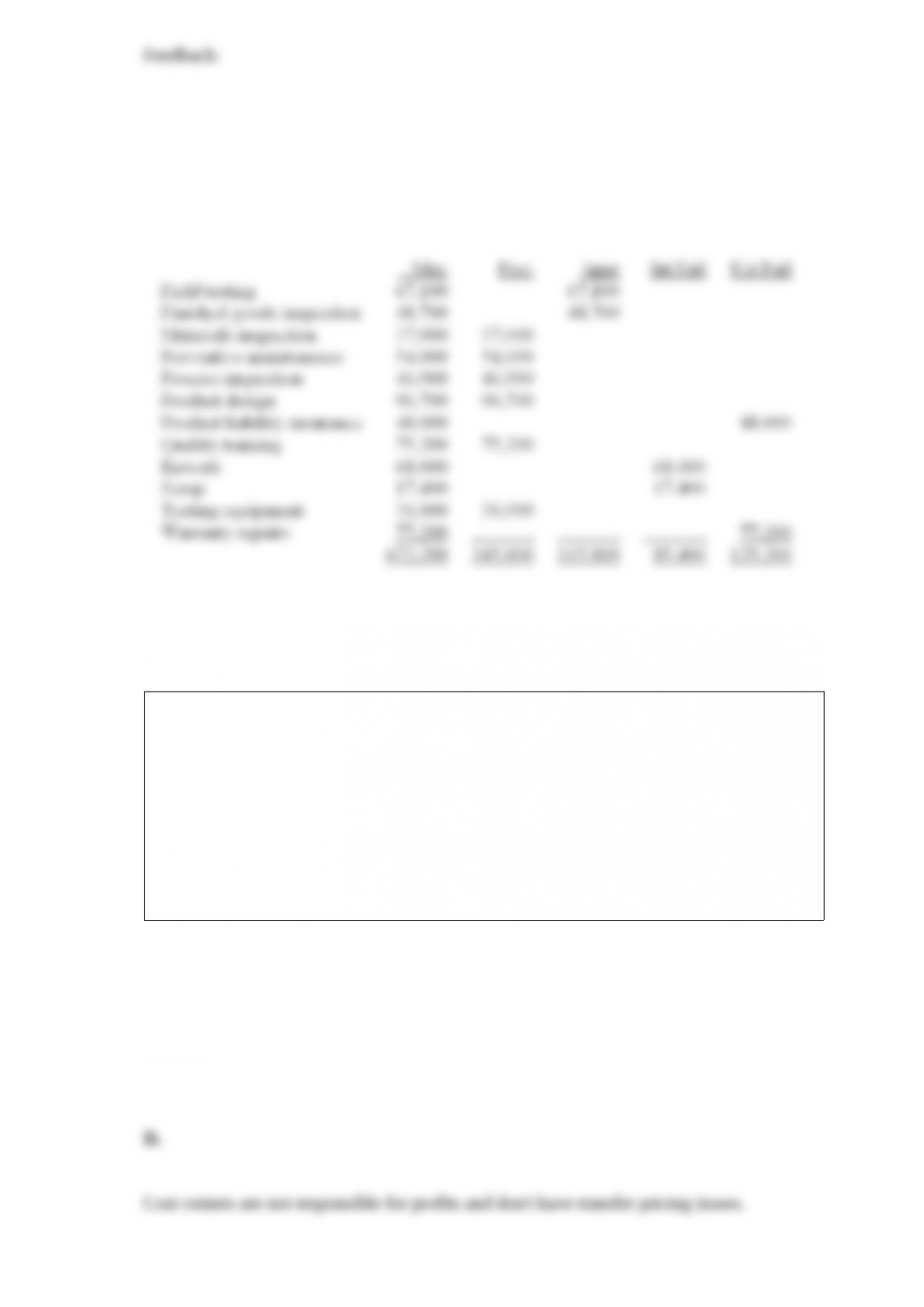
The following represents quality cost data for Banbury Corporation:
Required
a) Classify these items into prevention, appraisal, internal failure, or external failure
costs. Determine the total cost of each category.
Answer:
Transfer prices would not be used by
A. production centers.
B. investment centers.
C. profit centers.
D. cost centers.
Answer:
The Black Swan Company has three client-contact departments: Market Research,
Branding, and Promotion. Each department requires the services of the Legal
Department for the contracts that each undertakes. The size of the Legal Department
was based on long-run estimates of contracts. Information on the Legal Department’s
budgeted and actual costs is as follows:
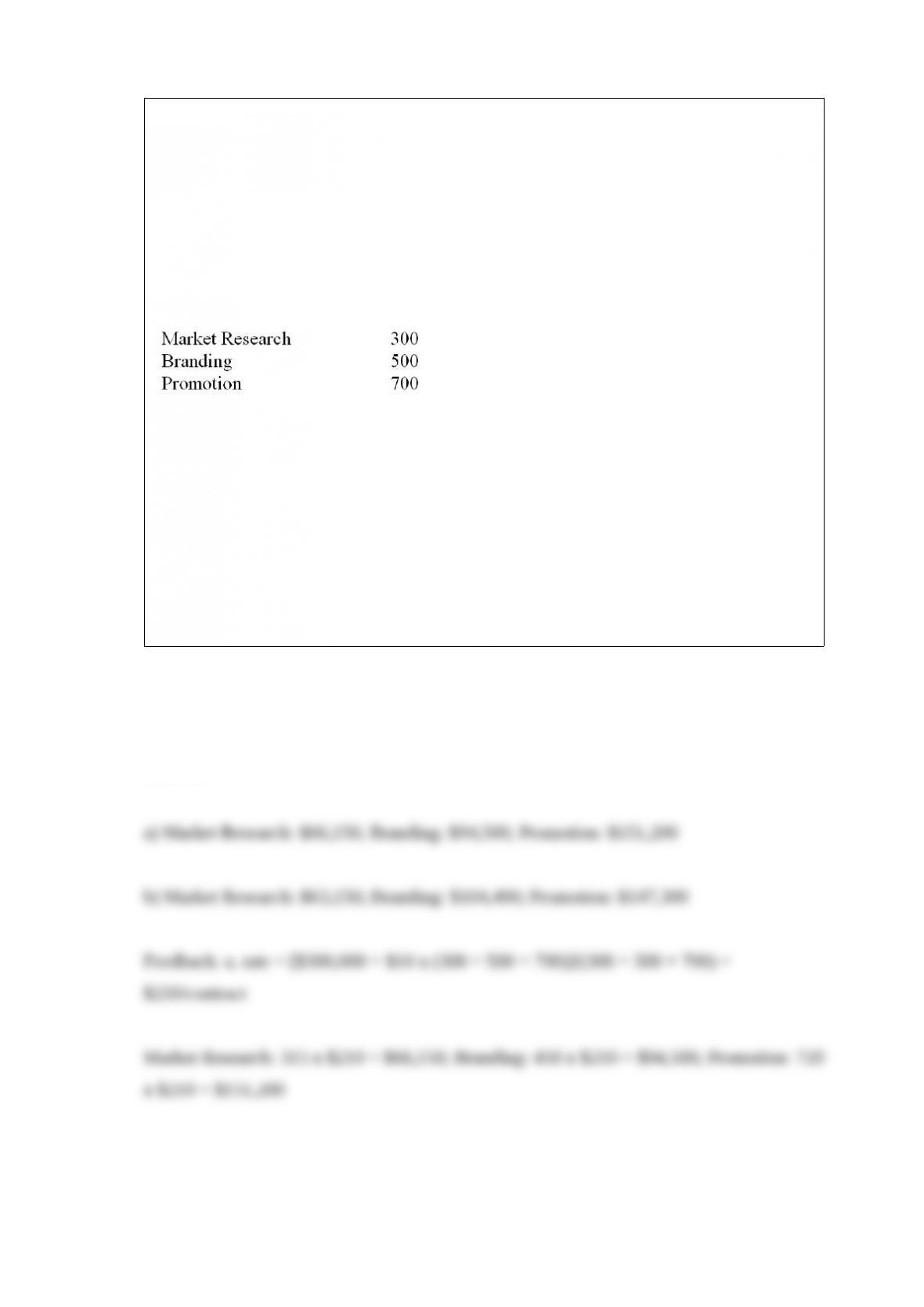
The budget for the Legal Dept is $300,000 + $10/contract. The budgeted volume of
contracts is as follows:
The actual number of contracts for Market Research was 315, for Branding was 450,
and for Promotion was 720.
Required (use three decimal places in your calculations):
a) If a single charging rate based on budgeted usage is used, how much of the cost of
the Legal Department would be allocated to each of the producing departments?
b) If a dual charging rate is used, how much of the cost of the Legal Department would
be allocated to each of the producing departments
Answer:

Which of the following statements is (are) true regarding the sales activity variance?
(A) The sales activity variance is the actual selling price per unit times the difference
between the budgeted units and actual units.
(B) If the sales activity variance for sales revenue is unfavorable, then the contribution
margin sales activity variance will be unfavorable.
A. Only A is true.
B. Only B is true.
C. Neither A and B is true.
D. Both A and B are true.
Answer:

Division B has variable manufacturing costs of $50 per unit and fixed costs of $10 per
unit. Division B is operating significantly below capacity, what is the opportunity cost
of an internal transfer when the market price is $75?
A. $0
B. $25
C. $50
D. $60
E. $75
Answer:
The Blue Corporation started and completed 4,800 units during February. Blue started
the month with 700 units in process (40% complete) and ended the month with 400
units in process (40% complete). How many units were transferred to the Finished
Goods Inventory during February?
A. 5,500.
B. 5,380.
C. 5,100.
D. 4,400.
E. 4,100.
Answer:

Which of the following statement is (are) true?
(A) Unused capacity costs incurred for the benefit of a company’s customers (e.g., meet
seasonal demands) should be assigned to the customers that require (use) the excess
capacity.
(B) In general, managerial decisions affecting capacity-level costs and activities also
affect volume-level, batch-level, and product-level cost and activities.
A. Only A is true.
B. Only B is true.
C. Both A and B are true.
D. Neither A nor B is true.
Answer:
The Acme Company collected the following information (in days) for October,
November and December.
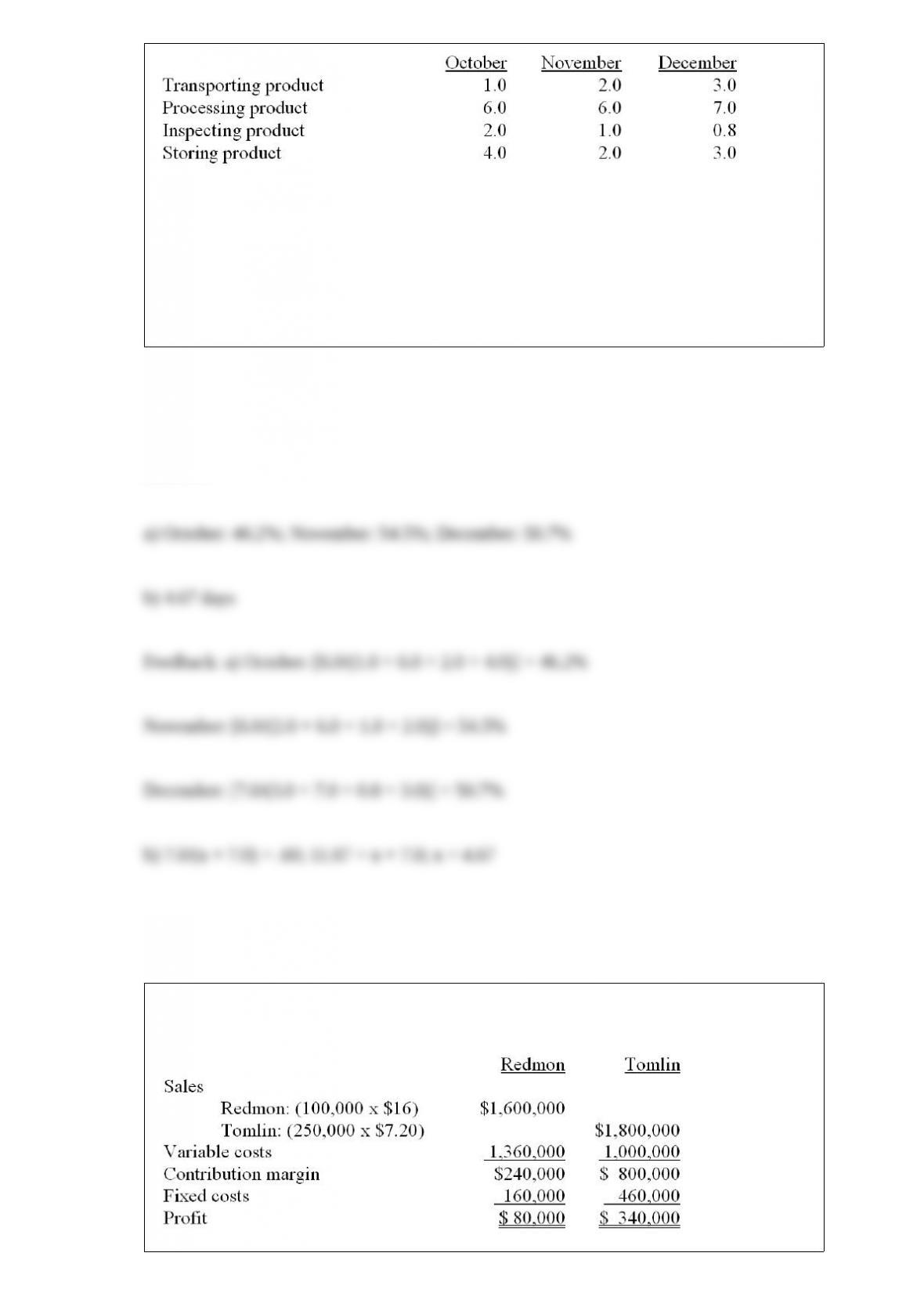
Required:
a) Calculate the manufacturing cycle efficiency for October, November, and December.
b) Assume January’s processing time will be the same as December’s. If Acme’s target
for manufacturing cycle efficiency is 60%, what will January’s target for non-processing
times be?
Answer:
Ryman Company has two divisions organized as profit centers: Redmon and Tomlin.
Ryman expects the following results:
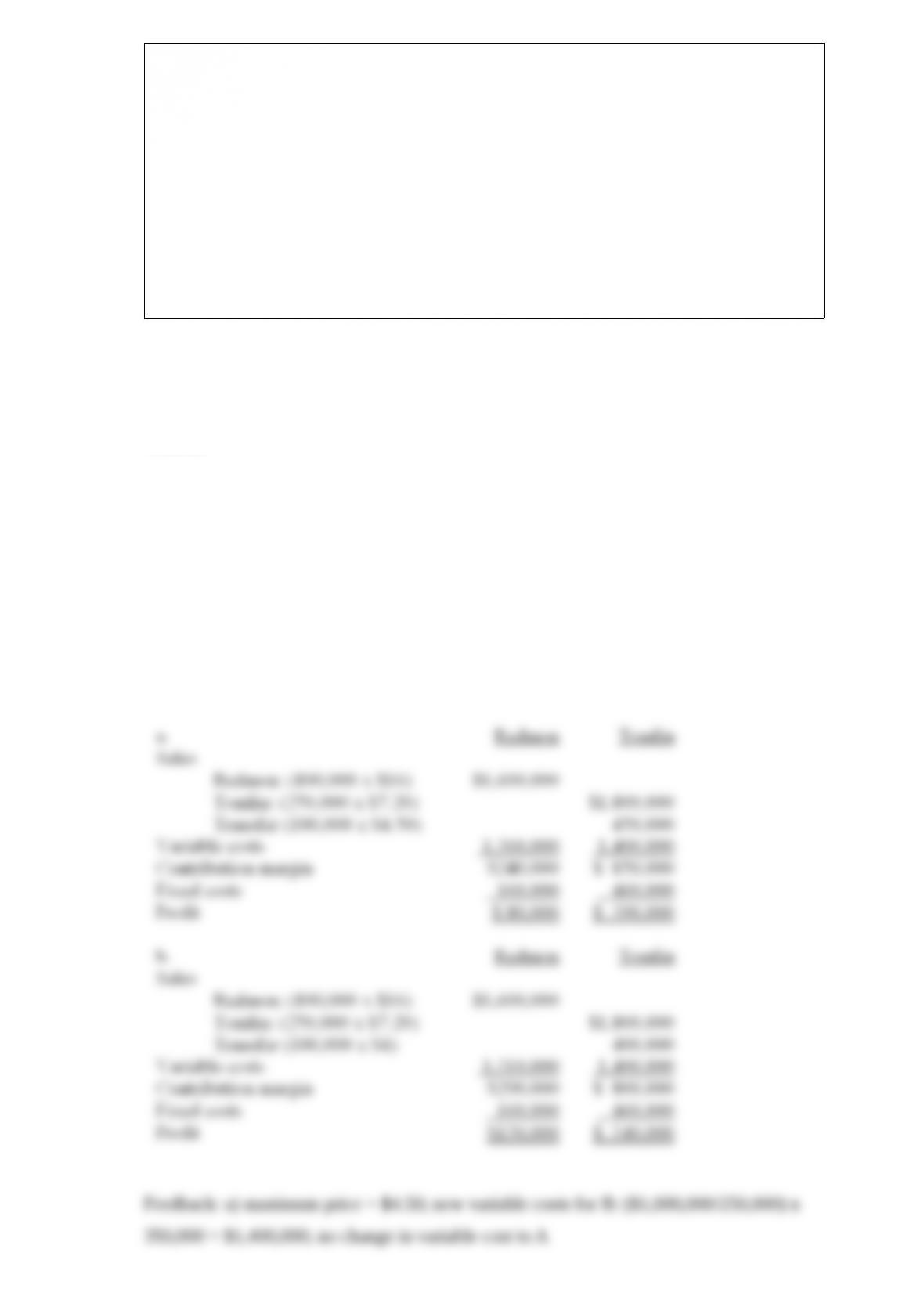
Included in Redmon’s costs are 100,000 units of a subcomponent purchased from an
outside supplier for $4.50. The managers have recently initiated negotiations for Tomlin
to supply the components to Redmon. Tomlin has a total capacity of 400,000 units.
Required:
a) Prepare a new segment reporting statement for Ryman, assuming an internal transfer
at the maximum transfer price.
b) Prepare a new segment reporting statement for Ryman, assuming an internal transfer
at the minimum transfer price.
Answer:
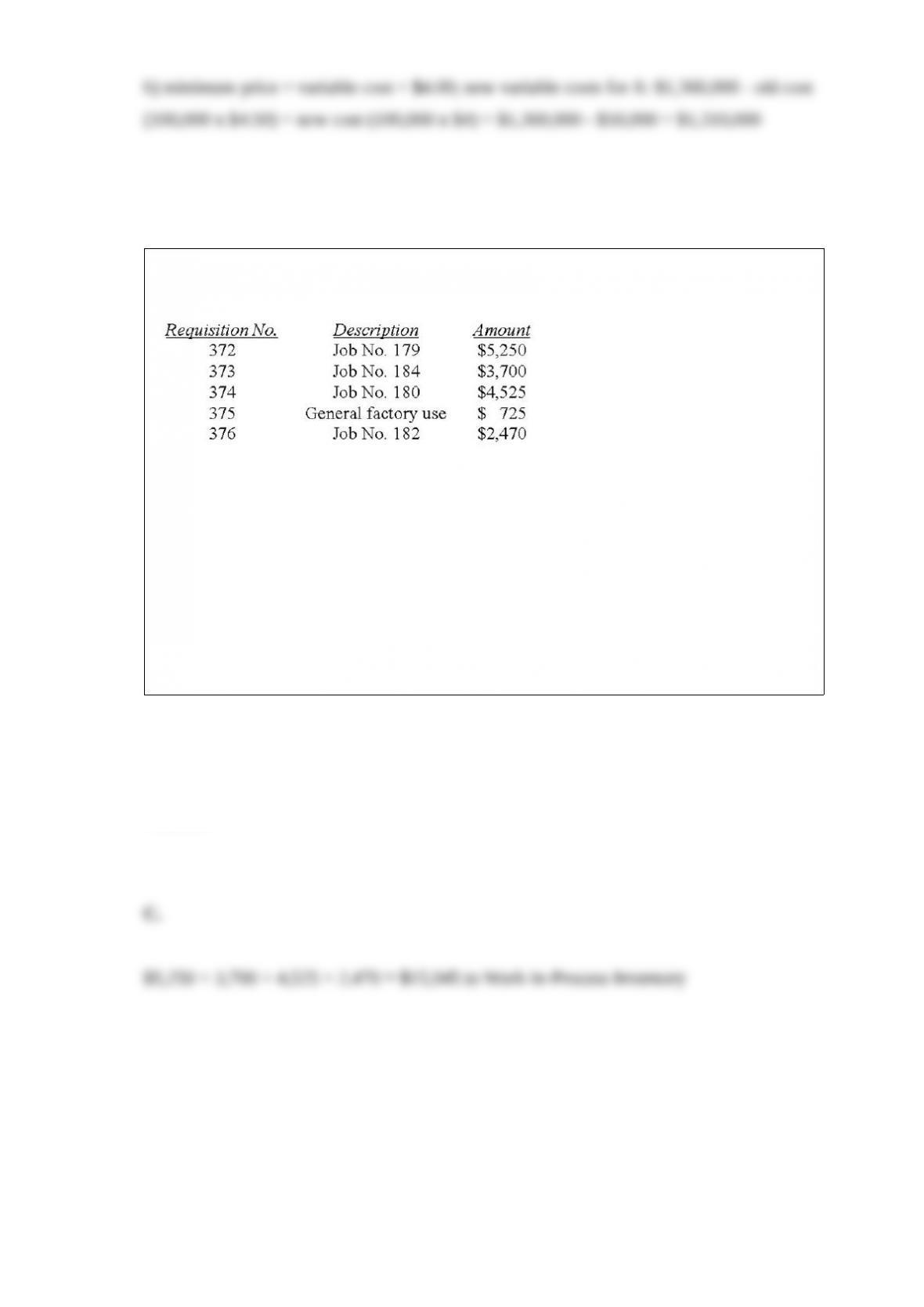
The general journal entry to record the issuance of the materials represented by the
following materials requisitions for the month includes:
A. a debit to Materials Inventory, $15,945.
B. a debit to Materials Inventory, $16,670.
C. a debit to Work in Process Inventory, $15,945.
D. a credit to Work in Process Inventory, $15,945.
E. a credit to Factory Overhead, $725.
Answer: