General Product Inc. shipped 100 million coupons in products it sold in 2013. The
coupons are redeemable for 30 cents each. General anticipates that 70% of the coupons
will be redeemed. The coupons expire on December 31, 2014. There were 45 million
coupons redeemed in 2013 and 30 million redeemed in 2014
What was General’s coupon promotion expense in 2013? A. $30.0 million.
B. $21.0 million.
C. $13.5 million.
D. $7.5 million.
Answer:
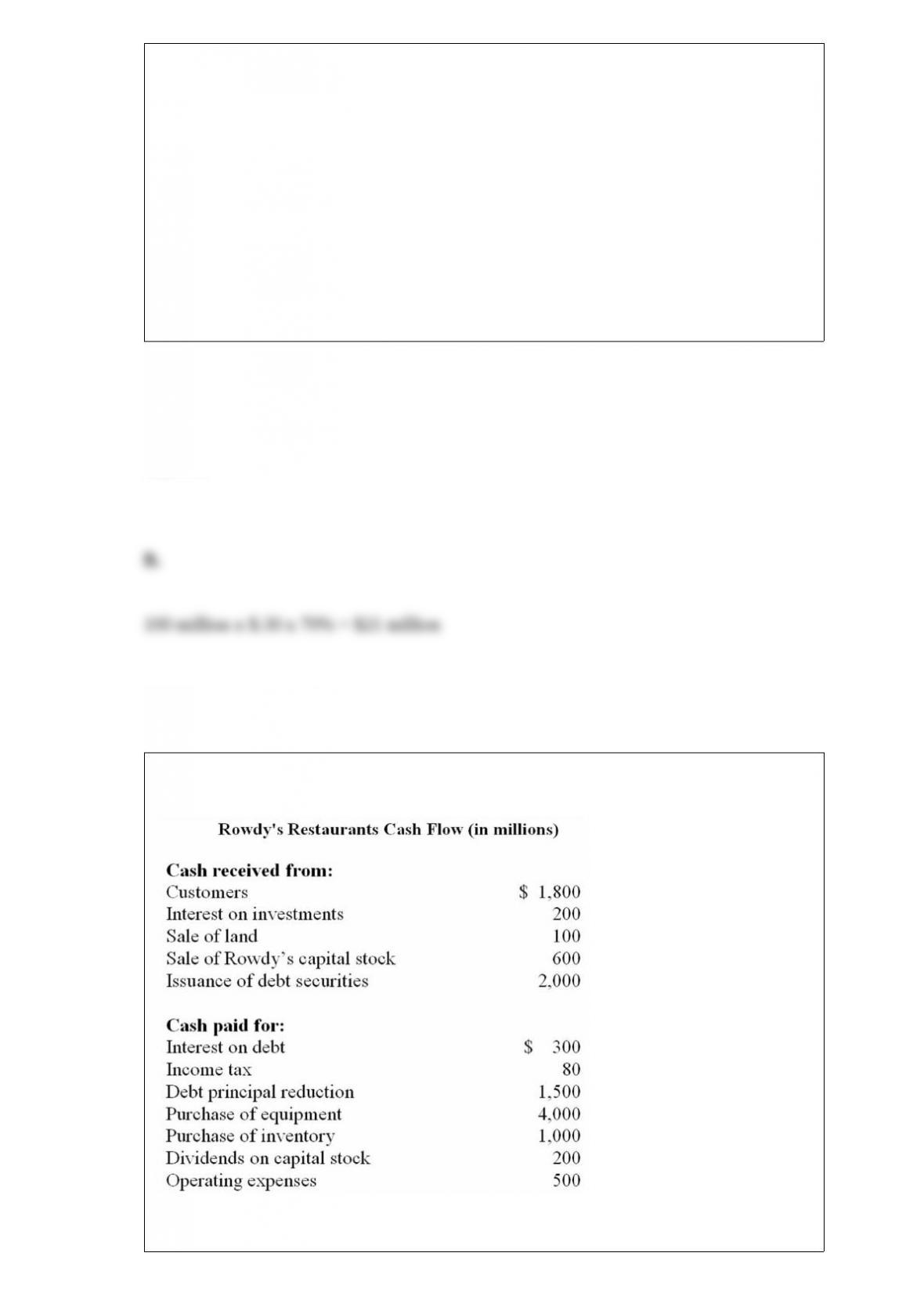
Rowdy’s would report net cash inflows (outflows) from financing activities in the

amount of: A. $1,100.
B. $(1,100).
C. $820.
D. $900.
Answer:
As of December 31, 2012, Gill Co. reported accounts receivable of $216,000 and an
allowance for uncollectible accounts of $8,400. During 2013, accounts receivable
increased by $22,000, and $7,800 of bad debts were written off. An analysis of Gill
Co.’s December 31, 2013, accounts receivable suggests that the allowance for
uncollectible accounts should be 3% of accounts receivable. Bad debt expense for 2013
would be: A. $6,540.
B. $7,800.
C. $7,140.
D. None of the above is correct.
Answer:

Puritan Corp. reported the following pretax accounting income and taxable income for
its first three years of operations:
Puritan’s tax rate is 40% for all years. As of December 31, 2013, Puritan was certain
that it would recover the full tax benefit of the NOL that remained after the operating
loss carryback.
What would Puritan report as net income for 2014? A. $620,000.
B. $420,000.
C. $250,000.
D. $460,000.
Answer:

A future economic benefit owned or controlled by an entity is: A. A revenue.
B. An asset.
C. A liability.
D. A contra asset until used.
Answer:
When bonds include detachable warrants, what is the appropriate accounting for the
cash proceeds from the bond issue? A. The proceeds from the bond issue are allocated
between the bonds and the warrants on the basis of their relative market values.
B. The proceeds from the bond issue are allocated between the bonds and the warrants
on the basis of their relative face values.
C. A nominal amount is allocated to the warrants.
D. All of the proceeds are allocated to the bonds.
Answer:

Which of the following usually results in an increase in a deferred tax asset? A.
Accelerated depreciation for tax reporting and straight-line depreciation for financial
reporting.
B. Prepaid insurance.
C. Subscriptions delivered for which customers had paid in advance.
D. None of the above is correct.
Answer:
One of the elements that many believe distinguishes a profession from other
occupations is the acceptance of responsibility by its members for the interests of those
it serves, which is often articulated in: A.Its conceptual framework.
B.Its code of ethics.
C.Federal laws.
D.State laws.
Answer:
For classification purposes, a valuation allowance: A. Is allocated proportionately

between deferred tax assets and deferred tax liabilities.
B. Is allocated proportionately between the current and noncurrent portions of the
deferred tax asset.
C. Is allocated proportionately between the current and noncurrent portions of the
deferred tax liability.
D. Is added to the deferred tax asset.
Answer:
Which of the following is not true when the fair value option is elected for an
investment that would normally be accounted for under the equity method? A. No
journal entry need be made to recognize the investor’s portion of the investee’s net
income.
B. Unrealized gains and losses on that investment are recognized in net income.
C. No journal entry need be made to recognize the investor’s portion of dividends paid
by the investee.
D. All of the above are true.
Answer:

Under the realization principle, revenue should not be recognized until the earnings
process is deemed virtually complete and: A. Revenue is realized.
B. Any receivable is collected.
C. Collection is reasonably certain.
D. Collection is absolutely assured.
Answer:
Pronouncements issued by the Committee on Accounting Procedures: A.Dealt with
specific accounting and reporting problems.
B.Were based on exposure drafts and public comment letters.
C.Originated from congressional studies and SEC directives.
D.Were the outcome of research studies and a theoretical framework.
Answer:
On November 10 of the current year, Flores Mills sold carpet to a customer for $8,000
with credit terms 2/10, n/30. Flores uses the gross method of accounting for cash
discounts. What is the correct entry for Flores on November 17, assuming the correct
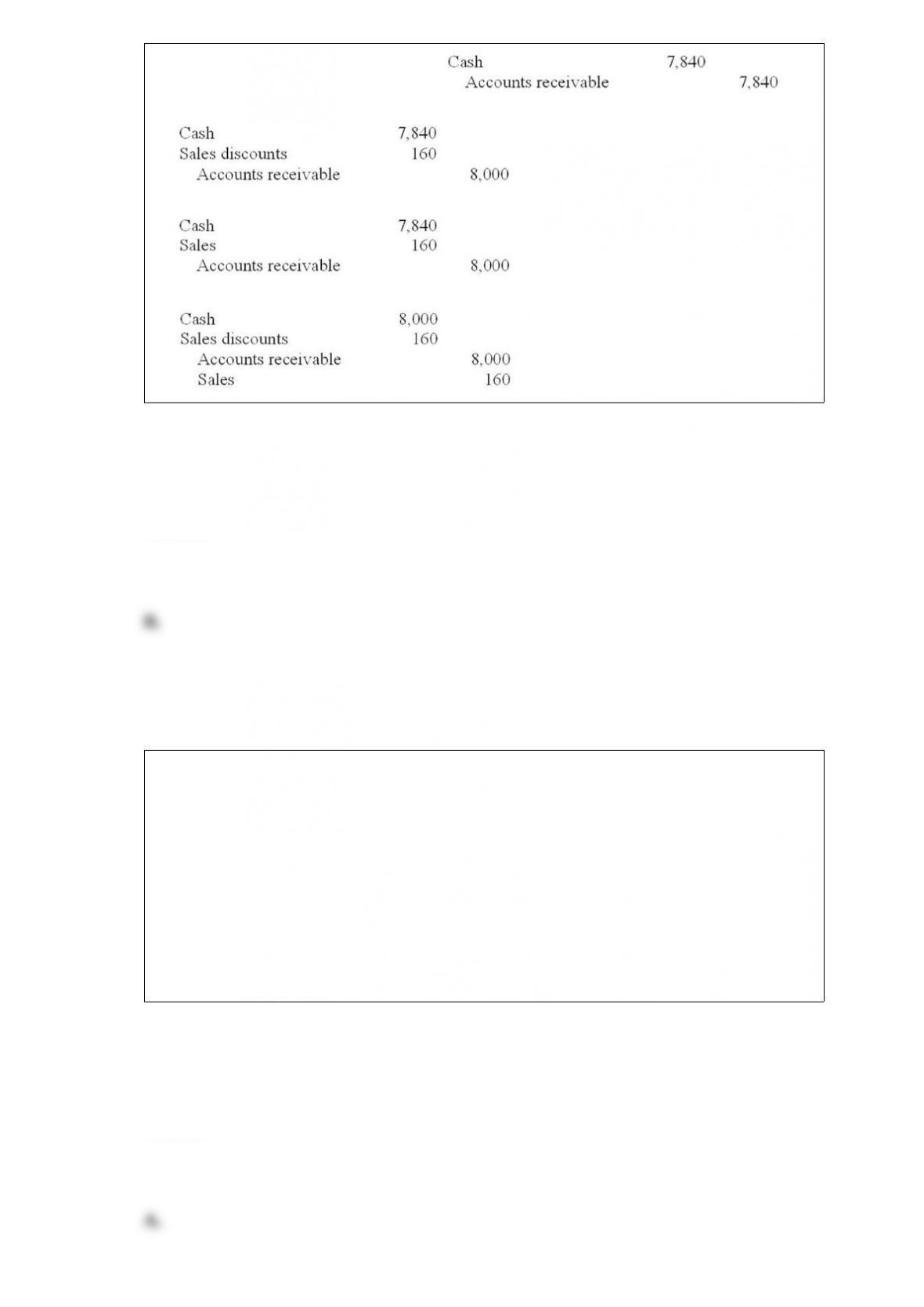
payment was received on that date? A.
B.
C.
D.
Answer:
In the previous year, a firm failed to record premium amortization of $40,000 and
$30,000, respectively, on its bonds payable and held to maturity bond investments.
These errors affect both income before tax and taxable income. The firm’s tax rate is
30%. As a result of this error, net income was: A. Understated by $7,000.
B. Overstated by $7,000.
C. Understated by $33,000.
D. Overstated by $33,000.
Answer:

Prior to 2013, Trapper John Inc. used sum-of-the-years’-digits depreciation on its store
equipment. Beginning in 2013, Trapper John decided to use straight-line depreciation
for these assets. The equipment cost $3 million when it was purchased at the beginning
of 2011, had an estimated useful life of five years and no estimated residual value. To
account for the change in 2013, Trapper John: A. Would retrospectively report $600,000
in depreciation expense annually for 2011 and 2012, and report $600,000 in
depreciation expense for 2013.
B. Would adjust accumulated depreciation and retained earnings for the excess charges
made in 2011 and 2012.
C. Would report depreciation expense of $400,000 in its 2013 income statement.
D. None of the above is correct.
Answer:

Carla Salons leased equipment from SmithCo on July 1, 2013. The present value of the
lease payments discounted at 10% was $80,000. Ten annual lease payments of $12,000
are due at the beginning of each fiscal year beginning July 1, 2013. SmithCo had
constructed the equipment recently for $66,000, and its retail fair value was $100,000.
Under the new ASU, what amount of profit did SmithCo record at the commencement
of the lease? A. $34,000.
B. $27,200.
C. $14,000.
D. $11,800.
Answer:
The matching principle is: A.A valuation method.
B.An expense recognition accounting principle.
C.A cash basis reporting principle.
D.An asset classification procedure.
Answer:

The declaration and issuance of a stock dividend on shares of common stock: A. Has no
effect on assets, liabilities, or total shareholders’ equity.
B. Decreases total shareholders’ equity and increases common stock.
C. Decreases assets and decreases total shareholders’ equity.
D. Does not change retained earnings or paid-in capital.
Answer:
At December 31, 2013, Hansen Corporation had 50,000 shares of common stock and
5,000 shares of 6%, $100 par cumulative preferred stock outstanding. No dividends
were declared or paid in 2013. Net income was reported as $200,000. What is basic
EPS? A. $4.00.
B. $3.40.
C. $3.64.
D. $4.02.
Answer:

Information for Hobson Corp. for the current year ($ in millions):
What is Hobson’s income tax payable for the current year? A. $52 million.
B. $50 million.
C. $48 million.
D. $44 million.
Answer:
Which of the following has the statutory authority to set accounting standards in the
United States? A.FASB.
B.IRS.
C.SEC.
D.AICPA.
Answer:

Goofy Inc. bought 15,000 shares of Crazy Co.’s stock for $150,000 on May 5, 2012,
and classified the stock as available for sale. The market value of the stock declined to
$118,000 by December 31, 2012. Goofy reclassified this investment as trading
securities in December of 2013 when the market value had risen to $125,000. What
effect on 2013 income should be reported by Goofy for the Crazy Co. shares? A. $0.
B. $25,000 net loss.
C. $7,000 net gain.
D. $32,000 net loss.
Answer:
If a change is made from straight-line to SYD depreciation, one should record the
effects by a journal entry including: A. A credit to deferred tax liability.
B. A credit to accumulated depreciation.
C. A debit to depreciation expense.
D. No journal entry is required.
Answer:

On March 31, 2013, M. Belotti purchased the right to remove gravel from an old rock
quarry. The gravel is to be sold as roadbed for highway construction. The cost of the
quarry rights was $164,000, with estimated salable rock of 20,000 tons. During 2013,
Belotti loaded and sold 4,000 tons of rock and estimated that 16,000 tons remained at
December 31, 2013. At January 1, 2014, Belotti estimated that 20,000 tons still
remained. During 2014, Belotti loaded and sold 8,000 tons.
The legal life of a patent is: A. 40 years.
B. 20 years.
C. Life of the inventor plus 50 years.
D. Indefinite.
Answer:
Hepburn Company bought a copyright for $90,000 on January 1, 2010, at which time
the copyright had an estimated useful life of 15 years. On January 5, 2013, the company
determined that the copyright would expire at the end of 2018. How much should
Hepburn record as amortization expense for this copyright for 2013? A. $14,400.
B. $7,200.
C. $8,000.
D. $12,000.
Answer:
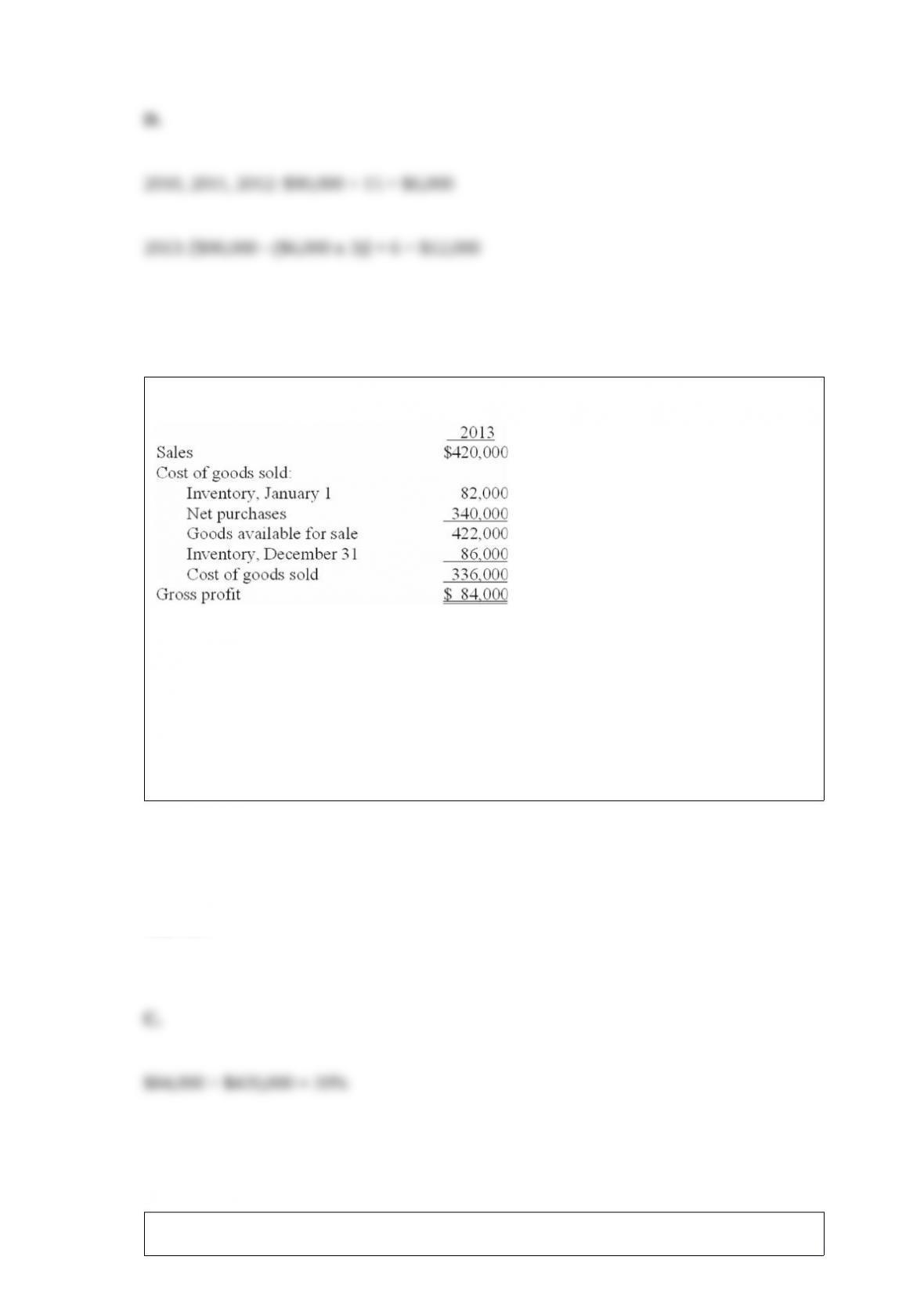
Thompson TV and Appliance reported the following in its 2013 financial statements:
Thompson’s 2013 gross profit ratio is: A. 25%.
B. 19%.
C. 20%.
D. None of the above is correct.
Answer:
Franklin’s balance sheet at the end of its first year would report: A. A deferred tax

liability of $16 among noncurrent liabilities.
B. A deferred tax liability of $16 among current liabilities.
C. A deferred tax asset of $16 among noncurrent assets.
D. A deferred tax asset of $16 among current assets.
Answer:
On December 31, 2012, Beta Company had 300,000 shares of common stock issued
and outstanding. Beta issued a 5% stock dividend on June 30, 2013. On September 30,
2013, 40,000 shares of common stock were reacquired as treasury stock. What is the
appropriate number of shares to be used in the basic earnings per share computation for
2013? A. 315,000.
B. 307,500.
C. 305,000.
D. 267,500.
Answer:

Listed below are six terms followed by a list of phrases that describe or characterize
each of the terms. Match each phrase with the most correct term. 1) EPBO
2) Loss or (gain) on plan assets
3) Service cost
4) Choice between PBO and ABO
5) Defined contribution plan
6) Discount rate
A. Actuarial estimate of postretirement benefits to be received by participants
B. Return on plan assets lower or (higher) than expected
C. Risk borne by employee
D. Used by actuaries to adjust for the time value of money
E. Trade-off between relevance and reliability
F. Increase in the PBO
Answer:
Jacobsen Corporation prepares its financial statement applying U.S. GAAP. During its
2013 fiscal year, the company reported before-tax income of $620,000. This amount
does not include the following two items, both of which are considered to be material in
amount:
The company’s income tax rate is 40%. In its 2013 income statement, Jacobsen would
report income from continuing operations of: A. $312,000.
B. $372,000.
C. $492,000.
D. $620,000.
Answer:
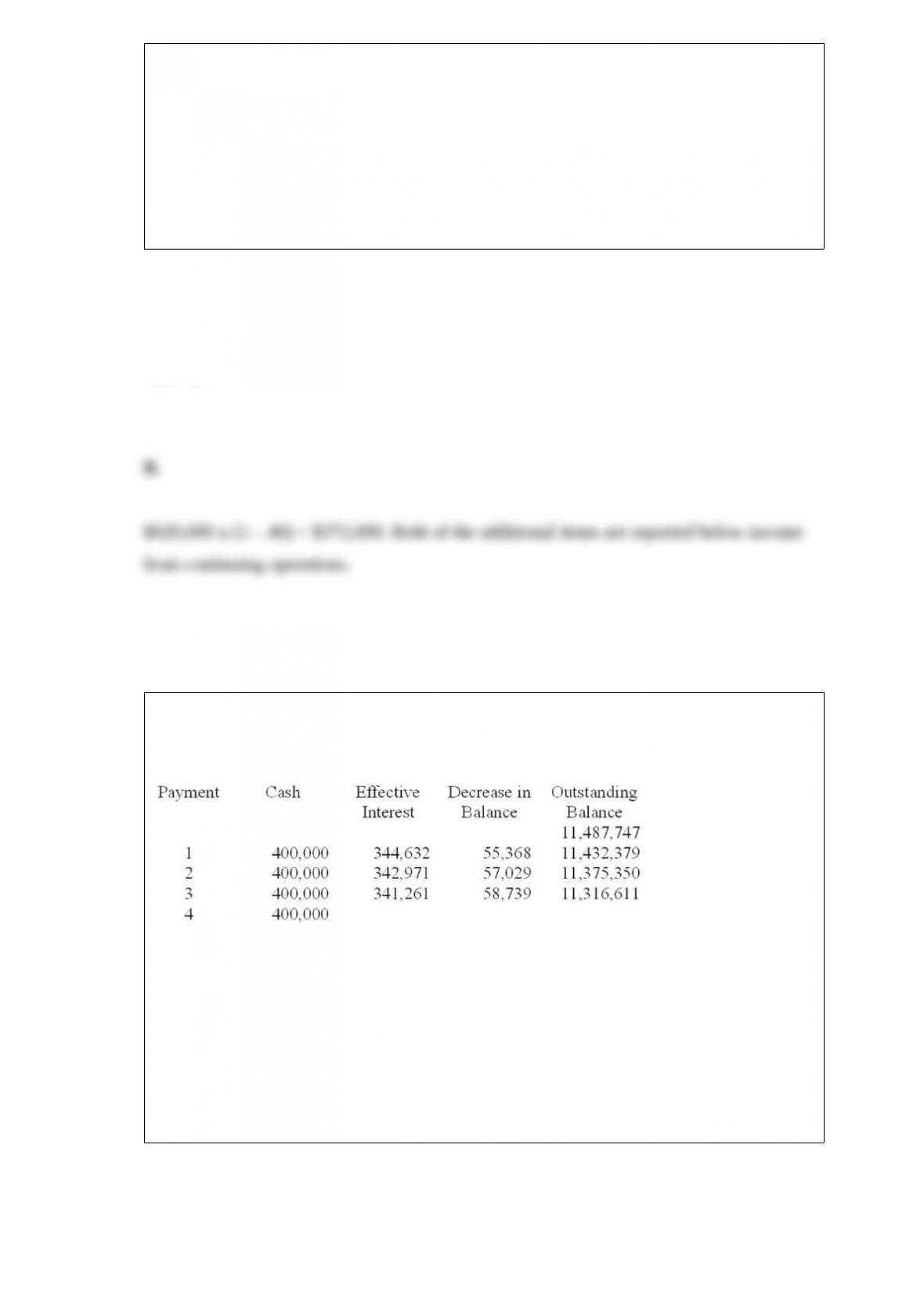
Prescott Corporation issued ten thousand $1,000 bonds on January 1, 2013. The bonds
have a 10-year term and pay interest semiannually. This is the partial bond amortization
schedule for the bonds.
What would be the total interest expense recognized for the bond issue over its full
term? A. $6,512,253.
B. $8,000,000.
C. $9,487,747.
D. $11,487,747.

Answer:
Four independent situations are described below. Each involves future deductible
amounts and/or future taxable amounts produced by temporary differences reported first
on:
Required:
For each situation, determine the taxable income assuming pretax accounting income is
$100,000. Show well-labeled computations.
Answer:
What is meant by the term “minimum lease payments”?
Answer:

On December 31, 2012, Merlin Company had outstanding 400,000 shares of common
stock and 40,000 shares of 8% cumulative preferred stock (par $10). On February 28,
2013, Merlin issued an additional 36,000 shares of common stock. A 10% stock
dividend was declared and distributed on July 1, 2013. On September 1, 2013, 9,000
shares were retired. At year-end, there were fully vested incentive stock options
outstanding for 30,000 shares of common stock (adjusted for the stock dividend). The
exercise price was $18. The market price of the common stock averaged $20 during the
year. Also outstanding were $1,000,000 face amount of 10% convertible bonds issued
in 2010 and convertible into 50,000 common shares (adjusted for the stock dividend).
Net income was $900,000. The tax rate for the year was 40%.
Required:
Compute basic and diluted EPS (rounded to 2 decimal places) for the year ended
December 31, 2013.
Answer:
Describe what is meant by prepaid expenses and give two examples.
Answer:
What is the purpose of the statement of cash flows? List the three major categories of
cash flows and give an example of a cash transaction for each category.
Answer:
The following information is taken from the accounting records of Rapid Runner Inc.
for the year 2013. Missing information has been left blank.
Required:
Compute the missing amounts.

Answer:
Eastwood Enterprises owns 30,000 shares of the Van Cleef Company (5% of the
outstanding equity of Van Cleef). Eastwood is trying to determine Van Cleef’s fair
value. The relevant facts are as follows:
– Eastwood bought the Van Cleef shares earlier in the accounting period for $10/share at
a time when the shares were publicly traded on the New York Stock Exchange.
– Since Eastwood bought the shares, Van Cleef has been delisted and there is no longer
an active market in the Van Cleef shares.
– Eastwood’s internal valuation specialist estimates the Van Cleef shares to be worth
$8/share. Eastwood plans to continue holding the shares, but may someday sell them if
their value increases sufficiently.
Required:
(1) What is the fair value of Eastwood’s investment in Van Cleef? Briefly explain your
choice of fair value, and relate that choice to the requirements of GAAP regarding fair
value measurement.
(2) Prepare a journal entry to record any necessary fair value adjustment.
Answer:

Woolery, Inc., had 50,000 shares of common stock outstanding at January 1, On March
31, 2013, an additional 12,000 shares were sold for cash. Woolery also had $4,000,000
of 6% convertible bonds outstanding throughout the year. The bonds are convertible
into 40,000 shares of common stock. Net income for the year was $350,000. The tax
rate is 35%.
Required:
Compute basic and diluted earnings per share (rounded to 2 decimal places) for the year
ended December 31, 2013.
Answer:
You are reviewing O’Brian Co.’s adjusted trial balance for the year ended 12/31/13. You
notice several omissions and incorrect items during your review, some of which are
noted below. For each one, you are to determine what effect, if any, these items would
have on the stated components of O’Brian Co.’s 2013 Income Statement and 12/31/13
Balance Sheet if they are not corrected or updated. Assume no income taxes.
Use the following code for your answers. You need not include any dollar amounts.
N = No Effect
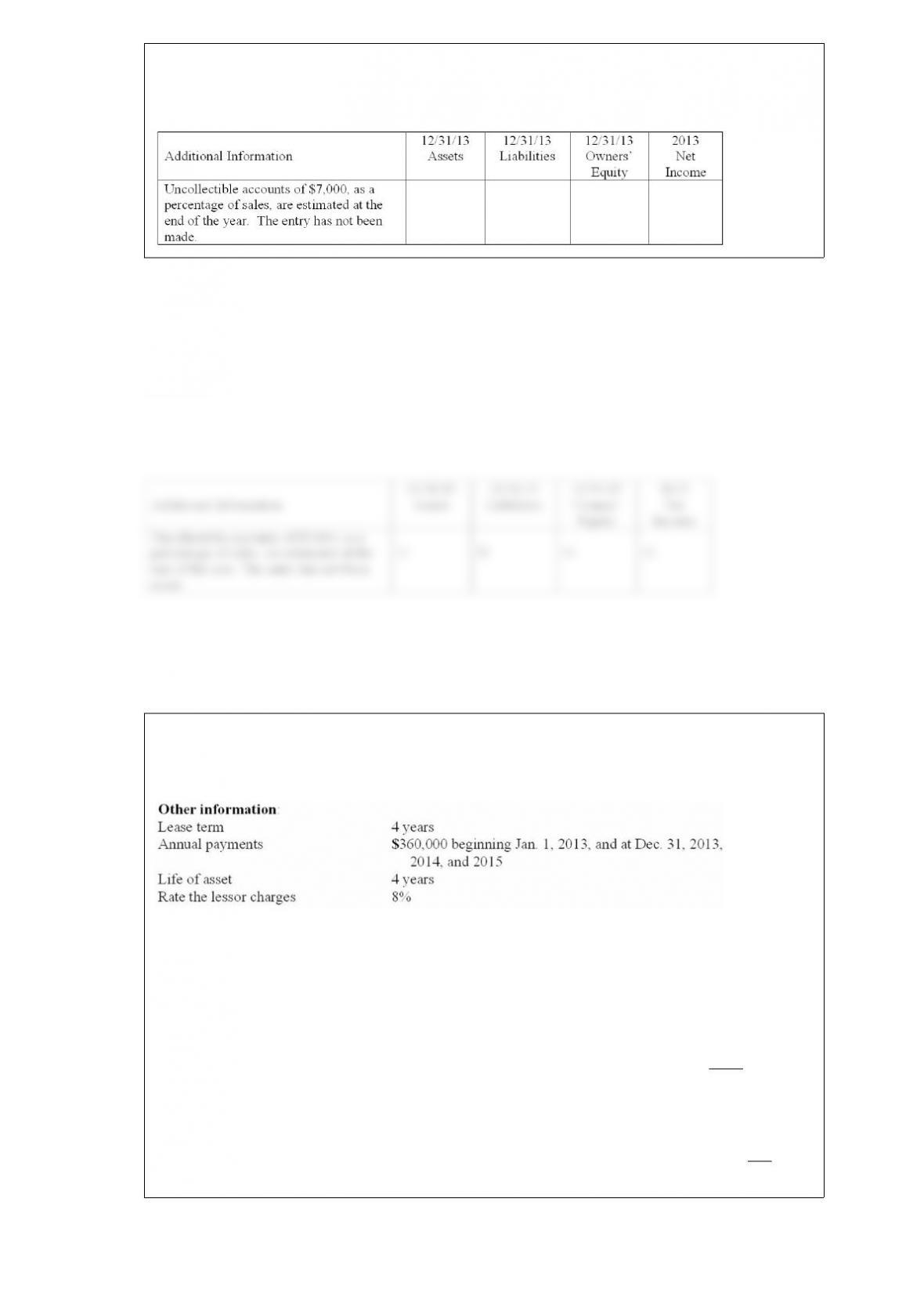
O = Overstated
U = Understated
Answer:
Neely BBQ leased equipment from Smoke Industries on January 1, 2013. Smoke
Industries had manufactured the equipment at a cost of $810,000. Its cash selling price
and fair value is $1,287,756. Both companies employ the lease ASU.
Required:
1) Prepare the appropriate entries for Neely BBQ (Lessee) on January 1, 2013, and
December 31, 2013.
2) Prepare the appropriate entries for Smoke Industries (Lessor) on January 1, 2013,
and December 31, 2013. Assume that Smoke Industries determined that it does retain
exposure to significant risks or benefits associated with the equipment.
3) Prepare the appropriate entries for Smoke Industries (Lessor) on January 1, 2013,
and December 31, 2013. Assume that Smoke Industries determined that it does not
retain exposure to significant risks or benefits associated with the equipment.

Answer:
Arctic Cat Inc., the snowmobile manufacturer, reported the following in its 20X5
annual report to shareholders:
NOTE B – SHORT-TERM INVESTMENTS
Short-term investments consist primarily of a diversified portfolio of municipal bonds
and money market funds and are classified as follows at March 31:
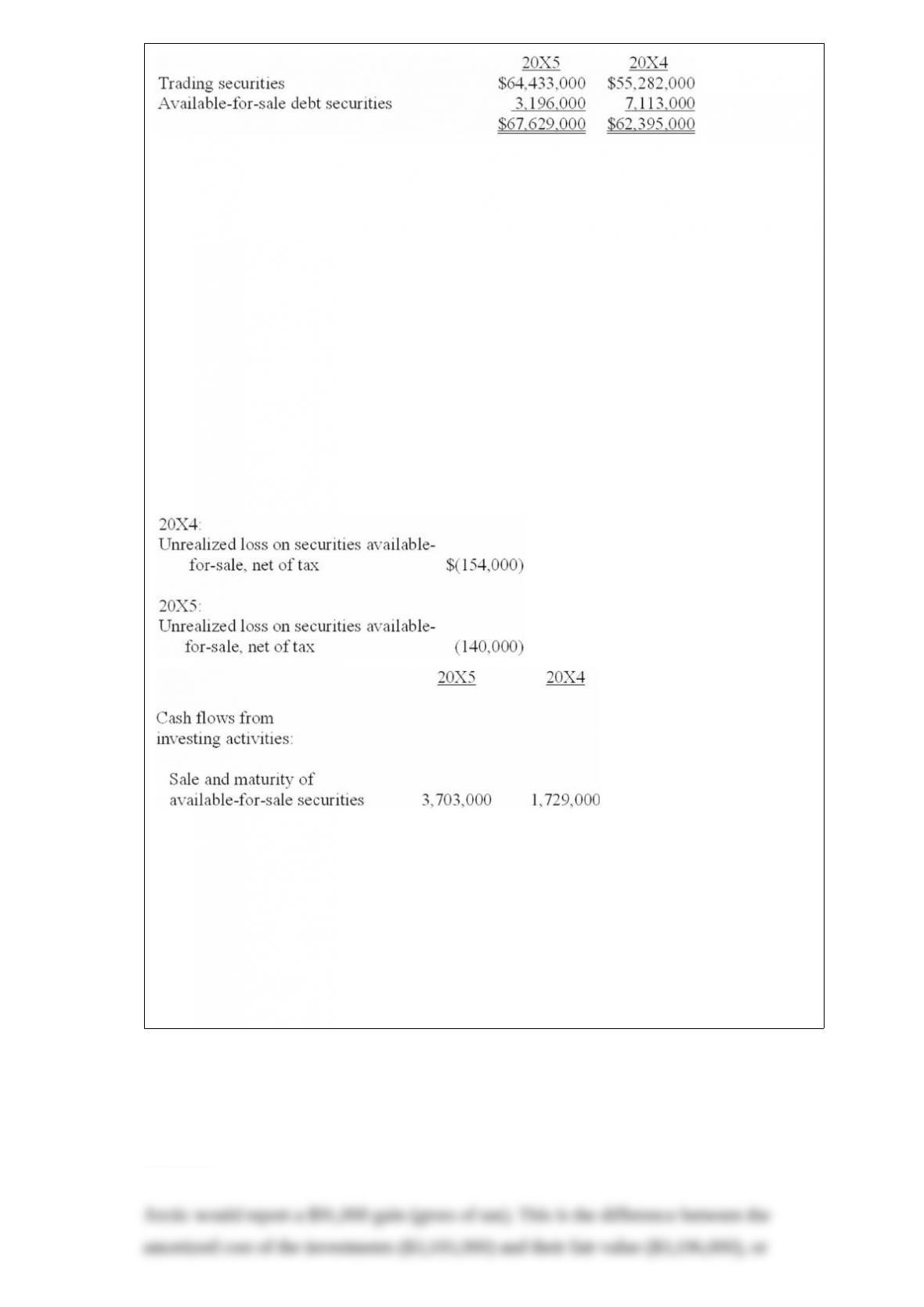
Trading securities consist of $54,608,000 and $41,707,000 invested in various money
market funds at March 31, 20X5 and 20X4, respectively, while the remainder of trading
securities and available-for-sale securities consist primarily of A-rated or higher
municipal bond investments. The amortized cost and fair value of debt securities
classified as available-for-sale was $3,105,000 and $3,196,000, at March 31, 20X5. The
unrealized gain on available-for-sale debt securities is reported, net of tax, as a separate
component of shareholders’ equity.
Arctic Cat Inc.
CONSOLIDATED STATEMENTS OF SHAREHOLDERS’ EQUITY
Years Ended March 31,
Accumulated Other Comprehensive Income changed by the following amounts:
In its 20X4 annual report, Arctic Cat disclosed, “The contractual maturities of
available-for-sale debt securities at March 31, 20X4, are $3,573,000 within one year
and $3,340,000 from one year through five years.”
What gain or loss would be realized if the available for sale securities on Arctic Cat’s
3/31/X5 balance sheet were sold immediately for their fair value? Show the journal
entry that would record the sale, and show a journal entry to record the effects of the
sale on their fair value adjustment at the end of the period (ignore taxes).
Answer:
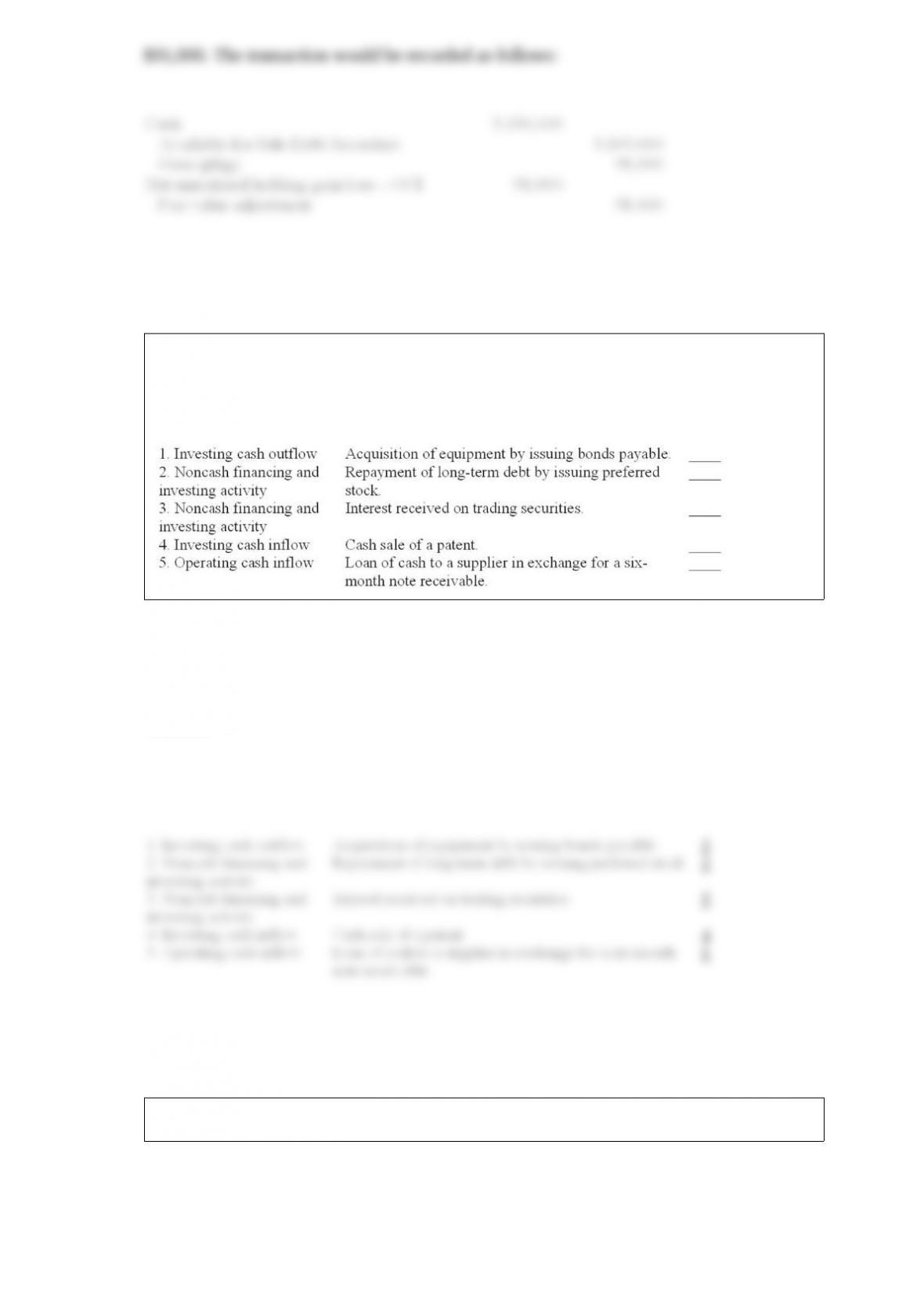
Listed below are the reporting classifications for a statement of cash flows using the
direct method for reporting operating cash flows. Indicate the reporting classification
that would apply to each of the five transactions described below by placing the number
of the reporting classification in the space provided by each transaction.
Answer:
The balance sheet for Altoid Co. is shown below.
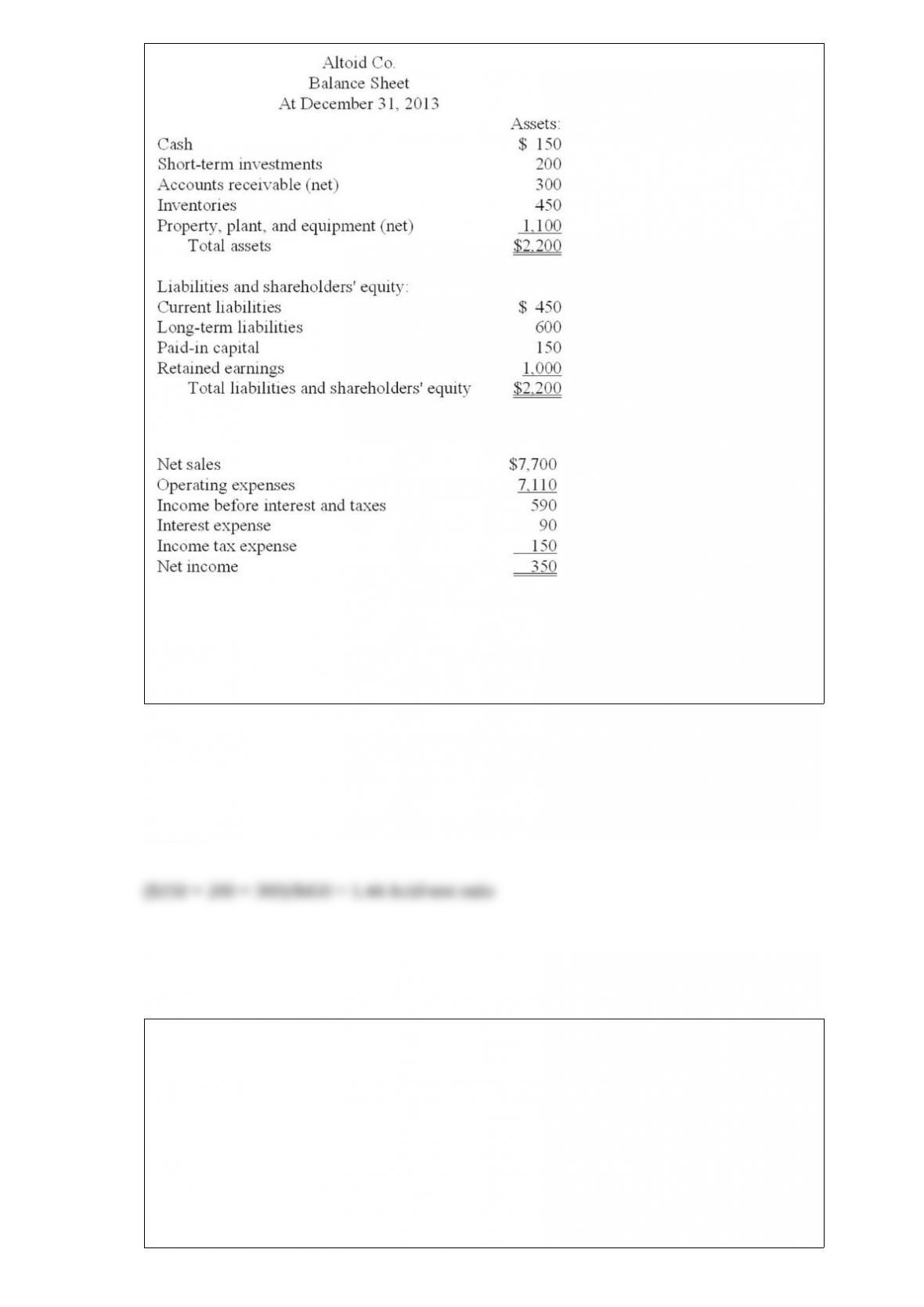
Selected 2013 income statement information for Altoid Co. includes:
Required:
Compute the following financial statement ratios for 2013:
Altoid Co.’s acid-test ratio. Round your answer to two decimal places.
Answer:
On September 1, 2013, Triton Entertainment borrowed $24 million cash to fund a new
Fun Park. The loan was made by Nevada Bank under a noncommitted short-term line of
credit arrangement. Triton issued a 9-month, 12% promissory note. Interest was payable
at maturity. Triton’s fiscal period is the calendar year.
Required:
1) Prepare the journal entry for the issuance of the note by Triton.
2) Prepare the appropriate adjusting entry for the note by Triton on December 31, 2013.
3) Prepare the journal entry for the payment of the note at maturity.
Answer:
Give an example of a violation of the stable monetary unit assumption. How would it
affect the quality of financial statement information?
Answer: