1) On January 1, 2011, Pardy Corporation acquired a 70% interest in the common stock
of Salter Corporation for $7,000,000 when Salter’s stockholders’ equity was as follows:
10% cumulative, nonparticipating preferred stock,
$100 par, with a $105 liquidation preference,
callable at $110$ 1,000,000
Common stock, $10 par value6,000,000
Additional paid-in capital1,500,000
Retained earnings2,500,000
Total stockholders’ equity$11,000,000
There were no preferred dividends in arrears on January 1, 2011 . There are no book
value/fair value differentials.
What is the implied goodwill for Salter based on Pardy’s purchase price for Salter on
January 1, 2011?
A) $ 0
B) $ 35,000
C) $ 70,000
D) $100,000
2) Assume an upstream sale of machinery occurs on January 1, 2011 . The parent owns
70% of the subsidiary. There is a gain on the intercompany transfer and the machine has
five remaining years of useful life and no salvage value. Straight-line depreciation is
used. Which of the following statements is correct?
A) Noncontrolling interest share for 2011 is equal to: subsidiary income for 2011
multiplied by 30%
B) Noncontrolling interest share for 2011 is equal to: (subsidiary income for 2011
minus the gain on sale plus the excess depreciation expense) multiplied by 30%
C) Noncontrolling interest share for 2011 is equal to: (subsidiary income for 2011
minus the gain on sale) multiplied by 30%
D) Noncontrolling interest share for 2011 is equal to: (subsidiary income for 2011 plus
the excess depreciation expense) multiplied by 30%

3) The expectations theory and the segmented markets theory do not explain the facts
very well, but they provide the groundwork for the most widely accepted theory of the
term structure of interest rates,
A) the Keynesian theory
B) separable markets theory
C) liquidity premium theory
D) the asset market approach
4) Under the amended Uniform Probate Code, if the decedent dies intestate, and if there
are descendants from a prior marriage or relationship, the surviving spouse receives
what?
A) $25,000 and 2/3 of the remaining intestate estate
B) $200,000 and 1/3 of the remaining intestate estate
C) $50,000 and 1/2 of the remaining intestate estate
D) $100,000 and 1/2 of the remaining intestate estate
5) Pass Corporation owns 80% of Sindy Company, purchased at the underlying book
value on January 1, 2010 . On January 1, 2010, Pass also purchased $200,000 par value
6% bonds that had been issued by Sindy on January 1, 2007 with a ten-year
maturity(due January 1, 2017). Annual interest is paid on December 31 . Straight-line
amortization is used by both companies.
At year-end 2010, the following entry was made on the consolidating worksheet.
Bonds Payable$200,000
Bond Premium12,000
Loss on Bond Retirement7,000
Interest Income(a)
Investment in Sindy Bonds$218,000
Interest Expense(b)
Required:
1>How much did Pass pay for the bonds?
2>What is the book value of the bonds on the date of purchase?
3>What amount of interest income and interest expense must be eliminated in the entry
above designated as (a) and (b)?
6) Which of the following statements are true?
A) An increase in tax rates will increase the demand for Treasury bonds, lowering their
interest rates
B) Because the tax-exempt status of municipal bonds was of little benefit to bond
holders when tax rates were low, they had higher interest rates than US government
bonds before World War II
C) Interest rates on municipal bonds will be higher than comparable bonds without the
tax exemption
D) Because coupon payments on municipal bonds are exempt from federal income tax,
the expected after-tax return on them will be higher for individuals in lower income tax
brackets
7) Paris Corporation purchased 80% of the outstanding voting common stock of
Sanders Corporation on January 1, 2011, at a cost of $400,000. The stockholders’ equity
of Sanders Corporation on this date consisted of $200,000 of Capital Stock and
$100,000 of Retained Earnings. Book values were equal to fair values except for land
and inventory. The book value of Sanders’ land was $10,000, and fair value was
$22,000. The book value of Sanders’ inventory was $30,000, and fair value was
$25,000.
Assume Paris’s land account had a book value of $50,000 and a fair value of $70,000 on
January 1, 2011. Using the parent company and entity theories, what amounts would be
reported on the consolidated balance sheet at January 1, 2011 for the land account?
Parent Company TheoryEntity Theory
A)
B)
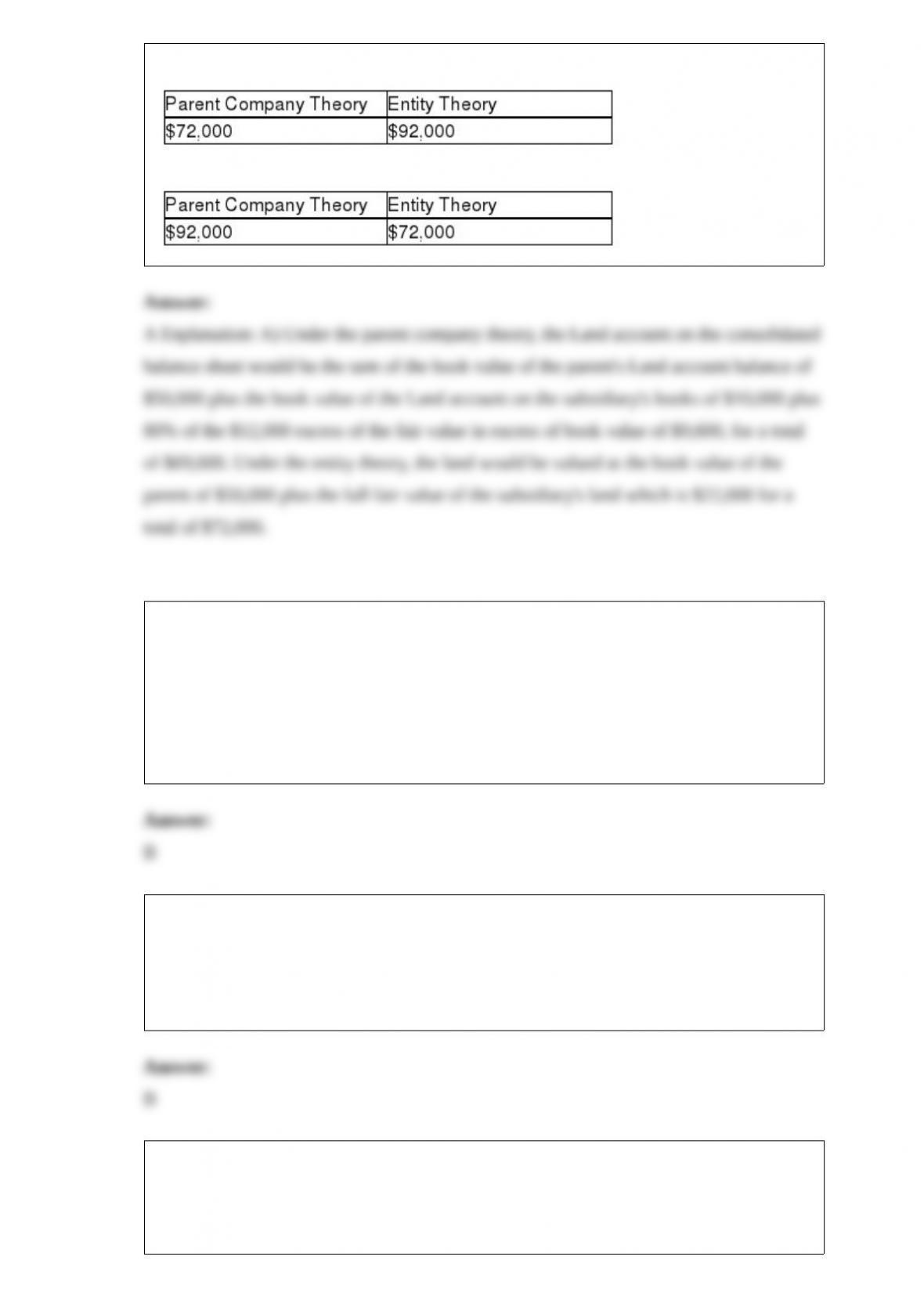
C)
D)
8) Other things being equal, a decrease in the default risk of corporate bonds shifts the
demand curve for corporate bonds to the ________ and the demand curve for Treasury
bonds to the ________
A) right; right
B) right; left
C) left; right
D) left; left
9) What basis of accounting is used by fiduciary funds?
A) Modified accrual accounting
B) Accrual accounting
C) Cash basis accounting
D) Present value accounting
10) Phast Corporation owns a 80% interest in Stechno Company, acquired several years
ago at a cost equal to book value and fair value. Stechno sells merchandise to Phast for
the first time in 2011, and some is unsold at December 31, 2011 . In computing income
from the investee for 2011 under the equity method, Phast uses which equation?

A) 80% of Stechno’s income less 100% of the unrealized profit in Phast’s ending
inventory
B) 80% of Stechno’s income plus 100% of the unrealized profit in Phast’s ending
inventory
C) 80% of Stechno’s income less 80% of the unrealized profit in Phast’s ending
inventory
D) 80% of Stechno’s income plus 80% of the unrealized profit in Phast’s ending
inventory
11) The mound-shaped yield curve in the figure above indicates that short-term interest
rates are expected to
A) rise in the near-term and fall later on
B) fall moderately in the near-term and rise later on
C) fall sharply in the near-term and rise later on
D) remain unchanged in the near-term and fall later on
12) Which fund would most likely report depreciation expense?
A) A special revenue fund
B) An enterprise fund
C) A capital projects fund
D) A debt service fund
13) On January 1, 2011, Punch Corporation purchased 80% of the common stock of
Soopy Co. Separate balance sheet data for the companies at the acquisition date(after
the acquisition) are given below:
PunchSoopy
Cash$34,000 $206,000
Accounts Receivable144,00026,000
Inventory132,00038,000
Land68,00032,000
Plant assets700,000300,000
Accum. Depreciation(240,000)(60,000)
Investment in Soopy392,000
Total assets$ 1,230,000$ 542,000
Accounts payable$206,000$142,000
Capital stock800,000300,000
Retained earnings224,000100,000

Total liabilities & equities$ 1,230,000$ 542,000
At the date of the acquisition, the book values of Soopy’s net assets were equal to the
fair value except for Soopy’s inventory, which had a fair value of $60,000.
Determine below what the consolidated balance would be for each of the requested
accounts.
What is the reported amount for the noncontrolling interest?
A) $80,000
B) $84,400
C) $98,000
D) $122,500
14) According to the expectations theory of the term structure
A) the interest rate on long-term bonds will exceed the average of short-term interest
rates that people expect to occur over the life of the long-term bonds, because of their
preference for short-term securities
B) interest rates on bonds of different maturities move together over time
C) buyers of bonds prefer short-term to long-term bonds
D) buyers require an additional incentive to hold long-term bonds
15) On January 1, 2011, the Enterprise Fund for a local city receives an operating grant
of $100,000 cash from the state government. Upon receipt of the cash, qualifying
expenses of $200,000 for the operating grant have been incurred. What journal entry
did the Enterprise Fund prepare on January 1, 2011?
A) Debit Cash $100,000, credit Deferred Revenue $100,000
B) Debit Cash $100,000, credit Contributed Capital $100,000
C) Debit Restricted Cash $100,000, credit Nonoperating Revenues $100,000
D) Debit Restricted Cash $100,000, credit Other Financing Sources – operating grant
$100,000
16) Which type of fund is used to account for a government activity that sells goods or
services either solely or almost solely to external customers?
A) A temporary fund
B) A general fund
C) An agency fund
D) An enterprise fund

17) Bounty County had the following transactions in 2011 .
1>The budget for the county was approved, showing estimated revenues of $320,000
from local income taxes, and total estimated expenditures of $316,000.
2>Tax bills were mailed amounting to $326,000, which are due in 60 days. All but 2%
was expected to be collectible.
3>Taxes collected prior to the due date amounted to $260,800. The balance was
delinquent.
4>$4,200 of taxes due were determined to be uncollectible and written off.
5>The year-end books were closed, with the expectation that the remaining taxes due
would be collected evenly over the first two months after the fiscal year end.
Required:
Prepare the journal entries for the General Fund for the transactions.
18) Based upon the cash flow information provided below for the year ended December
31, 2011, prepare a cash flow statement for the Bloomfield Municipal Golf Course, an
enterprise fund.
Green fees received$400,000
Membership fees received160,000
League outing fees received90,000
Interest revenue received2,000
Cash received from short-term note payable (not used
for capital assets)75,000
Payments to employees350,000
Payments to suppliers198,000
Cash paid to the General Fund – Noncapital loan60,000
Payments for capital improvements85,000
Interest paid on short-term loan (loan not used for capital assets)5,000
Unrestricted cash and cash equivalents, January 1, 201117,000
19) Peyton Corporation owns an 80% interest in Sampe Corporation’s common stock.
Throughout 2011, Sampe had 10,000 shares of common stock outstanding and Peyton
had 100,000 shares of common stock outstanding. Sampe’s only dilutive security
consists of $100,000 face amount of 8% bonds payable. Each $1,000 bond is
convertible into 20 shares of Sampe stock. Peyton and Sampe’s separate net incomes for
the year are $200,000 and $150,000, respectively. Assume a 34% flat income tax rate.
Required:
Compute the amount of basic and diluted earnings per share for Peyton (consolidated)
and Sampe Corporations.
20) Ohio Corporation is being liquidated under Chapter 7 of the Bankruptcy Act. The
trustee has determined that the unsecured claims will receive $.05 on the dollar. Lender
Bank holds a $100,000 mortgage note receivable from Ohio that is secured by
equipment with a $120,000 book value and a $90,000 fair value, and a second mortgage
on the same equipment amounting to $50,000.
Required:

How much of the mortgage receivable will be recovered by Lender?
21) Astrotuff Company is planning to purchase 200,000 pounds of nylon from Tangsun
Company. On November 1, 2011, Astrotuff entered into a 90-day forward contract to
hedge the planned purchase. The forward contract is to purchase 200,000 pounds of
nylon at $1.80 per pound (forward rate at November 1, 2011). On November 1, 2011,
the spot price of nylon is $1.75 per pound, but Astrotuff anticipates significant increases
in the price of nylon. The forward contract is to be settled net.
On December 31, 2011, Astrotuff’s year end, the forward rate to January 30, 2012 is
$1.78 per pound. The spot and forward rates on January 30, 2012 are $1.85 per pound.
Astrotuff uses a 6% discount rate relating to their hedging activity. Astrotuff purchases
200,000 pounds of nylon on January 30 when the forward contract expires.
Required:
Prepare the necessary journal entries to account for this cash flow hedge and related
purchase of nylon.
22) Opie Industries is a manufacturer of plastic bottles. On September 1, 2011, Opie
purchased an option contract at a cost of $2,000. The purpose of the option is to hedge
against increases in the price of this type of plastic, “PET.” The option is to buy
1,000,000 pounds of PET on March 1, 2012 for $.75 per pound. If the market price of
PET is below $.75 on March 1, Opie will let the option expire. If the market price is
above $.75, then Opie will exercise the option. The option is to be settled net. Opie
assumes a 6% annual borrowing rate. Assume this is a cash flow hedge.
Required:
Prepare the entry that Opie should record on September 1, 2011 . Then, assuming that
the price of PET is $.72 on December 31, 2011 (Opie’s year end), prepare the entry that
Opie should record. Finally, prepare the entries for March 1, 2012, assuming that the
price of PET is $.78.
23) At December 31, 2012 year-end, Lapwing Corporation’s investment in Ground Inc.
was $200,000 consisting of 80% of Ground’s $250,000 stockholders’ equity on that
date. On April 1, 2013, Lapwing sold 20% interest (one-fourth of its holdings) in
Ground for $65,000. During 2013, Ground had net income of $75,000(earned
uniformly) and on July 1, 2013, Ground paid dividends of $40,000. Lapwing uses the
equity method to account for the investment.
Required:
1> What is the gain or loss on sale of the 20% interest?
2> Record the journal entries for Lapwing for the year ending December 31, 2013 . Use
the actual-sale-date assumption.
24) Pancino Corporation owns a 90% interest in Sakal Corporation’s common stock.
Throughout 2010, Sakal had 20,000 shares of common stock outstanding and Pancino
had 50,000 shares of common stock outstanding. Sakal’s only dilutive security consists
of 2,500 stock options, with an exercise price of $20 per share. The average price of
Sakal’s stock is $50 per share in 2010 . The options are exercisable for one share of
Sakal’s common stock. Pancino’s and Sakal’s separate net incomes for the year are
$100,000 and $80,000, respectively.
Required:
Compute the amount of basic and diluted earnings per share for Pancino (Consolidated)
and Sakal Corporations.