Overestimating a period’s allocation base will understate the predetermined overhead
rate.
Answer:
Unused resource capacity plus the amount of the resources used is equal to the amount
of resources supplied.
Answer:
Service organizations, by their nature, cannot have a balance in Work-in-Process
Inventory.
Answer:
One difference between jobs and projects is the account titles used in the costing
process.
Answer:
If materials are added continuously throughout the production process, then the
equivalent units for materials will always equal the equivalent units for the conversion
costs.
Answer:
One advantage of decentralization is faster response time to changes in the
organization’s environment by local managers.
Answer:
Sales projections are often the most difficult part of the budgeting process because it
involves a considerable amount of subjectivity.
Answer:
Which of the following statements does not represent a limitation of using return on
investment (ROI) for measuring and evaluating performance?
A. ROI uses accounting income which is based on historical costs.
B. ROI cannot be used to compare divisions of different sizes.
C. ROI has the potential to create goal congruence problems.
D. ROI fails to align some costs incurred in one period with the benefits received in
another period.
Answer:
Acme, Inc. had overhead of $310,000 during the year when $260,000 in labor costs
were incurred. Estimates at the start of the year for overhead and labor costs were
$300,000 for overhead and $250,000 for labor costs. The predetermined overhead rate
would be:
A. 101.67%
B. 104.00%
C. 120.00%
D. 83.33%
Answer:
The Axle Division of Becker Company produces axles for off-road sport vehicles.
One-third of Axle’s 30,000 unit output is sold to an internal division of Becker; the
remainder is sold to outside customers. Axles’ estimated operating profit for the year is:
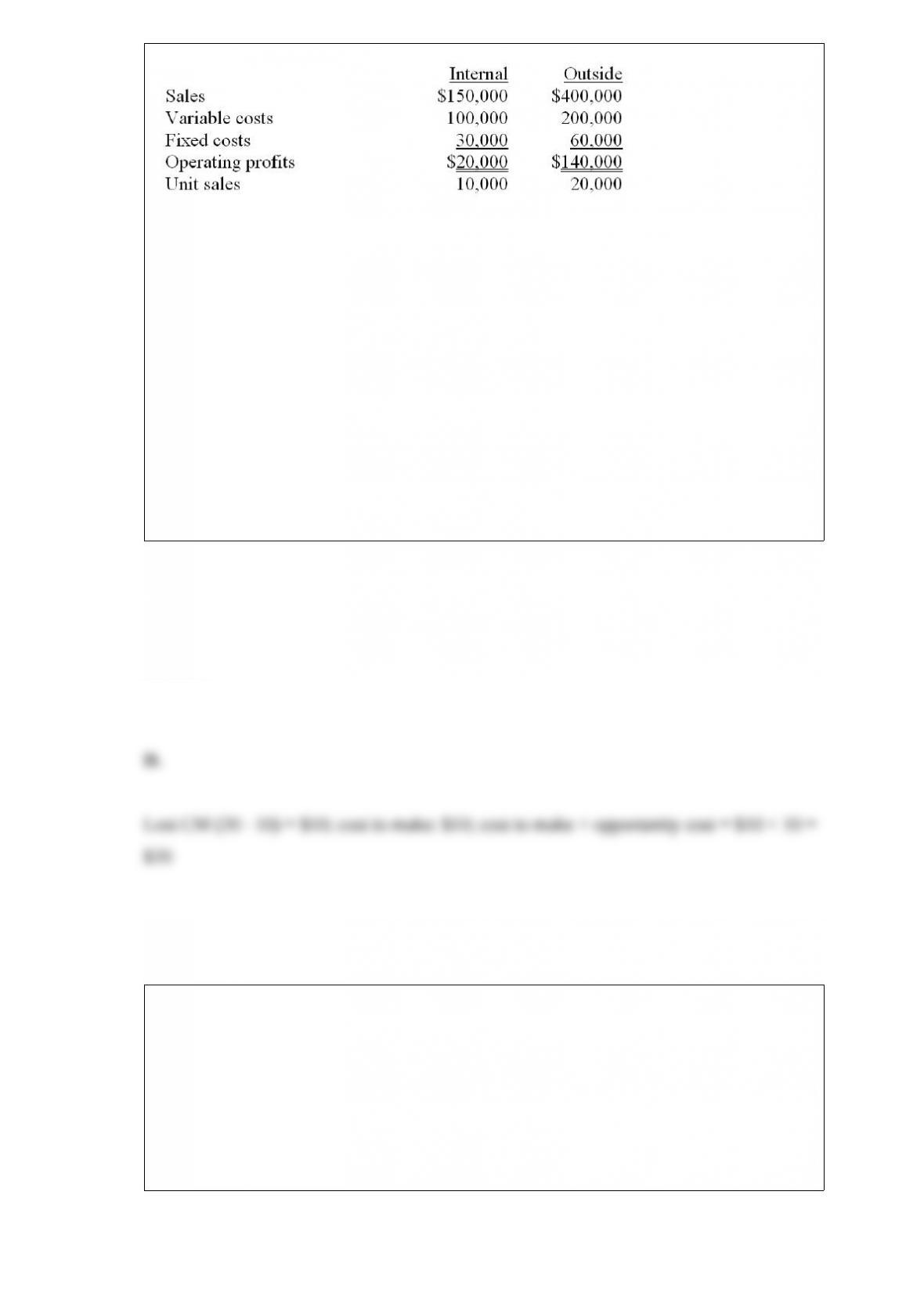
The internal division has an opportunity to purchase 10,000 axles of the same quality
from an outside supplier on a continuing basis. The purchase price would be $13.00. If
the Axle Division is now operating at full capacity and can sell all its units to outside
customers at the present selling price, what is the minimum selling price that Axle
should accept from the internal division?
A. $10.00
B. $13.00
C. $15.00
D. $20.00
Answer:
Baltic Resorts operates a centralized call center for the reservation needs of its
time-share units. Costs associated with use of the center are charged to the time-share
group (Luxury, Standard, and Budget) where a reservation is made on the basis of time
spent on a call. Due to recent increased competition in the time-share, the company has
decided that it is necessary to more accurately allocate its costs to price its services
competitively and profitably. During the current period, the use of the call center for
each group was as follows (in thousands of seconds for time usage and in number of
reservations):
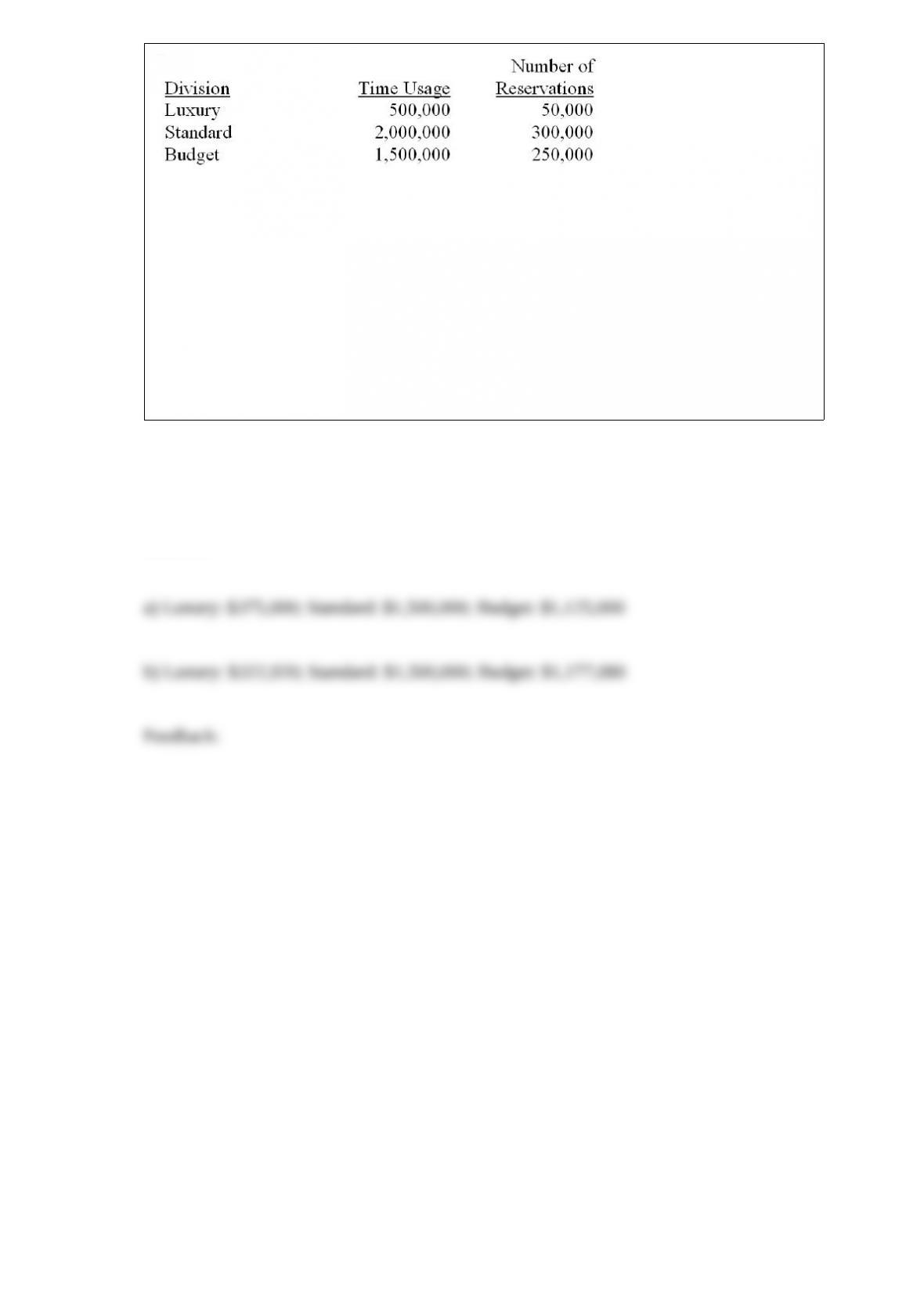
During this period, the cost of the computer center amounted to $1,760,000 for
personnel and $1,240,000 for equipment and other costs.
Required Determine the allocation to each of the divisions using (round all decimals to
three places):
a) A single rate based on time used.
b) Multiple rates based on time used (for personnel costs) and number of reservations
(for equipment and other cost).
Answer:
Classifying a cost as either direct or indirect depends upon
A. whether an expenditure is unavoidable because it cannot be changed regardless of
any action taken.
B. whether the cost is expensed in the period in which it is incurred.
C. the behavior of the cost in response to volume changes.
D. the cost object to which the cost is being related.
Answer:
The most fundamental variance analysis compares
A. standard material prices with actual material prices.
B. standard direct labor rates with actual direct labor rates.
C. budgeted sales revenue with actual sales revenue.
D. budgeted operating income with actual operating income.
Answer:
The just-in-time (JIT) methods of production focuses on
A. increasing sales revenue.
B. reducing inventories.
C. increasing customer service.
D. reducing operating expenses.
E. increasing product quality.
Answer:
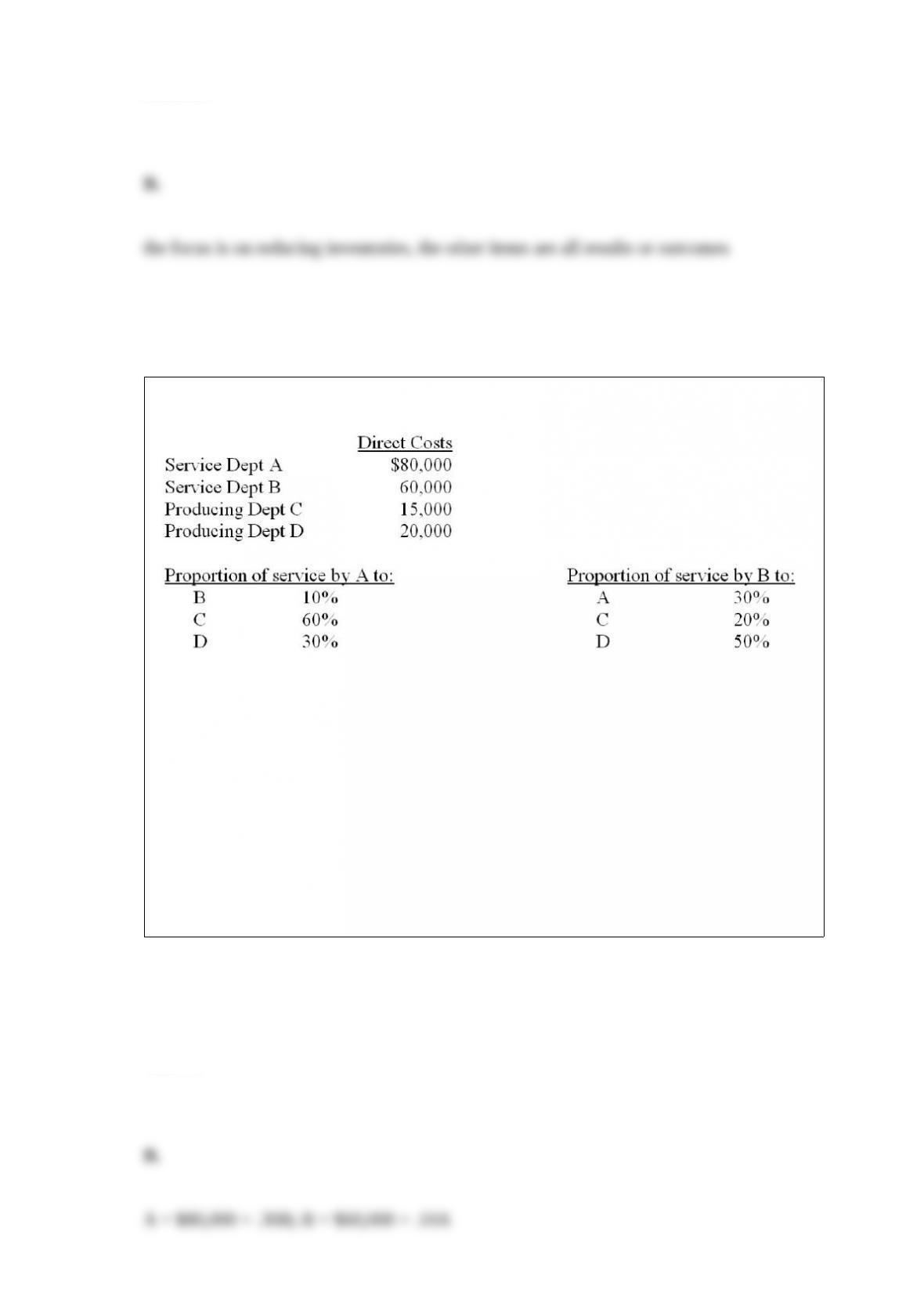
The following information relates to Ray Corporation for the past accounting period.
Using the simultaneous solution method, department B’s cost allocated to department C
is
A. $29,021
B. $14,021
C. $13,192
D. $7,794
Answer:
A company’s break-even point will not be changed by:
A. a change in total fixed costs.
B. a change in the selling price per unit.
C. a change in the variable cost per unit.
D. a change in the contribution margin ratio.
E. a change in the income tax rate.
Answer:
The sales quantity variance would be favorable when a company sells
A. relatively fewer of the products bearing contribution margins lower than average.
B. relatively more of the products bearing contribution margins higher than average.
C. more total units than budgeted, holding the sales mix constant.
D. less total units than budgeted, holding the sales mix constant.
Answer:
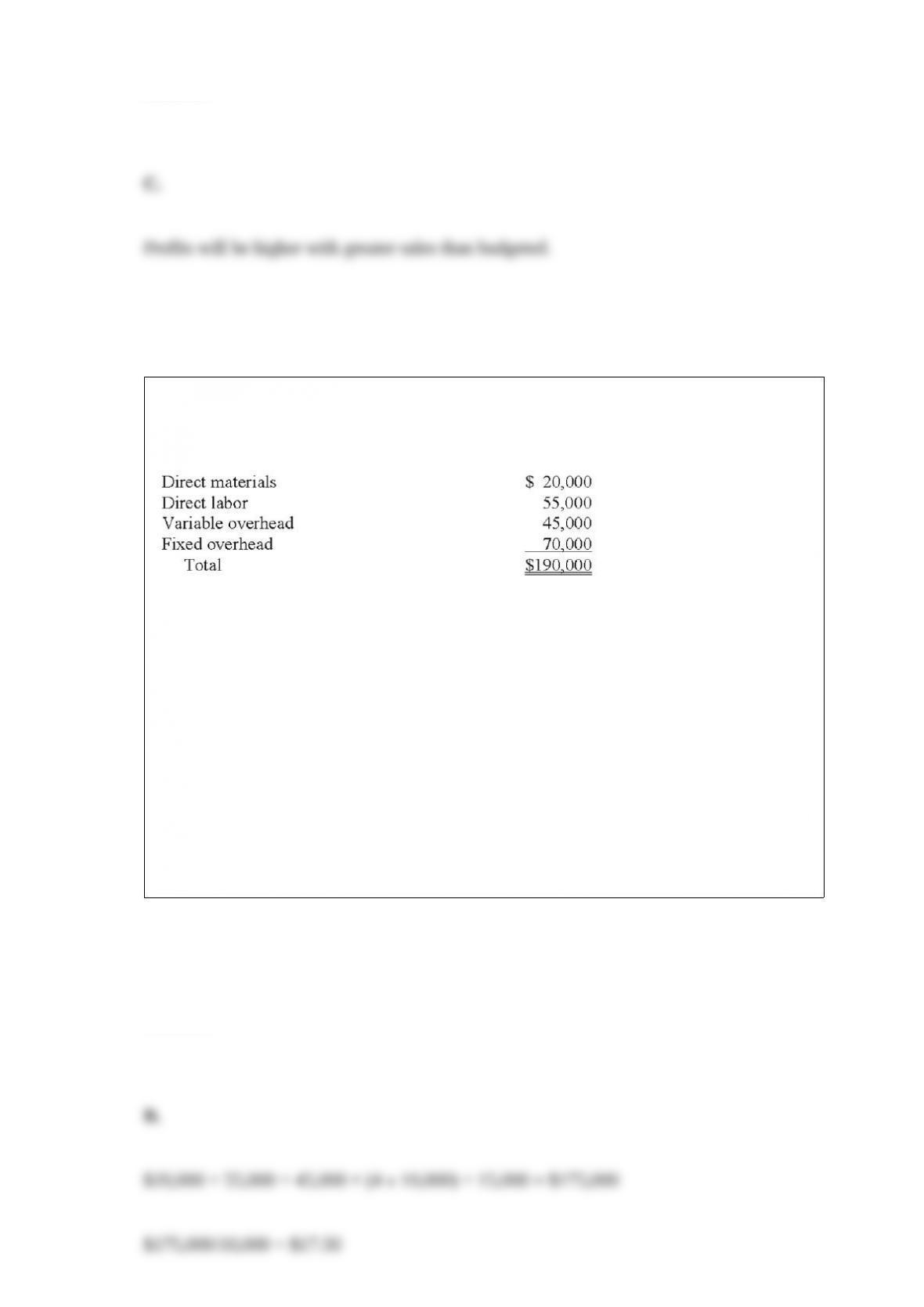
The CJP Company produces 10,000 units of item S10 annually at a total cost of
$190,000.
The XYZ Company has offered to supply 10,000 units of S10 per year for $18 per unit.
If CJP accepts the offer, $4 per unit of the fixed overhead would be saved. In addition,
some of CJP’s facilities could be rented to a third party for $15,000 per year. At what
price would CJP be indifferent to XYZ’s offer?
A. $17.00
B. $17.50
C. $18.50
D. $19.50
Answer:
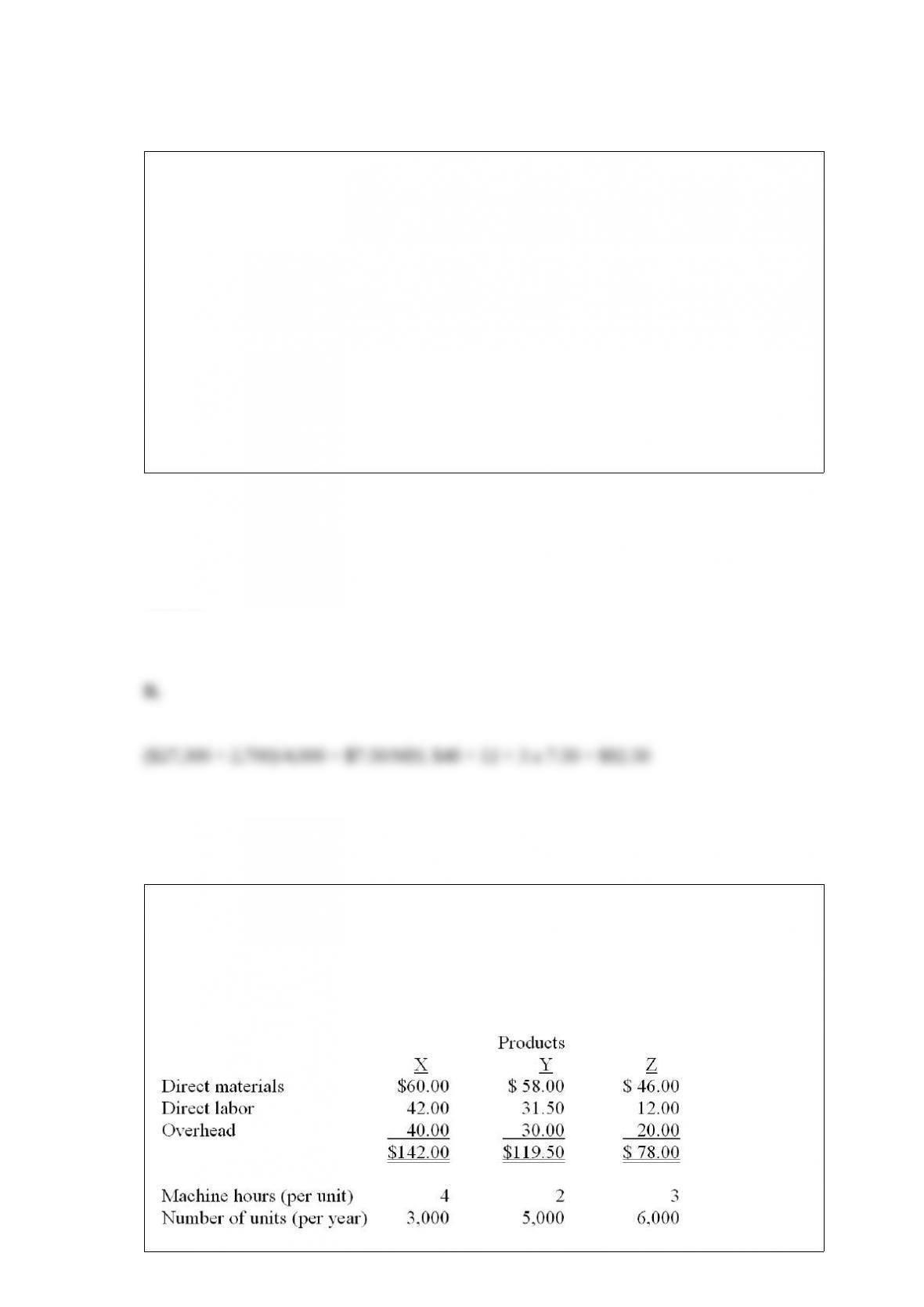
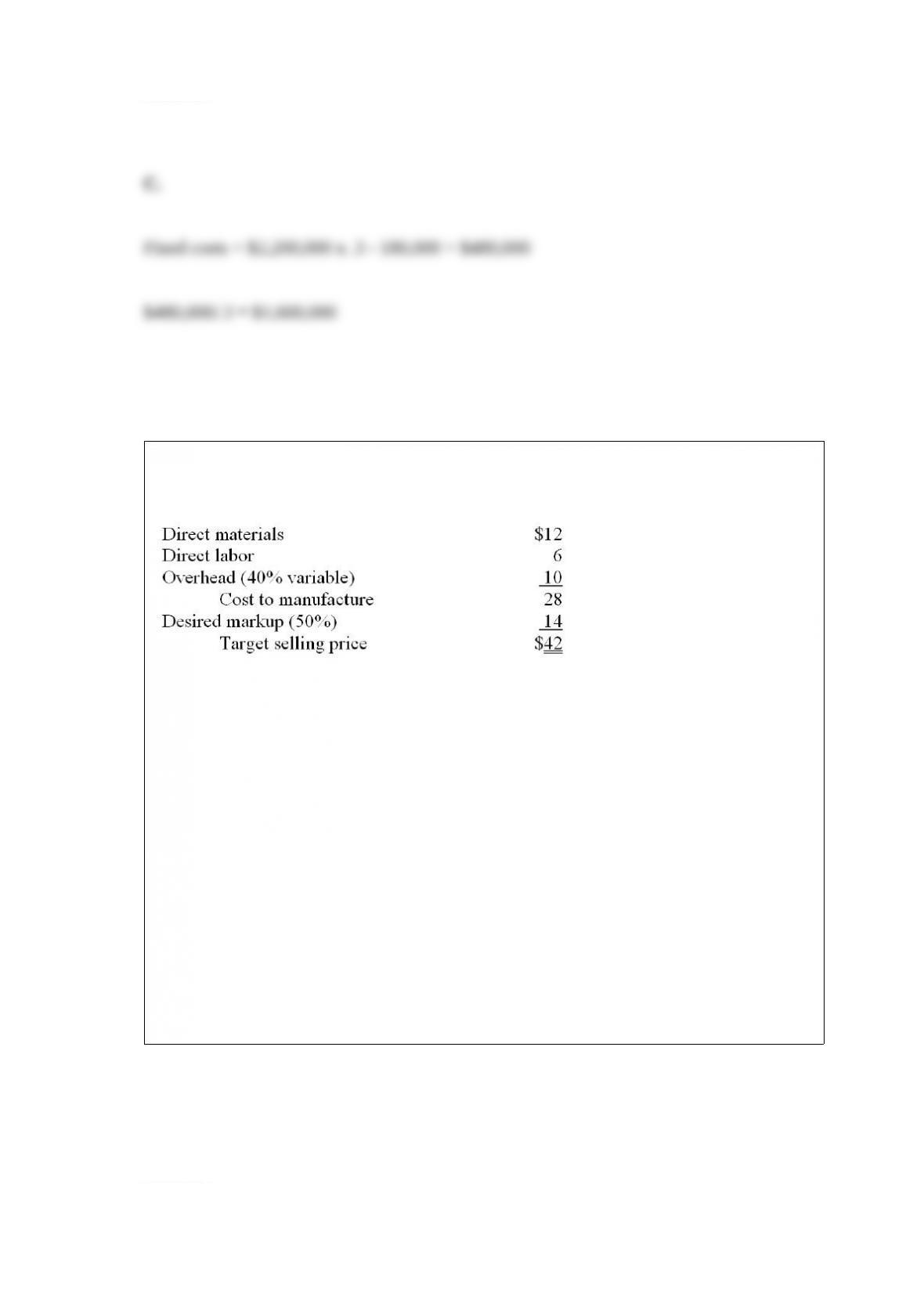
Department D has recently purchased and installed new computerized equipment for
Product X. This equipment will increase the overhead costs by $2,700 and decrease
labor costs (due to time savings) in Department D by $3.00 per case. Machine hours
will not change. If Smelly uses a plantwide rate based on machine hours, what is the
revised product cost per case for Product X?
A. $74.00
B. $82.50
C. $69.50
D. $79.50
Answer:
XYZ Company manufactures and distributes several different products. They currently
use a plantwide allocation method for allocating overhead at a rate of $10 per direct
labor hour. Department 1 produces Products X and Y. Department 1 has $262,000 in
traceable overhead. Department 2 manufactures Product Z. Department 2 has $128,000
in traceable overhead. The product costs (per unit) and other information are as follows:
Required:
a) changes its allocation basis to machine hours, what is the total product cost per unit
for Product X, Y and Z?
b) If XYZ changes its overhead allocation to departmental rates, what are the product
costs per unit for Product X, Y and Z, assuming Departments 1 and 2 use direct labor
hours and machine hours as their respective allocation bases?
Answer:
Total factor productivity
A. is a ratio of the value of output to the value of all key inputs.
B. is the same thing as the production volume variance.
C. focuses on an individual input.
D. includes materials and labor but not overhead.
Answer:
A description of an organization’s values, definition of its responsibilities to
stakeholders, and identification of its major strategies is called its
A. business-level strategy.
B. mission statement.
C. performance objectives.
D. master budget.
Answer:
The Document Creation Center (DCC) for Alegis Corp. provides photocopying and
document services for three departments in the St. Paul office. The following budget
has been prepared for the year.
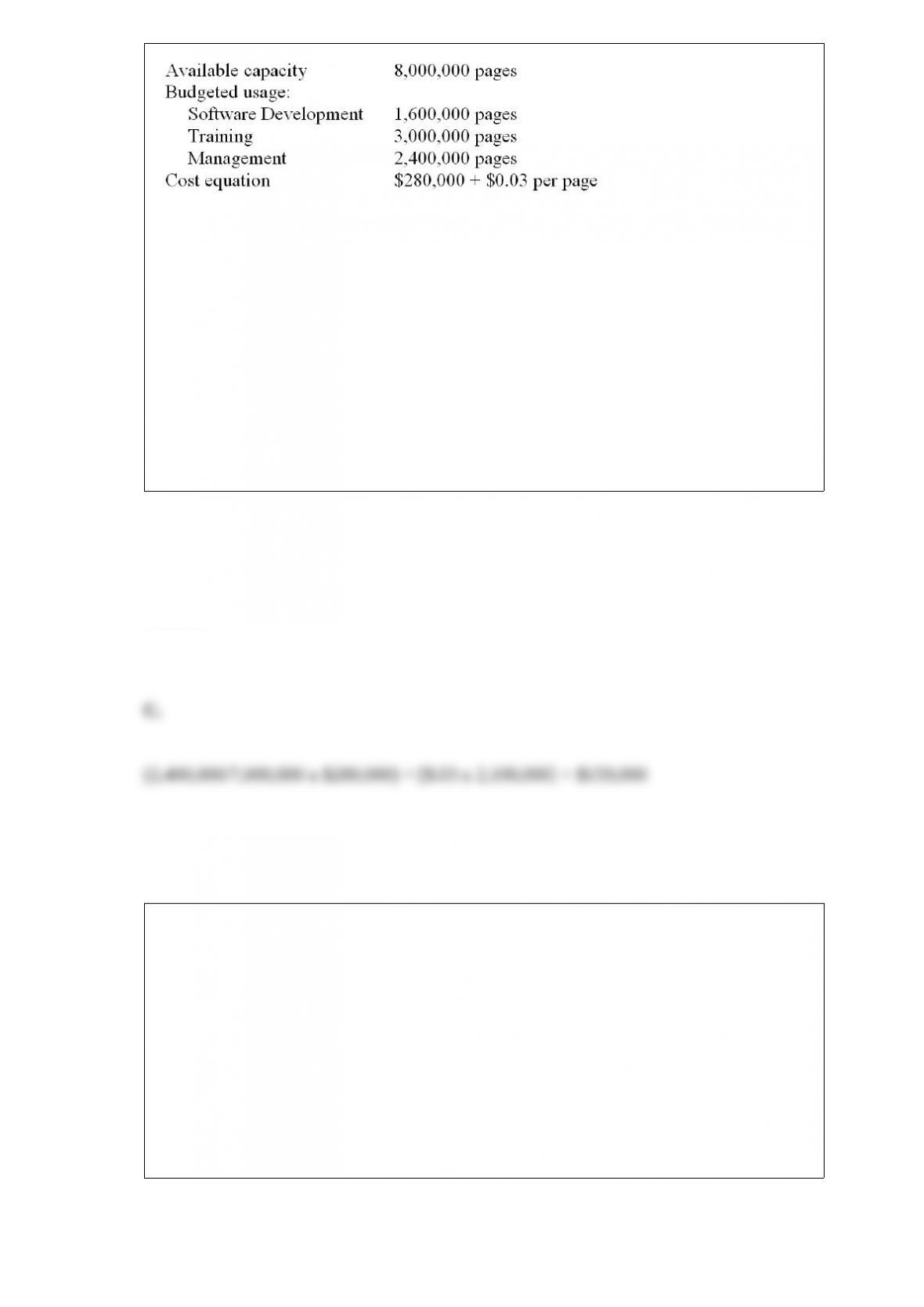
If DCC uses a dual-rate for allocating its costs, how much cost will be allocated to the
Management Department, assuming the Management Department actually made
2,100,000 copies during the year?
A. $147,000
B. $136,500
C. $159,000
D. $150,761
Answer:
In the balanced scorecard, the financial perspective addresses which of the following
questions?
A. “To achieve our mission, how will we sustain our ability to change and improve?”
B. “To succeed financially, how should we appear to our shareholders?”
C. “To satisfy our shareholders and customers, in what business process must we
excel?”
D. “To achieve our mission, how should we appear to our customers?”
Answer:
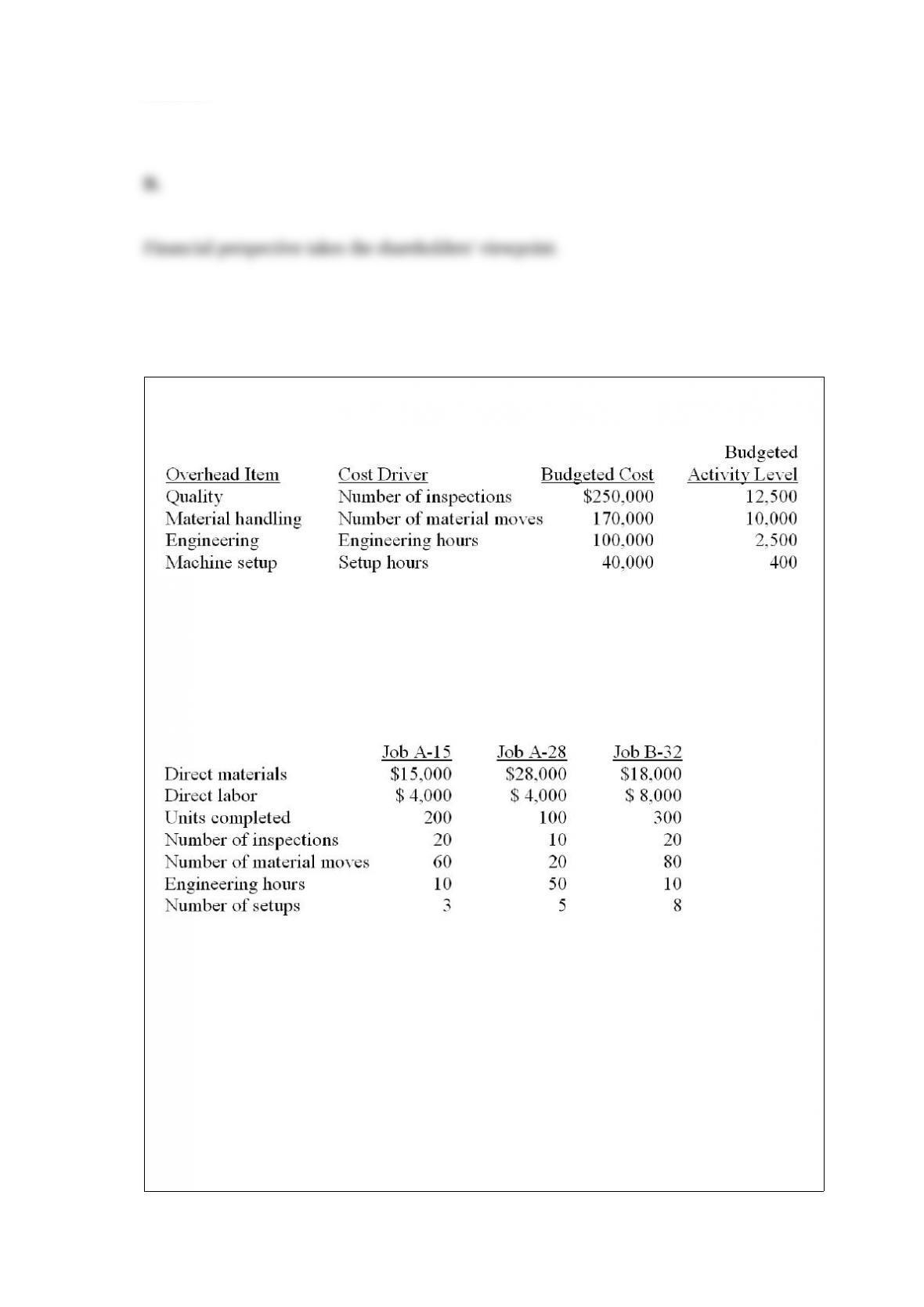
Scottso Enterprises has identified the following overhead costs and cost drivers for the
coming year:
Budgeted direct labor cost was $200,000 and budgeted direct material cost was
$800,000. The following information was collected on three jobs that were completed
during the month:
If the company uses traditional costing and allocates overhead using direct materials
cost, how much overhead cost should be assigned to Job A-15?
A. $10,500
B. $11,200
C. $2,800
D. $2,050
Answer:
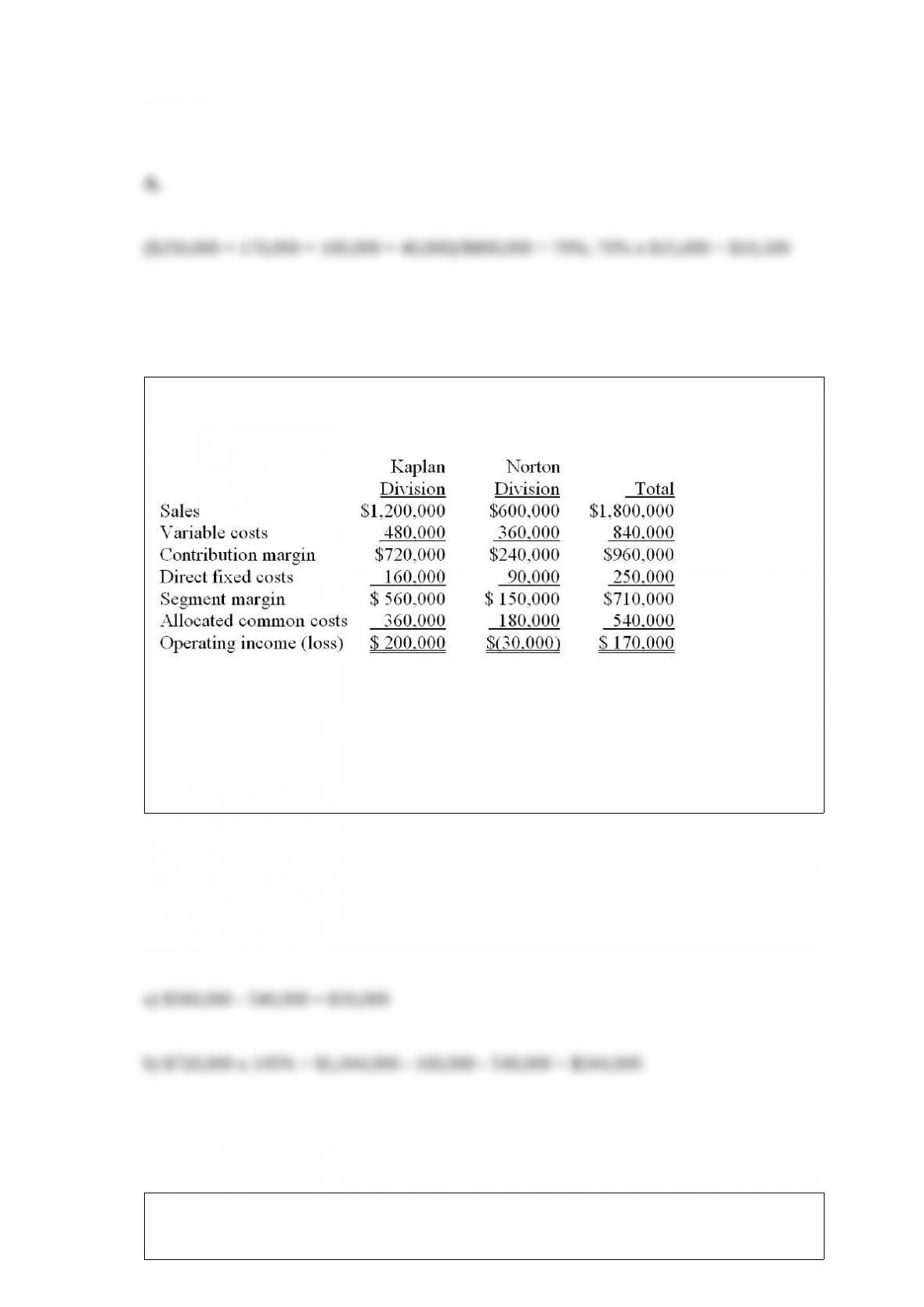
The operations of BSC Corporation are divided into the Kaplan Division and the
Norton Division. Projections for the next year are as follows:
a) Operating income for BSC Corporation as a whole if the Norton Division were
dropped would be
b) If the Norton Division were dropped, Kaplan Division’s sales would increase by
45%. If this happened, the operating income for BSC Corporation as a whole would be
Answer:
Smelly Perfume Company manufactures and distributes several different products.
They currently use a plantwide allocation method for allocating overhead at a rate of $7
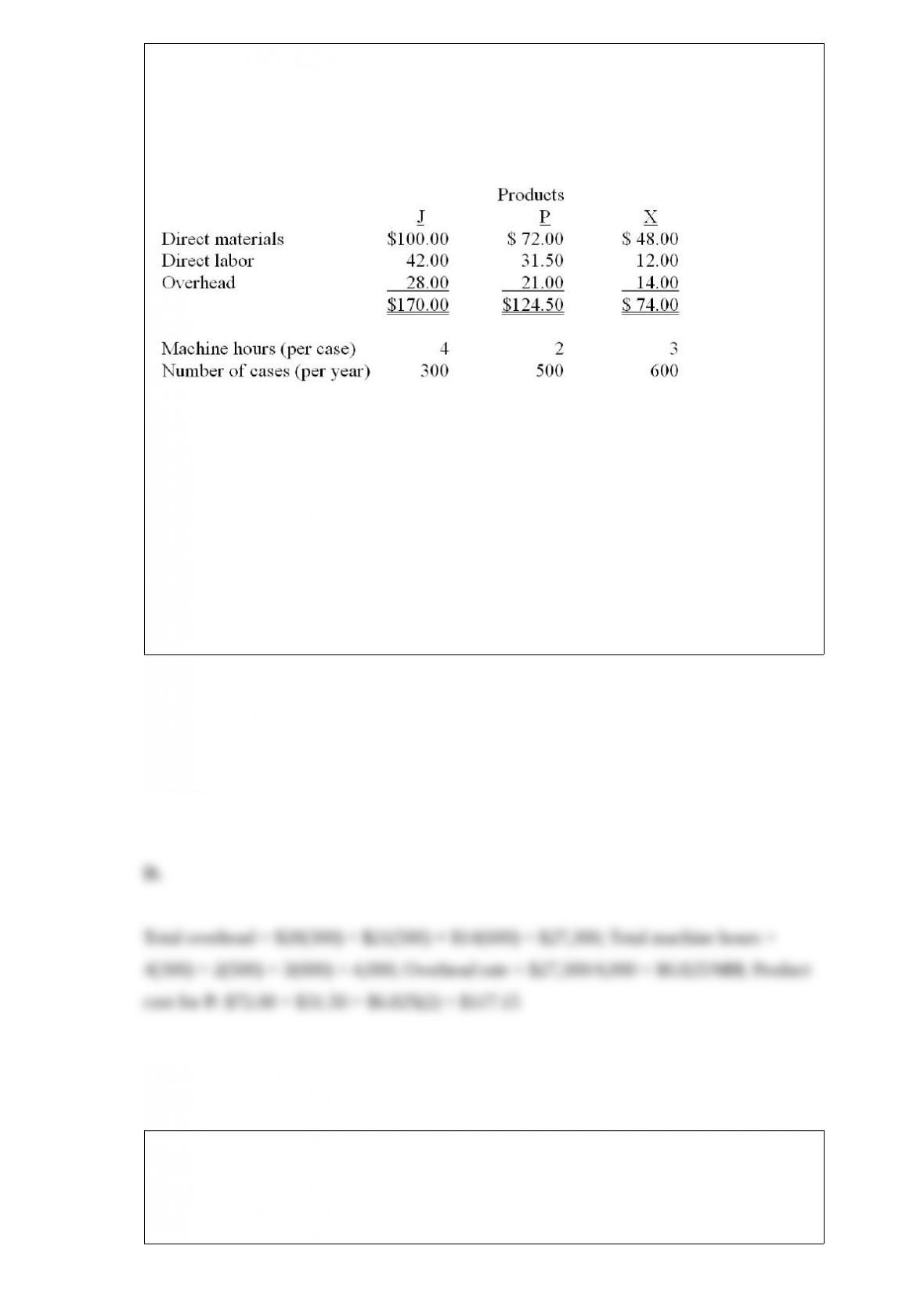
per direct labor hour. Cindy is the department manager of Department C which
produces Products J and P. Department C has $16,200 in traceable overhead. Diane is
the department manager of Department D which manufactures Product X. Department
D has $11,100 in traceable overhead. The product costs (per case of 24 bottles) and
other information are as follows:
If Smelly changes its allocation basis to machine hours, what is the total product cost
per case for Product P?
A. $163.50
B. $144.00
C. $138.15
D. $117.15
Answer:
Cruises, Inc., operates two divisions: (1) a management division that owns and
manages cruise ships in the Florida Keys and (2) a repair division that operates a dry
dock in Marble Sand Florida. The repair division works on company ships, as well as
other large-hull ships.
The repair division has an estimated variable cost of $28.50 per labor-hour. The repair
division has a backlog of work for outside ships. They charge $48.00 per hour for labor,
which is standard for this type of work. The management division complained that it
could hire its own repair workers for $30.00 per hour, including leasing an adequate
work area.
What is the minimum transfer price per hour that the repair division should obtain for
its services, assuming it is operating at capacity?
A. $28.50
B. $30.00
C. $39.00
D. $46.50
E. $48.00
Answer:
Which of the following accounts is used to accumulate the actual manufacturing
overhead costs incurred during a period?
A. Applied Manufacturing Overhead
B. Work-in-Process Inventory
C. Manufacturing Overhead Control
D. Cost of Goods Sold
E. Finished Goods Inventory
Answer:
Which of the following statements is (are) false?
(A) Internal, regional, and local benchmarks should be used for the most important
processes and activities in an organization.
(B) In general, the use of multiple measures to evaluate performance is better than that
use of a single performance measure.
A. Only A is false.
B. Only B is false.
C. Both A and B are false.
D. Neither A nor B is false.
Answer:
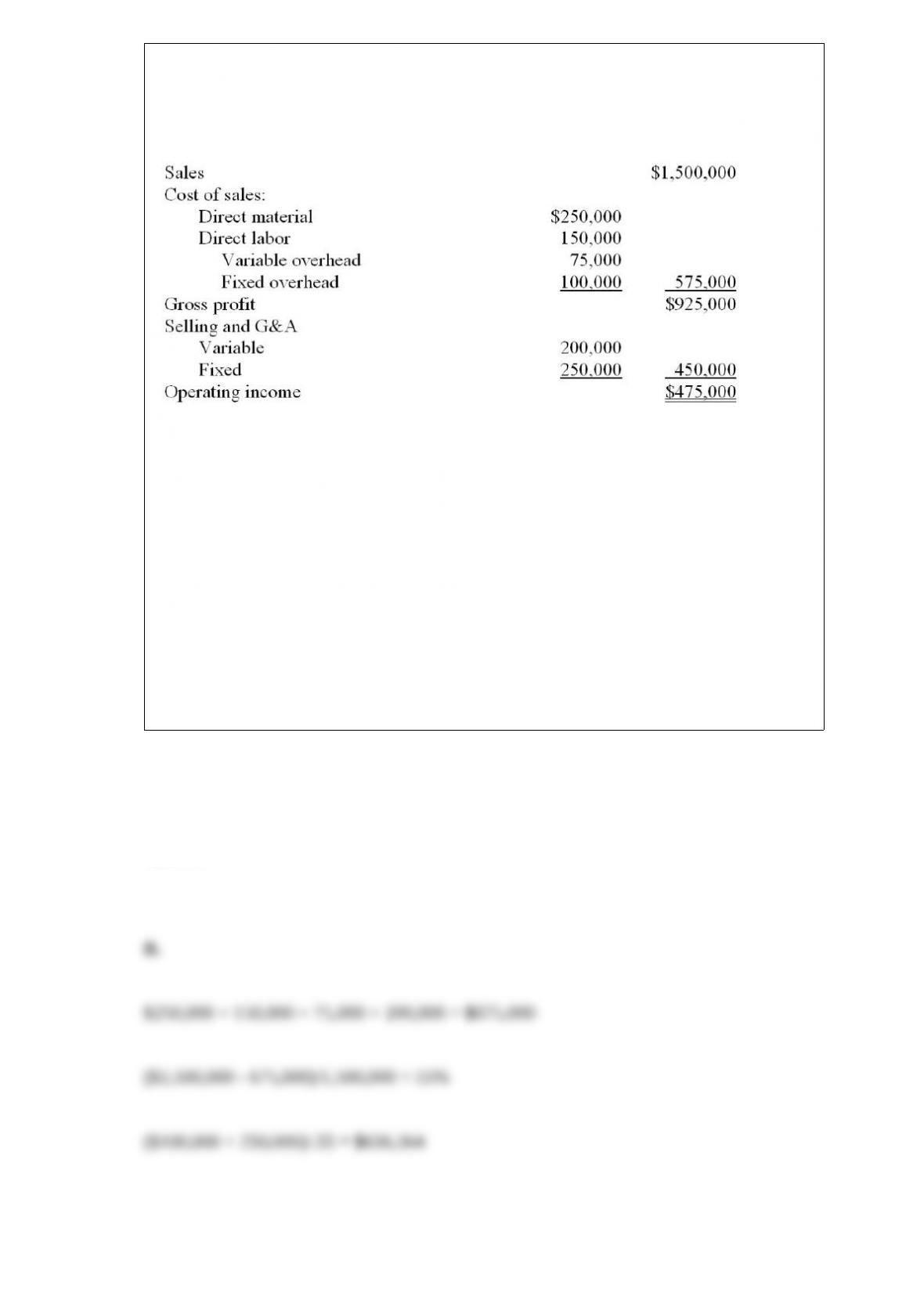
Barnes Corporation manufactures skateboards and is in the process of preparing next
year’s budget. The pro forma income statement for the current year is presented below.
The break-even point (rounded to the nearest dollar) for Barnes Corporation for the
current year is
A. $146,341.
B. $636,364.
C. $729,730.
D. $181,818.
E. $658,537.
Answer:
Continual process of measuring a company’s own products, services or activities
against competitors’ performance is
A. performance measure
B. benchmarking
C. budgeting
D. responsibility center
E. lean accounting
Answer:
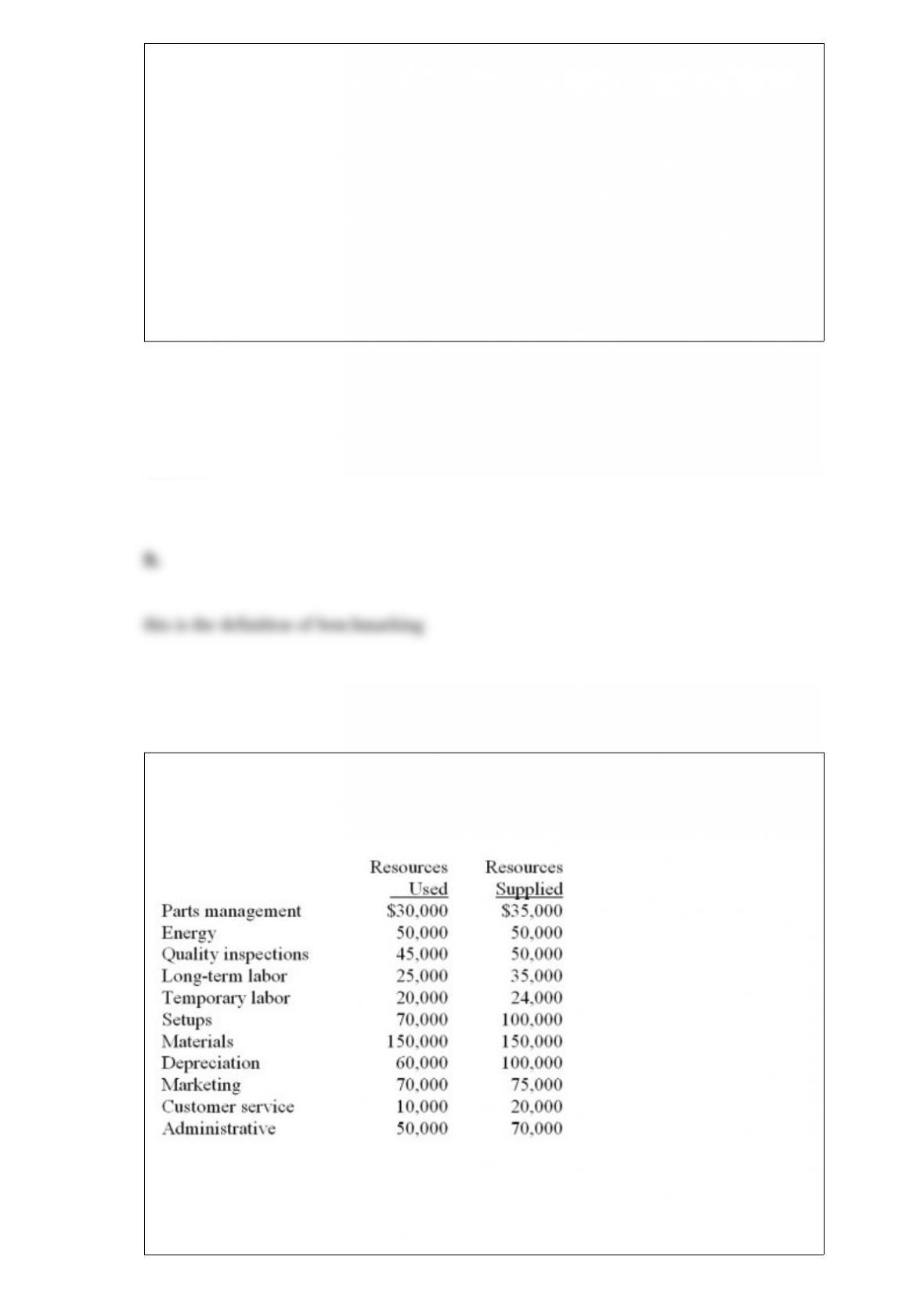
Leidenheimer Corporation manufactures small airplane propellers. Sales for April
totaled $850,000. Information regarding resources for the month follows:
In addition, Leidenheimer spent $25,000 on 50 engineering changes with a cost driver
rate of $500 and $30,000 on eight outside contracts with a cost driver rate of $3,750.
Required
a) Prepare a traditional income statement.
b) Prepare an activity-based income statement.
Answer:
Smelly Perfume Company manufactures and distributes several different products.
They currently use a plantwide allocation method for allocating overhead at a rate of $7
per direct labor hour. Cindy is the department manager of Department C which
produces Products J and P. Department C has $16,200 in traceable overhead. Diane is
the department manager of Department D which manufactures Product X. Department
D has $11,100 in traceable overhead. The product costs (per case of 24 bottles) and
other information are as follows:
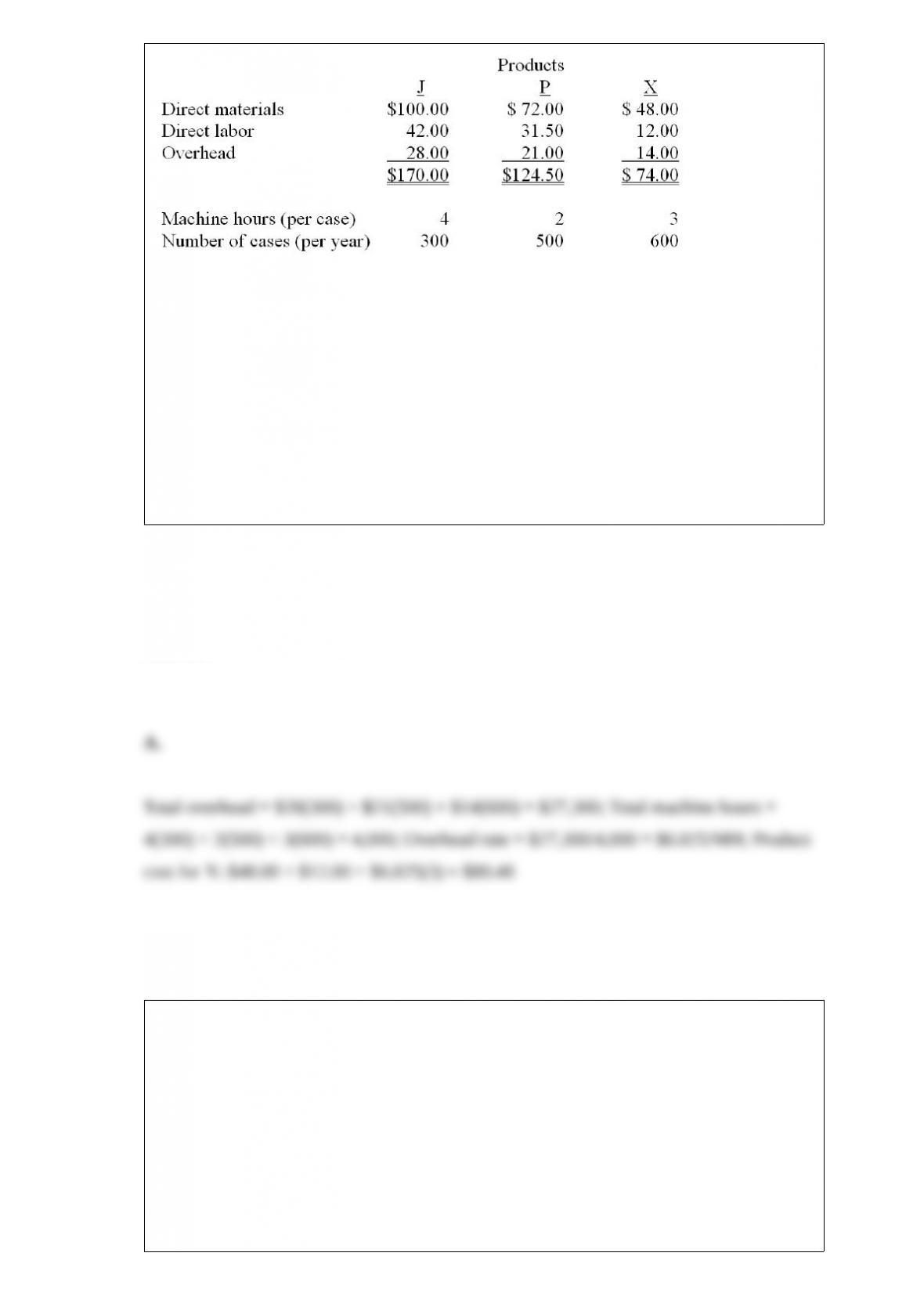
If Smelly changes its allocation basis to machine hours, what is the total product cost
per case for Product X?
A. $80.48
B. $79.50
C. $74.00
D. $75.17
Answer:
Using the abbreviations listed below, what is the formula for the industry volume
variance?
AMS = actual market share
BMS = budgeted market share
BCM = budgeted contribution margin per unit
ACM = actual contribution margin per unit
ATM = actual total market
BTM = budgeted total market
A. (ATM – BTM) (BMS) (ACM)
B. (ATM – BTM) (BMS) (BCM)
C. (AMS – BMS) (ATM) (ACM)
D. (AMS – BMS) (ATM) (BCM)
E. (ATM – BTM) (AMS) (ACM)
Answer:
Acme, Inc. has estimated overhead to be $300,000 and labor hours to be 30,000. Actual
overhead turned out to be $310,000 when 30,500 labor hours were worked. The
predetermined overhead rate would be:
A. 101.67%
B. $10.00
C. $10.16
D. $10.33
Answer:
When there is no intermediate market,
A. there is no optimal transfer price.
B. the selling division cannot transfer its goods internally.
C. the buying division cannot purchase its goods externally.
D. there is no reason for top management to intervene in transfer pricing disputes.
Answer:
EM Sales had $2,200,000 in sales last month. The contribution margin ratio was 30%
and operating profits were $180,000. What is EM’s break-even sales volume?
A. $660,000
B. $1,540,000
C. $1,600,000
D. $2,020,000
Answer:
The Buchanan Company has gathered the following information for a unit of its most
popular product:
The above cost information is based on 10,000 units. A distributor has offered to buy
2,000 units at a price of $32 per unit. This special order would not disturb regular sales.
Special packaging and other selling expenses would be an additional $0.50 per unit for
the special order. If the special order is accepted, Buchanan’s operating profits will
increase by:
A. $4,000.
B. $6,400.
C. $8,000.
D. $19,000.
E. $20,000.
Answer:
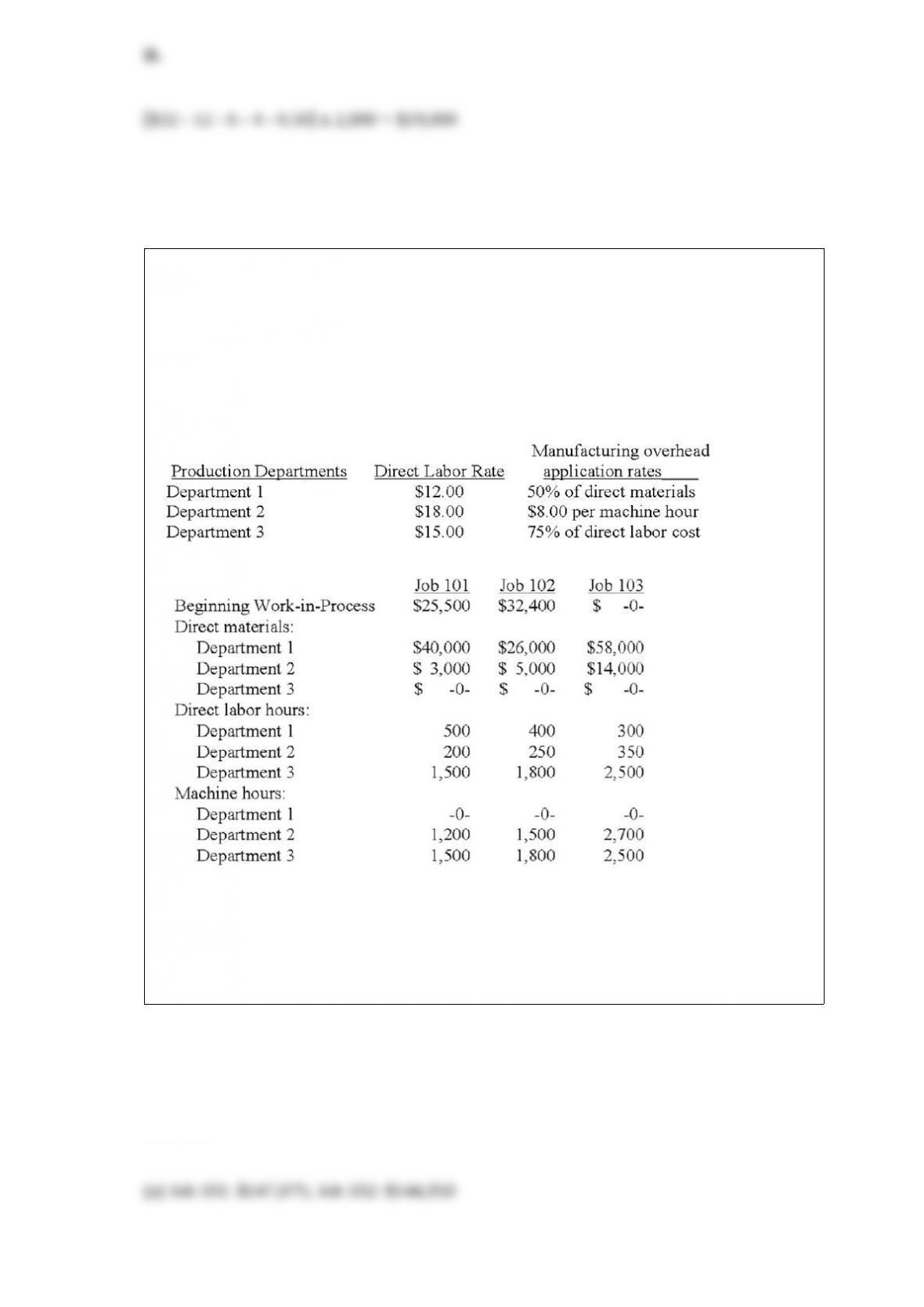
A manufacturing company employs job costing to account for its costs. There are three
production departments, and separate departmental overhead application rates are
employed because the operations of the departments are so different. All jobs generally
pass through all three production departments. Data regarding the hourly direct labor
rates, overhead application rates, and three jobs on which work was done during the
month appear below. Job 101 and Job 102 were completed during the current month.
(CIA Examination adapted)
Required:
(a) Compute the completed costs of Job 101 and Job 102.
(b) Compute the value of the Work-in-Process Inventory at the end of the month.
Answer:
A manager is trying to estimate the manufacturing costs of a new product. The
company makes several other products that utilize some of the same manufacturing
procedures as the new product. Which cost estimation method would be the best
method to determine the total cost of manufacturing the new product?
A. engineering estimates
B. regression analysis
C. account analysis
D. scattergraph
E. high-low
Answer:
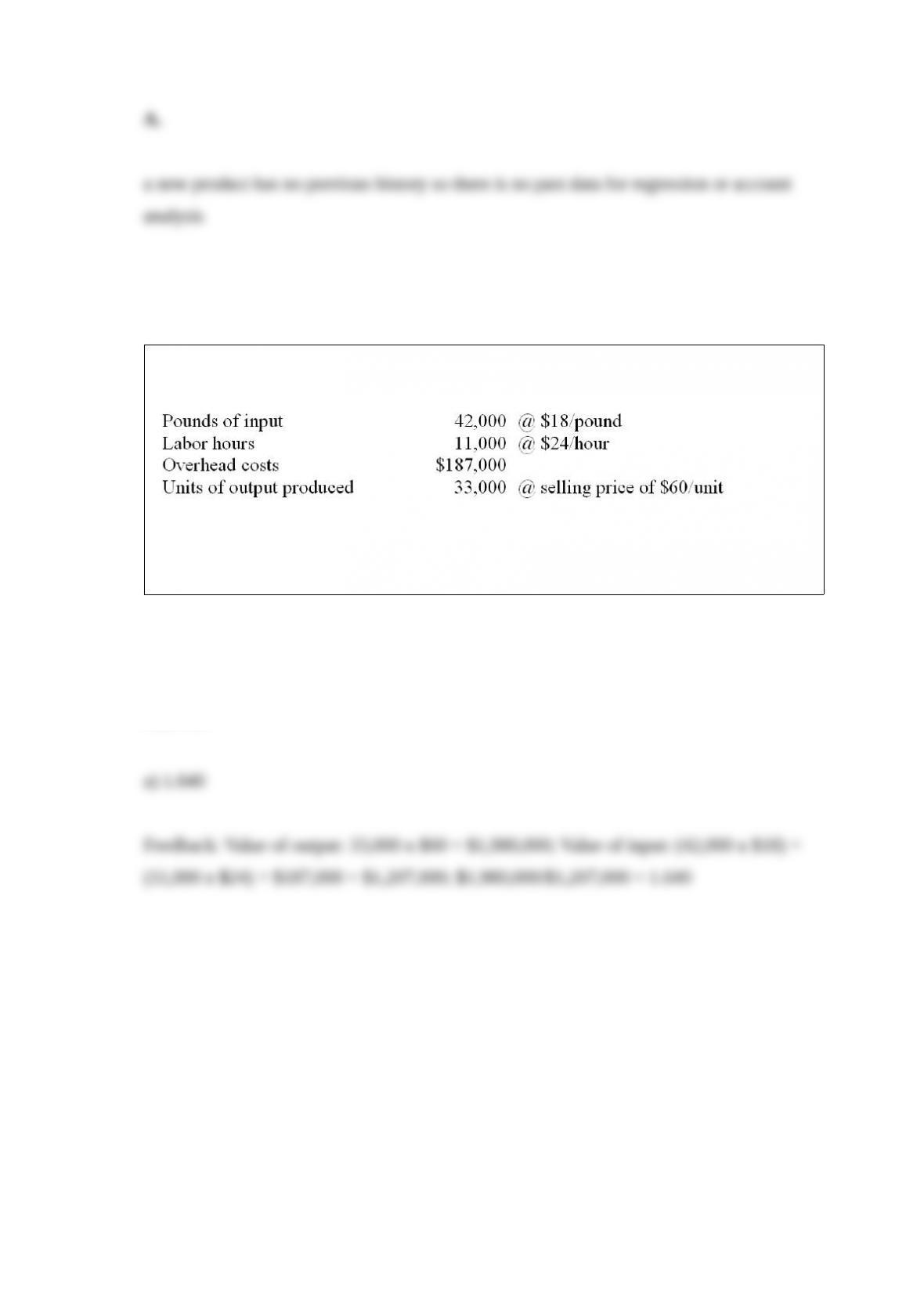
Melrose, Inc., has provided the following information for last year:
Required:
a) Calculate the total factor productivity measure.
Answer: