
Which of the following is true regarding bond discounts and/or premiums?
A. Bond discount is amortized but bond premium is not.
B. Bond premium is amortized but bond discount is not.
C. Neither bond discount nor premium is amortized.
D. Both bond discount and premium are amortized.
Accounting can be defined as:
A. the process of preparing and auditing an entity’s financial statements.
B. the process of identifying, measuring, and communicating economic information
about an organization for the purpose of making decisions and informed judgments.
C. the process of communicating the financial results of corporate activities to investors
and regulatory bodies.
D. None of the above definitions are correct.
E. A, B and C are correct.
Which of the following is a true statement pertaining to segment income statements?
A. Present the individual segments’ net income.
B. Variable costs should be reported by segment.
C. Do not present a segment margin.
D. Do not include arbitrarily allocated common fixed expenses when calculating
segment margin.
E. All of the above.
An example of a product cost is:
A. advertising expense for the product.
B. a portion of the president’s travel expenses.
C. interest expense on a loan to finance inventory.
D. production line maintenance costs.
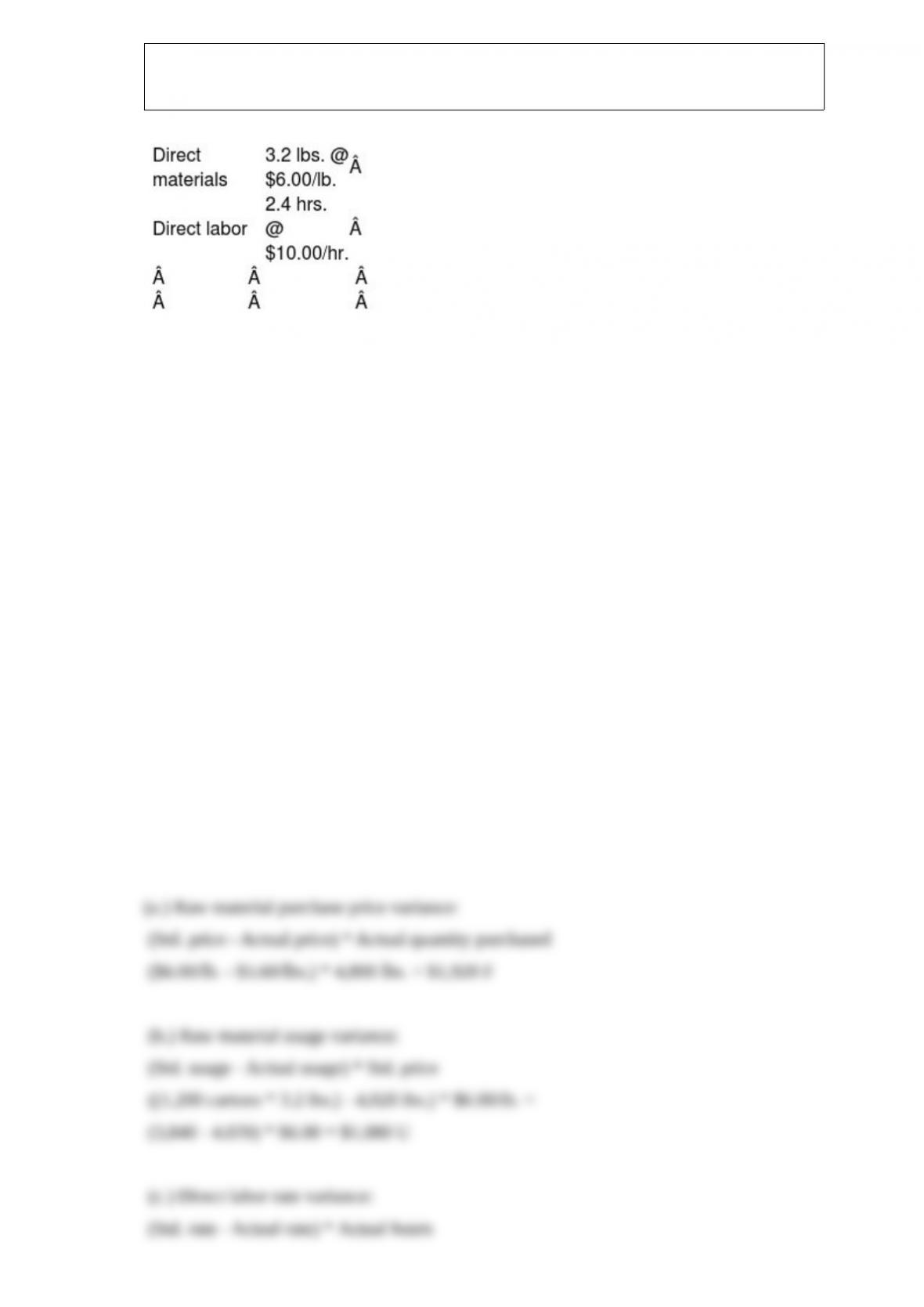
The standards for one carton of Flavor Rite are:
During the week ended May 17, the following activity took place:
• 4,800 lbs. of raw material were purchased for inventory at a cost of $5.60 per pound;
• 1,200 cartons of finished product were produced;
• 4,020 lbs. of raw material were used;
• 3,110 labor hours were worked at a total cost of $26,435.
Calculate each of the following variances:
(a.) Raw materials purchase price variance.
(b.) Raw materials usage variance.
(c.) Direct labor rate variance.
(d.) Direct labor efficiency variance.
(e.) Explain the factors that most likely caused the variances computed above.
In a capital budgeting decision, if a firm uses the net present value method and a 12%
discount rate, what does a negative net present value indicate?
A. the proposal’s rate of return exceeds 12%.
B. the proposal’s rate of return is less than the minimum rate required.
C. the proposal earns a rate of return between 10% and 12%.
D. none of the above.
If a project promises to generate a higher rate of return than the firm’s cost of capital,
accepting the project will:
A. increase ROI.
B. decrease ROI.
C. increase payback.
D. decrease payback.
The ethical concept of independence means that an accountant employed:
A. by a corporation cannot prepare financial statements for use by the company’s bank.
B. by one company cannot work part-time for another company.
C. by an auditing firm cannot own any stock in the company being audited.
D. by one company cannot accept a job with another company in the same industry.
Which of the following is a true statement regarding the internal rate of return in capital
budgeting?
A. it provides the same basic information as the net present value method.
B. it calculates the net present value of future cash flows.
C. it calculates the proposal’s rate of return.
D. it doesn’t consider the time value of money.
Gains differ from revenues because gains:
A. are not a result of the entity’s ongoing, central operations.
B. do not have to be realized.
C. are reported as income from operating activities.
D. do not involve any offsetting costs or expenses.
The present value of an obligation of $8,000 payable in 7 years at 8% is:
A. $3,520
B. $4,668
C. $6,412
D. $7,360
Operating income using the contribution margin format income statement is calculated
as:
A. revenue – variable expenses = contribution margin – fixed expenses.
B. revenue – variable expenses = gross profit – fixed expenses.
C. revenue – cost of goods sold = contribution margin – fixed expenses.
D. revenue – cost of goods sold = contribution margin – operating expenses.
Erber, Inc. produces men’s neckties and dress socks. Manufacturing overhead is
assigned to production using an application rate based on direct labor hours.
(a.) For 2016, the company’s cost accountant estimated that total overhead costs
incurred would be $184,500, and that a total of 24,600 direct labor hours would be
worked. Calculate the amount of overhead to be applied for each direct labor hour
worked on a production run.
(b.) A production run of 500 neckties required raw materials that cost $3,120, and 140
direct labor hours at a cost of $8.00 per hour. Calculate the cost of each necktie
produced.
(c.) At the end of February 2016, 420 neckties made in the above production run had
been sold, and the rest were in ending inventory. Calculate the cost of the neckties sold
that would have been reported in the income statement and the cost included in the
February 28, 2016, finished goods inventory.

Which of the following statements is true about capital investment decisions:
A. the project with the highest net present value will always be selected.
B. the project with the highest internal rate of return will always be selected.
C. the project with the highest net present value may not always be selected.
D. the project with the highest accounting rate of return will always be selected.
Which of the following is a universally accepted measure of profitability?
A. Return on investment.
B. Return on retained earnings.
C. Return on liabilities.
D. All of these.
The distinction between a current asset and other assets:
A. is based on how long the asset has been owned.
B. is based on amounts that will be paid to other entities within a year.
C. is based on the ability to determine the current fair value of the asset.
D. is based on when the asset is expected to be converted to cash, or used to benefit the
entity.
One of the most important reasons for having a system of internal control is to:
A. improve the effectiveness and efficiency of the operations of the organization.
B. ensure no employees have ever been convicted of stealing.
C. eliminate any temptations that may be presented to employees that could lead to theft
from the company.
D. prevent a salesperson from using a company car for personal transportation.

Financial leverage:
A. arises because most borrowed funds have a fixed interest rate.
B. arises because most borrowed funds have a variable interest rate.
C. usually has no bearing on the risk associated with a company.
D. is a concept that does not apply to individuals.
An Accounts Payable normally results from which of the following transactions?
A. Purchasing accounts for cash.
B. Purchasing property, plant and equipment on credit.
C. Purchasing goods and services from suppliers on credit.
D. All of the above.
The declaration of a cash dividend by the directors results in:
A. a decrease in cash and a decrease in retained earnings.
B. a decrease in retained earnings and an increase in current liabilities.
C. a decrease in net income and a decrease in cash.
D. a decrease in net income and an increase in current liabilities.
A firm’s net income for the year was $800,000. Average assets totaled $6 million, and
average liabilities totaled $1.2 million. Return on equity was:
A. 13.3%
B. 16.7%
C. 10%
D. 20%

Which of the following budgets must be completed before a budgeted income statement
can be prepared?
A. sales, cash, and cost of goods sold.
B. sales, cost of goods sold, and operating expense.
C. sales, operating expense, and cash.
D. sales, cash, and balance sheet.
When a firm has financial leverage:
A. ROI will be greater than ROE.
B. ROI will usually be less than it would be without leverage.
C. risk is greater than if there wasn’t any leverage.
D. the firm will always have a higher ROE than it would without leverage.
The raw materials budgeted to be purchased for the period is equal to:
A. ending inventory + raw material used – beginning inventory.
B. ending inventory + ending inventory – raw material used.
C. beginning inventory – ending inventory + raw material used.
D. beginning inventory + raw material used – ending inventory.
The term, “earned,” in revenue recognition refers to which of the following?
A. The entity has completed, or substantially completed, the activities it must perform
to be entitled to the revenue benefits.
B. The product or service has been exchanged for cash, claims to cash, or an asset that
is readily convertible to a known amount of cash or claims to cash.
C. The entity has received an irrevocable order for goods or services.
D. Cash has been received with an irrevocable order for goods or services.

Which of the following is another term for mixed costs?
A. semifixed costs.
B. semivariable costs.
C. component costs.
D. none of the above.
Selling price per unit $100 Variable expenses per unit $40 Fixed expenses per month
$60,000
The contribution margin ratio is:
A. 40%.
B. 60%.
C. 62.5%.
D. 70%.
A budget that has been prepared only once prior to the budget period is called a:
A. continuous budget.
B. zero-based budget.
C. discretionary budget.
D. single-period budget.
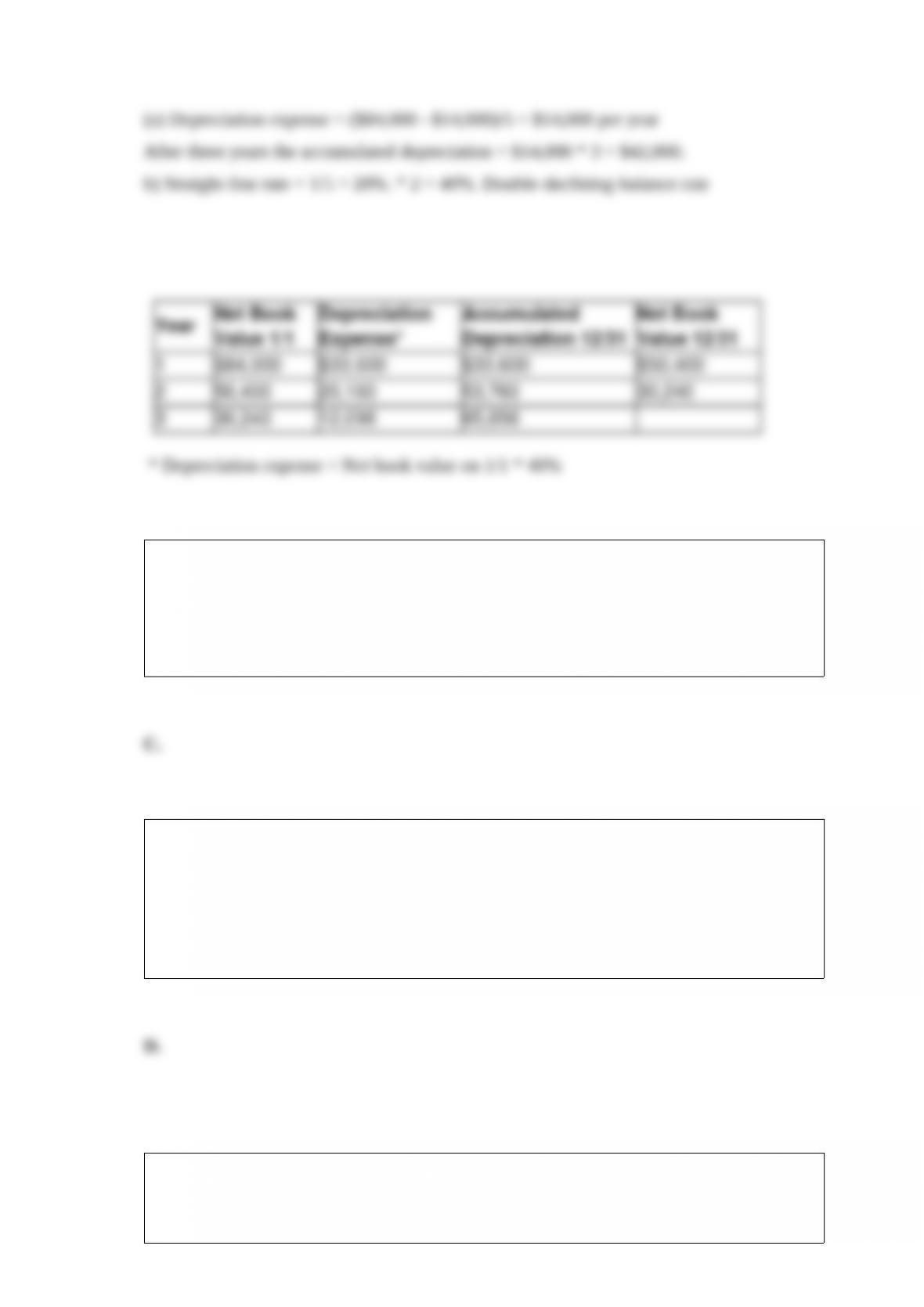
Lone Star Sales & Service acquired a new machine that cost $84,000 in early 2016. The
machine is expected to have a five-year useful life and is estimated to have a salvage
value of $14,000 at the end of its life. (Round your final answers to the nearest dollar.)
(a.) Using the straight-line depreciation method, calculate the depreciation expense to
be recognized in the second year of the machine’s life and calculate the accumulated
depreciation after the third year of the machine’s life.
(b.) Using the double-declining-balance depreciation method, calculate the depreciation
expense for the third year of the machine’s life and the net book value of the machine at
this point in time.
What should the decision rule be to determine what budget variances to investigate?
A. Investigate unfavorable variances only.
B. Investigate favorable variances only.
C. Investigate if the variance is significant.
D. Investigate all variances.
Which of the following costs are included in the cost classification that is based on the
time frame perspective?
A. Variable cost and fixed cost.
B. Direct cost and indirect cost.
C. Product cost and period cost.
D. Committed cost and discretionary cost.
Which of the following activities is not part of the management planning and control
cycle?
A. data collection and performance feedback.

B. implementation of plans.
C. providing information to investors and creditors.
D. revisiting plans.
When a supplier makes a downward adjustment in the amount owed by a creditor, the
creditor will:
A. reduce the amount of the account payable to the supplier, and decrease an asset such
as inventory.
B. increase the amount of the account payable to the supplier, and decrease an asset
such as inventory.
C. reduce the amount of the account payable to the supplier, and increase cash.
D. reduce the amount of the account payable to the supplier, and decrease cash.