Burns Industries currently manufactures and sells 20,000 power saws per month,
although it has the capacity to produce 35,000 units per month. At the
20,000-unit-per-month level of production, the per-unit cost is $65, consisting of $40 in
variable costs and $25 in fixed costs. Burns sells its saws to retail stores for $80 each.
Allen Distributors has offered to purchase 5,000 saws per month at a reduced price.
Burns can manufacture these additional units with no change in its present level of
fixed manufacturing costs.
Refer to the information above. Using an incremental analysis approach, Burns should
consider accepting this special order only if the price per unit offered by Allen is at
least:
A. $20.
B. $50.
C. $80.
D. $40.
Burns Industries currently manufactures and sells 20,000 power saws per month,
although it has the capacity to produce 35,000 units per month. At the
20,000-unit-per-month level of production, the per-unit cost is $65, consisting of $40 in
variable costs and $25 in fixed costs. Burns sells its saws to retail stores for $80 each.
Allen Distributors has offered to purchase 5,000 saws per month at a reduced price.
Burns can manufacture these additional units with no change in its present level of
fixed manufacturing costs.
Refer to the information above. Assume that Allen Distributors offers to purchase the
additional 5,000 saws at a price of $47 per unit. If Burns accepts this price, Burns’
monthly gross profit on sales of power saws will:
A. Increase by $35,000.
B. Increase by $185,000.
C. Decrease by $40,000.
D. Decrease by $240,000.
If the exchange rate for a foreign currency (stated in dollars) has risen, a dollar will
purchase:
A. An increased amount of that foreign currency.
B. An unchanged amount of that foreign currency.
C. A smaller amount of that foreign currency.
D. An undetermined amount of that foreign currency.
Steps in the budgeting process
Listed below are eight operating budgets. In the space provided, list which of these
budgets is typically prepared first, second, third, etc.
(a) ____Operating expense budget
(b) ____Budgeted income statement
(c) ____Ending finished goods forecast
(d) ____Production schedule (in units)
(e) ____Manufacturing cost estimates
(f) ____Cost of goods sold budget
(g) ____Sales forecast
(h) ____Manufacturing cost budget
The Abrams Corporation incurred the following quality costs for the year ending
December 31, 2015:
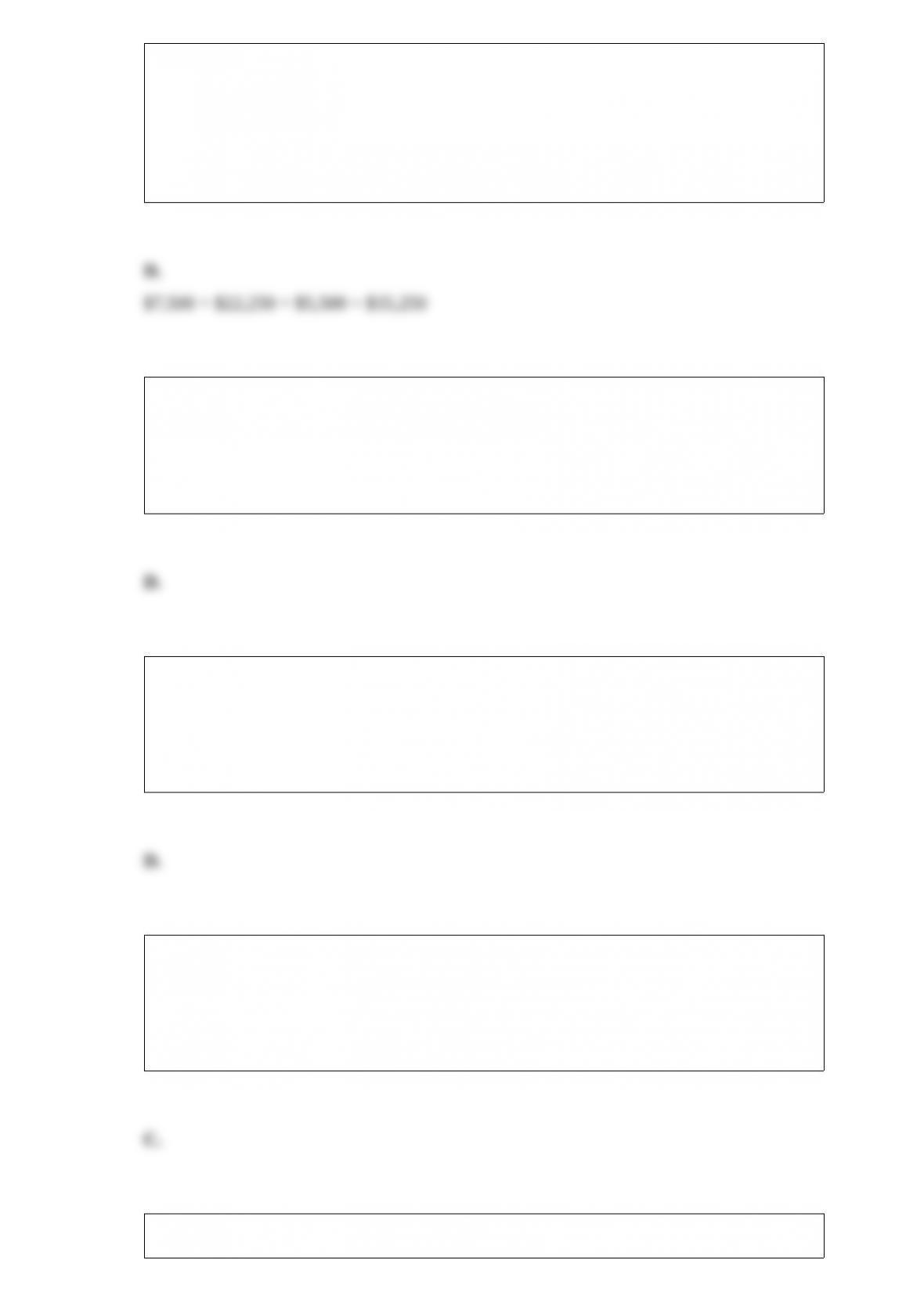
Refer to the information above. What are the total external failure costs for the Abrams
Corporation?
A. $38,300.
B. $34,500.
C. $19,700.
D. $35,250.
The advantages of corporations going public include all of the following except:
A. Professional management.
B. Transferability of ownership.
C. Limited shareholder liability.
D. Ability to remove assets.
Preparation of interim financial statements:
A. Makes the preparation of year-end financial statements unnecessary.
B. Requires the journalizing and posting of adjusting entries.
C. Requires the journalizing and posting of closing entries.
D. Is done monthly or quarterly or in-between the year-end financial statements.
A balance sheet is designed to show:
A. How much a business is worth.
B. The profitability of the business during the current year.
C. The assets, liabilities, and owners’ equity of a business as of a particular date.
D. The cost of replacing the assets and of paying off the liabilities at December 31.
The amounts that a business withholds as taxes from an employee’s earnings:
A. Represent payroll taxes expense to the employer.
B. Are deposited in an interest-bearing account until the employee is terminated.
C. Represent miscellaneous revenue to the employer.
D. Represent current liabilities to the employer.
Which of the following is not commonly used to measure product quality in a
just-in-time system?
A. Defects per million.
B. Merchandise returns.
C. Manufacturing efficiency ratio.
D. Warranty claims.
Accounting terminology
Listed below are nine technical accounting terms introduced in this chapter:
Each of the following statements may (or may not) describe one of these technical
terms. In the space provided beside each statement, indicate the accounting term
described, or answer “None” if the statement does not correctly describe any of the
terms.
____ (a) A financial statement showing the revenue, expenses, and net earnings of a
corporation during the current accounting period.
____ (b) A distribution of cash to stockholders.
____ (c) A distribution to stockholders of additional shares of stock, accompanied by a
proportionate reduction in the par value per share.
____ (d) The market price of a share of preferred stock, divided by the net income of
the corporation.
____ (e) A correction in the amount of net income reported in an earlier accounting
period.
____ (f) An event that is material in dollar amount, unusual in nature, and not expected
to recur in the foreseeable future.
____ (g) A subtotal sometimes included in an income statement to assist investors in
forecasting the income of future accounting periods.
Under a job order cost system, costs are accumulated for:
A. Each department in the production cycle.
B. Each batch of production, known as a job or lot.
C. Each individual unit produced.
D. Each job supervisor.
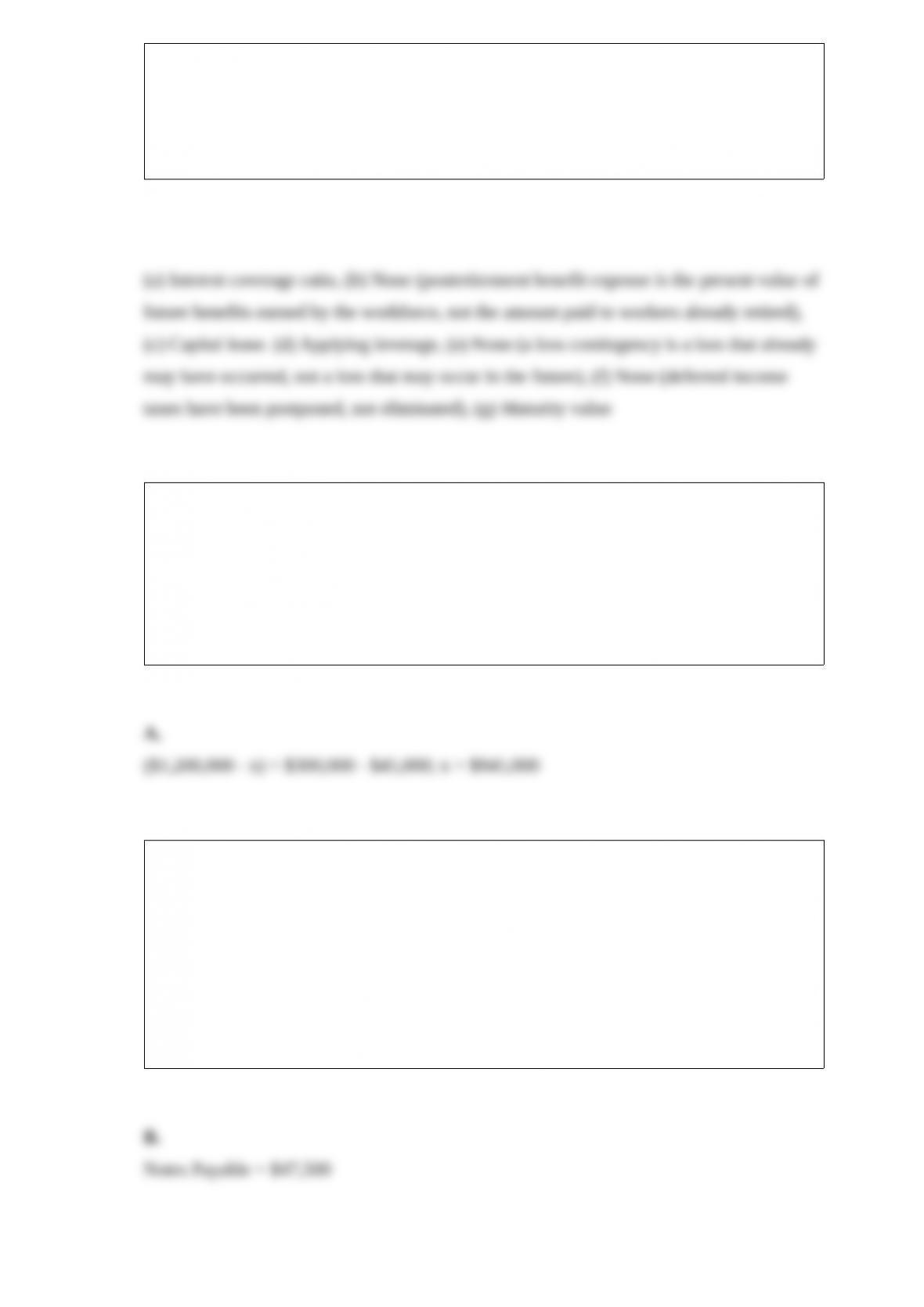
Accounting terminology
Listed below are nine technical accounting terms introduced in this chapter:
Each of the following statements may (or may not) describe one of these technical
terms. In the space provided beside each statement, indicate the accounting term
described, or answer “None” if the statement does not correctly describe any of the
terms.
_____ (a) Operating income divided by annual interest expense.
_____ (b) The amount paid during the current period to retired employees.
_____ (c) A lease agreement that is viewed as equivalent to the lessee purchasing the
leased asset.
_____ (d) Using borrowed money to finance business operations.
_____ (e) The risk of a loss occurring in a future period.
_____ (f) A permanent reduction in the amount of income taxes owed which results
from the tax deductions for depreciation.
_____ (g) The amount that must be paid to settle a liability at the date it becomes due.
Mayer Instrumentation sold a depreciable asset for cash of $300,000. The original cost
of the asset was $1,200,000. Mayer recognized a gain of $45,000 on the sale. What was
the amount of accumulated depreciation on the asset at the time of its sale?
A. $945,000.
B. $255,000.
C. $1,155,000.
D. $990,000.
Refer to the information above. If the Cash balance at December 31, 2014 is $67,500,
the Notes Payable balance is:
A. $118,750.
B. $47,500.
C. $137,500.
D. $140,000.
Cash ($67,500) + A/R ($18,750) + Land ($30,000) + Building ($31,250) + Equipment
($40,000) = $187,500
A/P ($2,500) + N/P (?) + Capital Stock ($12,500) + R.E. ($125,000) = $187,500

The term paid-in capital means:
A. All assets other than retained earnings.
B. Legal capital plus retained earnings.
C. Total stockholders’ equity minus retained earnings.
D. Legal capital minus retained earnings.
Herb Company manufactured more product than it was able to sell during the current
year. If the salaries of the sales staff of Herb Company are improperly recorded as a
product cost, what will be the likely effect on net income of the period in which the
error occurs?
A. Net income will be overstated.
B. Net income will be understated.
C. Net income will be unaffected.
D. Net income will be understated only if inventory levels rise.
Which of the following best defines an asset?
A. Something with physical form that is valued at cost in the accounting records.
B. An economic resource owned by a business and expected to benefit future
operations.
C. An economic resource representing cash or the right to receive cash in the near
future.
D. Something owned by a business that has a ready market value.
A transaction caused a $60,000 increase in both assets and total liabilities. This
transaction could have been which of the following?
A. Purchase for office equipment for $60,000 cash.
B. Purchase of office equipment for $120,000, paying $60,000 cash and issuing a note
payable for the balance.
C. Repayment of a $60,000 bank loan.
D. Investment of $60,000 cash in the business by the owner.
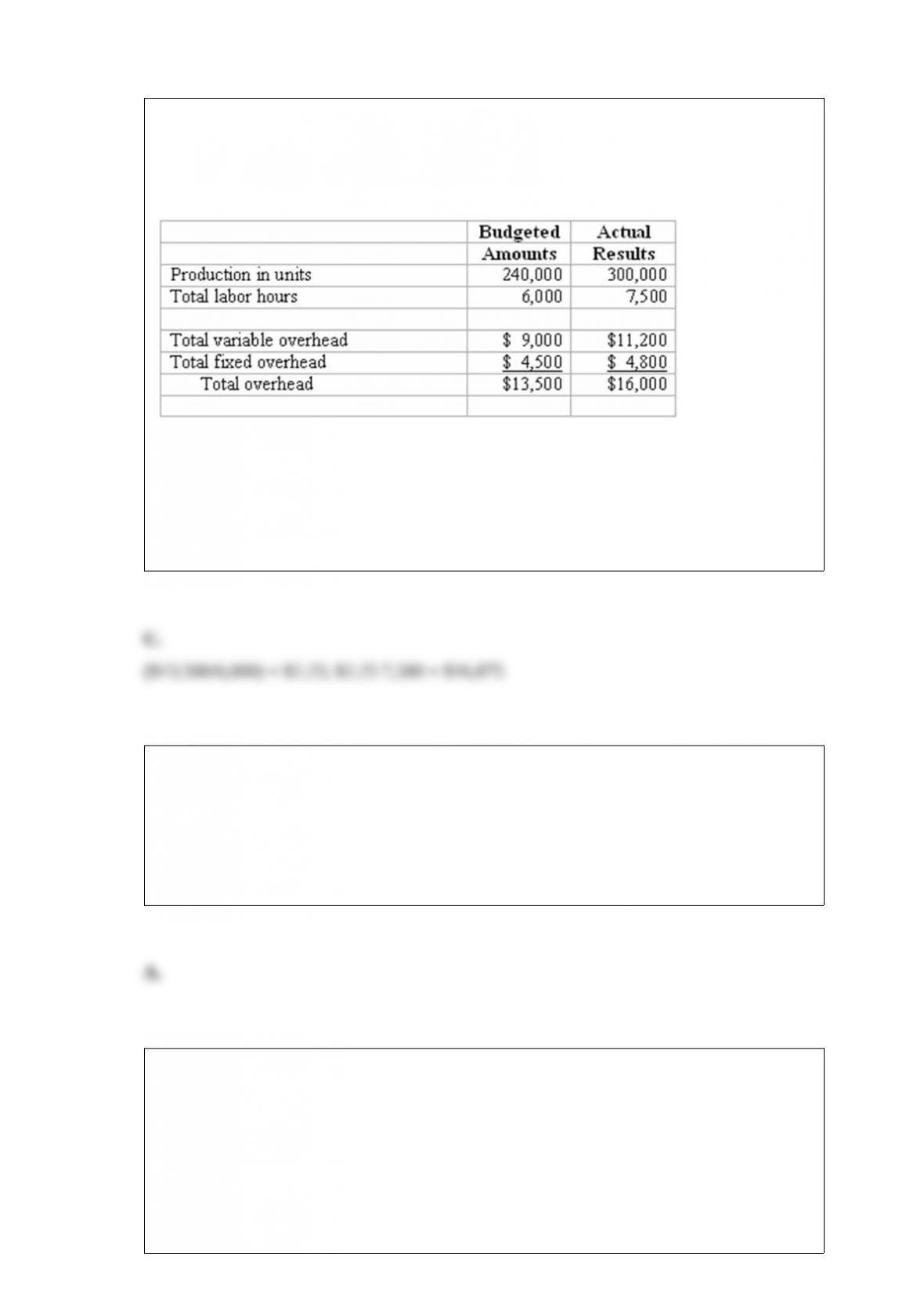
Cooper Corporation produces decorator wall coverings. Budgeted production is
240,000 square feet per month, and the standard direct labor requirement to make this
amount is 6,000 hours. All overhead is allocated based on direct labor hours. The
following information is available:
Refer to the information above. The journal entry to apply overhead to Work in Process
Inventory for the month included:
A. A debit to Work in Process Inventory of $16,000.
B. A debit to Work in Process Inventory of $13,500.
C. A debit to Work in Process Inventory of $16,875.
D. A credit to Work in Process Inventory of $875.
Each of these categories of assets is normally shown in the balance sheet at current
value, except:
A. Inventories.
B. Accounts receivable.
C. Short-term investments in marketable securities.
D. Cash.
The average carrying value (or average investment) of an asset with no salvage value is
equal to:
A. The original cost of the asset divided by its estimated useful life.
B. The original cost of the asset divided by two.
C. The average annual net cash flow of the asset multiplied by the asset’s estimated
useful life.
D. The average annual net income of the asset multiplied by the asset’s estimated useful
life.
At the beginning of the year, Saratoga Dress Co. had an inventory of $300,000. During
the year, the company purchased merchandise costing $850,000. Net sales for the year
totaled $1,200,000, and the gross profit rate was 45%. The cost of goods sold and the
ending inventory, respectively, were:
A. $1,150,000 and $660,000.
B. $540,000 and $610,000.
C. $660,000 and $490,000.
D. $1,150,000 and $490,000.
Which company would most likely not use a process costing system?
A. Bic Pens.
B. Pepsi Cola.
C. Hershey Candy.
D. Tiffany Jewelers.
The identification of a target price for a newly designed product or service is focused
on:
A. The expected costs of production.
B. The required profit margin.
C. The prices charged by existing and potential competitors.
D. Customers and their functional requirements.
Sutton Supplies reports net sales of $3,750,000, net income of $375,000, and gross
profit of $900,000. The company’s cost of goods sold is:
A. $1,700,000.
B. $1,900,000.
C. $3,375,000.
D. $2,850,000.
Which of the following is correct if at the end of Crystal Imports’ first year of
operations, Assets are $800,000 and Owners’ Equity is $720,000?
A. The owner(s) must have invested $800,000 to start the business.
B. The business must be operating profitably.
C. Liabilities are $80,000.
D. Liabilities are $1,520,000.
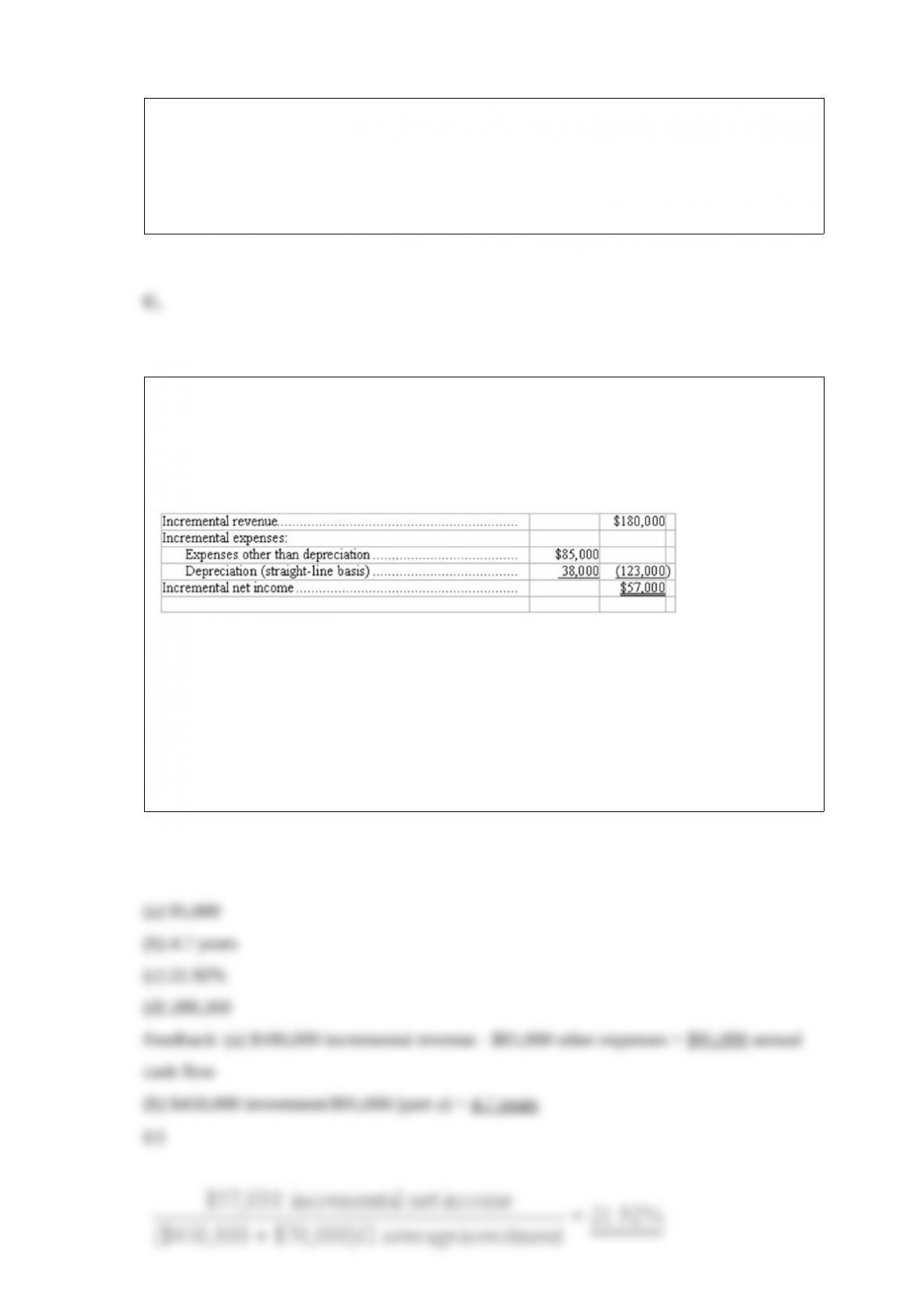
Aves Treats, Inc. produces bird seeds. All direct materials used in the production
process are added at the beginning of the manufacturing process. Labor and overhead
are added evenly thereafter, as each unit is mixed and packaged. Aves Treats uses
process costing and had the following unit production information available for the
months of June and July:
The units remaining in work in process at the end of June were 30% complete. During
the month of July, all of the beginning work in process units was completed and the
units remaining in work in process at the end of the month were 60% complete.
Refer to the information above. For the month of June, the number of equivalent units
of direct materials produced was:
A. 750.
B. 600.
C. 150.
D. Some other amount.
The price-earnings ratio is measured by dividing:
A. Book value by earnings per share.
B. Par value by earnings per share.
C. Market value by earnings per share.
D. Market value by total net income.
Capital budgeting
Flynn Corporation is debating whether to purchase a new computerized production
system. The system will cost $450,000, and have an estimated 10-year life with a
salvage value of $70,000. The estimated operating results from the new production
system are as follows:
All revenue and expenses other than depreciation will be received and paid in cash.
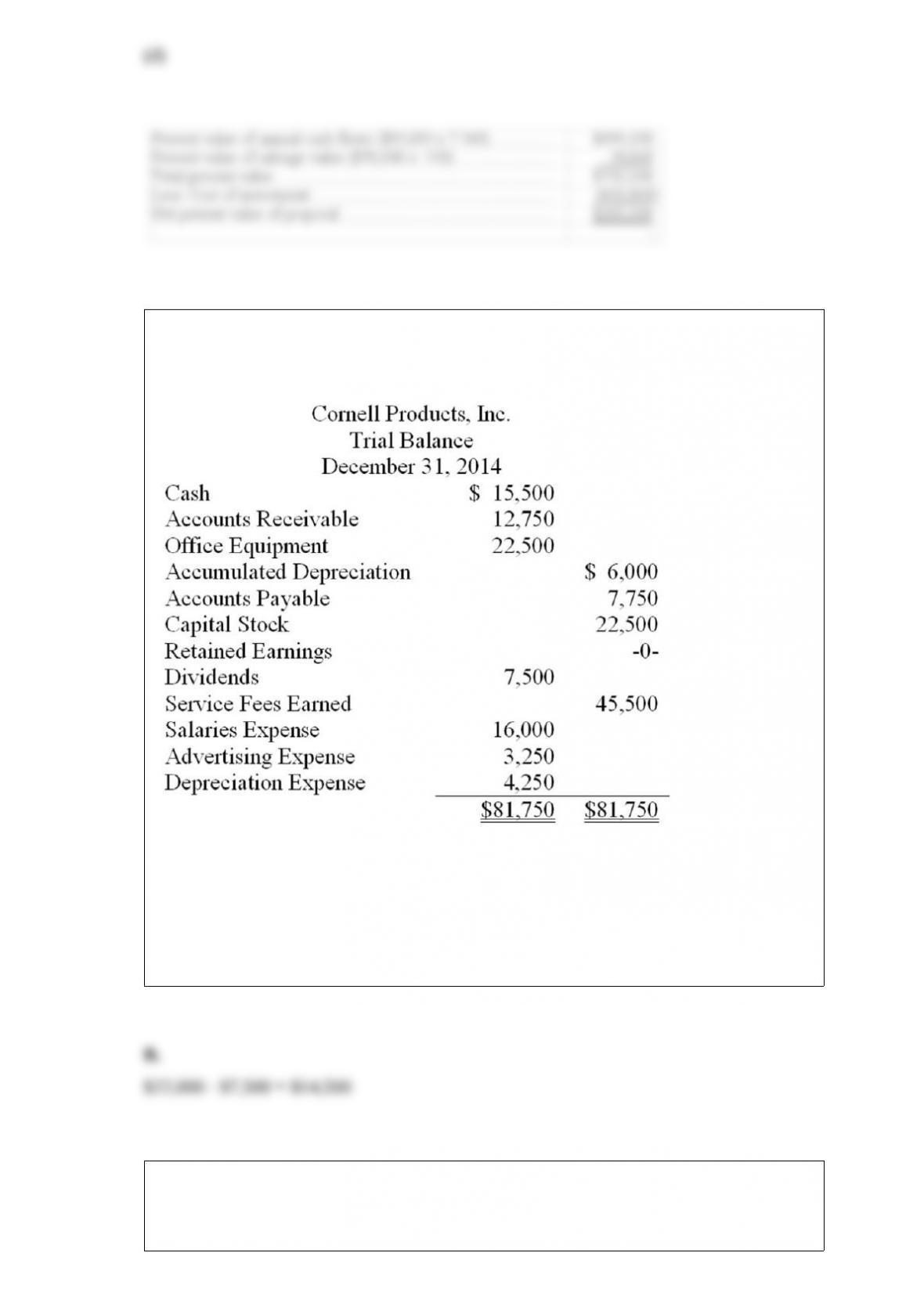
Compute the following for this proposal: (rounded)
(a) Annual net cash flow: $__________
(b) Payback period: __________
(c) Return on average investment: __________
(d) Net present value, discounted at an annual rate of 6% (present value of $1 due in 10
years, discounted at 6%, is 0.558; present value of $1 received annually for 10 years,
discounted at 6%, is 7.360): $__________
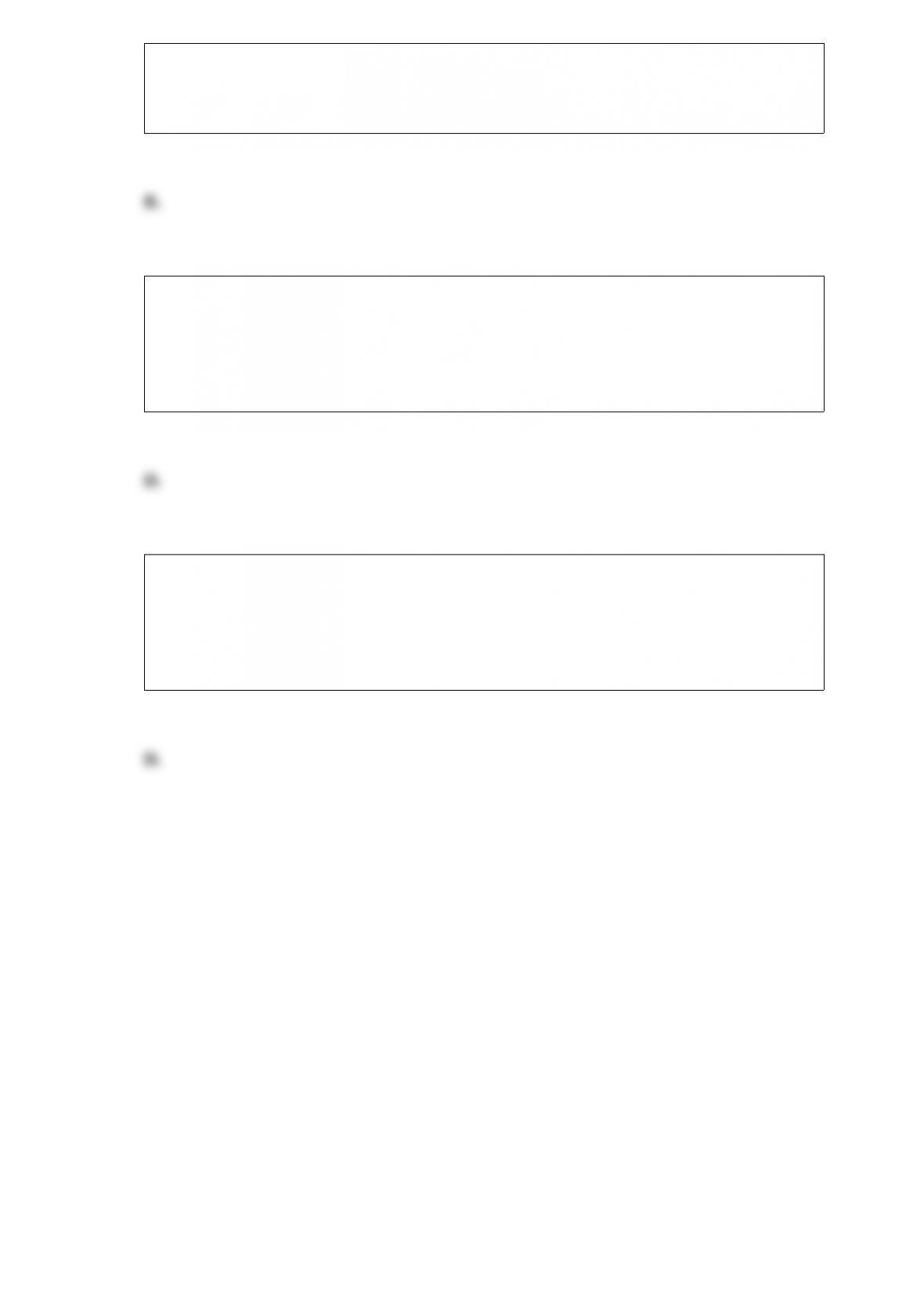
Shown below is a trial balance for Cornell Products Inc., on December 31, after
adjusting entries:
Refer to the information above. After closing the accounts, Retained Earnings at
December 31 equals:
A. zero.
B. $14,500.
C. $22,000.
D. $22,500.
The statement of stockholders’ equity:
A. Is a required financial statement.
B. May be issued as a substitute for the statement of retained earnings.
C. Shows the changes during the year in all stockholders’ equity accounts except
retained earnings.
D. Is a statement sent to each stockholder showing that person’s return on equity.
A supervisor’s salary is an example of:
A. Direct labor.
B. Variable factory overhead.
C. A standard cost.
D. Fixed manufacturing costs.
Which of the following factors does the payback method consider?
A. Total profitability of an investment.
B. The cash flows over the entire life of an investment.
C. The timing of cash flows.
D. The initial investment.