
1) lerner co. had 200,000 shares of common stock, 20,000 shares of convertible
preferred stock, and $1,500,000 of 10% convertible bonds outstanding during 2013. the
preferred stock is convertible into 40,000 shares of common stock. during 2013, lerner
paid dividends of $1.35 per share on the common stock and $4.50 per share on the
preferred stock. each $1,000 bond is convertible into 45 shares of common stock. the
net income for 2013 was $900,000 and the income tax rate was 30%.
diluted earnings per share for 2013 is (rounded to the nearest penny)
a.$3.21
b.$3.37
c.$3.53
d.$3.69
2) harlan mining co. has recently decided to go public and has hired you as an
independent cpa. one statement that the enterprise is anxious to have prepared is a
statement of cash flows. financial statements of harlan mining co. for 2013 and 2012
are provided below.
balance sheets
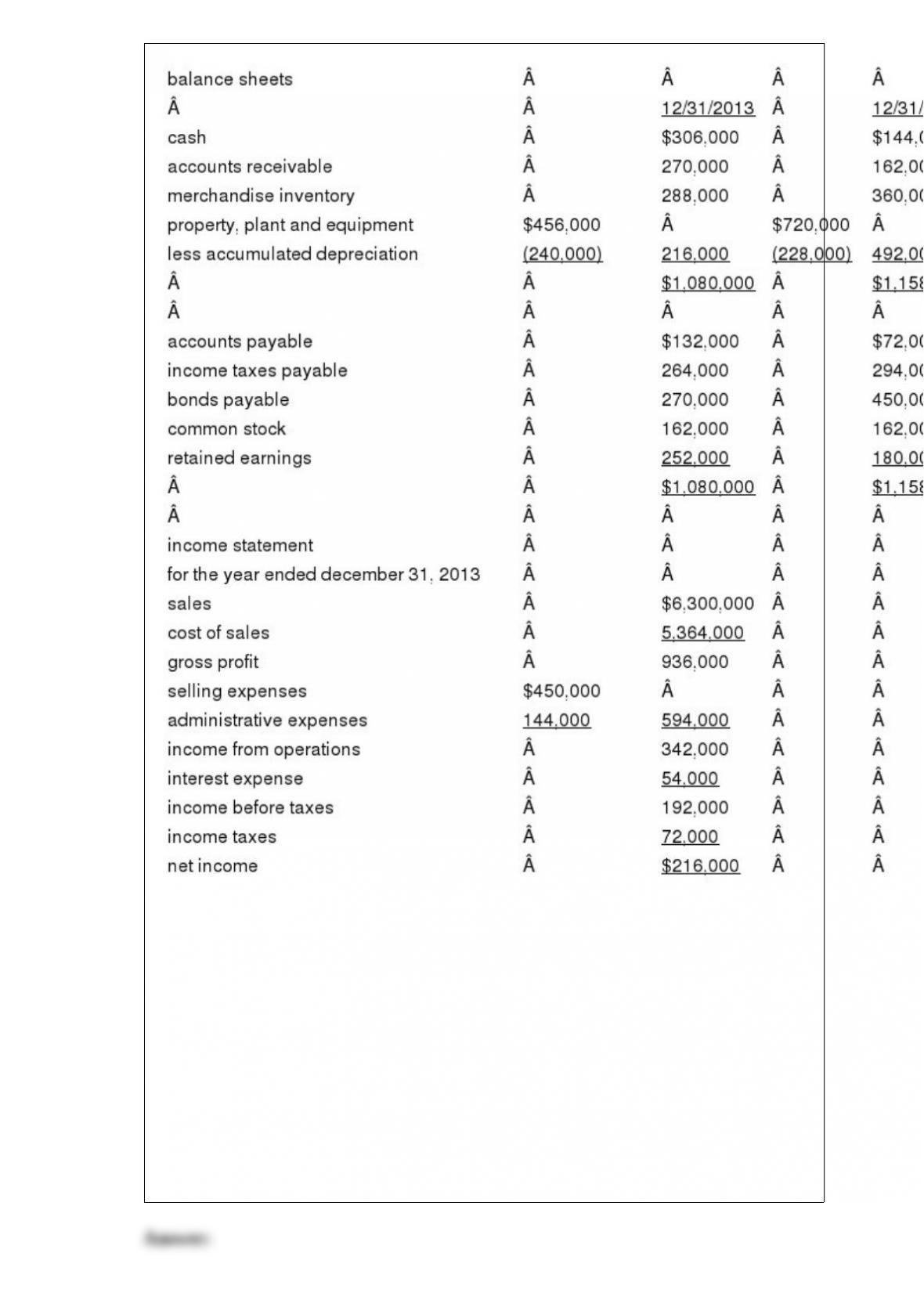
the following additional data were provided:
1>dividends for the year 2013 were $144,000.
2>during the year, equipment was sold for $180,000. this equipment cost $264,000
originally and had a book value of $216,000 at the time of sale. the loss on sale was
incorrectly charged to cost of sales.
3>all depreciation expense is in the selling expense category.
questions 58 through 62 relate to a statement of cash flows (direct method) for the year
ended december 31, 2013, for harlan mining company.
under the direct method, the cash received from customers is
a.$6,408,000
b.$6,192,000
c.$6,300,000
d.$6,330,000

3) on march 1, 2012, ruiz corporation issued $1,000,000 of 8% nonconvertible bonds at
104, which are due on february 28, 2032. in addition, each $1,000 bond was issued with
25 detachable stock warrants, each of which entitled the bondholder to purchase for $50
one share of ruiz common stock, par value $25. the bonds without the warrants would
normally sell at 95. on march 1, 2012, the fair value of ruizs common stock was $40 per
share and the fair value of the warrants was $2.00. what amount should ruiz record on
march 1, 2010 as paid-in capital from stock warrants?
a.$36,800
b.$42,600
c.$52,600
d.$50,000
4) the primary basis of accounting for inventories is cost. a departure from the cost
basis of pricing the inventory is required where there is evidence that when the goods
are sold in the ordinary course of business their
a.selling price will be less than their replacement cost
b.replacement cost will be more than their net realizable value
c.cost will be less than their replacement cost
d.future utility will be less than their cost
5) kohlman corporation owns machinery with a book value of $380,000. it is estimated
that the machinery will generate future cash flows of $350,000. the machinery has a fair
value of $280,000. kohlman should recognize a loss on impairment of
a.$ -0-
b.$ 30,000
c.$100,000
d.$ 70,000
6) on january 1, 2012, jackson company has a building with a carrying value of $50,000
and a remaining useful life 5 years that was recently valued at $150,000. assuming that
the company uses straight-line depreciation, ifrs would show the depreciation as
a.$10,000
b.$30,000
c.$20,000

d.more than one of these answers could be correct
7) factors considered in determining an intangible assets useful life include all of the
following except
a.the expected use of the asset
b.any legal or contractual provisions that may limit the useful life
c.any provisions for renewal or extension of the assets legal life
d.the amortization method used
8) how much must be deposited on january 1, 2012 in a savings account paying 6%
annually in order to make annual withdrawals of $25,000 at the end of the years 2012
and 2013? the present value of one at 6% for one period is .9434.
a.$45,835
b.$47,175
c.$50,000
d.$22,250
9) the revaluation surplus of ifrs is
a.similar to u.s. gaap in that it allows both increases and decreases in valuation
b.similar to u.s. gaap in that it only allows for the decrease in valuation
c.similar to u.s. gaap in that it only allows for the increase in valuation
d.different than u.s. gaap in that it allows the increase in valuation
10) typical contractual situations that are disclosed in the notes to the balance sheet
include all of the following except
a.debt covenants
b.lease obligations
c.advertising contracts
d.pension obligations

11) stock warrants outstanding should be classified as
a.liabilities
b.reductions of capital contributed in excess of par value
c.assets
d.none of these
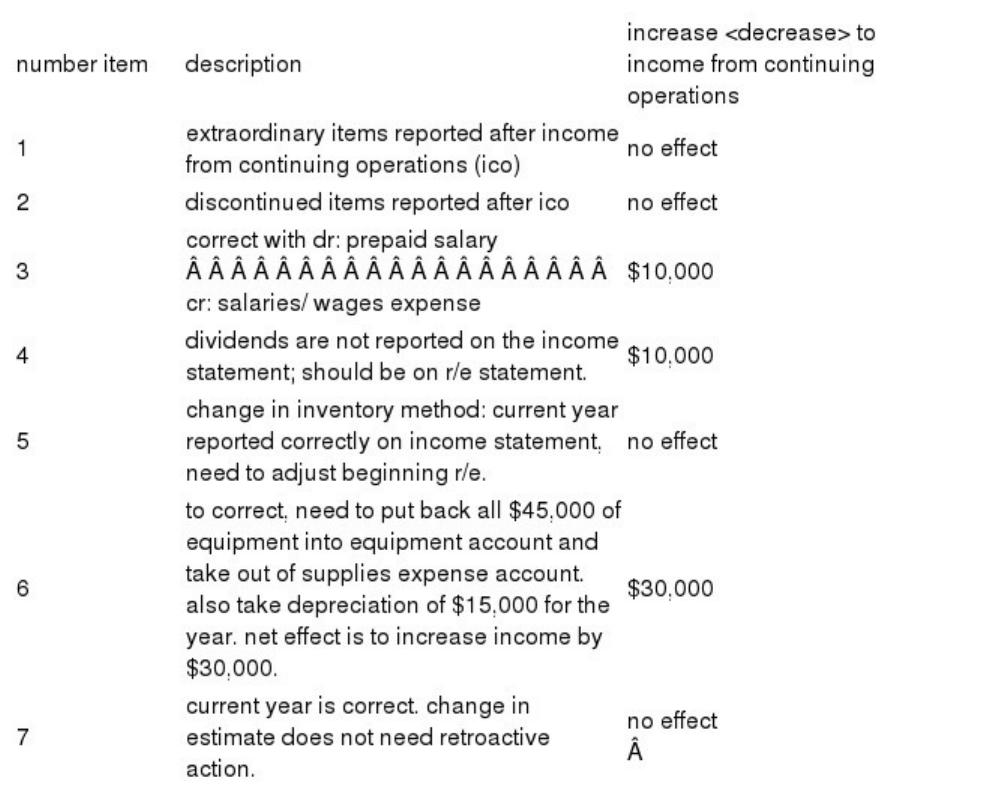
12) the accountant preparing the income statement for bakersfield, inc. had some doubts
about the appropriate accounting treatment of the seven items listed below during the
fiscal year ending december 31, 2012. assume a tax rate of 40 percent.
1. the corporation experienced an uninsured flood loss of $70,000 before taxes. while
this loss meets the criteria of an extraordinary item, it has not been recorded.
2. the corporation disposed of its sporting goods division during 2012. this disposal
meets the criteria for discontinued operations. the division correctly calculated
income from operating this division of $110,000 before taxes and a loss of $12,000
before taxes on the disposal of the division. all of these events occurred in 2012 and
have not been recorded.
3. the company recorded advances of $10,000 to employees made december 31, 2012
as salaries and wages expense.
4. dividends of $10,000 during 2012 were recorded as an operating expense.
5. in 2012, bakersfield changed its method of accounting for inventory from the
first-in-first-out method to the average cost method. inventory in 2012 was
correctly recorded using the average cost method. the new inventory method would
have resulted in an additional $115,000 of cost of goods sold (before taxes) being
reported on prior years’ income statement.
6. office equipment purchased january 1, 2012 for $45,000 was incorrectly charged to
supplies expense at the time of purchase. the office equipment has an estimated
three-year service life with no expected salvage value. bakersfield uses the
straight-line method to depreciate office equipment for financial reporting
purposes. this error has not been recorded.
7. on january 1, 2008, bakersfield bought a building that cost $85,000, had an
estimated useful life of ten years, and had a salvage value of $5,000. bakersfield
uses the
straight-line depreciation method to depreciate the building. in 2012, it was
estimated that the remaining useful life was eight years and the salvage value was
zero. depreciation expense reported on the 2012 income statement was correctly
calculated based on the new estimates. no adjustment for prior years’ depreciation
estimates was made.
part a. for each item, record corrections to income from continuing operations before
taxes, if any. denote any negative numbers by using brackets < >.
part b. at january 1, 2010, bakersfield, inc.’s retained earnings balance was $200,000.
assume that income from continuing operations (before taxes) and after correctly
considering any of the seven additional items was $1,200,000. prepare the income
statement and retained earnings statement. denote negative numbers by using brackets
< >. do not disclose earnings per share data.
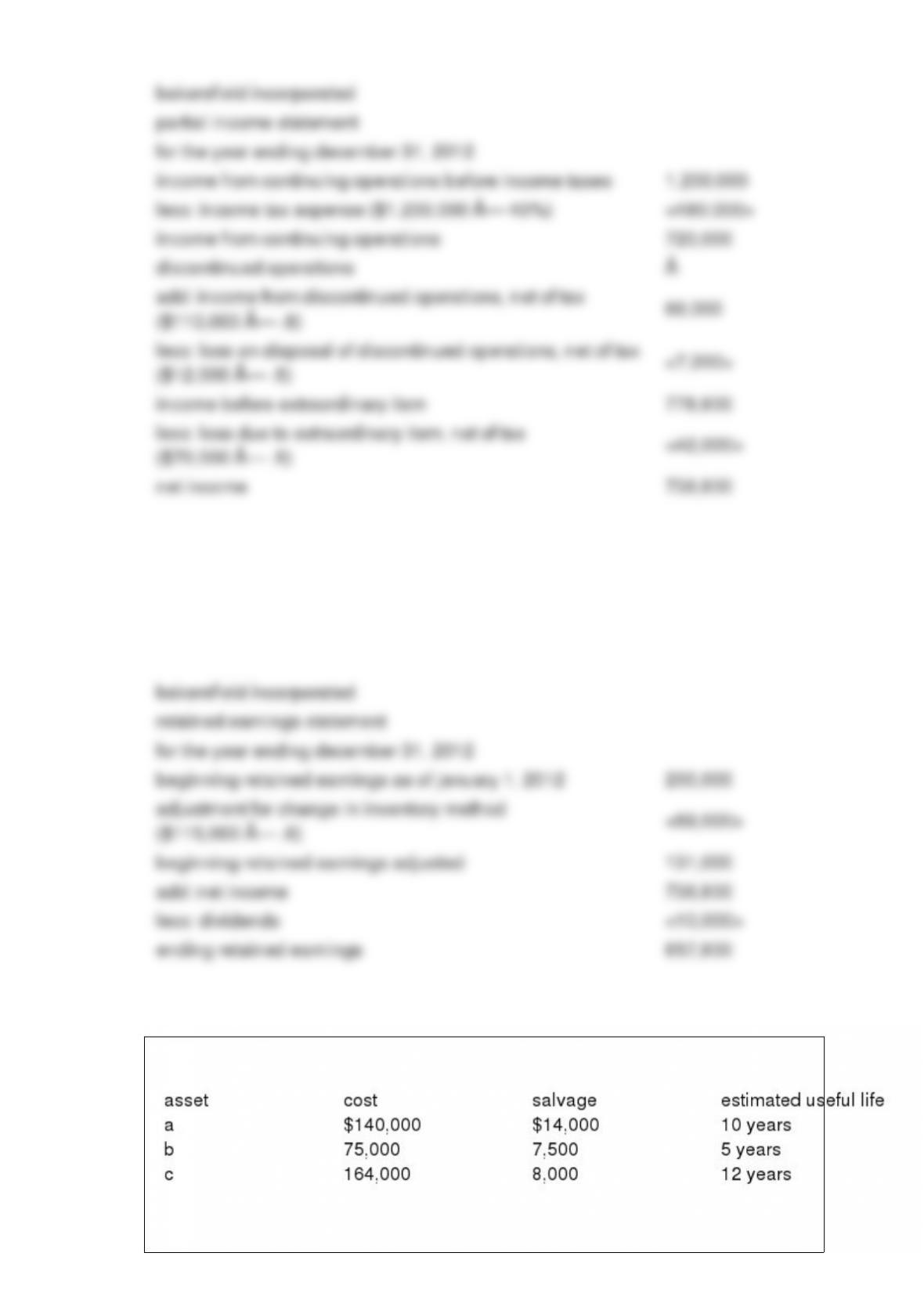
13) ebert inc. owns the following assets:
what is the composite life of ebert’s assets?
a.14.0 years

b.9.7 years
c.8.9 years
d.10.3 years
14) cashman company reported net income of $285,000 for the year ended 12/31/13.
included in the computation of net income were: depreciation expense, $45,000;
amortization of a patent, $24,000; income from an investment in common stock of linda
inc., accounted for under the equity method, $36,000; and amortization of a bond
premium, $9,000. cashman also paid a $60,000 dividend during the year. the net cash
provided by operating activities would be reported at:
a.$309,000
b.$261,000
c.$249,000
d.$201,000
15) when a note payable is issued for property, goods, or services, the present value of
the note is measured by
a.the fair value of the property, goods, or services
b.the fair value of the note
c.using an imputed interest rate to discount all future payments on the note
d.any of these
16) which type of accounting change should always be accounted for in current and
future periods?
a.change in accounting principle
b.change in reporting entity
c.change in accounting estimate
d.correction of an error