Flynn Company ‘s monthly bank statement showed the ending balance of cash of
$18,500. The bank reconciliation for the period showed an adjustment for a deposit in
transit of $1,500, outstanding checks of $2,000, a NSF check of $700, bank service
charges of $30 and the EFT from a customer in payment of the customer ‘s account of
$1,500.
Use the information above to answer the following question. What was the cash balance
on the company ‘s books (before the adjustments for items on the bank reconciliation)?
A) $18,000
B) $17,230
C) $19,000
D) $20,270
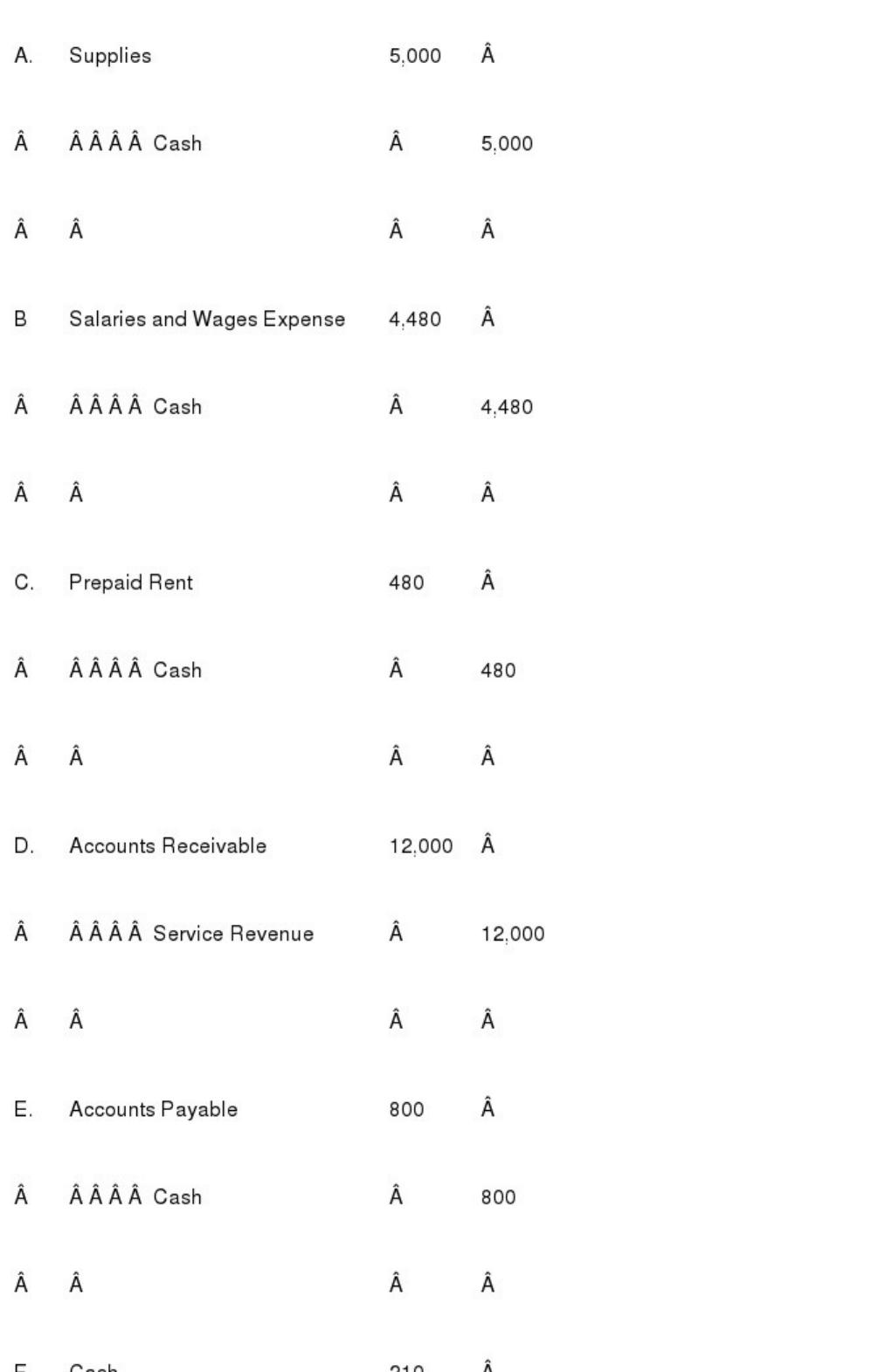
The Pet Sitters, Inc. entered into the following transactions during the month of

January.
A. Purchased supplies for $5,000 cash.
B. Paid $4,480 for salaries and wages for the month of January.
C. Paid $480 in advance for February rent.
D. Provided $12,000 in services on account.
E. Paid $800 on accounts payable.
F. Received $210 from customers as deposits for future pet sitting services.
G. Received a bill for $1,500 from the plumber who repaired a broken pipe in the
restrooms, but will not pay the bill until February.
H. Purchased equipment for cash of $780.
Required:
Prepare journal entries to record the transactions identified among activities (A) through
(H).
When a company sells goods, it removes their cost from the balance sheet and reports
the cost on the income statement as:
A) Selling Expenses.
B) Cost of Goods Sold.
C) Finished Goods Inventory.
D) Inventory.
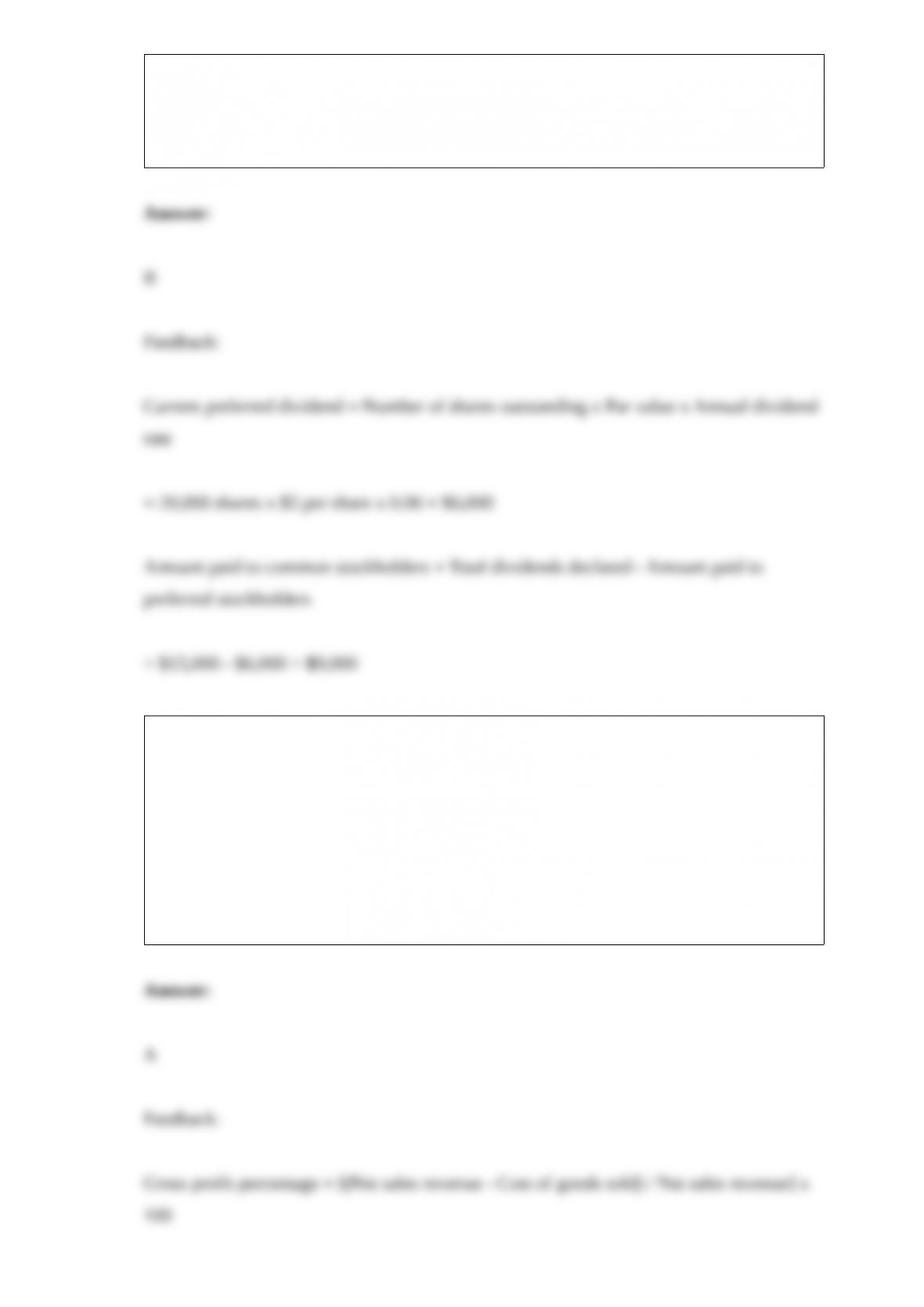
A company has the following paid-in capital:
Use the information above to answer the following question. If the company pays a
$15,000 dividend and the preferred stock is noncumulative, what is the amount the
common stockholders will receive?
A) $15,000
B) $9,000
C) $9,900
D) $0
An increase in the gross profit percentage indicates that:
A) cost of goods sold as a percentage of sales has decreased.
B) cost of goods sold as a percentage of sales has increased.
C) operating expenses as a percentage of sales have increased.
D) operating expenses as a percentage of sales have decreased.
Which of the following statements about the closing process is correct?
A) Closing entries are recorded at the end of each reporting period which could be
monthly, quarterly or annually.
B) After closing entries are posted, the balances of the income statement accounts will
be zero.
C) Closing entries are made to zero out the balances of the permanent accounts on the
balance sheet.
D) After closing entries are posted, the only temporary account with a balance is the
Dividends account.
Which of the following statements about the financial statements is correct?
A) The “change in cash ” reported on the statement of cash flows is also reported on the
statement of retained earnings.
B) Both the income statement and the statement of cash flows show the result of a
company’s operating activities.
C) The statement of cash flows is for a period of time while the income statement is at a
point in time.
D) The statement of cash flows is at a point of time while the income statement is for a
period of time.
Which of the following ratios is used to evaluate how efficient a company is in using its
fixed assets to generate revenues?
A) Current ratio
B) Debt-to-assets ratio
C) Return on fixed assets ratio
D) Fixed asset turnover ratio
B. Darin Company purchased a truck and trailer for $54,000. The appraised values of
the truck and trailer are $38,000 and $19,000, respectively. What is the amount of the
cost that should be assigned to the trailer?
A) $19,000
B) $18,000
C) $16,000
D) $22,000
Which of the following sequences indicates the correct order of steps in the accounting
cycle?
A) Post to T-accounts, prepare journal entries, prepare trial balance, and prepare
financial statements.
B) Post to T-accounts, prepare journal entries, prepare financial statements, and prepare
trial balance.
C) Prepare Journal entries, post to T-accounts, prepare trial balance, and prepare
financial statements.
D) Prepare Journal entries, post to T-accounts, prepare financial statements, and prepare
trial balance.
Cash flows from investing activities include all of the following except a(n):
A) purchase of an automobile.
B) sale of a trademark.
C) purchase of stock of another company.
D) issuance of bonds.
Using the aging method of accounts receivable method, $5,000 of the company’s
Accounts Receivable are estimated to be uncollectible. At the end of the year, the
balance of Accounts Receivable is $100,000 and the unadjusted credit balance of the
Allowance for Doubtful Accounts is $500. Credit sales during the year totaled
$150,000. What is the current year’s Bad Debt Expense?
A) $4,500
B) $5,000
C) $7,000
D) $7,500
The following information is available for a company for the current year:
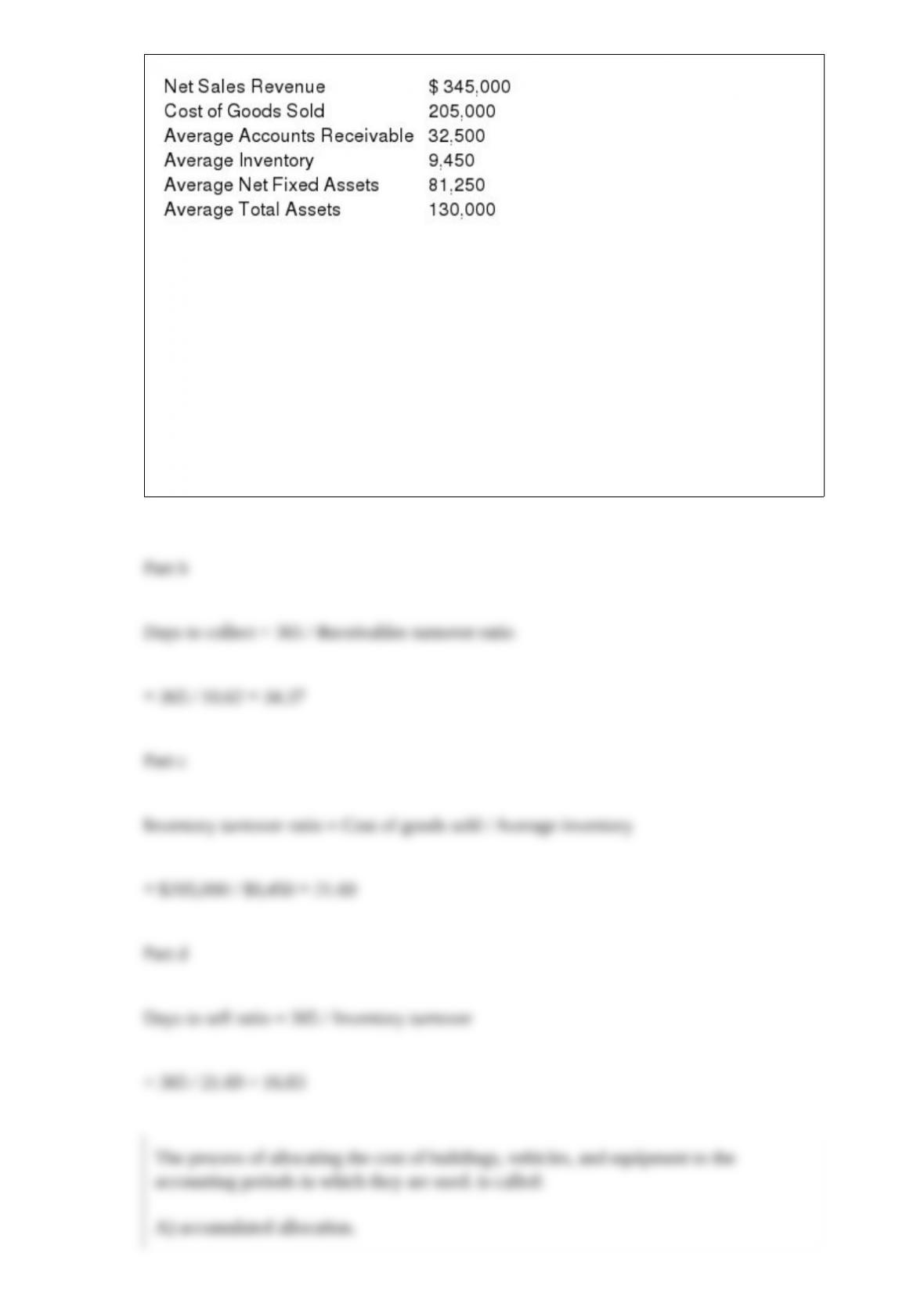
Required:
Part a. Calculate the receivables turnover ratio for the current year.
Part b. Calculate the days to collect for the current year.
Part c. Calculate the inventory turnover ratio for the current year.
Part d. Calculate the days to sell for the current year.
Round all ratios to two decimal points.
The process of allocating the cost of buildings, vehicles, and equipment to the
accounting periods in which they are used. is called:
A) accumulated allocation.
B) unearned revenue.
C) depreciation.
D) prepaid expense.
On December 31, 2015, Hoosier Inc. paid $10,000 to rent a storage facility from July 1,
2016 to July 1, 2017. Which of the following statements about the effect of this
transaction on Hoosier’ financial statements is correct?
A) Prepaid Rent in the amount of $10,000 will be reported as a liability on the balance
sheet at December 31, 2015.
B) Rent Expense in the amount of $10,000 should be reported on the income statement
for the year ended December 31, 2015.
C) The income statement for the year ended December 31, 2015 is unaffected by this
transaction.
D) The balance sheet at December 31, 2016 will not report any assets relating to this
transaction.
Spangle Corporation uses the unit-of-production method to estimate depreciation. The
company purchased a new machine for $18,000 that will produce an estimated 100,000
units over its useful life. The estimated residual value of the machine is $2,000. What is
the depreciation rate per unit?
A) $1.60
B) $1.80
C) $0.16
D) $0.18
Which of the following statements about the balance sheet is correct?
A) A classified balance sheet is one that contains privileged information.
B) Current liabilities are debts and other obligations that will be paid or fulfilled within
12 months of the balance sheet date.
C) All companies use the chart of account names defined by the Financial Accounting
Standards Board (FASB).
D) A balance sheet is prepared for a period of time.
The direct write-off method for uncollectible accounts:
A) violates the expense recognition principle.
B) is an acceptable alternative method of recognizing Bad Debt Expense under GAAP.
C) results in higher Bad Debt Expense for most companies.
D) may only be used by companies that do not extend credit to their customers.