1) u.s. gaap, per sfas no. 153, now requires that gains on exchanges of nonmonetary
assets be recognized if the exchange lacks commercial substance.
2) companies classify some cash flows relating to investing or financing activities as
operating activities.
3) companies must consider presently enacted changes in the tax rate that become
effective in future years when determining the tax rate to apply to existing temporary
differences.
4) under ifrs compliance requirements the u.s. gaap formatted income statement need
not be replaced with the igaap statement of recognized income and expenses.
5) the cash paid for interest will always be greater than interest expense when using
effective-interest amortization for a bond.
6) treasury stock is a companys own stock that has been reacquired and retired.
7) the cost method records all transactions in treasury shares at their cost and reports the
treasury stock as a deduction from capital stock.

8) the recognition criteria for an aro are more stringent under u.s. gaap: the aro is not
recognized unless there is a present legal obligation and the fair value of the obligation
can be reasonably estimated.
9) research and development costs are recorded as an intangible asset if it is felt they
will provide economic benefits in future years.
10) cash payments for operating expenses are computed by subtracting an increase in
prepaid expenses and a decrease in accrued expenses payable from operating expenses.
11) amortization of limited-life intangible assets should not be impacted by expected
residual values.
12) mendenhall corporation constructed a building at a cost of $10,000,000. average
accumulated expenditures were $4,000,000, actual interest was $600,000, and
avoidable interest was $400,000. if the salvage value is $800,000, and the useful life is
40 years, depreciation expense for the first full year using the straight-line method is
a.$240,000
b.$245,000
c.$260,000
d.$340,000
13) porter corporation’s capital structure consists of 50,000 shares of common stock. at
december 31, 2012 an analysis of the accounts and discussions with company officials
revealed the following information:
sales revenue$1,100,000
purchase discounts18,000
purchases692,000

earthquake loss (net of tax) (extraordinary item)35,000
selling expenses128,000
cash60,000
accounts receivable90,000
common stock200,000
accumulated depreciation-machinery180,000
dividend revenue8,000
inventory, january 1, 2012152,000
inventory, december 31, 2012125,000
unearned service revenue4,400
interest payable1,000
land370,000
patents100,000
retained earnings, january 1, 2012290,000
interest expense17,000
administrative expenses170,000
dividends declared24,000
allowance for doubtful accounts5,000
notes payable (maturity 7/1/15)200,000
machinery450,000
materials40,000
accounts payable60,000
the amount of income taxes applicable to ordinary income was $27,600, excluding the
tax effect of the earthquake loss which amounted to $15,000.
instructions
(a)prepare a multiple-step income statement.
(b)prepare a retained earnings statement.
14) a company acquired a building, paying a portion of the purchase price in cash and
issuing a mortgage note payable to the seller for the balance.
in a statement of cash flows, what amount is included in investing activities for the
above transaction?
a.cash payment
b.acquisition price
c.zero
d.mortgage amount
15) goods on consignment are
a.included in the consignee’s inventory
b.recorded in a consignment out account which is an inventory account
c.recorded in a consignment in account which is an inventory account
d.all of these
16) tanner corporation’s inventory cost on its balance sheet was lower using first-in,
first-out than it would have been using last-in, first-out. assuming no beginning
inventory, in what direction did the cost of purchases move during the period?
a.up
b.down
c.steady
d.cannot be determined
17) bell inc. took a physical inventory at the end of the year and determined that
$760,000 of goods were on hand. in addition, the following items were not included in
the physical count. bell, inc. determined that $96,000 of goods were in transit that were
shipped f.o.b. destination (goods were actually received by the company three days
after the inventory count).the company sold $40,000 worth of inventory f.o.b.
destination. what amount should bell report as inventory at the end of the year?
a.$760,000
b.$856,000
c.$800,000
d.$896,000
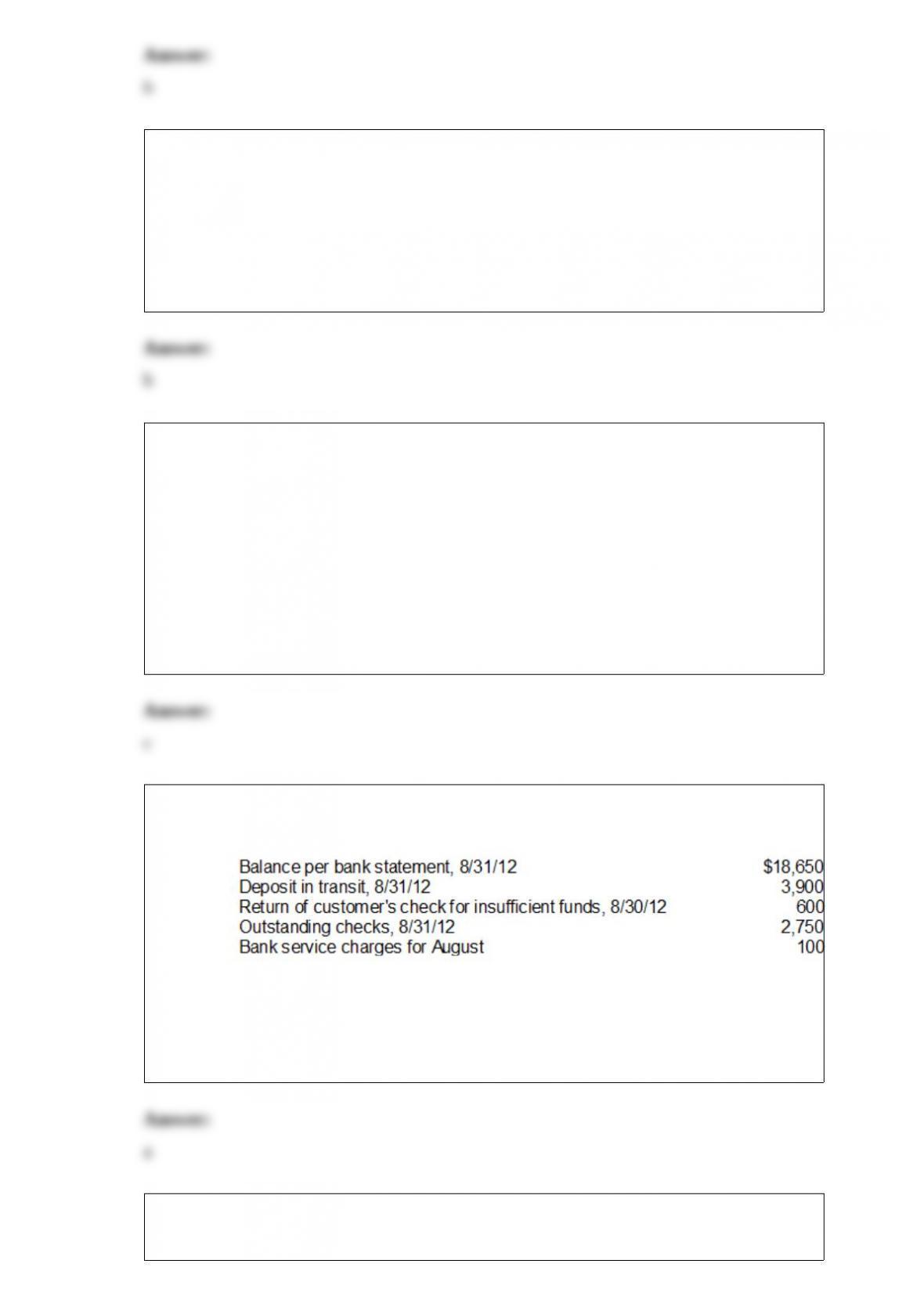
18) in preparing its august 31, 2012 bank reconciliation, bing corp. has available the
following information:
at august 31, 2012, bing’s correct cash balance is
a.$19,800
b.$19,200.
c.$19,100
d.$17,500
19) the accounts receivable turnover ratio measures the
a.number of times the average balance of accounts receivable is collected during the

period
b.percentage of accounts receivable turned over to a collection agency during the period
c.percentage of accounts receivable arising during certain seasons
d.number of times the average balance of inventory is sold during the period.
20) white corporation uses the fifo method for internal reporting purposes and lifo for
external reporting purposes. the balance in the lifo reserve account at the end of 2012
was $120,000. the balance in the same account at the end of 2013 is $180,000. whites
cost of goods sold account has a balance of $900,000 from sales transactions recorded
during the year. what amount should white report as cost of goods sold in the 2013
income statement?
a.$840,000
b.$900,000
c.$960,000
d.$1,080,000
21) lemay frosted flakes company offers its customers a pottery cereal bowl if they send
in 4 boxtops from lemay frosted flakes boxes and $1. the company estimates that 60%
of the boxtops will be redeemed. in 2012, the company sold 500,000 boxes of frosted
flakes and customers redeemed 220,000 boxtops receiving 55,000 bowls. if the bowls
cost lemay company $3 each, how much liability for outstanding premiums should be
recorded at the end of 2012?
a.$150,000
b.$40,000
c.$60,000
d.$84,000
22) colson inc. declared a $240,000 cash dividend. it currently has 9,000 shares of 7%,
$100 par value cumulative preferred stock outstanding. it is one year in arrears on its
preferred stock. how much cash will colson distribute to the common stockholders?
a.$114,000
b.$126,000
c.$177,000
d.none

23) logan corp.’s trial balance of income statement accounts for the year ended
december 31, 2012 included the following:
debit credit
sales$280,000
cost of sales$100,000
administrative expenses50,000
loss on sale of equipment18,000
commissions to salespersons16,000
interest revenue10,000
freight-out6,000
loss due to earthquake damage24,000
bad debt expense 6,000
totals$220,000$290,000
other information:
logan’s income tax rate is 30%. finished goods inventory:
january 1, 2012$160,000
december 31, 2012140,000
on logan’s multiple-step income statement for 2012,
extraordinary loss is
a.$16,800
b.$24,000
c.$29,400
d.$42,000
24) ely co. bought a patent from baden corp. on january 1, 2013, for $450,000. an
independent consultant retained by ely estimated that the remaining useful life at
january 1, 2013 is 15 years. its unamortized cost on badens accounting records was
$225,000; the patent had been amortized for 5 years by baden. how much should be
amortized for the year ended december 31, 2013 by ely co.?
a.$0
b.$22,500
c.$30,000
d.$45,000
25) when a new company is acquired, which of these intangible assets, unrecorded on
the acquired companys books, might be recorded in addition to goodwill?
a.a brand name
b.a patent
c.a customer list
d.all of the above
26) in a business combination, companies record identifiable intangible assets that they
can reliably measure. all other intangible assets, too difficult to identify or measure, are
recorded as:
a.other assets
b.indirect costs
c.goodwill
d.direct costs
27) which of the following statements is correct?
a.the indirect method starts with income before extraordinary items
b.the direct method is known as the reconciliation method
c.the direct method is more consistent with the primary purpose of the statement of cash
flows
d.all of these
28) on may 1, 2012, marly co. issued $1,000,000 of 7% bonds at 103, which are due on
april 30, 2022. twenty detachable stock warrants entitling the holder to purchase for $40
one share of marlys common stock, $15 par value, were attached to each $1,000 bond.
the bonds without the warrants would sell at 96. on may 1, 2012, the fair value of
marlys common stock was $35 per share and of the warrants was $2.
what amount of compensation expense should korsak recognize for the year ended
december 31, 2013?
a.$0
b.$40,000
c.$400,000
d.$200,000
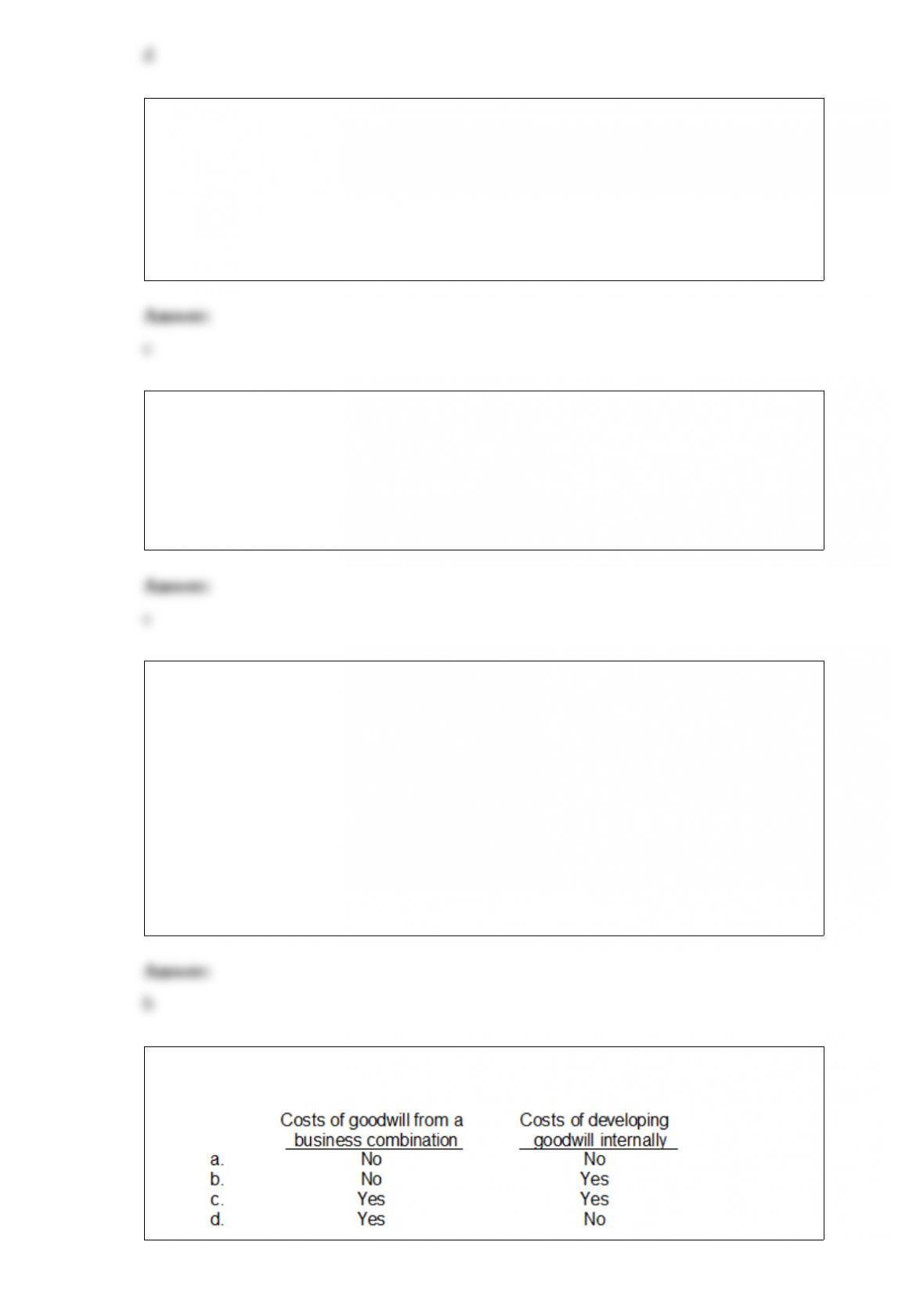
29) which of the following costs of goodwill should be amortized over their estimated
useful lives?
30) vogts company sells tvs. the perpetual inventory was stated as $33,500 on the books
at december 31, 2012. at the close of the year, a new approach for compiling inventory
was used and apparently a satisfactory cut-off for preparation of financial statements
was not made. some events that occurred are as follows.
1>tvs shipped to a customer january 2, 2013, costing $5,000 were included in inventory
at december 31, 2012. the sale was recorded in 2013.
2>tvs costing $12,000 received december 30, 2012, were recorded as received on
january 2, 2013.
3>tvs received during 2012 costing $4,600 were recorded twice in the inventory
account.
4>tvs shipped to a customer december 28, 2012, f.o.b. shipping point, which cost
$8,000, were not received by the customer until january, 2013. the tvs were included in
the ending inventory.
5>tvs on hand that cost $6,100 were never recorded on the books.
instructions
compute the correct inventory at december 31, 2012.
31) at the date of issue, bond buyers determine the present value of the bonds cash
flows using the market interest rate.

32) declaration of a cash dividend on common stock affects cash flows from operating
activities under the direct and indirect methods as follows:
33) for each of the unrelated transactions described below, present the entry(ies)
required to record the bond transactions.
1>on august 1, 2013, lane corporation called its 10% convertible bonds for conversion.
the $6,000,000 par bonds were converted into 240,000 shares of $20 par common stock.
on august 1, there was $700,000 of unamortized premium applicable to the bonds. the
fair value of the common stock was $20 per share. ignore all interest payments.
2>packard, inc. decides to issue convertible bonds instead of common stock. the
company issues 10% convertible bonds, par $3,000,000, at 97. the investment banker
indicates that if the bonds had not been convertible they would have sold at 94.
3>gomez company issues $10,000,000 of bonds with a coupon rate of 8%. to help the
sale, detachable stock warrants are issued at the rate of ten warrants for each $1,000
bond sold. it is estimated that the value of the bonds without the warrants is $9,870,000
and the value of the warrants is $630,000. the bonds with the warrants sold at 101.