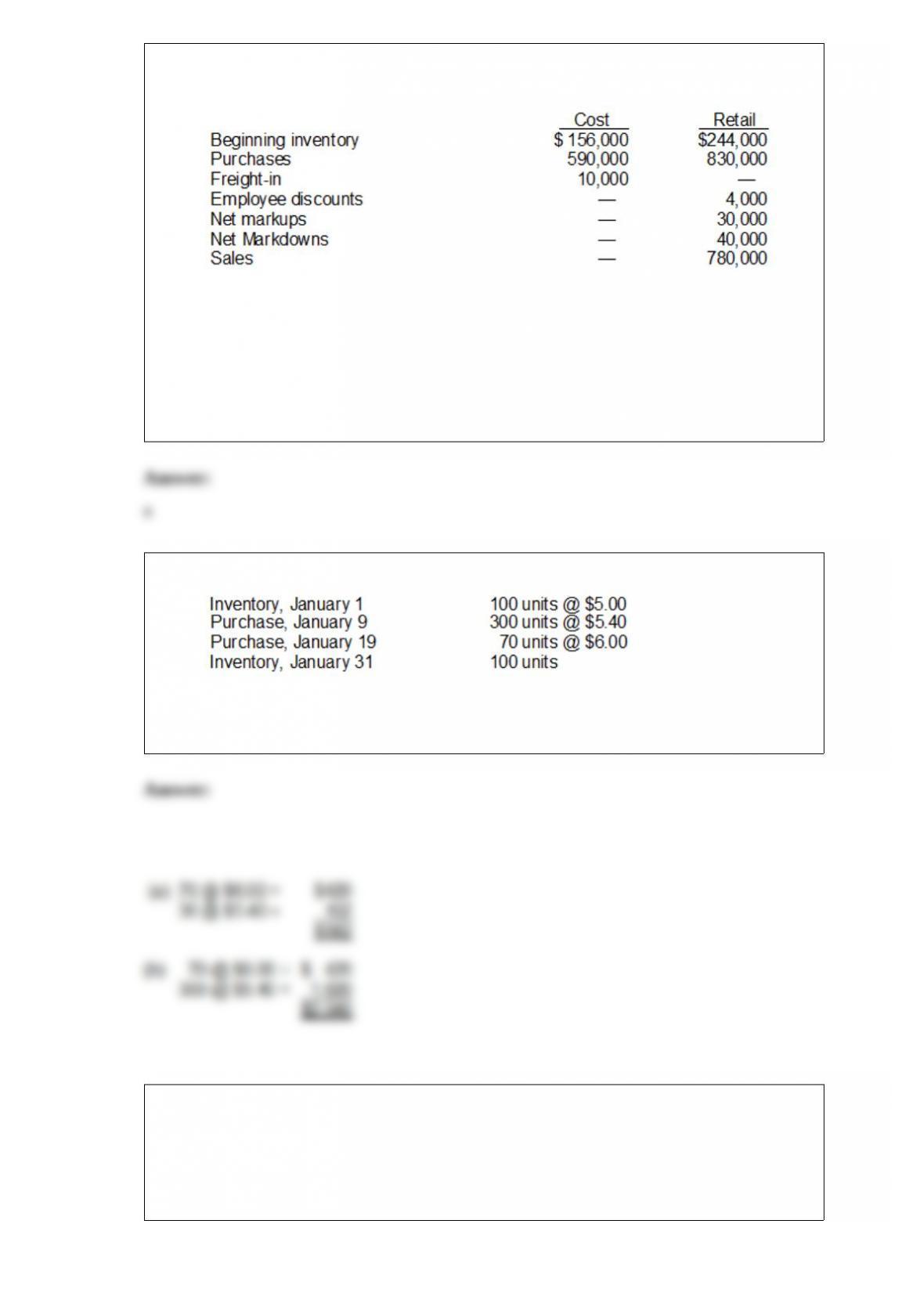
1) plank co. uses the retail inventory method. the following information is available for
the current year.
assuming that the lifo inventory method is used, that the beginning inventory is the base
inventory when the index was 100, and that the index at year end is 112, the ending
inventory at dollar-value lifo retail cost is
a.$160,920
b.$185,514
c.$191,800
d.$204,960
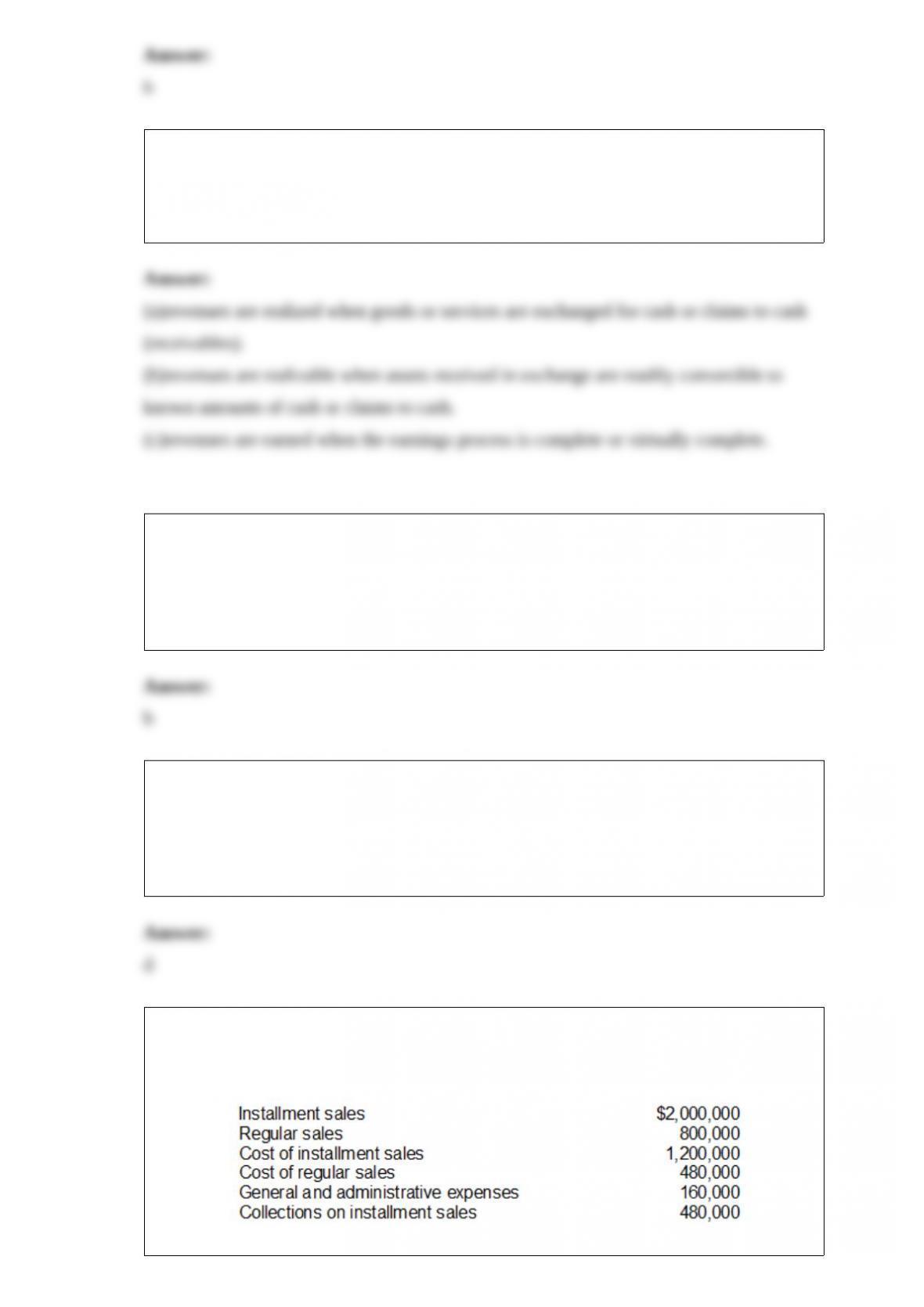
2) the rock shop shows the following data related to an item of inventory:
instructions
(a)what value should be assigned to the ending inventory using fifo?
(b)what value should be assigned to cost of goods sold using lifo?
3) which of the following is not a long-term investment?
a.cash surrender value of life insurance
b.franchise
c.land held for speculation
d.a sinking fund
4) the revenue recognition principle provides that revenue is recognized when (1) it is
realized or realizable and (2) it is earned.
instructions
explain when revenues are (a) realized, (b) realizable, and (c) earned.
5) the accounting principle of expense recognition is best demonstrated by
a.not recognizing any expense unless some revenue is realized
b.associating effort (expense) with accomplishment (revenue)
c.recognizing prepaid rent received as revenue
d.establishing an appropriation for contingencies account
6) the income statement reveals
a.resources and equities of a firm at a point in time
b.resources and equities of a firm for a period of time
c.net earnings (net income) of a firm at a point in time
d.net earnings (net income) of a firm for a period of time
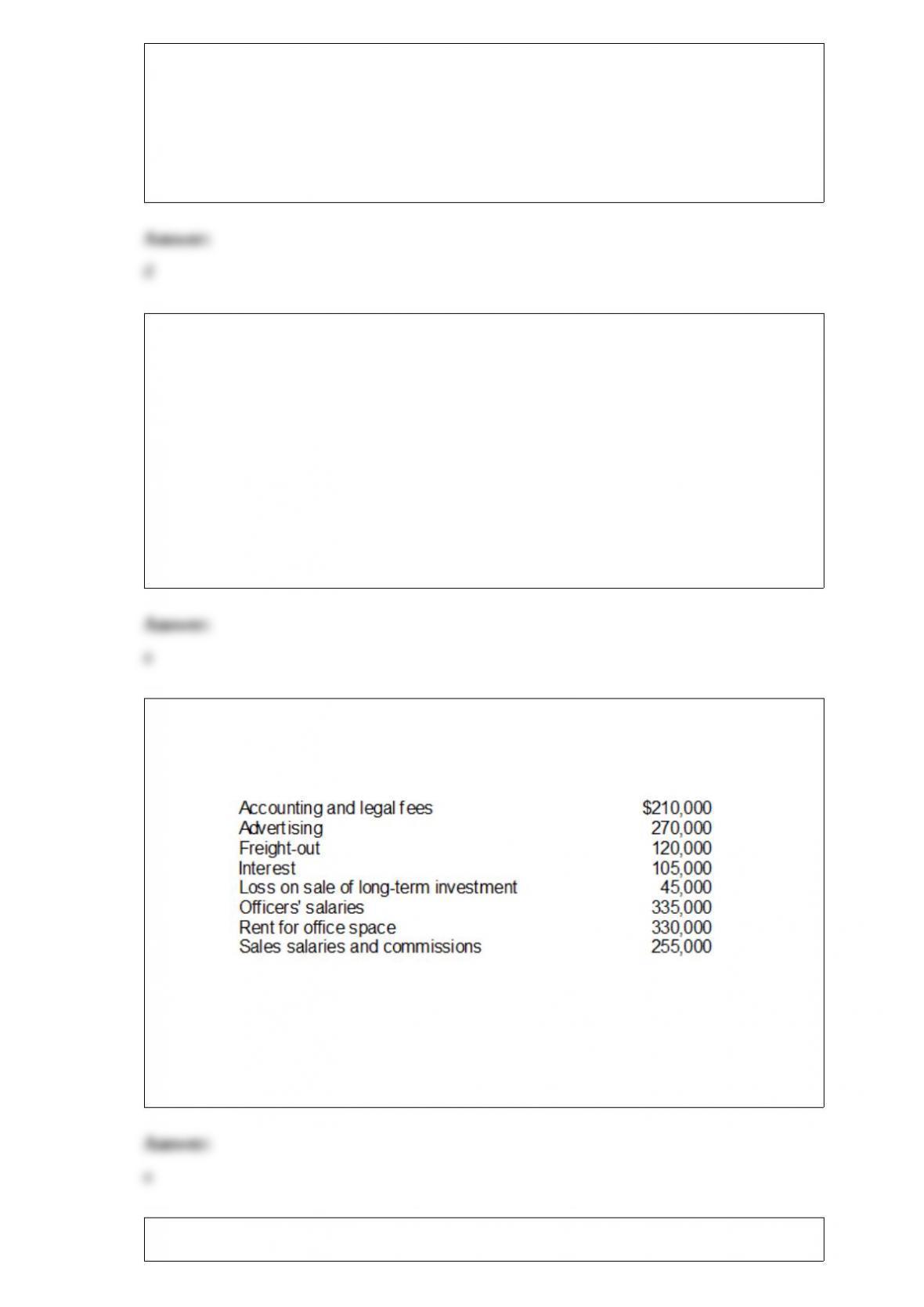
7) hartz co., which began operations on january 1, 2013, appropriately uses the
installment-sales method of accounting. the following information pertains to hartz’s
operations for the year 2013:
the deferred gross profit account in hartz’s december 31, 2013 balance sheet should be

a.$192,000
b.$320,000
c.$608,000
d.$800,000
8) which of the following basic accounting assumptions is threatened by the existence
of severe inflation in the economy?
a.monetary unit assumption
b.periodicity assumption
c.going-concern assumption
d.economic entity assumption
9) which of the following is not a selling expense?
a.advertising expense
b.office salaries expense
c.freight-out
d.store supplies consumed
10) which of the following is not correct in regard to trading securities?
a.they are held with the intention of selling them in a short period of time
b.unrealized holding gains and losses are reported as part of net income
c.any discount or premium is not amortized
d.all of these are correct
11) which of the following is not a common disclosure for inventories?
a.inventory composition
b.inventory location
c.inventory financing arrangements
d.inventory costing methods employed
12) tate company purchased equipment on november 1, 2012 and gave a 3-month, 9%
note with a face value of $40,000. the december 31, 2012 adjusting entry is
a.debit interest expense and credit interest payable, $3,600
b.debit interest expense and credit interest payable, $900
c.debit interest expense and credit cash, $600
d.debit interest expense and credit interest payable, $600
13) which of the following transactions would require the use of the present value of an
annuity due concept in order to calculate the present value of the asset obtained or
liability owed at the date of incurrence?
a.a capital lease is entered into with the initial lease payment due upon the signing of
the lease agreement
b.a capital lease is entered into with the initial lease payment due one month
subse-quent to the signing of the lease agreement
c.a ten-year 8% bond is issued on january 2 with interest payable semiannually on july
1 and january 1 yielding 7%
d.a ten-year 8% bond is issued on january 2 with interest payable semiannually on july
1 and january 1 yielding 9%
14) didde corp. reports operating expenses in two categories: (1) selling and (2) general
and administrative. the adjusted trial balance at december 31, 2012 included the
following expense and loss accounts:
one-half of the rented premises is occupied by the sales department. didde’s total selling
expenses for 2012 are
a.$810,000
b.$690,000
c.$645,000
d.$555,000
15) impairments are

a.based on discounted cash flows for securities
b.recognized as a realized loss if the impairment is judged to be temporary
c.based on fair value for available-for-sale investments and on negotiated values for
held-to-maturity investments
d.evaluated at each reporting date for every investment