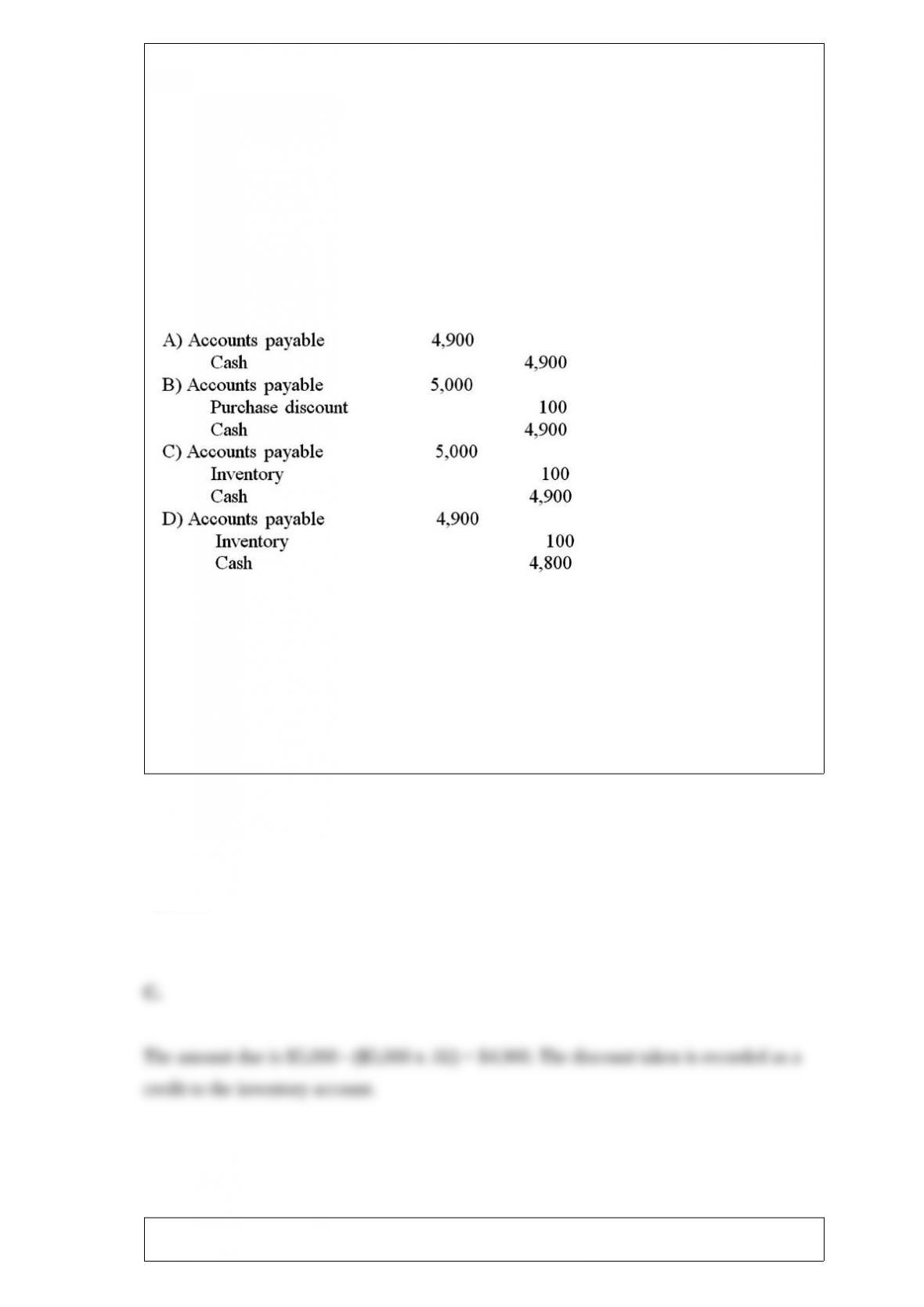
E. Flynn Company uses a perpetual inventory system and had the following
transactions during November:
November 6: Purchased $5,800 of inventory on account, terms 2/10, n/30.
November 8: Returned $800 of defective units and received full credit.
November 15: Paid the amount due.
Use the information above to answer the following question. What is the journal entry
to be recorded by E. Flynn Company on November 15?
A. Option A
B. Option B
C. Option C
D. Option D
Answer:
Investors and creditors look at the balance sheet to see whether the company:
A. is profitable.
B. owns enough assets to pay what it owes to creditors.
C. has had a positive cash flow from operations.
D. is paying sufficient dividends to stockholders.
Answer:
The Return on Equity ratio measures:
A. the return stockholders receive in dividends for each dollar of their investment.
B. the return stockholders receive in dividends and stock price growth for each dollar of
their investment.
C. the amount earned by the company on each dollar contributed by stockholders and
earnings reinvested in the company.
D. the amount earned by the company on each dollar obtained from equity and debt
financing.
Answer:
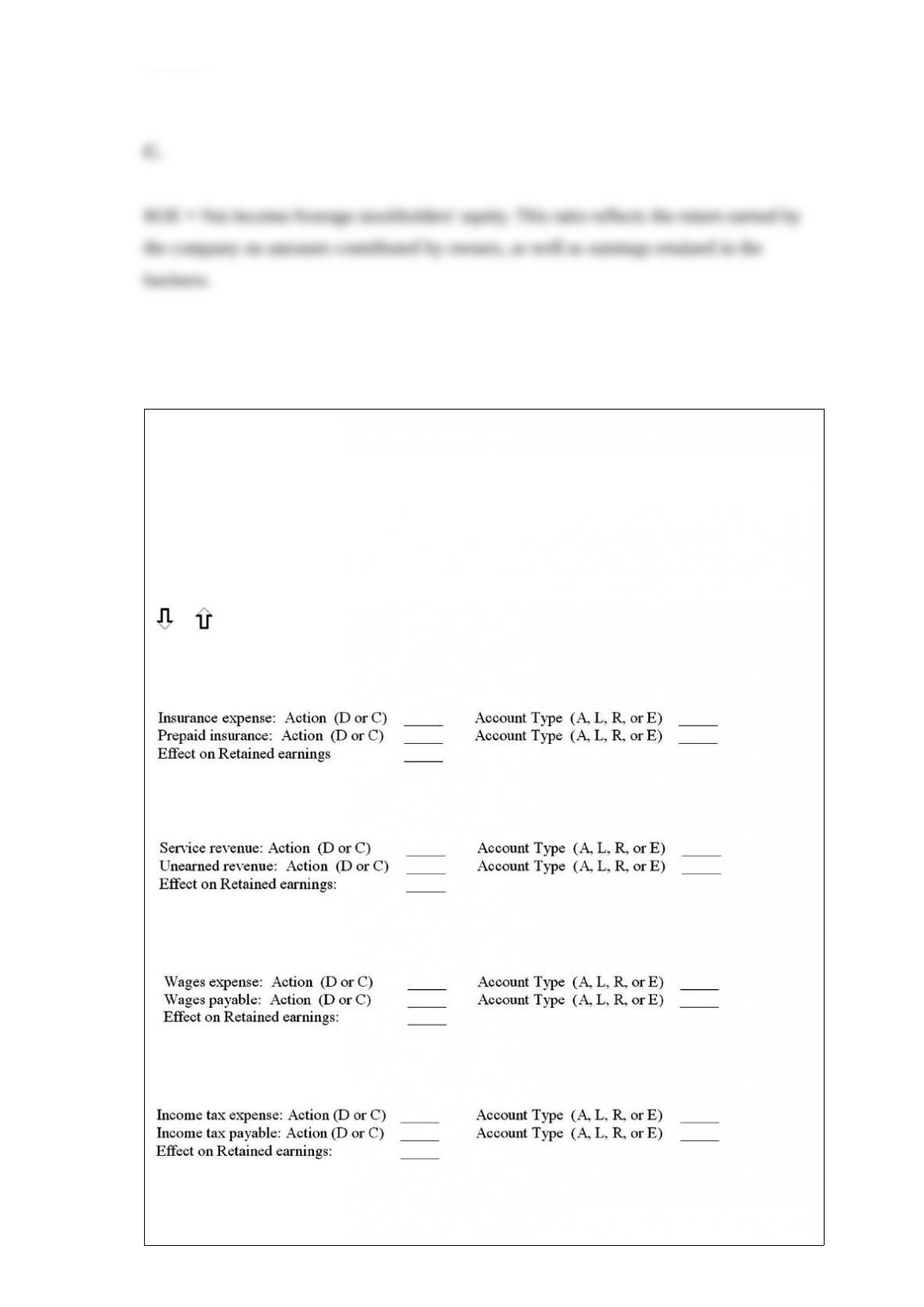
For each of the following transactions, match the action (Debit or Credit) and the
account type (Asset, Liability, Revenue, or Expense) to each account for the appropriate
adjustment that needs to be made at the end of June. Also, show the effect on Retained
Earnings.
(D) Debit or (C) Credit
(A) Asset, (L) Liability, (R) Revenue or (E) Expense Account
or Retained Earnings
a. The company has insurance costs of $620 a day for the month of June. On June 1 the
company had $26,000 of prepaid insurance.
b. The company provides services in June for which it had received payment of $18,300
in May.
c. The company had $12,500 worth of labor performed by workers who will be paid in
July.
d. The company had income before income taxes of $287,400 for June and will pay
taxes at the rate of 36%. The tax will be paid in July.
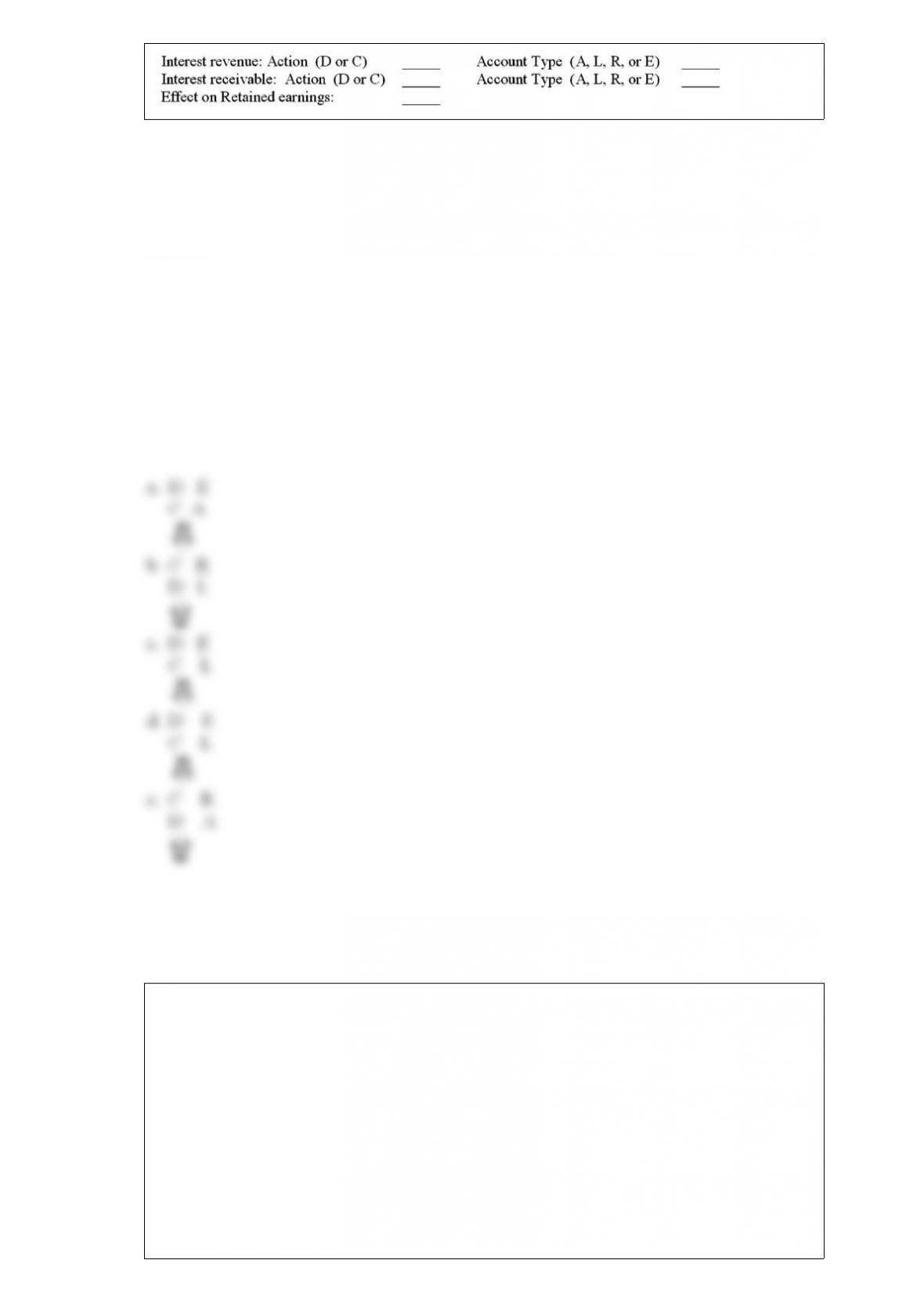
e. The company had interest of $1,000 due for June on a Certificate of Deposit (CD).
The interest will be received in August.
Answer:
Which of the following statements best describes a contingent liability?
A. The amount of a contingent liability is known and will definitely have to be paid in
the future.
B. A contingent liability is a potential liability that has arisen because of a past
transaction or event, but its ultimate outcome will not be known until a future event
occurs or fails to occur.
C. A contingent liability will only be incurred if a particular future event takes place.
D. A contingent liability is a potential liability that will be incurred if a natural disaster
happens.
Answer:
Use the information above to answer the following question. What is the amount of
cash paid for wages?
A. $34,000
B. $35,000
C. $36,000
D. $22,000
Answer:
On June 15, Oakley Inc. sells merchandise on account to Sunglass Hut (SH) for $1,000,
terms 2/10, n/30. On June 20, SH returns to Oakley merchandise that SH had purchased
for $300. On June 24, SH completely fulfills its obligation to Oakley by making a cash
payment. What is the amount of cash paid by SH to Oakley?
A. $680.
B. $686.
C. $700.
D. $1,000.
Answer:
Preferred stock differs from common stock in that preferred stock:
A. has more voting power and, as such, greater control over the management of the
company.
B. is less risky because preferred stockholders are paid dividends before common
stockholders.
C. pays a tax-free dividend.
D. has no preemptive rights or residual claims.
Answer:
A merchandise company’s beginning inventory plus merchandise purchases minus
ending inventory equals:
A. net sales.
B. cost of goods sold.
C. goods available for sale.
D. net purchases.
Answer:
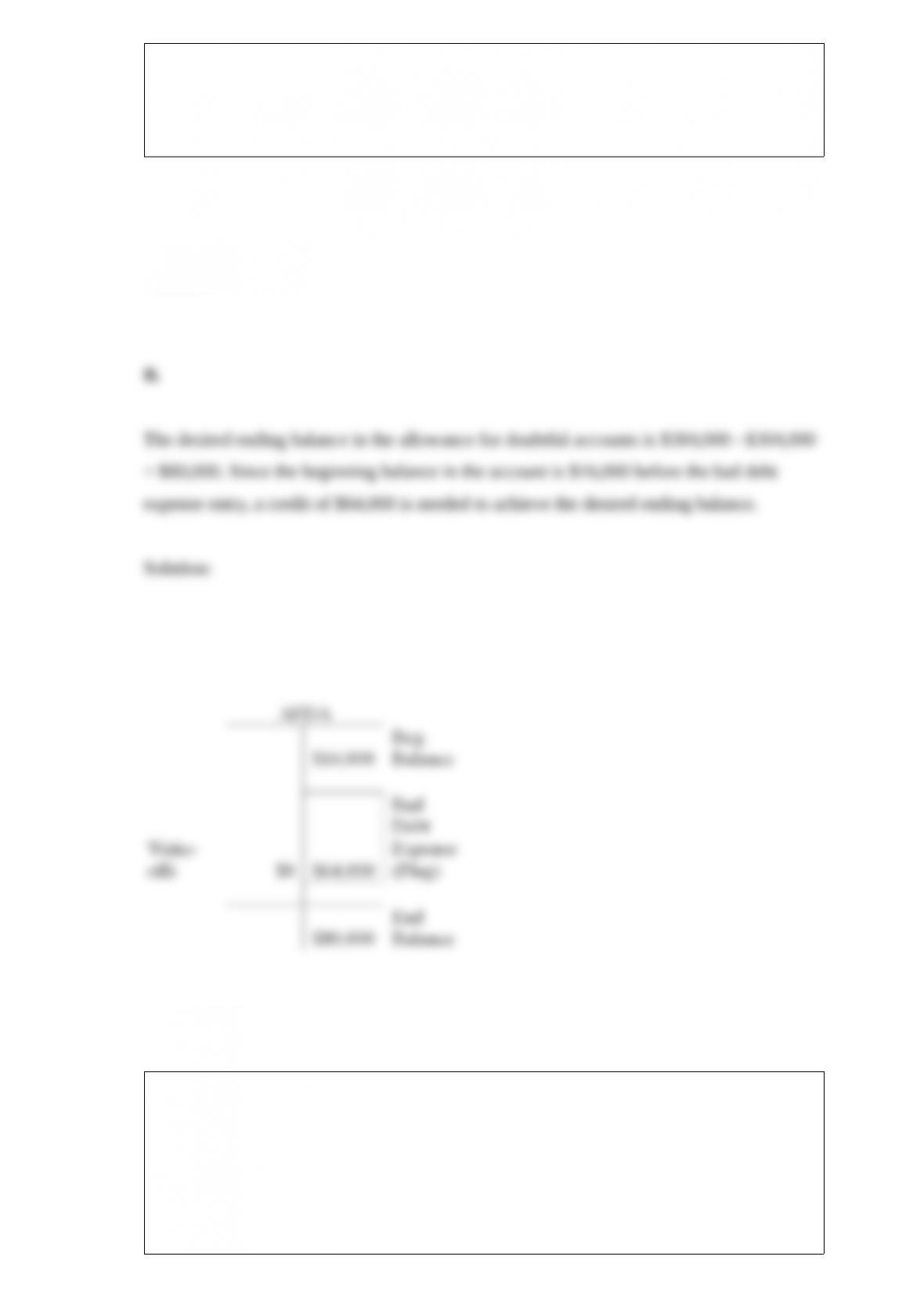
A company used the aging of accounts receivable method and at December 31
determined that the net realizable value of accounts receivable was $304,000. In
addition, the records show the following:
What was the amount of Bad Debt Expense for the year?
A. $96,000
B. $64,000
C. $80,000
D. $16,000
Answer:
Which of the following is not a reason why businesses need an effective internal control
system?
A. To help ensure that sales are not lost because desired goods are not in stock.
B. To help ensure that money is not tied up in excessive inventory.
C. To help ensure the loss of inventory and cash to theft is minimized.
D. To identify ways to circumvent applicable laws and regulations.
Answer:
The book value of a depreciable asset can never be less than its
A. historical cost.
B. market value.
C. capitalized cost.
D. residual value.
Answer:
Accounting information serves a governance function when it is used by:
A. managers to make a business decision.
B. government officials to regulate the business and its financial records.
C. directors to oversee the business.
D. analysts to vote on company policies.
Answer:
At the end of the accounting period, but before closing entries are made, Harry, the
proprietor of Harry’s Bar and Grill, has a debit of $24,500 in his drawing account and a
credit of $126,800 in his capital account. If his capital account has a credit balance of
$137,900 after the closing, what was his net income?
A. $11,100
B. $35,600
C. $113,400
D. $13,400
Answer:
On January 1, 2014, a company purchased a machine for $138,000 with an expected
life of 5 years and a residual value of $12,000. In addition, the company paid delivery
costs of $1,200 and $4,800 to have the machine installed. The company uses the
double-declining-balance method of depreciation.
Use the information above to answer the following question. What is the depreciation
expense for the first year using the double-declining-balance method?
A. $52,800.
B. $57,600.
C. $53,000
D. $55,200.
Answer:
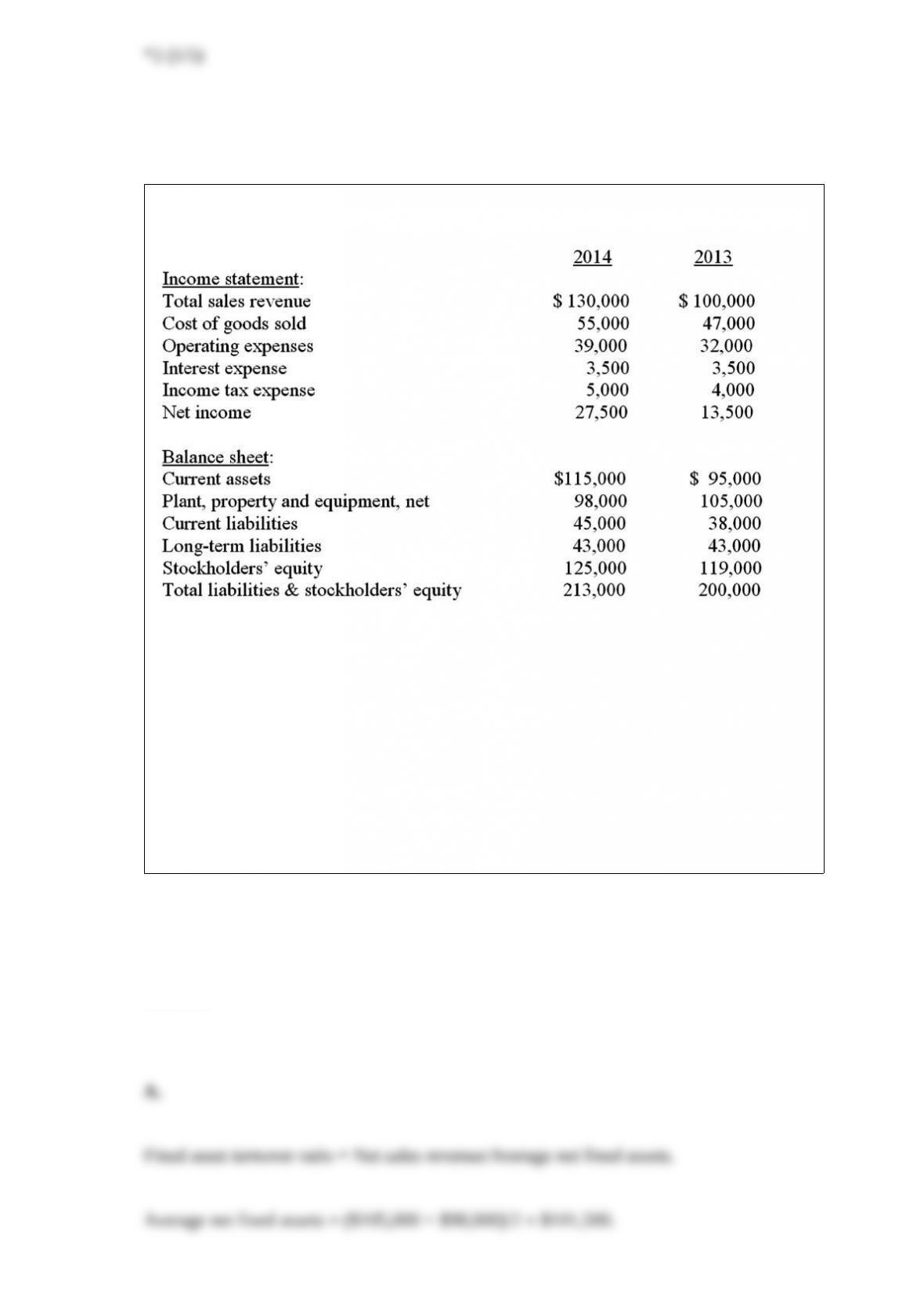
The comparative financial statements of B. Darin include the following data:
Use the information above to answer the following question. The fixed asset turnover
ratio for 2014 is closest to:
A. 1.28.
B. 1.24.
C. 0.75.
D. 1.64.
Answer:
Use the information above to answer the following question. What is the amount of
cash paid for inventory?
A. $77,000
B. $78,000
C. $80,000
D. $81,000
Answer:
A company sells goods on account at a selling price of $20,000. The cost of the goods is
$15,000. Under a perpetual inventory system the journal entries to record the sale will
include:
A. $20,000 will be debited to Inventory and $20,000 will be credited to Accounts
Receivable.
B. $20,000 will be debited to Cost of goods sold and $20,000 will be credited to
Inventory.
C. $15,000 will be credited to Inventory and $15,000 will be credited to Sales.
D. $20,000 will be debited to Accounts receivable and $20,000 will be credited to
Sales.
Answer:
Which concept should be applied when reporting a piece of land that was bought for
$50,000 five years ago, and which would probably now sell for $80,000?
A. The cost principle
B. Conservatism
C. The separate entity concept
D. The monetary concept
Answer:
Choose the letter of the appropriate definition to match the term. Not all definitions will
be used.

Term
_____ 1/ Amortization
_____ 2/ Useful life
_____ 3/ Licensing right
_____ 4/ Least and latest rule
_____ 5/ Component allocation
_____ 6/ Fixed asset turnover ratio
_____ 7/ Depreciable cost
_____ 8/ Copyright
_____ 9/ Depreciation schedule
_____ 10/ Revenue expenditures
Definition
A. Allocating the cost of tangible assets over their limited useful life.
B. Costs that are recorded as revenues.
C. Asset cost minus residual value.
D. Net income divided by average total assets.
E. Allocating the cost of intangible assets over their limited useful life.
F. Asset cost minus accumulated depreciation.
G. Costs that are expensed in the period incurred.
H. Grants the exclusive right to sell or use a creative work.
I. A cumulative record of depreciation expense, accumulated depreciation and book
value.
J. An estimate of low long a company will use a particular asset.
K. Net sales revenue divided by average net fixed assets.
L. The principle that companies wish to pay the lowest possible tax at the last possible
time.
M. A contractual agreement that allows limited permission for use of a property.

N. An estimate of how long a tangible asset will last before it physically wears out.
O. The method whereby different parts of an asset may be depreciated over different
useful lives under IFRS.
Answer:
The journal entry to record the increase in the value of a long-lived asset would include
which of the following?
A. A credit to Gain on Asset Value Increase.
B. A debit to the long-lived asset account.
C. A credit to Non-Impairment of Asset.
D. No entry would be made according to GAAP.
Answer:
Flynn Corporation had the following cash flows for the current year. The company uses
the direct method in preparing the statement of cash flows.
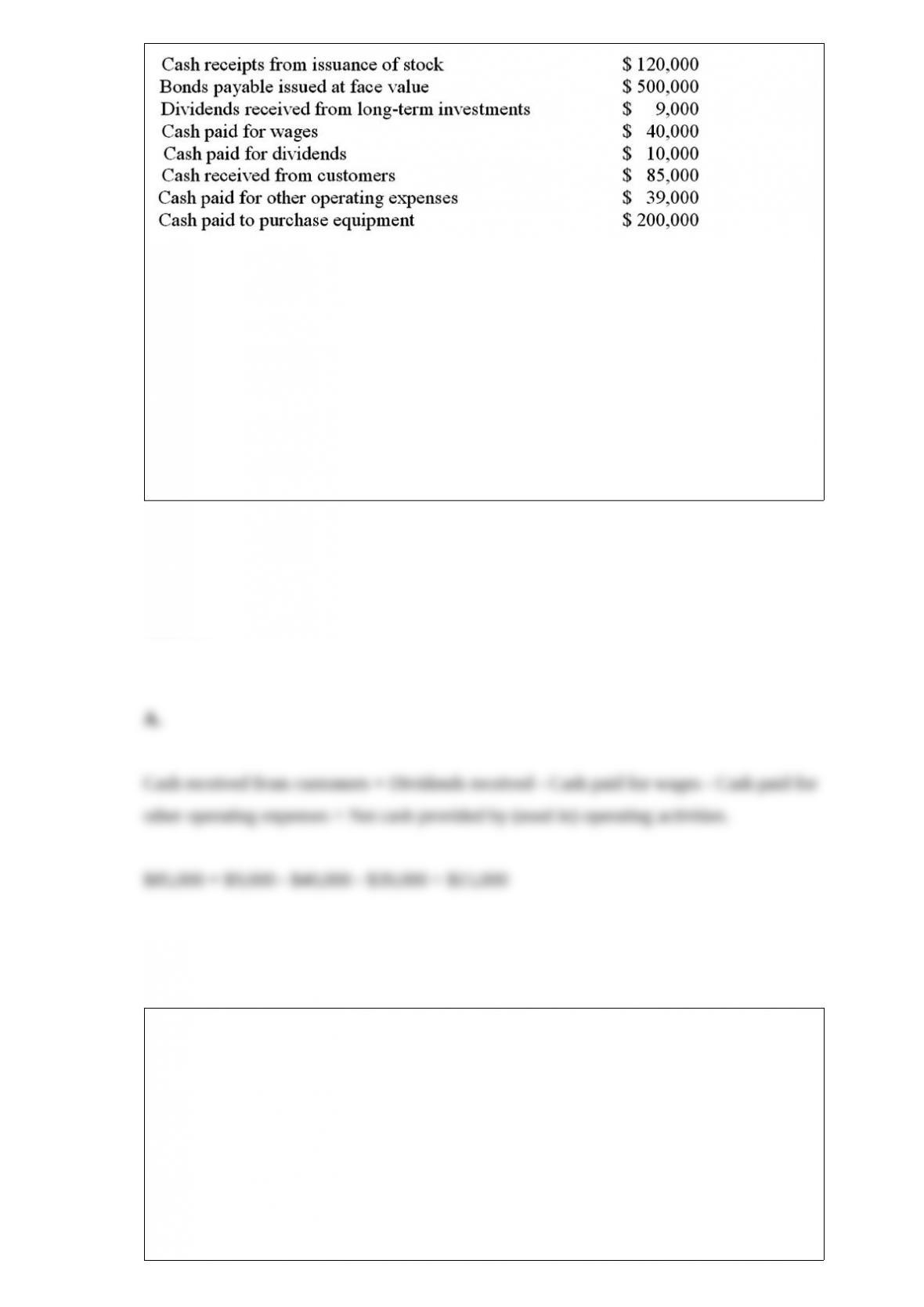
Use the information above to answer the following question. What is the net cash
provided by (used in) operating activities?
A. $15,000
B. $6,000
C. ($4,000)
D. ($75,000)
Answer:
A company issues 500,000 shares of preferred stock for $30 a share. The stock has a
fixed annual dividend rate of 5% and a par value of $9 per share. The current price of
the preferred stock is $32 a share. Preferred stockholders can anticipate receiving a per
share annual dividend of:
A. $.45.
B. $1.50.
C. $1.60.
D. $1.05.
Answer:
A negative times interest earned ratio suggests that the company:
A. is using resources very efficiently.
B. has a serious financial problem.
C. has a very high interest expense.
D. has a high level of sales revenue.
Answer:
The asset account Office Supplies has a balance of $800 at the beginning of the year.
The amount on hand at the end of the year is $500. The company has calculated the
Office Supplies Expense for the year to be $3,500. Based on this information, what
amount of office supplies was purchased during the year?
A. $0
B. $4,000
C. $3,200
D. $3,000
Answer:
At the beginning of 2013, your company buys a $30,000 piece of equipment that it
expects to use for 4 years. The company expects to produce a total of 200,000 units.
The equipment has an estimated residual value of $2,000.
a. Find the depreciable cost.
b. Find the depreciation expense per year under the straight-line method.
c. Prepare a depreciation schedule under the straight-line method.
d. Find the depreciation rate per unit under the units-of-production method.
e. Prepare a depreciation schedule under the units-of-production method if, 44,000 units
are produced in one year, 53,000 units in year two, 51,000 units in year three, and
52,000 units in year four.
Answer:
Which account is least likely to be credited when an expense is recorded?
A. Cash.
B. Accounts Payable.
C. Prepaid Expenses.
D. Accounts Receivable.
Answer:
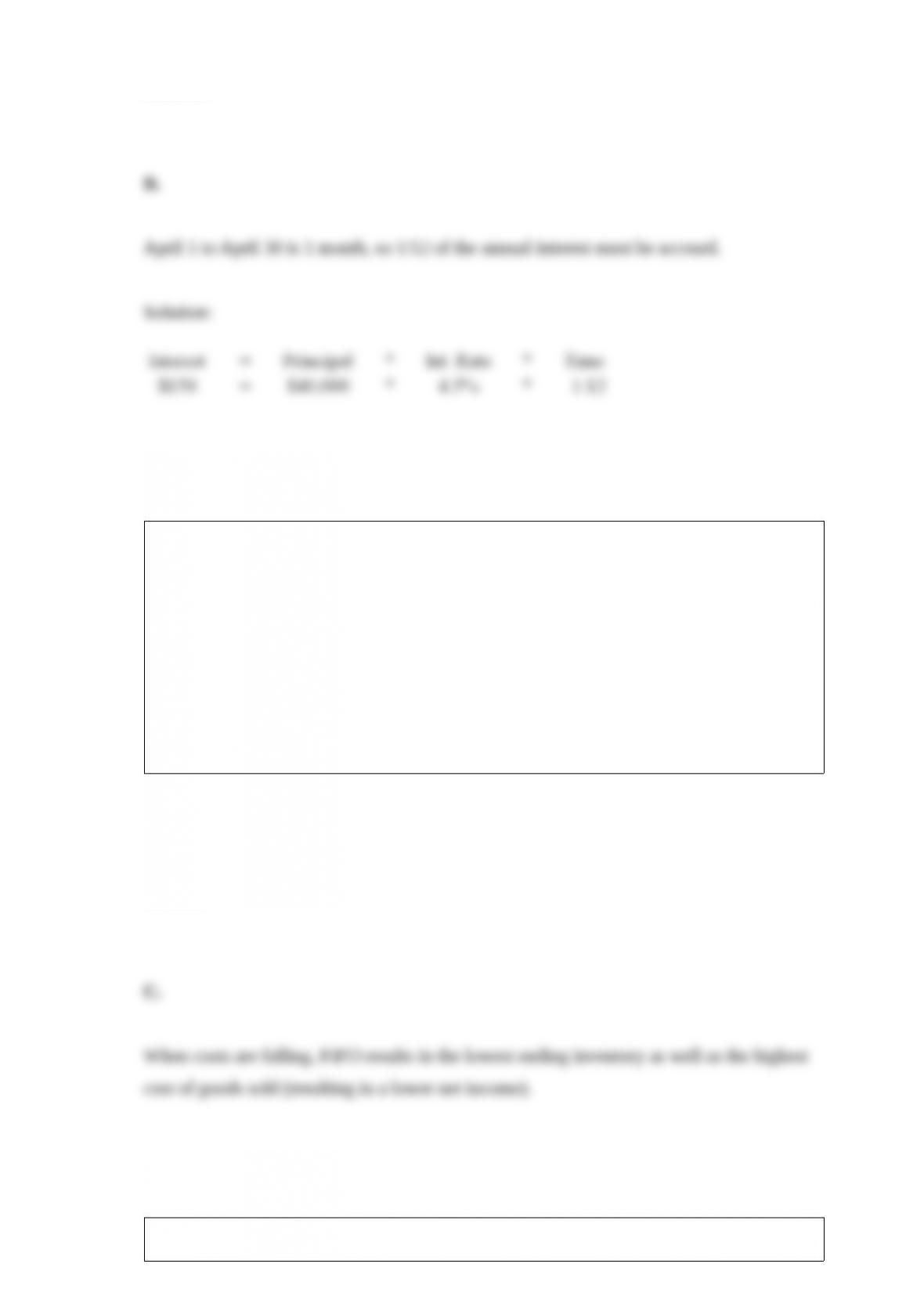
Generous Inc. lends Blue Inc. $40,000 on April 1, accepting a four-month, 4.5%
interest-bearing note. Generous Inc. prepares financial statements on April 30. What
adjusting entry should be made by Generous Inc. before its financial statements are
prepared?
A. Option A
B. Option B
C. Option C
D. Option D
Answer:
Which of the following will occur when inventory costs are decreasing?
A. FIFO will result in a lower net income but a higher ending inventory then will LIFO.
B. FIFO will result in a higher net income but a lower ending inventory then will LIFO.
C. FIFO will result in a lower net income and a lower ending inventory then will LIFO.
D. FIFO will result in a higher net income and a higher ending inventory then will
LIFO.
Answer:
Your company previously averaged about 20% of its total accounts receivable in the
“over 90 days past due” category and now has 35% in this category. All else equal,
using the aging of accounts receivable method, the amount of the bad debt adjustment
will:
A. decline, thus increasing the ending balance of the allowance account.
B. increase, thus increasing the ending balance of the allowance account.
C. decline, thus reducing the ending balance of the allowance account.
D. increase, thus reducing the ending balance of the allowance account.
Answer: