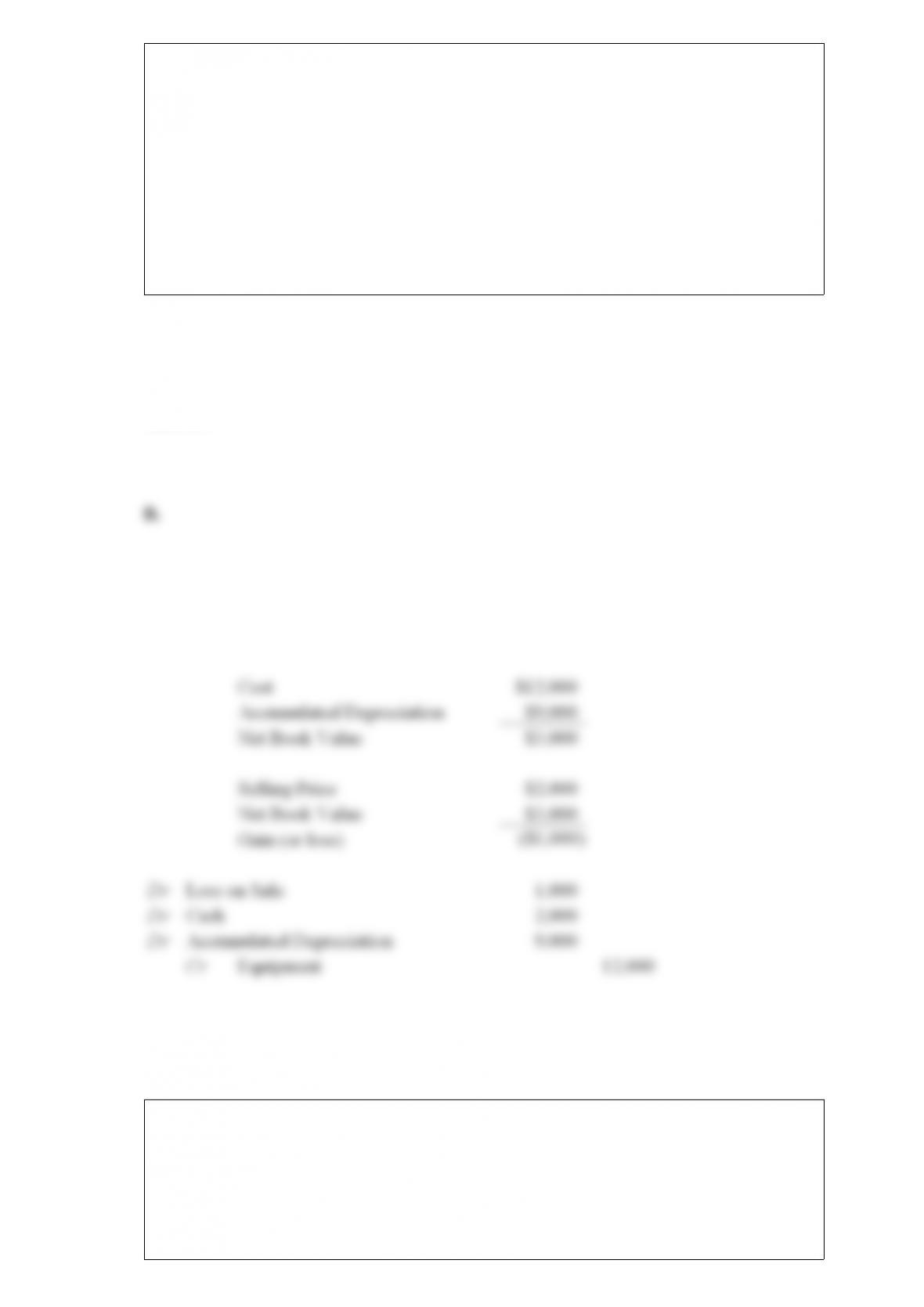
A truck costing $12,000, on which $9,000 of accumulated depreciation has been
recorded was sold for $2,000 cash. The entry to record this event would include a:
A. gain of $1,000.
B. loss of $1,000.
C. credit to the Truck account for $3,000.
D. credit to Accumulated Depreciation for $9,000.
Answer:
At the end of the year, accrual adjusting entries could include a:
A. debit to an expense and a credit to an asset.
B. credit to a revenue and a debit to an expense.
C. debit to cash and a credit to contributed capital.
D. debit to an expense and a credit to a liability.
Answer:
Which of the following is calculated by dividing net income by average total
stockholders’ equity?
A. Return on assets ratio.
B. Return on equity ratio.
C. Earnings per share.
D. Net profit margin ratio.
Answer:
When the direct write-off method is used, the entry to write-off a specific account
would
A. decrease expenses and increase net income.
B. have no effect on net income.
C. increase the accounts receivable and increase net income.
D. decrease the accounts receivable and decrease net income.
Answer:
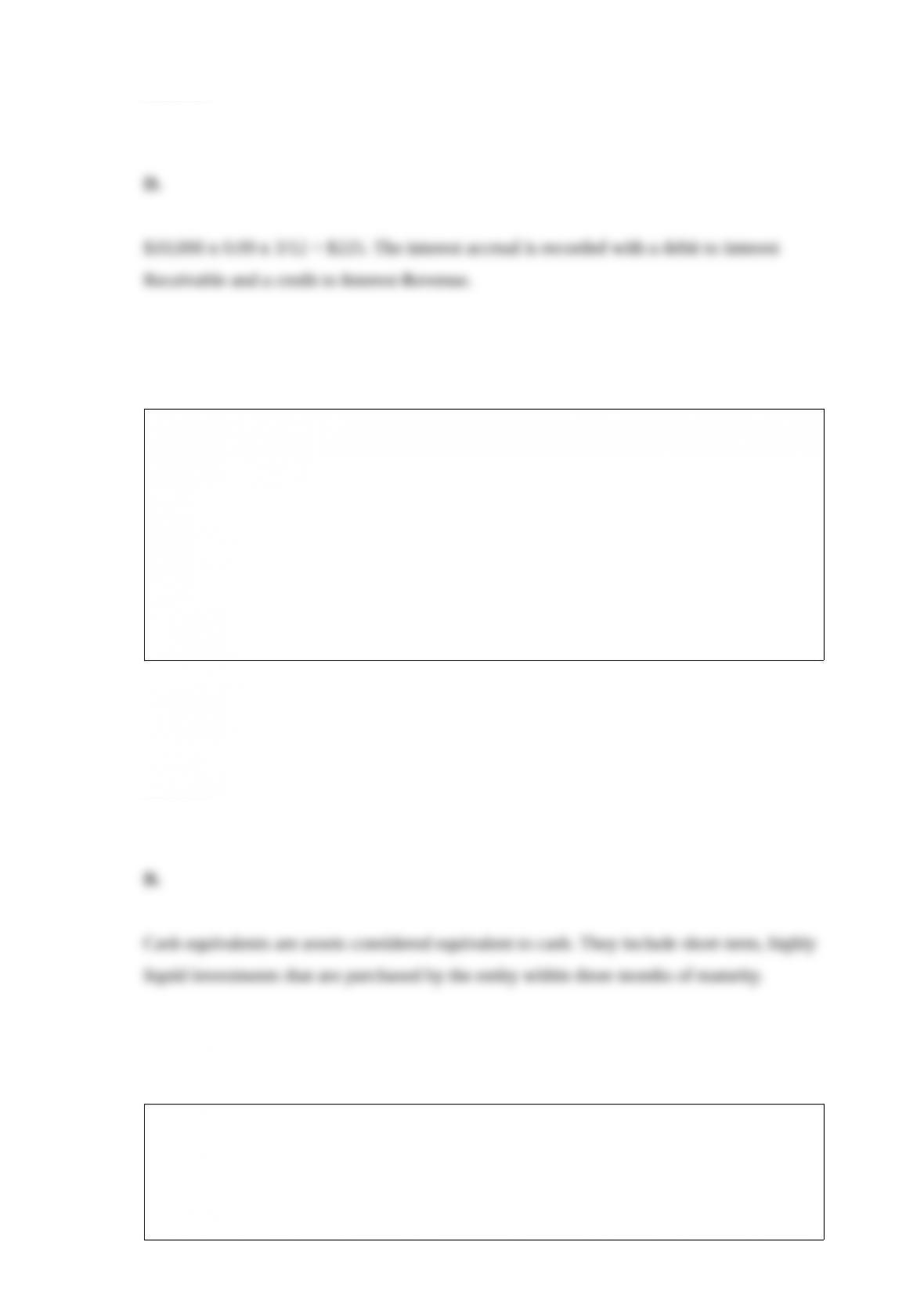
Use the information above to answer the following question. If the company is
preparing financial statements 3 months after this transaction, what is the necessary
adjusting entry?
A. Option A
B. Option B
C. Option C
D. Option D
Answer:
Cash and cash equivalents include:
A. assets that have stable long-term value.
B. assets that are short-term, highly liquid, and are purchased by the entity within three
months of maturity.
C. assets that consistently grow in value over the long run.
D. assets that are expected to be used up within a year.
Answer:
The Sweet Smell of Success Fragrance Company borrowed $60,000 from the bank and
used all of the money to redesign its new store. Sweet Smell’s balance sheet would
show this as:
A. $60,000 under Furnishings and Equipment and $60,000 under Notes Payable.
B. $60,000 under Supplies and $60,000 under Notes Payable.
C. $60,000 under Furnishings and Equipment and $60,000 under Accounts Payable.
D. $60,000 under Other Assets and $60,000 under Other Liabilities.
Answer:
Holders of common stock receive certain benefits, such as a residual claim, which:
A. is the right of stockholders to be paid back their investment before anyone else if the
company ceases operation.
B. is the right to oversee management of the company.
C. is the right to share in any remaining assets after creditors have been paid off, should
the company cease operations.
D. is the continuing right to receive a share of the company’s profits in the form of
dividends.
Answer:
The standard formatting for a journal entry:
A. lists credits first and then debits, both aligned to the left.
B. lists credits first and then debits, indented underneath.
C. lists debits first and then credits, both aligned to the right.
D. lists debits first and then credits, indented underneath.
Answer:
On January 1, 2014, a company purchased a machine for $138,000 with an expected
life of 5 years and a residual value of $12,000. In addition, the company paid delivery
costs of $1,200 and $4,800 to have the machine installed. The company uses the
double-declining-balance method of depreciation.
Use the information above to answer the following question. If the company sells the
machine at the end of 5 years and receives $11,500, the journal entry to record the sale
will include which of the following?
A. Debit to Accumulated Depreciation for $138,000.
B. Credit to Machine for $138,000.
C. Debit to Loss on Sale for $500.
D. Credit to Residual Value for $12,000.
Answer:
The Acme Corporation uses a periodic inventory system and buys 300 units of
merchandise in January at $5 each. Acme buys 500 units at $4 each in February and 200
units at $6 each in March. The company had no beginning inventory.
Use the information above to answer the following question. Acme sells 300 units
during the quarter. If Acme uses the LIFO method, what is its cost of goods sold for the
quarter?
A. $1,600
B. $1,400
C. $1,500
D. $1,800
Answer:
Which form must be filed quarterly by a public corporation with the SEC?
A. 10-K.
B. 8-K.
C. 10-Q.
D. 8-Q.
Answer:
When a company collects from a customer who pays within the discount period, the
company:
A. debits a contra-revenue account.
B. debits a liability account.
C. credits a liability account.
D. debits a revenue account.
Answer:
Which of the following statements concerning financial reporting is FALSE?
A. Accounting rules in the U.S. are called GAAP.
B. Accounting rules developed by the IASB are called IFRS.
C. Both GAAP and IFRS share the same goal which is to ensure useful information to
users of financial statements.
D. There are no differences between the accounting rules developed by FASB and those
developed by IASB.
Answer:

Which of McGraw-Hill’s intangible assets gives it the legal right to prevent you from
borrowing a textbook from a friend and photocopying all of it?
A. Patent
B. Trademark
C. Franchise agreement
D. Copyright
Answer:
A corporation declared and issued a 15% stock dividend on November 1. Prior to the
dividend, the balance in retained earnings was $850,000, the number of shares of $5 par
value stock issued and outstanding was 60,000, and the market value of the stock was
$12. The amount of the change in total stockholders’ equity as a result of recording this
stock dividend is:
A. $0.
B. $45,000 increase.
C. $108,000 decrease.
D. $63,000 decrease.
Answer:

Negative operating cash flow may indicate all of the following except:
A. the company may not be able to replace property, plant and equipment.
B. stockholders may not receive a dividend.
C. the company may be in the introductory phase of its life cycle.
D. The company did not earn a profit from its core business activity.
Answer:
In January 2013, a new consulting firm recorded the following transactions:
1. Issued stock to investors for $20,000 cash.
2. Purchased $5,000 of equipment, paying 20% in cash and giving a promissory note
for the balance.
3. Received $9,000 in cash for consulting services performed in January.
4. Bought $1,500 of supplies on account; all of the supplies were used in January.
5. Provided consulting services for clients and billed them $16,000.
6. Paid $750 toward the supplies purchased in #4.
7. Paid $3,000 to employees for work performed in January.
8. Received a bill for rent and utilities for January of $3,400.
What the amount of total expense to be reported on the Income Statement for the month
of January?
A. $3,750
B. $7,900
C. $8,150
D. $4,500
Answer:
An increase in operating expenses would have which of the following effects on a
company’s profit margin?
A. Net profit margin would increase.
B. Net profit margin would decrease.
C. Net profit margin would remain unchanged.
D. There is not enough information given to determine the effect.
Answer:
Which of the following must be paid by both the employee and the employer?
A. FICA taxes.
B. State unemployment tax.
C. State withholding tax.
D. Federal unemployment tax.
Answer:
For a business to be considered a corporation:
A. its stock must be sold in very large amounts.
B. it must be organized as a separate legal entity.

C. it must issue both common and preferred stock.
D. it must pay dividends.
Answer:
Choose the appropriate letter to match the term and the explanation. More explanations
are provided than terms.
Term
_____ 1/ Net profit margin.
_____ 2/ Contracting role.
_____ 3/ Asset turnover ratio.
_____ 4/ Cross-sectional analysis.
_____ 5/ Press release.
_____ 6/ 8-K.
_____ 7/ Relevant data.
_____ 8/ Governance role.
_____ 9/ Material misstatements
_____ 10/ IFRS
Explanation
A. When creditors use a company’s financial data to manage financial agreements with
the company.

B. Numbers that forecast financial results that are expected for the future.
C. Sales revenue divided by average total assets.
D. Net income divided by average total assets.
E. When financial data can be verified.
F. When directors use financial data to oversee the management of a company.
G. Accounting principles used in other countries.
H. Refers to a company filing reports with the SEC on current events affecting the
company.
I. Compares a company’s performance in one time period to competitors during the
same time period.
J. Net income divided by sales revenue.
K. Financial data that affects decision making.
L. When advisors use financial data to recommend buying or selling stocks.
M. Large enough to make a difference to users.
N. Public news announcement distributed to news agencies three to five weeks after
accounting period ends.
Answer:
The spreadsheet approach to preparing a statement of cash flows includes all of the
following except:
A. a debit to intangible assets and a credit to cash flow from investing activities for the
purchase of licensing rights.
B. a decrease in cash flow from operating activities if prepayments exceed amounts
expensed.

C. an increase in cash flow from operating activities if more inventory is purchased than
sold.
D. a credit to contributed capital and a debit to cash flow from investing activities for
proceeds of a stock issuance.
Answer:
A company entered into the following transactions:
– Borrowed $5,000 from the bank by signing a promissory note
– Issued stock to owners for $10,000
– Purchased $1,000 of supplies, on account
– Paid $400 to suppliers as payment on account for the supplies purchased
What is the amount of total assets?
A. $16,000
B. $5,600
C. $15,000
D. $15,600
Answer:
If a company did not extend credit to customers:
A. gross revenue would increase.
B. costs would increase but so would its revenue.
C. costs would decrease but so would its revenue.
D. gross profit would increase.
Answer:
On January 1, your company issues a 5-year bond with a face value of $10,000 and a
stated interest rate of 7%. The market interest rate is 5%. The issue price of the bond
was $10,866. Using the effective-interest method of amortization and rounding to the
nearest dollar, the interest expense for the first year ended December 31 would be:
A. $700.
B. $543.
C. $667.
D. $759.
Answer:
A company paid $500,000 to purchase equipment and $15,000 to have the equipment
delivered to and installed in the company’s production facilities. Commercial use of the
equipment began on May 1, 2014. The estimated residual value of the equipment is
$5,000. The equipment is expected to be used a total of 28,000 hours throughout its
estimated useful life of six years. The company has an October 31, 2014 year-end and
had used the equipment a total of 11,200 hours prior to the year-end. Using the units-
of- production method, what amount of depreciation expense (to the nearest thousand)
would the company report for this equipment in the income statement prepared for the
year-ended October 31, 2014?
A. $102,000
B. $198,000
C. $204,000
D. $206,000
Answer:

A company has current assets of $5 million and net income of $10 million. Current
liabilities total $2.5 million, interest expense is $2 million, and income tax expense is
$3 million. The times interest earned ratio for this company is:
A. 0.5.
B. 7.5.
C. 0.3.
D. 2.0.
Answer:
When goods are sold to a customer with credit terms of 2/15, n/30, the customer will:
A. receive a 15% discount if they pay within 2 days.
B. receive a 2% discount if they pay 15% of the amount due within 30 days.
C. receive a 15% discount if they pay within 30 days.
D. receive a 2% discount if they pay within 15 days.
Answer:
Which of the following is not a similarity of GAAP and IFRS?
A. They both generally require that an exchange take place before a transaction is
recorded.
B. They both promote information that is relevant and that faithfully represents the
underlying transactions.
C. They both include rules regarding recognition, classification, and measurement of
transactions.
D. They both allow fixed assets to be reported at fair values.
Answer: