Cleary, Wasser, and Nolan formed a partnership on January 1, 2012, with investments
of $100,000, $150,000, and $200,000, respectively. For division of income, they agreed
to (1) interest of 10% of the beginning capital balance each year, (2) annual
compensation of $10,000 to Wasser, and (3) sharing the remainder of the income or loss
in a ratio of 20% for Cleary, and 40% each for Wasser and Nolan. Net income was
$150,000 in 2012 and $180,000 in 2013. Each partner withdrew $1,000 for personal use
every month during 2012 and 2013.
What was the remainder portion of net income allocated to Nolan for 2013?
A.$45,440
B.$58,040
C.$70,040
D.$72,000
E.$82,040
Record each of the following events in the horizontal statements model. After each
event, record the corresponding end-of-year adjustment that would be necessary.
a) Paid $18,000 for a 1-year lease beginning April 1
b) Paid $1,500 to purchase supplies. At year end, $540 of supplies remained.
c) Received a $24,000 cash advance for a 6-month contract beginning on Sept. 1
Cleary, Wasser, and Nolan formed a partnership on January 1, 2012, with investments
of $100,000, $150,000, and $200,000, respectively. For division of income, they agreed
to (1) interest of 10% of the beginning capital balance each year, (2) annual
compensation of $10,000 to Wasser, and (3) sharing the remainder of the income or loss
in a ratio of 20% for Cleary, and 40% each for Wasser and Nolan. Net income was
$150,000 in 2012 and $180,000 in 2013. Each partner withdrew $1,000 for personal use
every month during 2012 and 2013.
What was Wasser’s total share of net income for 2012?
A.$63,000.
B.$53,000.
C.$58,000.
D.$29,000.
E.$51,000.
Petras Company engaged in the following transactions during 2012, its first year in
operations: (Assume all transactions are cash transactions)
1) Acquired $950 cash from the issue of common stock.
2) Borrowed $420 from a bank.
3) Earned $600 of revenues.
4) Paid expenses of $250.
5) Paid a $50 dividend.
During 2013, Petras engaged in the following transactions: (Assume all transactions are
cash transactions)
1) Issued an additional $325 of common stock.
2) Repaid $220 of its debt to the bank.
3) Earned revenues of $750.
4) Incurred expenses of $360.
5) Paid dividends of $100.
The amount of total equity on Petras’ 2012 balance sheet is
A.$1,250.
B.$900.
C.$300.
D.$1,300.
At the end of 2013, retained earnings for the Bisk Company was $1,750. Revenue
earned by the company in 2013 was $2,000, expenses paid during the period were
$1,100, and dividends paid during the period were $500. Based on this information
alone, retained earnings at the beginning of 2013 was
A.$850.
B.$2,150.
C.$1,350.
D.$4,000.
Redmond Company is considering investing in one of the following two projects:
Required:
1) Which project is more desirable strictly in terms of cash inflows? Why?
2) Compute the present value of each project’s cash inflows assuming the company’s
required rate of return is 12%.
3) What is the maximum amount Redmond should be willing to pay for each project?
4) Suppose each project costs $7,000. Which project(s) should be accepted? Note that
only one project can be accepted.
A company that was to be liquidated had the following liabilities:
The company had the following assets:
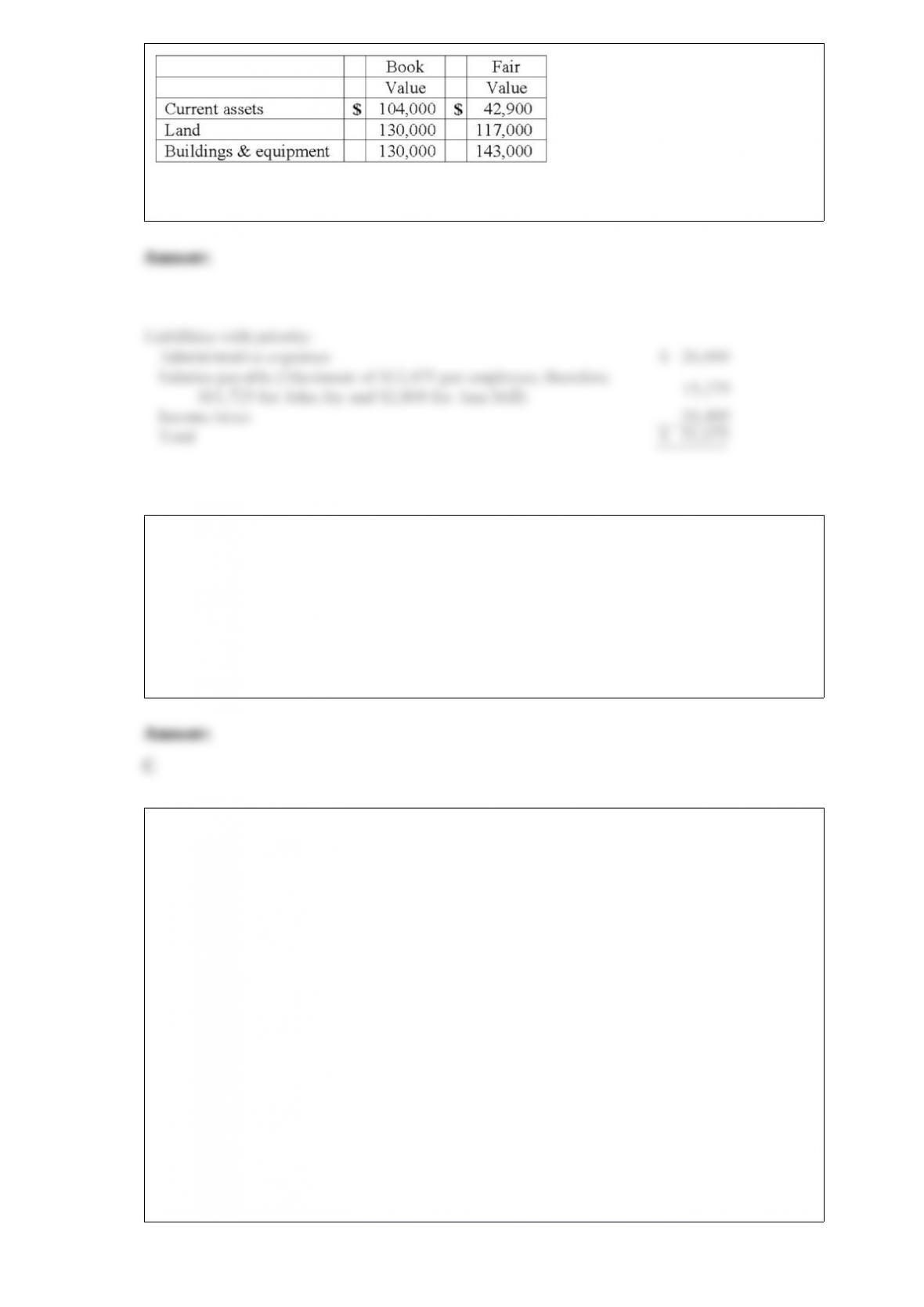
Total liabilities with priority are calculated to be what amount?
An investment that cost $30,000 provided annual cash inflows of $9,000 per year for
five years. The desired rate of return is 10%. The internal rate of return from the
investment was (Do not round your PV factors and intermediate calculations.):
A.less than the desired rate of return.
B.equal to the desired rate of return.
C.greater than the desired rate of return.
D.the answer cannot be determined from the information provided.
At the beginning of 2012, Gratiot Company’s accounting records had the general ledger
accounts and balances shown in the table below. During 2012, the following
transactions occurred:
1) received $95,000 cash for providing services to customers
2) paid salaries expense, $50,000
3) purchased land for $12,000 cash
4) paid $4,000 on note payable
5) paid operating expenses, $22,000
6) paid cash dividend, $2,500
Required:
a) Record the transactions in the appropriate general ledger accounts. Record the
amounts of revenue, expense, and dividends in the retained earnings column. Provide
appropriate titles for these accounts in the last column of the table.
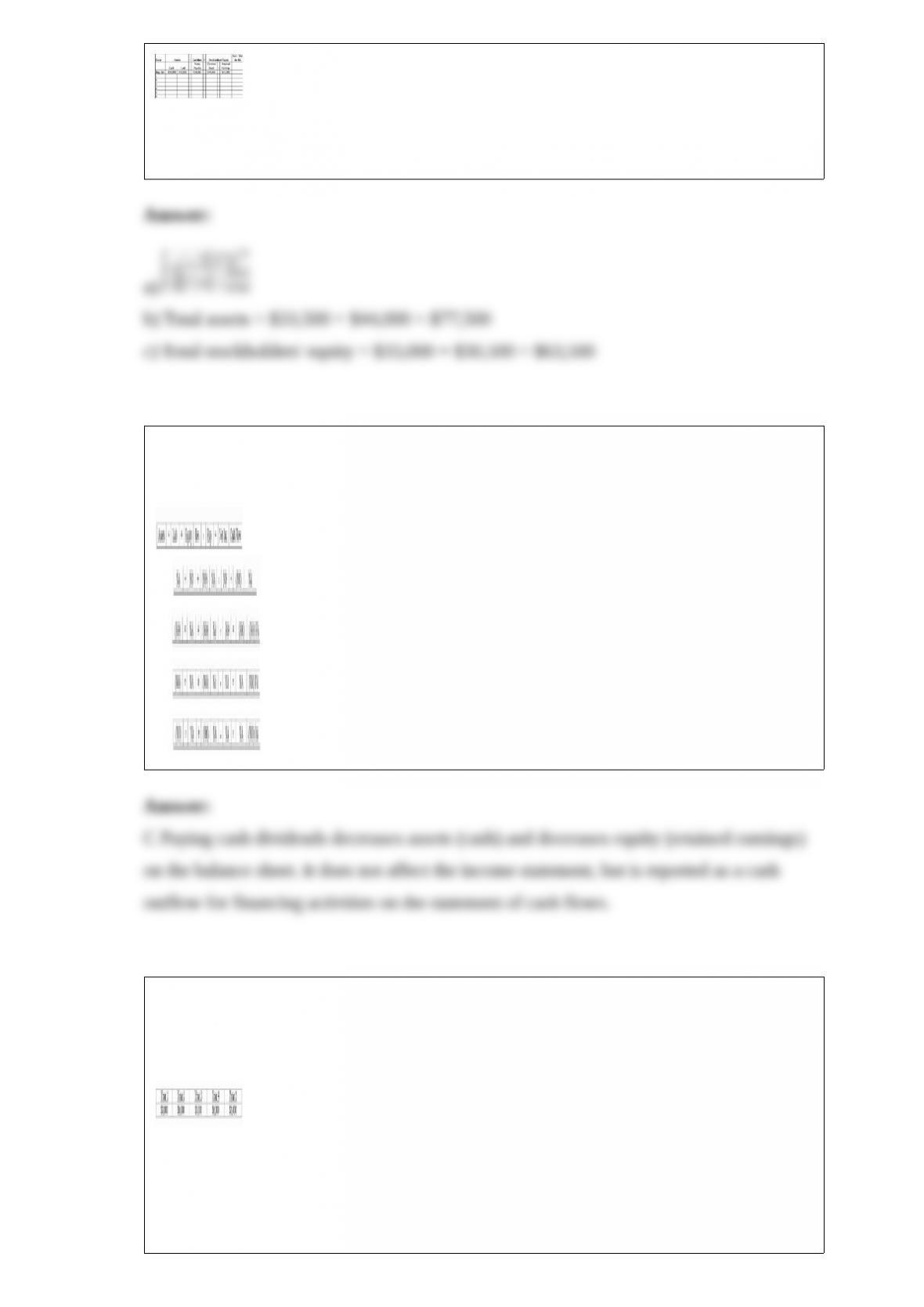
b) What is the amount of total assets as of December 31, 2012?
c) What is the amount of total stockholders’ equity as of December 31, 2012?
Jiminez Company paid a $300 cash dividend. Which of the following choices
accurately reflects how this event affects the company’s financial statements?
A.
B.
C.
D.
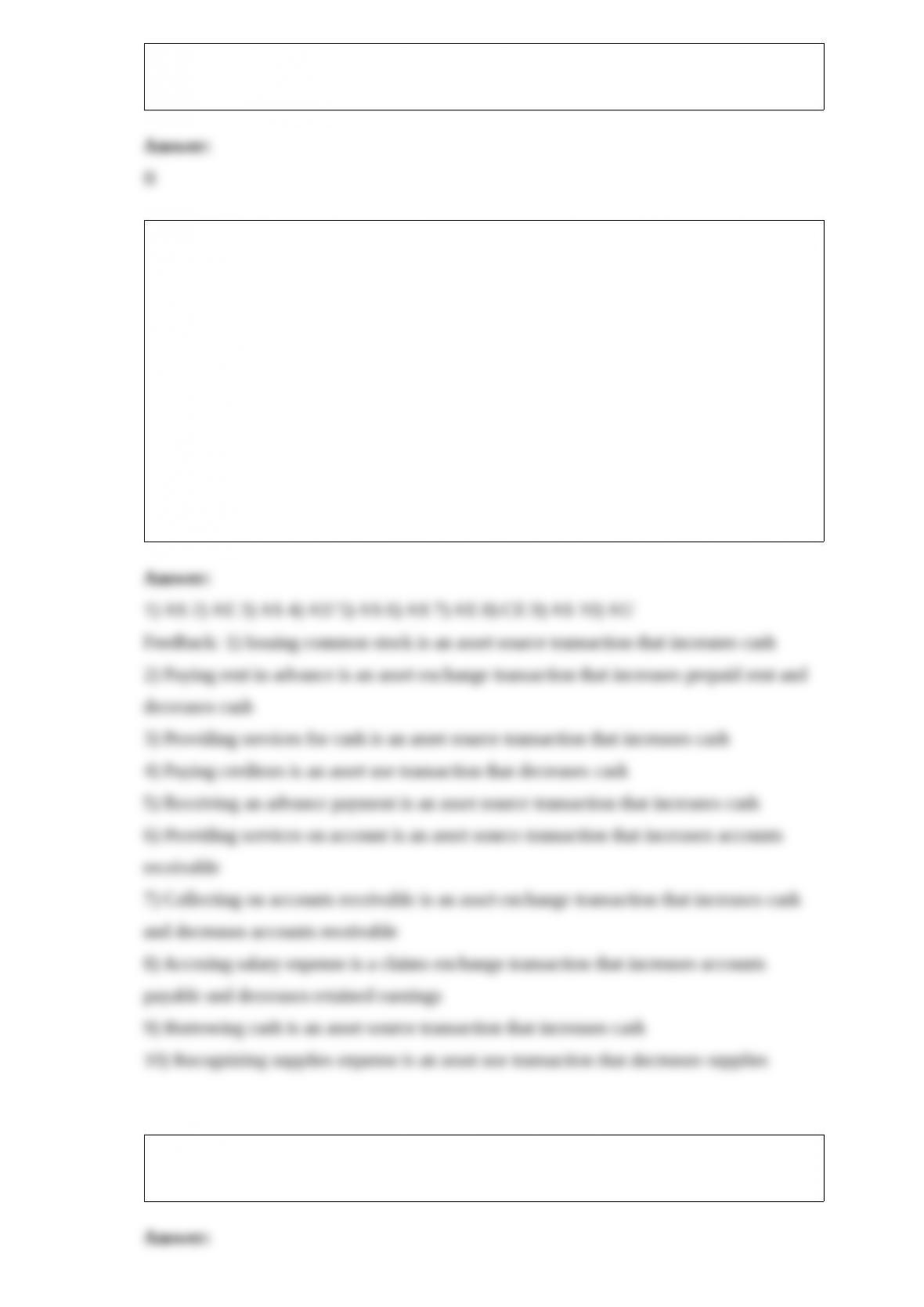
Mr. J’s Bagels invested in a new oven for $14,000. The oven reduced the amount of
time for baking which increased production and sales for five years by the following
amounts of cash inflows:
Using the averaging method, the payback period for the investment in the oven would
be:
A.5.0 years.
B.2.3 years.
C.2.0 years.
D.0.5 years.
Tell whether each of the following events are asset source (AS), asset use (AU), asset
exchange (AE), or claims exchange (CE) transactions.
_____1) Issued common stock to investors for $8,000 cash
_____2) Paid one year’s rent in advance
_____3) Provided services to customers and received $35,000 cash
_____4) Paid creditors $10,000
_____5) Received $3,000 of revenue in advance
_____6) Provided services to customers on account, $12,000
_____7) Collected $2,000 from accounts receivable
_____8) Recognized accrued salary expense of $2,000
_____9) Borrowed $6,000 from creditors
_____10) Adjusted the records for supplies used of $800
What are recognition differences in international reporting and what would be an
example of a difference?
Norr and Caylor established a partnership on January 1, 2012. Norr invested cash of
$100,000 and Caylor invested $30,000 in cash and equipment with a book value of
$40,000 and fair value of $50,000. For both partners, the beginning capital balance was
to equal the initial investment. Norr and Caylor agreed to the following procedure for
sharing profits and losses:
– 12% interest on the yearly beginning capital balance
– $10 per hour of work that can be billed to the partnership’s clients
– the remainder divided in a 3:2 ratio
The Articles of Partnership specified that each partner should withdraw no more than
$1,000 per month.
For 2012, the partnership’s income was $70,000. Norr had 1,000 billable hours, and
Caylor worked 1,400 billable hours. In 2013, the partnership’s income was $24,000, and
Norr and Caylor worked 800 and 1,200 billable hours respectively. Each partner
withdrew $1,000 per month throughout 2012 and 2013.
Determine the balance in both capital accounts at the end of 2012.
Mount Inc. was a hardware store that operated in Boise, Idaho. Management made
some poor inventory acquisitions that loaded the store with unsalable merchandise. Due
to the decline in revenues, the company became insolvent. Following is a trial balance
as of March 15, 2013, the day the company filed for Chapter 7 liquidation.
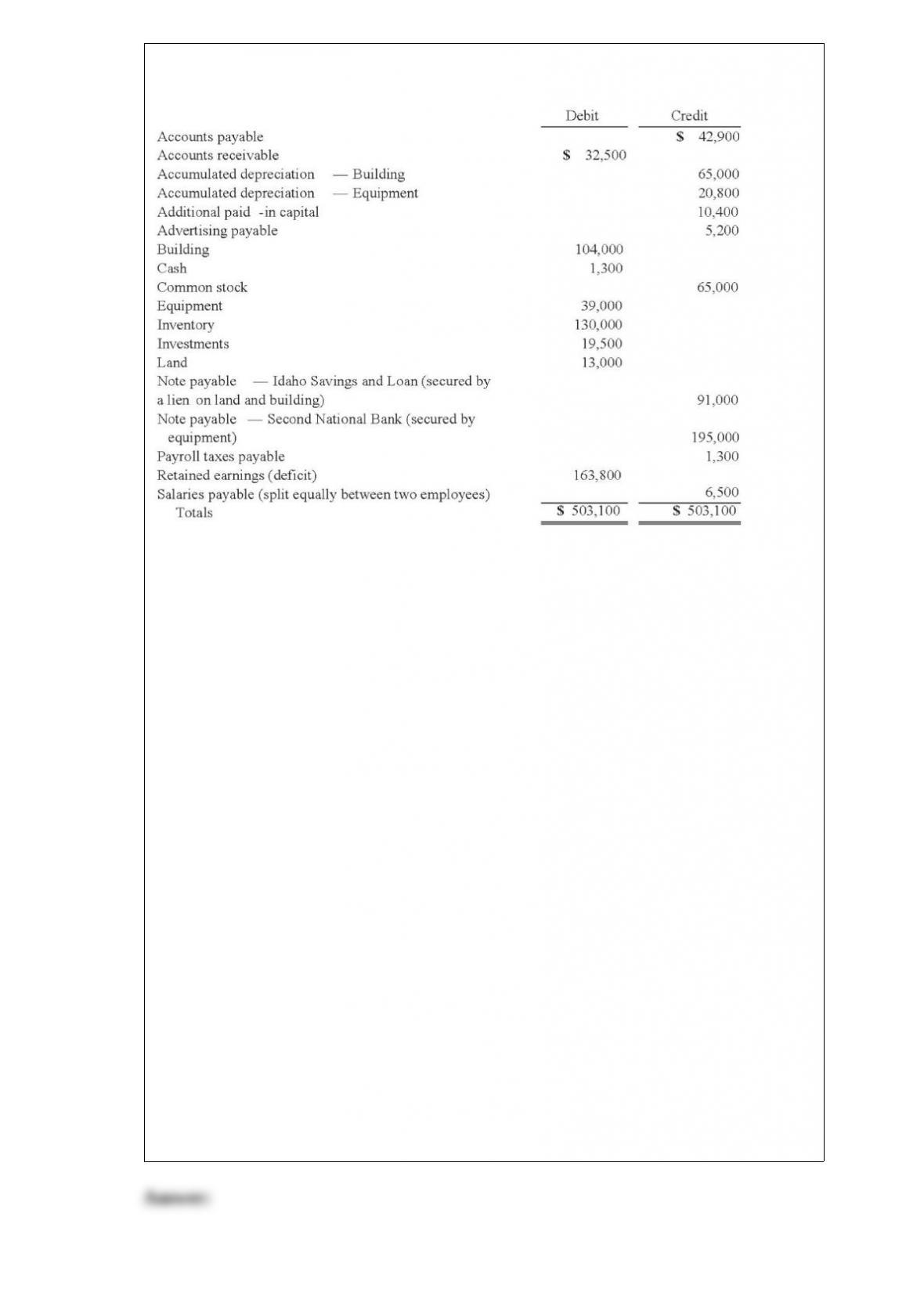
Company officials believed that sixty percent of the accounts receivable could be
collected if the company was liquidated. The building and land had a fair value of
$97,500, while the equipment was worth $24,700. The investments represented shares
of a publicly traded company that could be sold at the time for $27,300. The entire
inventory could be sold for only $42,900. Administrative expenses necessary to carry
out a liquidation would have approximated $20,800.
Assume that the company was being liquidated and that the following transactions
occurred:
– Accounts receivable of $23,400 were collected.
– All of the company’s inventory was sold for $52,000.
– Additional accounts payable of $13,000 incurred for various expenses such as utilities
and maintenance were discovered.
– The land and building were sold for $92,300.
– The note payable due to the Idaho Savings and Loan was paid.
– The equipment was sold at auction for only $14,300 with the proceeds applied to the
note owed to the Second National Bank.
– The investments were sold for $27,300.
– Administrative expenses totaled $26,000 as of July 26, 2013, but no payment had yet
been made.
Required:
Prepare a statement of realization and liquidation for the period from March 15 through
July 26, 2013.
Janelle Bates has just inherited $250,000 from her uncle’s estate. She is considering
opening a small sewing and fabric shop. She would need to purchase inventory costing
$50,000. Janelle plans to rent a shop in a local shopping center for $12,000 per year.
Fixtures, display equipment, and furniture will cost $18,000 and will be depreciated
$3,000 per year for 5 years to its expected salvage value of $3,000. Operating costs will
amount to $25,000 per year. Janelle estimates her revenues from sales and sewing
services will total $65,000. Because Janelle believes she can earn a 10% return by
investing in mutual funds, she does not want to start the business unless she can earn at
least this rate. Ignore income taxes.
Required:
1) Prepare a schedule of expected cash flows for the proposed investment by
completing the table provided below. In column 1 enter a brief description of the cash
flow. In column 2 indicate whether the cash flow is an inflow (I) or an outflow (O). In
column 3 enter the years in which the cash flow will occur. For example, if the cash
flow occurs immediately enter a 0. If the cash flow occurs each year enter 1-5, etc. In
column 4 enter the cash flow amount.
2) What is the initial outlay for this capital investment (the amount of the cash flow at
time = 0)?
3) What is the amount of the annual net cash flow for this capital investment?
4) What is the net present value of the proposed venture? Should Janelle proceed?
What is meant by the term double-entry bookkeeping?
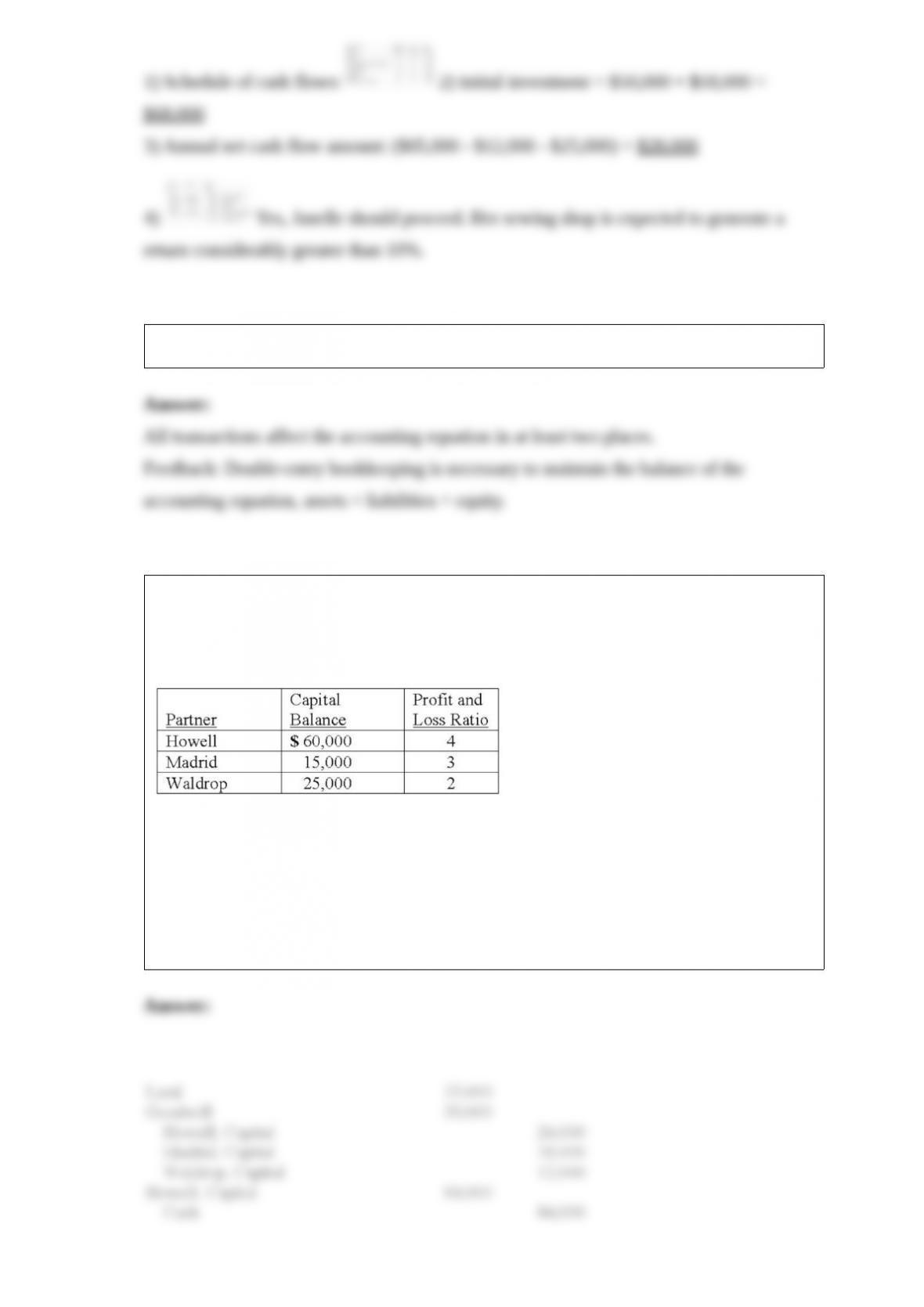
Assume the partnership of Howell, Madrid, and Waldrop has been in existence for a
number of years. Howell decides to withdraw from the partnership when the partners’
capital balances are as follows:
An appraisal of the business and its net assets estimates the fair value to be $154,000.
Land with a book value of $20,000 has a fair value of $35,000. Howell has agreed to
receive $84,000 in exchange for her partnership interest.
Prepare the journal entries for the dissolution of Howell’s partnership interest, assuming
the goodwill method is to be applied.
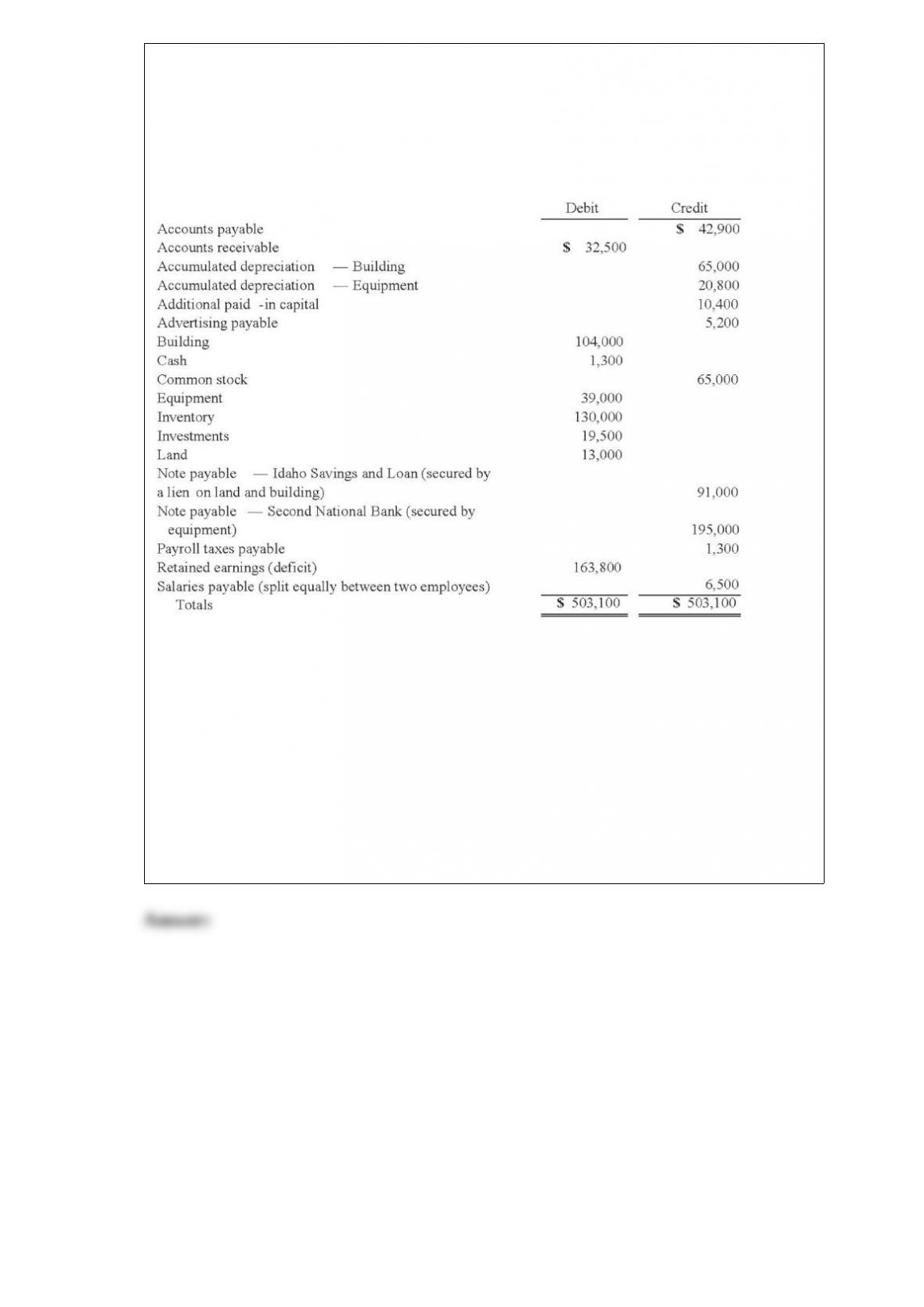
Mount Inc. was a hardware store that operated in Boise, Idaho. Management made
some poor inventory acquisitions that loaded the store with unsalable merchandise. Due
to the decline in revenues, the company became insolvent. Following is a trial balance
as of March 15, 2013, the day the company filed for Chapter 7 liquidation.
Company officials believed that sixty percent of the accounts receivable could be
collected if the company was liquidated. The building and land had a fair value of
$97,500, while the equipment was worth $24,700. The investments represented shares
of a publicly traded company that could be sold at the time for $27,300. The entire
inventory could be sold for only $42,900. Administrative expenses necessary to carry
out a liquidation would have approximated $20,800.
Required:
Prepare a statement of financial affairs for Mount Inc. as of March 15, 2013.
Hampton Company is trying to decide whether to seek liquidation or reorganization.
Hampton has provided the following balance sheet:
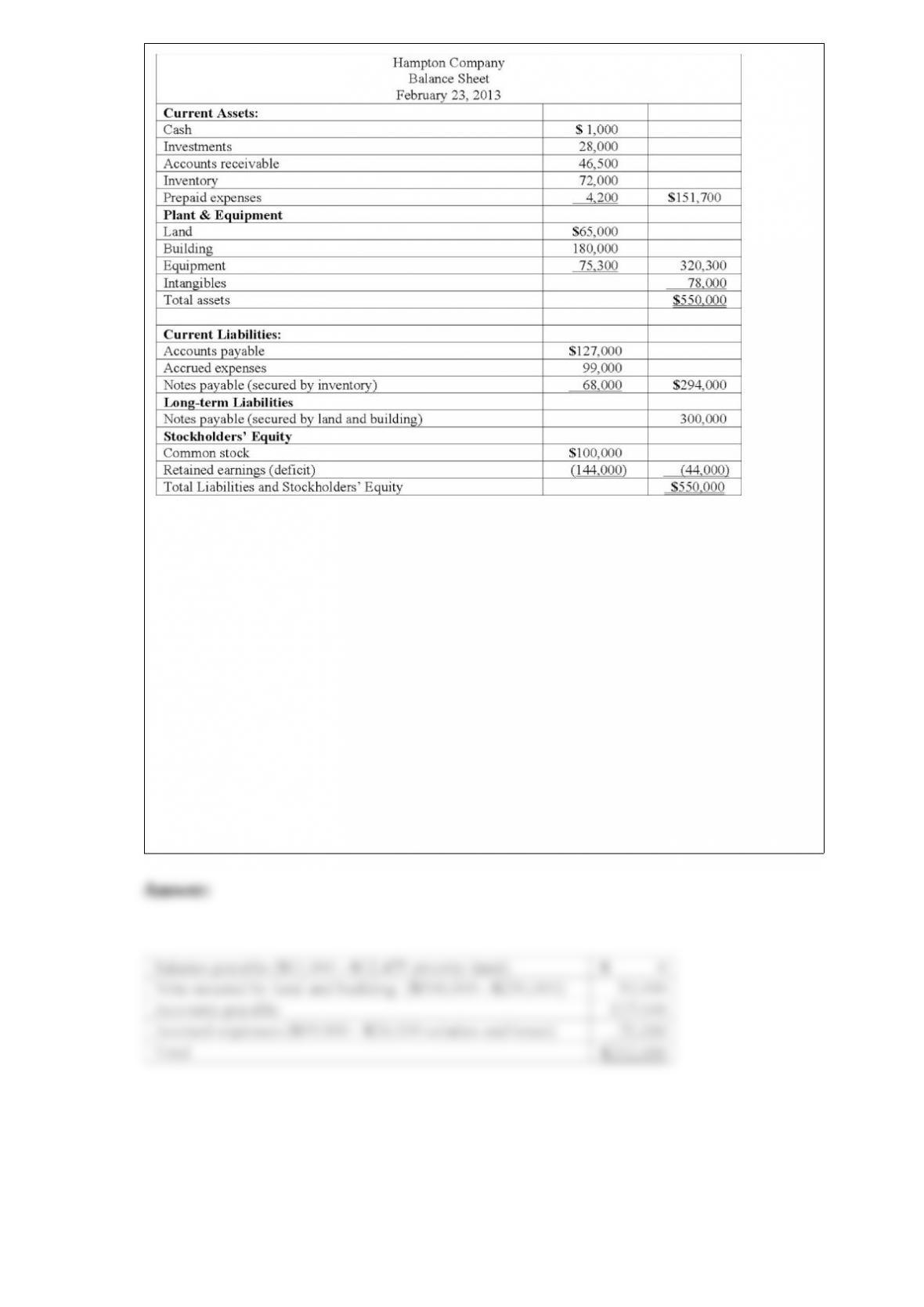
Additional information is as follows:
– The investments are currently worth $13,000.
– It is estimated that $32,000 of the accounts receivable are collectible.
– The inventory can be sold for $74,000.
– The prepaid expenses and the intangible assets have no net realizable value.
– The land and building are currently valued at $250,000.
– The equipment can be sold for $60,000.
– Administrative expenses (not yet recorded) are estimated to be $12,500.
– Accrued expenses include $17,000 of salaries payable ($11,000 to one employee and
$3,000 each to two other employees).
– Accrued expenses include $7,000 of unpaid payroll taxes.
Compute the amount of unsecured liabilities without priority.