Profit margin indicates management’s efficiency with regard to sales and expenses.
Manipulation of segment expenses may result in the segment margin not being an
accurate performance measure.
In estimating factory overhead, it is necessary to separate costs into their fixed and
variable components.
For an annuity due, the first cash flow occurs at the end of the period.
In order for cost information to be effective, a meaningful baseline performance
measure should be available for comparison.
The cash budget is constructed after all other budgets have been completed.
Phantom profits result when absorption costing is used and sales exceed production.
Cost minimization is the major focus of value engineering.
An annual budget is an example of a single use tactical plan.
When using a market-based transfer price, a decision must be made which market price
to use.
Inspection of incoming inventory is a value-added activity.
An indirect cost can be easily traced to a cost object.
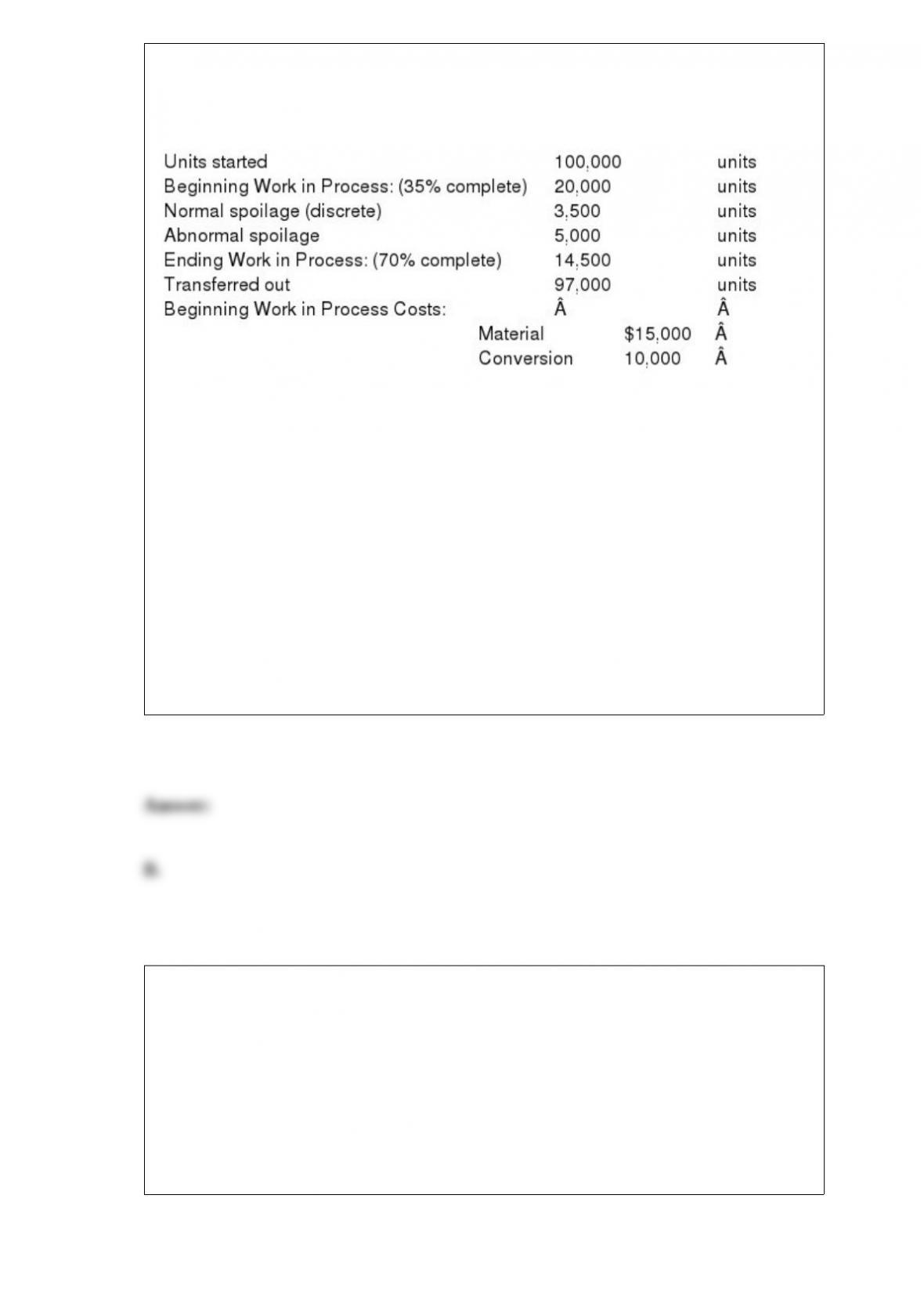
Painter Corporation
Painter Corporation has the following information for the current month:
All materials are added at the start of the production process. Painter Corporation
inspects goods at 75 percent completion as to conversion.
Refer to Painter Corporation. Assume that the costs per EUP for material and
conversion are $1.00 and $1.50, respectively. Using FIFO, what is the total cost
assigned to the transferred-out units (rounded to the nearest dollar)?
A. $245,750
B. $244,438
C. $237,000
D. $224,938
The role of safety stock in an organization is to
A. reduce the lead time for an order to be received.
B. reduce the probability of a stockout.
C. reduce the order point.
D. decrease the economic order quantity.
Chambers Company
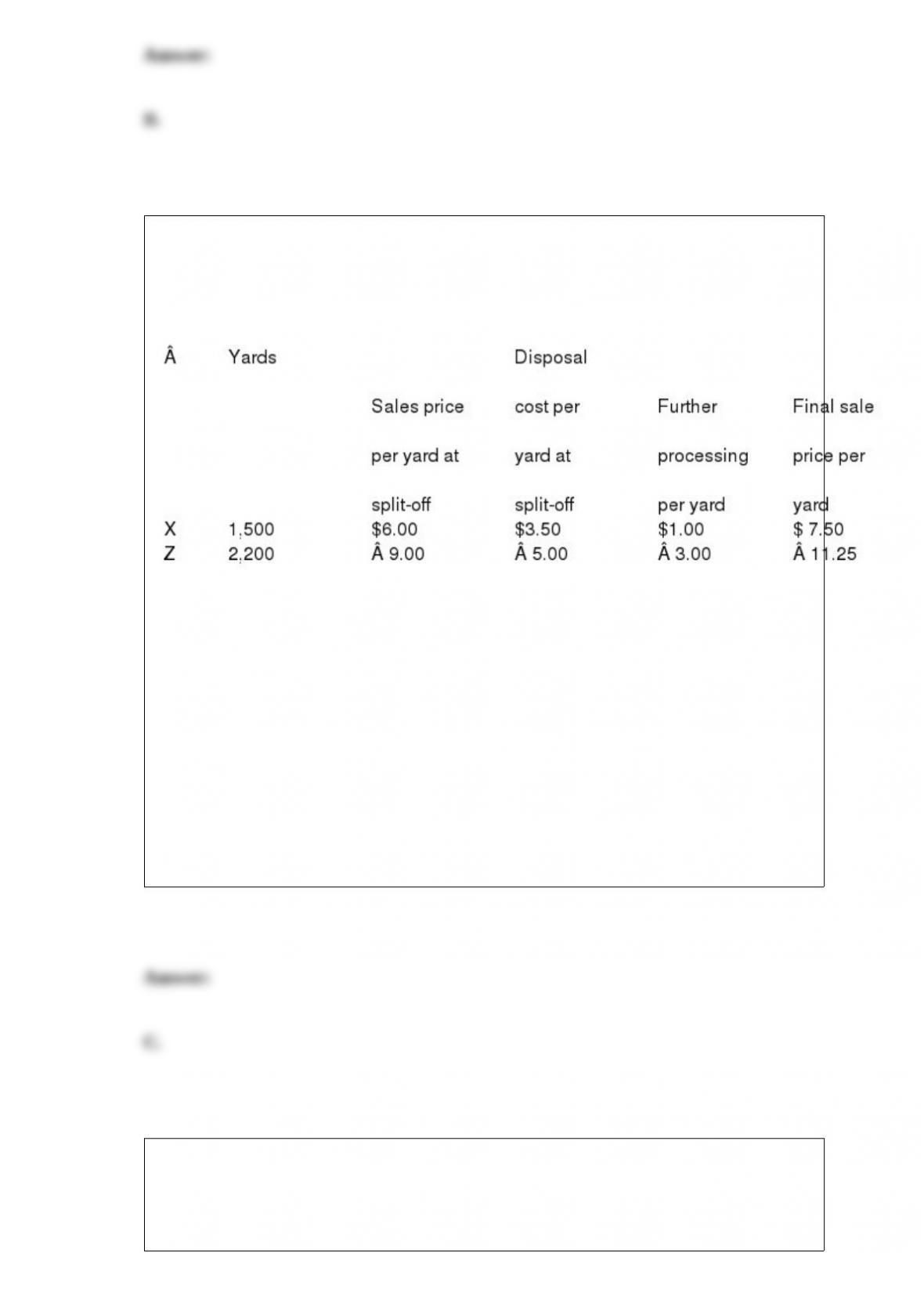
Chambers Company produces two products from a joint process: X and Z. Joint
processing costs for this production cycle are $8,000.
If X and Z are processed further, no disposal costs will be incurred or such costs will be
borne by the buyer.
Refer to Chambers Company. Using net realizable value at split-off, what amount of
joint processing cost is allocated to Product X (round to the nearest dollar)?
A. $4,000
B. $5,610
C. $2,390
D. $5,500
In a make or buy decision, the reliability of a potential supplier is
A. an irrelevant decision factor.

B. relevant information if it can be quantified.
C. an opportunity cost of continued production.
D. a qualitative decision factor.
A division of Shamrock Corporation reported a return on investment of 20% for a
recent period. If the division’s asset turnover was 5, its profit margin must have been
A. 100%
B. 4%
C. 25%
D. 2%
The world has essentially become smaller because of
A. improved technology.
B. trade agreements.
C. better communications systems.
D. all of the above.

The formula for cost of goods sold for a manufacturer is
A. beginning Finished Goods Inventory plus Cost of Goods Manufactured minus
ending Finished Goods Inventory.
B. beginning Work in Process Inventory plus Cost of Goods Manufactured minus
ending Work in Process Inventory.
C. direct material plus direct labor plus applied overhead.
D. direct material plus direct labor plus overhead incurred plus beginning Work in
Process Inventory.
Which of the following statements is false?
A. While the use of standard costing is acceptable for job-order costing systems, actual
cost records should still be maintained.
B. It is normally more time-consuming for a company to use standard costs in a
job-order costing system.
C. Standards can be used in a job-order costing system, if the company usually
produces items that are similar in nature.
D. Standard costs may be used for material, labor, or both material and labor in a
job-order costing environment.

The capital budgeting technique known as accounting rate of return uses
A. no no
B. no yes
C. yes yes
D. yes no
If a discretionary cost can be treated like an engineered cost, cost control may be
achieved through the use of
A. program budgeting.
B. zero-base budgeting.
C. capital budgeting.
D. flexible budgeting.

The method of budgeting that adds one month’s budget to the end of the plan when the
current month’s budget is dropped from the plan is called ____ budgeting.
A. long-term
B. operations
C. incremental
D. continuous
JIT concepts
A. can be effectively implemented in organizations that are only partially automated.
B. are only appropriate for use with CIM systems.
C. involve shifting from a capital-intensive to a labor-intensive process.
D. require full computerization of the JIT manufacturing process.
Delta, Epilson, and Sigma Companies
Three new companies (Delta, Epilson, and Sigma) began operations on January 1 of the
current year. Consider the following operating costs that were incurred by these
companies during the complete calendar year:
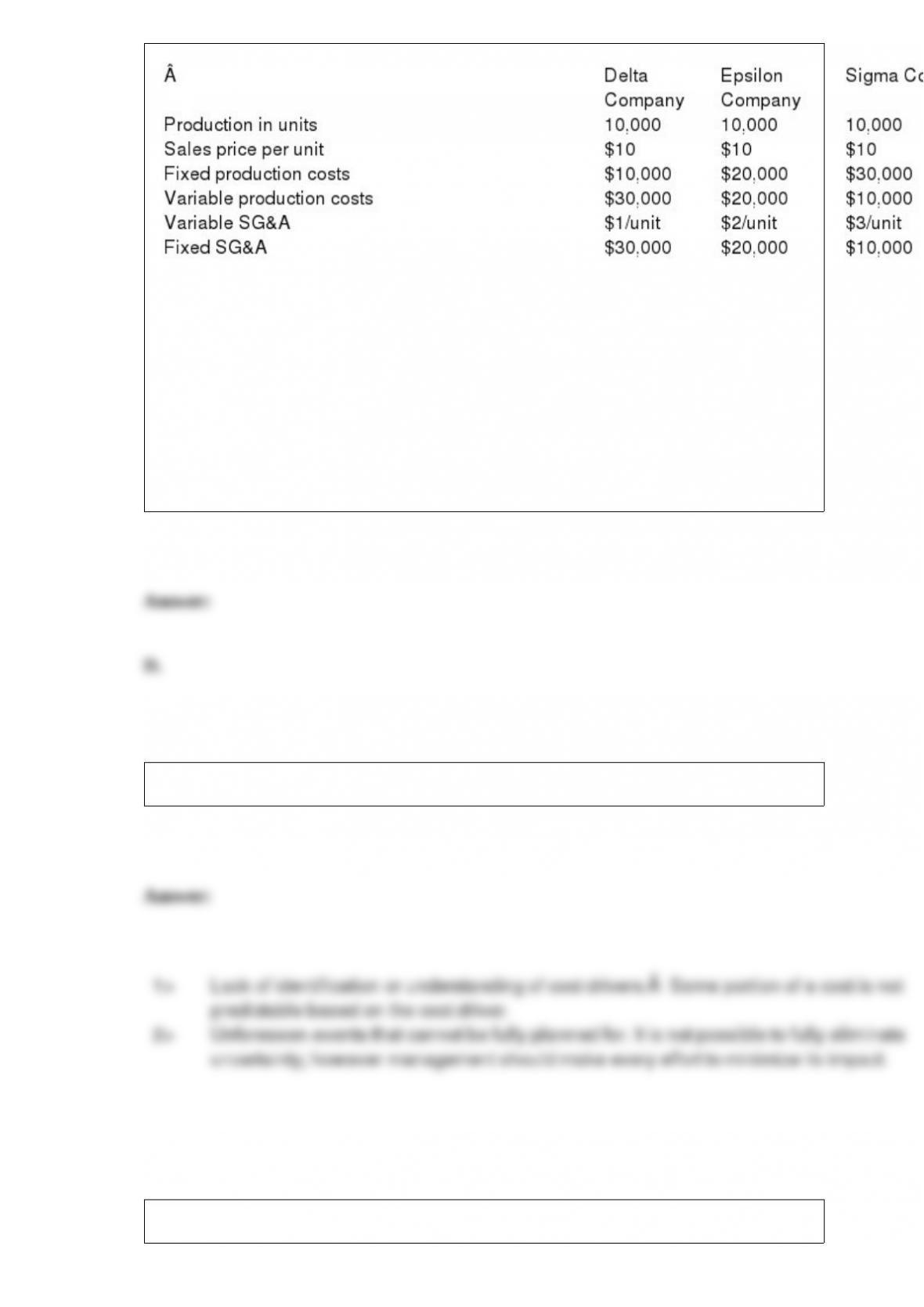
Refer to Delta, Epilson, and Sigma Companies. Based on sales of 7,000 units, which
company will report the greater income before income taxes if variable costing is used?
A. Delta Company
B. Epsilon Company
C. Sigma Company
D. All of the companies will report the same income.
What are the two main sources of uncertainty in cost management?
Discuss the ways in which management uses flexible budgets.
What are three characteristics of relevant information?
Costs that are associated with the production of a single unit of a product are referred
to as _________________________.
Grant Company.
Grant Company uses a job-order costing system and develops its predetermined
overhead rate based on machine hours. The company has two jobs in process at the end
of the cycle, Jobs #177 and #179.
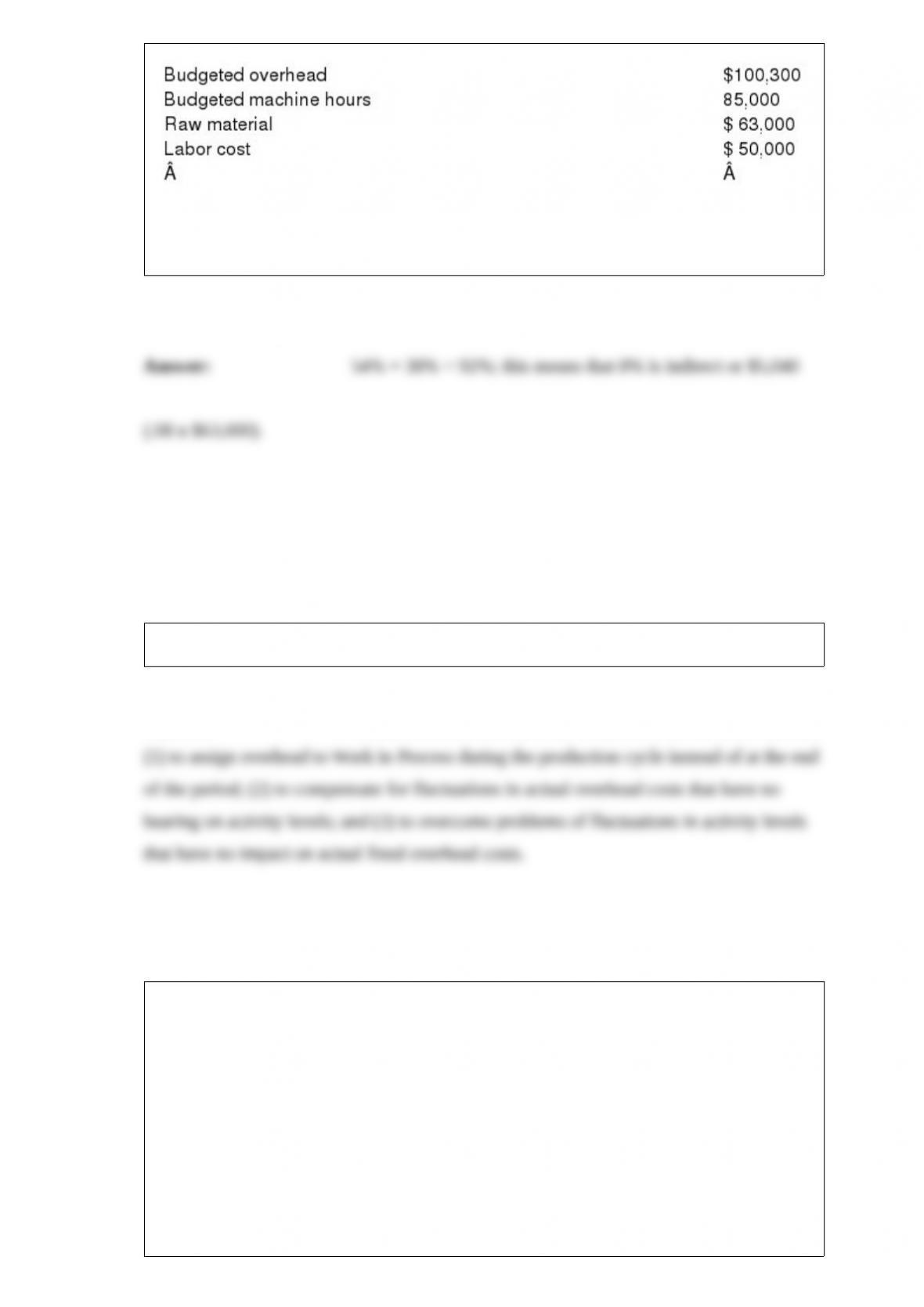
Refer to Grant Company. Fifty-four percent of raw material belongs to Job 17 and 38
percent belongs to Job 179, and the balance is considered indirect material. What
amount of raw material used was allocated to overhead as indirect material?
Why should predetermined overhead rates be used?
Ecology Solutions Corporation
The Green Division of Ecology Solutions Co. has developed a wind generator that
requires a special “S” ball bearing. The Ball Bearing Division of Ecology Solutions Co.
has the capability to produce such a ball bearing.
Unfortunately, the Ball Bearing Division is operating at capacity and will need to
reduce production of another existing product, the “T” bearing, by 1,000 units per
month to provide the 600 “S” bearings needed each month by the Green Division. The
“T” bearing currently sells for $50 per unit. Variable costs incurred to produce the “T”
bearing are $30 per unit; variable costs to produce the new “S” bearing would be $60
per unit.
The Green Division has found an external supplier that would furnish the needed “S”
bearings at $100 per unit. Assume that both the Green Division and Ball Bearing
Division are independent, autonomous investment centers.
Refer to Ecology Solutions Co. What is the minimum price that Ball Bearing Division
would consider to produce the “S” bearing?
What are the five steps involved in implementing a cost control system?
Discuss the accounting treatment of spoilage in a job-order costing system.
What does the term “pull” mean in the context of production control?