A company incurred $5,000 in wages for employees for the year. $4,500 of these wages
were paid by the end of the year. Choose theTRUE statement.
A. Wages payable on the income statement will be $4,500.
B. Wages expense on the income statement will be $500.
C. Wages expense on the balance sheet will be $5,000.
D. Wages payable on the balance sheet will be $500.
Answer:
Depreciation expense is not reported on the statement of cash flows when prepared
using the direct method.
Answer:
A transaction is an exchange or event that directly affects the assets, liabilities, or
stockholders’ equity of a company.
Answer:
Which of the following statements isTRUE regarding accounting standards used in
other countries?
A. U.S. GAAP is used worldwide.
B. IFRS are used by all countries.
C. More and more countries are using IFRS.
D. There are no plans to converge U.S. GAAP with IFRS.
Answer:
Under IFRS, the balance sheet is called the statement of financial position and the
income statement is called the statement of comprehensive income.
Answer:
The accounts receivable account for each customer is called a subsidiary account.
Answer:
Depreciation is a measure of the decline in market value of an asset.
Answer:
Generally Accepted Accounting Standards require profitable companies to distribute
some of their profits to their stockholders.
Answer:
B. Darin Company loaned $3,000,000 at 7% interest to S. Dee Company. B. Darin
Company would report this as an investing activity on the statement of cash flows.
Answer:
Which of the following statements isTRUE regarding cash flows from financing
activities?
A. When companies borrow, cash outflows for financing activities have occurred.
B. When companies receive dividends, cash inflows from financing activities have
occurred.
C. When companies repurchase their own stock, cash outflows for financing activities
have occurred.
D. When companies pay dividends, cash inflows from financing activities have
occurred.
Answer:
Which of the following statements is notTRUE?
A. Net income implies that revenues are greater than expenses.
B. A net loss causes retained earnings to decrease.
C. Net income causes stockholders’ equity to increase.
D. A net loss prevents a company from declaring dividends.
Answer:
Which of the following statements regarding gross profit percentage is notTRUE?
A. It is possible for a company to increase both its gross profit percentage and net
income without increasing the dollar amount of sales.
B. A rising gross profit percentage indicates management’s inability to control
production and inventory costs.
C. The gross profit percentage can be used to determine if a company is making enough
on each sale to cover its operating expenses.
D. Gross profit percentages vary across industries.
Answer:
If a merchandiser offers a sales discount of 2/10, net/30 on a sale of $1,000, the amount
due in 30 days is the net amount of $980.
Answer:
Amounts reported on financial statements are sometimes rounded to the nearest million.
Answer:
When a company pays for transportation on goods purchased FOB Shipping Point, total
assets will remain unchanged.
Answer:
Which of the following statements isTRUE about the cash basis of accounting?
A. It can distort reported profits.
B. It is the only acceptable method for external reporting.
C. It reports revenues when earned and expenses when incurred.
D. It is used when cash is paid at the same time as the cost is incurred, but is not used
when cash is paid before the expense is incurred.
Answer:
Which of the following is notTRUE of the unadjusted trial balance?
A. A trial balance is an internal report used to determine whether total debits equal total
credits.
B. A trial balance lists every account name in one column, usually in the order of assets,
liabilities, stockholders’ equity, revenues and expenses.
C. A trial balance shows the ending balances obtained from the ledger listed in either
the debit or credit column.
D. If debits equal credits in the unadjusted trial balance, it means that no errors were
made in the recording of transactions.
Answer:
When a company reissues shares of its treasury stock, it must report a gain or a loss on
the sale.
Answer:
Which of the following is NOTTRUE about the role of the external auditors?
A. Must test the effectiveness of the company’s internal controls.
B. Must issue a report that gives an opinion about the company’s internal controls.
C. Must examine the company’s financial statements by performing adequate tests of
the underlying financial information.
D. Must issue a qualified opinion on the financial statements if any misstatements are
found.
Answer:
Which of the following statements isTRUE?
A. Liabilities – Assets = Stockholders’ Equity.
B. The total value of credits in all accounts must always equal the total value of debits
in all accounts.
C. It’s normal to have more decreases in an account than increases.
D. A decrease in contributed capital would be recorded with a credit.
Answer:
An overstatement of ending inventory will cause an overstatement of assets and an
understatement of stockholders’ equity on the balance sheet.
Answer:
Which of the following statements regarding the balance sheet isTRUE?
A. A “classified” balance sheet is one that contains privileged information.
B. All liabilities require that the company sacrifice resources at some time in the future.
C. All companies use an identical list of account names defined by the Financial
Accounting Standards Board (FASB).
D. A balance sheet is prepared for a period of time.
Answer:
Which of the following statements regarding business forms isTRUE?
A. A sole proprietorship is an unincorporated business owned by one person.
B. All partnerships are owned by two people.
C. A corporation is not a legal entity.
D. An LLC (limited liability company) has the same tax treatment as a corporation.
Answer:
Which of the following statements is notTRUE?
A. The statement of cash flows does not replace the income statement.
B. The statement of cash flows provides details as to how cash changed during a period.
C. The statement of cash flows provides information about cash receipts and cash
payments over a period of time.
D. The statement of cash flows measures profitability.
Answer:
Unpaid dividends on cumulative preferred stock are called dividends in arrears.
Answer:
The use of internal controls guarantees protection against losses due to fraud, errors,
and inefficiencies.
Answer:
Using the indirect method, the increase in accumulated depreciation is added to net
income in the operating section.
Answer:
After posting the closing entries, all the revenue accounts and all the expense accounts
are zero and the Retained Earnings account has been debited for $4,000. This implies
that the company had a net income of $4,000.
Answer:
One reason why a company may choose a stock split over a stock dividend is that the
stock split does not reduce retained earnings.
Answer:
At the date of maturity, the carrying value of a bond should always be equal to the face
value.
Answer:
Treasury stock is a corporation’s own stock that has been issued and subsequently
repurchased by the corporation.
Answer:
The direct write-off method for uncollectible accounts is better than the allowance
method because it is more consistent with the conservatism principle.
Answer:
A major advantage of debt financing is that interest expense is tax deductible.
Answer:
The calculation for depletion of natural resources is similar to the calculation for
units-of-production depreciation.
Answer:
A real estate management company buys an abandoned apartment complex for $4.5
million. It pays a construction company $500,000 to demolish the entire building.
Which of the following isTRUE?
A. The company would record $5 million as the cost of the land.
B. The company would record $4.5 million as the cost of the land.
C. The company would record $4 million as the cost of the land.
D. The company would record $500,000 as demolition expense.
Answer:
Which of the following is notTRUE about an auto manufacturer’s inventory?
A. Tires, batteries, glass, paint, headlamp bulbs, and electric wiring would be included
in raw materials inventory.
B. Incomplete cars that are still being processed would be included in work-in-process
inventory.
C. Finished cars ready to be shipped to dealers would be included in finished goods
inventory.
D. Cars that have been sold to dealers would be included in finished goods inventory.
Answer:
The purpose of adjusting entries is to transfer net income and dividends to retained
earnings.
Answer:
Goodwill may be attributable to all of the following except which one?
A. A large amount of charitable contributions
B. A good reputation
C. A well-trained work force
D. A superior location
Answer:
Which of the following would be classified as an investing activity on the statement of
cash flows?
A. Cash received from sale of land.
B. Cash paid for interest.
C. Cash received from stock issuance.
D. Dividends paid.
Answer:
A company had calculated net income to be $77,550 based on the unadjusted trial
balance. The following adjusting entries were then made: Salaries payable of $790 was
recorded; Interest earned but not received from investments $750; Prepaid insurance
decreased by $550 for insurance used up during the period; $750 of Unearned revenue
has now been earned. After recording these adjustments, net income would be:
A. $77,710.
B. $74,710.
C. $77,310.
D. $79,600.
Answer:
In October, your company prepays rent of $7,000 for November and December. Which
of the following describes the effects of this transaction on your company in October?
A. Assets decrease $7,000 and liabilities decrease $7,000.
B. Assets increase $7,000 and stockholders’ equity increases $7,000.
C. There is no change to total assets, liabilities or stockholders’ equity.
D. Liabilities decrease $7,000 and stockholders’ equity increases $7,000.
Answer:
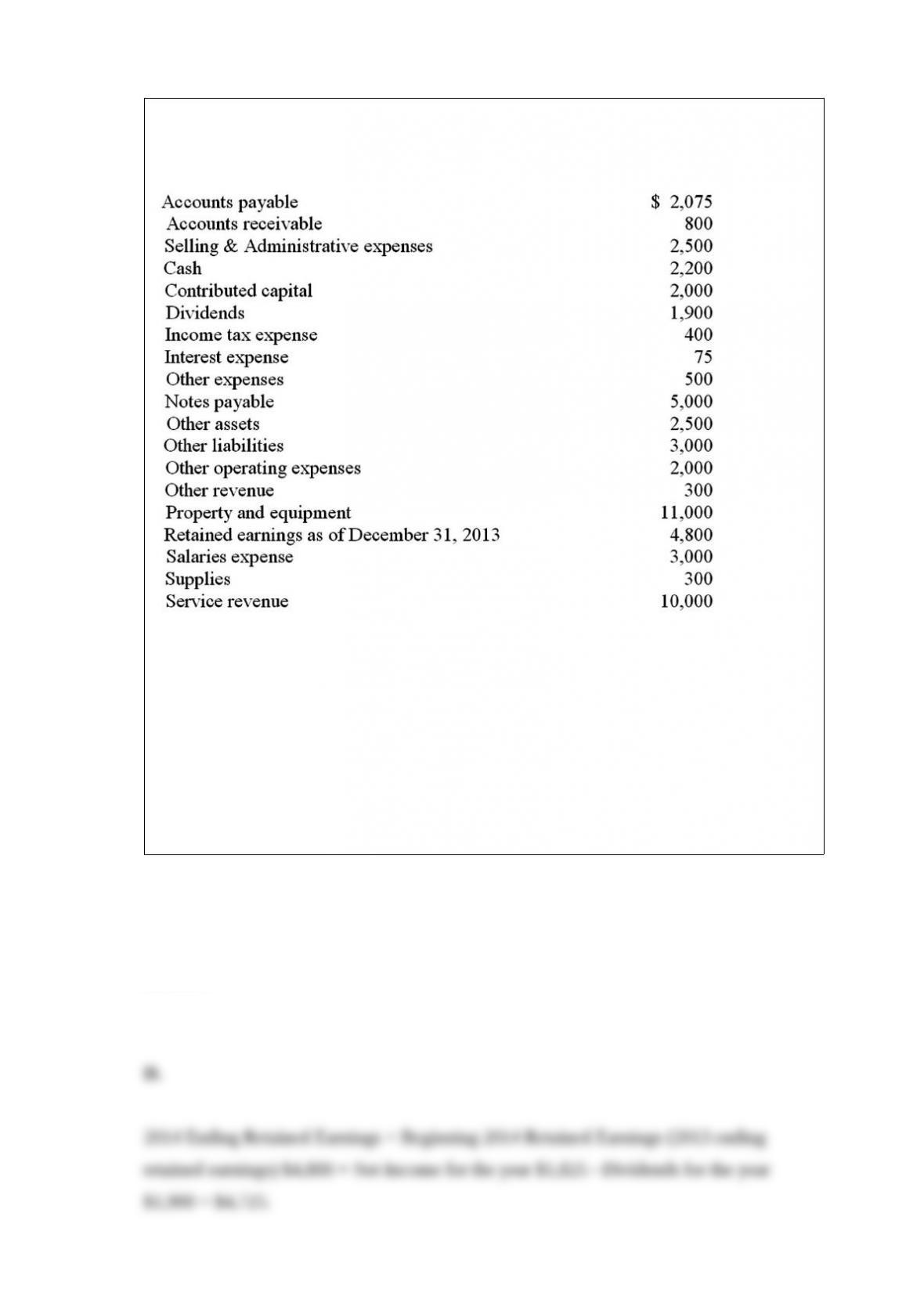
The following accounts are taken from the December 31, 2014 financial statements of a
company.
What is the amount of retained earnings on the Balance Sheet at the end of 2014?
A. $7,725
B. $6,725
C. $4,800
D. $4,725
Answer:
A company had the same amount of assets at the end of 2014 and 2015, $300,000. In
2015, net income was $40,000 and sales revenue was $390,000. At the end of 2015,
total liabilities are $120,000.
What is the asset turnover ratio for 2015?
A. 1.30
B. 0.13
C. 0.77
D. 9.75
Answer:
Because LIFO uses older costs for inventory, in times of rising prices:
A. LIFO results in a higher book value of inventory and lower inventory turnover ratio
than FIFO.
B. LIFO results in a lower book value of inventory and lower inventory turnover ratio
than FIFO.
C. LIFO results in a higher book value of inventory and higher inventory turnover ratio
than FIFO.
D. LIFO results in a lower book value of inventory and higher inventory turnover ratio
than FIFO.
Answer:
Which of the following statements most appropriately describes the purpose of
depreciating a long-lived tangible asset?
A. To indicate how the asset has physically deteriorated.
B. To show that the asset will eventually and gradually become obsolete.
C. To record that the asset’s market value declines over time.
D. To match the cost of the asset to the period in which it generates revenue.
Answer:
Sneetch Inc. purchased a star-making machine on January 1, 2014. The cost of the
machine was $17,000. Its estimated residual value was $2,000 at the end of an
estimated 10-year life. The company expects to produce a total of 20,000 units.
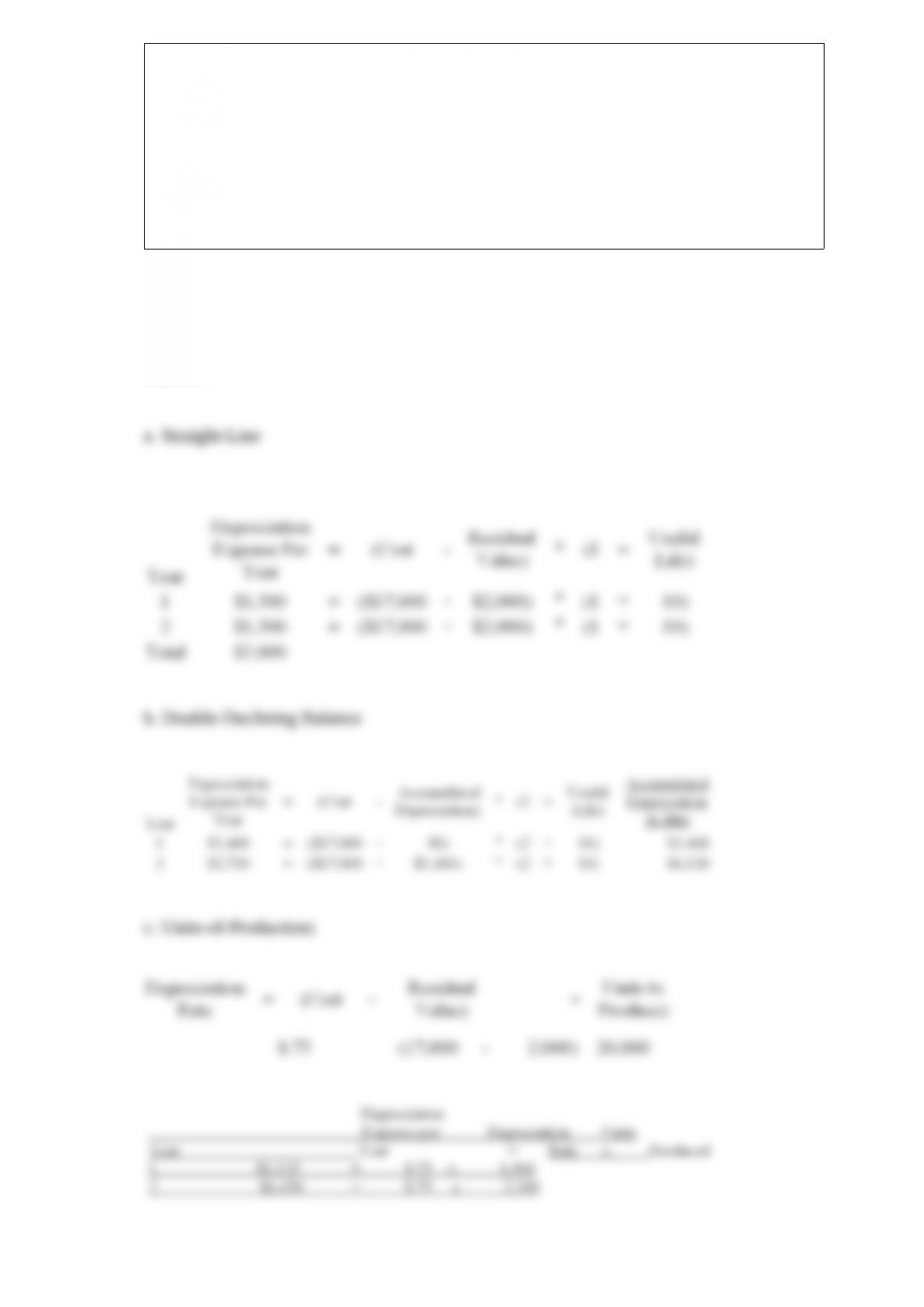
a. Calculate depreciation expense for 2014 and 2015 using the straight-line method.
b. Calculate depreciation expense for 2014 and 2015 using the double-declining balance
method.
c. Calculate the depreciation expense for 2014 and 2015 using the units-of-production
method. The company produced 1,500 units in 2014 and 2,200 units in 2015.
Answer:
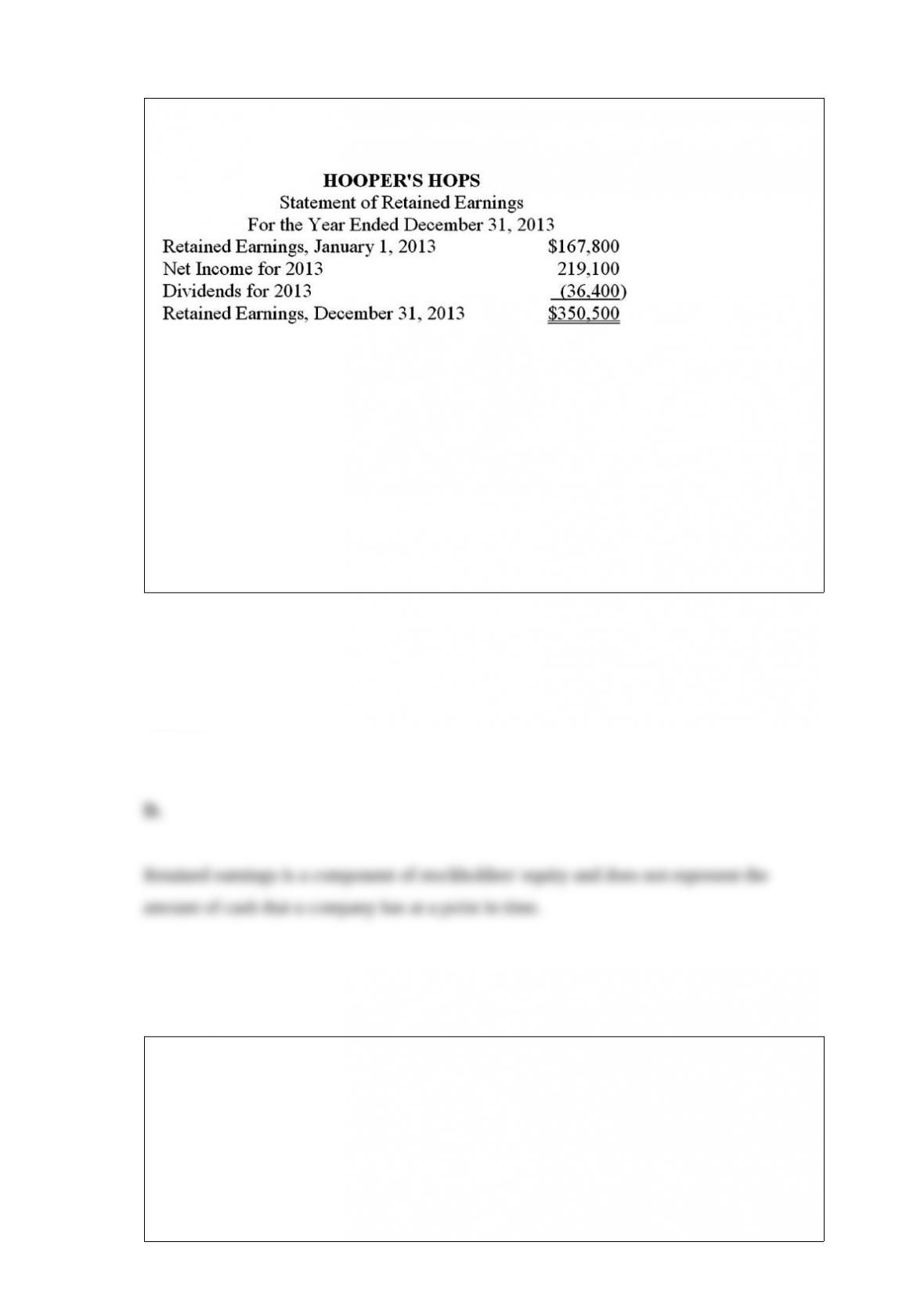
Which inference may be considered incorrect concerning the Statement of Retained
Earnings?
A. Retained earnings of $350,500 will appear on the balance sheet as of December 31,
2013.
B. The net income in the above statement came from the income statement for the year
ending December 31, 2013.
C. Dividends are shown in parentheses because they are distributions made by a
company to its stockholders as a return on their investment.
D. Retained earnings represents the amount of cash at the end of 2013.
Answer:
Account titles in the chart of accounts are:
A. general purpose and do not indicate the nature of the account.
B. consistent with those used by other companies.
C. linked to account numbers.
D. the names mandated for use by the FASB.
Answer:
If interest revenue for the period is $14,000 and the beginning and ending interest
receivable balances are $1,320 and $5,900, respectively, cash received for interest is:
A. $14,000
B. $9,420
C. $18,500
D. $8,100
Answer:
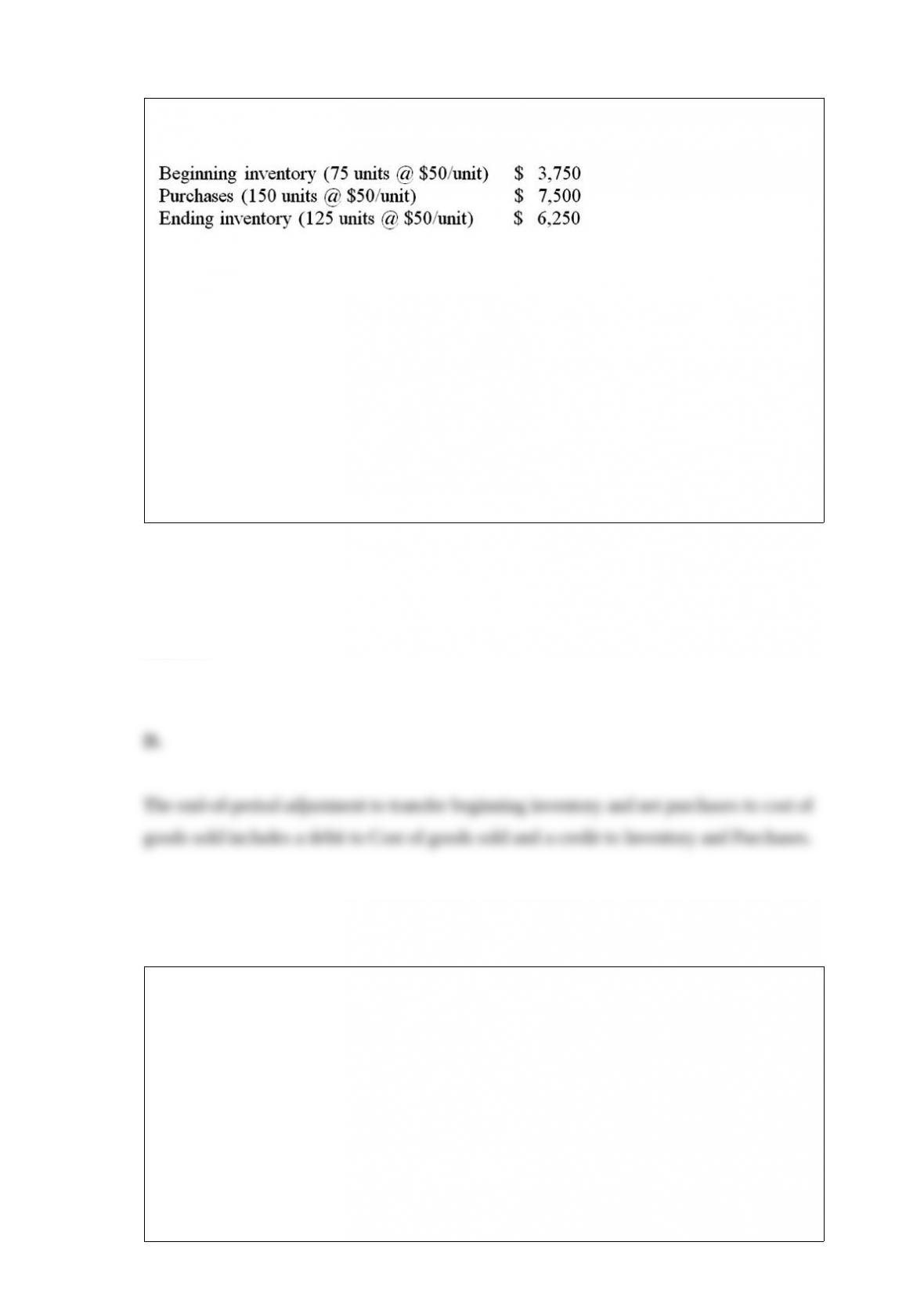
FAD Company uses a periodic inventory system and its inventory records for the period
contain the following information:
Use the information above to answer the following question. The journal entry
necessary at the end of the period to transfer beginning inventory and net purchases to
cost of goods sold will include which of the following?
A. Credit Inventory, $6,250.
B. Debit Purchases, $11,250.
C. Debit Inventory, $6,250.
D. Debit Cost of goods sold, $11,250.
Answer:
Choose the appropriate letter to match the term and the explanation. Not all
explanations will be used.
TERM
_____ 1/ Promissory note
_____ 2/ Net accounts receivable
_____ 3/ Bad debt expense
_____ 4/ Maturity date

_____ 5/ Days-to-collect
_____ 6/ Gross accounts receivable
_____ 7/ Allowance for doubtful accounts
_____ 8/ Receivables turnover
EXPLANATION
A. The time at which a loan must be repaid.
B. A financial statement that shows the calculation of bad debt expense for a company.
C. Total money owed the company for sales made on credit.
D. Net credit sales revenue divided by the net income.
E. An agreement by a borrower to repay the lending company with interest during a
specified time period.
F. The time at which a borrower must make annual interest payments.
G. A contra-asset account.
H. The days of the year divided by the receivables turnover ratio.
I. The portion of accounts receivable that the company expects to collect.
J. An account that is debited for the amount of credit sales estimated as uncollectible.
K. Net credit sales revenue divided by the average net accounts receivable.
L. The days of the year divided by the net sales revenue.
Answer:
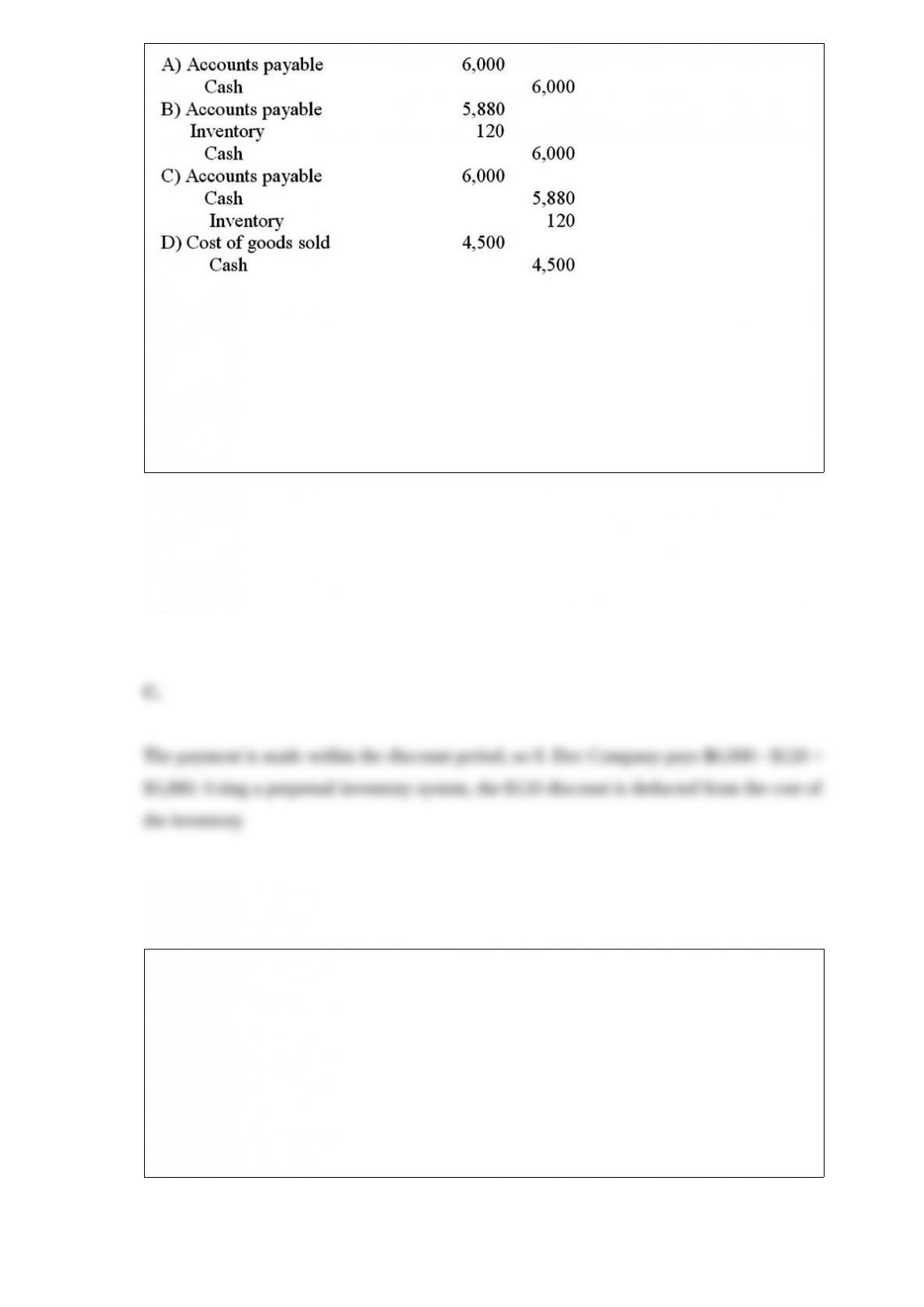
On July 1, B. Darin Company sold merchandise costing $4,500 to S. Dee Company for
$6,000, terms 2/10, n/30. Both companies use the perpetual inventory system. S. Dee
Company pays the invoice on July 8 and takes the appropriate discount. What is the
journal entry that S. Dee Company will make on July 8?
A. Option A
B. Option B
C. Option C
D. Option D
Answer:
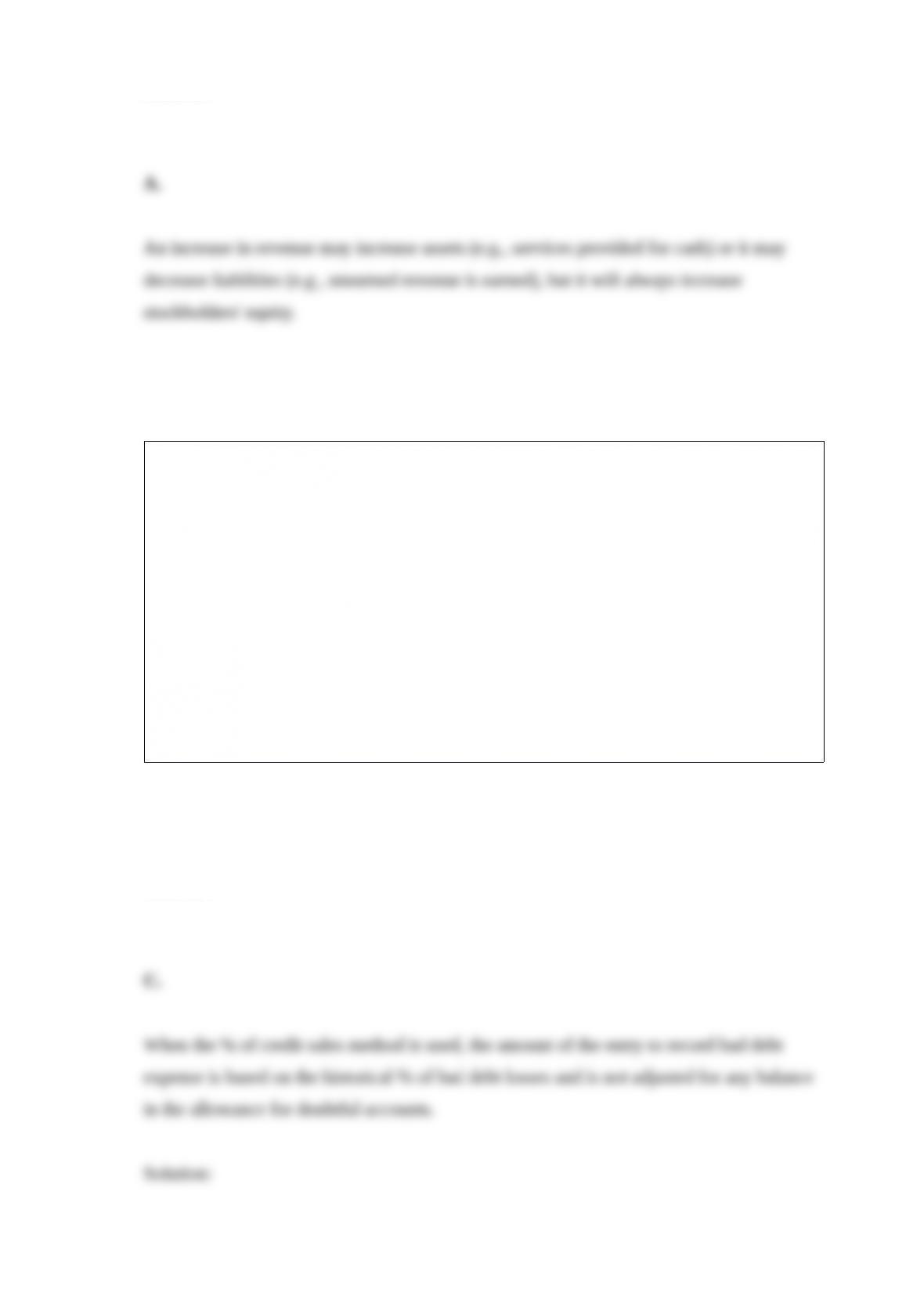
An increase in revenue will always:
A. increase stockholders’ equity.
B. increase assets.
C. decrease stockholders’ equity.
D. decrease assets.
Answer:
Plasma Inc., has net credit sales of $500,000 during the year. Based on historical
information, Plasma estimates that 2% of net credit sales result in bad debts. At the
beginning of the year, Plasma has a credit balance in its Allowance for Doubtful
Accounts of $4,000. What amount of bad debt expense should Plasma recognize for the
year, assuming no specific customer accounts were written off?
A. $4,000.
B. $6,000.
C. $10,000.
D. $14,000.
Answer:
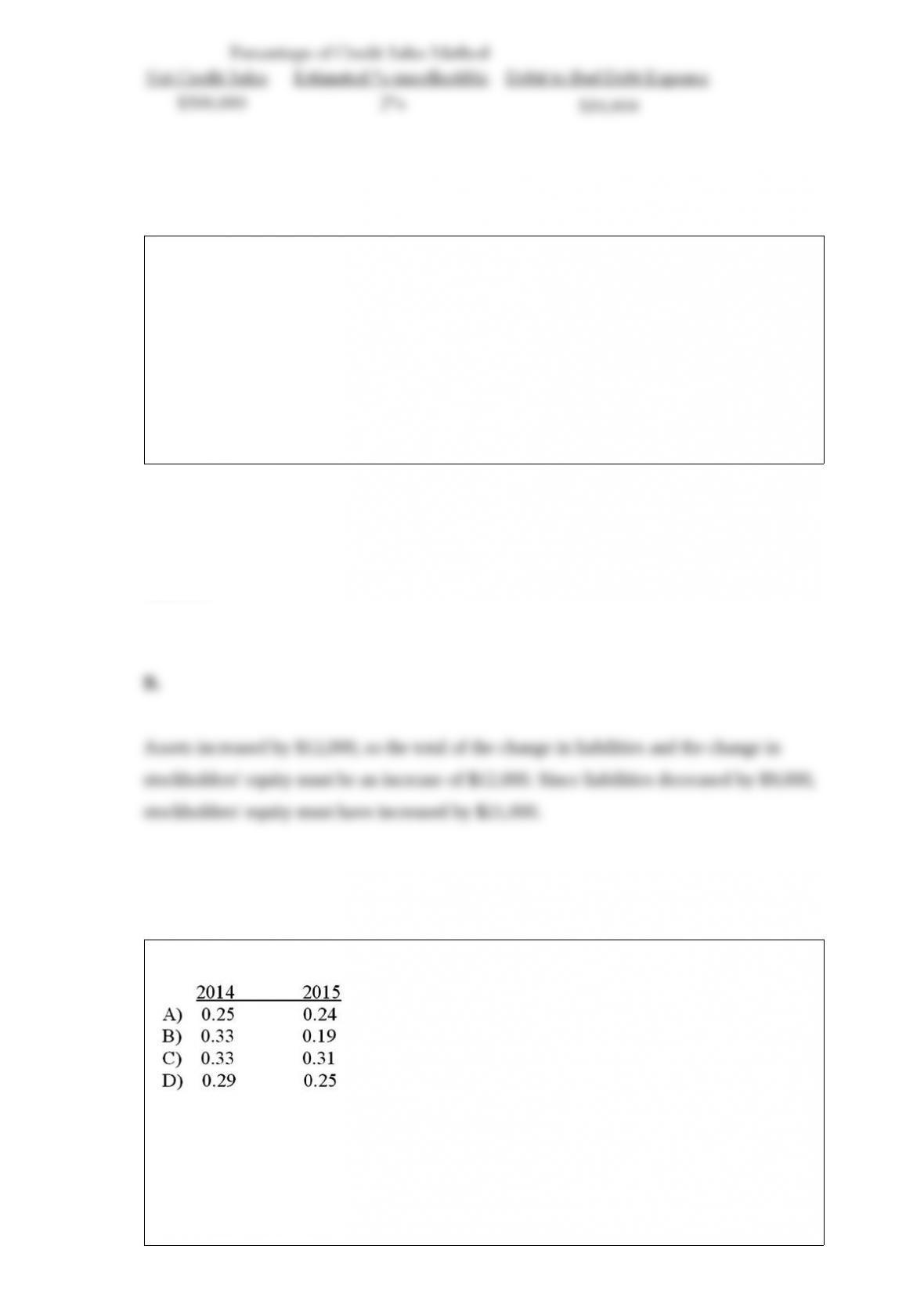
What is the amount of the change in stockholders’ equity during the year?
A. $3,000 increase
B. $21,000 increase
C. $21,000 decrease
D. $3,000 decrease
Answer:
The debt-to-assets ratio for 2014 and 2015 are closest to:
A. Option A
B. Option B
C. Option C
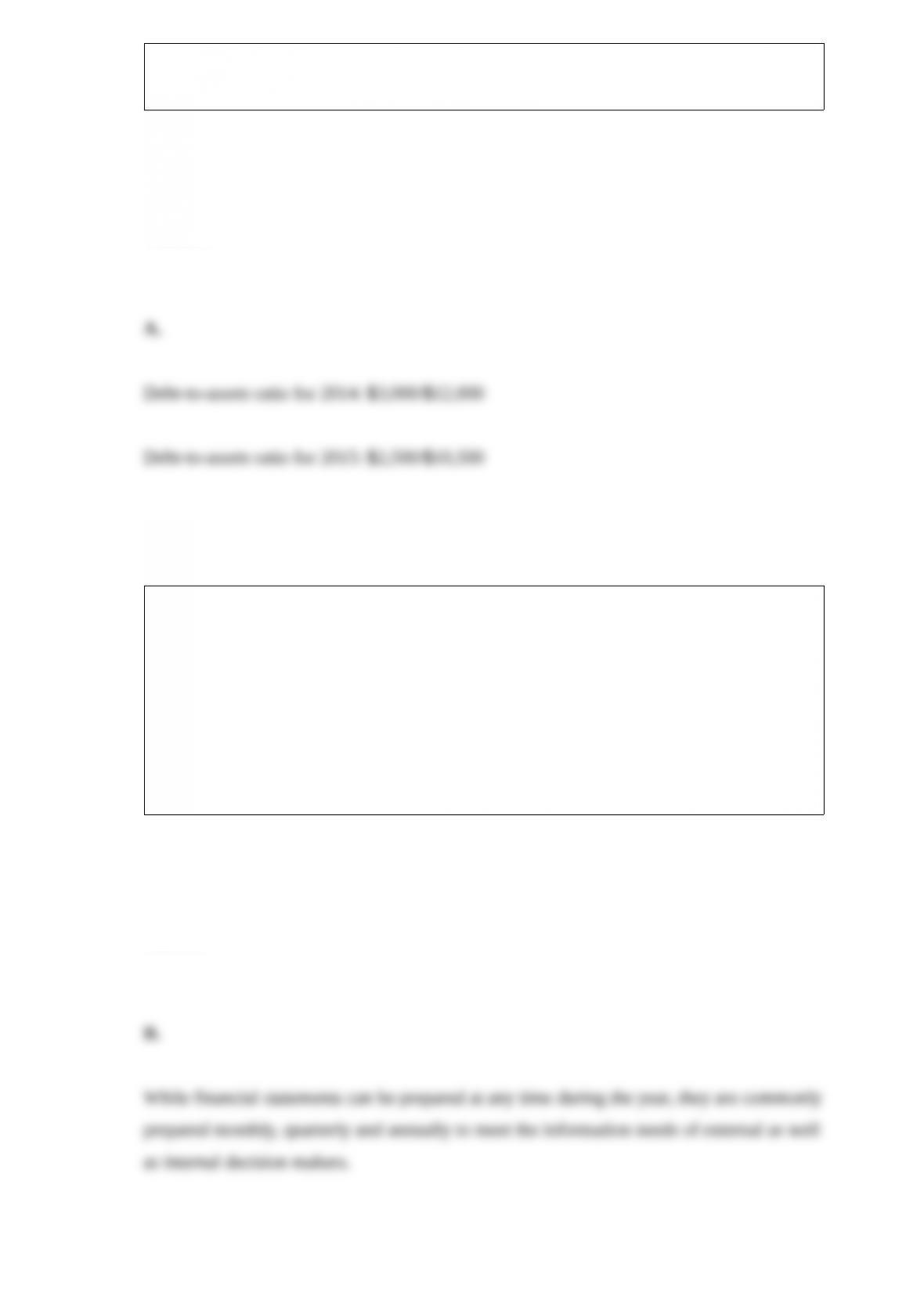
D. Option D
Answer:
Financial statements are most commonly prepared:
A. daily.
B. monthly, quarterly and annually.
C. as needed.
D. weekly.
Answer:
The separate entity assumption means
A. the financial information depicts the economic substance of the business activities.
B. the financial reports of a business are assumed to include the results of only that
business’s activities.
C. the results of business activities are reported in an appropriate monetary unit.
D. the financial information can be compared across businesses because similar
accounting methods have been applied.
Answer:
Ordinary repairs and maintenance:
A. are part of the asset cost of equipment and facilities.
B. are recorded as expenses when the dollar amount is material.
C. are always recorded as liabilities.
D. improve the asset beyond the current accounting period.
Answer:
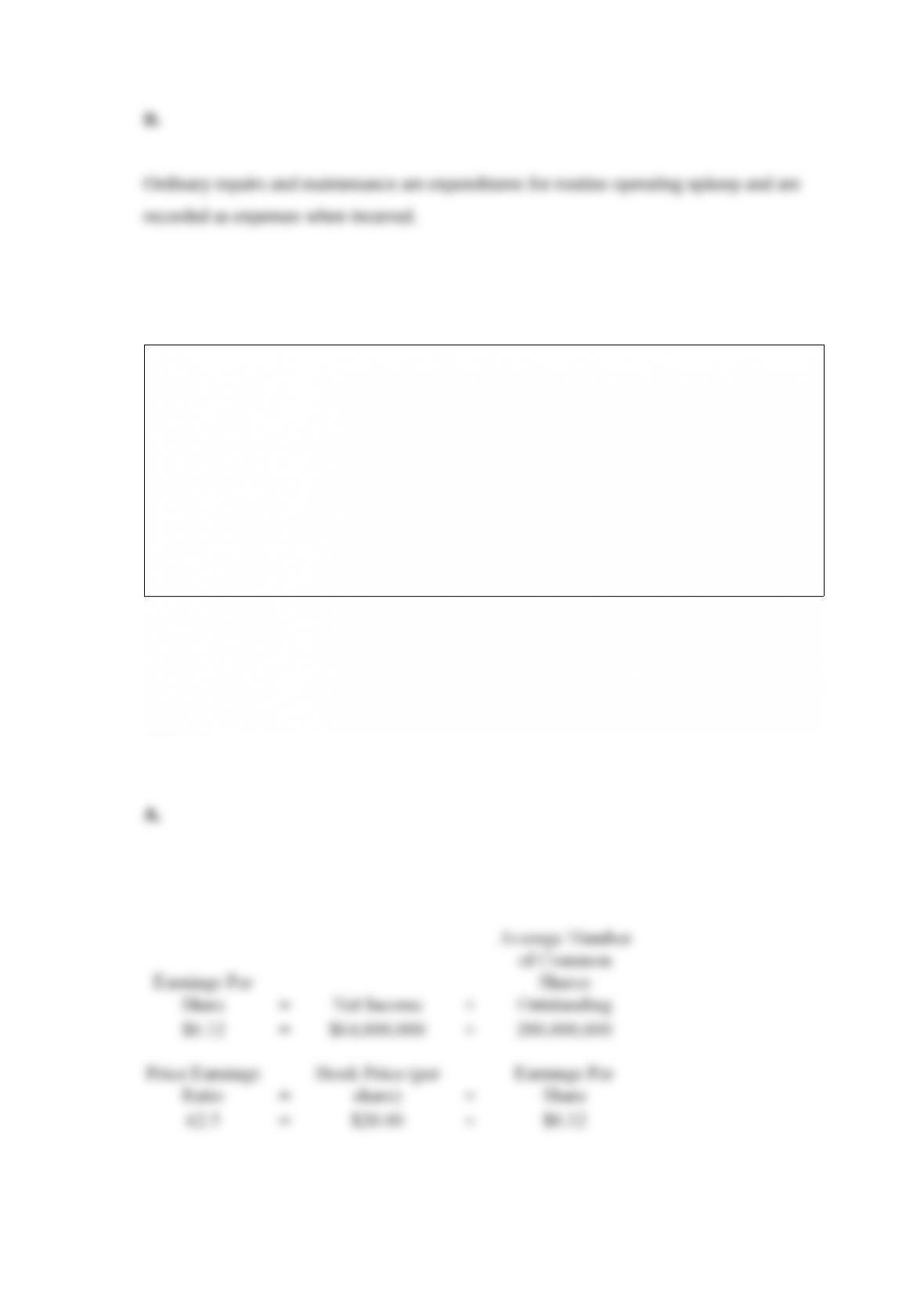
A share of stock sells for $20. The company has $64 million in earnings and 200
million outstanding shares. The P/E ratio for the company is closest to:
A. 62.5.
B. 200.
C. 0.31.
D. 6.4.
Answer:
Important sources of publicly available financial information about a company other
than its financial statements do not include:
A. press releases.
B. annual reports.
C. SEC filings.
D. management reports.
Answer:
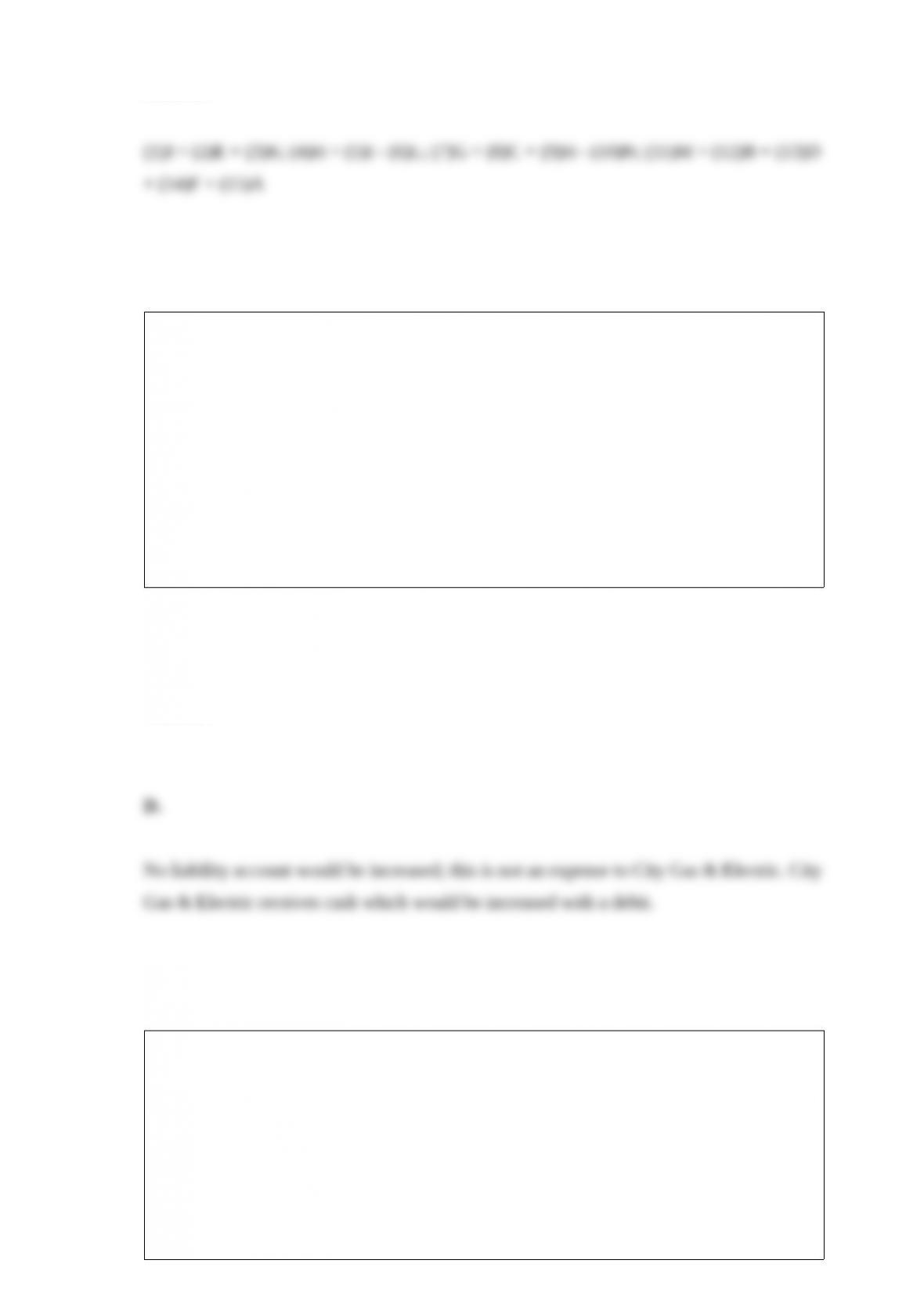
A company issues $20 million in new stock. It later uses the cash received to pay off
promissory notes. How many different accounts and which account names are affected
by these two transactions?
A. 3 accounts involved: contributed capital, cash, and notes payable.
B. 4 accounts involved: contributed capital, cash, investments, and notes payable.
C. 3 accounts involved: cash, contributed capital, and accounts payable.
D. 3 accounts involved: contributed capital, investments, and accounts payable.
Answer:
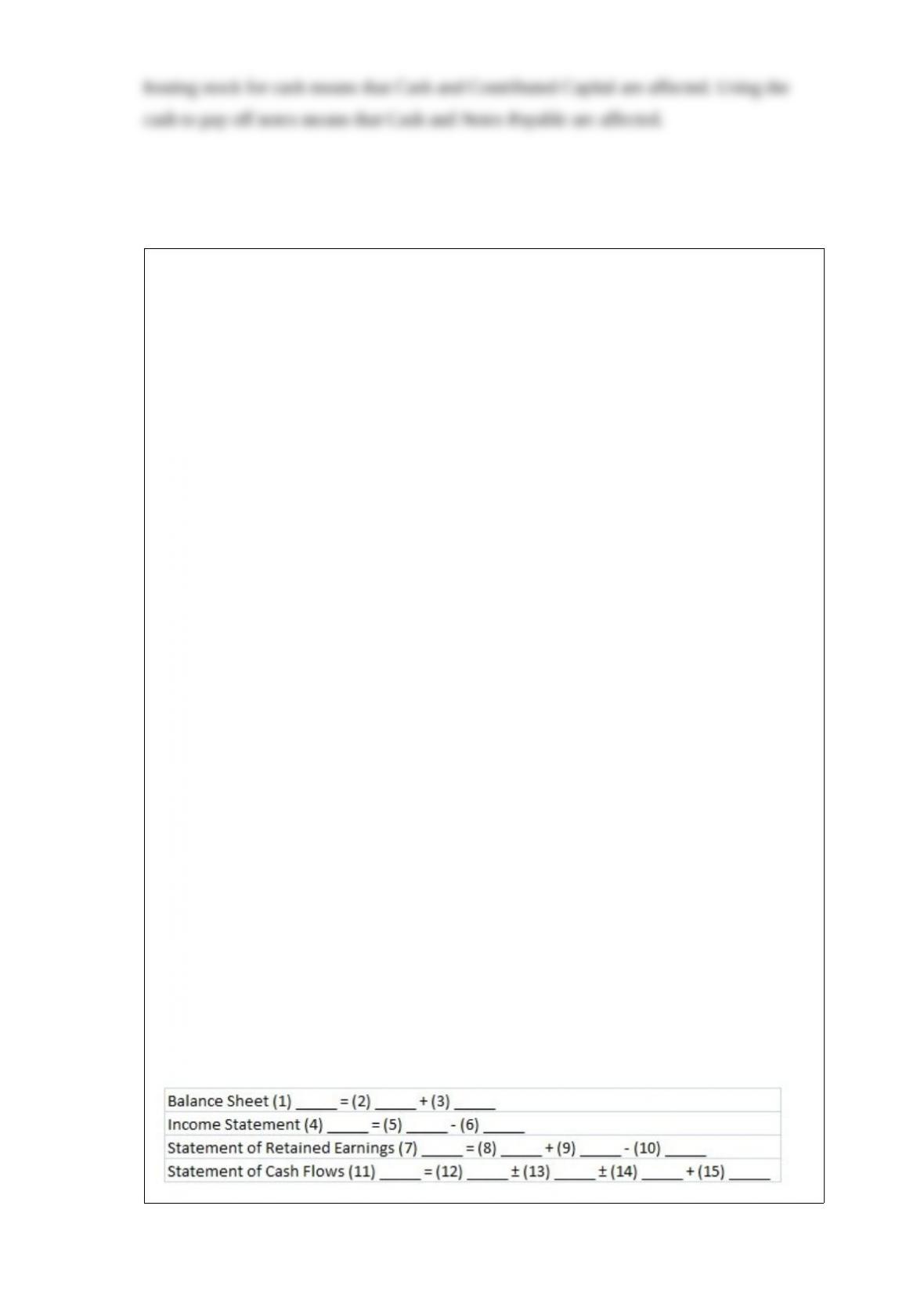
Match the lettered terms to the blanks below to complete the relevant formula for each
financial statement.
A. Cash at beginning of year
B. Net cash flow from operating activities
C. Balance of retained earnings from previous year
D. Net cash flow from investing activities
E. Liabilities
F. Net cash flow from financing activities
G. Balance of retained earnings at end of year
H. Net income
I. Revenue
J. Assets
K. Stockholders’ equity
L. Expenses
M. Cash at end of year
N. Dividends paid
A letter may be used more than once. Use the blank on the left side of the equal sign for
the “bottom line” number that is reported at the end of each financial statement.
Rearrange the formula if necessary.
Answer:
Seconds Best Retail Store receives and immediately pays a $3,500 utility bill from the
City Gas & Electric Company. The entry by the City Gas & Electric Company to record
receipt of this payment would include a:
A. credit to accounts payable.
B. credit to utilities expense.
C. debit to utilities revenue.
D. debit to cash.
Answer:
Assume a company uses the direct method to prepare its statement of cash flows. If the
company’s accounts receivable increase during the accounting period, the change in
accounts receivable is:
A. added to the change in the cash account to calculate cash collected from customers.
B. subtracted from sales revenue to calculate the cash collected from customers.
C. added to sales revenue to calculate the cash collected from customers.
D. subtracted from the change in the cash account to calculate cash collected from
customers.
Answer:
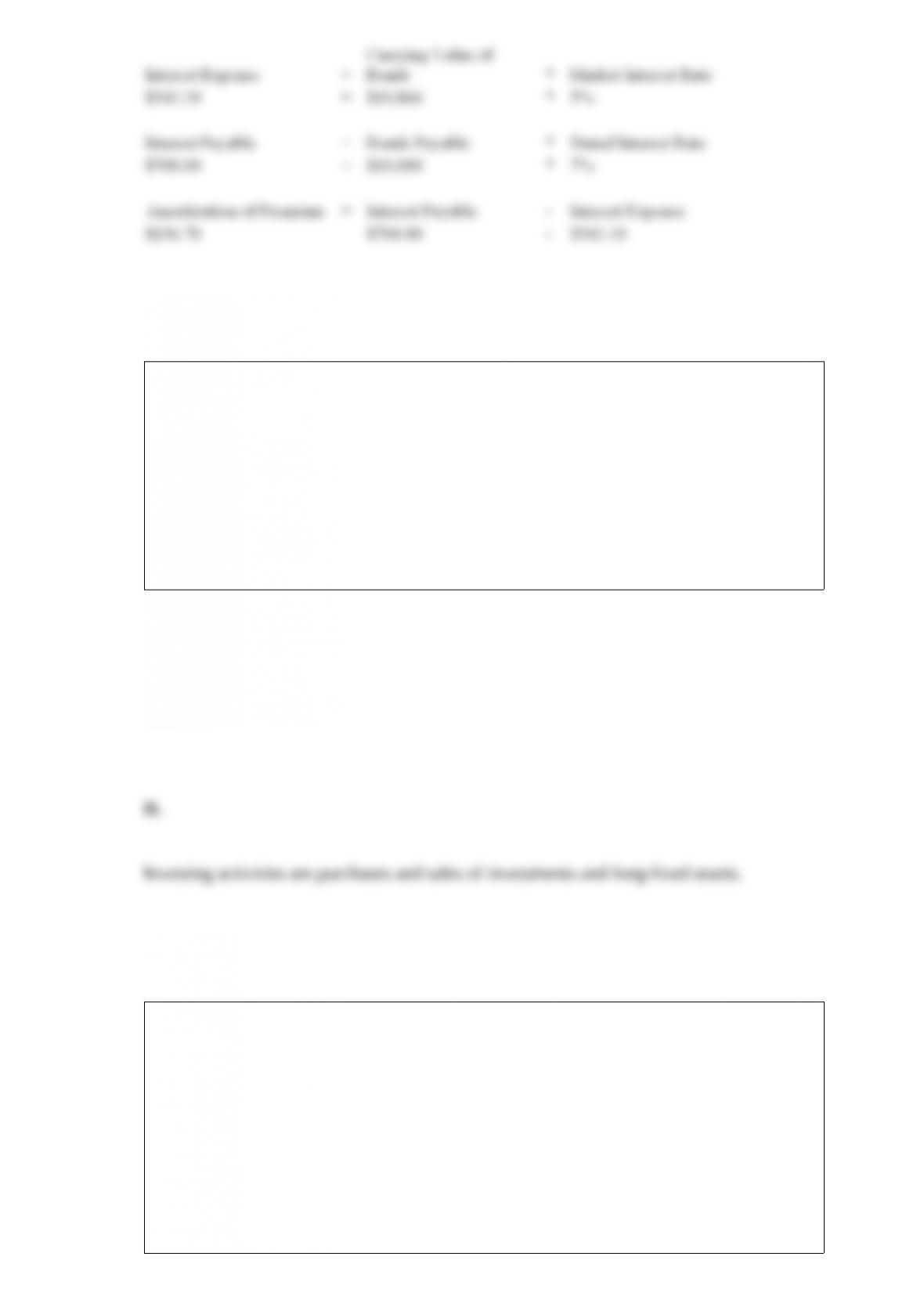
On January 1, your company issues a 5-year bond with a face value of $10,000 and a
stated interest rate of 7%. The market interest rate is 5%. The issue price of the bond
was $10,866. Your company used the effective-interest method of amortization. At the
end of the first year, your company should:
A. debit Interest Expense for $543, debit Premium on Bonds Payable for $157, and
credit Interest Payable for $700.
B. debit Interest Expense for $700, credit Premium on Bonds Payable for $157, and
credit Interest Payable for $543.
C. debit Interest Expense for $700, debit Premium on Bonds Payable for $157, and
credit Interest Payable for $543.
D. debit Interest Expense for $543 and credit Interest Payable for $543.
Answer:
Which of the following would be included in cash flows from investing activities?
A. Cash proceeds from sales.
B. Cash received from an issuance of bonds.
C. Dividends paid to stockholders.
D. Cash used to purchases of equipment.
Answer:
How competitors calculate inventory cost is least likely to affect comparisons between
competitors if inventory makes up a:
A. large percentage of assets and inventory costs are stable.
B. large percentage of assets and inventory costs are not stable.
C. small percentage of assets and inventory costs are not stable.
D. small percentage of assets and inventory costs are stable.
Answer:
A company had been selling its product for $20 per unit, but recently lowered the
selling price to $15 per unit. The company’s current inventory consists of 200 units
purchased at $16 per unit. The replacement cost of this merchandise is currently $13 per
unit. At what amount should the company’s inventory be reported on the balance sheet
under the lower of cost or market rule?
A. $2,600
B. $3,200
C. $3,000
D. $4,000
Answer:

Which of the following would not represent a financing activity?
A. Paying dividends to stockholders.
B. An investment of capital by the owners.
C. Borrowing money from a bank to purchase new equipment.
D. Buying supplies on account.
Answer:
Alphabet Company, which uses the periodic inventory method, buys different letters for
resale. It buys A thru G in January at $4 per letter. In February, it buys H thru L at $6
per letter. It buys M thru R in March at $7 per letter. It sells A, D, E, H, J and N in
April.
Use the information above to answer the following question. If the company uses the
FIFO method, what is the cost of its ending inventory?
A. $24
B. $42
C. $58
D. $76
Answer:
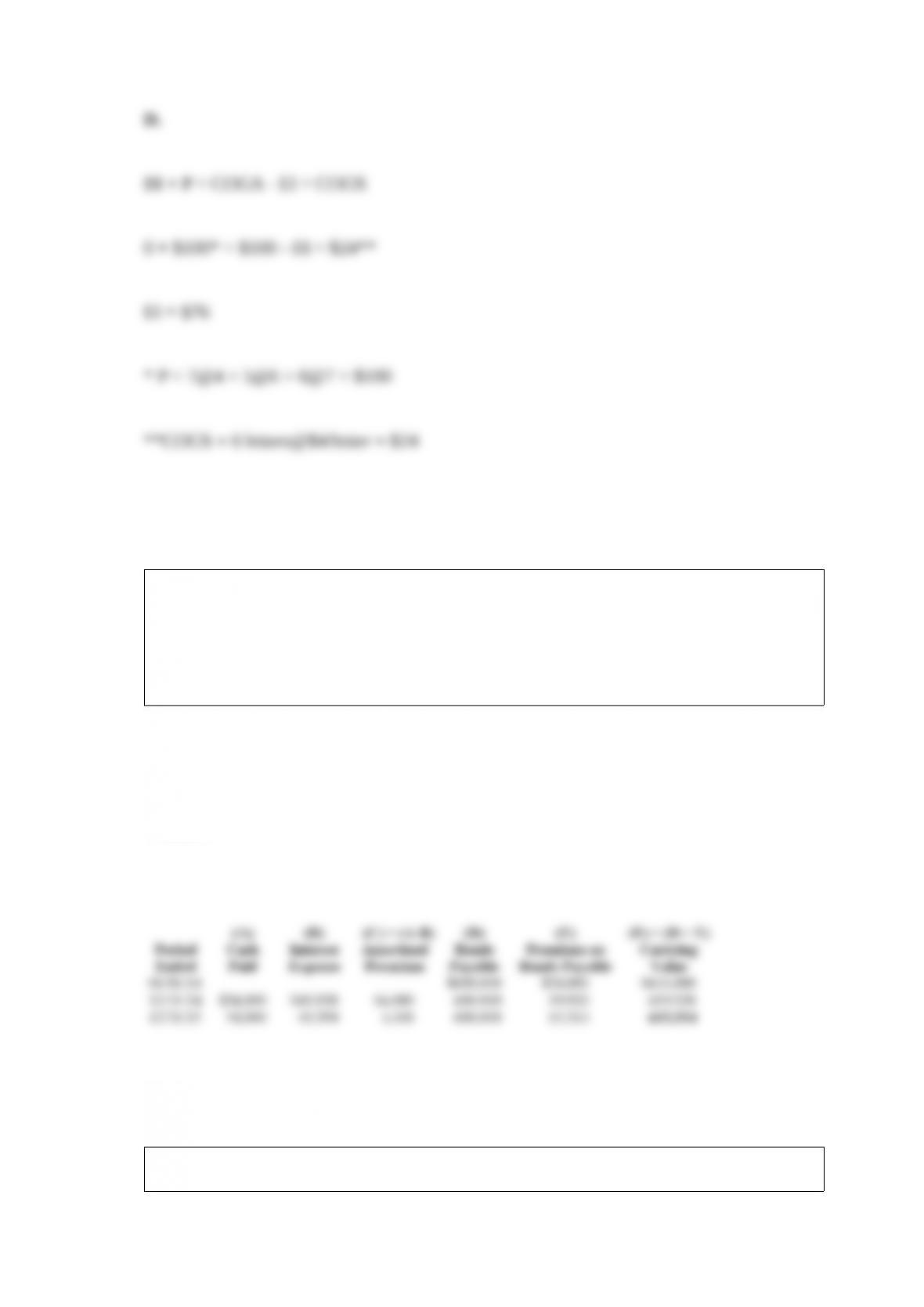
Bonds with a stated interest rate of 9% and a face value totaling $600,000 were issued
at 104 on January 1, 2014, implying an annual market interest rate of 8%. Assuming
that interest is computed annually, at what carrying value should the total liability for
these bonds be reported two years later on December 31, 2015, if the effective-interest
method of amortization is used?
Answer:
Garcia Company will buy merchandise from one of the following suppliers.
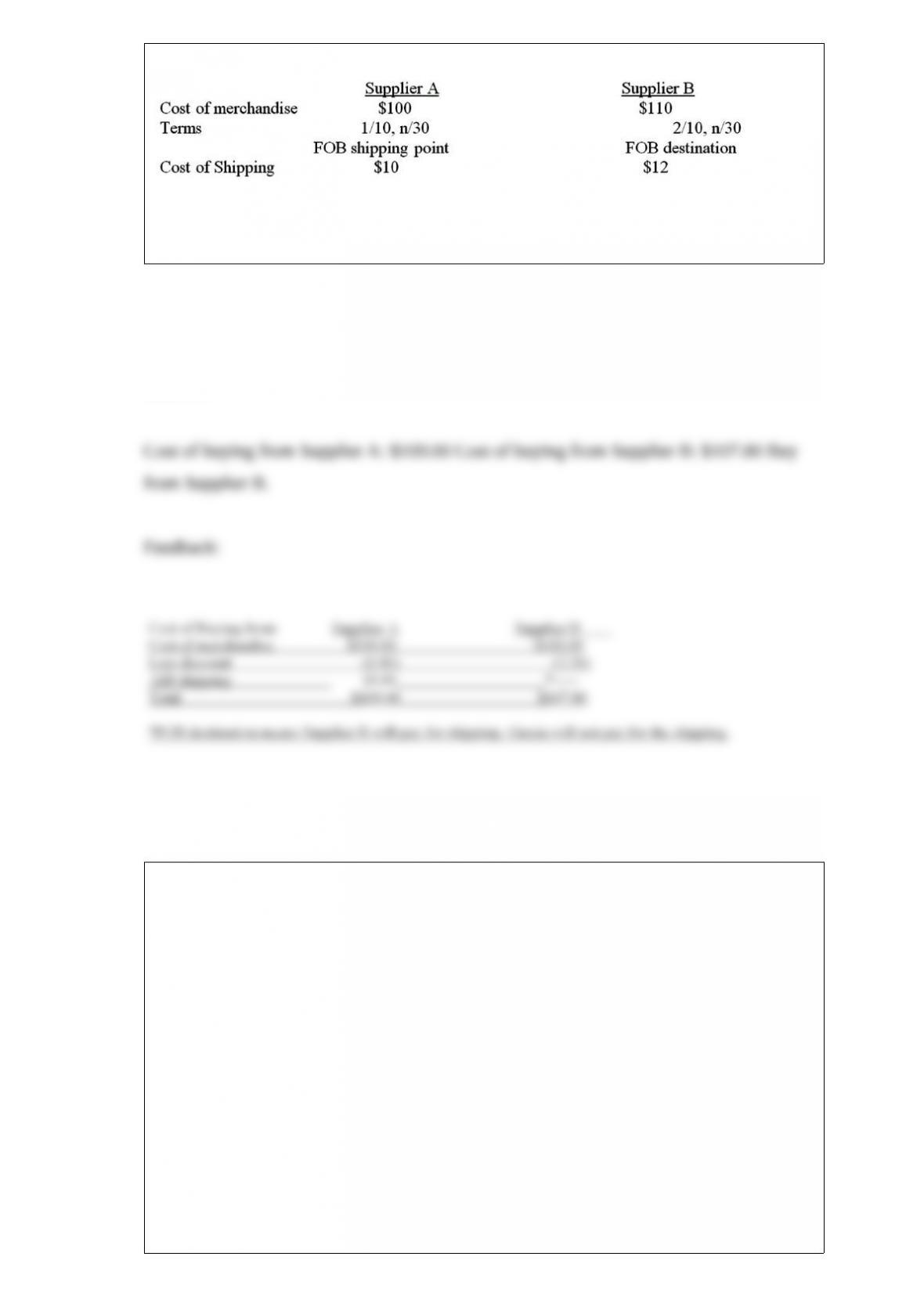
Assume the company takes all discounts. What is the total cost for each supplier?
Which supplier should it buy from?
Answer:
Match each of the following elements with the financial report it is part of or associated
with.
AR – Annual Report
QR – Quarterly Report
B – Both
_____ 1/ Letter to shareholders.
_____ 2/ Management’s discussion of financial results
_____ 3/ An audit opinion.
_____ 4/ Condensed income statement for the period.

_____ 5/ Statement of retained earnings for the period.
_____ 6/ SEC filings.
_____ 7/ Unaudited condensed balance sheet.
_____ 8/ Notes to the financial statements.
_____ 9/ Summarized financial data, covering a period of five to ten years.
Answer:
For each of the following, indicate the step of the basic business model that is most
appropriate for the activity listed.
1/ Step one – Obtaining financing
2/ Step two – Investing in assets
3/ Step three – Generating revenues
4/ Step four – Producing net income
_____ Increasing retained earnings.
_____ Borrowing money from creditors.
_____ Selling goods to consumers.
_____ Buying equipment.
_____ Selling shares of company stock.
_____ Buying goods for future sale.
_____ Selling services to consumers.
Answer:
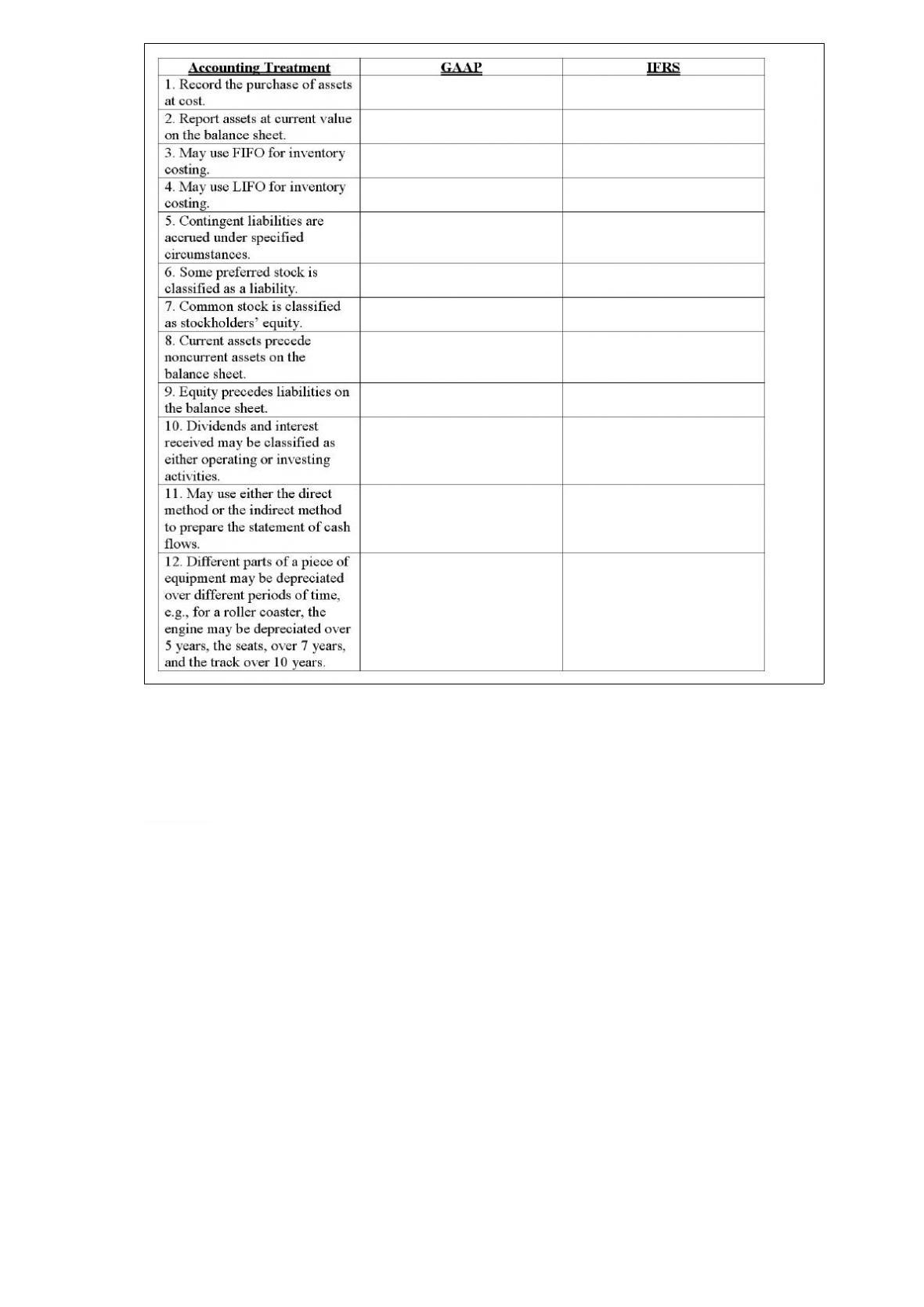
For each of the accounting treatments below, indicate whether it is followed in GAAP,
or IFRS, or both, by placing an “X” in the appropriate column(s).
Answer:
A company reported a decrease in sales from $860,000 last year to $760,000 this year
and a decrease in gross profit from $400,000 last year to $360,000 this year. Was the
drop in gross profit caused by a decline in the gross profit per sale, a decline in the sales
volume, or a combination of the two?
Answer:
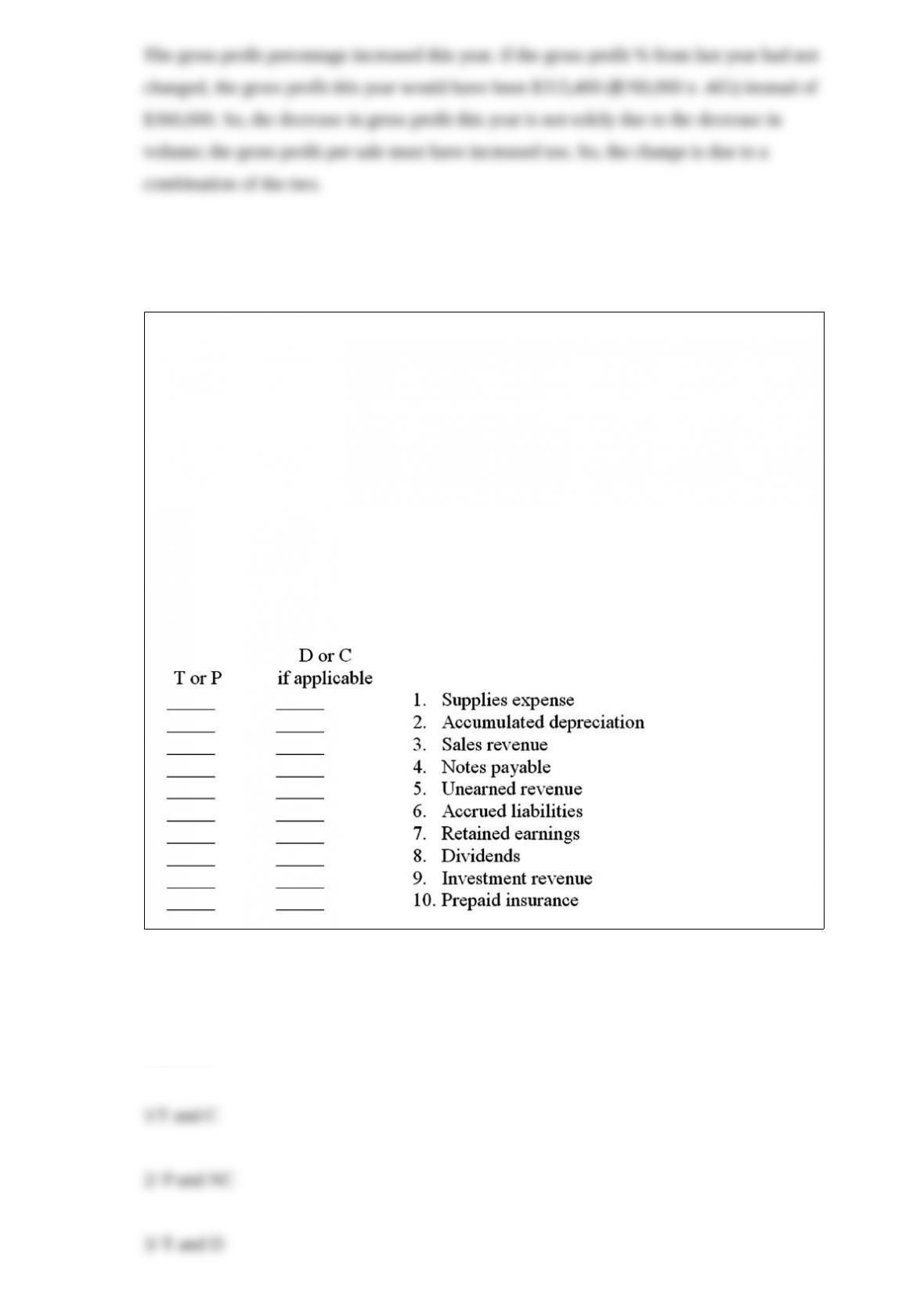
Match each of the following accounts to the term that identifies its nature – temporary
or permanent. If temporary, indicate whether the account would be closed with a debit
or a credit, or not closed.
P – permanent account
T – temporary account
D – close account with a debit
C – close account with a credit
N – not closed
Answer:

Answer:
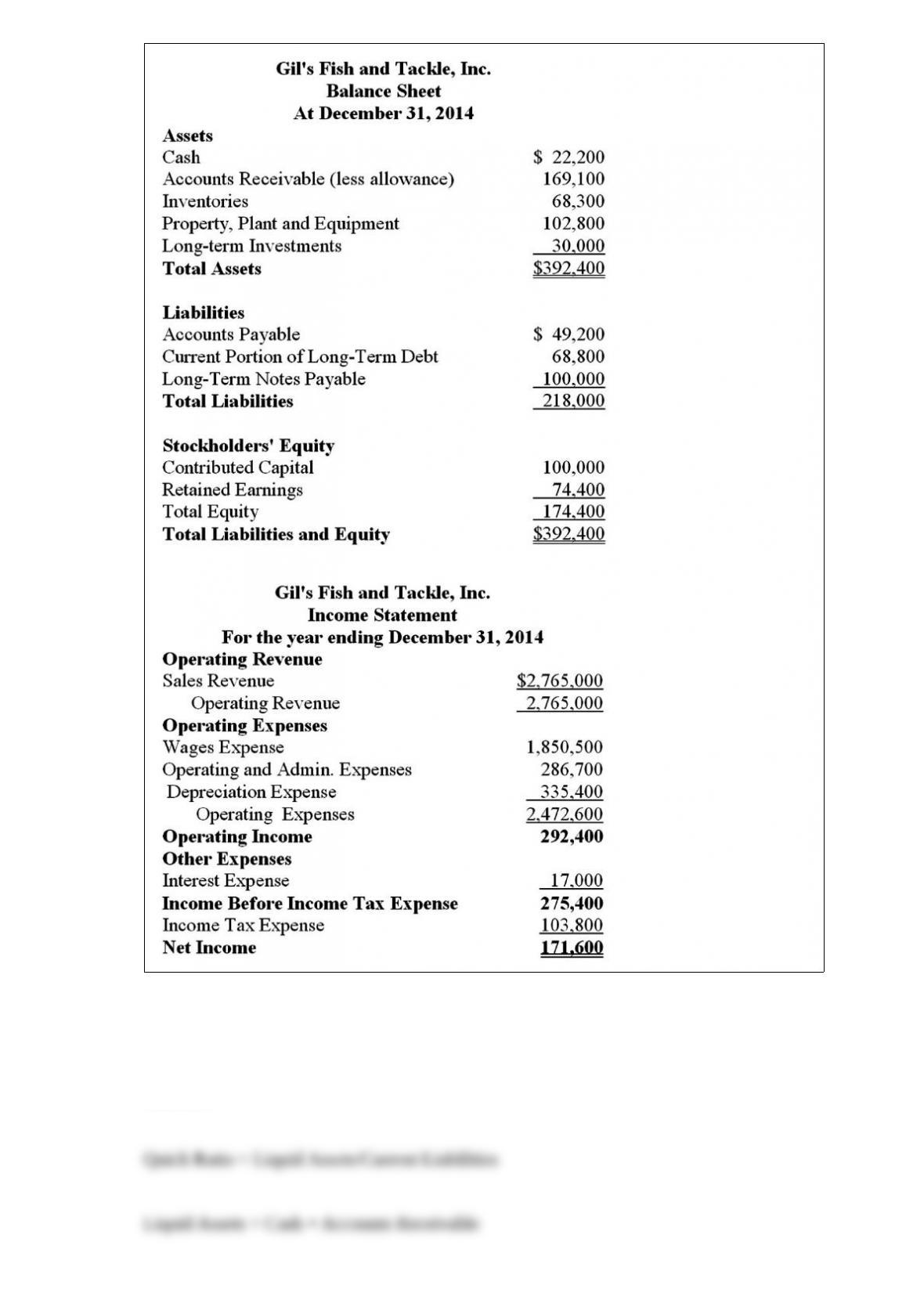
Calculate the quick ratio and the times interest earned ratio for Gil’s Fish and Tackle,
Inc. Comment on the company’s ability to pay its current liabilities and cover interest
payments on debt.
Answer:
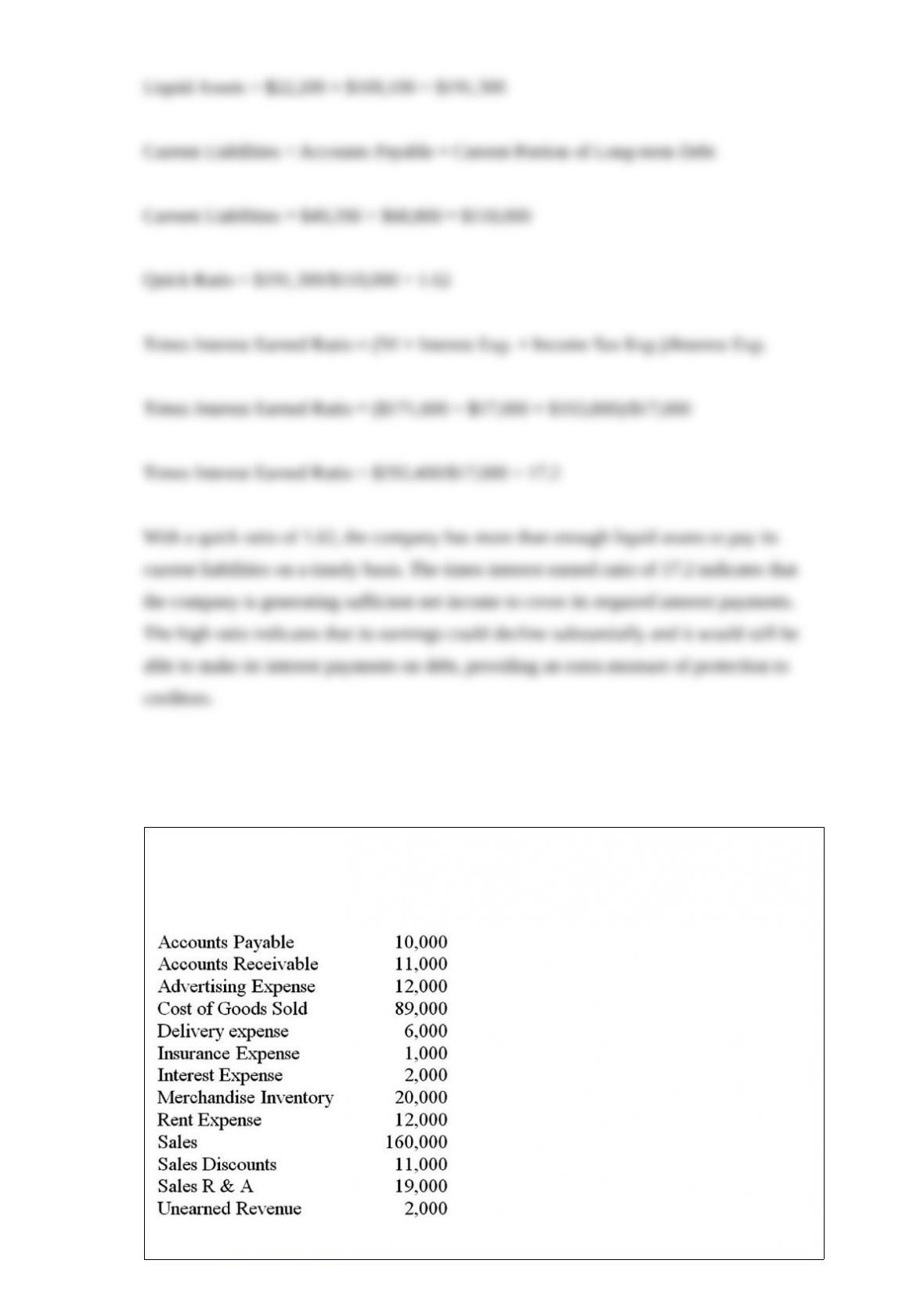
The following is a listing of some of the balance sheet accounts and all of the income
statement accounts for Mulberry Street Sportswear as they appear on the 12/31/14
adjusted trial balance.
A) Prepare a multi-step income statement for 2014 for Mulberry Street Sportswear.
B) Compute the gross profit percentage for 2014 for Mulberry Street Sportswear.
Answer:
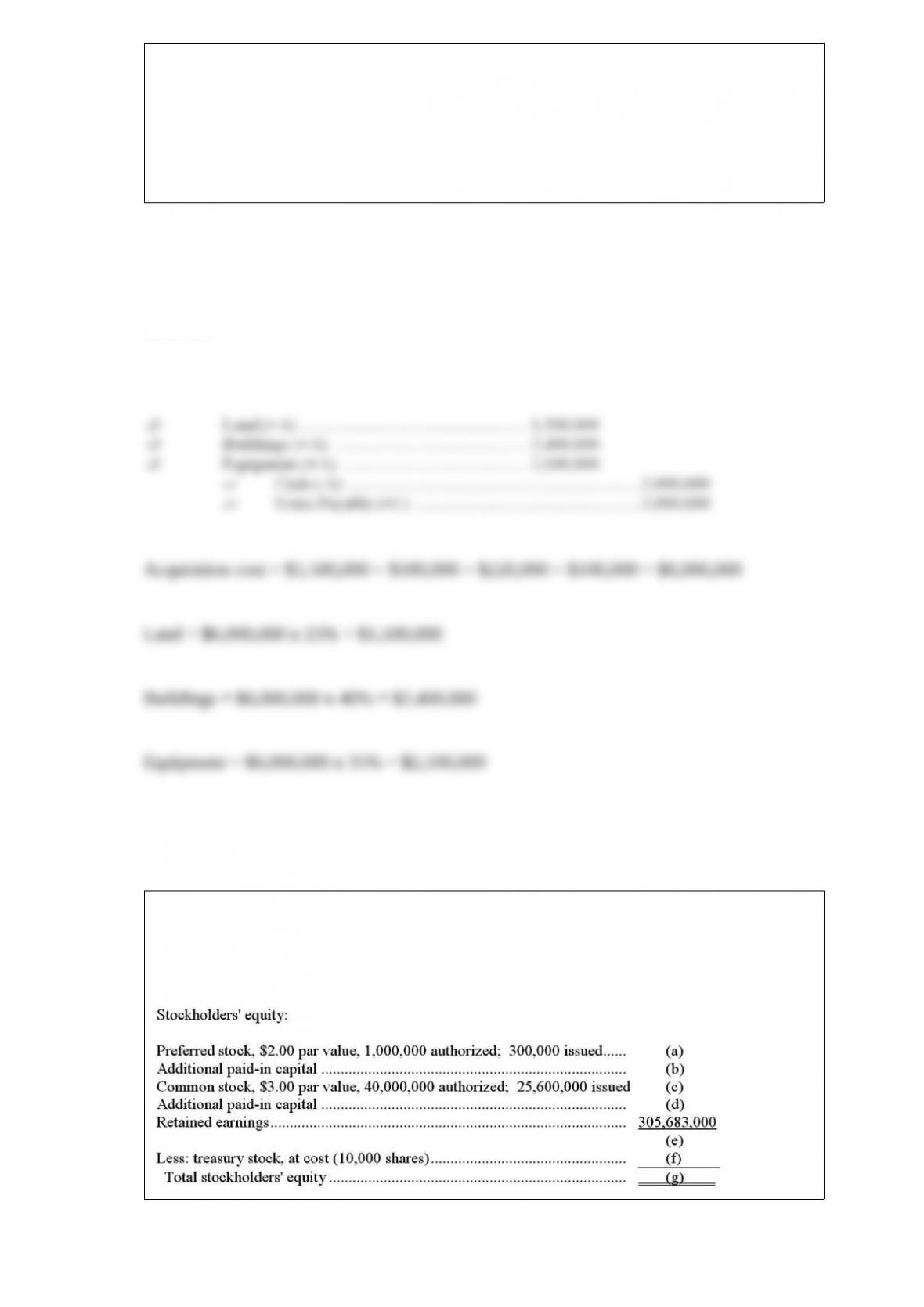
A company purchases property that includes land, buildings and equipment for $5.5
million. The company pays $180,000 in legal fees, $220,000 in commissions, and
$100,000 in appraisal fees. The land is estimated at 25%, the buildings are at 40%, and
the equipment at 35% of the property value. Prepare the journal entry that is required to
record the purchase assuming that the company paid 50% of the amounts using cash
and signed a note for the remainder.
Answer:
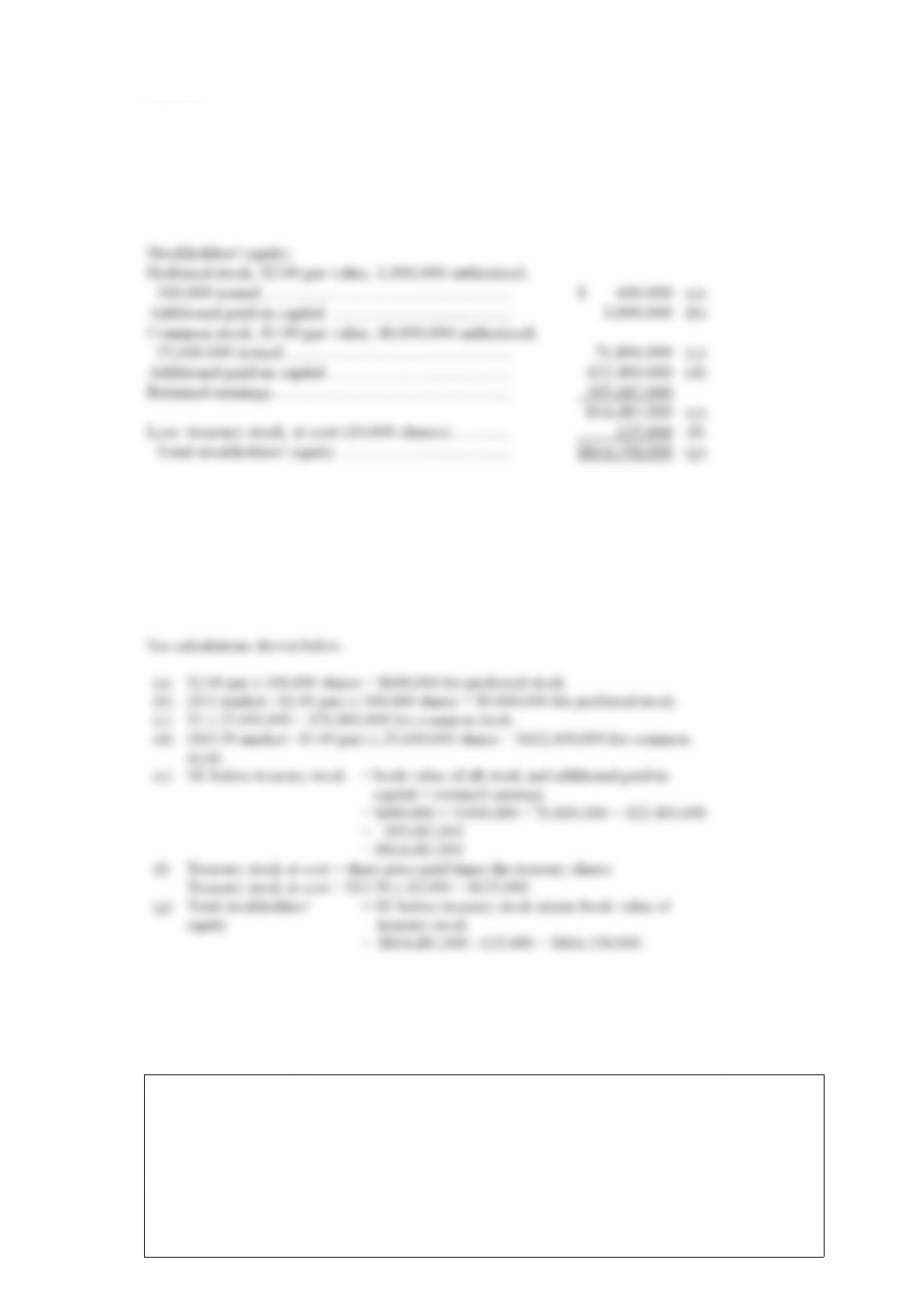
The market price of a share of common stock at the time of issuance was $19.50, while
the market price of a preferred share of stock at the time of issuance was $32. The
company paid $12.50 for its treasury stock. Fill in the missing stockholders’ equity
information below.
Answer:
For each of the following, indicate the effect the situation would have on net income in
the current period.
O overstate net income
U understate net income
N/A not applicable; no effect on net income
_____ 1/ recording prepaid costs as current expenses.
_____ 2/ recording an expense at more than the actual cost.
_____ 3/ failing to record the receipt of a payment by a customer on account.
_____ 4/ failing to record some supplies received.
_____ 5/ recording unearned revenue as revenue.
_____ 6/ recording an expense as revenue.
_____ 7/ failing to record the company issuing additional shares of its own common
stock.
Answer:
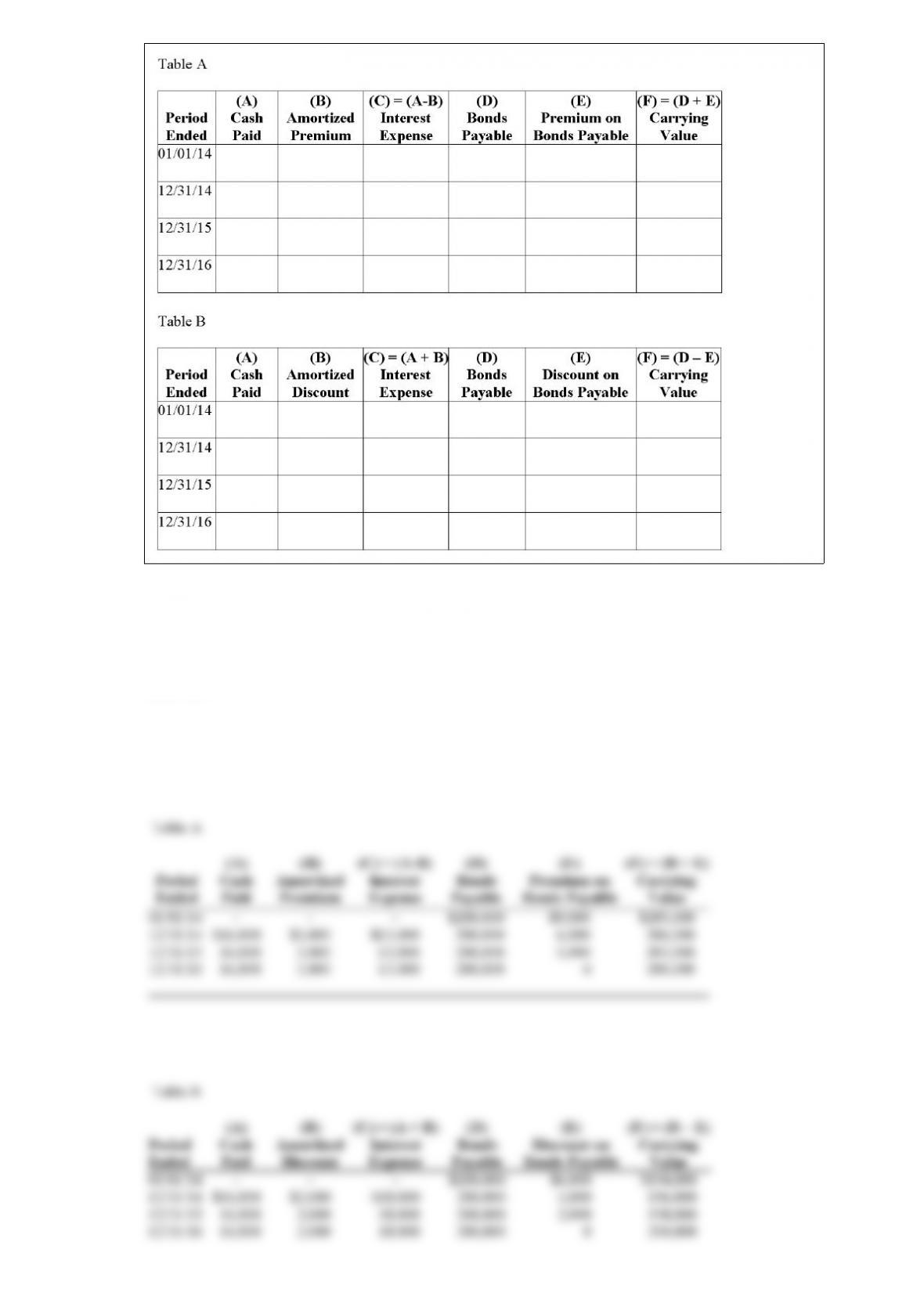
On January 1, 2014, a company sells a 3-year bond with a face value of $200,000 and a
stated interest rate of 8%. Because the market interest rate is lower, the company
receives $209,000 for the bond. Fill in Table A assuming the company uses the
straight-line method of amortization. Fill in Table B assuming the company received
only $194,000 for the bond and used the straight-line method of amortization.
Answer:
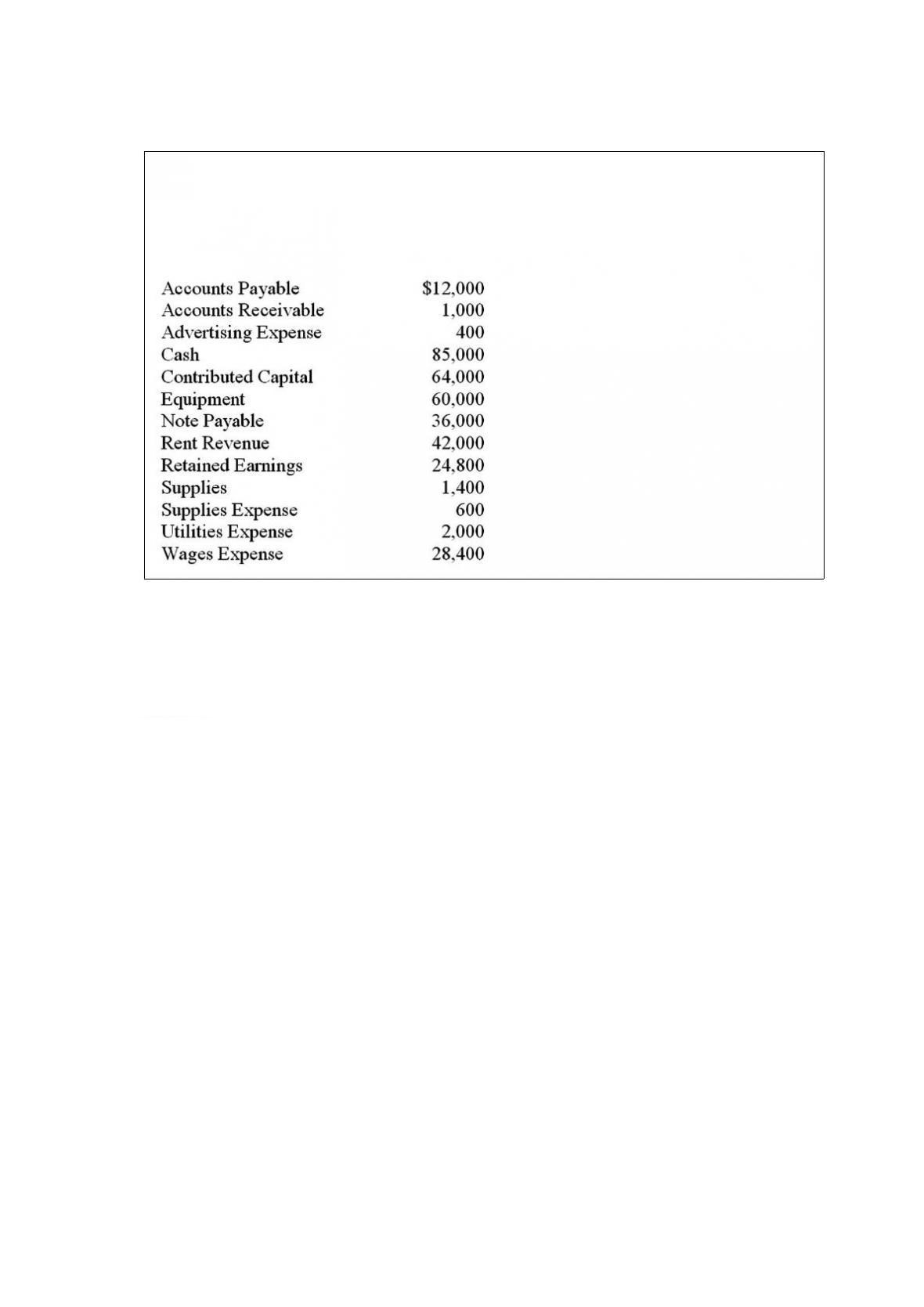
At September 30, Balance Corporation reported the following unadjusted amounts for
its accounts, each of which is considered to be a “normal” balance. That is, an account
that normally has a debit balance actually does have a debit balance. Prepare an
unadjusted trial balance.
Answer:

Identify whether a company should debit (Dr) or credit (Cr) its Cash account to record
each of the following transactions:
_____ 1/ The company writes a $197.06 check.
_____ 2/ The company deposits a $5,000 check into its account.
_____ 3/ In a bank reconciliation, the company discovers that it recorded a $127.35
payment to a supplier as $27.35.
_____ 4/ The bank pays $16.00 interest on the company’s account.
_____ 5/ The company electronically transfers $867 to a supplier.
_____ 6/ A customer check in the amount of $31 is returned by the bank as NSF.
_____ 7/ The bank charges $12 in fees to the company’s bank account.
_____ 8/ When preparing the bank reconciliation, the company’s accountant discovers a
check in the amount of $1,000 that had been written but had not been recorded.
_____ 9/ A customer electronically transfers $189.43 to the company’s bank account.
Answer:
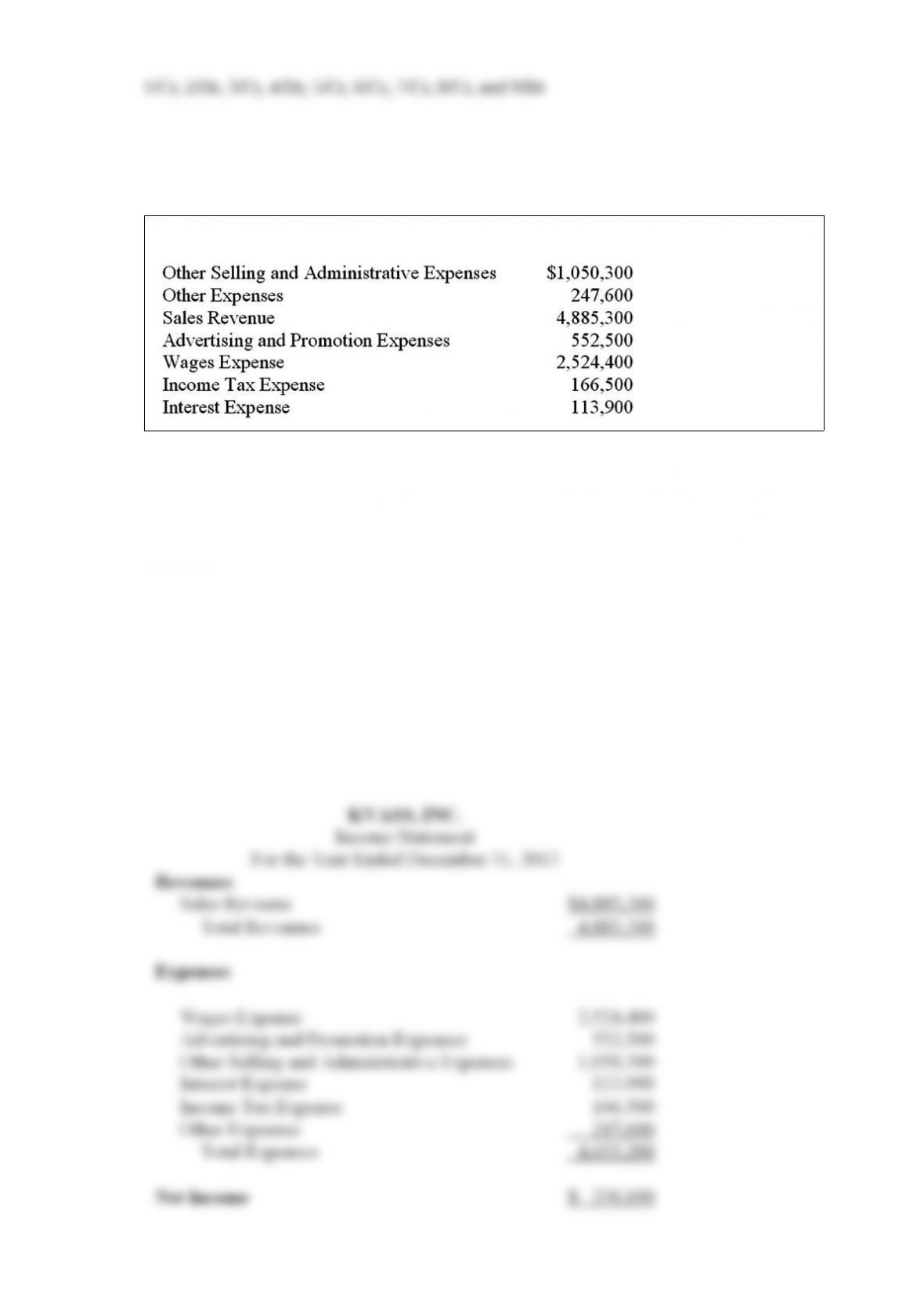
Use the following 2013 data to prepare the annual income statement for Kvass, Inc.
Answer: