Which of the following costs are included in the “for cost accounting purposes”
classification?
A. Variable cost and fixed cost.
B. Direct cost and indirect cost.
C. Product cost and period cost.
D. Committed cost and discretionary cost.
If the market price of a bond exceeds its face amount:
A. the coupon rate is less than the market interest rate.
B. the coupon rate is more than the market interest rate.
C. the company’s ROI and working capital have been increasing over time.
D. the maturity rate has been declining.
Which of the following costs would be classified as a period cost?
A. production line maintenance costs.
B. advertising expense for the product.
C. plant electricity.
D. indirect labor.
April Corporation developed the following per-unit standards for its product: 2 pounds
of direct materials at $3.75 per pound. Last month, 2,000 pounds of direct materials
were purchased for $7,600. The direct materials price variance for last month was:
A. $3,800 favorable.
B. $200 favorable.
C. $100 unfavorable.
D. $200 unfavorable.

An item that cost $270 is sold for $360. The gross profit ratio for this item is:
A. 20%
B. 25%
C. 33.3%
D. 60% ($360 – $270)/$360 = 25%
For 2016, Skresso Co. reported $1.82 of earnings per share of common stock. During
2017, the firm had a 4% common stock dividend. The 2016 earnings per share to be
reported in the annual report for 2017 are:
A. $1.90
B. $1.82
C. $1.75
D. $1.70 $1.82/1.04 = $1.75 per share
Which of the following is an objective of financial reporting by business enterprises?
A. Financial reporting should provide assurance that all liabilities of business
enterprises will be paid.
B. Financial reporting should show the timing and amount of future cash dividends to
potential investors.
C. The primary focus of financial reporting is information about the assets of the entity.
D. Financial reporting should provide information about the economic resources of an
enterprise, the claims to those resources, and changes in those resources and claims to
them.
The payment of a current liability will:
A. decrease net income.
B. decrease working capital.
C. increase working capital.
D. not affect working capital.
Which of the following statements concerning repair and maintenance expenditures is
true?
A. Routine repair costs and preventive maintenance expenditures are capitalized as
assets in the period in which they are incurred.
B. For income tax purposes, most taxpayers would prefer to capitalize an expenditure
and depreciate the asset over time rather than expensing the expenditure and deducting
the entire amount in the year it is incurred.
C. Maintenance expenditures that extend the useful life and ∕or increase the salvage
value of an asset should be capitalized and depreciated over the asset’s remaining useful
life.
D. All repair and maintenance expenditures are accounted for as expenses in the year in
which they are incurred.
A sunk cost is a cost that:
A. has been incurred and cannot be eliminated.
B. is never relevant in decision-making.
C. is never a differential cost.
D. all of the above.
At the beginning of the year, paid-in capital was $164 and retained earnings was $94.
During the year, the stockholders invested $48 and dividends of $12 were declared and
paid. Retained earnings at the end of the year were $104.
Total stockholders’ equity at the end of the year was:
A. $164
B. $188
C. $212
D. $316
Which of the following is not a principal category of “Other operating expenses”
frequently reported on the income statement?
A. Cost of goods sold
B. Selling expenses
C. General and administrative expenses
D. Research and development expenses
The Statement of Changes in Stockholders’ Equity shows:
A. the change in cash during a year.
B. revenues, expenses, and liabilities for the period.
C. net income and dividends for the period.
D. paid-in capital and long-term debt at the end of the period.
When a company issues a bond at a premium:
A. the company is more profitable than most companies in its industry.
B. investors perceive the bond to be a very safe investment.
C. the company’s interest expense will be less than the interest paid each year.
D. the company’s interest expense will be more than the interest paid each year.
Spike Jones owns 112 shares of the Robust Corporation’s stock. Robust announces a
3-for-2 stock split. How many shares will Fred have after this split?
A. 356 shares.
B. 224 shares.
C. 168 shares.
D. 112 shares
For a firm that presently has a current ratio of 2.0, the effect on this ratio of paying a

current liability is that it:
A. raises the current ratio.
B. lowers the current ratio.
C. doesn’t affect the current ratio.
D. depends on the amount paid.
Current U.S. Generally Accepted Accounting Principles and auditing standards require
the financial statements of an entity for the reporting period to include:
A. Earnings and gross receipts of cash for the period.
B. Projected earnings for the subsequent period.
C. Financial position at the end of the period.
D. Current fair values of all assets at the end of the period.
When analyzing end of period production cost variances, which of the following
product cost components will not need “flexing”?
A. direct material.
B. direct labor.
C. variable manufacturing overhead.
D. fixed manufacturing overhead.
Which of the following is true regarding bond discounts and/or premiums?
A. Bond discount is amortized but bond premium is not.
B. Bond premium is amortized but bond discount is not.
C. Neither bond discount nor premium is amortized.
D. Both bond discount and premium are amortized.
“Accumulated other comprehensive income (loss)” includes each of the following items

except:
A. cumulative foreign currency translation adjustments.
B. amounts received from the sale of additional common stock during the year.
C. unrealized gains or losses on available-for-sale investments.
D. gains on certain derivative instruments.
Accounting can be defined as:
A. the process of preparing and auditing an entity’s financial statements.
B. the process of identifying, measuring, and communicating economic information
about an organization for the purpose of making decisions and informed judgments.
C. the process of communicating the financial results of corporate activities to investors
and regulatory bodies.
D. None of the above definitions are correct.
E. A, B and C are correct.
The financial leverage characteristic of long-term debt results in:
A. a reduction of the risk that creditors will not be paid.
B. a magnification of ROE relative to what it would be without long-term debt.
C. a magnification of ROI relative to what it would be without long-term debt.
D. the deductibility, for income tax purposes, of dividends to stockholders.
The liability for product warranty claims is an example of a liability that:
A. has been calculated using estimates.
B. has been recorded in the process of matching revenue and expense.
C. also resulted in a reduction of net income.
D. all of the above.

Managerial accounting, as compared to financial accounting:
A. must conform to GAAP.
B. places a great deal of emphasis on historical transactions.
C. uses frequent and prompt control reports.
D. focuses on information prepared for the investors and creditors.
Book value per share of common stock of a manufacturing company:
A. is not a very useful measure most of the time.
B. is calculated by dividing market value per share by earnings per share.
C. reflects the fair value of the company’s stock.
D. is the same as the total balance sheet asset value per share of common stock.
The price/earnings ratio:
A. is a measure of the relative expensiveness of a firm’s common stock.
B. does not usually change by more than 1.0 (e.g. 8.2 to 9.2) during the year.
C. can be used to determine the cash dividend to be received during the year.
D. is calculated by dividing the earnings multiple by net income.
A. is a measure of the relative expensiveness of a firm’s common stock.
B. does not usually change by more than 1.0 (e.g. 8.2 to 9.2) during the year.
The effect of an adjustment on the financial statements is usually to:
A. make the balance sheet balance.
B. increase net income.
C. increase the accuracy of both the balance sheet and income statement.
D. match revenues and assets.
When a firm uses the LIFO inventory cost flow assumption:
A. cost of goods sold will be greater than if FIFO were used.
B. net income will be greater than if FIFO were used.
C. cost of goods sold will be the same as if FIFO were used.
D. better matching of revenue and expense is achieved than under FIFO.
Management salaries are an example of a ____________ cost behavior pattern.
A. variable
B. semivariable
C. fixed
D. mixed
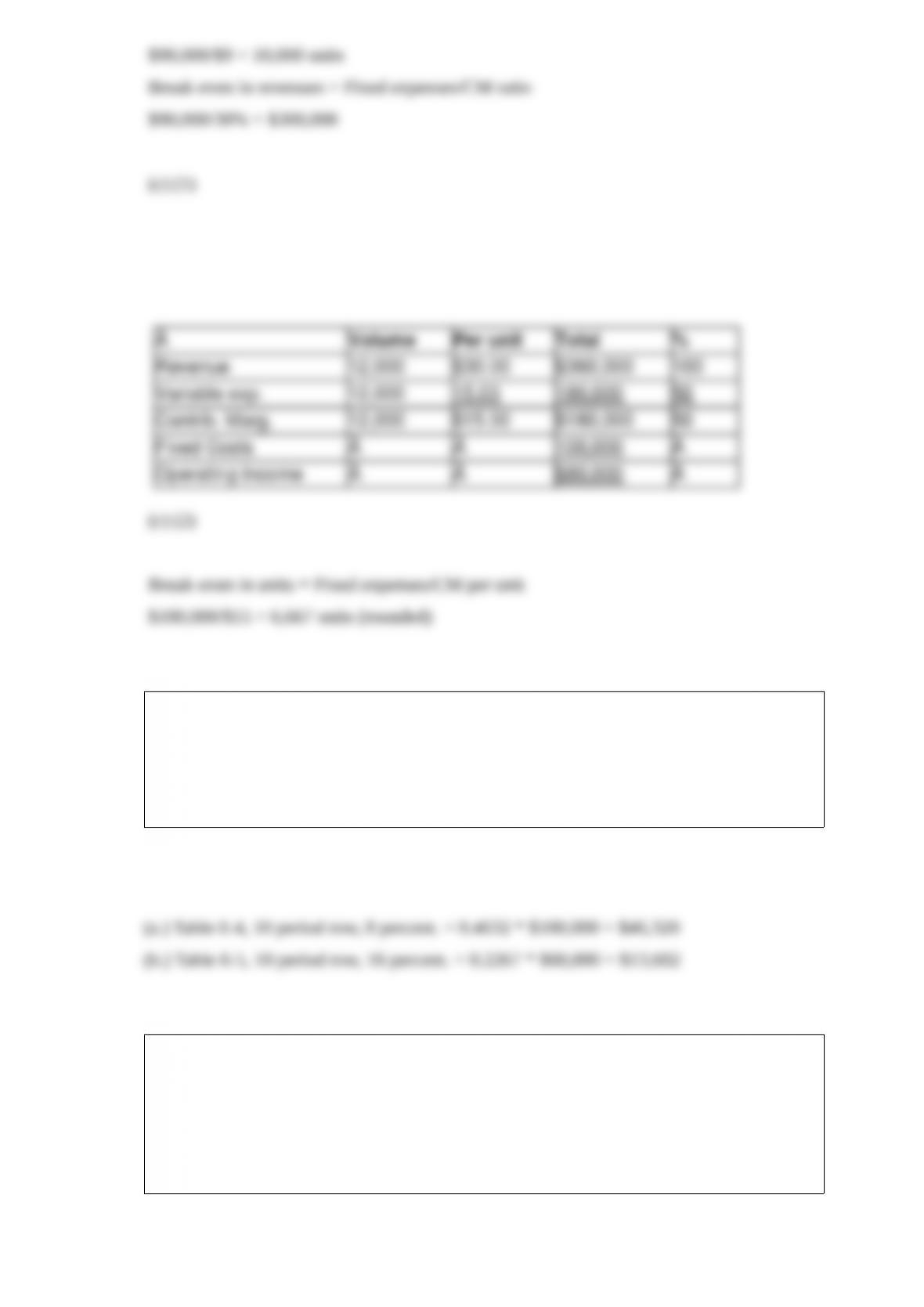
Preppy Co. makes and sells a single product. The current selling price is $30 per unit.
Variable costs are $21 per unit, and fixed expenses total $90,000 per month. Sales
volume for July totaled 12,000 units.
a. Calculate the operating income for July.
b. Calculate the break-even point in units sold and total revenues.
c. Management is considering the use of automated production equipment. If this were
done, variable costs would drop to $15.00 per unit, but fixed expenses would increase
to $100,000 per month.
(1.) Calculate operating income at a volume of 12,000 units per month with the new
cost structure.
(2.) Calculate the break-even point in units with the new cost structure
Use the appropriate factors from Table 6-4 or Table 6-5 to answer the following
questions.
(a.) What is the present value of $100,000 in ten years using a discount rate of 8%?
(b.) How much should be invested today at a return on investment of 16% compounded
annually to have $60,000 in ten years?
The major difference between the indirect and the direct method of a statement of cash
flows appears in which of the following activities section(s)?
A. The investing activities and financing activities sections.
B. The investing activities section only.
C. The operating activities and financing activities sections.
D. The operating activities section only.
Cost of Goods Manufactured can be computed as:
A. ending balance of work in process + raw materials used + direct labor costs incurred
+ manufacturing overhead costs applied – beginning balance of work in process.
B. beginning balance of work in process + raw materials purchased + direct labor costs
incurred + manufacturing overhead costs applied – ending balance of work in process.
C. ending balance of work in process + raw materials purchased + direct labor costs
incurred + manufacturing overhead costs applied – beginning balance of work in
process.
D. beginning balance of work in process + raw materials used + direct labor costs
incurred + manufacturing overhead costs applied – ending balance of work in process.