
Recording ongoing behaviors that may continue for several intervals is known as
whole-interval recording.
Prompts are offered before an SD is presented and failed to occasion a response.
In terms of making the closest representation of the actual occurrence of a behavior,
time sampling is the most exact.
When teaching a student to perform a new behavior, it is NOT necessary to teach every
example of a response class that we want students to perform.

The existence of a functional relation can be determined through use of a multiple
baseline design. False
According to the psychoanalytic theory, most people fixate at a certain stage thus
becoming overeaters, smokers, verbally abusive and/or anal-retentive.
Behavior analysis has the power to remove the ability of the individual to choose
alternative responses.
Shaping is used to teach behaviors not currently in students’ repertoires.
The Gestalt psychology cognitive explanation for behavior meets the criterion of
inclusiveness, predictive utility, and parsimony for explaining behavior.
Procedures tell students how they should behave.
Discuss the guidelines for providing an effective prompt.
The method of data collection that provides the most accurate record of how long a
behavior occurs is duration recording.
The basic AB design does not provide for the replication within an experiment that
establishes a functional relation between the independent and dependent variables.
An unexpected event is often referred to as a confounding variable.
A single subject design will provide information concerning which reading series to use
in the second grade.
Informal assessment is the most effective way to gather data for a functional analysis.
John Watson first distinguished operant from respondent conditioning.
When using backward chaining, the last component is taught first, and other
components are added one at a time.
Even inaccurate self-recording may result in a student’s positive behavior change.
Response-coast may maximize a student’s fear of failure.
A generalized response is one that occurs after instruction has been terminated.

Gestalt psychology emphasizes that learning is a process of imposing structure on
perceived information.
The physical arrangement of the classroom is an important component of establishing
stimulus control.
Behavior rating scales are instruments designed to obtain more qualitative information
from informants.
The term “behavior modification” refers ONLY to procedures derived from the
experimental analysis of human behavior.
A measure of response accuracy (e.g., 8 out of 10 correct) represents the acquisition
level of response competence.
Anecdotal reports can enable teachers to determine what factors in the classroom are
occasioning or maintaining appropriate and inappropriate behaviors.
Biophysical explanations of behavior include theories based on genetic or hereditary
factors.
The period between the presentation of a discriminative stimulus and the initiation of a
response is called the latency period.
Self management procedures are unnatural.
Negative reinforcement may be defined as the contingent presentation of an aversive
stimulus immediately following a response that increases the future rate of the response.

The best person to manage a student’s behavior is:
a. The teacher
b. The student
c. A school administrator
d. A peer
Mike’s job coach was concerned with his production on the job site. Mike had mastered
the assembly skills but was having difficulty keeping up with the competitive job
production of his coworkers. Mike’s job coach should work on which of the following?
a. Acquisition
b. Fluency
c. Generalization
d. None of the above
The Relevance of Behavior Rule states that:
a. If teachers can generate behaviors that are reinforced by the natural environment, a
situation equivalent to catching a mouse in a trap will be created.

b. The more relevant the behavior, the more likely the student will be to acquire the
behavioral skill.
c. There is seldom a behavior that is performed exactly the same way in exactly the
same place.
d. It is not always necessary to employ identical procedures to obtain stimulus
generalization or maintenance.
All of the following are reasons for identifying the target behavior in the behavioral
objective EXCEPT:
a. consistency in behavior observation
b. required by law
c. facilitates continuity of instruction
d. confirmation by a third party
Facilitation of transfer and maintenance of behaviors to reinforcement contingencies in
the natural environment may be facilitated by:
a. training students to avoid interfering reinforcers available
b. avoiding behaviors that are subject to trapping

c. teaching students to recognize reinforcement when given
d. training in a single natural environment
In _____________, students report an occurrence of their behavior.
a. self-recording
b. self-evaluation
c. self-reinforcement
d. self-instruction
Which of the following influenced the behaviorist movement?
a. cognitivism
b. functionalism
c. constructivism
d. none of the above

Duration data are collected:
a. from the time the teacher gives a performance direction until the student begins to
perform the response
b. from the time the student begins the response until he or she completes the response
c. from the time the teacher gives a performance direction until the student completes
the response
d. none of the above
John was scheduled to take a spelling test each Friday. His mother told him if he
received 90% correct or better for three out of four spelling test he would get to buy a
new video game. His mother was employing which of the following behavioral
techniques?
a. punishment
b. negative reinforcement
c. shaping
d. positive reinforcement
When a teacher requires a student to perform all the steps in sequence until the entire
task is mastered, she is using what instructional technique?
a. Backward chaining
b. Forward chaining
c. Total task presentation
d. Behavioral chaining
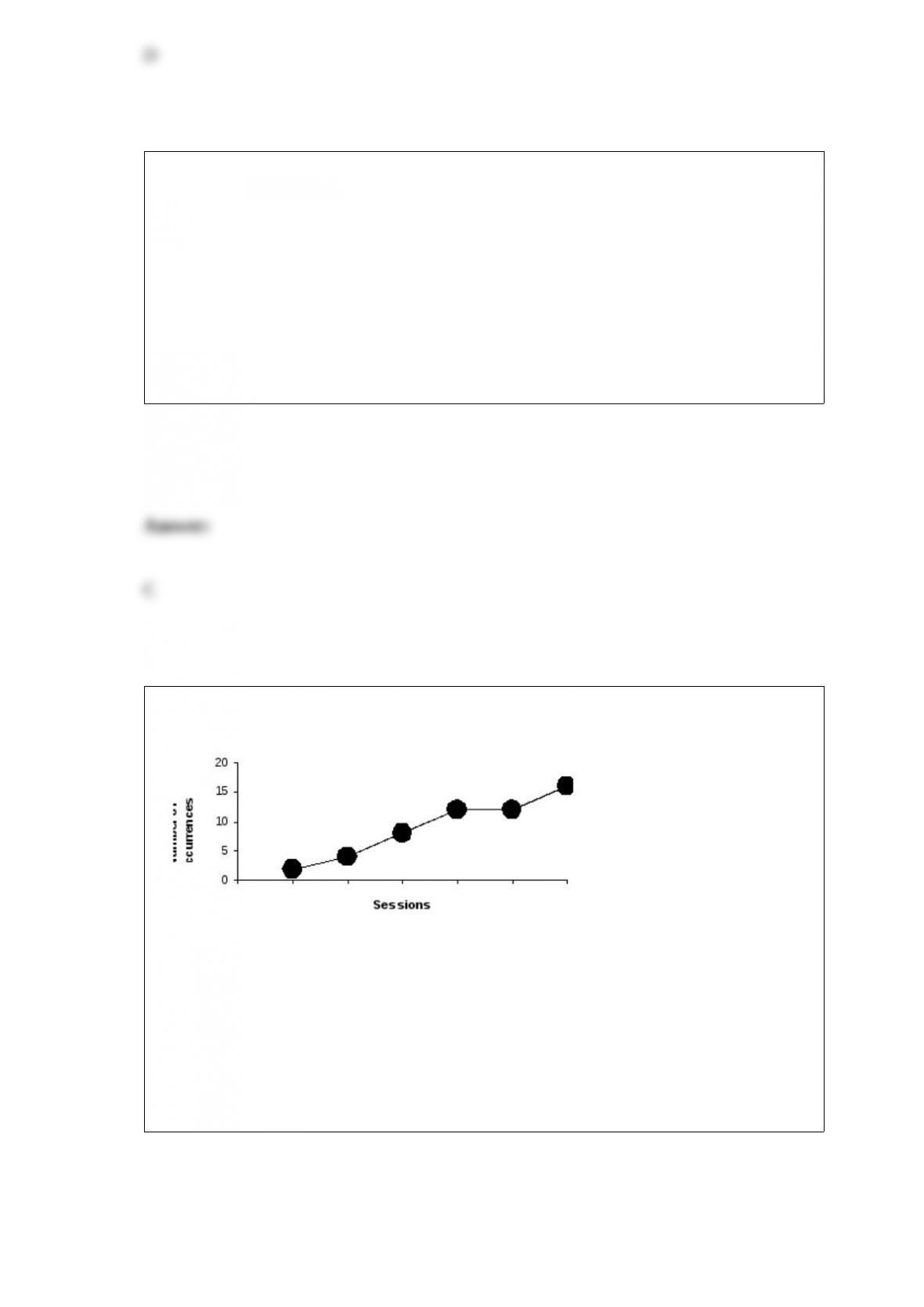
Based on the graph, what type of data collection system was employed?
a. event recording
b. interval recording
c. time sampling
d. duration

What kind of prompt is being used in the following example: Miss Elkhart
physically demonstrates for Brandon how to open the microwave oven.
a. Visual Prompt
b. Modeling
c. Verbal Prompt
d. Physical Guidance
All of the following reduce behavior by removing a desired stimulus EXCEPT:
a. time out
b. response cost
c. contingent observation
d. noncontingent reinforcement

A “therapeutic environment” is always:
a. safe, humane, and responsive to individual needs
b. the general education classroom
c. the setting providing the fewest distractions thus providing greater effectiveness of
behavioral strategies
d. all of the above
Quantitative measures of topography include all EXCEPT:
a. frequency
b. duration
c. percentage of intervals during which a behavior occurs
d. degree of malice involved
Jennifer learns to discriminate between hot and cold by operating the sink controls in
the science lab. She has maintained 100% accuracy on this skill over several weeks.
When she has to wash her hands in the restroom at Burger Barn next week, it is
anticipated that she will independently use the water controls. The generalization
technique being used here is:

a. Train Loosely
b. Train and Hope
c. Use Indiscriminable Contingencies
d. Program Common Stimuli
When constructing a graph, behavior is plotted along the:
a. x axis
b. horizontal axis
c. vertical axis
d. abscissa
You are a lead teacher and several of the teachers you supervise have concerns about
the frequency with which they should collect student data. Discuss how often data
should be collected and what patterns, if any, the teachers should look for in the data?

Following the practice spelling test, students are asked to check their own results. This
is a form of:
a. Self-monitoring
b. Self-evaluation
c. Self-instruction
d. Self-punishment
Justin often attempts to jump off classroom chairs. His teacher decided to reduce the
behavior
by having him repeatedly jump off the classroom chair, while under close supervision.
This is an example of ___________.
a. restitutional overcorrection
b. positive-practice overcorrection
c. negative practice
d. response cost

Willis Middle School participates in a school wide positive behavior supports program.
Several students have been identified with repeated office referrals and suspensions.
These students would fall into which level of the three-tiered model of intervention?
a. universal
b. intensive
c. targeted
d. none of the above
To write effective objectives, the applied behavior analyst must
a. Broadly identify a target behavior for instruction
b. Define the instructional procedures to use for behavior change
c. Refine broad generalizations into specific, observable, measurable objectives
d. b & c only

Which of the following is NOT considered a secondary reinforcer?
a. paycheck
b. a gold star
c. verbal praise
d. a nap
When parents or teachers react to inappropriate behavior by offering a student various
items or activities until the inappropriate behavior stops, they risk maintaining the
inappropriate behavior with:
a. positive reinforcement
b. negative reinforcement
c. extinction
d. punishment

When you graph the number of occurrences of a behavior in a given session after
adding it to the number of occurrences of a prior session you are employing a:
a. cumulative graph
b. bar graph
c. line graph
d. histogram
The following data can be reported on a graph as the number or percent of total
behavioral occurrence
a. Interval and time sampling
b. Event
c. Permanent product
d. All of the above
The Premack Principle is the reinforcement system used most often by teachers. Which
of the following is an example of the Premack Principle?
a. If you stay outside for 10 more minutes, then you must do your entire math problems

b. If you finish all your work, then you may have free time for 10 minutes
c. If you are the line leader for today, then you must be quiet during study period
d. If you get a drink of water, then you must stay in your seat the rest of the day
Which of the following is NOT important to the consumers of education (students,
parents, community)?
a. goals
b. procedures
c. outcomes
d. standardized assessment instruments
Ms. Kirkland set up a picture schedule to transition students between activities. Once a
student completed an activity they compared their work to a picture of the task
completed. Ms. Kirkland’s students were engaged in _______________.
a. self-monitoring
b. self-instruction
c. self-reinforcement
d. none of the above
An “operational definition”:
a. clearly states the form of the behavior
b. identifies the criterion of a behavior
c. defines the condition for behavioral occurrence
d. describes the setting events
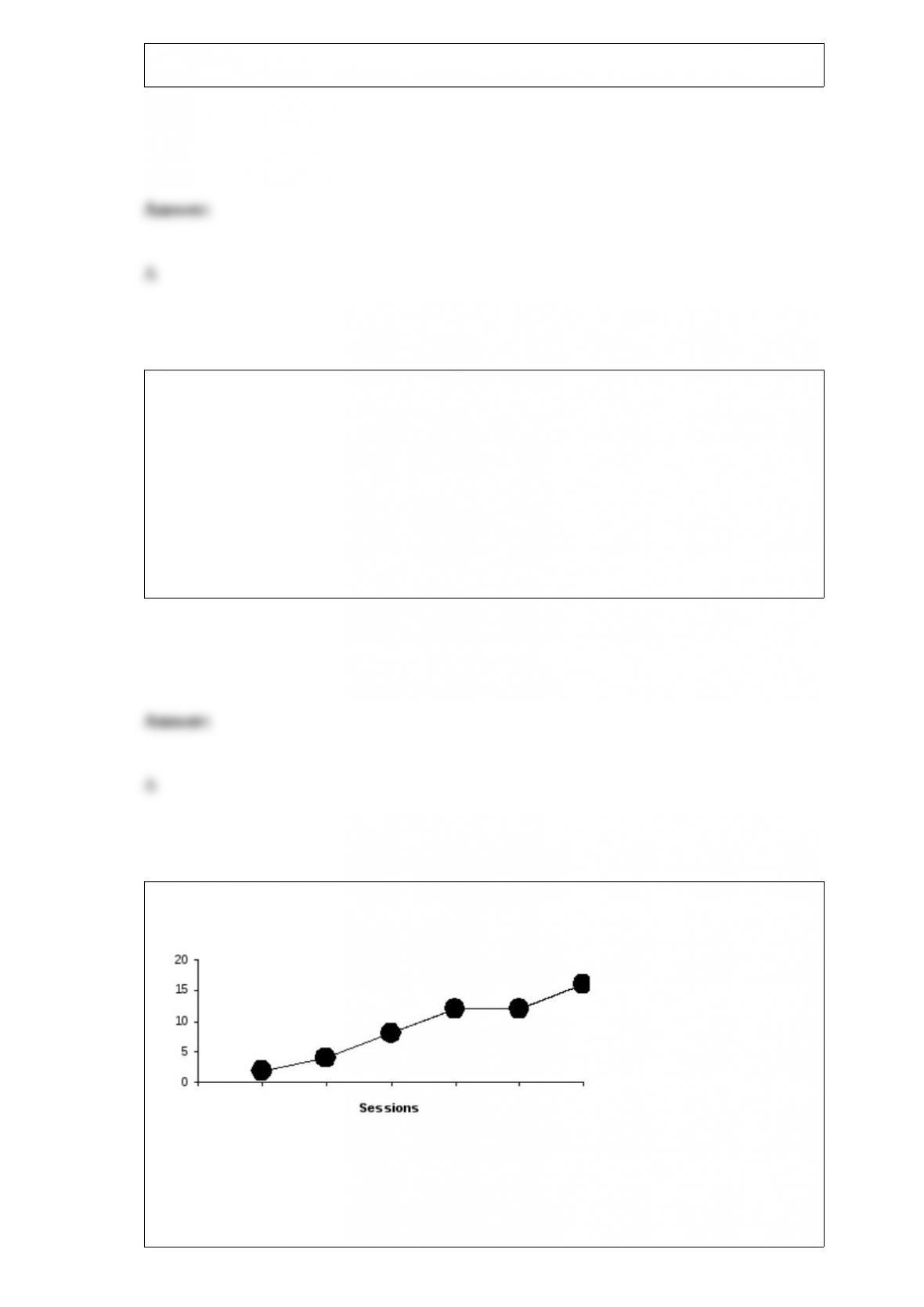
Which of the following is missing from the following graph?
Justin
a. student identification
b. ordinate label

c. data paths
d. abscissa
Behavioral objectives are
a. statements of annual program intent
b. statements of actual instructional intent
c. long term in nature
d. generically defined
When students escape from a task or environment by performing an inappropriate
behavior that behavior is likely to be maintained by:
a. positive reinforcement
b. negative reinforcement
c. extinction
d. punishment

Educational goals are
a. Statements of actual instructional intent
b. Statements of annual program intent
c. Usually 3 to 4 months long
d. The length of a grading period for students with mild disabilities
When an intervention like a token system works for all but one or two students in a
group, it is likely that:
a. those students are too seriously disturbed to respond
b. there is powerful competing reinforcers available outside the token system
c. the students’ home situation is so poor that their behavior is essentially unchangeable
d. those students will respond only to punishment
What are the steps a teacher needs to follow in developing and implementing a token
reinforcement system in his class?
Select one behavior concept discussed during this course, discuss the concept and
provide an example of the concept in the classroom setting.
Reinforcer sampling must be systematic. Describe a method of reinforcer sampling for
students with severe disabilities.
Discuss the advantages and disadvantages to using a multiple baseline design.
Define and give a rationale for social validity.
Briefly describe how trapping is used to promote generalization.
Discuss some of the guidelines for using aversive stimuli. What ethical considerations
must be made before aversives should be used?
There are four major procedures used to fade prompts. Name and briefly describe
ONE procedure. Be sure to include an example.
Discuss the possible conflict(s) between the philosophy of full inclusion and the ethical
use of applied behavior analysis procedures.
Define restitutional overcorrection and give an example.
Describe some opportunities for teaching generalization during community-based
instruction. Provide examples.
List the two primary reasons attributed to the success of self recording procedures in
assisting behavior change.
Select three behaviors and describe the topography of each.
Give an example of the use of a self reinforcement procedure.
Describe how teachers should be held accountable.
Compare and contrast each of the following experimental designs in relation to
establishing a functional relationship: reversal design, multiple baseline design, and
changing criterion design.
Three methods may be used to teach chains of behaviors. Name and briefly describe
ONE method. Be sure to include an example.