Chapter 18: Multivariate Data Analysis
Multiple Choice
1. What is multivariate analysis?
a. a procedure for managing large database systems.
b. synonymous with decision support analysis.
c. a group of statistical procedures used to analyze simultaneously multiple
measurements of the individual or object being measured.
d. the measurement procedure for monitoring how several marketing
variables function in multiple market situations.
2. This procedure is useful for analyzing the relationship among two or more
predictor/independent variables and one criterion/dependent variable.
a. multiple discriminant analysis
b. multiple regression analysis
c. conjoint analysis
d. cluster analysis
3. Which of the following would not be an application best suited for multiple
regression analysis?
a. estimating the relationship between various demographic and lifestyle
variables and the attitude toward a particular product
b. determining which variables best predict the sales of a particular product
or service
c. estimating the effect of several marketing mix variables on product sales
d. reducing a large number of potential predictor variables to a smaller set of
composite variables
235
Response: See page 545
Ref: Multivariate Software
Learning Objective 18.2: To describe multiple regression analysis and multiple
discriminant analysis.
4. The coefficient of determination is normally associated with which of the
following multivariate procedures?
a. multiple regression analysis
b. factor analysis
c. conjoint analysis
d. cluster analysis
5. Which of the following multivariate procedures does not include a dependent
variable in its analysis?
a. multiple regression analysis
b. cluster analysis
c. multiple discriminant analysis
d. None of the above procedures includes a dependent variable.
6. Which of the following techniques might be most useful in helping a restaurant
determine how to position itself in the marketplace?
a. factor analysis
b. multiple regression analysis
c. conjoint analysis
d. perceptual mapping
236
Learning Objective 18.1: To define multivariate data analysis.
7. A dependent variable is coded 1=respondent did purchase and 0=respondent did
not purchase. Independent variables include various demographic and lifestyle
characteristics of the respondents. The goal of the analysis is to determine how
respondents who did purchase are different from respondents who did not
purchase. Which of the following procedures goes with the preceding
description?
a. multiple discriminant analysis
b. multiple regression analysis
c. cluster analysis
d. perceptual mapping
8. A company that is trying to determine which 3 distinct target markets to focus its
marketing efforts on might use which statistical tool?
a. ANOVA
b. multiple regression analysis
c. cluster analysis
d. bivariate regression
9. Cluster analysis is particularly valuable for what type of marketing strategy?
a. product differentiation
b. positioning
c. segmentation
d. none of the above
237
10. Suppose an analyst wanted to determine whether or not dollars spent on
advertising, number of sales people, number of new products introduced, and
dollars spent on research and development were contributing to the growth in
company market share. Which of the following procedures would be most
appropriate?
a. conjoint analysis
b. cluster analysis
c. multiple regression analysis
d. perceptual mapping
11. Which of the following is not a step in conjoint analysis?
a. collecting trade-off data
b. estimating factor loadings
c. estimating preference structures
d. predicting consumers’ choice
12. An insurance company wants to know whether the subscribers to its HMO, PPO,
or traditional single indemnity plan exhibit better health characteristics. They
have the following data for each of their subscribers: % of body weight over
optimum weight; blood pressure; cholesterol and hours per week of exercise. The
analysis will group subscribers as either healthy, somewhat healthy or not healthy.
Which of the following would be the best procedure for making such a
determination?
a. factor analysis
b. multiple discriminant analysis
c. multiple regression analysis
d. cluster analysis
238
Ans: D
Difficulty: Medium
Response: See page 556
Ref: Cluster Analysis
Learning Objective 18.3: To learn about cluster analysis and factor analysis.
13. Summarizing a number of survey questions into a single concept could be
achieved with which type of analysis?
a. factor analysis
b. multiple discriminant analysis
c. multiple regression analysis
d. cluster analysis
14. If a product manager wanted to see how his company’s products are rated by
consumers against competing products across several dimensions, the best
procedure would be:
a. conjoint analysis.
b. multiple regression analysis.
c. perceptual mapping.
d. cluster analysis.
15. Which of the following techniques is often used for concept testing of new
products?
a. conjoint analysis
b. multiple regression analysis
c. perceptual mapping
d. cluster analysis
239
Ref: Factor Analysis
Learning Objective 18.4: To develop an understanding of conjoint analysis.
16. ______________ is a measure of the percentage of the variation in the dependent
variable that is explained by the variation in the independent variables.
a. Discriminant weights
b. Factor loadings
c. Coefficient of determination
d. Coefficient of correlation
17. Dummy variables created to include nominally scaled variables in an analysis are
commonly used in:
a. multiple discriminant analysis.
b. factor analysis.
c. conjoint analysis.
d. multiple regression analysis.
18. Independent variables are important components in multiple regression analysis
and ________________.
a. multiple discriminant analysis
b. factor analysis
c. conjoint analysis
d. cluster analysis
240
Learning Objective 18.2: To describe multiple regression analysis and multiple
discriminant analysis.
19. Which of the following is multiple discriminant analysis most similar to?
a. multiple regression analysis
b. factor analysis
c. conjoint analysis
d. cluster analysis
20. Cluster analysis produces mutually exclusive and exhaustive groups such that the
individuals or objects grouped are ______________ within and ______________
between groups.
a. homogeneous; heterogeneous
b. homogeneous; homogeneous
c. heterogeneous; homogeneous
d. heterogeneous; heterogeneous
21. If the goal is to classify business travelers into distinct groups based on their
responses to 20 questions on preferences to mode of transportation, hotel
accommodation, and ethnic food, which of the following techniques would be
most appropriate?
a. multiple regression analysis
b. conjoint analysis
c. cluster analysis
d. factor analysis
241
Learning Objective 18.3: To learn about cluster analysis and factor analysis.
22. The purpose of factor analysis can be best described as:
a. data simplification by summarizing the information contained in a large
number of variables into summary measures.
b. presenting the relationship between multiple categorical measures in a
low-dimensional diagram.
c. assessing the significance of group differences across many metric
dependent variables simultaneously.
d. assessing the degree of correlation of a group of categorical measures.
23. In a perceptual map, the brands that are closer to each other are perceived to be
_____________ and the brands that are farther apart are perceived to be
_____________.
a. similar; different
b. similar; in direct competition
c. in direct competition; equal in performance
d. different; in direct competition
24. This analytical technique helps determine what features a new product or service
should have and how it should be priced.
a. factor analysis
b. perceptual mapping
c. multiple discriminant analysis
d. conjoint analysis
25. In factor analysis, the correlation between factor scores and the original variables
is known as the factor ________,
a. loading
b. mapping
c. attribute rating
d. conjoint
26. All of the following are techniques for multivariate analysis procedure except
________.
a. Cluster analysis
b. Factor analysis
c. Conjoint analysis
d. Bivariate Regression analysis
27. Data mining typically involves four classes of task. Which is not one of the tasks?
a. Clustering
b. Classification
c. Numbering
d. Modeling
243
28. In the multiple regression formula, which of the following represents the
dependent variable?
a. Y
b. a
c. b1
d. X1
29. In the case of multiple regression analysis, the dependent variable must be
___________; in multiple discriminant analysis, the dependent variable
is__________ in nature.
a. Metric; nonmetric
b. Metric; nominal
c. Nominal; categorical
d. Categorical; nonmetric
30. Multivariate techniques analyze relationships between more than 2 variables.
31. In multiple regression analysis the dependent variable is nominal or categorical.
244
Ans: False
Difficulty: Medium
Response: See pages 544
Ref: Multivariate Software
Learning Objective 18.2: To describe multiple regression analysis and multiple
discriminant analysis.
32. If the goal of an analysis is to group respondents into mutually exclusive and
collectively exhaustive subgroups, the preferred procedure would be cluster
analysis.
33. Multiple regression analysis can group respondents into subgroups when there are
at least 4 classification variables.
34. The independent variables in multiple regression should not be correlated with
each other.
35. There is no dependent variable in a factor analysis.
245
Ref: Factor Analysis
Learning Objective 18.3: To learn about cluster analysis and factor analysis.
36. Multiple regression enables the researcher to show that two variables are causally
related.
37. In order to make valid comparisons of regression coefficients, the coefficients
must be scaled in the same units, or be standardized.
38. An analyst will always prefer that the R2 be close to zero.
39. The goal of factor analysis is to identify as many factors as possible.
40. Collinearity is a situation in which independent variables are heavily correlated
with each other.
41. Multiple discriminant analysis is useful when the dependent variable is metric.
42. Cluster analysis is useful for clustering groups of questions together into factors.
43. Perceptual mapping enables a company to see how its brand compares with others
in the minds of consumers.
44. If a company was interested in the impact that advertising and sales price had on
sales, cluster analysis would be an appropriate tool to use.
247
45. In multiple regression, the value of R2 is influenced by the number of predictor
variables relative to sample size.
46. Data mining does not draw upon statistics, artificial intelligence, database
management, and computer science to identify patterns in market data sets.
47. In factor analysis, naming factors is a somewhat subjective step, combining
intuition and knowledge of the variables with an inspection of the variables that
have high loadings on each factor.
Essay Questions
48. An analyst is trying to group together persons who attend theatre performances
and who prefer a dinner to accompany the theatre performance. Hence, the two
pieces of information are 1) frequency of attending theatre performances and 2)
preference for a dinner-theatre format. What type of analysis should be
undertaken to determine if those persons preferring the dinner-theatre format are
those who attend theatre performances more frequently?
248
49. An advertising agency has been doing work for a client selling widgets. The
three-month campaign has produced a low correlation between advertising
expenditures and sales for its client. Hence, the client is considering firing the ad
agency. The ad agency counters that consumer sales are not a fair assessment of
the effectiveness of the ad campaign after only three months. They counter with
an analysis of advertising expenditures in relation to number of requests for
information about the widgets; number of distributors stocking widgets; and
number of retailers requesting shipments of widgets. The ad agency has a
database with such information. What kind of analysis would best assist the ad
agency in making their case for the effectiveness of their ad campaign?
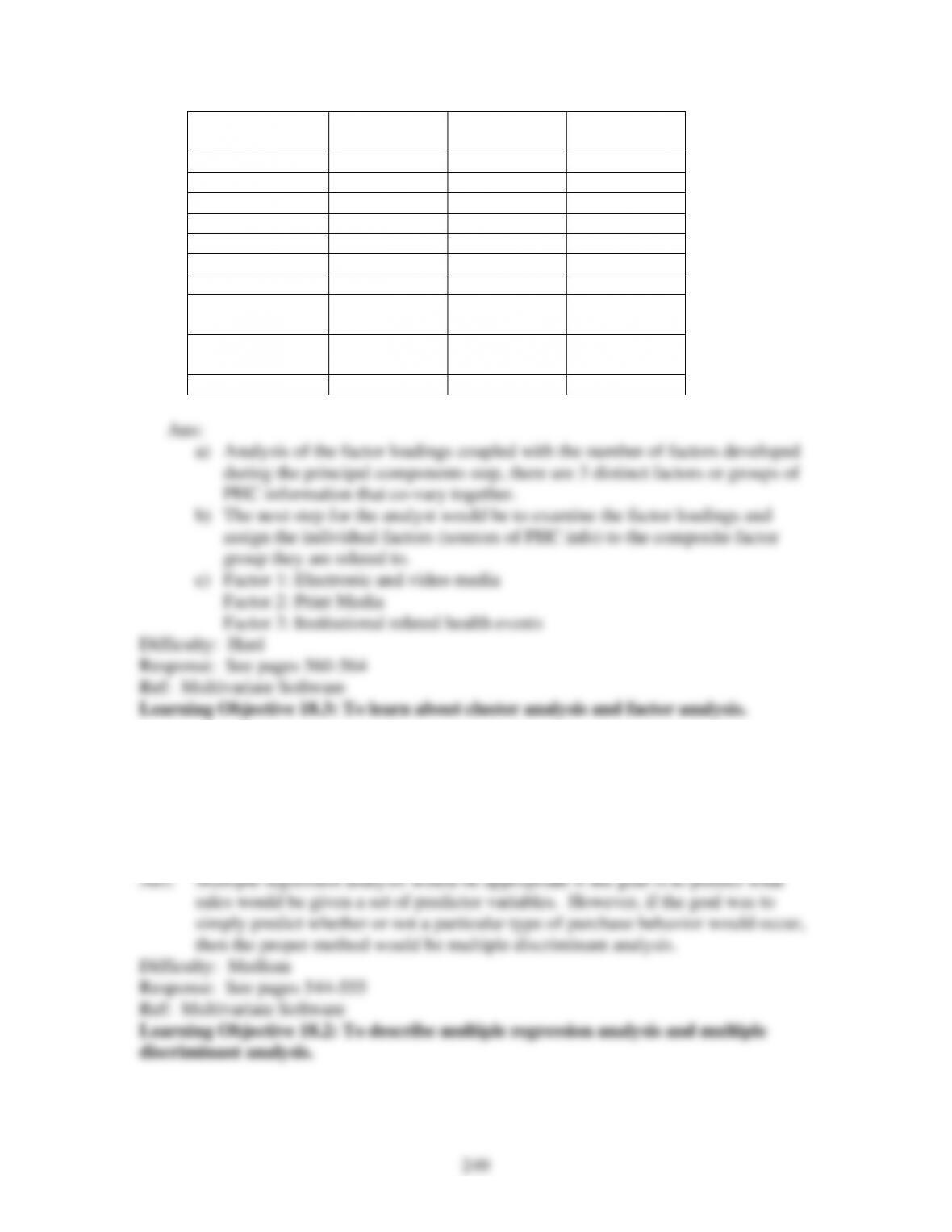
50. A client wanted to know which preventive health care information (PHC) sources
were related to each other. The following table has factor loadings for 10 types of
preventive health care information using a Varimax rotation. Based on the table
of results below, what would you tell your client?
Sources of PHC
information
Factor 1
Factor 2
Factor 3
Web MD
.88
.15
.23
Nutritional labels
.11
.67
.14
Health fairs
.25
.32
.88
Health magazines
.22
.74
.30
Health books
.43
.64
.31
Hospital seminars
.03
.21
.85
Television
.70
.31
.34
Wellness center
newsletters
.27
.70
.20
Medical
Encyclopedias
.33
.76
.31
Hospital websites
.72
.42
.19
51. A client has a data set that would be appropriate for a linear model. He wants the
resulting model to predict whether or not a person would buy a particular product.
The client has been advised that a multiple regression analysis would be the best
approach. What would you suggest?
52. Suppose a marketer was trying to predict the sales (Y) of a product for a given
level of advertising (X1) and sales performance (X2). The resulting output was as
follows:
Y = 2,300 + 34(X1) + 15.5(X2) with a R2 = .12
Given the above results, what would you suggest to the marketer?