Aggregate sales and operations planning occur in a company about every 3 to 18
months.
Answer:
Fixed-order quantity inventory models are “event triggered.”
Answer:
The smaller the capacity cushion the better.
Answer:
If the sum of the task times required to produce a product is 45 minutes and the cycle
time for the same product is 10 minutes. Thus, the theoretical minimum number of
workstations is 5 using the assembly-line balancing procedure.
Answer:
An example of an assemble-to-order firm is Dell Computer.
Answer:
The objective of strategic capacity planning is to determine the overall capacity level of
capital intensive resources (including facilities, equipment, and overall labor force size)
that best supports the company’s long-range competitive strategy.
Answer:
The central idea of supply chain management is to apply a total system approach to
managing the flow of information, materials, and services from raw material suppliers
through factories and warehouses to the end customer.
Answer:
Calculating the early start and early finish times for each activity in a CPM analysis
does not provide any useful information.
Answer:
Longest waiting time in line is a queue discipline discussed in the textbook.
Answer:
The probability of each occurrence at a decision tree chance node is the reciprocal of
the number of possibilities at the chance node.
FALSE
See the decision tree example in the text. This is only
Answer:
The essential issue in satisfying customers in the make-to-stock environment is to
balance the cost of the finished item against the willingness of the consumer to pay for
it.
Answer:
The time-phased plan specifying how many and when the firm plans to build each end
item is called the Materials Requirements Plan (MRP.)
Answer:
Machine breakdown and repair in a twelve machine factory having three repair
mechanics would develop which type of queuing system line structure concerning
machine breakdowns?
A. Single channel, single phase
B. Single channel, multiphase
C. Multichannel, single phase
D. Multichannel, multiphase
E. None of the above
Answer:
Which of the following is an improvement-driven reason for outsourcing?
A. Shorten cycle time
B. Improve effectiveness by focusing on what the firm does best
C. Increase product and service value by improving response to customer needs
D. Turn fixed costs into variable costs
E. Reduce costs through a lower cost structure
Answer:
Assuming no safety stock, what is the reorder point (R) given an average daily demand
of 78 units and a lead time of 3 days?
A. 421
B. 234
C. 78
D. 26
E. 312
Answer:
In acceptance sampling, the number of units in the sample (n) is determined by the
interaction of the acceptable quality level (AQL), the lot tolerance percent defective
(LTPD), the probability of rejecting a high quality lot (alpha) and the probability of
accepting a low quality lot (beta).
Answer:
The dimension of design quality that concerns secondary characteristics is which of the
following?
A. Features
B. Serviceability
C. Reliability
D. Reputation
E. Perceived quality
Answer:
Capacity planning involving consideration of production scheduling and inventory
position is characterized by which one of the following time durations?
A. Intermediate-range
B. Long-range
C. Short-range
D. Current
E. Upcoming
Answer:
Which of the following is not a characteristic that distinguishes services from goods?
A. Service jobs are unskilled.
B. A service is intangible.
C. Services are perishable
D. Services are heterogeneous
E. None of the above
Answer:
Which of the following are related to lean production?
A. A philosophy of waste elimination
B. Lean consumption
C. Never running out of inventory
D. The Wahei-Subaru method
E. Full use of capacity
Answer:
If annual demand is 6,125 units, annual holding cost is $5 per unit, and setup cost per
order is $50, which of the following is the EOQ lot size?
A. 350
B. 247
C. 23
D. 185
E. 78
Answer:
Which of the following are basic assumptions that justify an analysis of the costs of
quality?
A. Failures are caused
B. Prevention is more expensive
C. Performance can be learned
D. Rules of thumb don’t always work
E. Appraisal costs are less than prevention costs
Answer:
The dimension of design quality that concerns the sensory characteristics of the product
is which of the following?
A. Features
B. Serviceability
C. Perceived quality
D. Reputation
E. Aesthetics
Answer:
In the textbook Toyota’s Fujio Cho identified which of the following types of waste to
be eliminated?
A. Excess quality
B. Motion
C. Excess capacity
D. Underproduction
E. Excess demand
Answer:
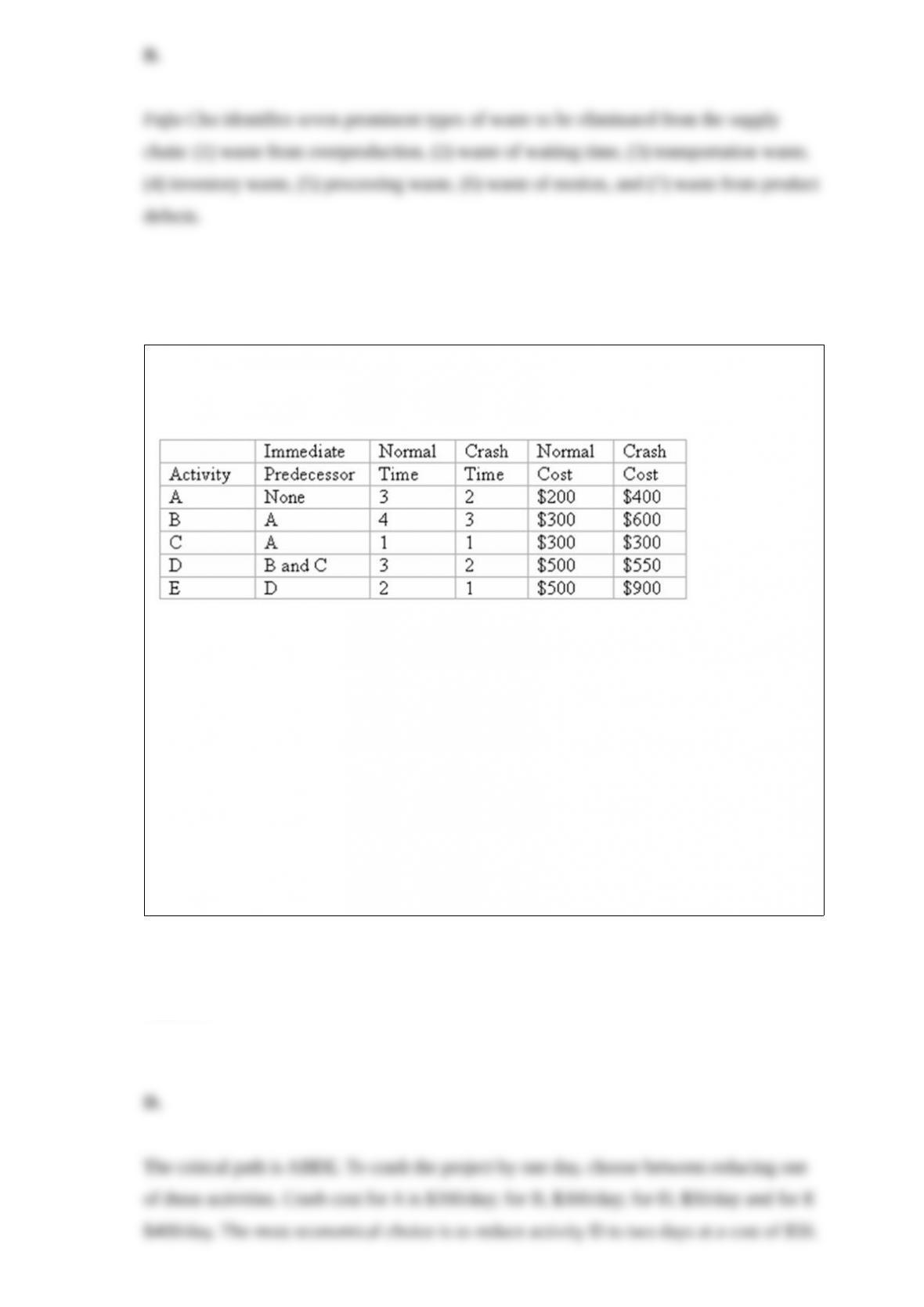
Below are the data for a Time-Cost CPM Scheduling model analysis. The time is in
days and the costs include both direct and indirect costs.
If you crash this project to reduce the total time by one day what is the total time of the
project and total cost?
A. Total time is 13 days, total cost is $1500
B. Total time is 12 days, total cost is $2000
C. Total time is 12 days, total cost is $2300
D. Total time is 11 days, total cost is $1850
E. Total time is 11 days, total cost is $2350
Answer:
Which of the following is not a suggestion for managing queues presented in the
textbook?
A. Try to divert your customer’s attention when waiting
B. Segment the customers
C. Encourage customers to come during a slack period
D. Train your servers to be friendly
E. Periodically close the service channel to temporarily disperse the line
Answer:
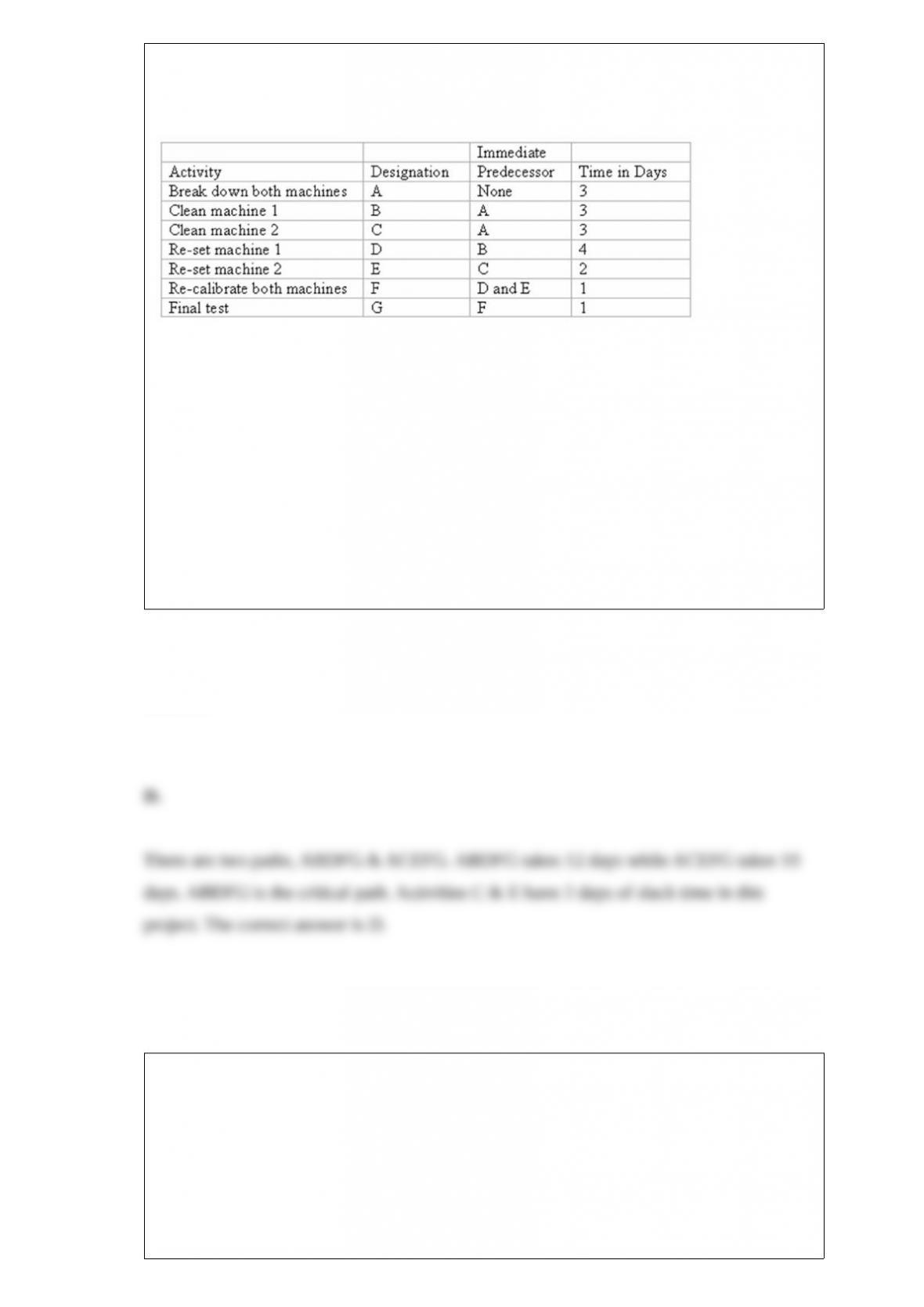
A company must perform a maintenance project consisting of seven activities. The
activities, their predecessors, and their respective time estimates are presented below:
Using CPM, which activities have slack in this project?
A. A, B, C
B. B, D
C. Only C
D. C, E
E. F, G
Answer:
Assume a fixed cost for a process of $15,000. The variable cost to produce each unit of
product is $10 and the selling price for the finished product is $25. Which of the
following is the number of units that has to be produced and sold to break-even?
A. 500 units
B. 667 units
C. 790 units
D. 900 units
E. 1,000 units
Answer:
If the average aggregate inventory value is $45,000 and the cost of goods sold is
$10,000, which of the following is weeks of supply?
A. 45,000
B. 234
C. 120
D. 23.4
E. 4.5
Answer:
In Hau Lee’s uncertainty framework to classify supply chains, a supply chain for
functional products with a stable supply process is called which of the following?
A. Efficient
B. Forward looking
C. Agile
D. Risk hedging
E. Responsive
Answer:
What is the planned-order release using an MRP program if the gross requirement is
1,600 and the inventory on hand is 600? ______________________________
Answer:
When arrivals occur in a purely random fashion at a service facility, what kind of
distribution does a plot of interarrival times yield? ___________________________
Answer:
Joining a line at an airport shoeshine stand where there are five people shining shoes
puts you in which type of queuing system line structure?
______________________________________________________
Answer:
If annual demand is 1,000 units, annual holding cost is $0.50 per unit, and the cost per
order is $10, what is the EOQ? ______________________________________
Answer:
Answer:
A company has calculated its running sum of forecast errors to be 1,000 and its tracking
signal is 50. What is the company’s mean absolute deviation?
_________________________________
Answer:
You have just determined the actual number of workstations that will be used on an
assembly line to be 25 using the assembly-line balancing procedure. The cycle time of
the line is 30 seconds and the sum of all that tasks required on the line is 10 minutes.
What is the line’s efficiency? ________________________________
Answer: