
Johnny consumes only bread and milk. Suppose the quantity of milk is measured along
the horizontal axis. If the price of milk rises, his budget constraint will
A. shift outward.
B. shift inward.
C. rotate inward along the horizontal axis.
D. rotate inward along the vertical axis.
Which of the following is a difference between a pure strategy and a mixed strategy?
A. When a player chooses a specific action in a game, it is a pure strategy, while in a
mixed strategy players randomize.
B. When a player assigns a probability to an action, it is a pure strategy, while in a
mixed strategy players choose their actions sequentially.
C. A pure strategy has an element of surprise, while a mixed strategy can be easily
predicted by rivals.
D. A pure strategy involves all players making their moves simultaneously, while a
mixed strategy minimizes the losses of players.
Which of the following regulatory procedures transfers wealth from consumers to
producers?
A. Import quotas and tariffs
B. Efficiency wages
C. Transaction costs
D. Deadweight loss
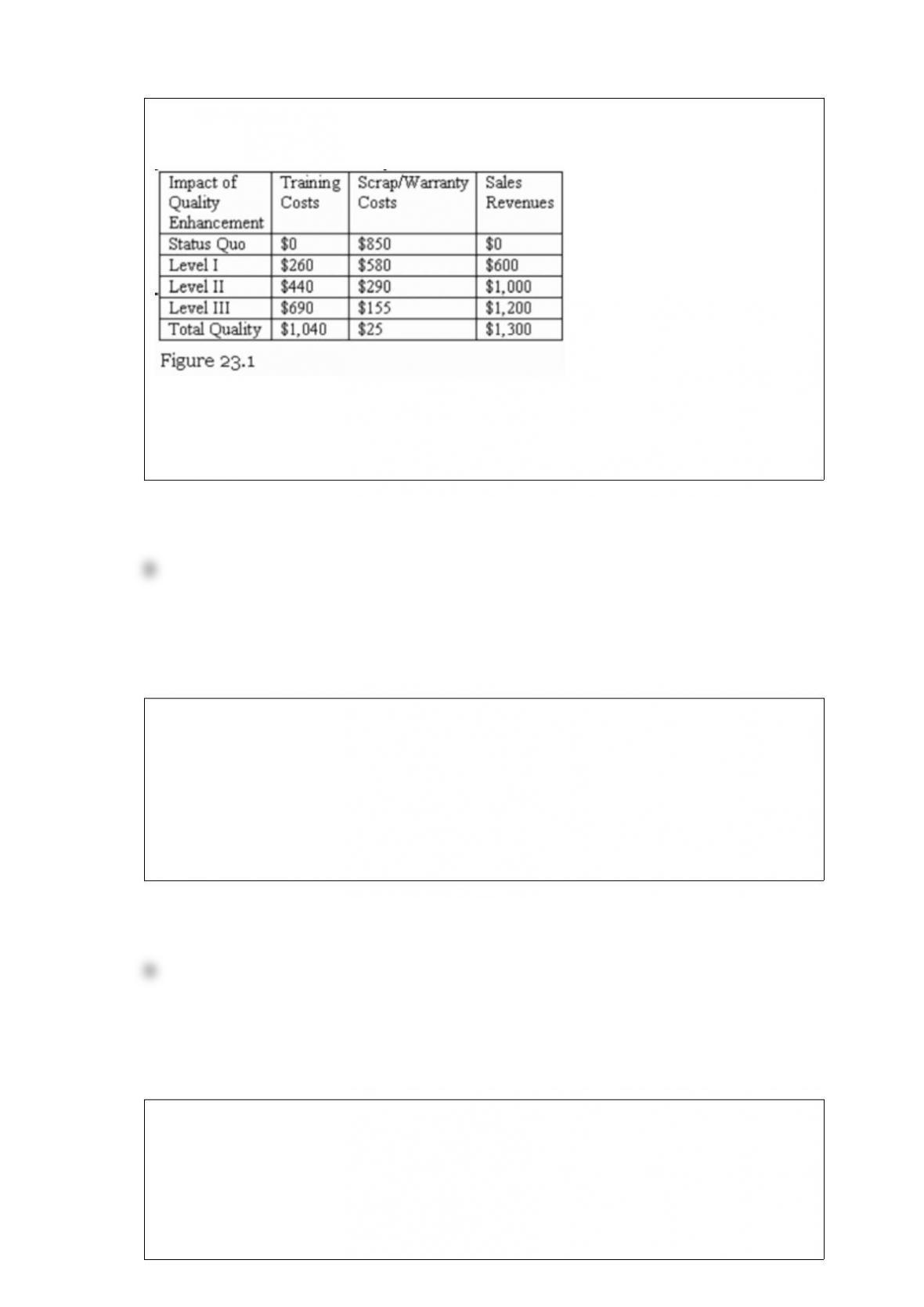
Refer to Figure 23.1. If the company moves from Level II to Level III, the additional
scrap/warranty costs are:
A. $155.
B. −$135.
C. $135.
D. $290.
Specific assets can create problems for a company. If a supplier invests in new
machinery to deliver a part useful only to its biggest and best customer, it can find itself
with:
A. a low cost delivery output.
B. a holdup problem.
C. significant externalities.
D. an outsourcing dilemma.
Firm A has been dealing in baby food products for the past 10 years and enjoys a good
market share. Suppose a new firm enters the market to capitalize on the increasing
demand for such products. However, the products of the new firm fail to attract
customers. The failure of the new firm is due to
A. the pioneering brand advantage of the incumbent.
B. the learning curve effect.

C. scale economies.
D. the specific assets owned by the incumbent.
An individual can sometimes create power by developing a service or product that
becomes important to other people within the organization. What is the source of
organizational power for this individual?
A. Control over key resources
B. Control over specific information
C. Formal authority
D. Nepotism
A small fitness center that offers only personal training services has the following
demand and cost parameters:
Demand: The fitness center has found that it has some discretion in pricing—that is, it
can raise price marginally without drastic reductions in volume. Based on statistical
estimates of demand and assuming that external factors stay constant (e.g., price of
competitors’ services, income levels, etc.), the following relationship exists between the
hourly rate for a personal training session (P) and the number of sessions demanded per
day (Q):
P = 140 – Q.
Costs: The fitness center finds that its variable costs (e.g., labor) increase at a constant
rate of $40 with each additional training session provided per day. Fixed costs such as
rent are equal to $200 per day. This yields the following total variable cost (TVC) and
total fixed cost (TFC) equations:
TVC = 40Q.
TFC = 200.
(a) Find the price and quantity demanded (P and Q) that maximize total profit.
(b) What is the maximum possible profit?
Strong incentives are provided by:
A. fixed salaries.
B. pay on performance.
C. fixed salaries and limited pay on performance.
D. threatening to outsource the job to low-wage countries.
When a worker specializes in one task, he focuses on that one function in the
production process, ignoring the whole system. This is likely to:
A. increase the cross-training costs.
B. eliminate trade-offs since only one task is undertaken by each employee.
C. lead to greater complementarity between one task and another.
D. result in functional myopia that reduces overall productivity.

A job in sales—such as a sales representative for an agricultural chemical company—
usually represents:
A. many tasks and little sales authority.
B. few tasks and very little sales authority.
C. many tasks and a lot of sales authority.
D. few tasks and a lot of sales authority.
Functional U form subunits work best in:
A. large, geographically spread-out companies.
B. companies that produce many products.
C. small, specialized companies.
D. industries with rapidly changing technology.
Alfie Kohn and Demming are of the opinion that:
A. pay is a prime motivator.
B. work place and environment are not important motivators.
C. pay is not a motivator.
D. incentive plans all work too well.

In a perfectly competitive market, the price faced by a firm is equal to its
A. average variable cost.
B. marginal revenue and average revenue.
C. total cost.
D. average revenue.
Corporate governance refers to:
A. government control of the top management.
B. organizational architecture at the bottom-level of an organization.
C. organizational architecture at the middle-management level of an organization.
D. organizational architecture at the top of an organization.
Independent distributors of a brand name product:
A. can commit to provide aftersales service to bulk purchasers.
B. can announce discounts on the product price to improve sales.
C. can increase its marked price to meet shortage of stock.
D. can free-ride on the product’s reputation and produce suboptimal sales.

Dan Heath is the owner of Plain Truth Advertising. He is attempting to design salary
systems for his employees, most of whom are sales agents. To get a good system, he
needs to recognize the trade-offs between:
A. benefits and incentives.
B. risk-sharing and benefits.
C. benefits and salaries.
D. risk-sharing and incentives.
By offering a compensation package rich in fringe benefits and slightly lower pay, a
firm is more likely to attract:
A. single employees.
B. married employees.
C. older or senior employees.
D. unskilled employees.
For a perfectly or purely competitive firm, profit maximization occurs at an output level
where
A. P = MC.
B. MC = ATC.
C. P = AVC.
D. P < AVC.
Dell Computer attempts to collect information about customers before purchase and

assemble customized product for the customers. This process tries to
A. reduce transaction costs for both Dell and the customer.
B. reduce transaction costs for the customers only.
C. increase transaction costs for Dell so that it can reduce taxable profits.
D. increase transaction costs for customers so that IBM can also sell PCs.
In the basic competitive model of labor markets, it is assumed that:
A. individuals are not identical in training and skills, and jobs are not identical.
B. not all individuals are identical in training and skills, but all jobs are identical.
C. individuals are identical in training and skills, but not all jobs are identical.
D. individuals are identical in training and skills, and all jobs are identical.
Strategy refers to the general policies that managers adopt to increase
A. costs.
B. the number of client meetings.
C. the rate of technological change.
D. the generation of profits.
Two tasks are said to be ______ if performing more of one task increases the benefit or
reduces the cost of performing another task.
A. substitutes
B. complements
C. bundled

D. flexible
Which of the following is the most important factor influencing the decision of a firm to
enter a new market?
A. The effect of the firm’s entry on product prices
B. The effect of the firm’s entry on the interest rate
C. The prevailing tax rate
D. The type of government in power
The business practice of looking for a firm that has best practices in an area and then
emulating those practices is called
A. organizational architecture.
B. benchmarking.
C. competitive markets.
D. decision management.
Designing efficient contracts are costly when:
A. there is perquisite involved.
B. there is complete information.
C. there is asymmetric information.
D. there is an agency relationship.

An incentive problem arising from decentralization of decision making is that:
A. it leads to communication problems relating to performance evaluation of
employees.
B. managers often recruit weaker subordinates and refrain from training them properly.
C. the costs of coordination among local managers is very high.
D. there is less effective use of central information and expertise.
The shape of a perfectly inelastic demand curve is
A. horizontal, Ed = ∞.
B. horizontal, Ed = 0.
C. horizontal, Ed = -1.
D. vertical, Ed = 0.
Which of the following is a primary role of a manager according to the good-citizen
model?
A. to communicate the goals and objectives of the organization to employees
B. to discourage innovation at work
C. to allow the employees to work independently, without any help from the managers
D. to recognize and reward an employee who is honest, punctual, and obedient
FancyFoods restaurant decided to introduce an all-you-can-eat buffet on Tuesdays and
Wednesdays to increase business. They found that they acquired a whole new set of
customers, most of whom were very big eaters. After a time, they increased the price of
the buffet. FancyFoods suffered from the problem of:
A. excessive high costs.
B. adverse selection.
C. .incentives
D. implicit contracts
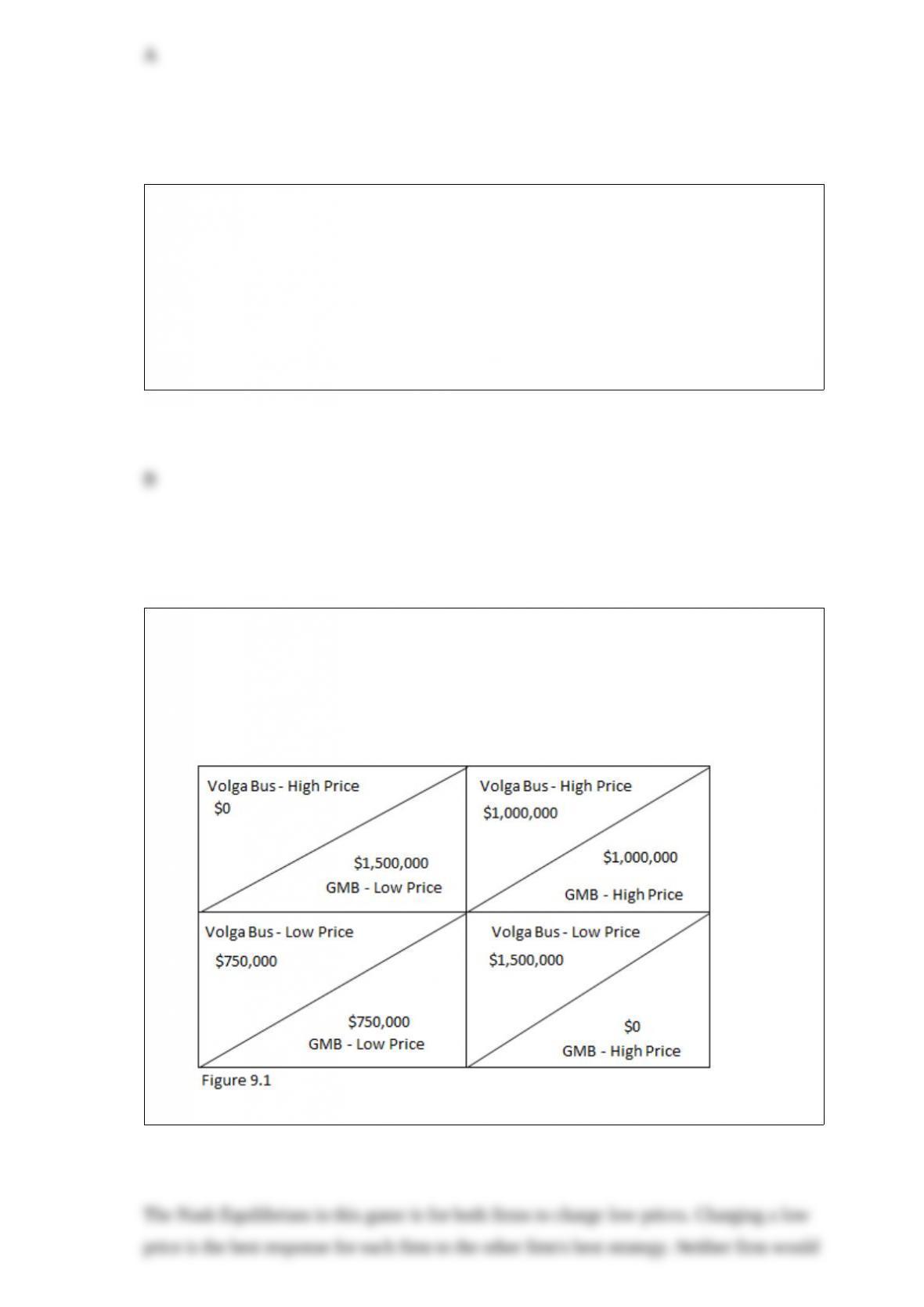
Refer to Figure 9.1. GMB and VolgaBus compete to sell 100 buses to MetroTravel, a
city-owned bus company. If sealed bids are required and no illegal activities occur, what
will be the outcome? Explain the process.
Always Round Tire is the only producer of tires for the new British import, the Maxi
Copper. Demand for a set of four tires is P = 800 – 5Q while the cost incurred by the
firm is MC = 15Q. What would be the monopoly price and quantity? What would
happen to price and quantity if the market was perfectly competitive (assuming the
same costs)?
Consider the salary of Mary Sue Nelson, a sales agent for Plain Truth Advertising. She
has an effort cost of C = e2 and a reservation wage of $1,500 so that wage package is W
= 1,500 + 0.2 Q where the CEO sets the incentive at 0.2 and Q = 200 e. If the CEO
increases the incentive from 0.2 to 0.25, what happens to Nelson’s effort? Will profits
rise or fall?
“Market forces determine the success of any management innovation”. Do you agree?
A and B are going to play a game twice. During both repetitions, if they both select a
low price or a high price, their market share stays the same. But if one selects a low
price while the other selects a high price, then the one with the low price gets more
money while the one with the high price loses some market share. Based on this
information, what is the most likely outcome in both periods?
What are some of the demerits of decentralization?
Economist Jack Hirshleifer notes that, “Altruism economizes on the costs of policing
and enforcing contracts.” Since economics assumes that people act in a self-interested
manner, what could he possibly mean?
The market environment heavily influences corporate decision-making ability. Discuss
the differences in executive decisions concerning pricing, product design, and
advertising between a company that exists in a perfectly competitive market and a
company in a monopolistically competitive market.
In the Bagby Copy Company case study, the executives are faced with wiring ten
different copiers that they make in five separate European countries. They must choose
between specializing by country or specializing by manufacturing of copier type. The
executives hire a lobbyist to work for a standard regulatory and sales environment
across the entire European Union. Why?
At Always Round Tire, managers and professional employees are evaluated each year
with the Subjective Information Performance Survey (SIPS). SIPS allows bosses to
rank their employees on several issues including achieving budget objectives,
communication quality, continuing education and training activities, and emphasis of
teamwork among subordinates. SIPS software computes means and standard deviations,
and benchmarks each employee relative to all others in the same evaluation system.
However, nobody at the company believes in SIPS output. Why?
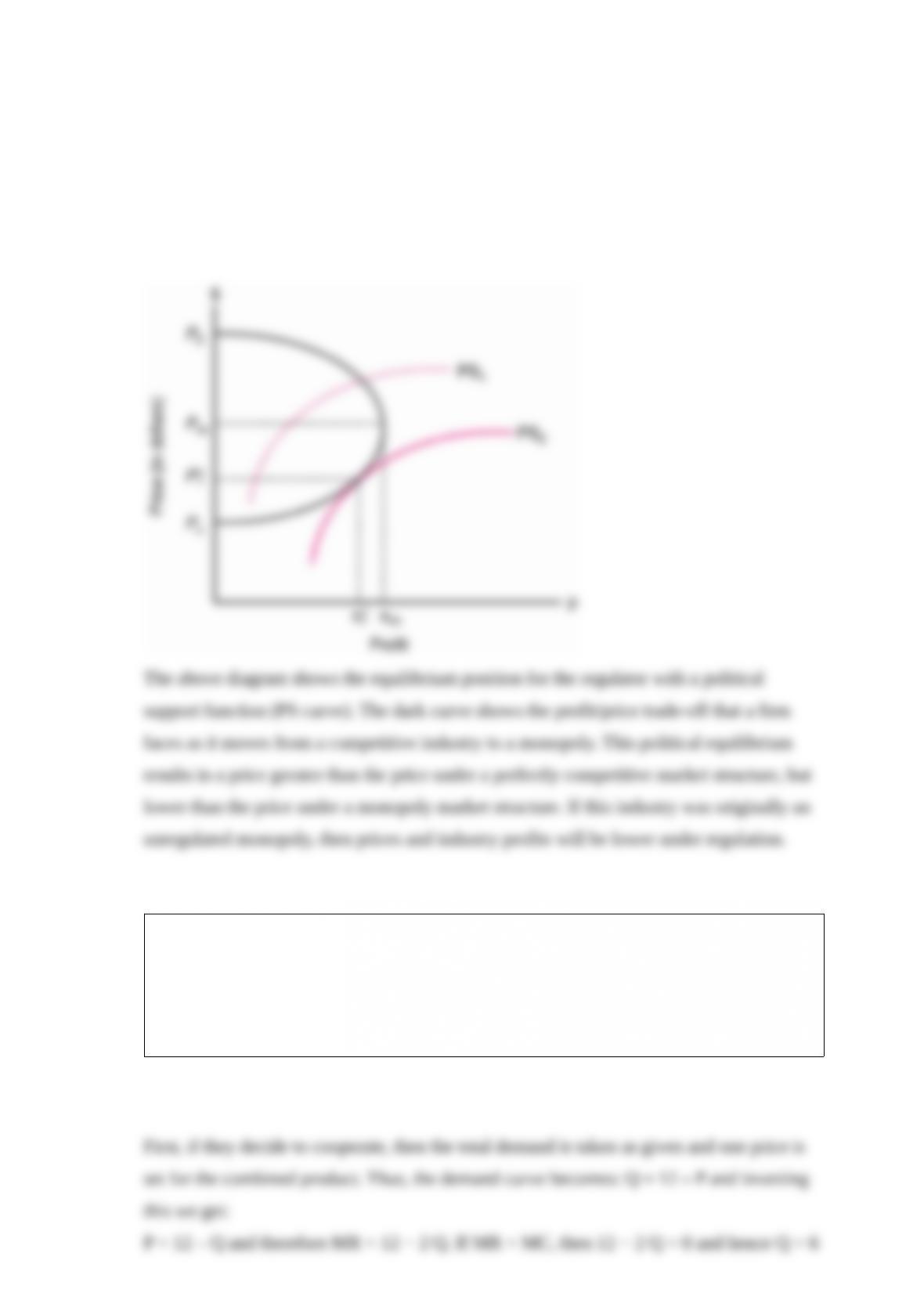
Draw a profit/price trade-off curve that results from moving from a competitive to a
monopoly industry organization. Show the equilibrium position for the regulator with a
political support function (PS curve). What can we say about prices and profits of the
regulated industry if it started as a monopoly?
Let Q be the number of printer-computer combinations sold in the market and let MC of
both these products equal $0. Let the demand for both the products be given as Q = 12 –
(Pp + Pc), where Pp and Pc are the prices of printers and computers. What are the profits
of each firm when they decide to cooperate, and what happens if they decide to go
alone?
A bunch of elementary school kids sit down at a long lunch table. For several minutes,
everyone trades food, but then the table becomes quiet as they begin to eat. What
happened?
Why is academic decision making different from decision making within firms?
An industry demand curve faced by firms in a duopoly is P = 69 – Q, where Q = Q1 +
Q2. MC for each firm is 0. How many units should each firm produce? How much
money will each firm make?
How can good management practices be useful in a global economy?
TruLite is managed by Fred Powell. It has three stages of production: (1) light
fabrication, (2) switch assembly, and (3) boxing. Chris Self works in the switch
assembly department. He is productive and seems to work hard. Powell decides to
change Chris Self’s pay system to a performance-based pay system that will be
determined by output per hour. Chris resists the change and asks for increase in his base
pay. What is Chris Self’s problem? Is he irrational or does he understand something
about the production system that Fred Powell does not understand?
What are some of the important questions regarding the assignment of decision rights in
an organizational hierarchy?