The type of forecasting method used depends entirely on whether the supply chain is
continuous replenishment or not.
Firms compete in the marketplace based on cost, speed, quality and flexibility.
Line balancing is constrained by precedence requirements and cycle time restrictions.
Establishing multifunctional design teams can help reduce the time-to-market.
Collaborative planning, forecasting and replenishment (CFPR) is a process where the
more influential member of the supply chain dictates schedules to ensure customer
demand is satisfied.
A major challenge and opportunity for many firms is the globalization of the supply
chain.
Concurrent design may involve simultaneously designing products and their production
processes.
To keep machines running firms can use either breakdown maintenance or preventative
maintenance.
One reason foreign firms locate facilities in the United States is to be closer to their
customers.
Work sampling is a technique for determining the proportion of time a worker or
machine is idle.
The three primary elements of project management include planning, scheduling, and
costing.
The balance delay is calculated by subtracting efficiency in percent from one hundred.
Forecast bias is measured by the per-period average of the sum of forecast errors.
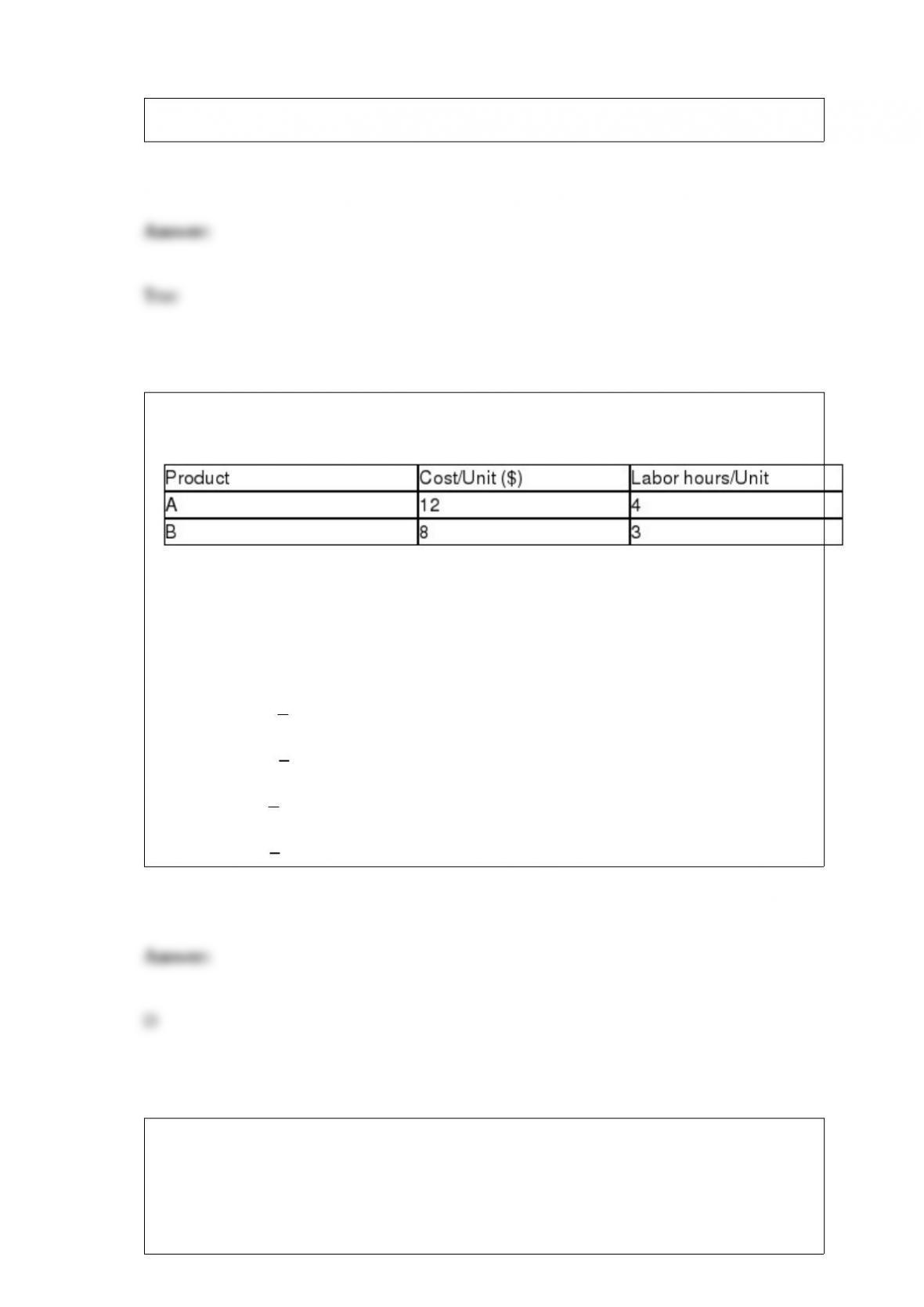
TicToc produces product A and product B. These products have the following resource
requirements.
The firm has a weekly production budget of $3000 and a maximum of 1000 hours of
labor per week. Each A produced generates $35.00 in profit for the company. Each B
produced generates $25.00 in profit for the company. The constraint for the budget is
represented by
a. $35A + $25B < $3,000.
b. $35A + $25B > $3,000.
c. $12A + $8B > $3,000.
d. $12A + $8B < $3,000.
Dividing a job into a series of small tasks, each performed by a different worker, is
known as
a. craft production

b. scientific management
c. division of labor
d. interchangeable parts
The two traditional forms of employee compensation include
a. hourly wage and individual incentive.
b. hourly wage and profit sharing.
c. salary and individual incentive.
d. hourly wage and gainsharing.
The bullwhip effect can
a. increase inventories.
b. increase demand.
c. increase customer service levels.
d. increase capacity.
Project managers must address cultural diversity in
a. project planning
b. project scheduling.
c. project control.
d. None of these answer choices is correct.
Atlas Inc. produces product A and product B. Each product must go through two
processes. Each A produced requires two hours in process 1 and five hours in process 2.
Each B produced requires six hours in process 1 and three hours in process 2. There are
80 hours of capacity available each week in each process. Each A produced generates
$6.00 in profit for the company. Each B produced generates $9.00 in profit for the
company. If the company produces 6 units of A and 9 units of B the amount of slack (in
hours) for process 1 is
a. 0 hours.
b. 14 hours.
c. 66 hours.
d. 80 hours.
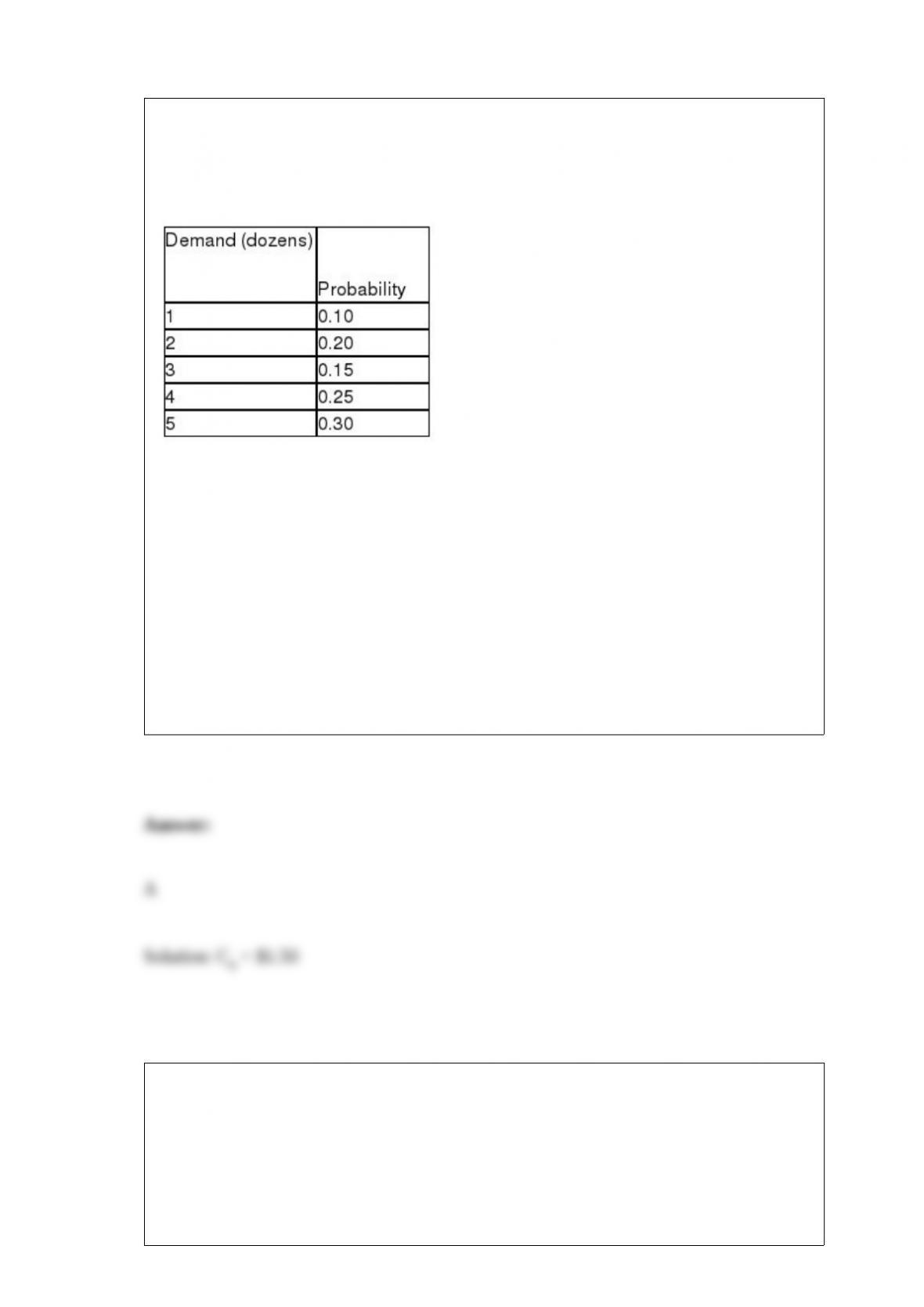
A bagel company bakes a specialty bagel that it sells by the dozen every day. These
specialty bagels can only be baked early in the morning before the store opens for
business. The company estimates that the daily demand (in dozens) for its specialty
bagel is distributed as follows:
Specialty bagels are sold by the dozen only at a cost of $9.00 per dozen. The cost to
make one bagel is $0.50. Leftover specialty bagels are sold by the dozen the next day
for a 50% discount. The bagel company’s cost of overestimating demand, Co, is
a. $1.50
b. $3.00
c. $4.50
d. $6.00
The suppliers in a supply chain are referred to as ______________ supply chain
members.
a. downstream
b. midstream
c. upstream
d. None of these answer choices is correct.
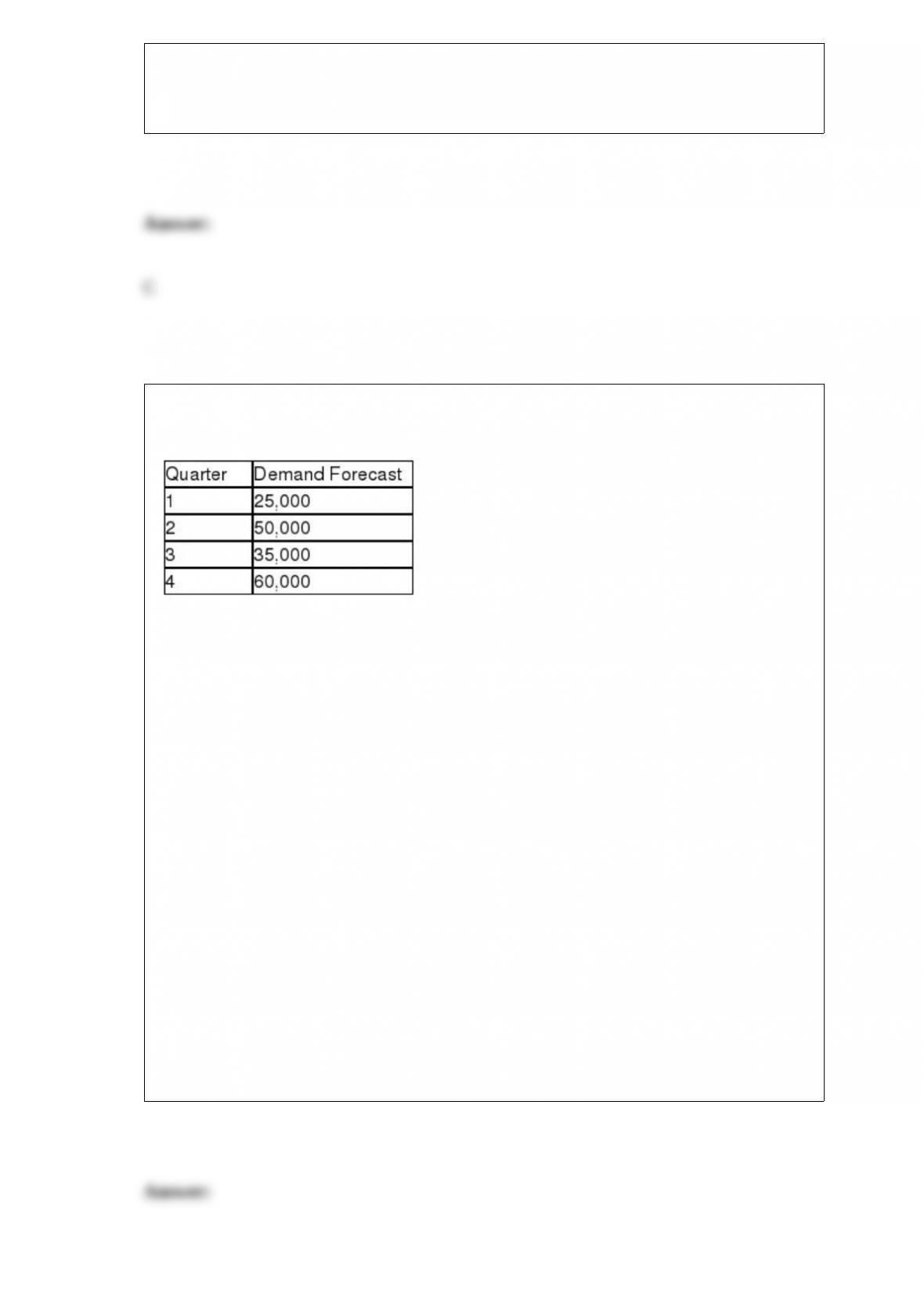
The following information relates to a company’s aggregate production planning
activities:
Beginning Workforce = 50 workers
Production per Employee = 250 units per quarter
Hiring Cost = $1000 per worker
Firing Cost = $1,500 per worker
Inventory Carrying Cost = $15 per unit per quarter
If a chase demand strategy is used then the number of workers hired at the start of
quarter 2 is
a. 0
b. 50
c. 100
d. 200

The primary cost associated with the level production strategy is the cost of
a. holding inventory.
b. hiring and firing workers.
c. overtime.
d. outsourcing (subcontracting).
___________________ is a concept where companies are held responsible for their
product even after its useful life.
a. Design for disposal or reuse
b. Sustainability
c. Extended producer responsibility
d. Environmentally safe people
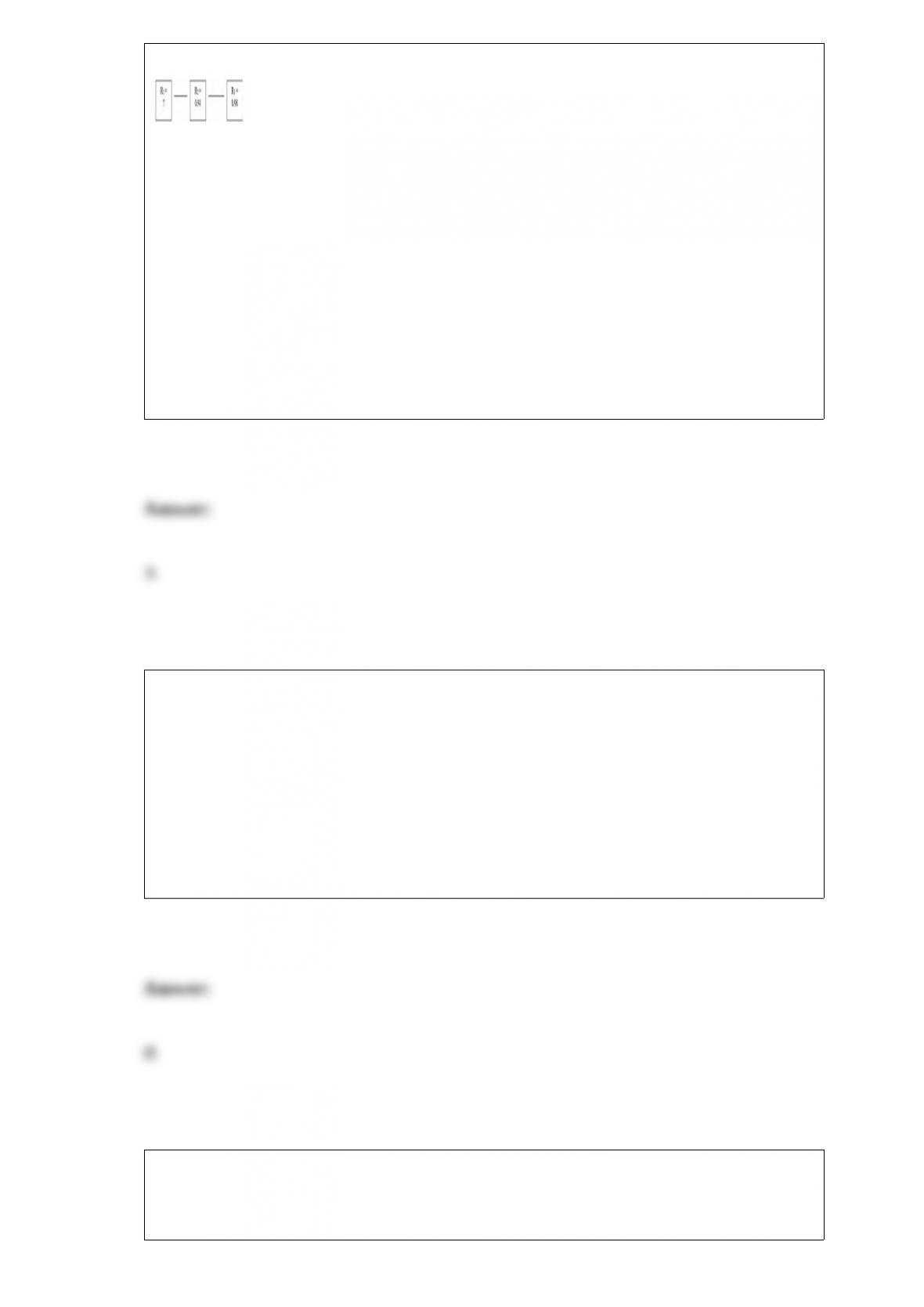
A product consists of three components arranged as follows:
If all three components must function for the product to function, and the product’s
overall reliability must be at least 0.92, then the reliability of the first component, R1,
must be
a. at least 0.999.
b. at least 0.84.
c. at least 0.96.
d. at least 0.972.
The most recent era in the evolution of operations and supply chain management is
a. Internet Revolution
b. Sustainability
c. Globalization
d. Quality Revolution
If a product fails 10 times in 500 hours of operation, then its mean time between
failures (MTBF) is

a. 0.02 hour.
b. 0.10 hour.
c. 20 hours.
d. 50 hours.
The production system that prizes flexibility and quality over efficiency and quantity is
known as
a. mass production.
b. craft production.
c. lean production.
d. electronic commerce.
A(n) ____________ strategy involves a series of integrated decisions on processes,
facilities, technology, quality, capacity, etc.
a. finance
b. marketing
c. operations
d. None of these answer choices is correct.
If a sample of 40units of output found 500 defects, then the 3-sigma upper control limit
for the chart would be
a. 12.50
b. 23.11
c. 37.50
d. 75.00
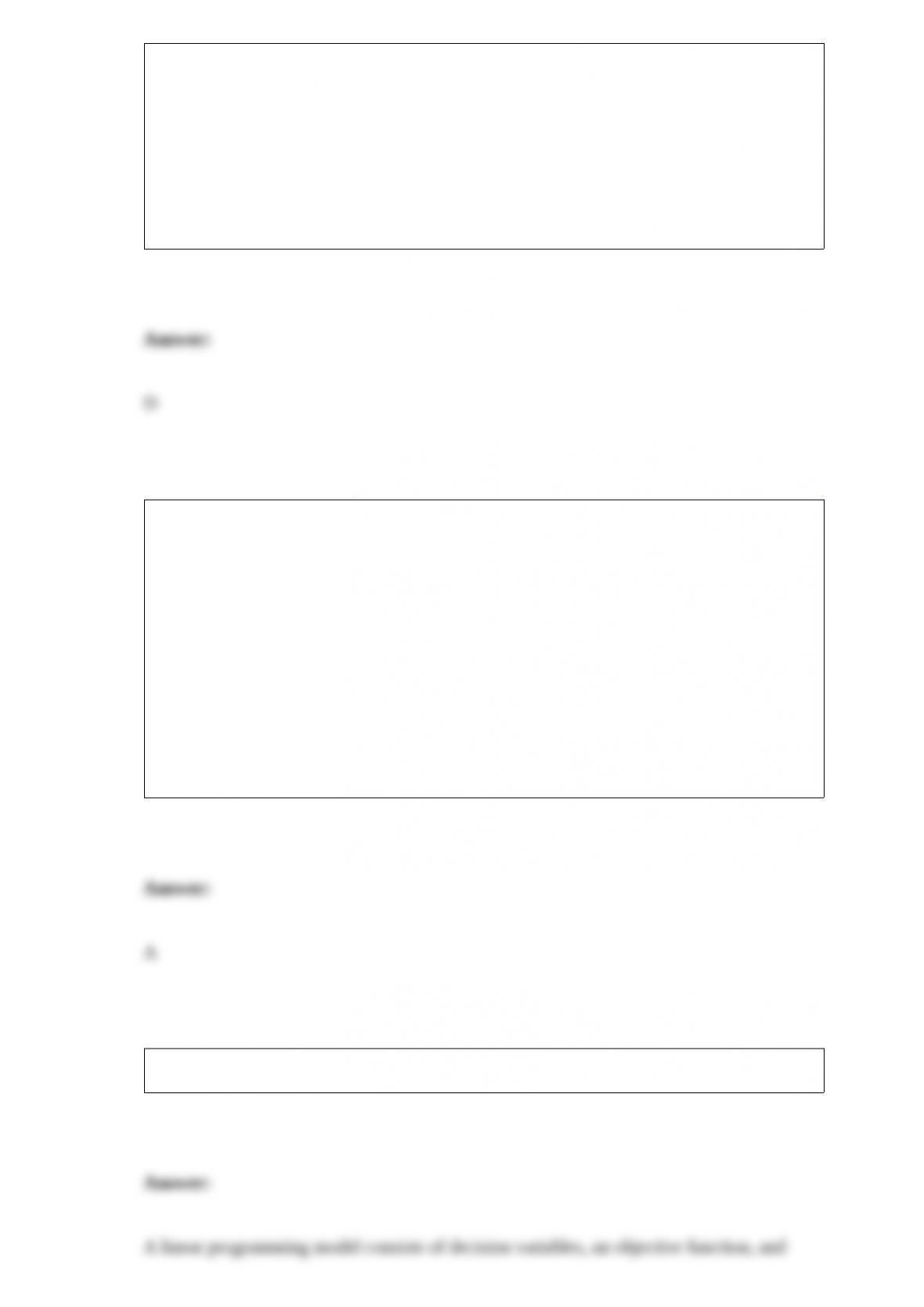
Given the following MRP matrix for Item E:
The planned order releases for period 1 is
a. 300.
b. 200.
c. 75.
d. 0.
A restaurant currently uses 62,500 boxes of napkins each year at a constant daily rate.
The cost to order napkins is $200.00 per order and the annual carrying cost for one box
of napkins is $1.00. If the restaurant orders the economic order quantity each time an
order is placed, then ______orders are placed during the year.
a. 13
b. 15
c. 20
d. 25
Briefly define the components that comprise a linear programming model.
List several types of uncertainty that may contribute to higher inventory levels.