
1) protective reflexes of the lungs include
a) coughing.
b) bronchoconstriction.
c) bronchodilation.
d) bronchodilation and coughing.
e) coughing and bronchoconstriction.
2) when more action potentials arrive at the axon terminal, how is the postsynaptic cell
affected?
a) neurotransmitter release increases, but does not change the graded potentials that
follow.
b) neurotransmitter release does not change, thus the postsynaptic cell behaves the same
way it always behaves.
c) neurotransmitter release increases, thereby increasing the frequency or magnitude of
graded potentials in the postsynaptic cell.
d) neurotransmitter release does not change, but voltages applied to the postsynaptic
cell increase.
3) when energy is released during catabolism, it is temporarily trapped in high energy
bonds or electrons of certain compounds. which of the following is not associated with
carrying energy?
a) atp
b) dna
c) nadh
d) fadh2
e) nadph
4) match these terms with their descriptions.
a. gray matter
b. white matter
c. ascending tracts
d. descending tracts
e. propriospinal tracts
myelinated axons with very few cell bodies

5) match the name of the pathological condition with its description.
a. hereditary spherocytosis
b. polycythemia vera
c. iron-deficiency anemia
d. sickle cell disease
e. anemia
a genetic condition where red blood cells have deficient cytoskeletons
6) if blood flow through the afferent arterioles increases,
a) stretch reflexes trigger vasoconstriction to reduce the flow.
b) the smooth muscle in the vessel walls stretches to accommodate the increased flow.
c) the stretch triggers further relaxation of the arteriolar wall, lessening blood pressure.
d) the smooth muscle in the vessel walls stretches to accommodate the increased flow
and the stretch triggers further relaxation of the arteriolar wall, lessening blood
pressure.
7) energy is defined as
a) doing tasks that make you tired.
b) the capacity to do work.
c) the light and heat from the sun.
d) using glucose to synthesize atp.
8) glucose and ribose are examples; these molecules provide energy or structure.
a. carbohydrates
b. lipids
c. proteins
d. nucleotides

9) match the type of reflex to its description.
a. somatic
b. autonomic
c. spinal
d. cranial
e. innate
f. acquired
g. polysynaptic
involves skeletal muscles
10) irreversible antagonist
a. involved in phosphorylation
b. cannot be displaced by competition
c. bind to proteins away from the active site
d. reversible antagonist
11) the multiple thin, branched structures on a neuron whose main function is to receive
incoming signals are the
a) cell bodies.
b) axons.
c) dendrites.
d) somata.
e) none of the answers are correct.
12) match the disease with the description.
a. addison’s disease
b. cushing’s disease
c. graves’ disease
d. paget’s disease
calcitonin may be an appropriate treatment.
13) which of the following characteristics makes hemoglobin’s structure such a good
match for its function as an oxygen carrier?

a) each hemoglobin molecule can bind one oxygen molecule.
b) each hemoglobin molecule can bind two oxygen molecules.
c) each hemoglobin molecule can bind four oxygen molecules.
d) each hemoglobin molecule can’t be saturated by oxygen molecules.
e) each hemoglobin binds irreversibly to an oxygen molecule.
14) the structure that transports the ovum to the uterus is the
a) uterosacral ligament.
b) vagina.
c) fallopian tube.
d) infundibulum.
e) myometrium.
15) the photosensitive pigment synthesized from vitamin a is
a) retinal.
b) opsin.
c) rhodopsin.
d) transducin.
e) cgmp.
16) which of the following statements is not true regarding mitochondria?
a) the outer mitochondrial membrane is responsible for its shape.
b) the intermembrane space is used in the production of atp.
c) mitochondria contain their own dna and rna.
d) mitochondria can replicate themselves only when directed by the cell’s nuclear dna.
e) mitochondria are responsible for providing energy to the cell.
17) tom suffers from hypertension (high blood pressure). which of the following might
help deal with his problem? a drug that
a) stimulates 1 receptors in cardiac muscle tissue.
b) blocks 2 receptors in cardiac muscle tissue.
c) stimulates camp formation in cardiac muscle tissue.
d) blocks beta receptors in cardiac muscle tissue.
e) blocks muscarinic receptors in cardiac muscle tissue.
18) a circulatory route that has two sets of capillaries is known as a ________.
19) what steps are necessary to terminate neurotransmitter action? what would happen
if these steps failed?
20) what is the approximate concentration of solute present in alien blood cells?
21) you and your fellow deep-sea scientists have discovered a new form of marine
invertebrate, and are anxious to determine the similarities and differences to animals
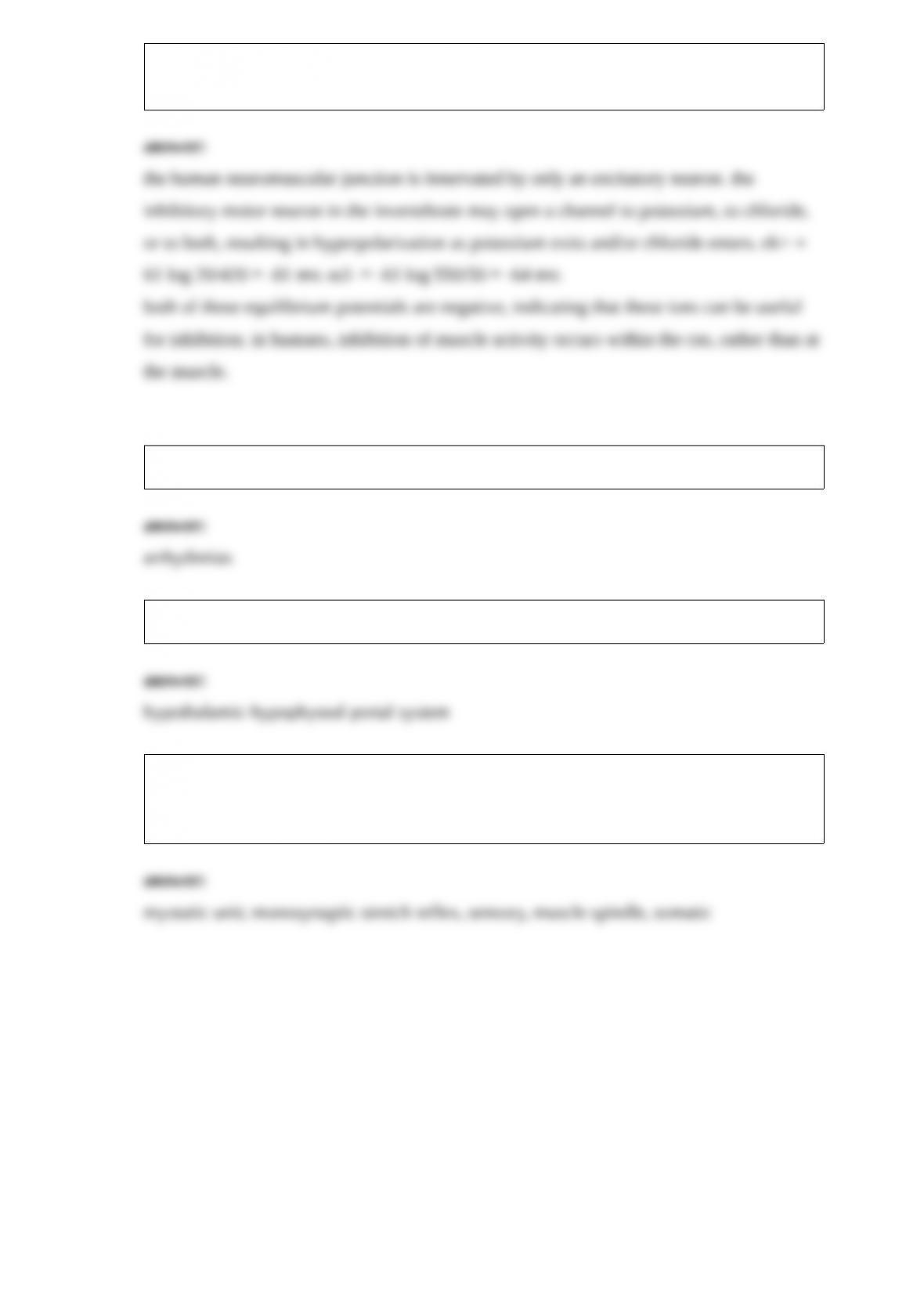
already characterized. chemical analysis reveals the following concentrations of
permeable cations:
nernst equation: eion = 61/z log [ion]out/[ion]in
control of the neuromuscular junction in this new invertebrate is found to involve dual
innervation, where one motor neuron secretes an excitatory neurotransmitter and
another secretes an inhibitory neurotransmitter onto the muscle. how does this compare
to the human neuromuscular junction? propose three different types of inhibitory
receptors/channels that would produce inhibition of the invertebrate muscle, specifying
ion and direction of ion flow. for each ion, calculate the equilibrium potential. what
similarity do you notice in the equilibrium potentials of the ions involved, and how is
that significant? how may inhibition be accomplished in human muscle?
22) abnormal patterns of cardiac activity are known as ________.
23) the trophic hormones reach the pituitary through the ________.
24) the collection of pathways controlling a single joint is known as ________. the
simplest reflex in this collection of pathways is the ________, which involves only two
neurons: ________ neuron from the ________ and the ________ neuron to the muscle.