
1) the nernst equation predicts
a) intracellular ion concentrations.
b) extracellular ion concentrations
c) the membrane potential resulting from all permeable ions.
d) the membrane potential resulting from permeability to a single ion.
e) the threshold membrane potential.
2) the first law of thermodynamics states that
a) the total amount of energy in the universe is variable.
b) energy can be neither created nor destroyed and thus must be accounted for.
c) what heats up must cool down.
d) natural processes move from order to disorder, or entropy.
e) there is no way a process can increase the amount of order.
3) which of the following hormones increase(s) in concentration in the plasma during
exercise?
a) cortisol
b) catecholamines
c) insulin
d) cortisol and catecholamines
e) cortisol, catecholamines, and insulin
4) air moves out of the lungs because
a) the gas pressure in the lungs is less than outside pressure.
b) the volume of the lungs decreases with expiration.
c) the thorax is muscular.
d) contraction of the diaphragm increases the volume of the pleural cavity.
e) all of the answers are correct.
5) the pons develops from the

a) forebrain.
b) midbrain.
c) hindbrain.
6) after ingestion of carbohydrates in an insulin-deficient diabetic, ________ would
happen.
a) protein degradation
b) fat synthesis
c) ketone production
d) glycolysis
e) protein degradation and ketone production
7) the primary purpose of the middle ear bony structures (maleus, incus and stapes) is to
a) equalize pressure in the middle ear.
b) amplify the vibration as it conducts to the cochlea.
c) dampen the vibration as it conducts to the cochlea.
d) transmit otitis media to the cochlea.
e) transduce the sound waves into vibration.
8) choose all of the items that are incorrectly matched.
a) inactivation gate closed at rest
b) activation gate open at rest
c) inactivation gate closed during repolarization
d) activation gate opens during depolarization
e) all of the answers are incorrectly matched.
9) one way to determine the total energy in calories of a food is to burn it in a device
called a bomb calorimeter. the heat produced during combustion minus the heat added
to begin the combustion is the total calories in the food. the typical human digestive
tract does not absorb all of the calories in food; thus it is not 100% efficient.
furthermore, calories in undigestible organic compounds may not be absorbed at all,
and thus can be considered to be zero calorie relative to human nutrition. artificial
sweeteners and fats are designed to produce desired sensation in the mouth without
being absorbed. these are organic compounds that would release heat in a bomb
calorimeter, thus they technically have calories.
a.what does this suggest about the accuracy of the bomb calorimeter in determining
available food calories for humans? what would be the results of bomb calorimetry of
human feces?
b.what is it about a particular food substance that may prevent absorption of its
calories?
c.what happens to the “zero-calorie” molecules as they pass through the digestive tract?
what are the potential effects on defecation?
10) the three-dimensional shape of an amino acid chain; can be fibrous or globular
a. primary
b. secondary
c. tertiary
d. quaternary
11) glands that secrete hormones into the blood via tissue fluids are
a) endocrine glands.
b) mixed glands.
c) exocrine glands.
d) unicellular glands.
e) none of the answers are correct.

12) match the lung volume with its description.
a. tidal volume
b. inspiratory reserve volume
c. expiratory reserve volume
d. residual volume
the minimum amount of air always present in the respiratory system, after blowing out
all you can
13) “glucose is transported from blood into cells because cells require glucose to meet
their energy needs.” this type of explanation is
a) mechanistic.
b) theological.
c) teleological.
d) metalogical.
e) scatological.
14) a hormone that helps to regulate the sodium ion concentration of the blood is
a) cortisol.
b) parathormone.
c) thymosin.
d) somatotropin.
e) aldosterone.
15) which area is not normally considered to be an autonomic control center?
a) pons
b) medulla
c) amygdala
d) hypothalamus
16) experimental animals become tamer and more sexually active following damage to
the
a) amygdala.
b) hippocampus.

c) suprachiamatic nucleus.
d) hypothalamus.
e) corpus callosum.
17) which of the following is a characteristic of slow-twitch oxidative skeletal muscle
fibers?
a) long contraction duration only
b) few mitochondria only
c) high capillary density only
d) long contraction duration and high capillary density
e) long contraction duration, few mitochondria, and high capillary density
18) iodine accumulation in thyroid cells involves symport with
a) hydrogen.
b) sodium.
c) potassium.
d) chloride.
19) oxidative phosphorylation occurs ________; the beneficial end product is
________.
a) in the cytoplasm just inside the plasma membrane, h2o
b) in the cytoplasm just inside the plasma membrane, atp
c) in the mitochondria due to the electron transport system, atp
d) in the mitochondria due to the electron transport system, co2
e) twice during the citric acid cycle, atp
20) list and describe the three categories of movement. explain why these categories are
not always distinct.
21) describe the embryonic development of the nervous system.
22) the primary function of the alveoli is ________.
23) diagram at least seven different factors that affect the components of the equation
that relates cardiac output to heart rate and stroke volume. explain each factor involved.
24) metabolic intermediates use ________ bonds to transfer energy to the high-energy
bonds of atp, nadh, fadh2 or nadph.
25) if immunizations were available to prevent cancer, would you want your children to
receive them? explain. is it likely that one immunization would prevent all cancers?
explain.
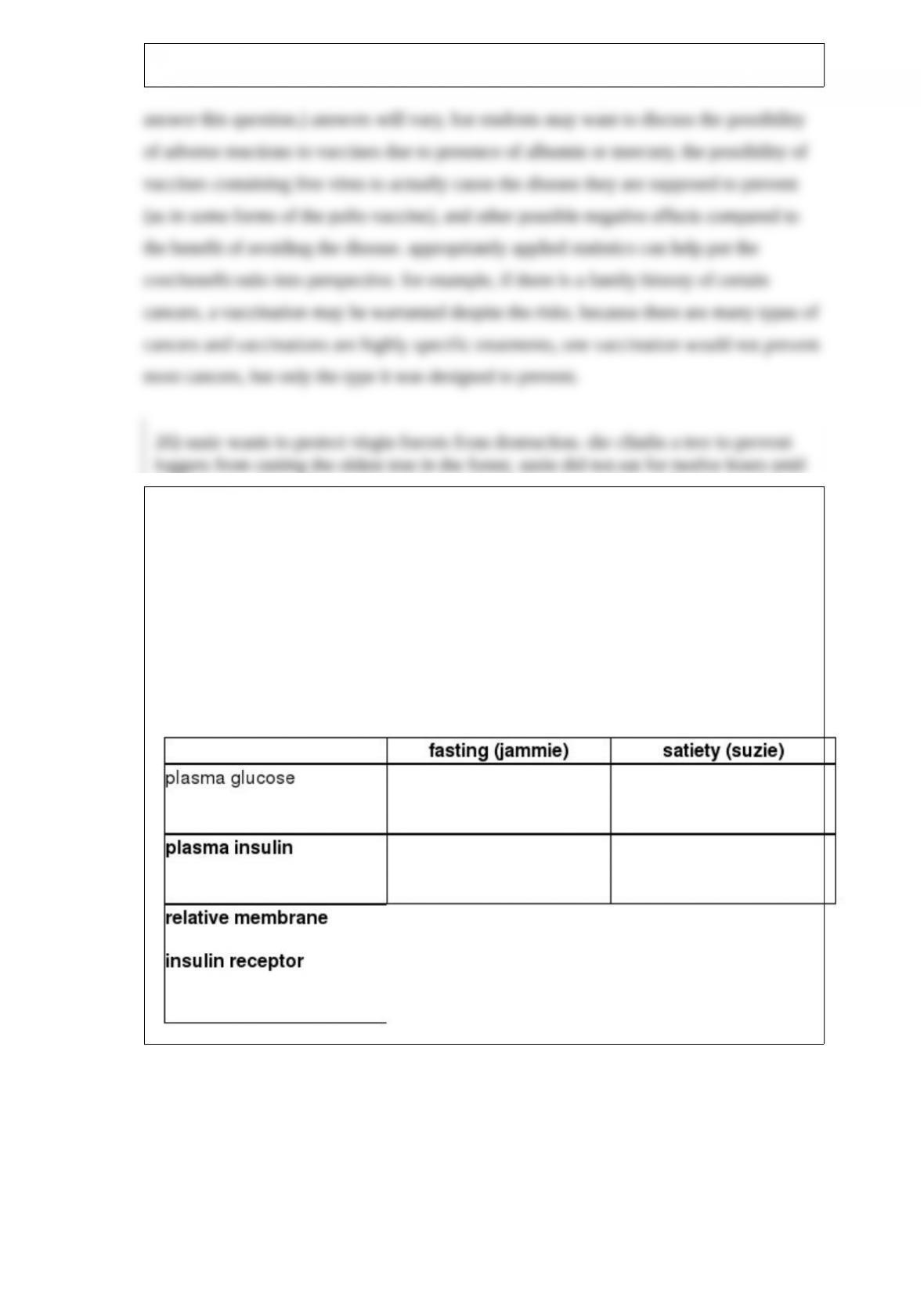
26) suzie wants to protect virgin forests from destruction. she climbs a tree to prevent
loggers from cutting the oldest tree in the forest. suzie did not eat for twelve hours until
a friend, jammie, took over the vigilance. match the correct levels of blood glucose
concentration, blood insulin concentration and relative membrane insulin receptor
concentration for a skeletal muscle cell 20 hours into jammie’s fast and one hour after
suzie had eaten a peanut butter and banana sandwich and a bowl of sweet potato soup.
plasma glucose: 90 mg/dl; 125 mg/dl
plasma insulin: 10iuu/ml (70 pmol/l); 40iuu/ml (280 pmol/l)
relative membrane insulin receptor concentration: increasing (high); decreasing (low)