1) lipoproteins that contain large amounts of cholesterol for transport to peripheral
tissues are called ________.
2) you are walking to school one day when you notice an alien spaceship that has
crashed in a nearby field. you and some other physiology students collect samples from
the beings inside of the spaceship. first, you collect a liquid sample of what appears to
be alien blood so that you can test for the concentration of solutes inside the alien blood
cells. you then extract some of these cells, place them in various concentrations of
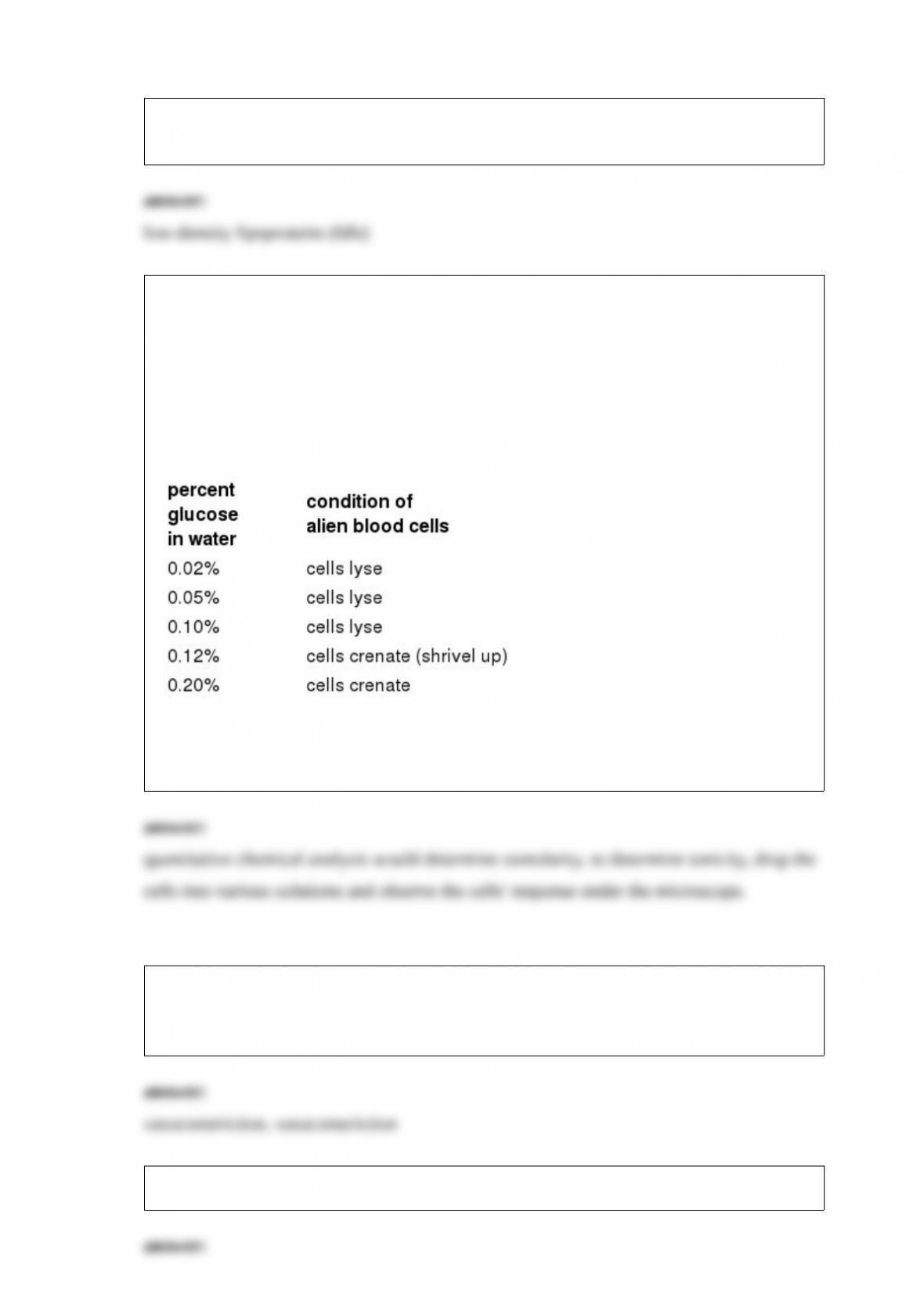
glucose in water, then look at them under the microscope. below is what happens to the
cells when they are placed in various concentrations of glucose:
table 5.1
refer to table 5.1. how can you determine the osmolarity and tonicity of the alien blood
and alien cells?
3) norepinephrine binding to alpha receptors on vascular smooth muscle causes
________ and epinephrine binding to alpha receptors on vascular smooth muscle causes
________.
4) the center of an atom is called the ________.
5) ________ monitor the position of skeletal muscles and joints.
6) diabetes mellitus produces many homeostatic imbalances, including acidosis. the ph
imbalance is due to ketoacidosis, which results from excessive accumulation of
by-products of fat metabolism, as the body cannot meet energy needs from
carbohydrate metabolism. sally is a teenaged diabetic who sometimes rebels by not
taking her insulin. her mother takes her to the hospital because her breathing has
become deep and gasping. explain sally’s breathing pattern. what other compensatory
responses may occur, and would they occur earlier or later than the respiratory
response?
7) the cardiovascular system is made up of ________, ________, and ________.
8) listening to the heart through the chest wall is called ________.
9) during a lab practical, kevin examines a tissue that is composed of densely packed
protein fibers that are running parallel and form a cord. there are few nuclei and no
striations, and there is no evidence of other cellular structures. kevin identifies the tissue
as skeletal muscle. why is kevin’s choice wrong, and what tissue is he probably
observing?