
Although developing a strategic plan is important for large companies, it is not essential
to managing a small company successfully because of its limited resources.
Entrepreneurs have three basic strategies to choose from when establishing a new
product’s price: a penetration pricing strategy; a skimming pricing strategy; and life
cycle pricing strategy.
The biggest barrier facing companies that have never exported is not knowing where or
how to start.
On the Web, service is not as important as it is in a traditional retail environment.

Researching potential export markets is a waste of time and resources for small
business owners; the best way to find export opportunities is to travel abroad and sell.
Porter’s five forces model only considers direct competitors within a single industry.
Changing from one form of ownership to another once a business is up and running can
be difficult, expensive, and complicated.
The better Web sites avoid clutter, include a menu bar for easier navigation, include a
FAQ section, and are careful about typos, formatting, font sizes, and colors.

The job specification outlines the duties and responsibilities of a job and its working
conditions, while the job description outlines the characteristics (skills, education,
experience) a person needs to fill a job.
Seasonal sales patterns cause cash balances to fluctuate dramatically, creating the need
for cash forecasts.
An entrepreneur should never purchase a business that is losing money.
When “brainstorming,” individuals should be encouraged to use “idea hitchhiking,” or
building new ideas on those already suggested.

Few decisions are as important for retailers as the choice of a location.
There are ________ levels of ethical standards.
A) 1
B) 2
C) 3
D) 4
Mini-Case 5-1: Finding a Competitive Advantage
Copreneurs Ed and Yolanda recently opened a vintage used car lot called Cherry Lane.
They sell antique and collectible cars on consignment for the owners at a fee of 30
percent of the selling price. The price is further reduced by 10 percent if a particular car
is not sold within the first 30 days. One of the first customers convinced Yolanda that
this was the only fair thing to do, and in an effort to provide something for “the cost
conscious buyer,” she provided what she thought was excellent customer service and
implemented the idea.
Ed and Yolanda feel Cherry Lane has an ideal location. It is located adjacent to the
city’s baseball stadium, alongside the freeway in the center of all the other car
dealerships. Although Cherry Lane has significant foot traffic, most people never make

offers to buy.
In an effort to increase sales, Ed and Yolanda are working on a new marketing strategy
that they believe should be quite different from the ‘shotgun” approach they had been
using over the last few months.
As Ed and Yolanda begin the strategic planning process, what steps should they take?
A labor force that has technical training would be most important to a ________.
A) clothing store

B) restaurant
C) skiing equipment specialty store
D) computer company
Refer to the following information to answer the question(s) regarding Port Royal:
Port Royal’s debt-to-net worth ratio is ________.
A) 0.36:1
B) 0.08:1
C) 1.57:1
D) 0.57:1
The ________ shows what assets the business owns and what claims creditors and
owners have against those assets, and is built on the basic accounting equation:
Assets = Liabilities + Owner’s Equity.

A) income statement
B) sources and uses of funds statement
C) balance sheet
D) cash budget
The fact that the cash budget illustrates the flow of cash in a business helps the owner to
________.
A) accelerate accounts payable payments
B) get a seasonal line of credit rather than an annual line of credit
C) slow accounts receivable payments
D) track the effects of depreciation and bad debts
A valuable method of preventing online fraud is to ________.
A) ask customers for their card verification value
B) not accept credit cards
C) run background checks on customers
D) All of the above

In a(n) ________, two or more U.S. small businesses form an alliance for the purpose
of exporting their goods and services. The companies get antitrust immunity and share
responsibility for the business equally.
A) foreign joint venture
B) trade intermediary
C) domestic joint venture
D) export management company
Which of the following is nottrue regarding the components of the income statement?
A) Cost of goods sold represents the total cost, excluding shipping, of the merchandise
sold during the accounting period.
B) Gross profit margin is calculated by dividing gross profit by net sales revenue.
C) Operating expenses include those costs that contribute directly to the manufacture
and distribution of goods.
D) A and B above

Small companies ________.
A) created fewer jobs than big companies in the last decade
B) are concentrated in the manufacturing and retail sectors
C) are the leaders in offering training and advancement opportunities to workers
D) account for approximately 10 percent of the nation’s GDP and 25 percent of business
sales
A(n) ________ is when a company raises capital by selling shares of its stock to the
general public for the first time.
A) venture capital offering
B) partnership
C) debt equity arrangement
D) initial public offering
What are the ethical tests for judging behavior?

What criteria should Wallace use in selecting employees?
Mini-Case 11-4: Calculating the Break-even Point
A small manufacturer plans to sell tents for $120 each. The variable cost for each tent is
$90. Fixed costs for the process are estimated to be $36,000. How many tents must the
company sell to break-even?

Suppose that the manufacturer desires a profit of $9,000 on this product. How many
units must be sold?
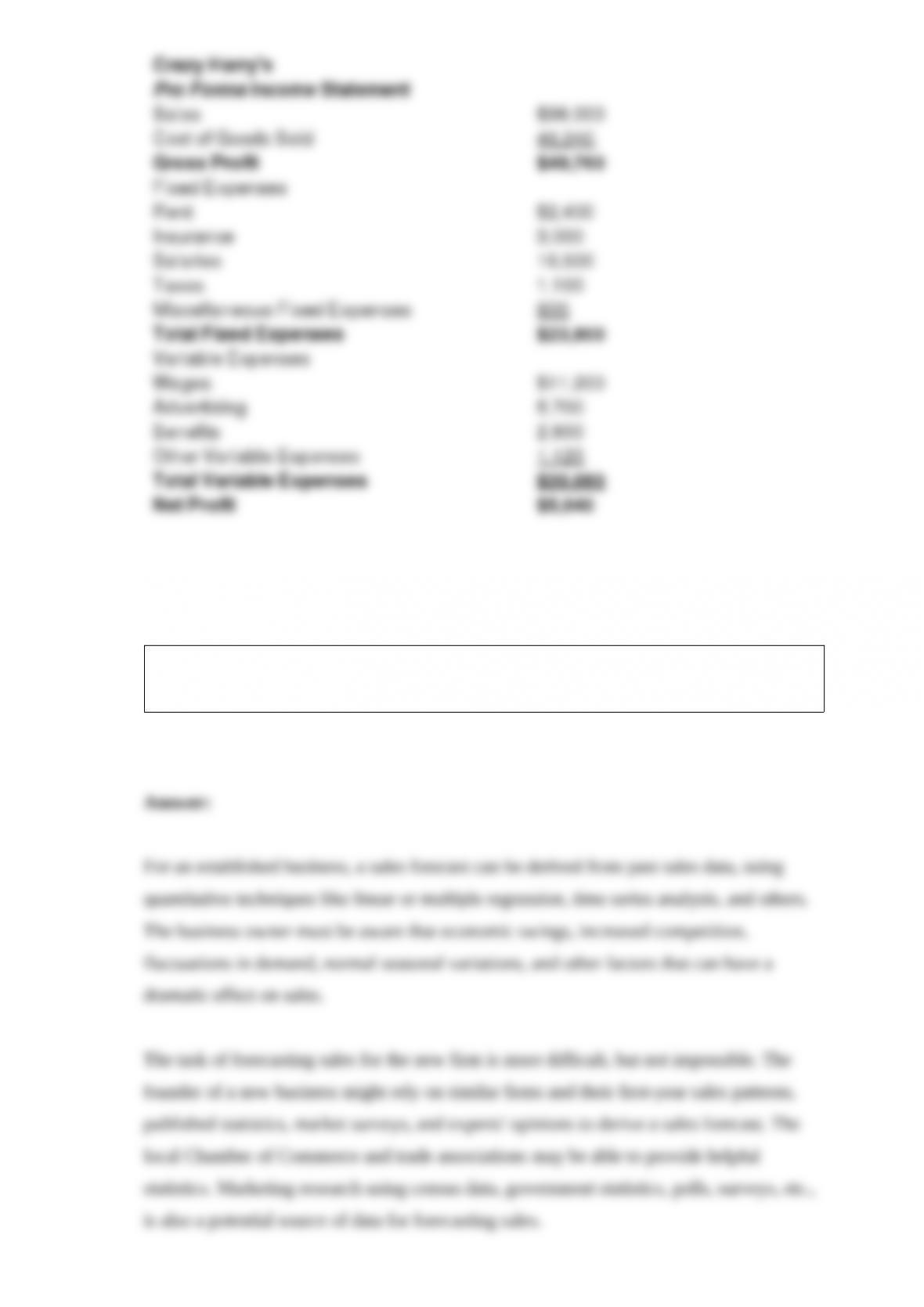
How are sales forecasts developed for an established business? How are sales forecasts
developed for a new business enterprise?

Mini-Case 13-1: “Where do I go now …?
Christine Hernandez is in the process of launching a restaurant. Christine has never
owned her own restaurant before, but she has worked for two of the best restaurants in
town. Starting out as a hostess, Christine developed a special knack for the business and
quickly worked her way up to the job of manager. Her 18 years of experience have
given her a solid foundation for running her own restaurant.
Christine has worked with a counselor at a nearby Small Business Development Center
and a counselor from the Service Corps of Retired Executives to prepare a business
plan. She asked two other consultants and an accountant to review the plan and
incorporated their suggestions into the finished product. When Christine took her plan
to her bank however, the bank turned down her loan request of $165,000 citing the
venture as “too risky, given the failure rate of restaurants.” The bank acknowledged her
experience as “a major asset,” but said that it “could not expose itself to such risks in its
portfolio.” Christine heard the same story from three other banks.
Christine is confident in her ability to manage her own restaurant successfully, and she
is determined to get the financing she needs to launch it.
Review the various loan programs under the Small Business Administration designed to
help finance businesses like Christine’s. Which of these programs would most likely
help Christine get the capital she needs?
Describe two situations – one where you consider dynamic pricing is ethical and the
other where dynamic pricing is unethical.
Identify and briefly discuss the eight factors an entrepreneur should consider when
selecting the city in which to locate her business.