Java How to Program, 11/e Multiple Choice Test Bank 1 of 9
Chapter 4 Control Statements: Part 1
Section 4.2 Algorithms
4.2 Q1: Which of the following is not an algorithm?
a. A recipe.
b. Operating instructions.
c. Textbook index.
d. Shampoo instructions (lather, rinse, repeat).
Section 4.3 Pseudocode
4.3 Q1: Which of the following is true?
a. Pseudocode is used to describe an algorithm.
b. Pseudocode is not an actual computer programming language.
c. Pseudocode is used to describe executable statements that will eventually be translated by the
programmer into a program.
d. All of the above.
Section 4.4 Control Structures
4.4 Q1: Which of the following is not a benefit of “goto–less programming”?
a. Easier to debug and modify
b. Shorter
c. Clearer
d. More likely to be bug free
4.4 Q2: Which of the following is not a control structure:
a. Sequence structure.
b. Selection structure.
c. Iteration structure.
d. Declaration structure.
Sequence Structure in Java
4.4 Q3: Which of the following is the shape of an action-state symbol?
a. Diamond.
b. Circle.
c. Rectangle with left and right sides replaced with arcs curving outward.
d. Rounded rectangle.
4.4 Q4: Which statement is false?
a. Unless directed otherwise, the computer executes Java statements one after the other in the order in
which they’re written.
b. Activity diagrams normally show the Java code that implements the activity.
c. Like pseudocode, activity diagrams help programmers develop and represent algorithms.
d. The arrows in the activity diagram represent transitions, which indicate the order in which the actions
represented by the action states occur.
Java How to Program, 11/e Multiple Choice Test Bank 2 of 9
Selection Statements in Java
4.4 Q5: Which of the following is a double-selection control statement?
a. do…while
b. for
c. if…else
d. if
Iteration Statements in Java
4.4 Q6: Which of the following is not a Java keyword?
a. do
b. next
c. while
d. for
Section 4.5 if Single-Selection Statement
4.5 Q1: What is output by the following Java code segment?
int temp = 200;
if (temp > 90) {
System.out.println(“This porridge is too hot.”);
}
if (temp < 70) {
System.out.println(“This porridge is too cold.”);
}
if (temp == 80) {
System.out.println(“This porridge is just right!”);
}
a. This porridge is too hot.
b. This porridge is too cold.
c. This porridge is just right!
d. None of the above.
4.5 Q2: A decision symbol in an activity diagram takes the shape of a ________.
a. Diamond.
b. Rectangle.
c. Circle.
d. Triangle.
4.5 Q3: Which of the following is not represented graphically in activity diagrams for control structures?
Java How to Program, 11/e Multiple Choice Test Bank 3 of 9
a. Transition arrow.
b. Attribute.
c. Action state.
d. Decision symbol.
Section 4.6 if…else Double-Selection Statement
Conditional Operator (?:)
4.6 Q1: Which of the following statements about the conditional operator (?:) is false?
a. The conditional operator is a ternary operator, meaning that it takes three operands.
b. The first operand is a boolean expression.
c. The second operand is the result value if the condition evaluates to false.
d. The second operand is the result value if the condition evaluates to true.
Nested if…else Statements
4.6 Q2: What is output by the following Java code segment?
int temp = 180;
if (temp > 90) {
System.out.println(“This porridge is too hot.”);
// cool down
temp = temp – (temp > 150 ? 100 : 20);
}
else {
if (temp < 70) {
System.out.println(“This porridge is too cold.”);
// warm up
temp = temp + (temp < 50 ? 30 : 20);
}
}
if (temp == 80) {
System.out.println(“This porridge is just right!”);
}
a. This porridge is too hot.
b. This porridge is too cold.
This porridge is just right!
c. This porridge is just right!
d. None of the above.
Blocks


Java How to Program, 11/e Multiple Choice Test Bank 6 of 9
Notes on Integer Division and Truncation
4.9 Q4: Which statement is true?
a. Dividing two integers results in integer division.
b. With integer division, any fractional part of the calculation is lost.
c. With integer division, any fractional part of the calculation is truncated.
d. All of the above.
Section 4.10 Formulating Algorithms: Sentinel-
Controlled Iteration
4.10 Q1: Which of the following terms is not used to refer to a sentinel value that breaks out of a while
loop?
a. signal value.
b. maximum value.
c. dummy value.
d. flag value.
4.10 Q2: Sentinel-controlled iteration is also known as:
a. Definite iteration.
b. Indefinite iteration.
c. Multiple iteration.
Developing the Pseudocode Algorithm with Top-Down, Stepwise
Refinement: The Top and First Refinement
4.10 Q3: Which of the following is not a common name for one of the three phases that a program often
can be split into using pseudocode?
a. Termination phase
b. Initialization phase
c. Processing phase
d. Action phase
Implementing Sentinel-Controlled Iteration
4.10 Q4: Which of the following segments is a proper way to call the method readData four times?
a. double k = 0.0;
while (k != 4) {
readData();
k = k + 1;
}
b. int i = 0;
while (i <= 4) {
readData();
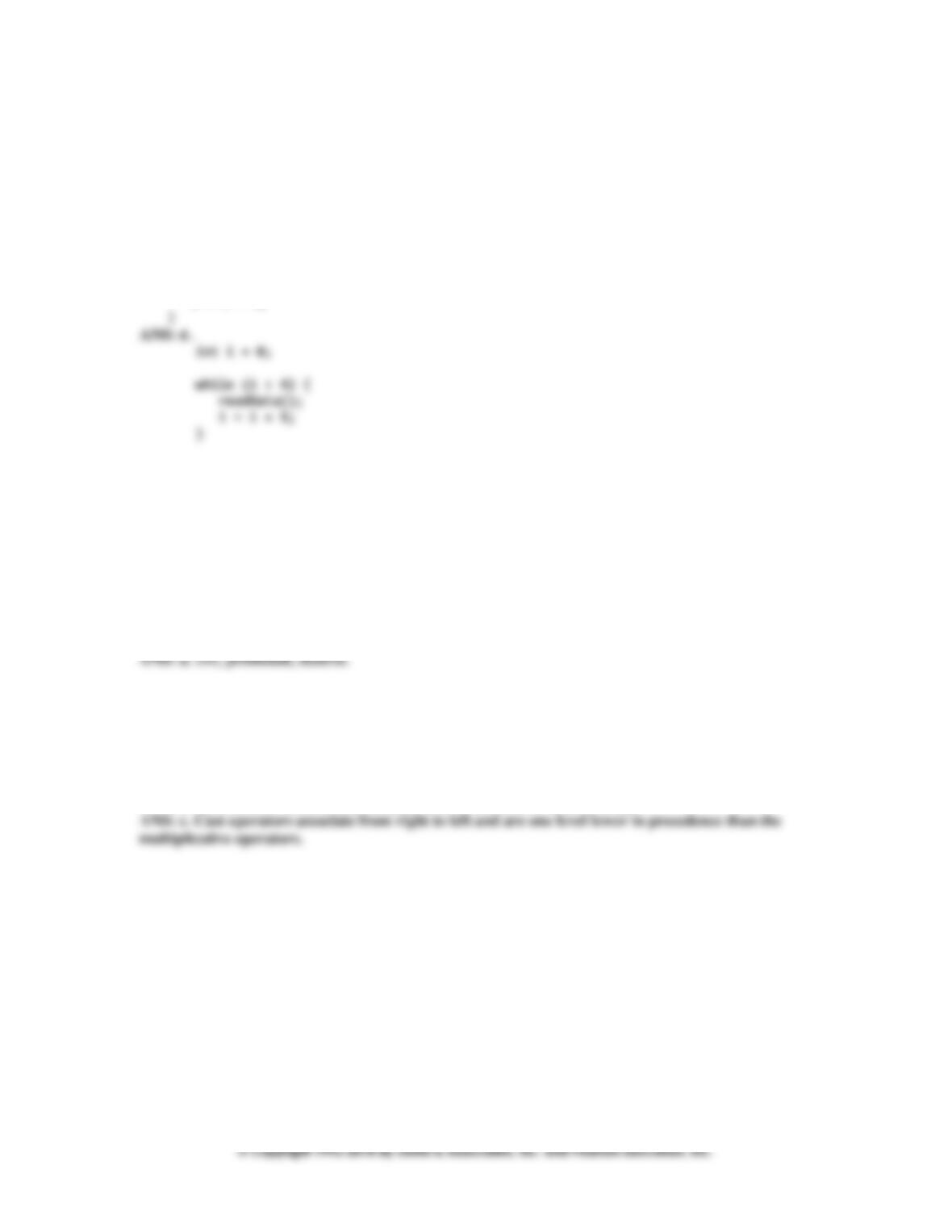
Java How to Program, 11/e Multiple Choice Test Bank 7 of 9
i = i + 1;
}
c. int i = 0;
while (i < 4) {
readData();
}
d. int i = 0;
while (i < 4) {
readData();
i = i + 1;
Explicitly and Implicitly Converting Between Primitive Types
4.10 Q5: In an expression containing values of the types int and double, the ________ values are
________ to ________ values for use in the expression.
a. int, promoted, double.
b. int, demoted, double.
c. double, promoted, int.
d. double, demoted, int.
4.10 Q6: Which of the following statements is false?
a. To ensure that the operands in a mixed-type expression are of the same type, Java performs implicit
conversion on selected operands.
b. Cast operators are unary operators.
c. Cast operators associate from right to left and are one level lower in precedence than the multiplicative
operators.
d. Cast operators are formed by placing parentheses around the name of a type.
Section 4.11 Formulating Algorithms: Nested Control
Statements
Complete Second Refinement of Pseudocode and Conversion to
Class Analysis
4.11 Q1: Local variables must be ________.
a. initialized when they’re declared.
Java How to Program, 11/e Multiple Choice Test Bank 8 of 9
b. initialized before their values are used in an expression.
c. declared and initialized in two steps.
d. declared at the top of the method’s body.
4.11 Q2: Which of the following statements is true?
a. A while statement cannot be nested inside another while statement.
b. An if statement cannot be nested inside another if statement.
c. A while statement cannot be nested inside an if statement.
d. None of the above is true.
Section 4.12 Compound Assignment Operators
4.12 Q1: Which of the following code segments does not increment val by 3:
a. val += 3;
b. val = val + 1;
val = val + 1;
val = val + 1;
c. c = 3;
val = val + (c == 3 ? 2 : 3);
d. All of the above increment val by 3.
4.12 Q2: What does the expression x %= 10 do?
a. Adds 10 to the value of x, and stores the result in x.
b. Divides x by 10 and stores the remainder in x.
c. Divides x by 10 and stores the integer result in x.
d. None of the above.
Section 4.13 Increment and Decrement Operators
4.13 Q1: Which of the following operators associates from left to right?
a. =
b. ?:
c. %=
d. /
4.13 Q2: What is the result value of c at the end of the following code segment?
int c = 8;
c++;
++c;
c %= 5;
a. 0.
b. 1.
c. 3.
d. None of the above.
Section 4.14 Primitive Types
4.14 Q1: Java is considered a strongly typed language because:

Java How to Program, 11/e Multiple Choice Test Bank 9 of 9
a. The primitive types in Java are portable across all computer platforms that support Java.
b. Java requires all variables to have a type before they can be used in a program.
c. Instance variables of the primitive types are automatically assigned a default value.
d. All of the above.
4.14 Q2: Which of the following is not a primitive type?
a. char
b. float
c. String
d. int
4.14 Q3: Which primitive type can hold the largest value?
a. int
b. long
c. float
d. double
4.14 Q4: What is the size in bits of an int?
a. 8
b. 16
c. 32
d. 64