
Match the type of fossilization with the correct definition.
A) Organic pores are filled with precipitated minerals
B) Indirect evidence of fossil life (i.e. tracks, burrows)
C) Hollows left by dissolved fossils are filled with mineral matter
D) Fine sediment encases plant remains, leaving behind an organic residue
7) Permineralization
Diff: 1
Bloom’s Taxonomy: Knowledge
Global Sci Out: 7
Section: 9.2 – Fossils: Evidence of Past Life
Focus/Concepts: 9.2
Earth Science LO: 6.1 – Fossils are the preserved evidence of ancient life.
8) Cast and Mold
Diff: 1
Bloom’s Taxonomy: Knowledge
Global Sci Out: 7
Section: 9.2 – Fossils: Evidence of Past Life
Focus/Concepts: 9.2
Earth Science LO: 6.1 – Fossils are the preserved evidence of ancient life.
9) Carbonization
Diff: 1
Bloom’s Taxonomy: Knowledge
Global Sci Out: 7
Section: 9.2 – Fossils: Evidence of Past Life
Focus/Concepts: 9.2
Earth Science LO: 6.1 – Fossils are the preserved evidence of ancient life.
10) Trace Fossil
Diff: 1
Bloom’s Taxonomy: Knowledge
Global Sci Out: 7
Section: 9.2 – Fossils: Evidence of Past Life
Focus/Concepts: 9.2
Earth Science LO: 6.1 – Fossils are the preserved evidence of ancient life.

16
Match the parent isotope with the correct daughter isotope. (Note: Some answers will be used
more than once.)
A) Strontium
B) Nitrogen
C) Argon
D) Lead
11) Uranium
Diff: 1
Bloom’s Taxonomy: Knowledge
Global Sci Out: 7
Section: 9.4 – Dating With Radioactivity
Focus/Concepts: 9.4
Earth Science LO: 1.2 – Earth scientists use a large variety of scientific principles to understand
how our planet works.
12) Potassium
Diff: 1
Bloom’s Taxonomy: Knowledge
Global Sci Out: 7
Section: 9.4 – Dating With Radioactivity
Focus/Concepts: 9.4
Earth Science LO: 1.2 – Earth scientists use a large variety of scientific principles to understand
how our planet works.
13) Carbon
Diff: 1
Bloom’s Taxonomy: Knowledge
Global Sci Out: 7
Section: 9.4 – Dating With Radioactivity
Focus/Concepts: 9.4
Earth Science LO: 1.2 – Earth scientists use a large variety of scientific principles to understand
how our planet works.
14) Thorium
Diff: 1
Bloom’s Taxonomy: Knowledge
Global Sci Out: 7
Section: 9.4 – Dating With Radioactivity
Focus/Concepts: 9.4
Earth Science LO: 1.2 – Earth scientists use a large variety of scientific principles to understand
how our planet works.

15) Rubidium
Diff: 1
Bloom’s Taxonomy: Knowledge
Global Sci Out: 7
Section: 9.4 – Dating With Radioactivity
Focus/Concepts: 9.4
Earth Science LO: 1.2 – Earth scientists use a large variety of scientific principles to understand
how our planet works.

Put the units of the Geologic Time Scale in order from largest to smallest. (Note: In this
situation, “First” refers the largest time period and “Fourth” refers to the smallest times period.)
A) Eon
B) Epoch
C) Period
D) Era
16) First (Largest period)
Diff: 1
Bloom’s Taxonomy: Knowledge
Global Sci Out: 7
Section: 9.5 – The Geologic Time Scale
Focus/Concepts: 9.5
Earth Science LO: 2.1 – Earth’s rocks and other materials provide a record of its history.
17) Second
Diff: 1
Bloom’s Taxonomy: Knowledge
Global Sci Out: 7
Section: 9.5 – The Geologic Time Scale
Focus/Concepts: 9.5
Earth Science LO: 2.1 – Earth’s rocks and other materials provide a record of its history.
18) Third
Diff: 1
Bloom’s Taxonomy: Knowledge
Global Sci Out: 7
Section: 9.5 – The Geologic Time Scale
Focus/Concepts: 9.5
Earth Science LO: 2.1 – Earth’s rocks and other materials provide a record of its history.
19) Fourth (Smallest period)
Diff: 1
Bloom’s Taxonomy: Knowledge
Global Sci Out: 7
Section: 9.5 – The Geologic Time Scale
Focus/Concepts: 9.5
Earth Science LO: 2.1 – Earth’s rocks and other materials provide a record of its history.
9.5 Essay Questions
1) One method of geologic dating is dendrochronology, or the science of tree ring dating. Based
on what you know about tree rings, how would researchers date the tree? Would this be relative
dating or numerical dating?
2) What are some natural sedimentary formations/structures that violate the Principle of Original
Horizontality? Explain how they form and how they violate this rule.
3) When reading the principles of relative dating, many of them are careful to state that the rule
applies to sediments or lava flows. (Example: The Principle of X states that sedimentary layers
or lava flows are originally deposited in fashion Y.) Why would these rules not apply to intrusive
igneous rocks or metamorphic rocks?
4) You are studying an outcrop where the base layer is limestone and the layer directly on top of
that is sandstone. Near the base of the sandstone are small, weathered pieces of limestone
entirely contained within the sandstone. Explain how these pieces of limestone came to be
contained within the sandstone.
5) Assuming that humans went extinct today, do you think that humans would be good index
fossils? Why or why not? (List three reasons.)
6) Compare and contrast the three common types of radioactive decay: alpha particle decay, beta
particle decay, electron capture. Your answer should include how the atomic mass and the
atomic number of the isotope have changed.
7) Support the following statement with evidence: Scientists know less about the first 4/5 of
Earth’s history than about the last 1/5.
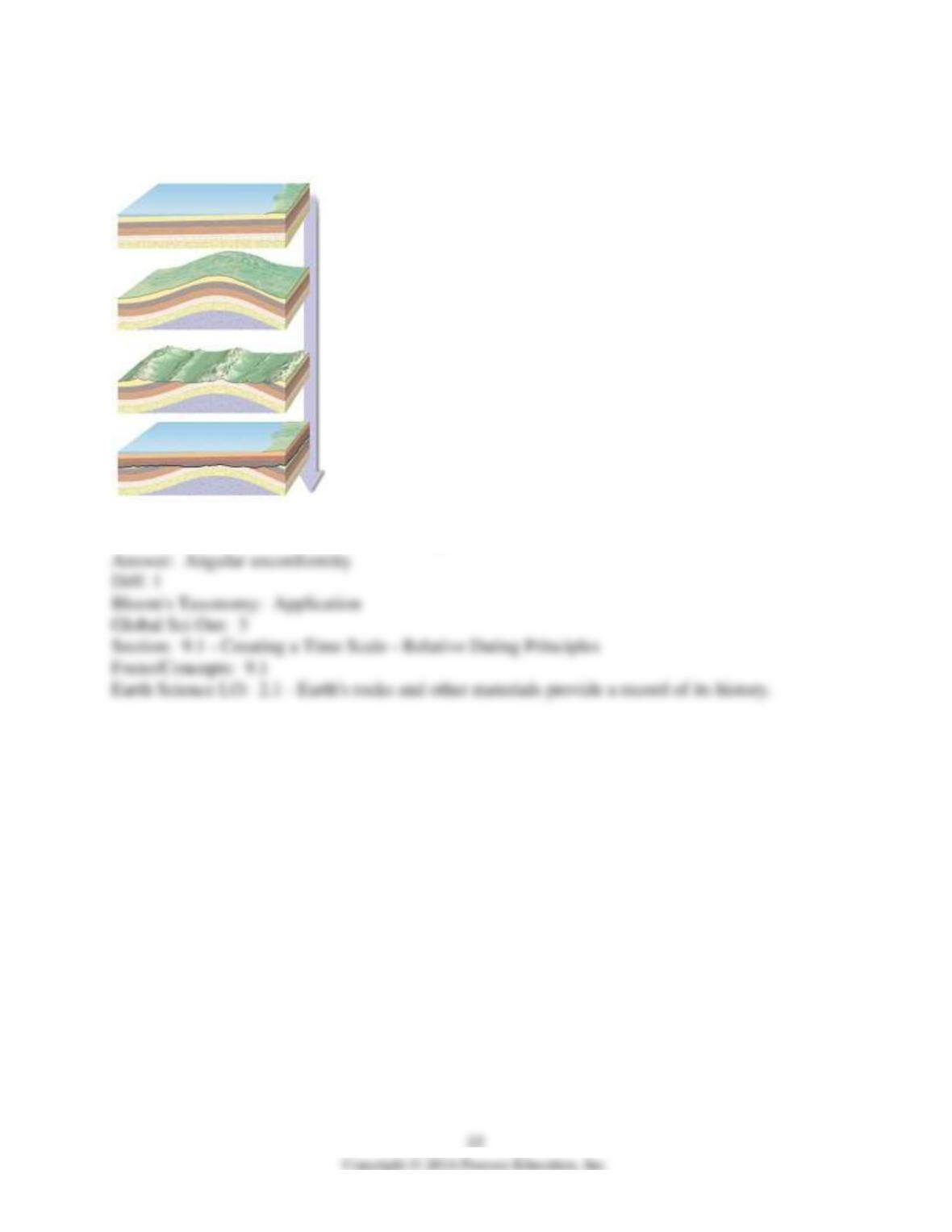
9.6 Visual
1)
What geologic feature is present in this image?
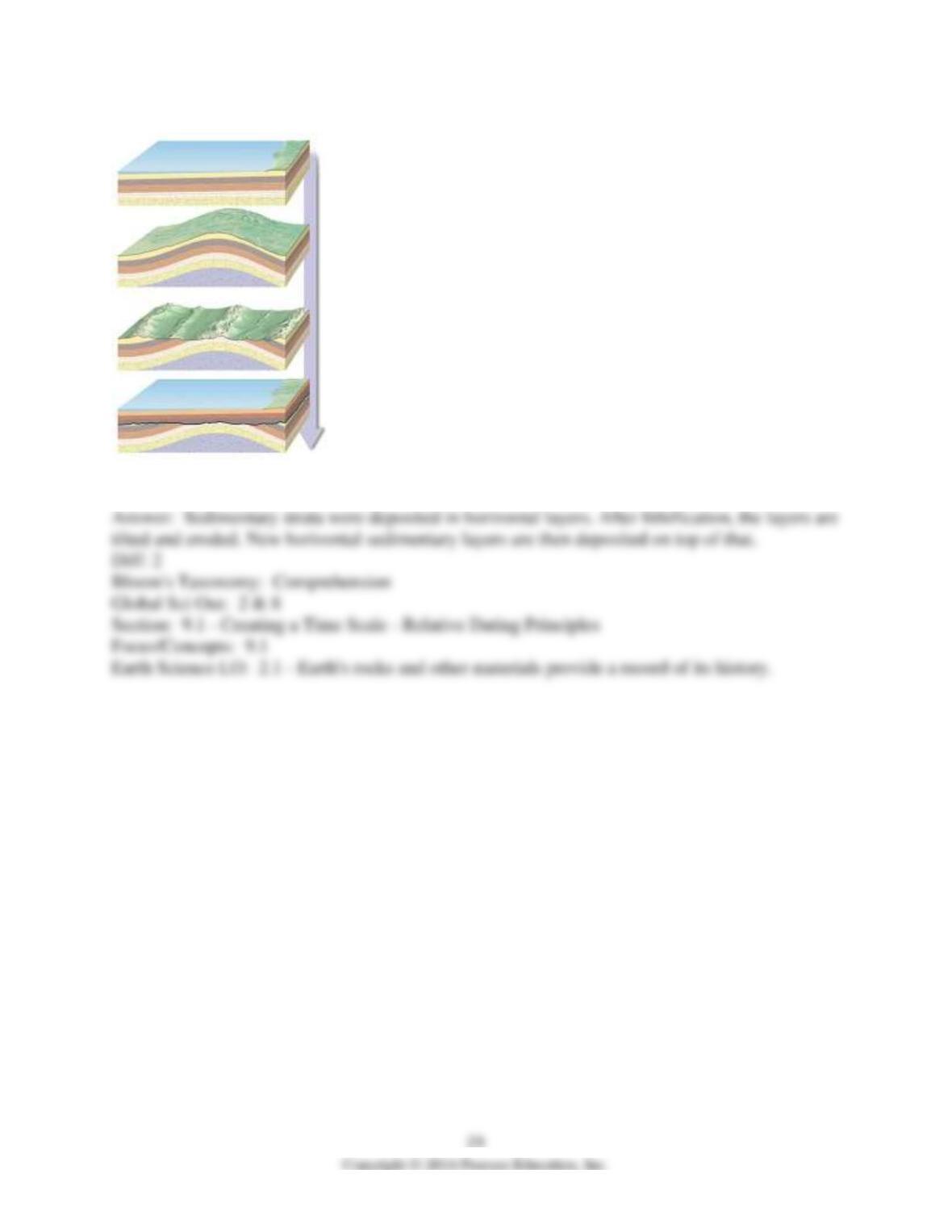
2)
Explain how the feature in this image formed.
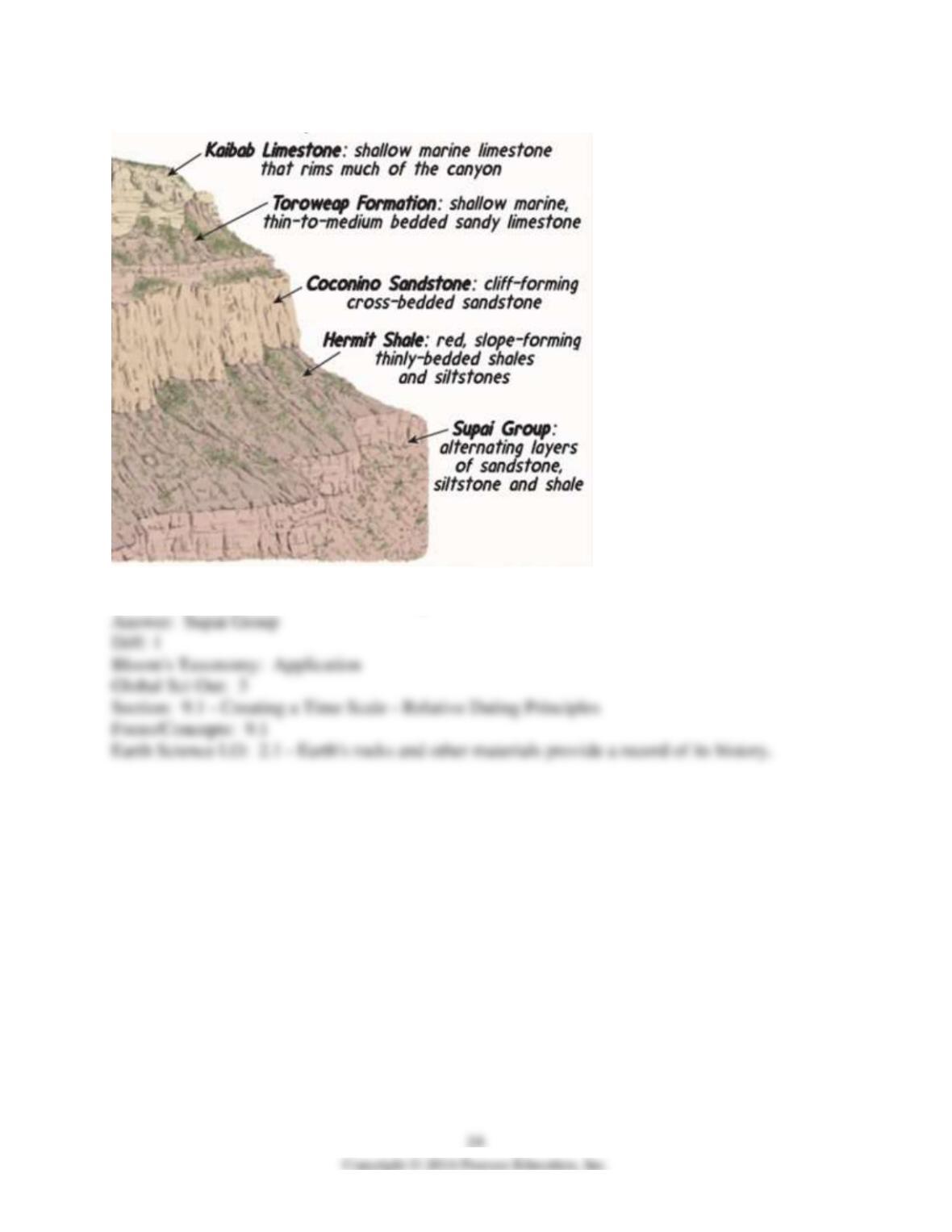
3)
Which rock layer is the oldest in this image?
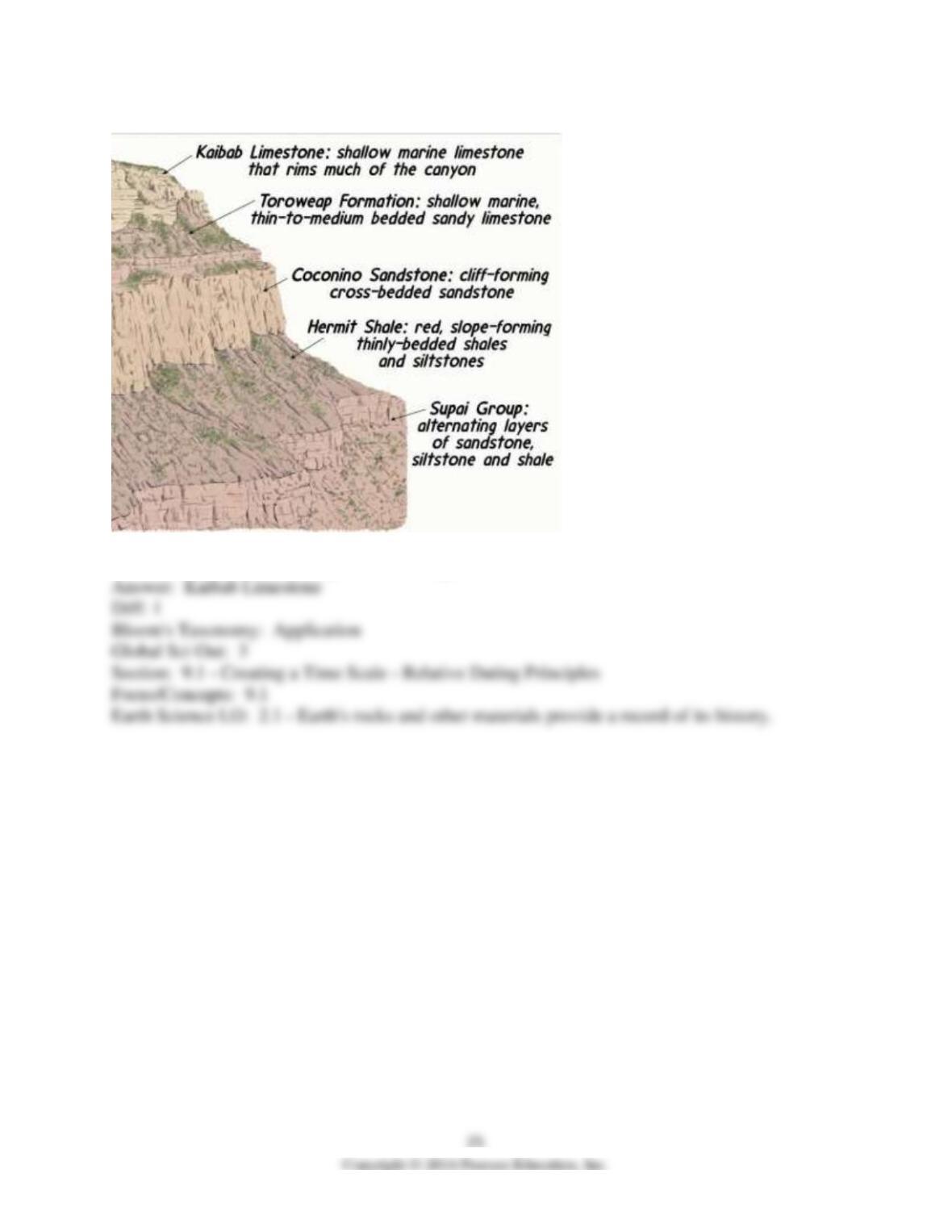
4)
Which rock layer is the youngest in this image?
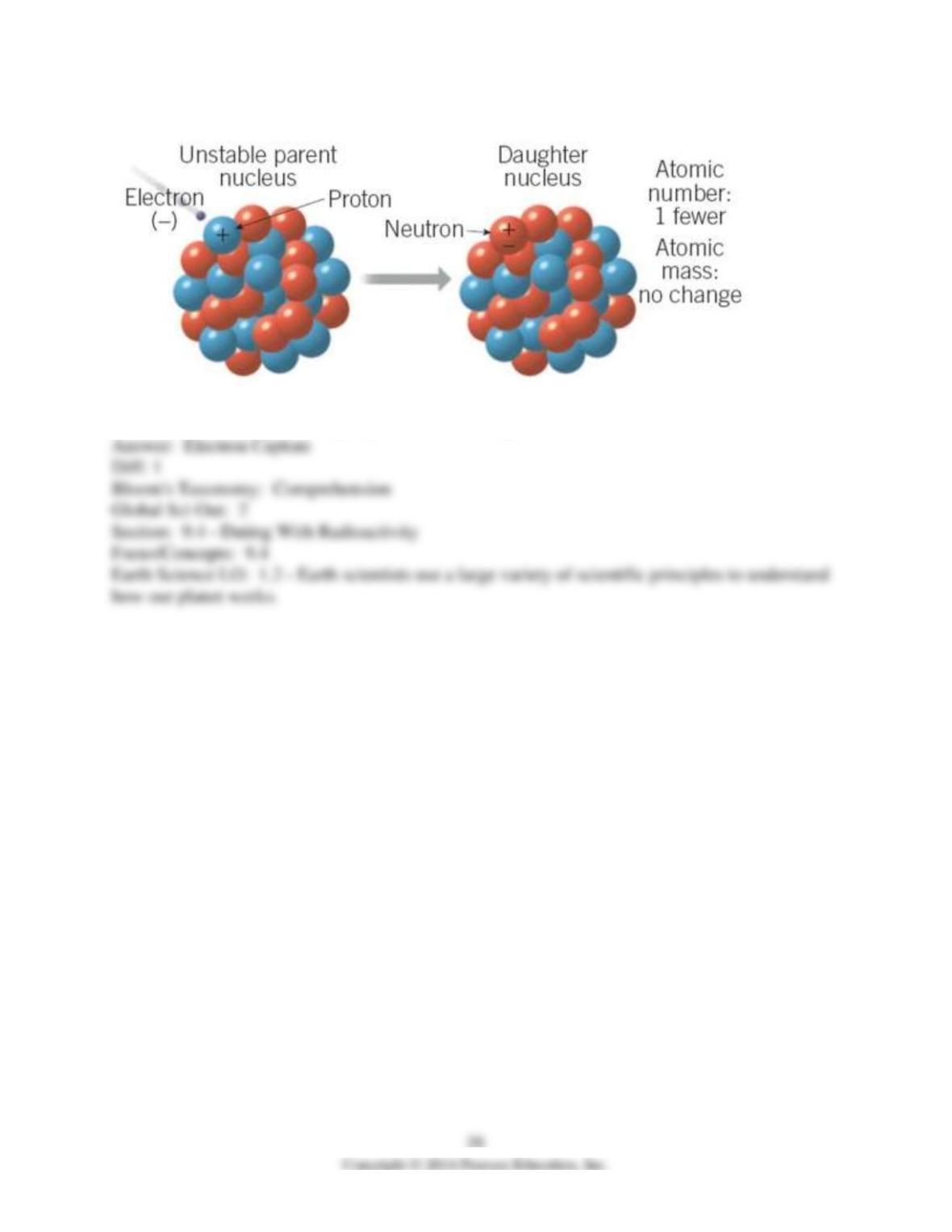
5)
What kind of radioactive decay is present in this image?
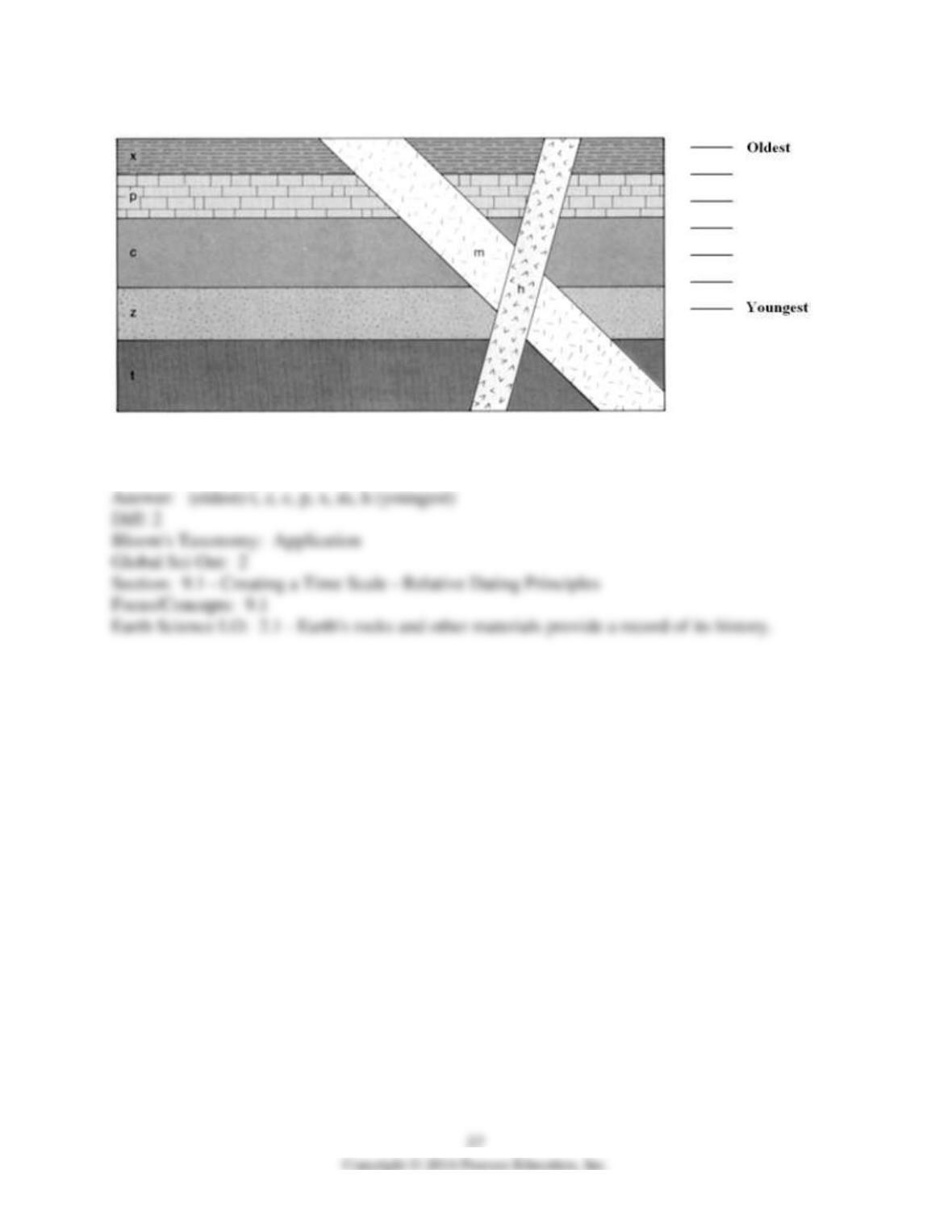
6)
Using the geologic cross-section above, put the rock layers in order from oldest to youngest. Use
the blanks to the right of the figure for your answers.
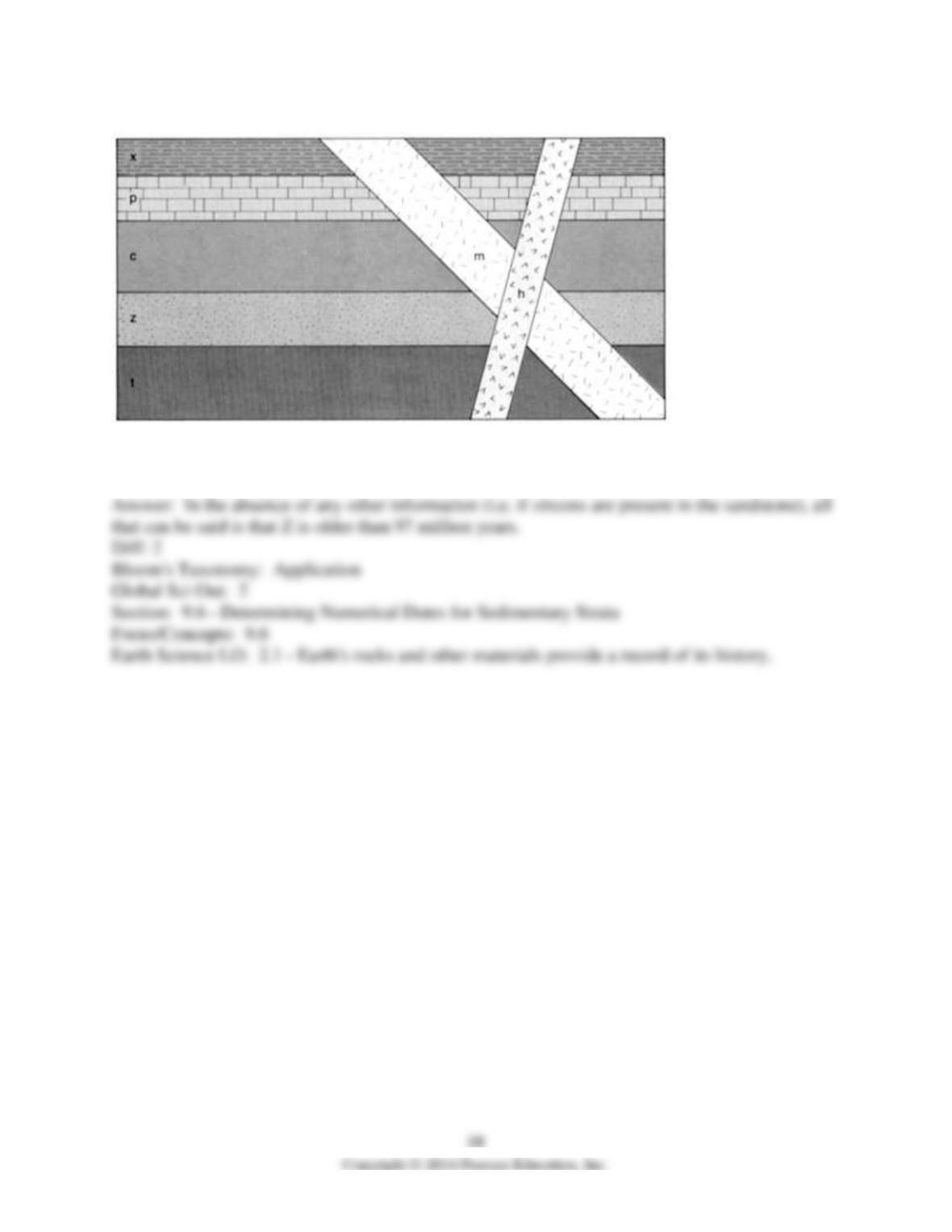
7)
Assume that Layer C is a lava flow that has been radiometrically dated to 97 million years ago.
What is the age of Layer Z?