12) Composite cones are famous for their conical shapes with steep summits, sloping flanks, and
broad base. Explain how the eruptive materials ejected by a composite cone are going to
contribute to the shape of the volcanic peak. (Keep in mind that eruptive materials can change
over time.)
13) Draw a cross-sectional diagram of a pyroclastic flow. Make sure to illustrate the two parts of
the flow as well as describe the materials making up each part.
14) When Eyjafjallajökull erupted in March 2010, ash plumes drifted southeast over Europe and,
as a result, the controlled airspaces over many European countries were closed to air traffic,
stranding thousands of people worldwide. Give three reasons why flying commercial jets
through ash plumes would be dangerous.
15) Provide three examples of how lahars can form.
16) You are in charge of emergency planning in Electron, Washington, when it is brought to
your attention that the entire town is built upon the remains of a major lahar from Mt. Rainier,
which is over 20 miles away. It is now up to you to develop an evacuation plan for the city. What
volcanic hazards would you need to plan for? How would you get people to safety? Provide a
brief outline of your emergency plan.
17) Explain how sulfur dioxide gas can affect global climate. Also, what role do you think that
latitude of the eruption will have, if any, on the distribution of these effects?
18) Explain how a volcanic neck will form.
19) How is a volcanic neck different from a volcanic pipe?
20) Explain how decompression melting will work at a divergent rift?
21) Volcanic island arcs are continental volcanic arcs are both associated with convergent plate
boundaries. However, the lavas that their volcanoes erupt are different. Explain how different
lavas are produced in these two arcs.
22) Along which tectonic boundary would the greatest amount of magma be generated every
year? Explain why.
23) How do scientists use earthquakes to determine if a volcano may erupt soon?

5.4 Matching Questions
Put the following pyroclastic materials in order from smallest to largest.
A) Smallest
B) Neither smallest nor largest
C) Largest
1) Volcanic bombs
Diff: 1
Bloom’s Taxonomy: Knowledge
Global Sci Out: 7
Section: 5.2 – Materials Extruded During an Eruption
Focus/Concepts: 5.2
Earth Science LO: 4.6 – Earth materials take many different forms as they cycle through the
geosphere.
2) Ash
Diff: 1
Bloom’s Taxonomy: Knowledge
Global Sci Out: 7
Section: 5.2 – Materials Extruded During an Eruption
Focus/Concepts: 5.2
Earth Science LO: 4.6 – Earth materials take many different forms as they cycle through the
geosphere.
3) Lapilli
Diff: 1
Bloom’s Taxonomy: Knowledge
Global Sci Out: 7
Section: 5.2 – Materials Extruded During an Eruption
Focus/Concepts: 5.2
Earth Science LO: 4.6 – Earth materials take many different forms as they cycle through the
geosphere.

23
Match the volcanic hazard with its definition.
A) Destructive sea wave triggered by powerful explosions or landslides into large bodies of
water
B) Hot, fast moving body of expanding gas and ash that hugs the flanks of the volcano
C) Substances like CO2, SO2, Cl, and F that can result in climate change and be hazardous to
human health
D) Fluid mudflow of volcanic debris
E) Large volumes of ash precipitating from eruption cloud
4) Pyroclastic flow
Diff: 1
Bloom’s Taxonomy: Knowledge
Global Sci Out: 5 & 7
Section: 5.7 – Volcanic Hazards
Focus/Concepts: 5.7
Earth Science LO: 8.1 – Natural hazards result from natural Earth processes.
5) Lahar
Diff: 1
Bloom’s Taxonomy: Knowledge
Global Sci Out: 5 & 7
Section: 5.7 – Volcanic Hazards
Focus/Concepts: 5.7
Earth Science LO: 8.1 – Natural hazards result from natural Earth processes.
6) Tsunami
Diff: 1
Bloom’s Taxonomy: Knowledge
Global Sci Out: 5 & 7
Section: 5.7 – Volcanic Hazards
Focus/Concepts: 5.7
Earth Science LO: 8.1 – Natural hazards result from natural Earth processes.
7) Ash Falls
Diff: 1
Bloom’s Taxonomy: Knowledge
Global Sci Out: 5 & 7
Section: 5.7 – Volcanic Hazards
Focus/Concepts: 5.7
Earth Science LO: 8.1 – Natural hazards result from natural Earth processes.

8) Volcanic Gases
Diff: 1
Bloom’s Taxonomy: Knowledge
Global Sci Out: 5 & 7
Section: 5.7 – Volcanic Hazards
Focus/Concepts: 5.7
Earth Science LO: 8.1 – Natural hazards result from natural Earth processes.

25
Match the volcano name with the volcano type for the following questions. Choices will be used
more than once.
A) Cinder Cone
B) Shield Volcano
C) Composite Cone
9) Mount Hood
Diff: 1
Bloom’s Taxonomy: Knowledge
Global Sci Out: 7
Section: 5.4 – Shield Volcanoes, 5.5 – Cinder Cones, & 5.6 – Composite Volcanoes
Focus/Concepts: 5.4
Earth Science LO: 4.7 – Landscapes result from the dynamic interplay between processes that
form and uplift new crust and processes that destroy and depress the crust.
10) Mauna Kea
Diff: 1
Bloom’s Taxonomy: Knowledge
Global Sci Out: 7
Section: 5.4 – Shield Volcanoes, 5.5 – Cinder Cones, & 5.6 – Composite Volcanoes
Focus/Concepts: 5.4
Earth Science LO: 4.7 – Landscapes result from the dynamic interplay between processes that
form and uplift new crust and processes that destroy and depress the crust.
11) Parícutin
Diff: 1
Bloom’s Taxonomy: Knowledge
Global Sci Out: 7
Section: 5.4 – Shield Volcanoes, 5.5 – Cinder Cones, & 5.6 – Composite Volcanoes
Focus/Concepts: 5.4
Earth Science LO: 4.7 – Landscapes result from the dynamic interplay between processes that
form and uplift new crust and processes that destroy and depress the crust.
12) Cerro Negro
Diff: 1
Bloom’s Taxonomy: Knowledge
Global Sci Out: 7
Section: 5.4 – Shield Volcanoes, 5.5 – Cinder Cones, & 5.6 – Composite Volcanoes
Focus/Concepts: 5.4
Earth Science LO: 4.7 – Landscapes result from the dynamic interplay between processes that
form and uplift new crust and processes that destroy and depress the crust.
13) Newberry Volcano
Diff: 1
Bloom’s Taxonomy: Knowledge
Global Sci Out: 7
Section: 5.4 – Shield Volcanoes, 5.5 – Cinder Cones, & 5.6 – Composite Volcanoes
Focus/Concepts: 5.4
Earth Science LO: 4.7 – Landscapes result from the dynamic interplay between processes that
form and uplift new crust and processes that destroy and depress the crust.
14) Mount Etna
Diff: 1
Bloom’s Taxonomy: Knowledge
Global Sci Out: 7
Section: 5.4 – Shield Volcanoes, 5.5 – Cinder Cones, & 5.6 – Composite Volcanoes
Focus/Concepts: 5.4
Earth Science LO: 4.7 – Landscapes result from the dynamic interplay between processes that
form and uplift new crust and processes that destroy and depress the crust.
5.5 Essay Questions
1) Explain the difference between a quiescent and an explosive eruption.
2) Explain the difference between a pyroclastic flow and a pyroclastic surge.
3) What is the importance of monitoring volcanic activity?
4) Compare and contrast the three types of volcanoes (shield, cinder cones, and composite
cones). Make sure to comment on the differences in size, shape, and slope angle.
5) Based on the eruptive materials, volcanic hazards, and violence of eruptions, which type of
volcano would be the most dangerous to live near? Cite specific hazards and how they could
affect nearby residents.
5.6 Visual
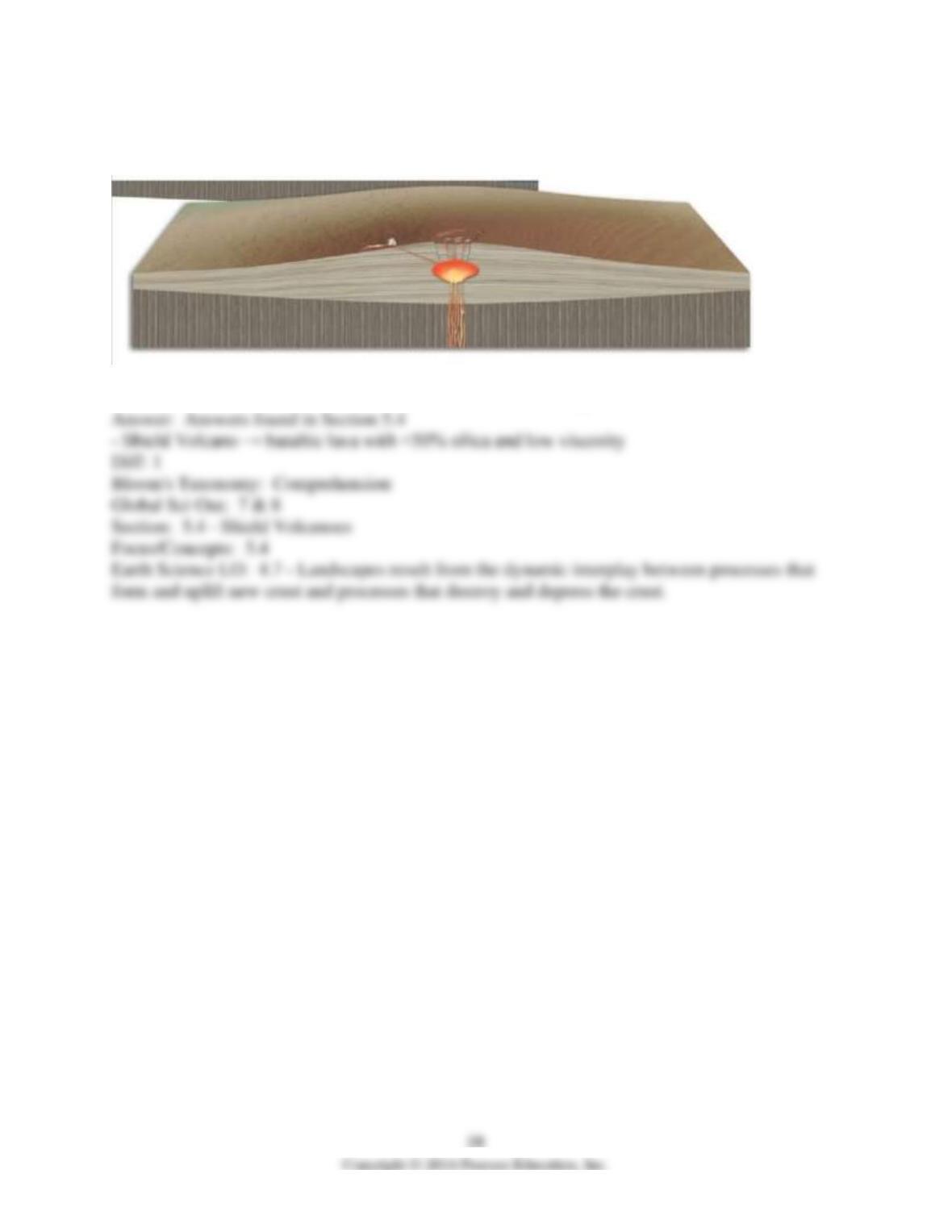
1)
What kind of volcano is this? Based on the volcanic type and construction of the flanks, what
assumptions can you make about the silica content and viscosity of the lava?
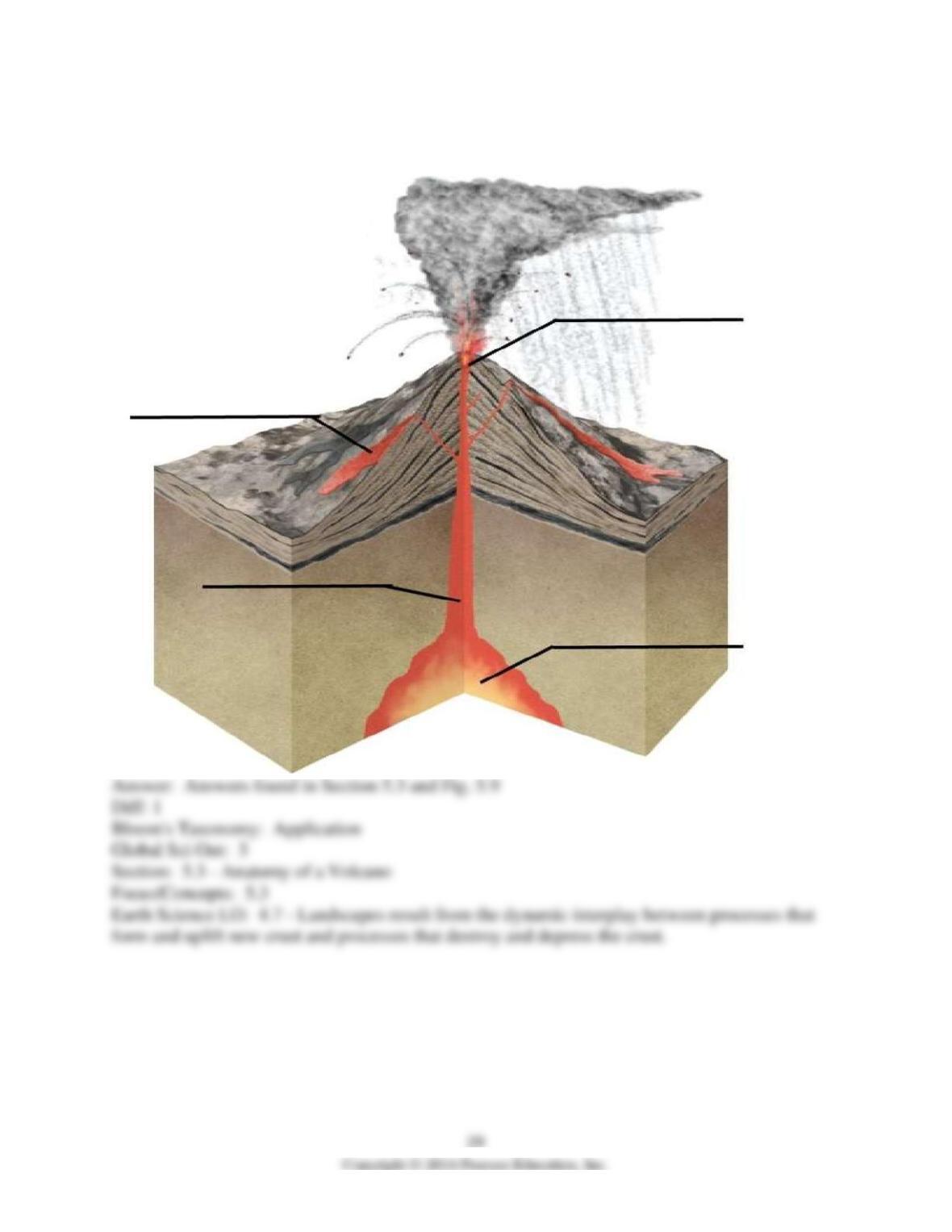
2) Using the figure below, identify the following features: lava flow, vent, conduit and magma
chamber.
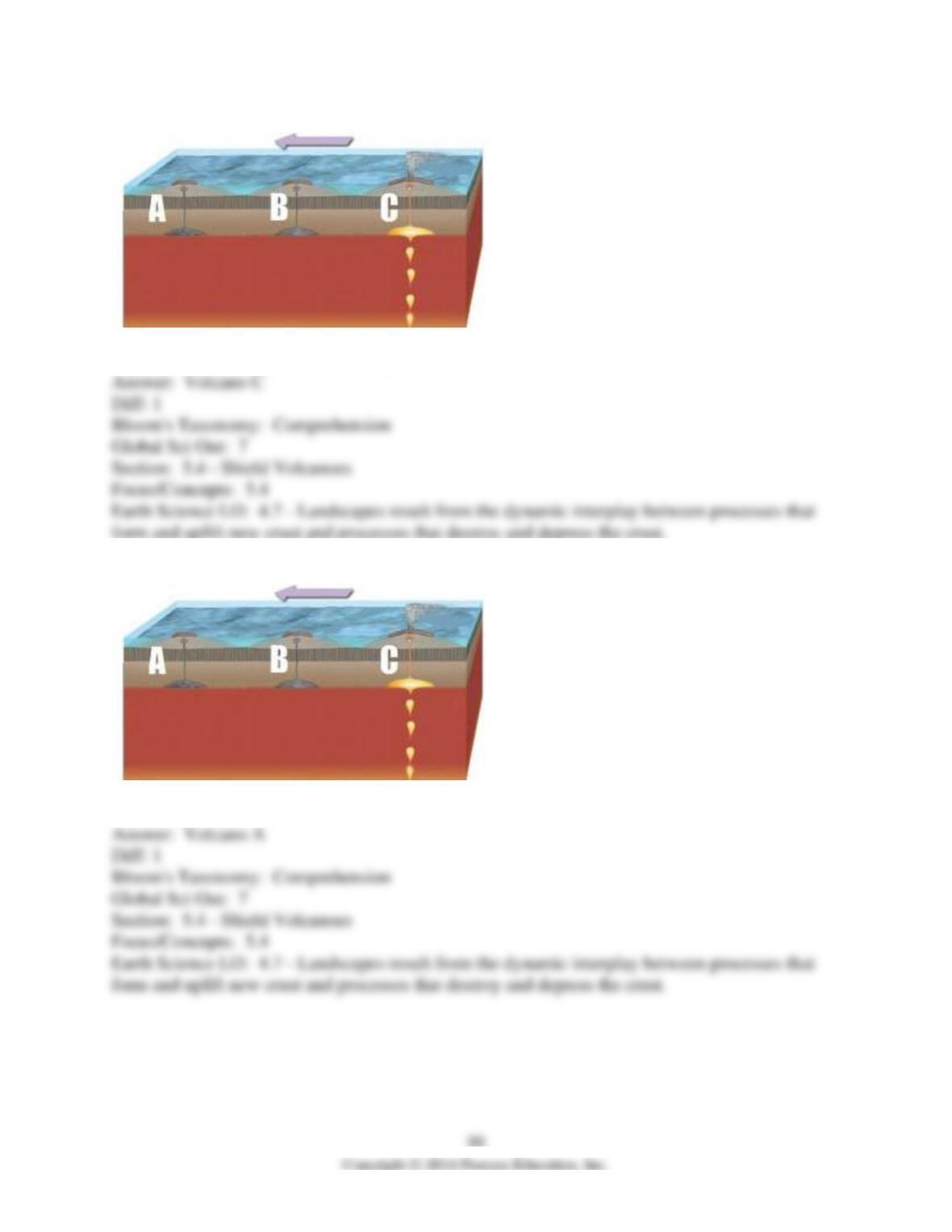
3)
Which volcanic island is still forming?
4)
Which volcanic island is the oldest?
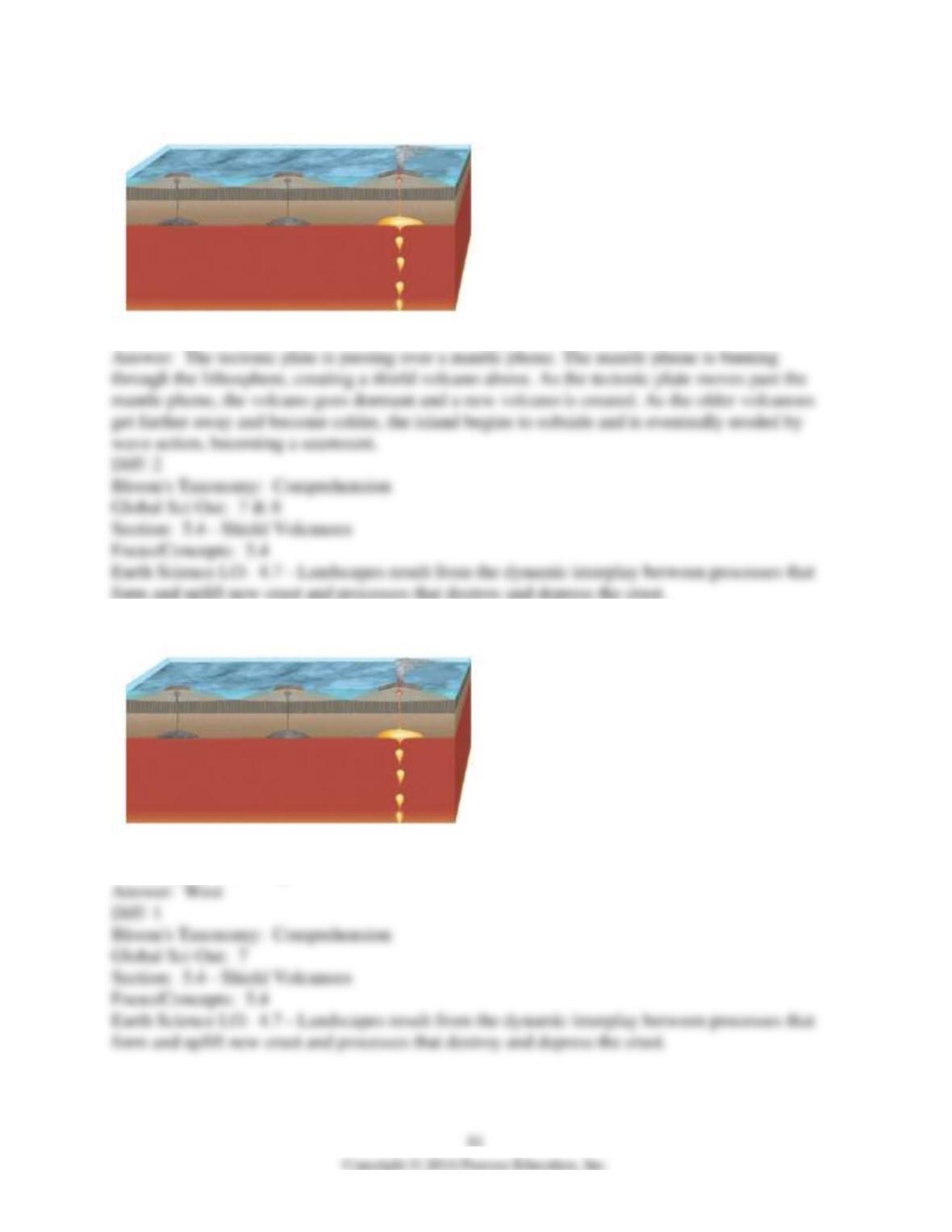
5)
Explain how this chain of volcanic islands is forming.
6)
Assuming the left side of the figure is West and the right side East, which direction is the
tectonic plate is moving?
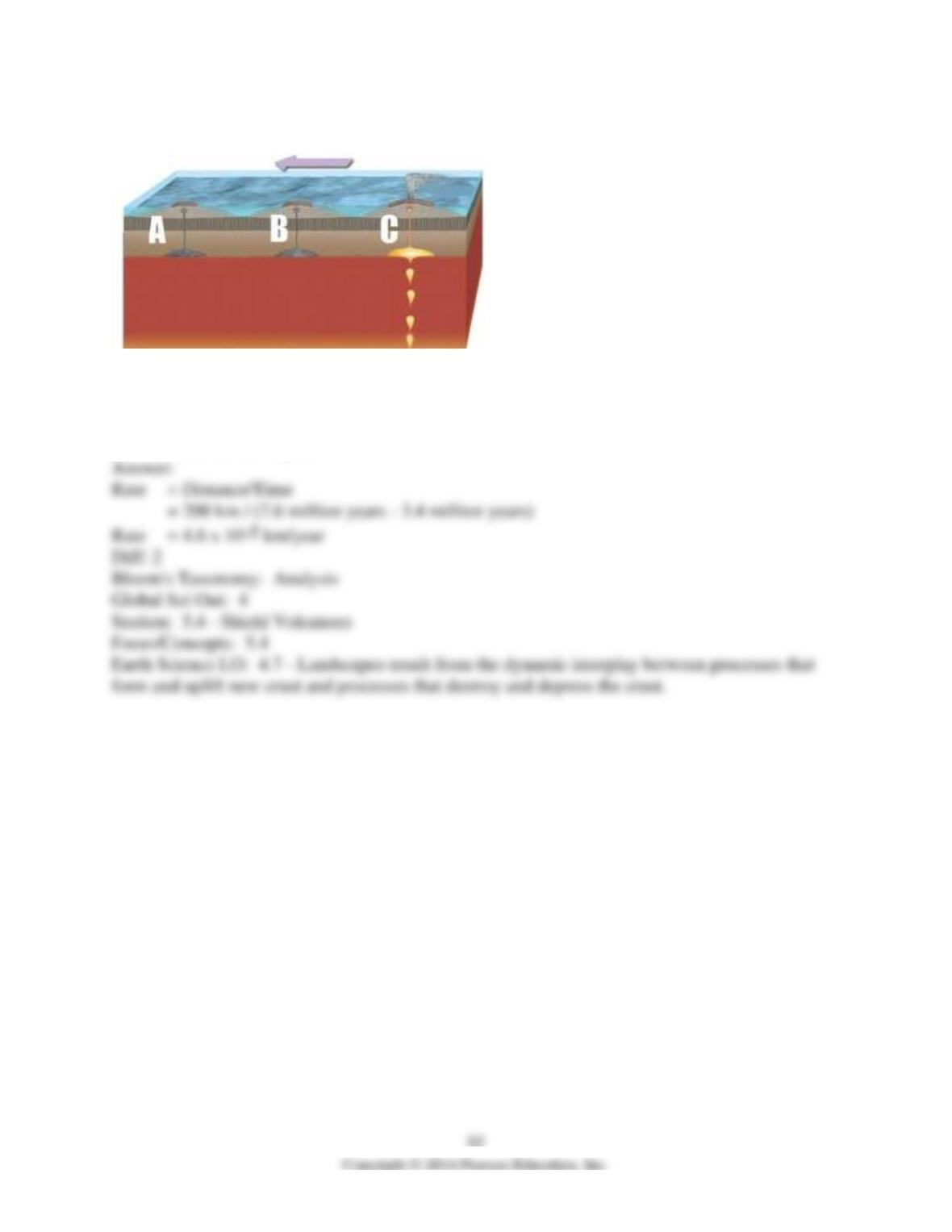
7)
Researchers working on these volcanic islands have collected basalt samples for Potassium-
Argon dating to determine when these islands formed. Volcanic Island A has been dated to 7.6
million years ago. Volcanic Island C dates back to 3.4 million years ago. Calculate the rate of
plate motion for this region.
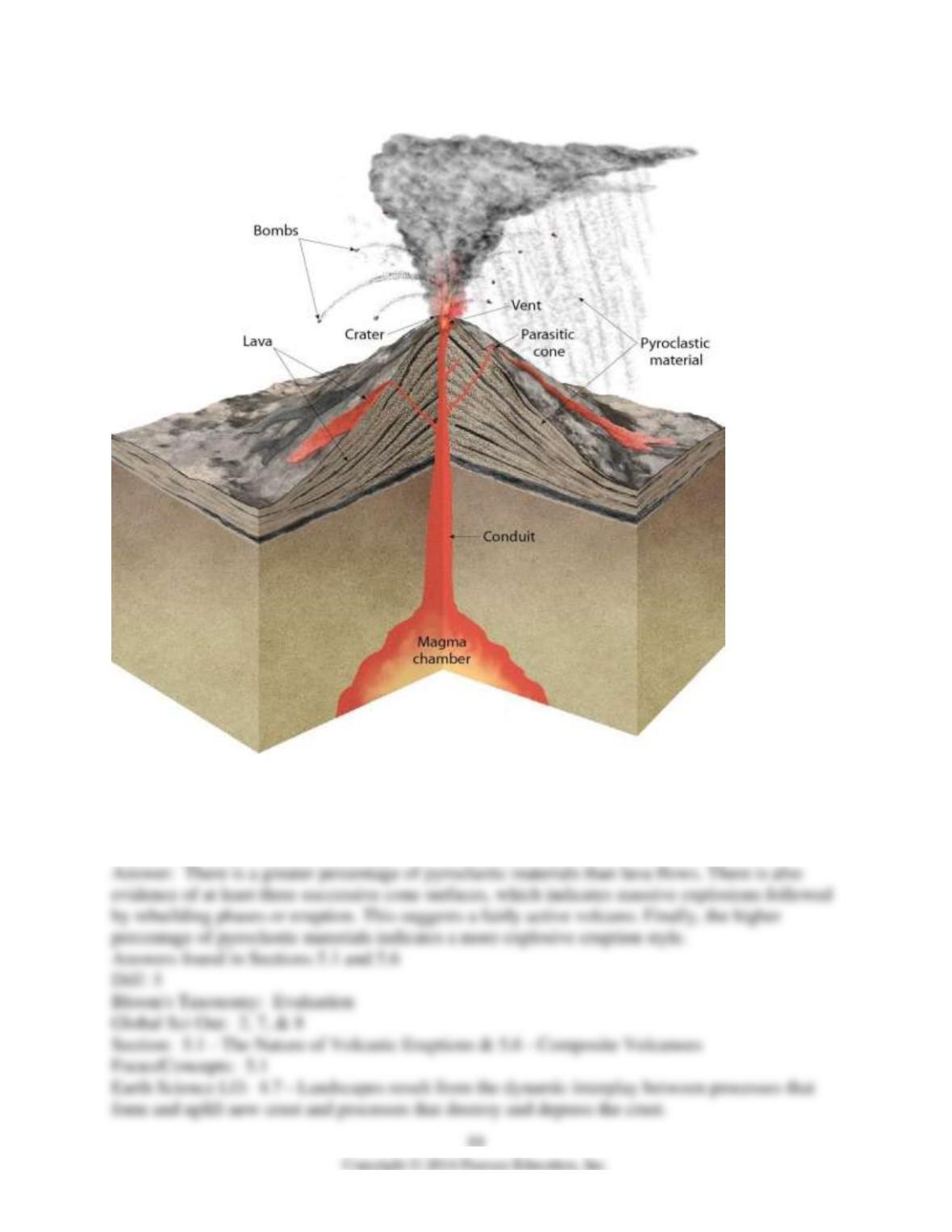
8)
Make a visual estimation of the percentage of lava flows and the percentage of pyroclastic
materials in the cross-section of a composite cone. Based on your estimation, how active would
you say this volcano is? When it is actively erupting, do you think it erupts quietly or
explosively? Explain your reasoning.