7) Circle the intrusive igneous textures below.
Phaneritic, Aphanitic, Glassy, Pyroclastic, Pegmatitic
8) All rocks are classified according to ________ and ________.
9) Why would rhyolite deposits be less common than granite deposits?

Use this scenario for the following questions: In the pursuit of scientific knowledge, you
decide to bore a hole into the crust to see how the temperature changes. You start your borehole
in Davenport, IA, where the geothermal gradient is 20°C/km.
10) Assuming a temperature of 20°C at the ground surface, what is the temperature at a depth of
2 miles?
11) How does this gradient compare to the average geothermal gradient?
12) How would you expect the geothermal gradient to change if this borehole were drilled near
Yellowstone National Park? Why?

13) In the process of a magma cooling and crystallizing, if the original melt contained large
amounts of iron, why isn’t quartz a ferromagnesian mineral?
14) How could a researcher use magmatic differentiation to determine if a batholith is the result
of one body of magma cooling and crystallizing or multiple bodies of magma?
15) What are two ways a primary magma can be generated?
16) Based on thickness and extent, what interpretations could be made about the viscosity of the
magma that created a dike?
17) Explain how columnar jointing is a function of cooling.

4.4 Matching Questions
Match the igneous composition to its silica content.
A) ~70%
B) ~60%
C) ~50%
1) Mafic
Diff: 1
Bloom’s Taxonomy: Knowledge
Global Sci Out: 2 & 7
Section: 4.2 – Igneous Compositions
Focus/Concepts: 4.2
Earth Science LO: 4.6 – Earth materials take many different forms as they cycle through the
geosphere.
2) Felsic
Diff: 1
Bloom’s Taxonomy: Knowledge
Global Sci Out: 2 & 7
Section: 4.2 – Igneous Compositions
Focus/Concepts: 4.2
Earth Science LO: 4.6 – Earth materials take many different forms as they cycle through the
geosphere.
3) Intermediate
Diff: 1
Bloom’s Taxonomy: Knowledge
Global Sci Out: 2 & 7
Section: 4.2 – Igneous Compositions
Focus/Concepts: 4.2
Earth Science LO: 4.6 – Earth materials take many different forms as they cycle through the
geosphere.

23
Match the rock with the correct igneous composition. (Some choices will be used more than
once.)
A) Intermediate
B) Mafic
C) Felsic
4) Rhyolite
Diff: 1
Bloom’s Taxonomy: Comprehension
Global Sci Out: 2 & 7
Section: 4.4 – Naming Igneous Rocks
Focus/Concepts: 4.4
Earth Science LO: 4.6 – Earth materials take many different forms as they cycle through the
geosphere.
5) Pumice
Diff: 1
Bloom’s Taxonomy: Comprehension
Global Sci Out: 2 & 7
Section: 4.4 – Naming Igneous Rocks
Focus/Concepts: 4.4
Earth Science LO: 4.6 – Earth materials take many different forms as they cycle through the
geosphere.
6) Gabbro
Diff: 1
Bloom’s Taxonomy: Comprehension
Global Sci Out: 2 & 7
Section: 4.4 – Naming Igneous Rocks
Focus/Concepts: 4.4
Earth Science LO: 4.6 – Earth materials take many different forms as they cycle through the
geosphere.
7) Diorite
Diff: 1
Bloom’s Taxonomy: Comprehension
Global Sci Out: 2 & 7
Section: 4.4 – Naming Igneous Rocks
Focus/Concepts: 4.4
Earth Science LO: 4.6 – Earth materials take many different forms as they cycle through the
geosphere.

8) Andesite
Diff: 1
Bloom’s Taxonomy: Comprehension
Global Sci Out: 2 & 7
Section: 4.4 – Naming Igneous Rocks
Focus/Concepts: 4.4
Earth Science LO: 4.6 – Earth materials take many different forms as they cycle through the
geosphere.
9) Obsidian
Diff: 1
Bloom’s Taxonomy: Comprehension
Global Sci Out: 2 & 7
Section: 4.4 – Naming Igneous Rocks
Focus/Concepts: 4.4
Earth Science LO: 4.6 – Earth materials take many different forms as they cycle through the
geosphere.

Match the intrusive igneous rock with its extrusive equivalent.
A) Basalt
B) Rhyolite
C) Andesite
10) Granite
Diff: 1
Bloom’s Taxonomy: Comprehension
Global Sci Out: 2 & 7
Section: 4.4 – Naming Igneous Rocks
Focus/Concepts: 4.4
Earth Science LO: 4.6 – Earth materials take many different forms as they cycle through the
geosphere.
11) Diorite
Diff: 1
Bloom’s Taxonomy: Comprehension
Global Sci Out: 2 & 7
Section: 4.4 – Naming Igneous Rocks
Focus/Concepts: 4.4
Earth Science LO: 4.6 – Earth materials take many different forms as they cycle through the
geosphere.
12) Gabbro
Diff: 1
Bloom’s Taxonomy: Comprehension
Global Sci Out: 2 & 7
Section: 4.4 – Naming Igneous Rocks
Focus/Concepts: 4.4
Earth Science LO: 4.6 – Earth materials take many different forms as they cycle through the
geosphere.
4.5 Essay Questions
1) What is the role that depth can play on cooling and crystallization on igneous rocks?
2) Magmas in the magma chamber of a volcano are often compared to soda to explain how the
magma is erupted. How is magma like a bottle of soda? What happens to both substances when
the pressure changes?
3) When teaching about igneous rocks, one trick instructors often use to help students determine
the igneous composition of the samples is to use the color of the rocks as a guide. Explain how
the color of an igneous rock can often be used as an indicator of its igneous composition. Be sure
to reference specific minerals for each composition.
4) The two branches of Bowen’s Reaction Series are the continuous series and the discontinuous
series. In what ways do the minerals in the discontinuous series differ from each other? And the
minerals in the continuous series?
5) How will mantle-derived magma change when it ponds against crustal rocks?
6) Magma that forms batholiths forms in the mantle and must migrate upward. However, the
sedimentary and metamorphic rocks that surround these batholiths are only moderately
deformed. How does a rising magma body make its way through several kilometers of solid rock
to be emplaced as a batholith? (Start your journey in the mantle.)
7) In July 1863, Union and Confederate forces fought in a three-day battle at Gettysburg, PA.
The Confederate position was on Seminary Ridge, an igneous dike. The Union position was on
Cemetery Ridge, an igneous sill. Using what you know about the history of the battle, interpret
how the geology of the battlefield aided the Union victory.
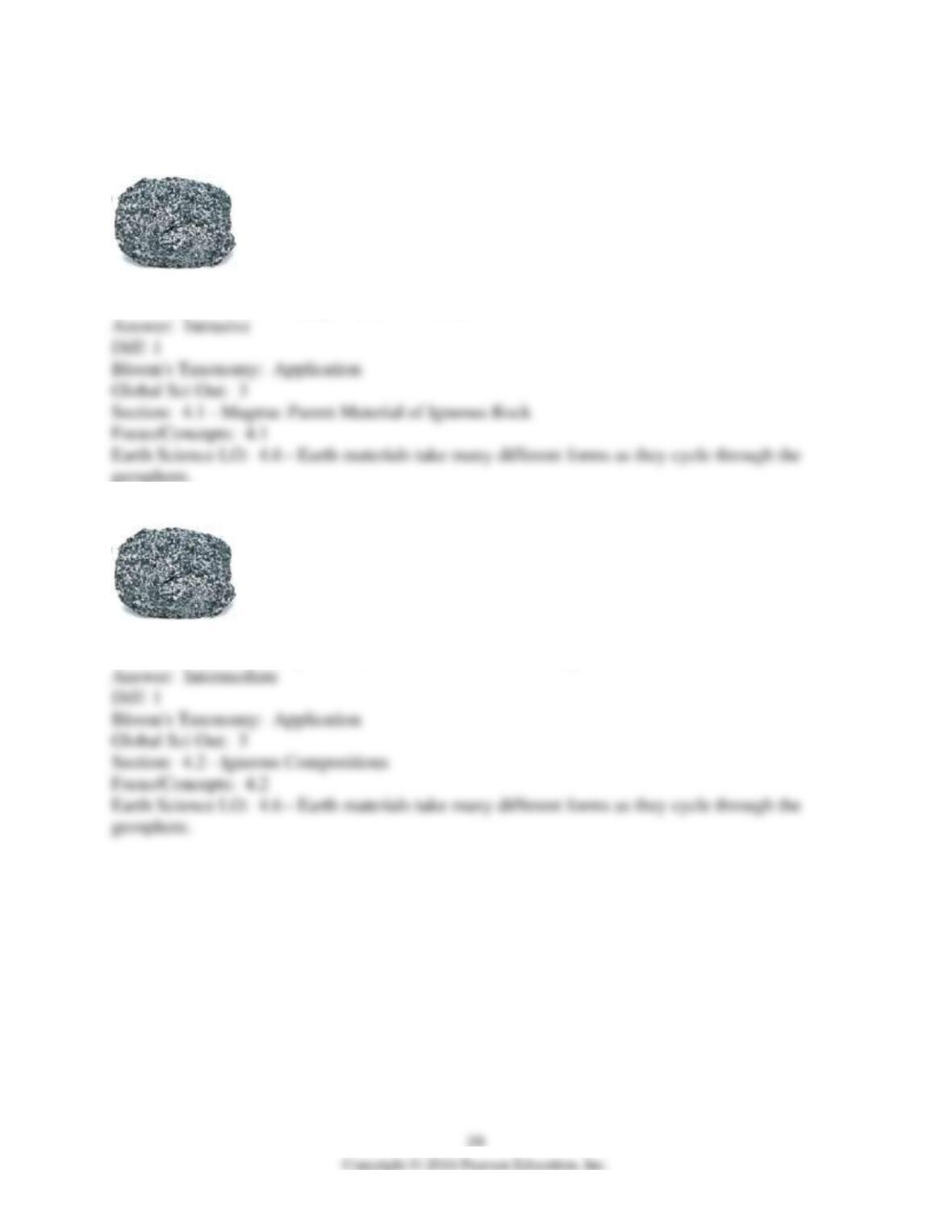
4.6 Visual
1)
Is the rock in the above image intrusive or extrusive?
2)
What is the igneous composition of the rock in the above image?
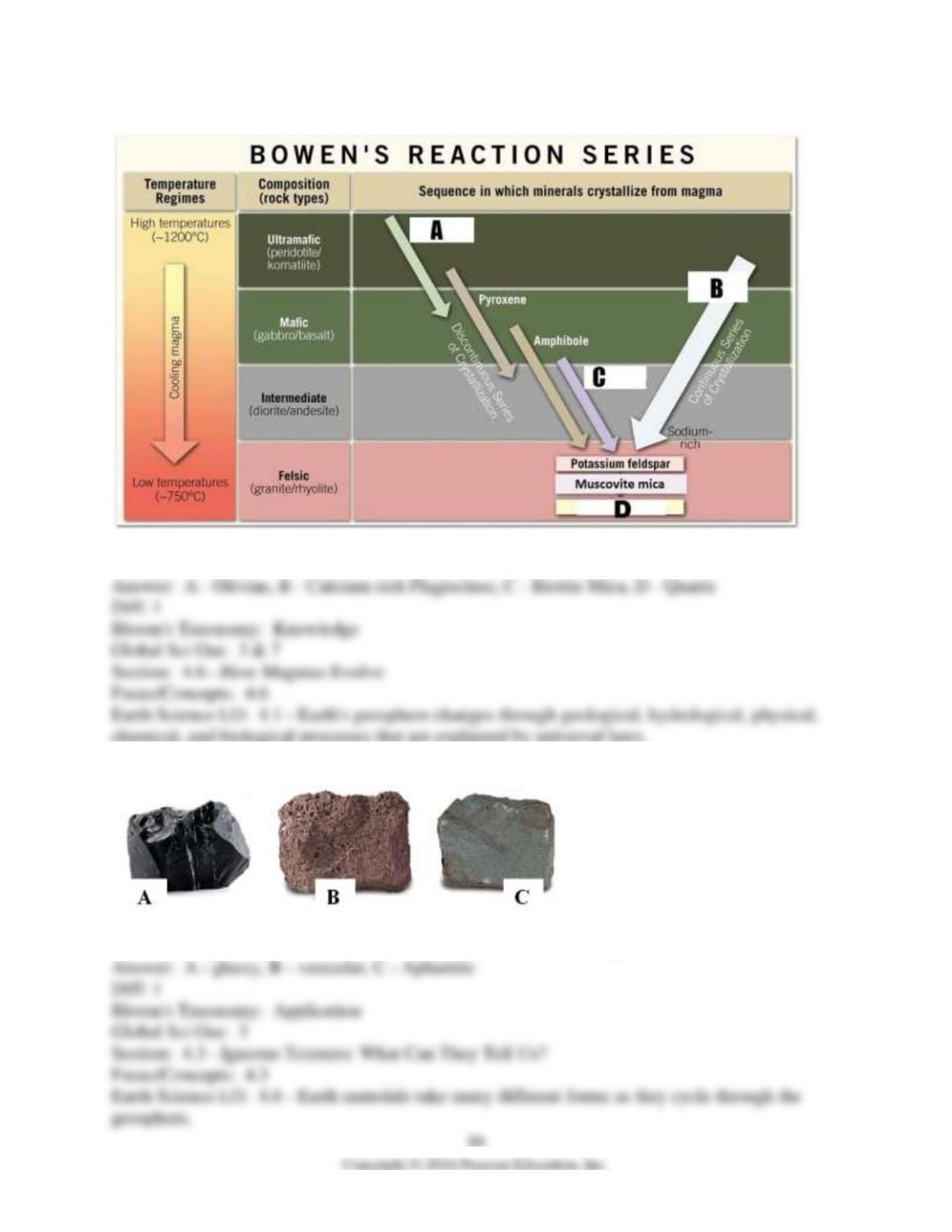
3)
Using the figure above, fill in the missing substances in Bowen’s Reaction Series.
4)
Identify the igneous textures visible in Images A, B, and C in the figure above.
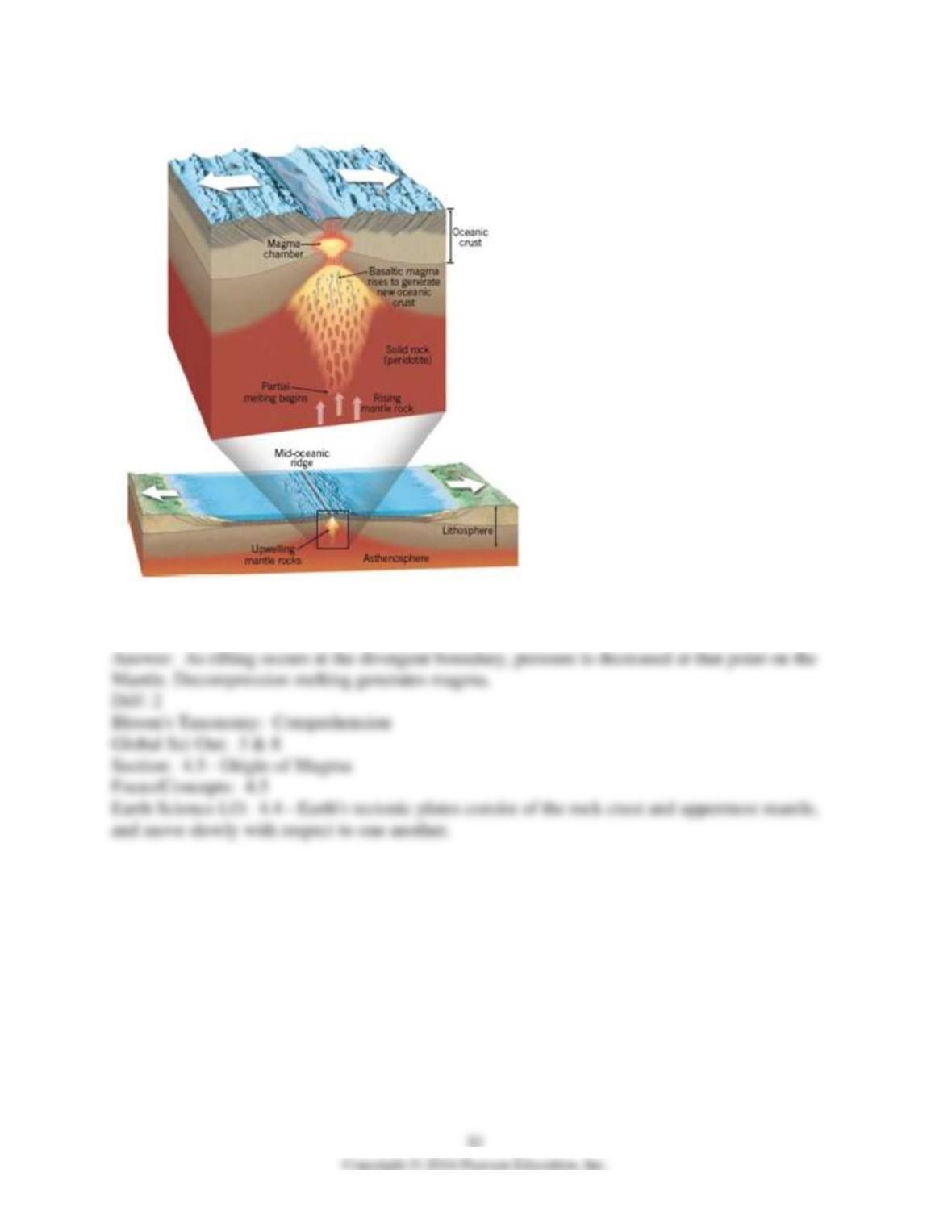
5)
Explain the processes occurring in the figure above that are generating magma. At what kind of
tectonic boundary are such processes common?
6)
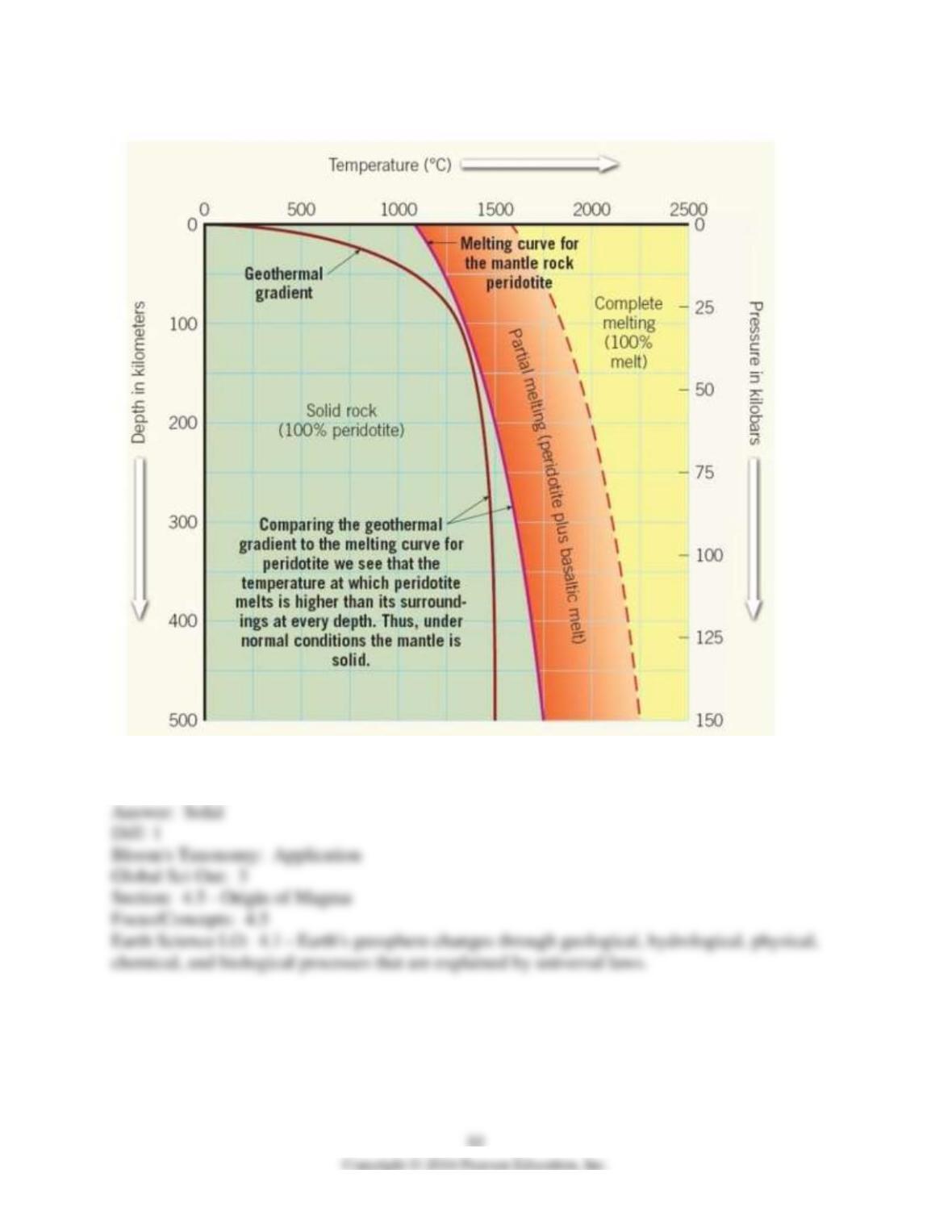
Follow the geothermal gradient to the depth of 100 km. In which state of matter will peridotite
exist at 100 km?
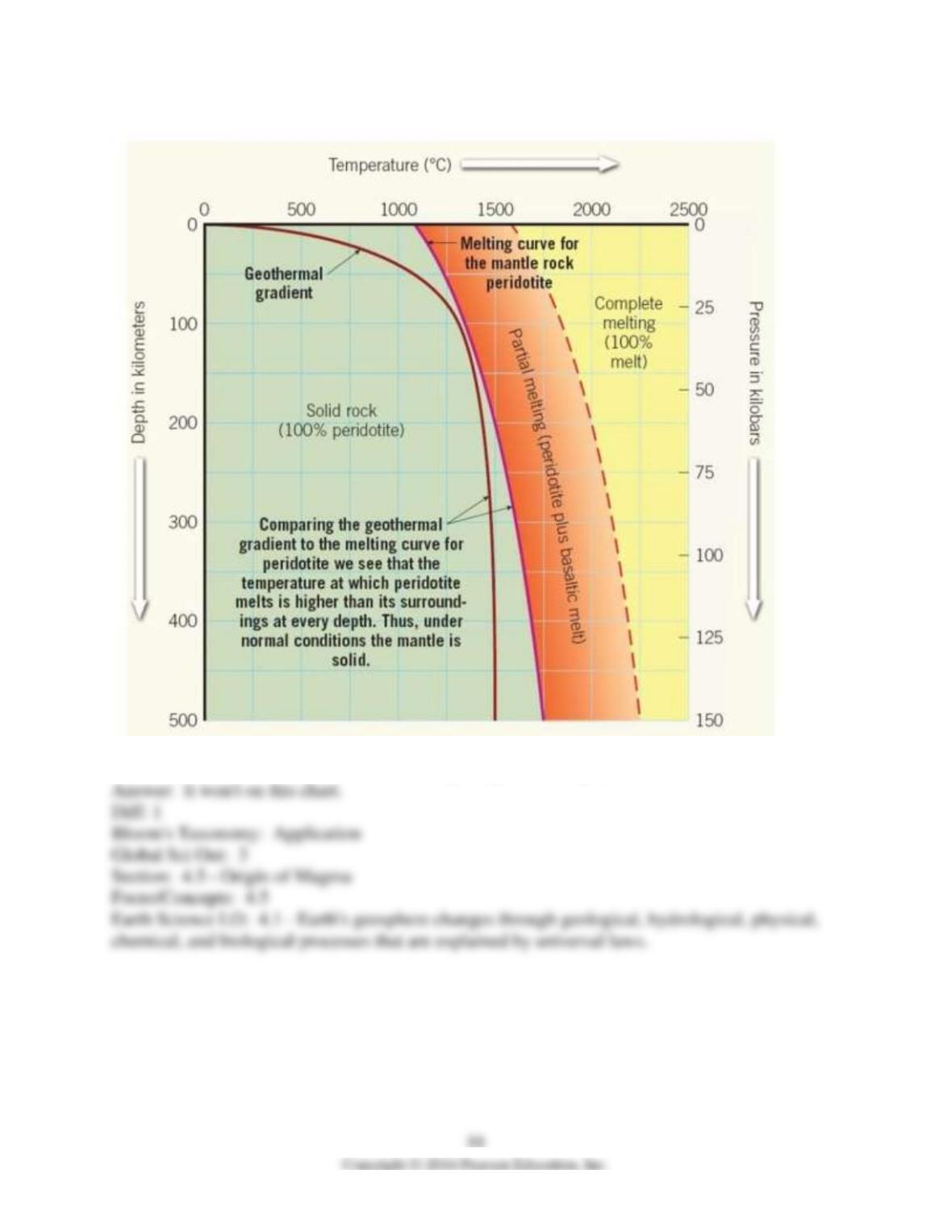
7)
At what temperature will peridotite melt along the geothermal gradient?
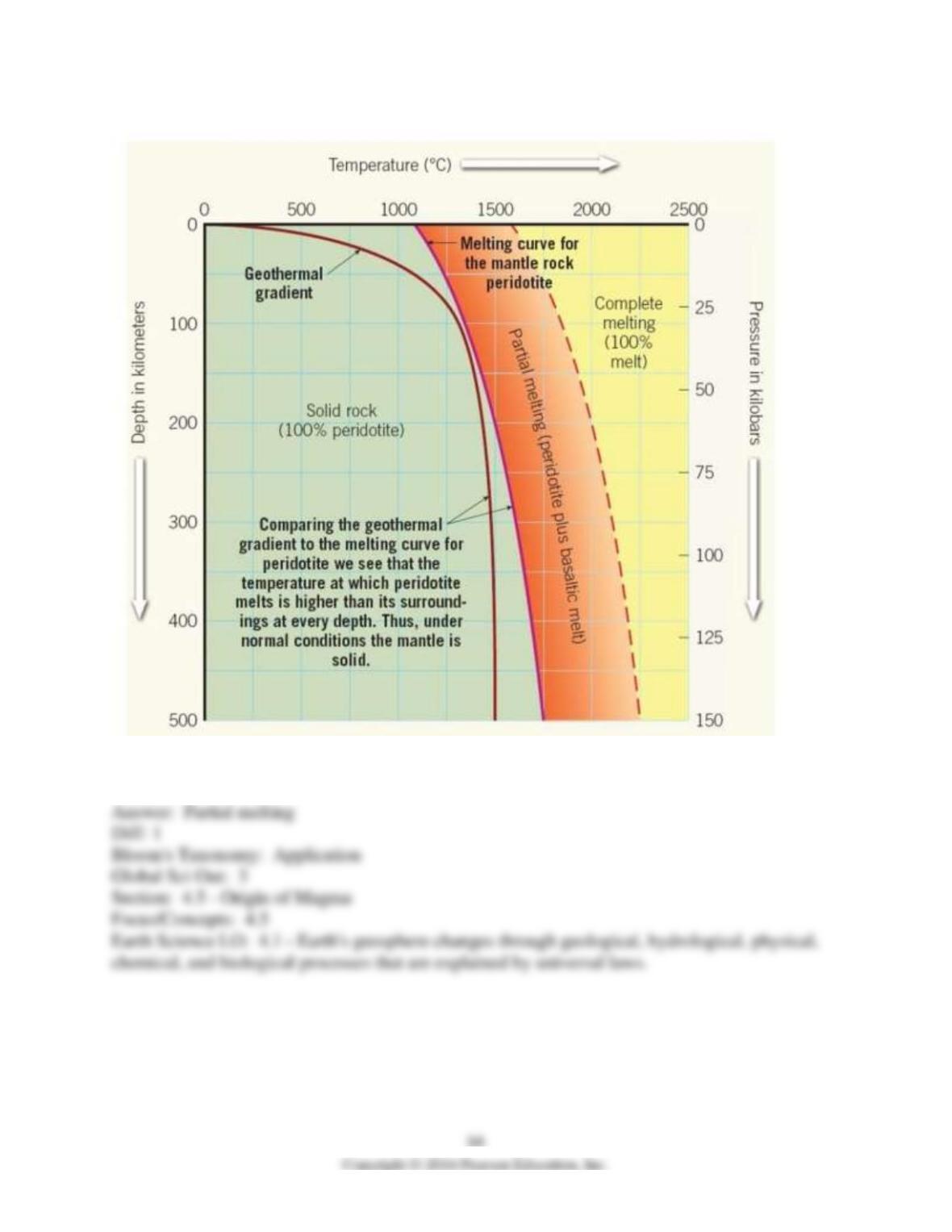
8)
What would happen to the peridotite if there was a decrease in pressure from that the depth of
100 km?