15) Quartz has only one color.
16) Ferromagnesian minerals have a higher specific gravity than nonferromagnesian minerals.
3.3 Short Answer Questions
1) Why would a synthetic gemstone not be considered a true mineral?
2) Is concrete a rock? Why or why not?
3) Which of the following substances is not a mineral and why: gold, water, ice, wood. (There
may be more than one answer.)
4) What is the purpose of atoms exchanging or sharing electrons?
5) When an aqueous solution containing dissolved mineral matter evaporates, why does the
mineral matter precipitate instead of evaporating with the water?
6) Explain how a mineral’s streak can be useful for identifying metallic minerals.
7) Two unknown minerals are placed before you for identification. You decide to test each
mineral’s hardness. Mineral A will scratch a piece of glass. Mineral B will not. Which mineral is
harder? (You should mention hardness according to Moh’s Hardness Scale in your answer.)
8) Describe how magnesium can be exchanged for iron in olivine without destroying the internal
framework of the mineral.
9) Certain diamond companies use the advertising slogan “Diamonds are Forever.” Explain why
this is or is not accurate.
10) Write a simple math formula showing the next charge of the silicate ion.

3.4 Matching Questions
Match the atomic particle with the correct definition.
A) Particle found in the nucleus; no charge
B) Particle found orbiting the nucleus; negative charge
C) Particle found in the nucleus; positive charge
1) Proton
Diff: 1
Bloom’s Taxonomy: Knowledge
Global Sci Out: 7
Section: 3.2 – Atoms: Building Blocks of Minerals
Focus/Concepts: 3.2
Earth Science LO: 1.2 – Earth scientists use a large variety of scientific principles to understand
how our planet works.
2) Neutron
Diff: 1
Bloom’s Taxonomy: Knowledge
Global Sci Out: 7
Section: 3.2 – Atoms: Building Blocks of Minerals
Focus/Concepts: 3.2
Earth Science LO: 1.2 – Earth scientists use a large variety of scientific principles to understand
how our planet works.
3) Electron
Diff: 1
Bloom’s Taxonomy: Knowledge
Global Sci Out: 7
Section: 3.2 – Atoms: Building Blocks of Minerals
Focus/Concepts: 3.2
Earth Science LO: 1.2 – Earth scientists use a large variety of scientific principles to understand
how our planet works.

Match the type of atomic bond with the correct definition.
A) Valence electrons are free to move from one atom to another so all atoms share available
valence electrons
B) Chemical bonds created by sharing a pair of electrons between atoms
C) Complete transfer of electrons between atoms
D) Incomplete transfer of electrons that results in atoms partially transferring and partially
sharing electrons
4) Ionic Bond
Diff: 1
Bloom’s Taxonomy: Knowledge
Global Sci Out: 7
Section: 3.3 – Why Atoms Bond
Focus/Concepts: 3.3
Earth Science LO: 1.2 – Earth scientists use a large variety of scientific principles to understand
how our planet works.
5) Covalent Bond
Diff: 1
Bloom’s Taxonomy: Knowledge
Global Sci Out: 7
Section: 3.3 – Why Atoms Bond
Focus/Concepts: 3.3
Earth Science LO: 1.2 – Earth scientists use a large variety of scientific principles to understand
how our planet works.
6) Metallic Bond
Diff: 1
Bloom’s Taxonomy: Knowledge
Global Sci Out: 7
Section: 3.3 – Why Atoms Bond
Focus/Concepts: 3.3
Earth Science LO: 1.2 – Earth scientists use a large variety of scientific principles to understand
how our planet works.
7) Hybrid Bond
Diff: 1
Bloom’s Taxonomy: Knowledge
Global Sci Out: 7
Section: 3.3 – Why Atoms Bond
Focus/Concepts: 3.3
Earth Science LO: 1.2 – Earth scientists use a large variety of scientific principles to understand
how our planet works.

22
Match the mineral class with the ion(s) it is based around.
A) S-
B) Cl-, F-, Br-
C) SO42-
D) CO32-
E) SiO24-
8) Halides
Diff: 1
Bloom’s Taxonomy: Knowledge
Global Sci Out: 7
Section: 3.7 – How Minerals Are Named and Classified
Focus/Concepts: 3.7
Earth Science LO: 1.2 – Earth scientists use a large variety of scientific principles to understand
how our planet works.
9) Sulfides
Diff: 1
Bloom’s Taxonomy: Knowledge
Global Sci Out: 7
Section: 3.7 – How Minerals Are Named and Classified
Focus/Concepts: 3.7
Earth Science LO: 1.2 – Earth scientists use a large variety of scientific principles to understand
how our planet works.
10) Sulfates
Diff: 1
Bloom’s Taxonomy: Knowledge
Global Sci Out: 7
Section: 3.7 – How Minerals Are Named and Classified
Focus/Concepts: 3.7
Earth Science LO: 1.2 – Earth scientists use a large variety of scientific principles to understand
how our planet works.
11) Carbonates
Diff: 1
Bloom’s Taxonomy: Knowledge
Global Sci Out: 7
Section: 3.7 – How Minerals Are Named and Classified
Focus/Concepts: 3.7
Earth Science LO: 1.2 – Earth scientists use a large variety of scientific principles to understand
how our planet works.

23
12) Silicates
Diff: 1
Bloom’s Taxonomy: Knowledge
Global Sci Out: 7
Section: 3.7 – How Minerals Are Named and Classified
Focus/Concepts: 3.7
Earth Science LO: 1.2 – Earth scientists use a large variety of scientific principles to understand
how our planet works.
Match the silicate structure with the appropriate mineral example.
A) Muscovite
B) Quartz
C) Olivine
D) Amphibole
E) Pyroxene
13) Independent Tetrahedra
Diff: 1
Bloom’s Taxonomy: Knowledge
Global Sci Out: 7
Section: 3.8 – The Silicates
Focus/Concepts: 3.8
Earth Science LO: 1.3 – Earth science investigations take many different forms.
14) Single Chain
Diff: 1
Bloom’s Taxonomy: Knowledge
Global Sci Out: 7
Section: 3.8 – The Silicates
Focus/Concepts: 3.8
Earth Science LO: 1.3 – Earth science investigations take many different forms.
15) Double Chain
Diff: 1
Bloom’s Taxonomy: Knowledge
Global Sci Out: 7
Section: 3.8 – The Silicates
Focus/Concepts: 3.8
Earth Science LO: 1.3 – Earth science investigations take many different forms.

16) Sheet
Diff: 1
Bloom’s Taxonomy: Knowledge
Global Sci Out: 7
Section: 3.8 – The Silicates
Focus/Concepts: 3.8
Earth Science LO: 1.3 – Earth science investigations take many different forms.
17) Network
Diff: 1
Bloom’s Taxonomy: Knowledge
Global Sci Out: 7
Section: 3.8 – The Silicates
Focus/Concepts: 3.8
Earth Science LO: 1.3 – Earth science investigations take many different forms.
3.5 Essay Questions
1) Explain the significance of valence electrons in connection to mineral formation.
2) Explain why a drop in temperature would result in the precipitation of minerals dissolved in
an aqueous solution.
3) Limestone is a sedimentary rock that is found over large areas of the United States. Using this
information, explain what the environment of deposition was like at the time of limestone
formation and how scientists can interpret the primary method of mineral formation.
4) Explain how differences in molecular bonds can result in cleavage versus fracture.
5) If there are over 100 elements on the Periodic Table of Elements, it would stand to reason that
there would be millions of ways these elements could combine to form minerals. However, there
are only 4,000 named minerals. Provide several reasons why there are so few.
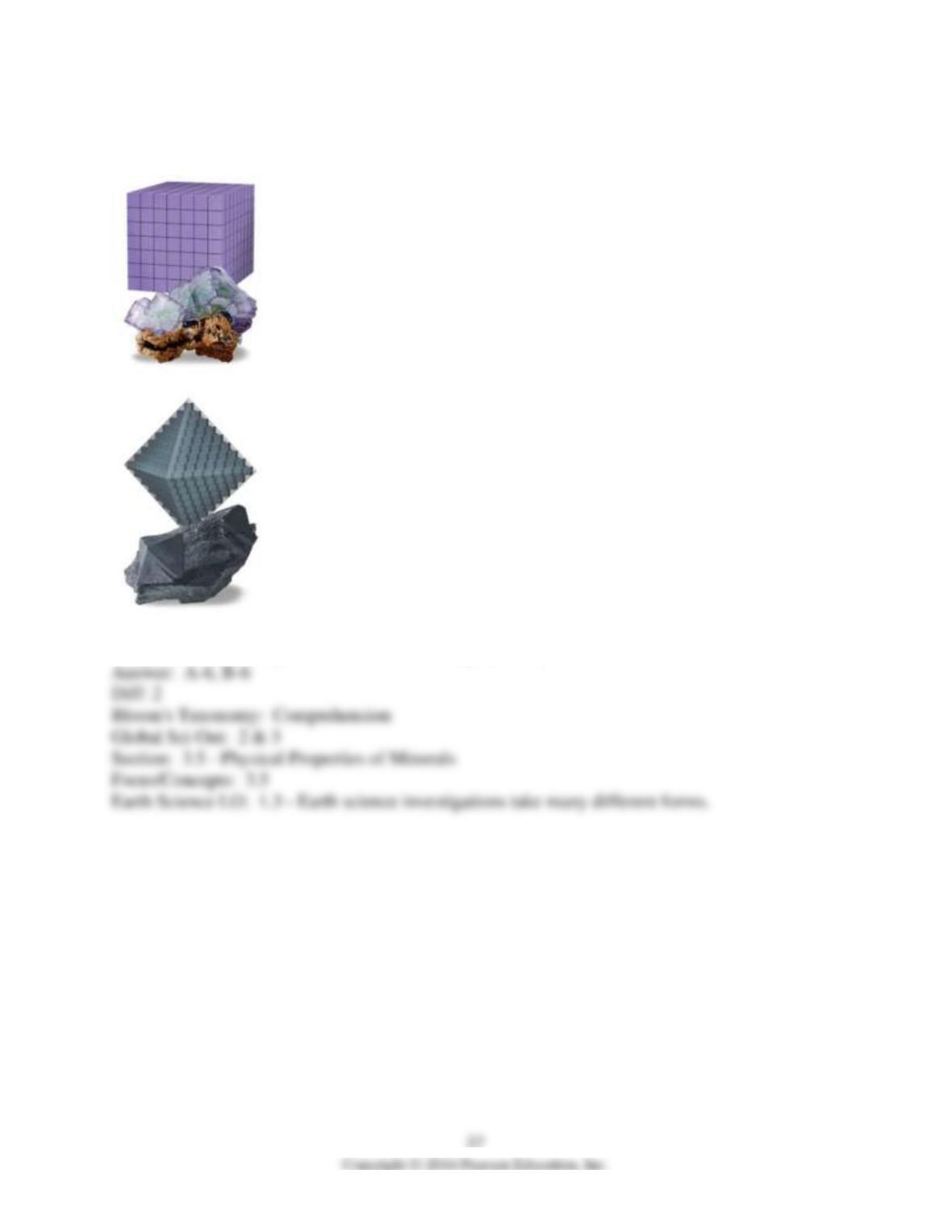
3.6 Visual
1)
Assuming well-formed crystals, how many cleavage surfaces are present on each sample in this
image? (Note: Cleavage surfaces are not cleavage planes.)
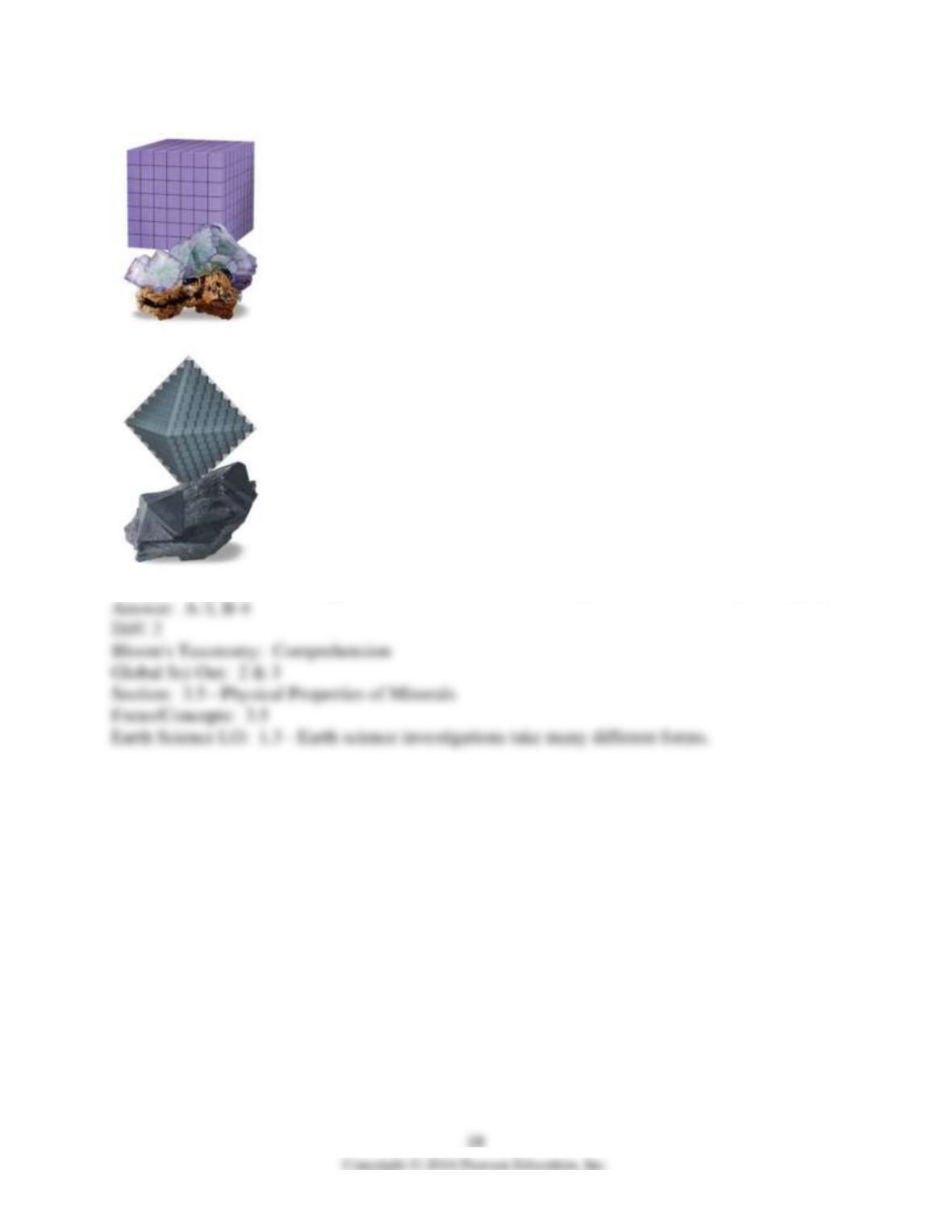
2)
Using the samples in this image, indicate the number of cleavage directions each crystal displays.
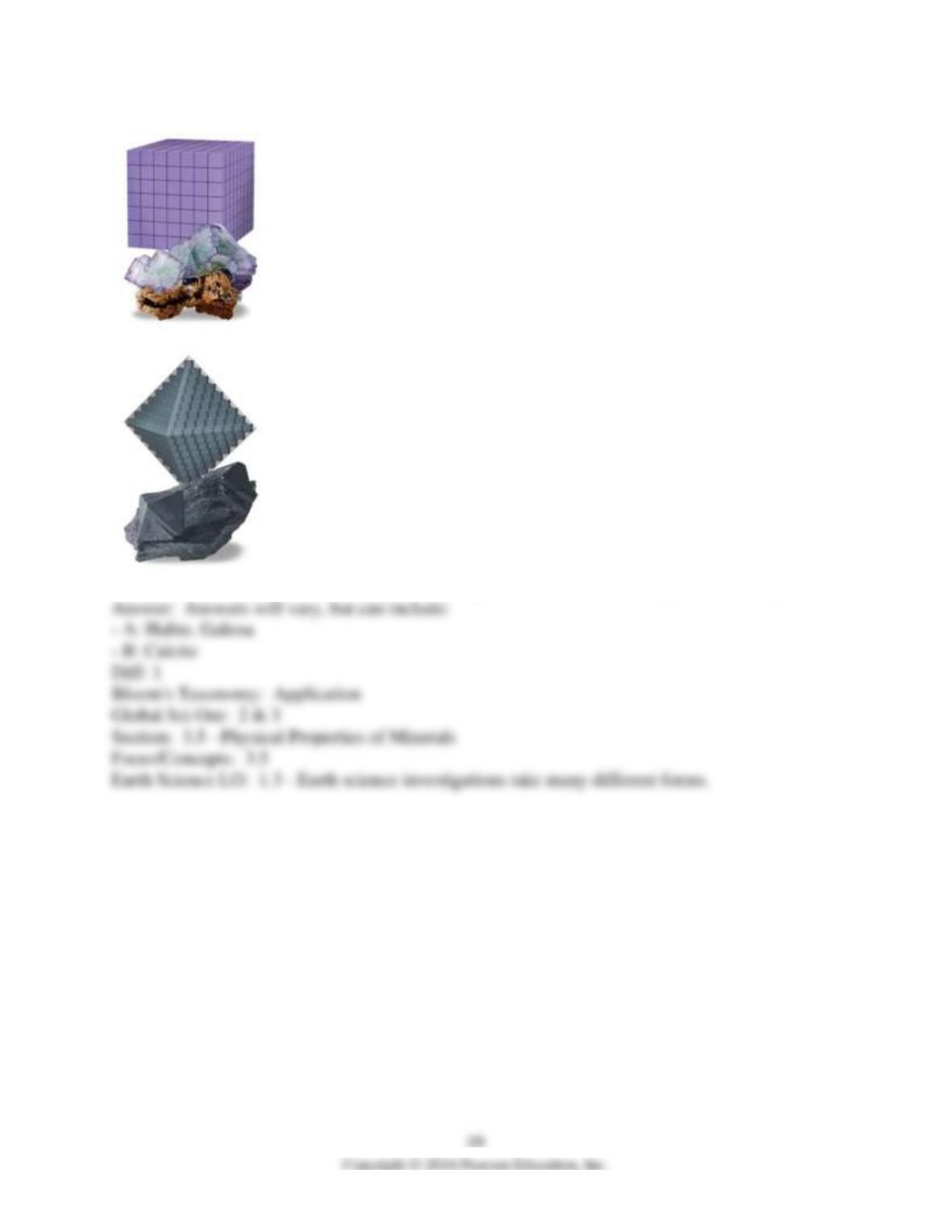
3)
Using the cleavage planes and shapes in this image, list one mineral example for each crystal.
4)
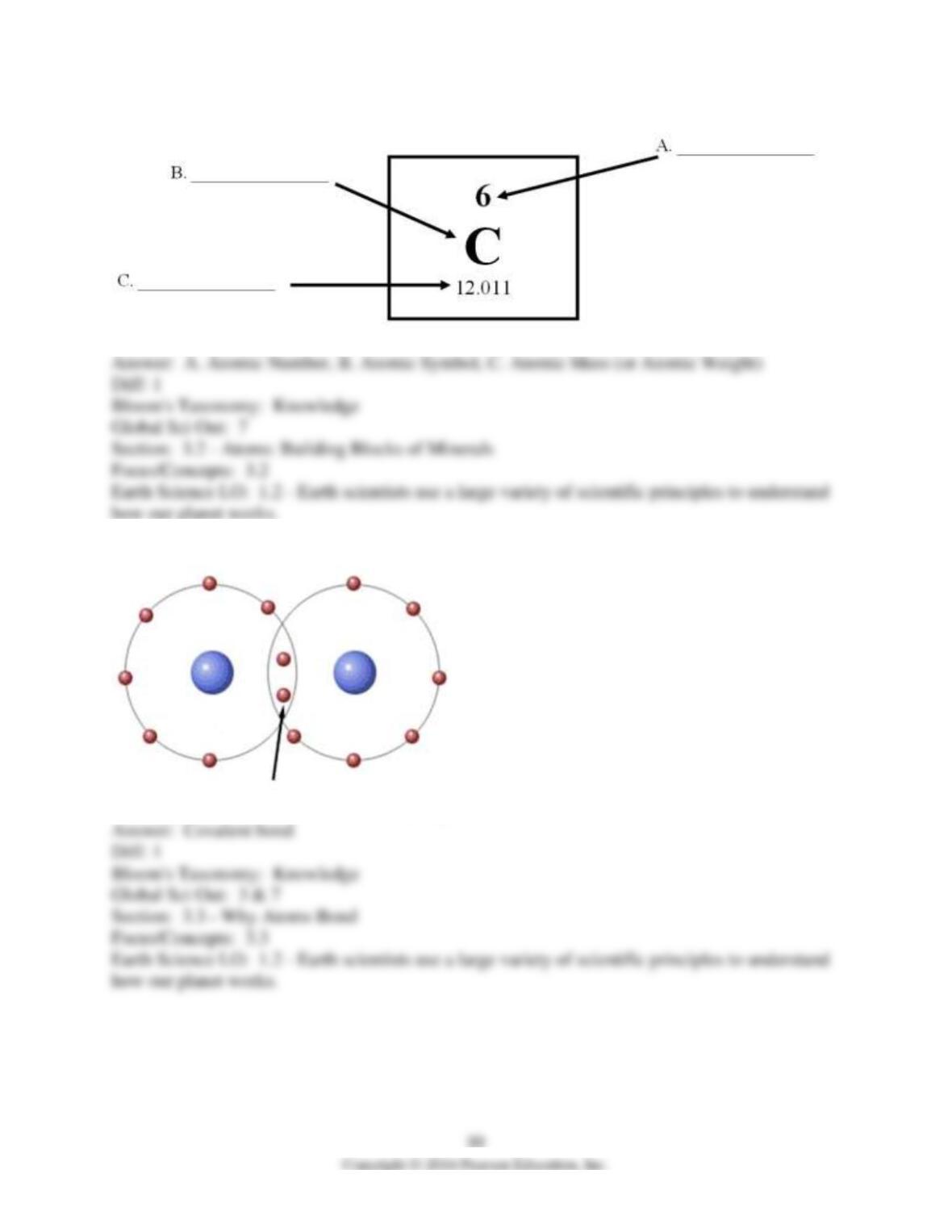
Label the properties of Carbon above.
5)
What type of atomic bond is shown in the figure above?
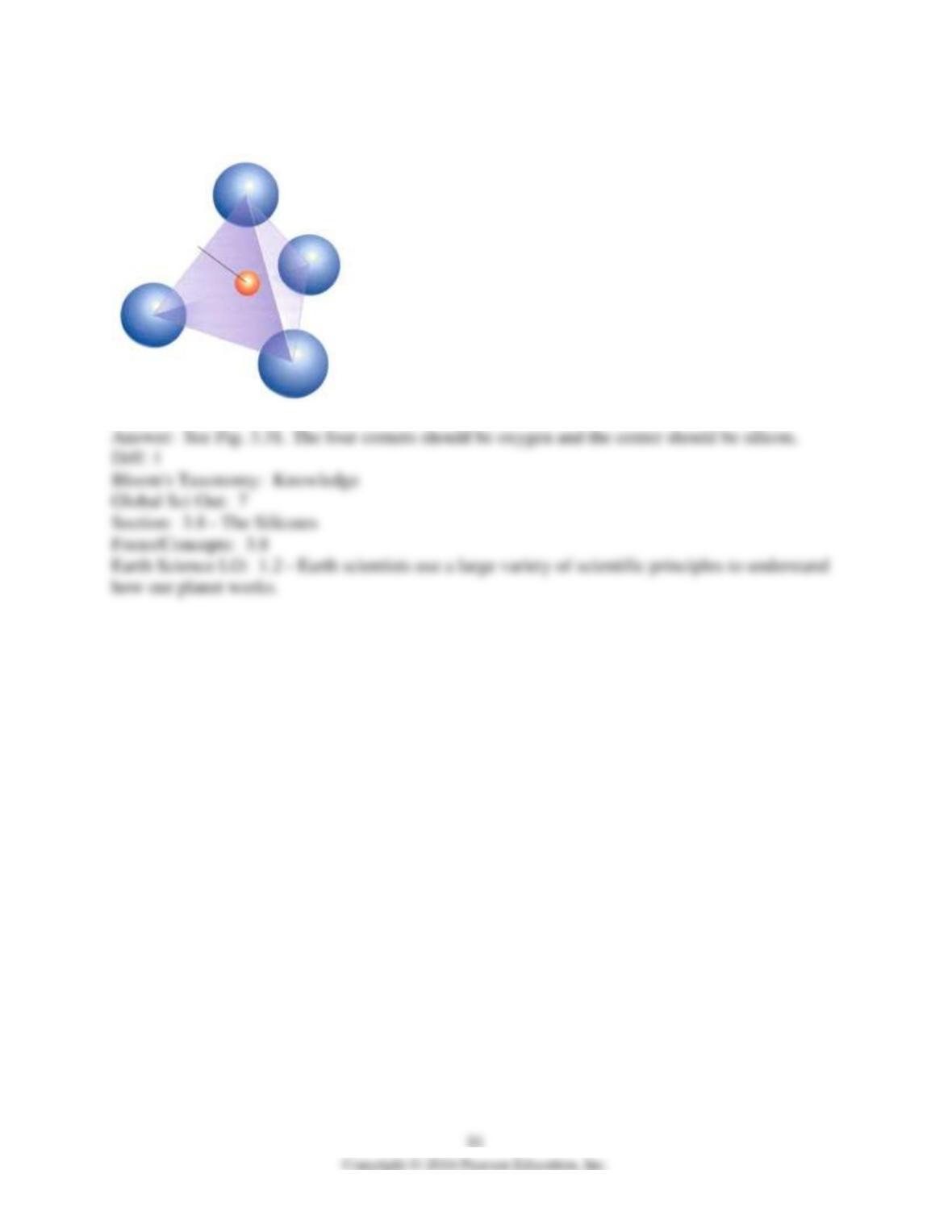
6) Using this image, label the atoms with the appropriate elements to make the silica tetrahedron.