12) Which planet was struck by a string of small asteroids and cometary fragments in the famous
Shoemaker-Levy event of 1994?
13) The Earth’s axial tilt is currently 23.5° from vertical. Uranus axis of rotation is completely
horizontal. How did this occur?
14) How do astronomers know that some asteroids are shattered fragments of a destroyed planet?

19
24.4 Matching Questions
Match the astronomical bodies to their correct description. (Note: some answers will be used
more than once.)
A) Jovian Planet
B) Dwarf Planet
C) Terrestrial Planet
1) Earth
Diff: 1
Bloom’s Taxonomy: Knowledge
Global Sci Out: 7
Section: 24.1 – Our Solar System: An Overview & 24.5 – Small Solar System Bodies
Focus/Concepts: 24.1 & 24.5
Earth Science LO: 2.3 – Earth formed from the accumulation of dust and gas, and multiple
collisions of smaller planetary bodies.
2) Neptune
Diff: 1
Bloom’s Taxonomy: Knowledge
Global Sci Out: 7
Section: 24.1 – Our Solar System: An Overview & 24.5 – Small Solar System Bodies
Focus/Concepts: 24.1 & 24.5
Earth Science LO: 2.3 – Earth formed from the accumulation of dust and gas, and multiple
collisions of smaller planetary bodies.
3) Uranus
Diff: 1
Bloom’s Taxonomy: Knowledge
Global Sci Out: 7
Section: 24.1 – Our Solar System: An Overview & 24.5 – Small Solar System Bodies
Focus/Concepts: 24.1 & 24.5
Earth Science LO: 2.3 – Earth formed from the accumulation of dust and gas, and multiple
collisions of smaller planetary bodies.
4) Pluto
Diff: 1
Bloom’s Taxonomy: Knowledge
Global Sci Out: 7
Section: 24.1 – Our Solar System: An Overview & 24.5 – Small Solar System Bodies
Focus/Concepts: 24.1 & 24.5
Earth Science LO: 2.3 – Earth formed from the accumulation of dust and gas, and multiple
collisions of smaller planetary bodies.
5) Mercury
Diff: 1
Bloom’s Taxonomy: Knowledge
Global Sci Out: 7
Section: 24.1 – Our Solar System: An Overview & 24.5 – Small Solar System Bodies
Focus/Concepts: 24.1 & 24.5
Earth Science LO: 2.3 – Earth formed from the accumulation of dust and gas, and multiple
collisions of smaller planetary bodies.
6) Ceres
Diff: 1
Bloom’s Taxonomy: Knowledge
Global Sci Out: 7
Section: 24.1 – Our Solar System: An Overview & 24.5 – Small Solar System Bodies
Focus/Concepts: 24.1 & 24.5
Earth Science LO: 2.3 – Earth formed from the accumulation of dust and gas, and multiple
collisions of smaller planetary bodies.
7) Jupiter
Diff: 1
Bloom’s Taxonomy: Knowledge
Global Sci Out: 7
Section: 24.1 – Our Solar System: An Overview & 24.5 – Small Solar System Bodies
Focus/Concepts: 24.1 & 24.5
Earth Science LO: 2.3 – Earth formed from the accumulation of dust and gas, and multiple
collisions of smaller planetary bodies.

Put the four phases of lunar formation in order from the oldest to the youngest. (Note: “First”
refers to the oldest event whereas “Fourth” refers to the youngest event.)
A) Formation of original crust
B) Formation of rayed craters
C) Excavation of large impact basins
D) Filling of mare basins
8) First
Diff: 1
Bloom’s Taxonomy: Knowledge
Global Sci Out: 7
Section: 24.2 – Earth’s Moon: A Chip Off the Old Block
Focus/Concepts: 24.2
Earth Science LO: 2.5 – Studying other objects in the solar system helps us to learn Earth’s
history.
9) Second
Diff: 1
Bloom’s Taxonomy: Knowledge
Global Sci Out: 7
Section: 24.2 – Earth’s Moon: A Chip Off the Old Block
Focus/Concepts: 24.2
Earth Science LO: 2.5 – Studying other objects in the solar system helps us to learn Earth’s
history.
10) Third
Diff: 1
Bloom’s Taxonomy: Knowledge
Global Sci Out: 7
Section: 24.2 – Earth’s Moon: A Chip Off the Old Block
Focus/Concepts: 24.2
Earth Science LO: 2.5 – Studying other objects in the solar system helps us to learn Earth’s
history.
11) Fourth
Diff: 1
Bloom’s Taxonomy: Knowledge
Global Sci Out: 7
Section: 24.2 – Earth’s Moon: A Chip Off the Old Block
Focus/Concepts: 24.2
Earth Science LO: 2.5 – Studying other objects in the solar system helps us to learn Earth’s
history.
24.5 Essay Questions
1) Compare and contrast terrestrial and Jovian planets.
2) Using the nebular theory, explain the formation of our solar system from the formation of the
solar nebula through the present day.
3) Conspiracy theorists argue that the United States never went to the Moon and that the lunar
landings were staged. What pieces of evidence could be used to prove the United States did land
on the Moon?
4) Compare the surface of the Earth to that of the Moon. Why doesn’t the Earth’s land retain the
same scarring from meteorite impact as the Moon? Why doesn’t the Earth’s ocean retain the same
scarring from meteorite impact?
5) Explain the impact hypothesis for the formation of the Moon. Be sure to discuss why the
Moon contains a higher ratio of silicate minerals (i.e. plagioclase) than the host body.
6) Compare and contrast the core of Mercury (40% of volume) to that of Earth (~10% of
volume). If Mercury is smaller, why is that core bigger than that of Earth’s?
7) Compare and contrast Earth’s Moon and the planet Mercury.
8) Mauna Loa, a shield volcano in Hawaii, is approximately 10 km in height. Olympus Mons is a
shield volcano on Mars that is approximately 27 km in height. Compare the formation of both of
these volcanoes. How is it that Olympus Mons could grow so much taller than Mauna Loa?
9) Over the last several decades, there have been many individuals who have proposed
colonizing the Moon and using it for mining substances such as Hydrogen and Helium-3. Is this
a feasible venture? Why or why not? Provide a detailed explanation.
10) How do the interior layers of a Jovian planet compare to the interior layers of a terrestrial
planet? Be specific.
11) In 2006, the International Astronomical Union developed a formal definition for what
constitutes a planet. What are the three parts of this definition? How does Pluto meet or not meet
these three criteria?
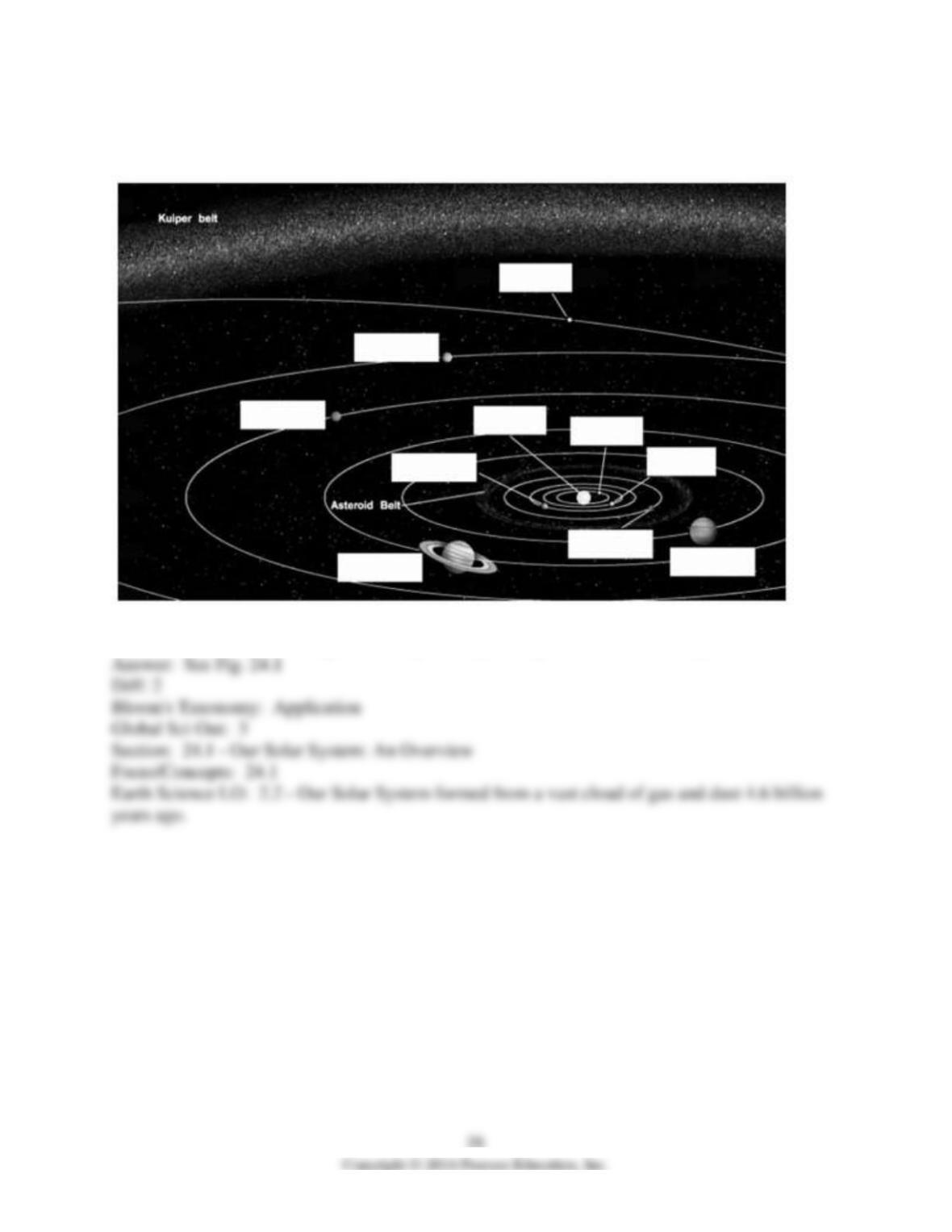
24.6 Visual
1)
Fill in the blanks on this image to identify the major components of our solar system.
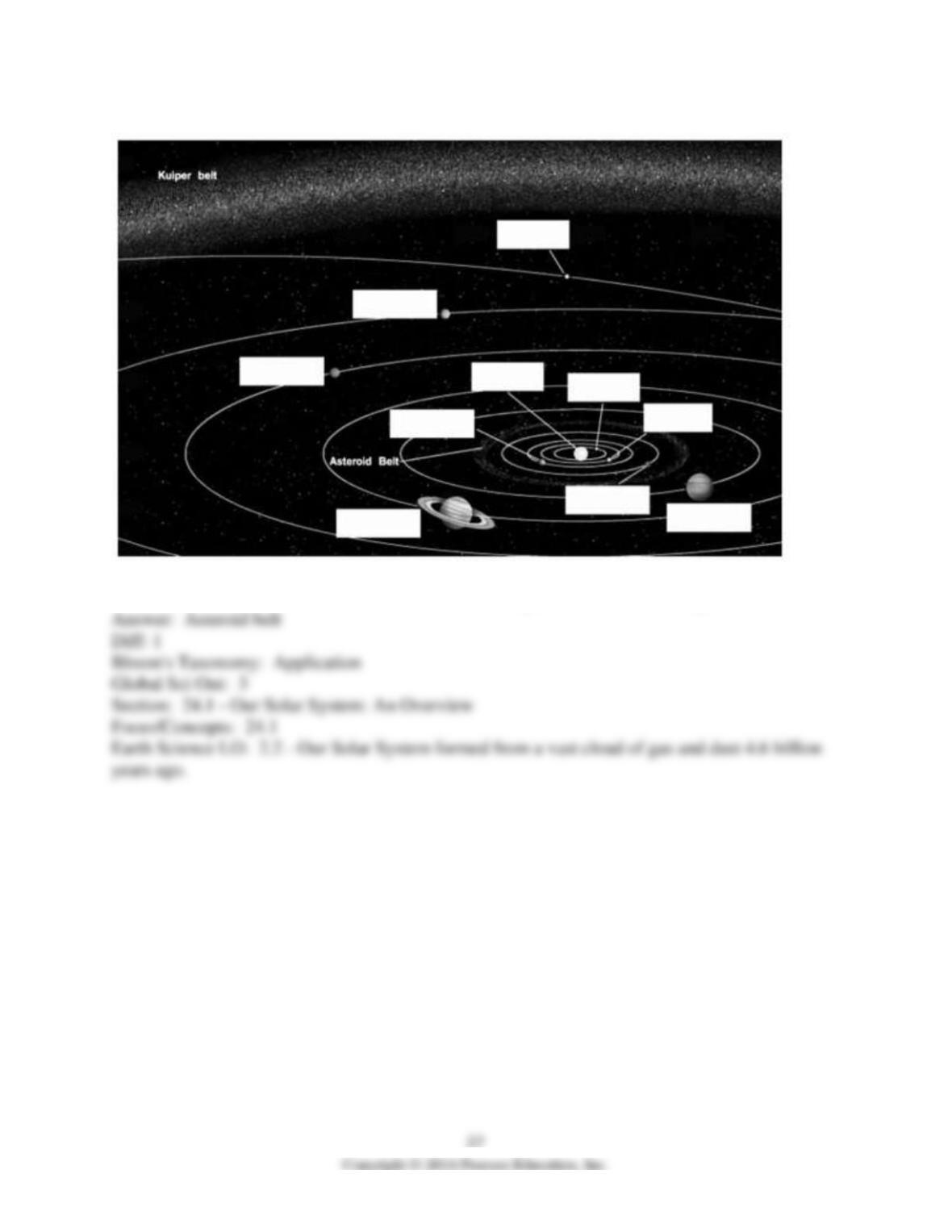
2)
What feature marks the division between the terrestrial planets and the Jovian planets?
3)
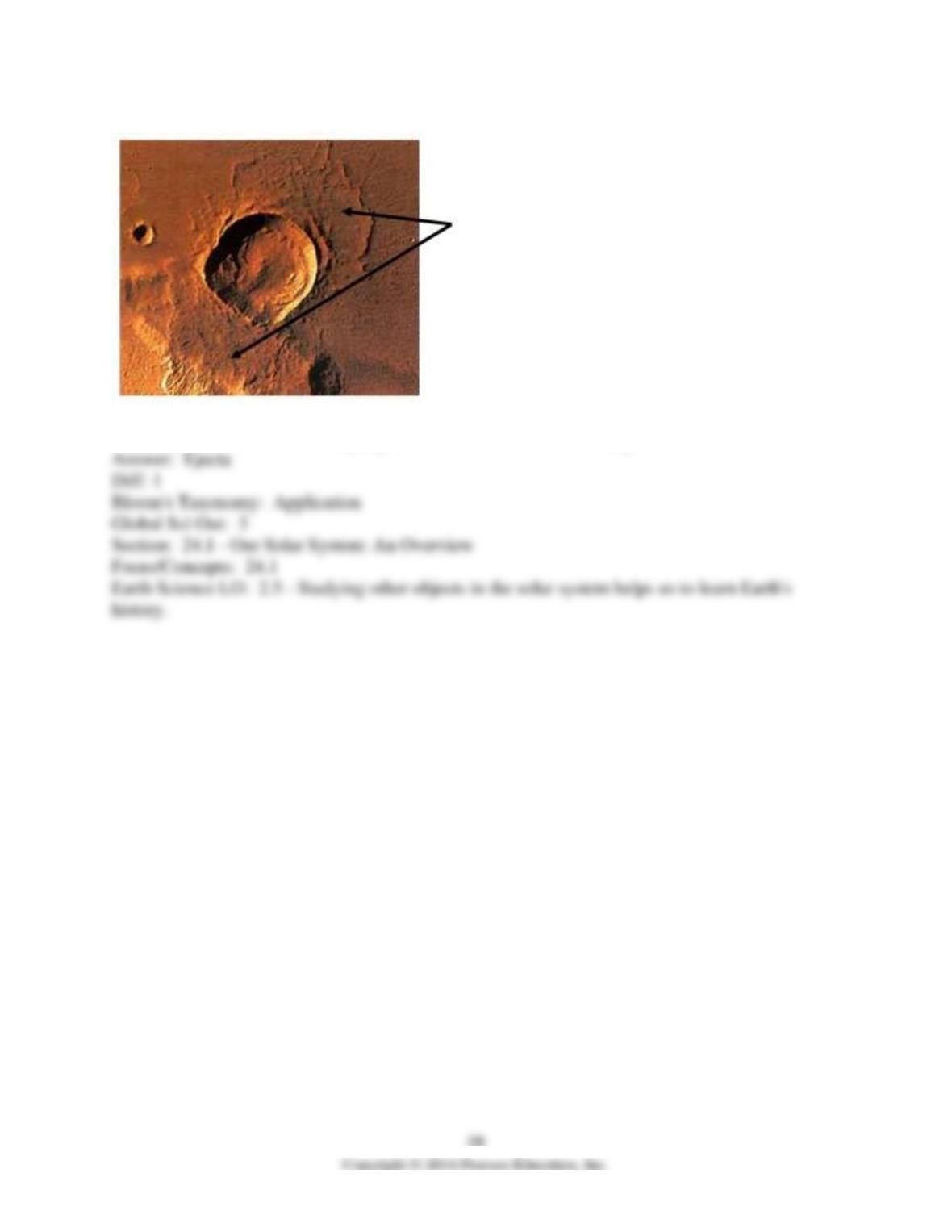
What impact crater feature is highlighted with the arrows in this image?
4)
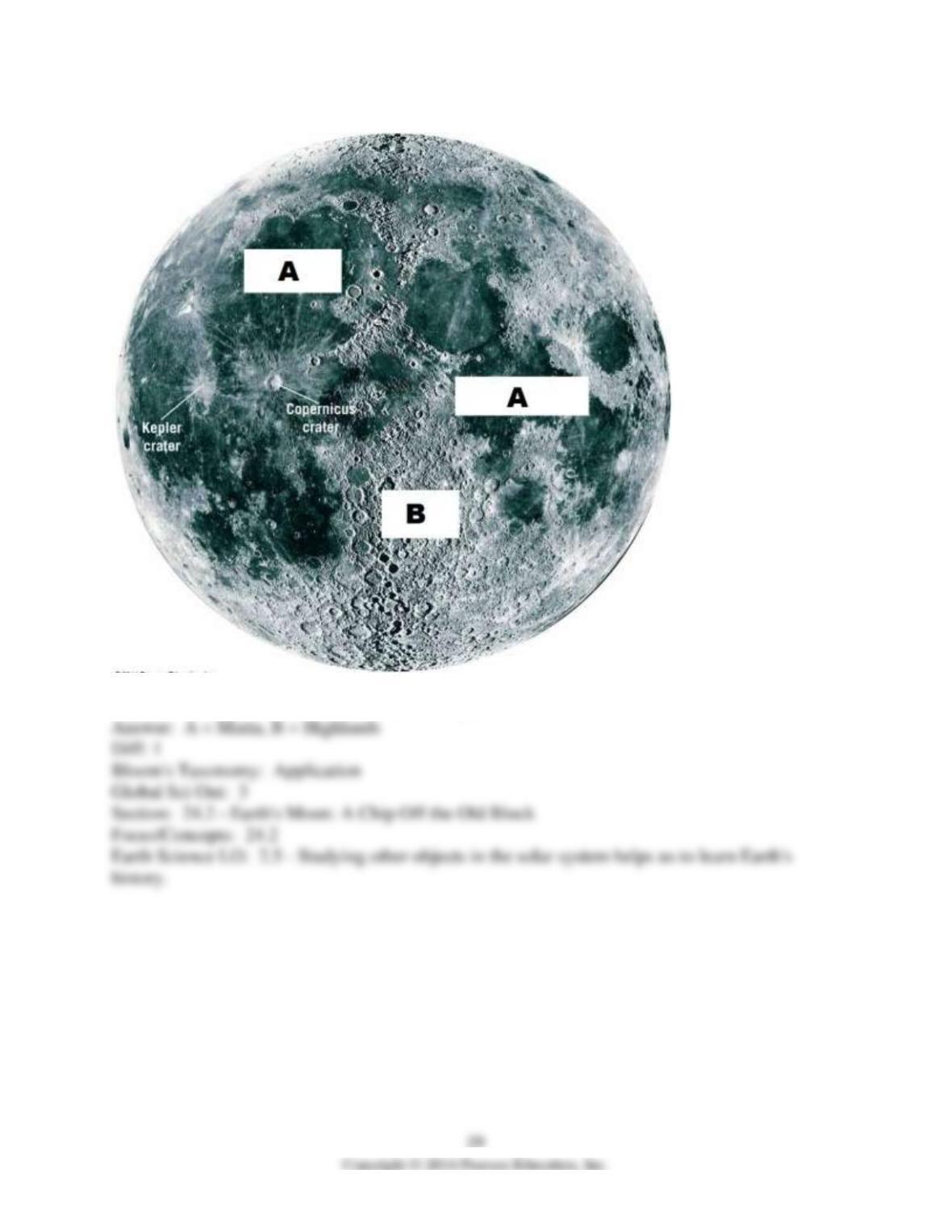
Using this image, identify the maria and the highlands.
5)
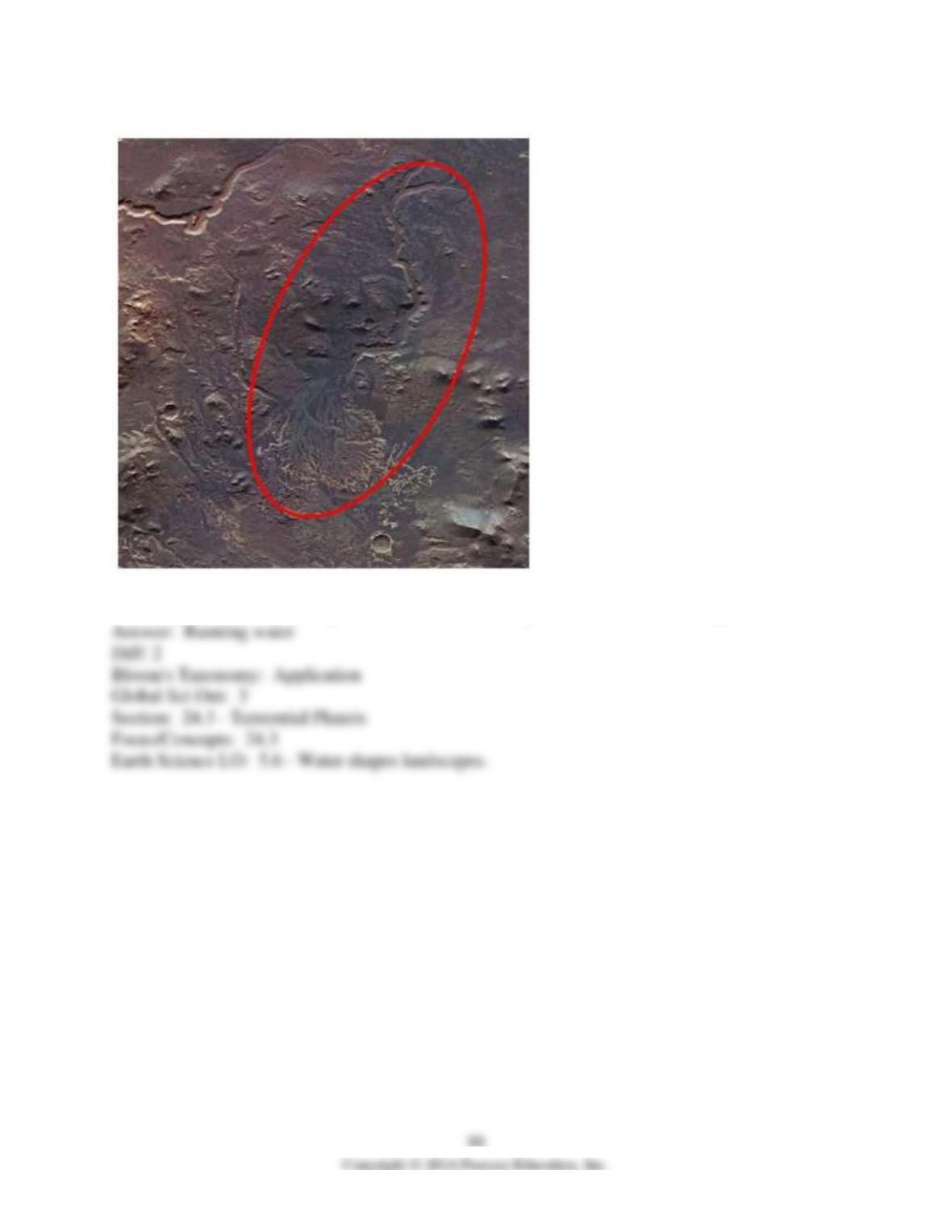
Which agent of erosion is responsible for the erosional pattern circled in this image?
6)
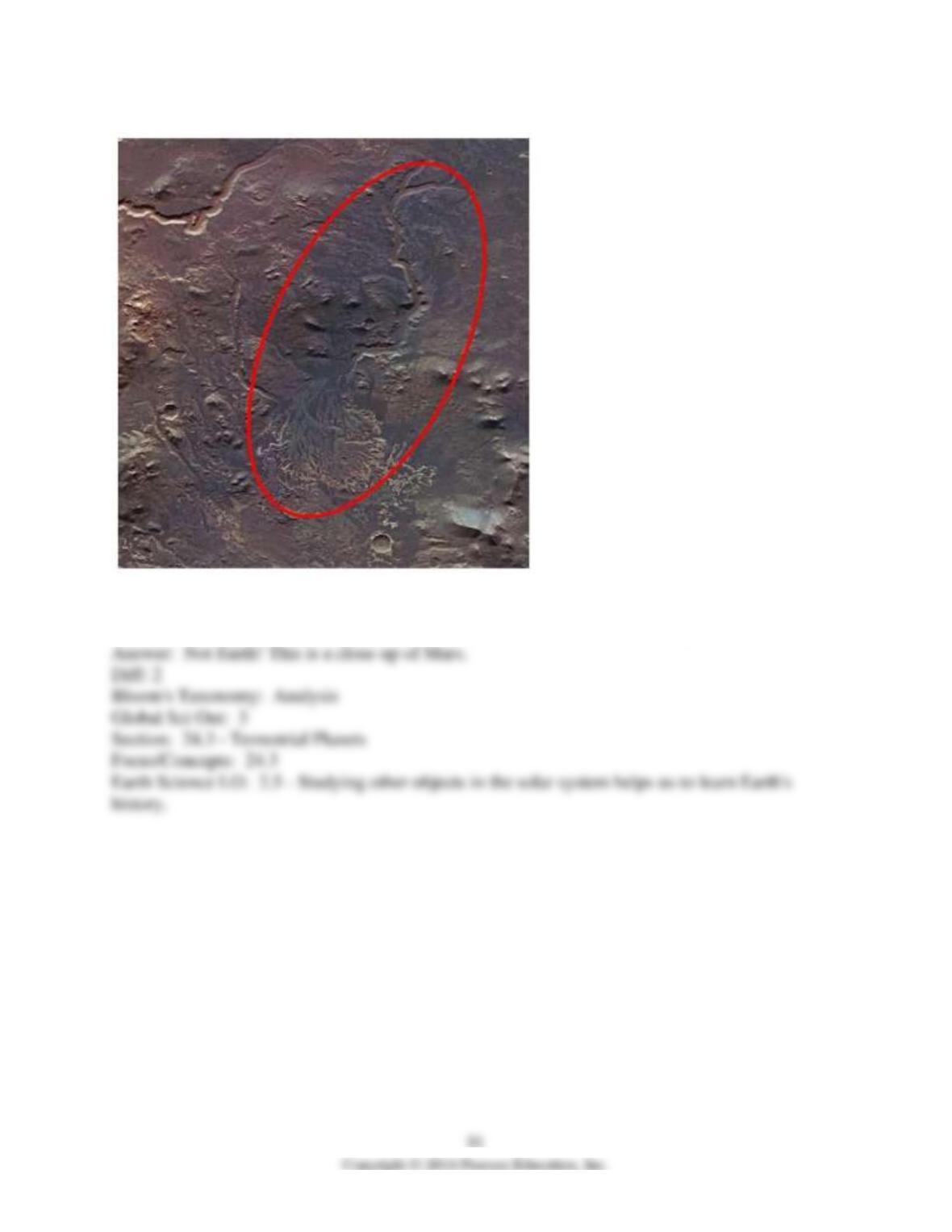
Note the impact craters in other areas of this image. Is this image likely to be of Earth? If not,
which other body in the solar system could have had erosion like this in the past?
7)
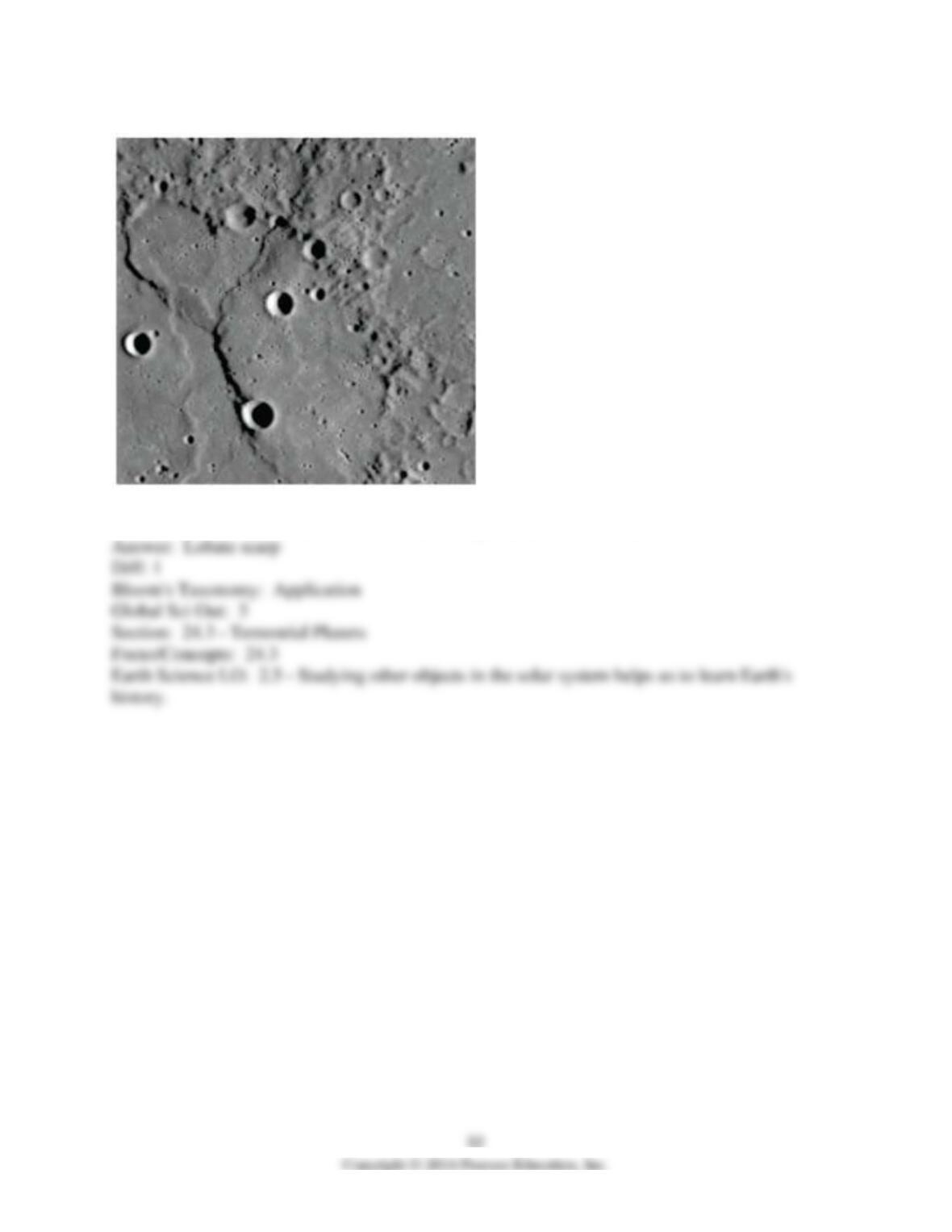
What is the name of the linear feature in this image? (Note: this is not a water erosion feature)
8)
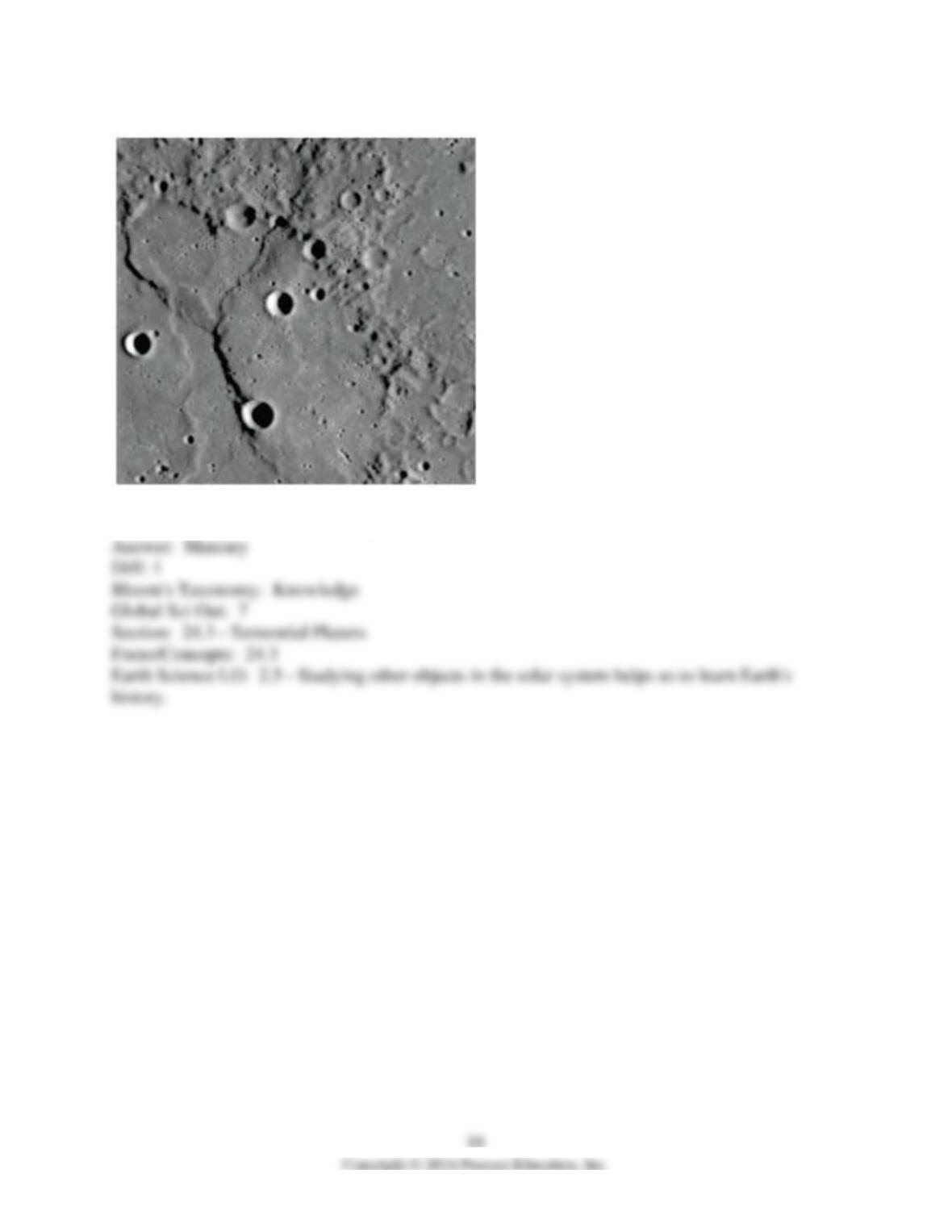
What planet are these features unique to?
9)
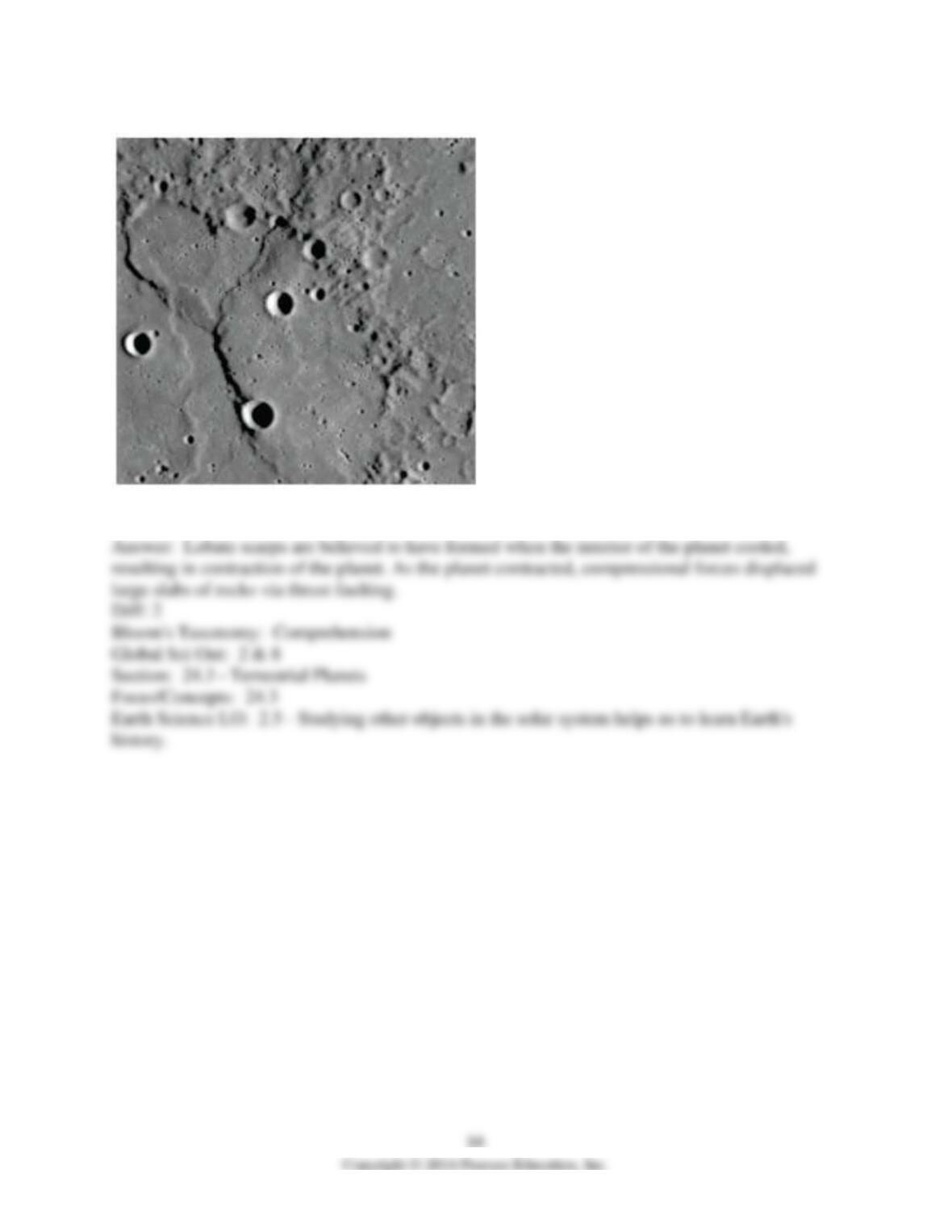
How do these linear features form?