13) Computer models are not infallible at predicting climate change because they used simplified
versions of the Earth to create the model.
14) The concentration of methane in the atmosphere has been shown to be increasing for the last
1,000 years, indicating that humans are not responsible for its generation.
15) Increasing amounts of CO2 in the thermosphere is resulting in increasing global
temperatures.
16) Dust storms can carry enough dust into the atmosphere to create aerosols.
17) Small sea level rise will cause a substantial shift in shoreline location.
21.3 Short Answer Questions
1) Outside of seafloor sediments, list three other sources of proxy data for studying past climates.
2) ________ are small solid or liquid particles suspended in the atmosphere.
3) What is the molecule for ozone?
4) In which layer of the atmosphere is the ozone layer found?
5) ________ are often the best-preserved, most easily identifiable plant remains in sediments and
can be used to interpret the paleoclimate.
6) Why is the Earth heated primarily by radiation from the Earth’s surface?
7) At what angle of axial tilt does the Earth receive the least solar radiation?
8) Which will have greater a greater impact on global temperatures: volcanic ash or volcanic
gases?
9) Sunspots occur in cycles with the maximum number of sunspots occurring every ________
years.
10) What is the current CO2 concentration in the atmosphere?
11) List three ways humans add CO2 to the atmosphere.
12) How does a positive feedback mechanism work?
13) If CFCs have not been widely used since the late 20th century, why are they considered a
major greenhouse gas in the 21st century?
14) How can agriculture be responsible for increasing the amount of methane in the atmosphere?
15) How does the residence time of aerosols in the atmosphere compare to that of greenhouse
gases?

16) Circle the Correct Answer: Which coastline will be more significantly impacted by sea
level change: the Pacific Coast or the Atlantic Coast?

21.4 Matching Questions
Match the layer of the atmosphere with the correct description.
A) The layer of the atmosphere with the greatest amount of air molecules. Temperatures
decrease from bottom to top
B) The outermost layer of the atmosphere where temperatures are extremely high due to solar
radiation
C) The second layer of the atmosphere where temperatures gradually increase from bottom to top
D) The third layer of the atmosphere where the coldest temperatures are found
1) Stratosphere
Diff: 1
Bloom’s Taxonomy: Knowledge
Global Sci Out: 7
Section: 21.3 – Some Atmospheric Basics
Focus/Concepts: 21.3
Earth Science LO: 2.3 – Earth formed from the accumulation of dust and gas, and multiple
collisions of smaller planetary bodies.
2) Troposphere
Diff: 1
Bloom’s Taxonomy: Knowledge
Global Sci Out: 7
Section: 21.3 – Some Atmospheric Basics
Focus/Concepts: 21.3
Earth Science LO: 2.3 – Earth formed from the accumulation of dust and gas, and multiple
collisions of smaller planetary bodies.
3) Mesosphere
Diff: 1
Bloom’s Taxonomy: Knowledge
Global Sci Out: 7
Section: 21.3 – Some Atmospheric Basics
Focus/Concepts: 21.3
Earth Science LO: 2.3 – Earth formed from the accumulation of dust and gas, and multiple
collisions of smaller planetary bodies.
4) Thermosphere
Diff: 1
Bloom’s Taxonomy: Knowledge
Global Sci Out: 7
Section: 21.3 – Some Atmospheric Basics
Focus/Concepts: 21.3
Earth Science LO: 2.3 – Earth formed from the accumulation of dust and gas, and multiple
collisions of smaller planetary bodies.

Match the paleoclimate proxies to the information they can provide about the past climate.
A) Trap gases to provide info about the atmosphere
B) Provide periods of plentiful rain and drought
C) Provide info about past temperature
D) Provide vegetation patterns for a location
5) Tree Rings
Diff: 1
Bloom’s Taxonomy: Knowledge
Global Sci Out: 7
Section: 21.1 – Climate and Geology
Focus/Concepts: 21.2
Earth Science LO: 9.2 – Earth scientists use the geologic record to distinguish between natural
and human influences on Earth’s systems.
6) Pollen
Diff: 1
Bloom’s Taxonomy: Knowledge
Global Sci Out: 7
Section: 21.1 – Climate and Geology
Focus/Concepts: 21.2
Earth Science LO: 9.2 – Earth scientists use the geologic record to distinguish between natural
and human influences on Earth’s systems.
7) Ice Cores
Diff: 1
Bloom’s Taxonomy: Knowledge
Global Sci Out: 7
Section: 21.1 – Climate and Geology
Focus/Concepts: 21.2
Earth Science LO: 9.2 – Earth scientists use the geologic record to distinguish between natural
and human influences on Earth’s systems.
8) Corals
Diff: 1
Bloom’s Taxonomy: Knowledge
Global Sci Out: 7
Section: 21.1 – Climate and Geology
Focus/Concepts: 21.2
Earth Science LO: 9.2 – Earth scientists use the geologic record to distinguish between natural
and human influences on Earth’s systems.
21.5 Essay Questions
1) How do weather and climate differ? Why is it incorrect to define climate as “average
weather”?
2) How can the ratios of oxygen isotopes be used to indicate past climate change? What marine
substance can be tested for its oxygen ratios?
3) How does air pressure change with elevation in the atmosphere? Why does air pressure
change with elevation in the atmosphere?
4) Compare and contrast three proxies for determining paleoclimate. Which do you think is the
most accurate and why?
5) Is the greenhouse effect a bad thing for the planet? Why or why not?
6) Draw a sketch of the greenhouse effect on Earth. Be sure to label the various types of
radiation and explain how heat is trapped.
7) Using the information you presented in your answer for the previous question, compare the
greenhouse effect on Earth to that on planetary bodies such as the Moon and Venus.
8) How did the 1815 eruption of Tambora have global implications for climate change? Was this
temporary or permanent? What is it about Tambora’s location that makes it more or less likely to
result in global climate change?
9) Evaluate the validity of sunspot periods changing climate on Earth.
10) Do you think global climate change is really occurring? Why or why not? Cite examples.
11) Compare and contrast positive climate-feedback mechanisms and negative climate-feedback
mechanisms.
12) Provide one example each of a positive and a negative feedback mechanism and explain how
those specific examples will affect the Earth system.
13) Explain why even small changes in sea level will have a profound effect on human
civilizations.
14) What geopolitical issues are being opened up by the decreasing polar ice caps?
15) Evaluate the following statement: “It is not the fact that the climate is changing that is the
problem. It is the rate at which the changes are taking place.”
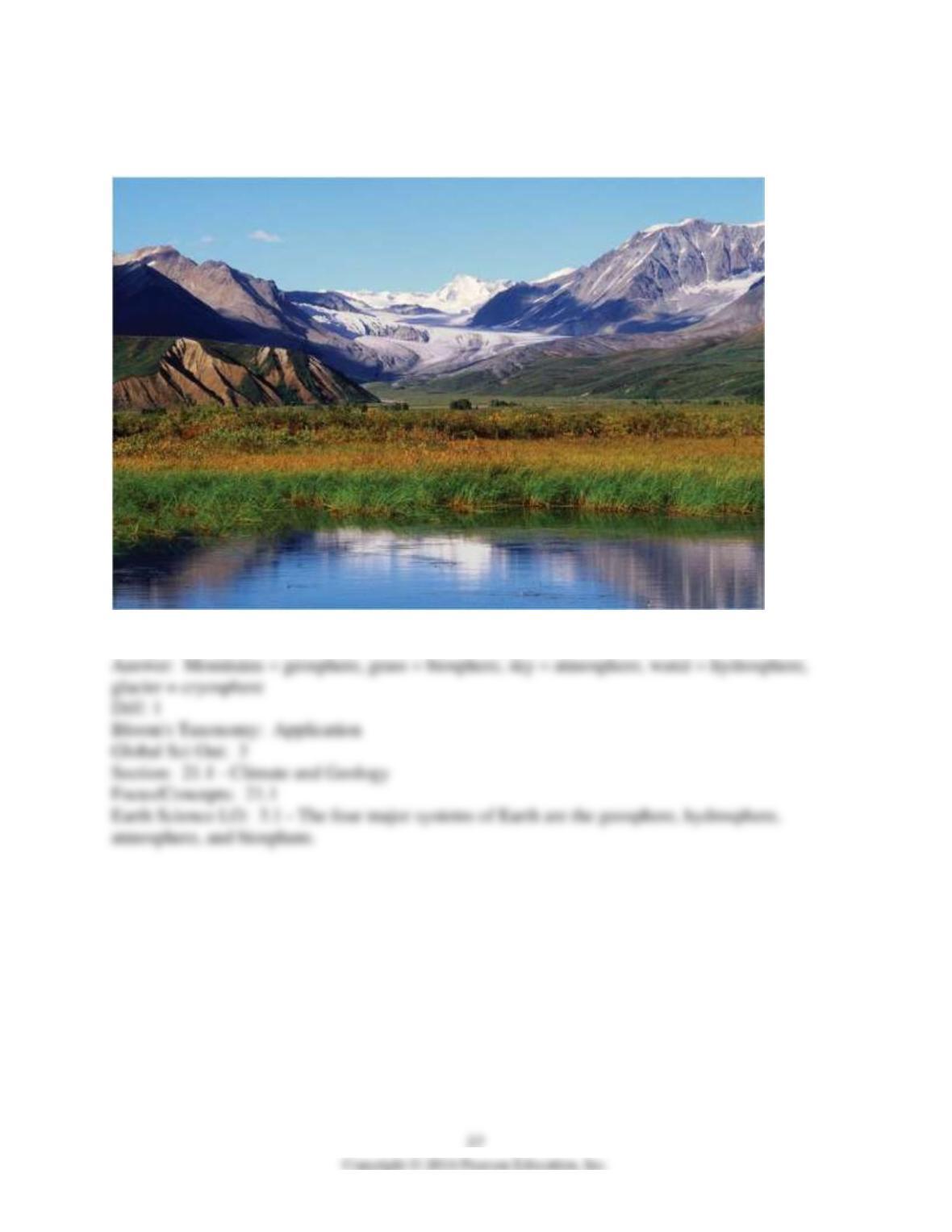
21.6 Visual
1)
Using this image, identify the spheres of the climate system present in this figure.
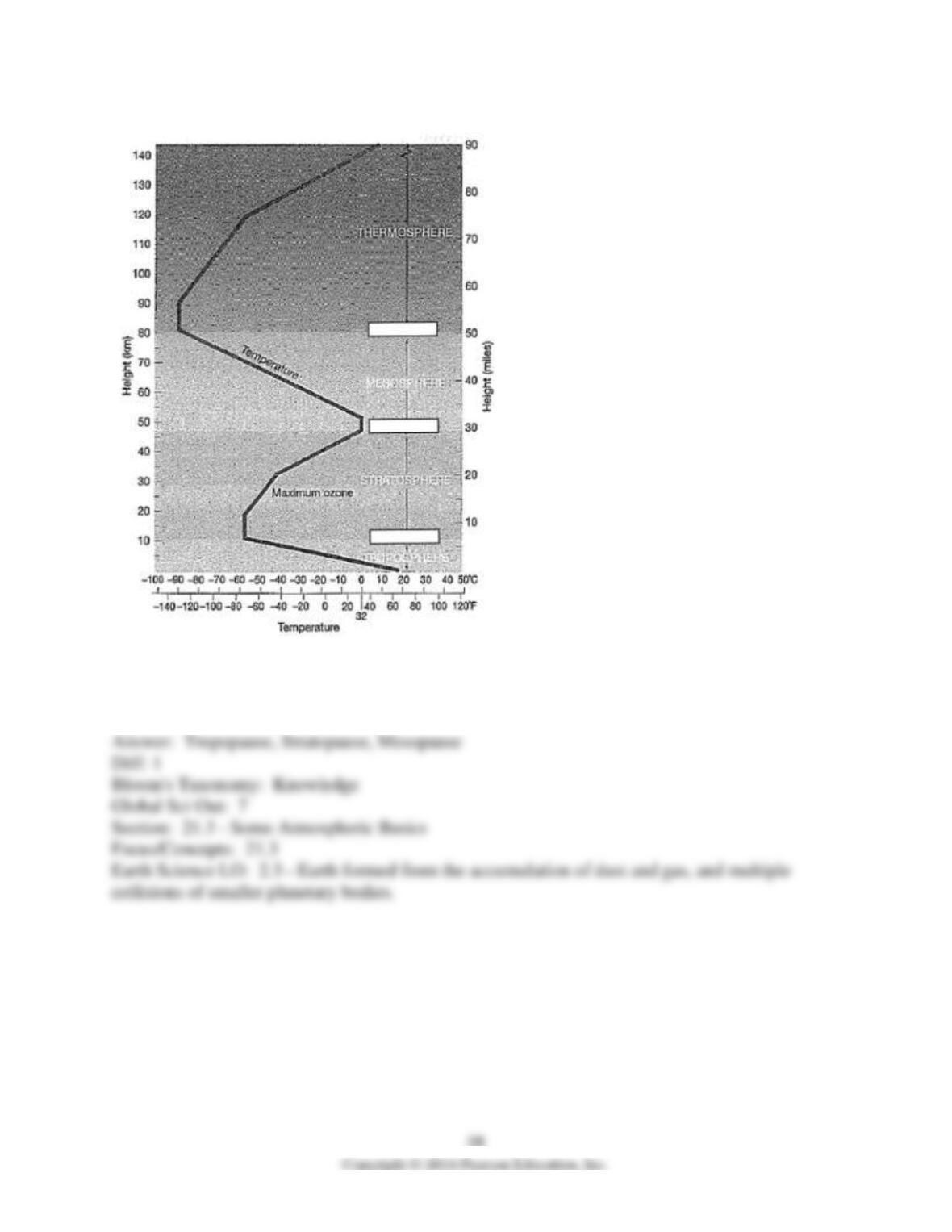
2)
This image is a diagram of the layers of the atmosphere. The breaks between the layers have
been blocked out. Put the names of the breaks between layers in the correct order from bottom to
top.