8) If there is no compositional difference between two oceanic plates, what factor will determine
which will become the subducted plate and why?
9) If new plate material is being created at divergent plate boundaries, is the Earth growing
larger? Explain why or why not.
10) ________ and ________ drive water from the pores of a subducted oceanic plate, which
leads to partial melting.
11) At a Continental-Continental convergence, will continental plate material descend into the
mantle during subduction? Why or why not?
12) Lava solidifying during a period of reverse polarity will align the magnetic fields of its iron
particles toward the ________ pole.
2.4 Matching Questions
Match the tectonic boundary with its direction of motion.
A) Two plates pull apart from each other
B) Two plates move toward each other
C) Two plates slide past each other
1) Convergent Boundary
Diff: 1
Bloom’s Taxonomy: Comprehension
Global Sci Out: 7
Section: 2.4 – The Theory of Plate Tectonics
Focus/Concepts: 2.5-2.7
Earth Science LO: 4.4 – Earth’s tectonic plates consist of the rock crust and uppermost mantle,
and move slowly with respect to one another.
2) Divergent Boundary
Diff: 1
Bloom’s Taxonomy: Comprehension
Global Sci Out: 7
Section: 2.4 – The Theory of Plate Tectonics
Focus/Concepts: 2.5-2.7
Earth Science LO: 4.4 – Earth’s tectonic plates consist of the rock crust and uppermost mantle,
and move slowly with respect to one another.
3) Transform Boundary
Diff: 1
Bloom’s Taxonomy: Comprehension
Global Sci Out: 7
Section: 2.4 – The Theory of Plate Tectonics
Focus/Concepts: 2.5-2.7
Earth Science LO: 4.4 – Earth’s tectonic plates consist of the rock crust and uppermost mantle,
and move slowly with respect to one another.
Match the tectonic boundary with what the boundary is doing to the crust.
A) Crust is being destroyed
B) Crust is being conserved
C) Crust is being created
4) Convergent Boundary
Diff: 1
Bloom’s Taxonomy: Comprehension
Global Sci Out: 7
Section: 2.4 – The Theory of Plate Tectonics
Focus/Concepts: 2.5-2.7
Earth Science LO: 4.4 – Earth’s tectonic plates consist of the rock crust and uppermost mantle,
and move slowly with respect to one another.
5) Divergent Boundary
Diff: 1
Bloom’s Taxonomy: Comprehension
Global Sci Out: 7
Section: 2.4 – The Theory of Plate Tectonics
Focus/Concepts: 2.5-2.7
Earth Science LO: 4.4 – Earth’s tectonic plates consist of the rock crust and uppermost mantle,
and move slowly with respect to one another.
6) Transform Boundary
Diff: 1
Bloom’s Taxonomy: Comprehension
Global Sci Out: 7
Section: 2.4 – The Theory of Plate Tectonics
Focus/Concepts: 2.5-2.7
Earth Science LO: 4.4 – Earth’s tectonic plates consist of the rock crust and uppermost mantle,
and move slowly with respect to one another.
Match the tectonic boundary with the type of stress affecting it.
A) Tension
B) Compression
C) Shear
7) Convergent Boundary
Diff: 1
Bloom’s Taxonomy: Comprehension
Global Sci Out: 7
Section: 2.5 – Divergent Plate Boundaries and Seafloor Spreading, 2.6 – Convergent Plate
Boundaries and Subduction, & 2.7 – Transform Plate Boundaries
Focus/Concepts: 2.5-2.7
Earth Science LO: 4.4 – Earth’s tectonic plates consist of the rock crust and uppermost mantle,
and move slowly with respect to one another.
8) Divergent Boundary
Diff: 1
Bloom’s Taxonomy: Comprehension
Global Sci Out: 7
Section: 2.5 – Divergent Plate Boundaries and Seafloor Spreading, 2.6 – Convergent Plate
Boundaries and Subduction, & 2.7 – Transform Plate Boundaries
Focus/Concepts: 2.5-2.7
Earth Science LO: 4.4 – Earth’s tectonic plates consist of the rock crust and uppermost mantle,
and move slowly with respect to one another.
9) Transform Boundary
Diff: 1
Bloom’s Taxonomy: Comprehension
Global Sci Out: 7
Section: 2.5 – Divergent Plate Boundaries and Seafloor Spreading, 2.6 – Convergent Plate
Boundaries and Subduction, & 2.7 – Transform Plate Boundaries
Focus/Concepts: 2.5-2.7
Earth Science LO: 4.4 – Earth’s tectonic plates consist of the rock crust and uppermost mantle,
and move slowly with respect to one another.
Match the convergent boundary with a real-world example.
A) Pacific & Philippine Plates
B) Indian & Eurasian Plates
C) North American & Juan de Fuca Plates
10) Oceanic-Continental
Diff: 1
Bloom’s Taxonomy: Comprehension
Global Sci Out: 2 & 7
Section: 2.6 – Convergent Plate Boundaries and Subduction
Focus/Concepts: 2.6
Earth Science LO: 4.4 – Earth’s tectonic plates consist of the rock crust and uppermost mantle,
and move slowly with respect to one another.
11) Oceanic-Oceanic
Diff: 1
Bloom’s Taxonomy: Comprehension
Global Sci Out: 2 & 7
Section: 2.6 – Convergent Plate Boundaries and Subduction
Focus/Concepts: 2.6
Earth Science LO: 4.4 – Earth’s tectonic plates consist of the rock crust and uppermost mantle,
and move slowly with respect to one another.
12) Continental-Continental
Diff: 1
Bloom’s Taxonomy: Comprehension
Global Sci Out: 2 & 7
Section: 2.6 – Convergent Plate Boundaries and Subduction
Focus/Concepts: 2.6
Earth Science LO: 4.4 – Earth’s tectonic plates consist of the rock crust and uppermost mantle,
and move slowly with respect to one another.
2.5 Essay Questions
1) Explain how geologists regarded the positions of the ocean basins and the continents prior to
the 1960s and how that perspective differs from how modern geologists regard those same
features.
2) When Continental Drift was first proposed in 1912, geologists from one continent above all
were strongly against the idea. Which continent’s geologists were against the idea and why did
they have difficulty accepting it?
3) The acceptance of Plate Tectonics after the initial rejection of Continental Drift has been
described as a scientific revolution. Explain why this scientific revolution took place and what
tools were used to bring it about.
4) Scientific research supports the existence of Alfred Wegener’s proposed supercontinent
approximately 300 million years ago. It has subsequently broken apart and the pieces – our
modern continents – have migrated to the positions they occupy today. Based on your knowledge
of the mechanics of tectonic motion, discuss the likelihood of such a supercontinent forming
again. Your discussion should include plate boundaries present and how they would help or
hinder such a prospect. Should you support this idea, also include in your discussion the probable
location you believe the next supercontinent would form.
5) Why would using the continental shelves to reassemble to continents provide a better fit than
using the margins of the continents?
6) Mesosaurus is a small aquatic freshwater reptile that existed in the Permian Period. It is only
found in black shale deposits found in eastern South America and southwestern Africa. If the
Mesosaurus is an aquatic reptile and the continents are separated by an ocean, evaluate why the
Mesosaurus would be used as strong evidence in favor of Continental Drift rather than as
evidence against it.
7) Which two aspects of Continental Drift were most objectionable to scientists of the early 20th
century? What evidence was used to support their objections?
8) Explain how the polar wandering paths for Europe and North America can be used to support
the existence of Pangaea.
9) Lava lamps are commonly used to illustrate how convection cells in the mantle convey heat
from the core to the exterior of the Earth. Explain how convection in a lava lamp transfers heat.
2.6 Visual
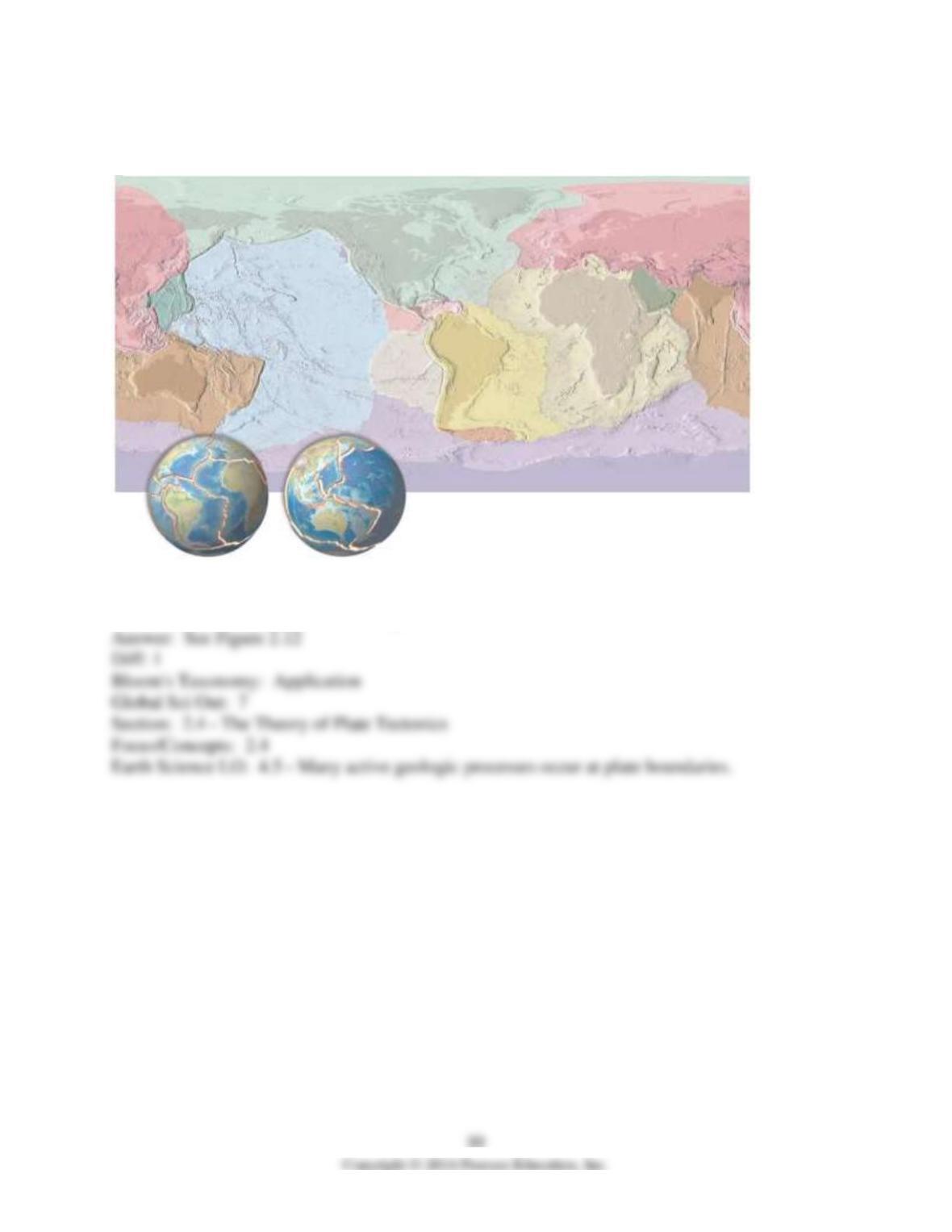
1)
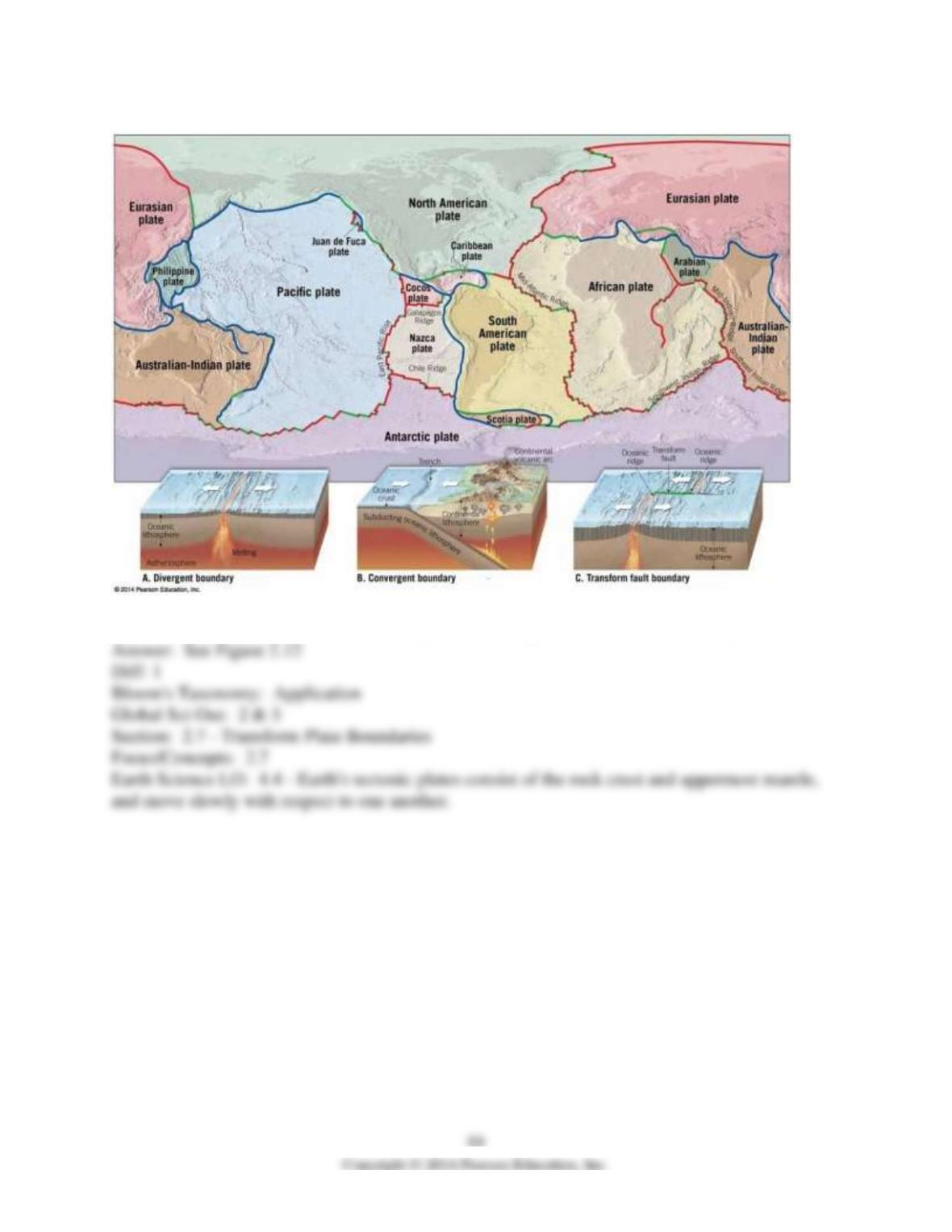
Using the map provided, identify one convergent boundary, one divergent boundary, and one
transform boundary anywhere on the globe.
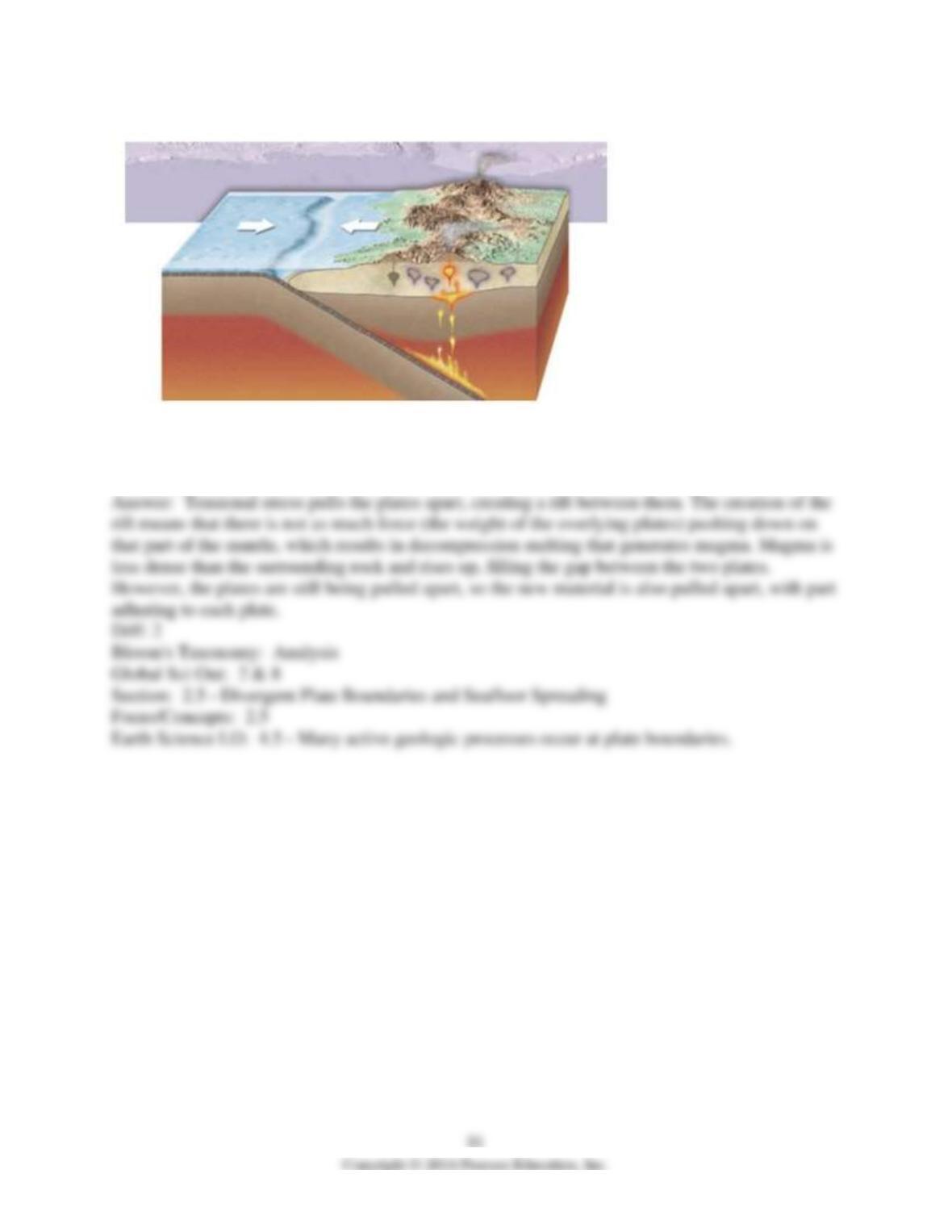
2)
Using the cross-section provided, explain how new plate material is created at a divergent plate
boundary. Make sure your answer includes a discussion on the forces at work and the generation
of magma beneath the rift.
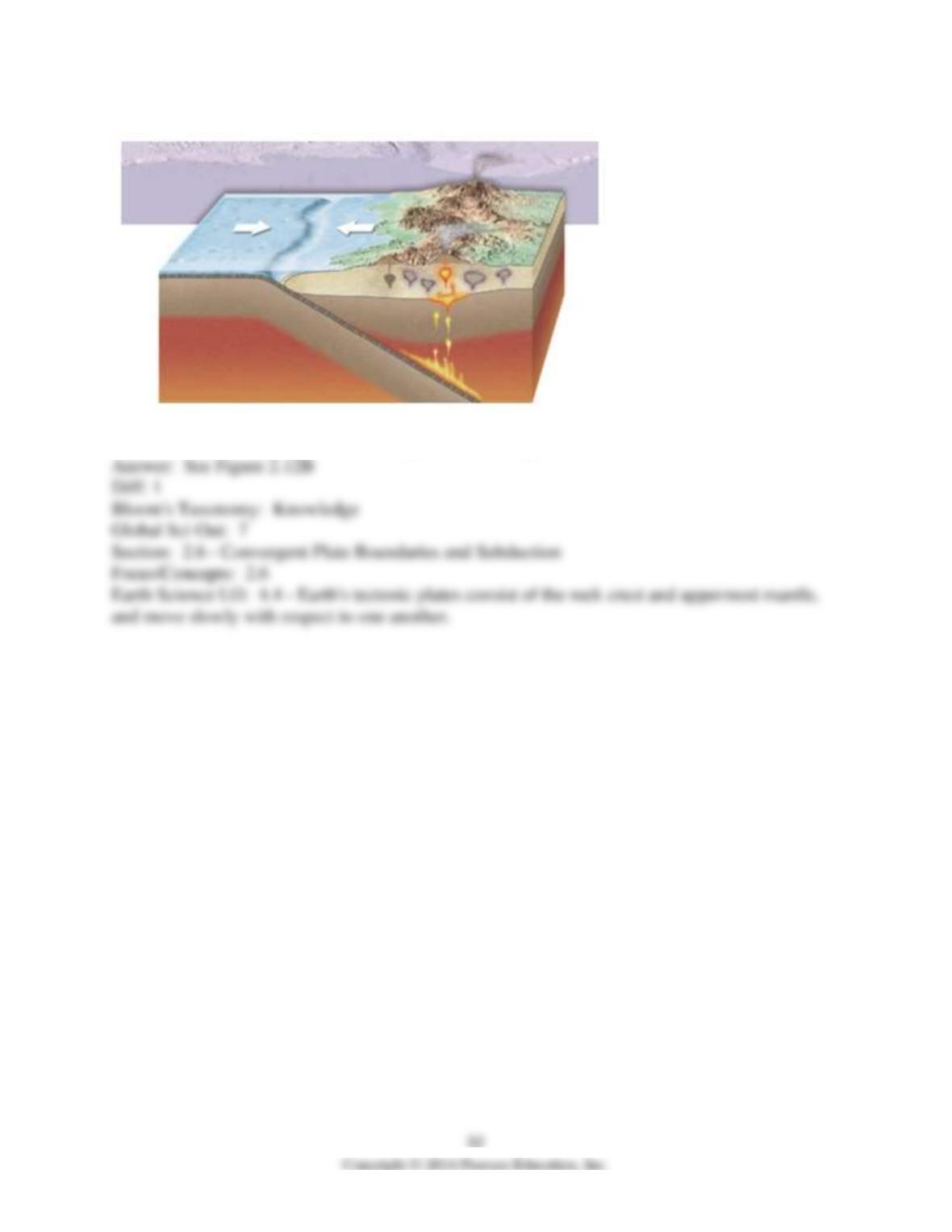
3)
Label the oceanic and continental lithospheres in this figure.
4)
Indicate on the figure above which boundaries are divergent and which are transform.
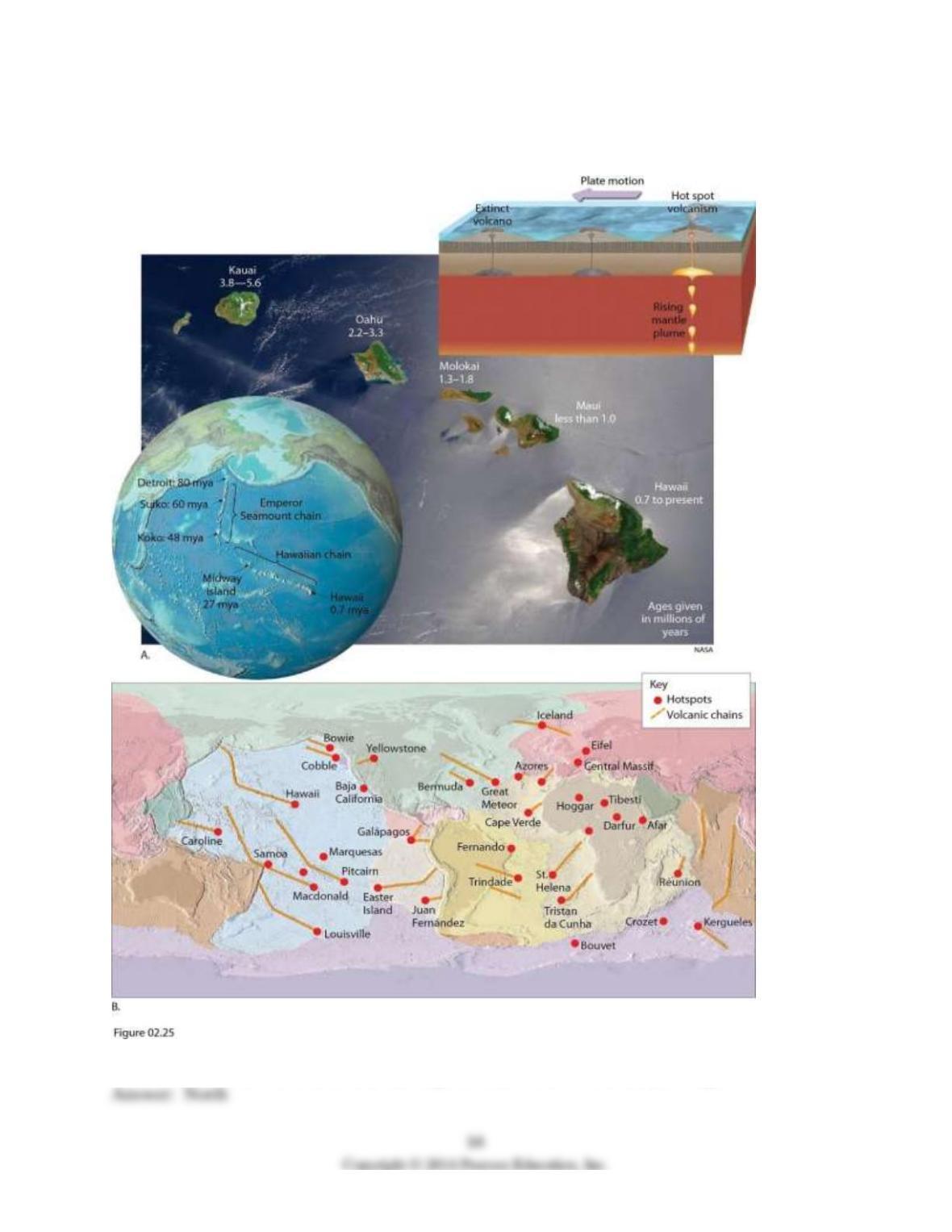
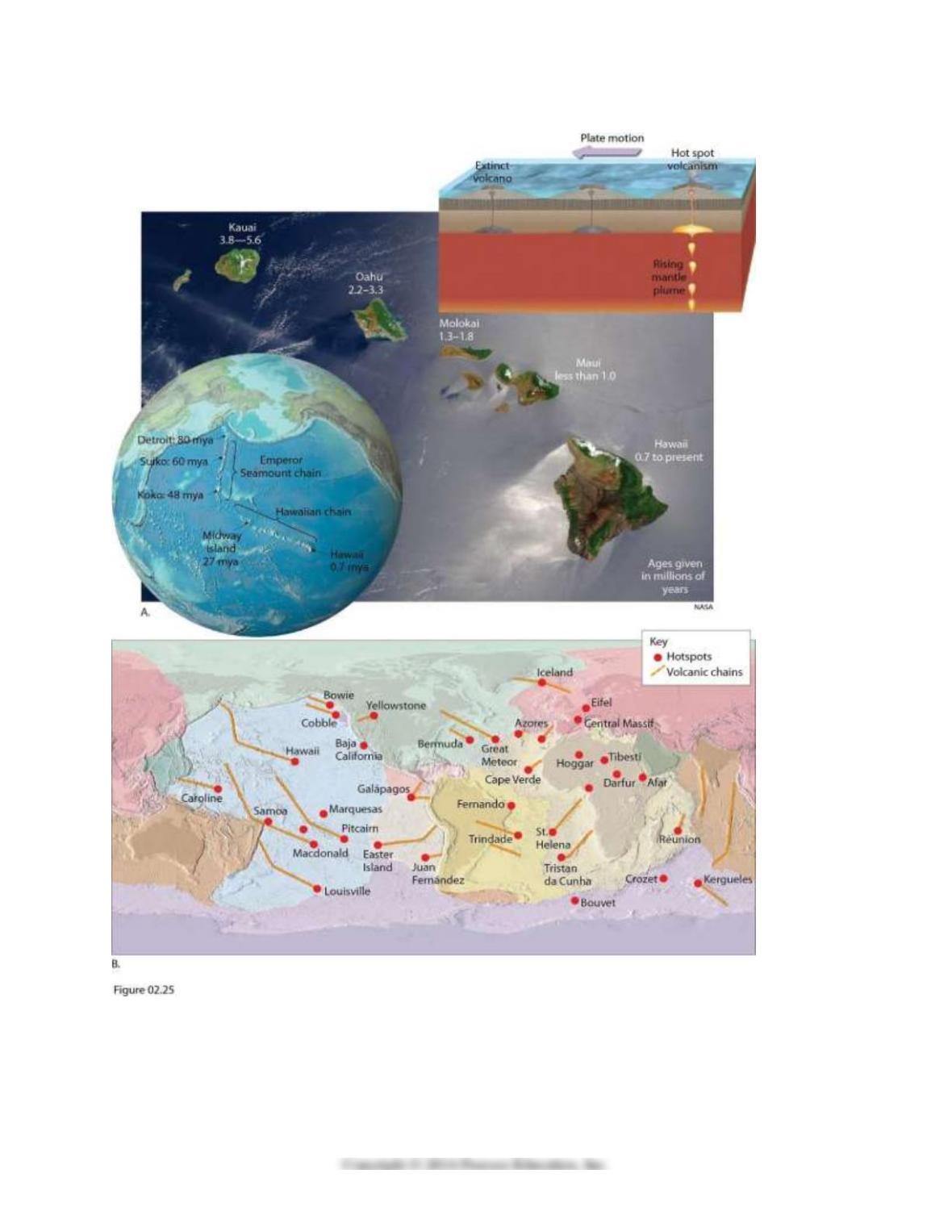
5) The Hawaiian Mantle Plume has left a chain of volcanic islands and seamounts stretching
back for ~70 million years. Although the mantle plume has remained relatively stationary, the
Pacific Plate above it has moved. Use the figure below to answer the following question.
What direction was the Pacific Plate moving between 65 and 43 million years ago?
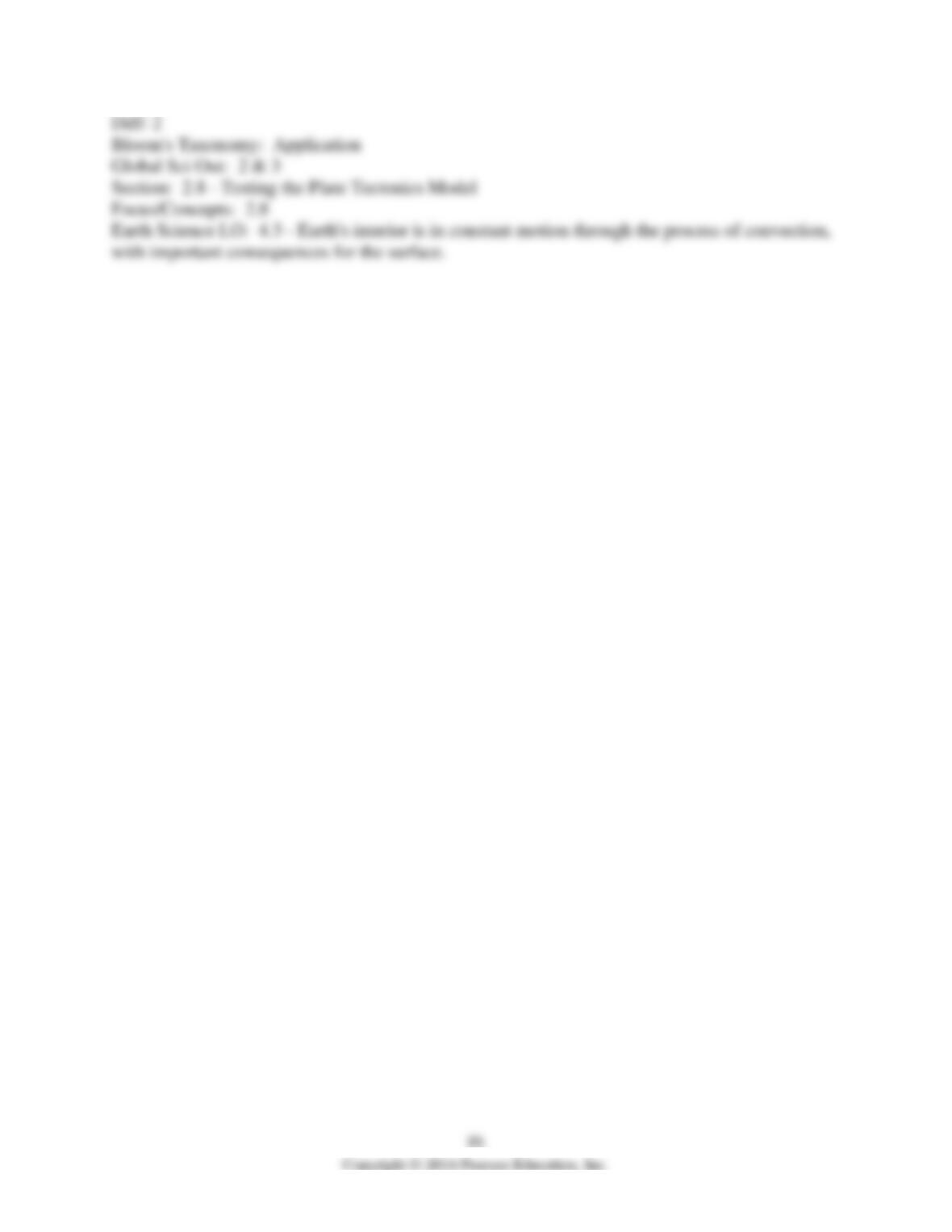
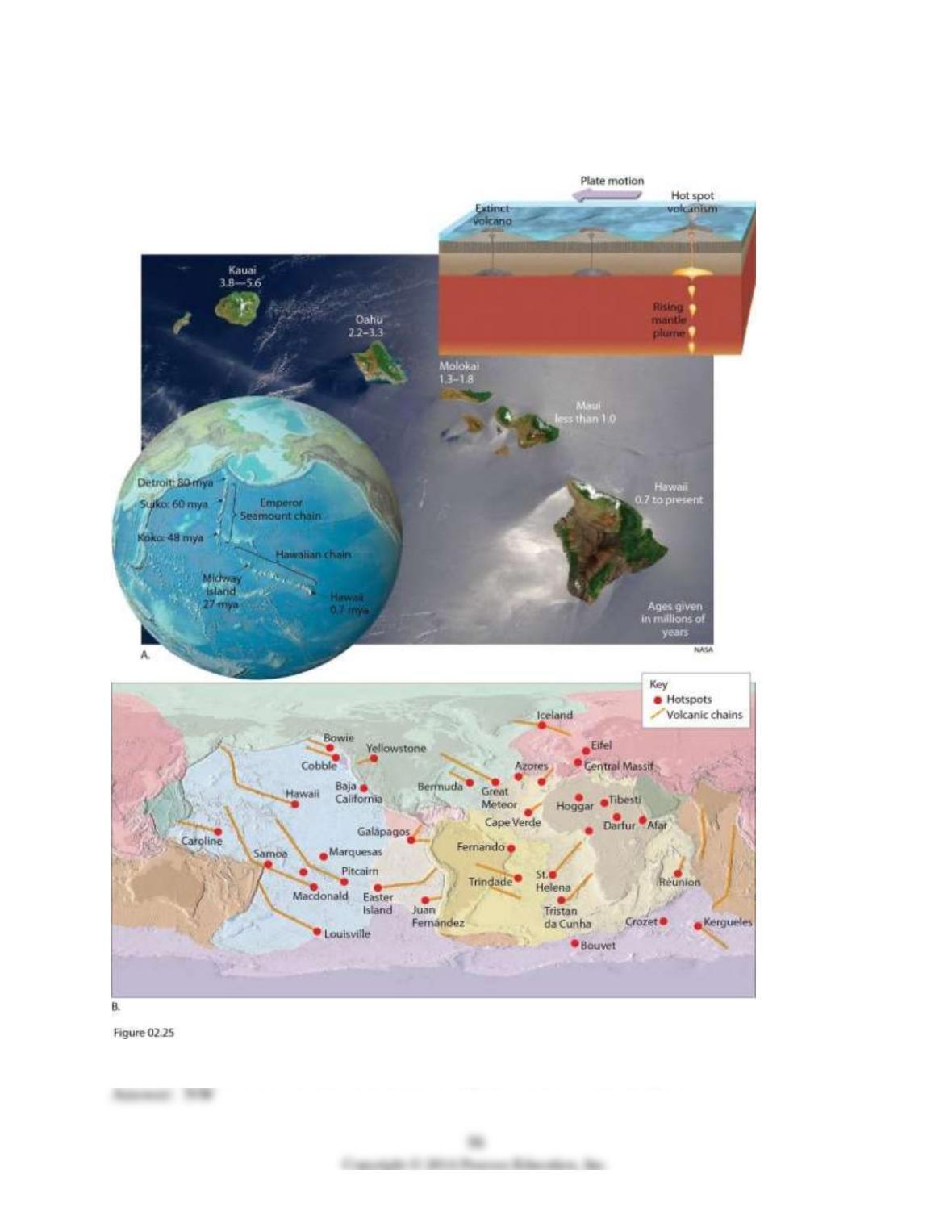
6) The Hawaiian Mantle Plume has left a chain of volcanic islands and seamounts stretching
back for ~70 million years. Although the mantle plume has remained relatively stationary, the
Pacific Plate above it has moved. Use the figure below to answer the following question.
What direction has the Pacific Plate been moving for the last 40 million years?
38
7)
The Hawaiian Mantle Plume is still affecting the island of Hawaii. One of the volcanoes on the
island is actively erupting because of it. Which volcano is currently erupting because of the
mantle plume? (Think about the direction of plate movement you answered in the previous
question.)
8) As the island of Hawaii continues to move away from the mantle plume, a new submarine
volcano will be created. Off which coast would you expect the new submarine volcano to be
forming?