5) Central Australia
Diff: 1
Bloom’s Taxonomy: Knowledge
Global Sci Out: 7
Section: 19.1 – Distribution and Causes of Dry Lands
Focus/Concepts: 19.1
Earth Science LO: 4.8 – Weathered and unstable rock materials erode from some parts of Earth’s
surface and are deposited in others.

Match the desert landform with the correct definition.
A) Cone of debris at the mouth of a canyon leaving the mountains
B) Dry, flat lake bed created by evaporation
C) Apron of sediment along the mountain front
D) Bedrock knob sticking up through sediment-filled basin
6) Inselberg
Diff: 1
Bloom’s Taxonomy: Knowledge
Global Sci Out: 7
Section: 19.3 – Basin and Range: The Evolution of a Desert Landscape
Focus/Concepts: 19.3
Earth Science LO: 4.7 – Landscapes result from the dynamic interplay between processes that
form and uplift new crust and processes that destroy and depress the crust.
7) Bajada
Diff: 1
Bloom’s Taxonomy: Knowledge
Global Sci Out: 7
Section: 19.3 – Basin and Range: The Evolution of a Desert Landscape
Focus/Concepts: 19.3
Earth Science LO: 4.7 – Landscapes result from the dynamic interplay between processes that
form and uplift new crust and processes that destroy and depress the crust.
8) Playa
Diff: 1
Bloom’s Taxonomy: Knowledge
Global Sci Out: 7
Section: 19.3 – Basin and Range: The Evolution of a Desert Landscape
Focus/Concepts: 19.3
Earth Science LO: 4.7 – Landscapes result from the dynamic interplay between processes that
form and uplift new crust and processes that destroy and depress the crust.
9) Alluvial Fan
Diff: 1
Bloom’s Taxonomy: Knowledge
Global Sci Out: 7
Section: 19.3 – Basin and Range: The Evolution of a Desert Landscape
Focus/Concepts: 19.3
Earth Science LO: 4.7 – Landscapes result from the dynamic interplay between processes that
form and uplift new crust and processes that destroy and depress the crust.
19
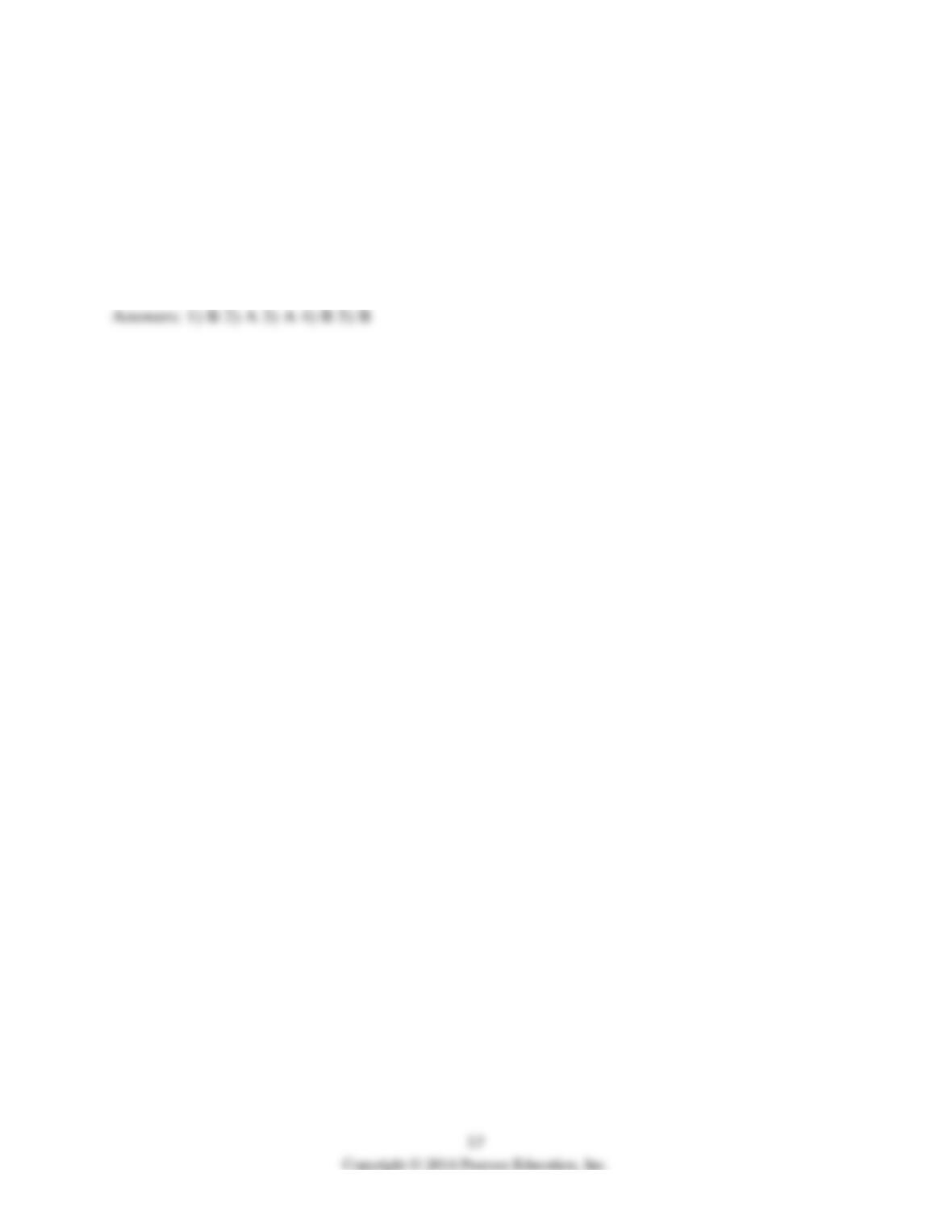
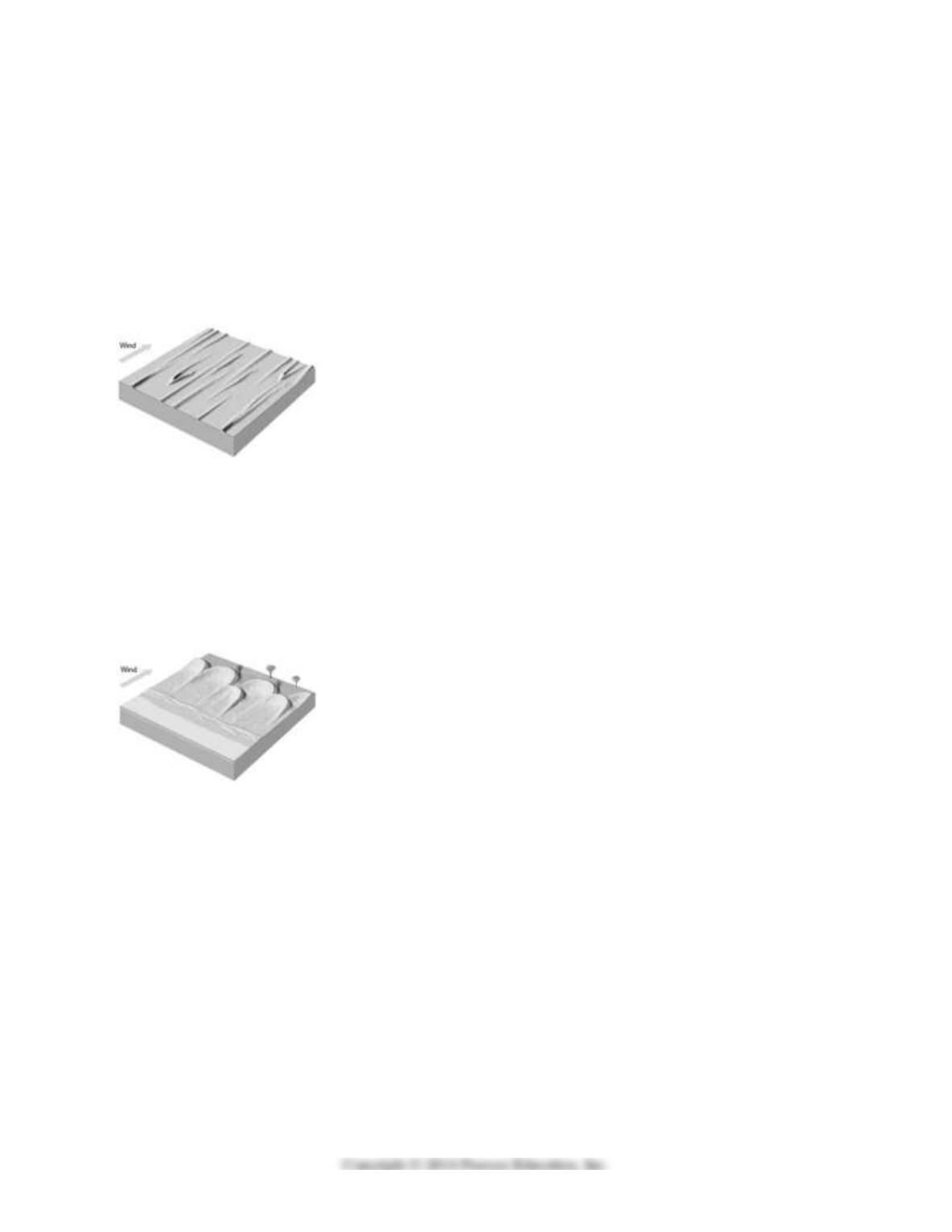
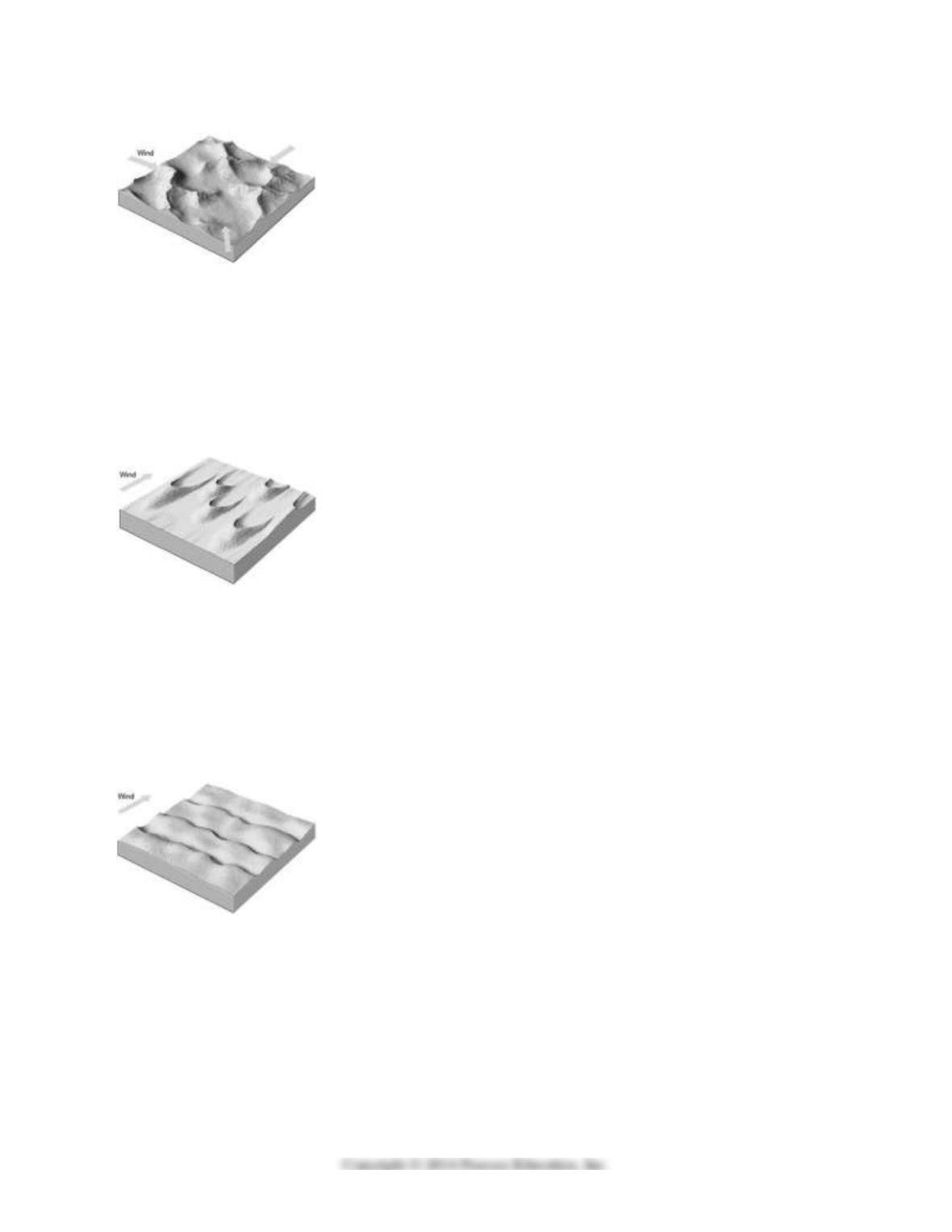
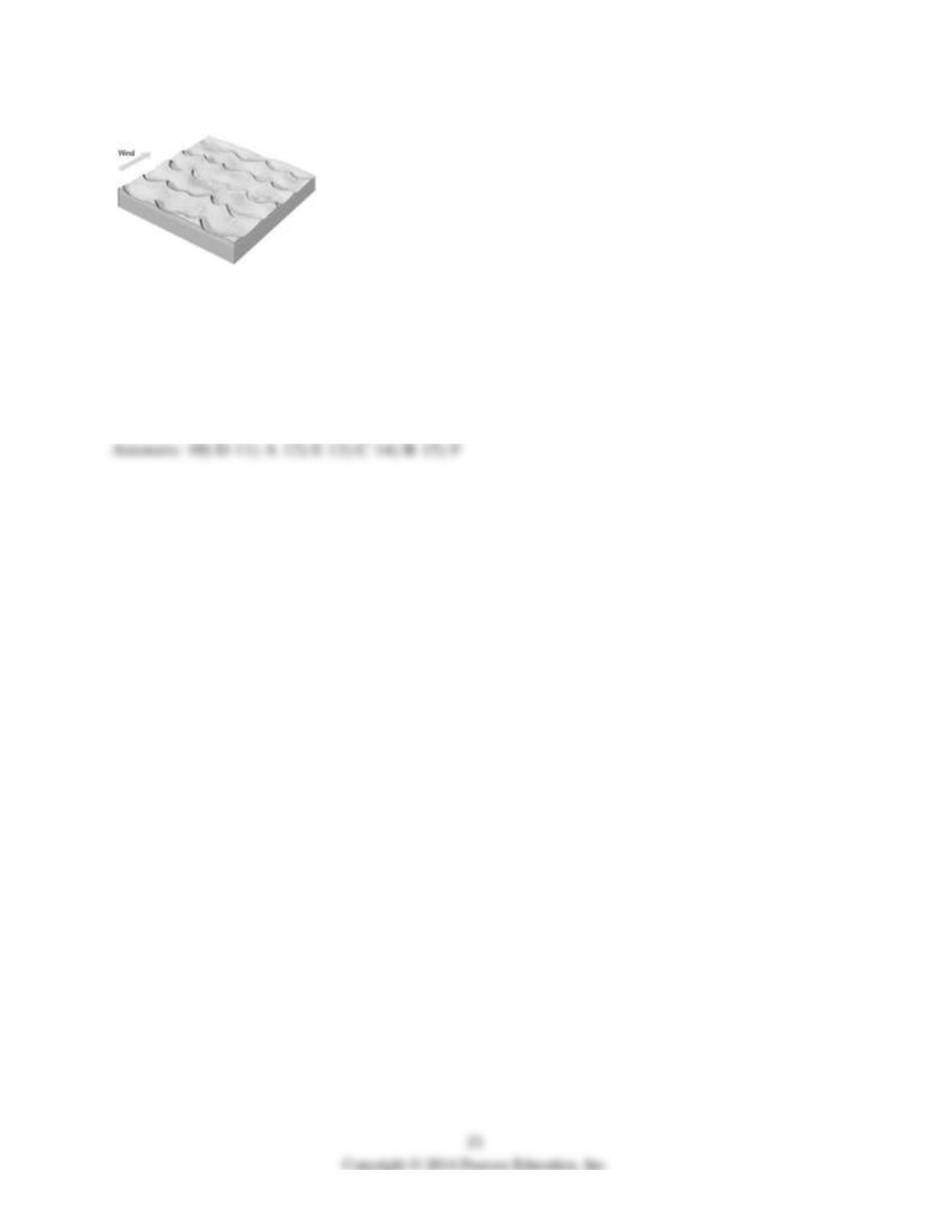
Match the name of the sand dune to the correct image.
A) Parabolic Dune
B) Transverse Dune
C) Barchan Dune
D) Longitudinal Dune
E) Star Dune
F) Barchanoid Dune
10)
Diff: 1
Bloom’s Taxonomy: Application
Global Sci Out: 3
Section: 19.6 – Wind Deposits
Focus/Concepts: 19.6
Earth Science LO: 4.8 – Weathered and unstable rock materials erode from some parts of Earth’s
surface and are deposited in others.
11)
Diff: 1
Bloom’s Taxonomy: Application
Global Sci Out: 3
Section: 19.6 – Wind Deposits
Focus/Concepts: 19.6
Earth Science LO: 4.8 – Weathered and unstable rock materials erode from some parts of Earth’s
surface and are deposited in others.
20
12)
Diff: 1
Bloom’s Taxonomy: Application
Global Sci Out: 3
Section: 19.6 – Wind Deposits
Focus/Concepts: 19.6
Earth Science LO: 4.8 – Weathered and unstable rock materials erode from some parts of Earth’s
surface and are deposited in others.
13)
Diff: 1
Bloom’s Taxonomy: Application
Global Sci Out: 3
Section: 19.6 – Wind Deposits
Focus/Concepts: 19.6
Earth Science LO: 4.8 – Weathered and unstable rock materials erode from some parts of Earth’s
surface and are deposited in others.
14)
Diff: 1
Bloom’s Taxonomy: Application
Global Sci Out: 3
Section: 19.6 – Wind Deposits
Focus/Concepts: 19.6
Earth Science LO: 4.8 – Weathered and unstable rock materials erode from some parts of Earth’s
surface and are deposited in others.
15)
Diff: 1
Bloom’s Taxonomy: Application
Global Sci Out: 3
Section: 19.6 – Wind Deposits
Focus/Concepts: 19.6
Earth Science LO: 4.8 – Weathered and unstable rock materials erode from some parts of Earth’s
surface and are deposited in others.

22
Match the sand dune with the correct description.
A) Linear ridges of sand perpendicular to the prevailing wind
B) Crescent-shaped dune with tips pointing downwind
C) Linear ridges of sand parallel to the prevailing wind direction
D) Dunes with complex shapes that formed as a result of various seasonal wind directions
E) Multiple, overlapping crescent-shaped coastal dunes with the dune tips pointing toward shore
F) Undulating sand ridges perpendicular to prevailing winds with crescent-shaped slip faces
pointing downwind
16) Longitudinal
Diff: 1
Bloom’s Taxonomy: Knowledge
Global Sci Out: 7
Section: 19.6 – Wind Deposits
Focus/Concepts: 19.6
Earth Science LO: 4.8 – Weathered and unstable rock materials erode from some parts of Earth’s
surface and are deposited in others.
17) Parabolic
Diff: 1
Bloom’s Taxonomy: Knowledge
Global Sci Out: 7
Section: 19.6 – Wind Deposits
Focus/Concepts: 19.6
Earth Science LO: 4.8 – Weathered and unstable rock materials erode from some parts of Earth’s
surface and are deposited in others.
18) Barchan
Diff: 1
Bloom’s Taxonomy: Knowledge
Global Sci Out: 7
Section: 19.6 – Wind Deposits
Focus/Concepts: 19.6
Earth Science LO: 4.8 – Weathered and unstable rock materials erode from some parts of Earth’s
surface and are deposited in others.
19) Transverse
Diff: 1
Bloom’s Taxonomy: Knowledge
Global Sci Out: 7
Section: 19.6 – Wind Deposits
Focus/Concepts: 19.6
Earth Science LO: 4.8 – Weathered and unstable rock materials erode from some parts of Earth’s
surface and are deposited in others.
20) Star
Diff: 1
Bloom’s Taxonomy: Knowledge
Global Sci Out: 7
Section: 19.6 – Wind Deposits
Focus/Concepts: 19.6
Earth Science LO: 4.8 – Weathered and unstable rock materials erode from some parts of Earth’s
surface and are deposited in others.
21) Barchanoid
Diff: 1
Bloom’s Taxonomy: Knowledge
Global Sci Out: 7
Section: 19.6 – Wind Deposits
Focus/Concepts: 19.6
Earth Science LO: 4.8 – Weathered and unstable rock materials erode from some parts of Earth’s
surface and are deposited in others.
19.5 Essay Questions
1) Explain how circulation patterns in the atmosphere generate the bands of low-latitude deserts
around the Equator.
2) How can cold coastal currents along the west coasts of continents generate subtropical
deserts?
3) Compare and contrast major floods in a humid environment (i.e. along the Mississippi River)
against those in a desert environment.
4) Explain how the environmental conditions in the headwaters of the Colorado River affect the
longevity of the river as it moves through the desert.
5) What are the three stages of desert landscape evolution? Provide examples of landforms for
each.
6) Compare and contrast sediment transportation by wind and by water.
7) What role (if any) will our changing climate play in future desertification?
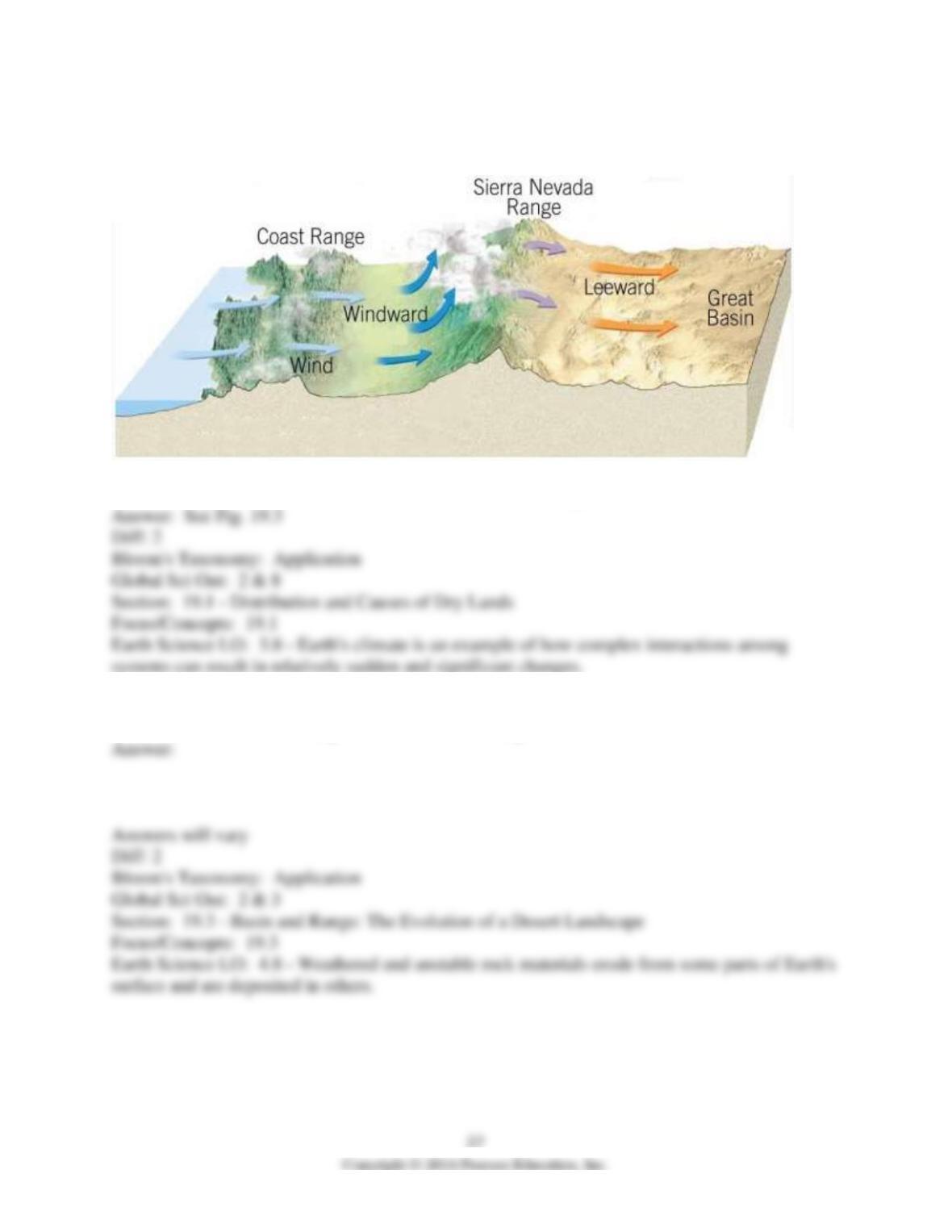
19.6 Visual
1)
Use this image to explain the formation of a rainshadow. Be specific.
2) Draw a cross-section of an alluvial fan. Be sure to indicate the upstream and downstream ends
of the fan as well as the change in sediment size through the fan.
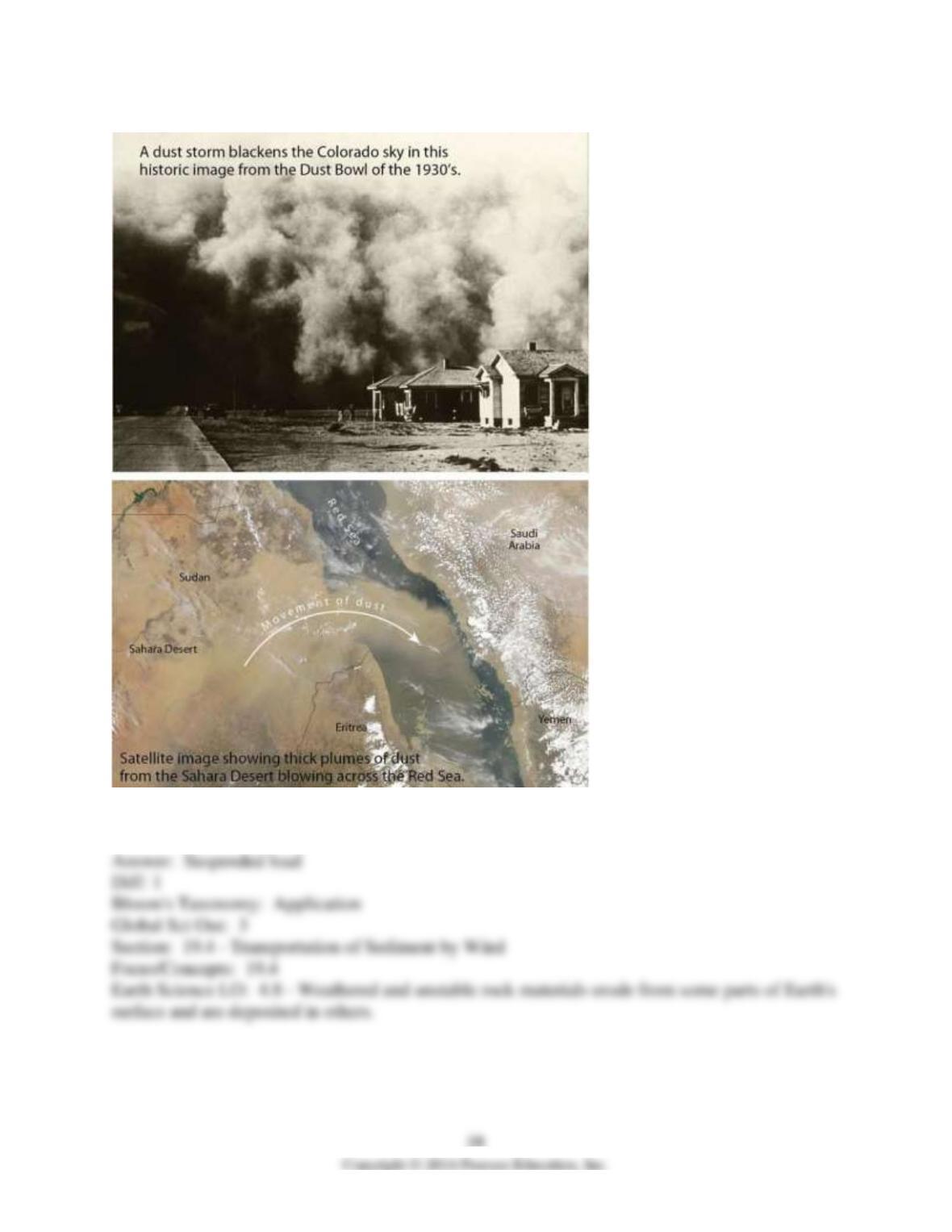
3)
Which part of the wind’s sediment load is visible in this image?
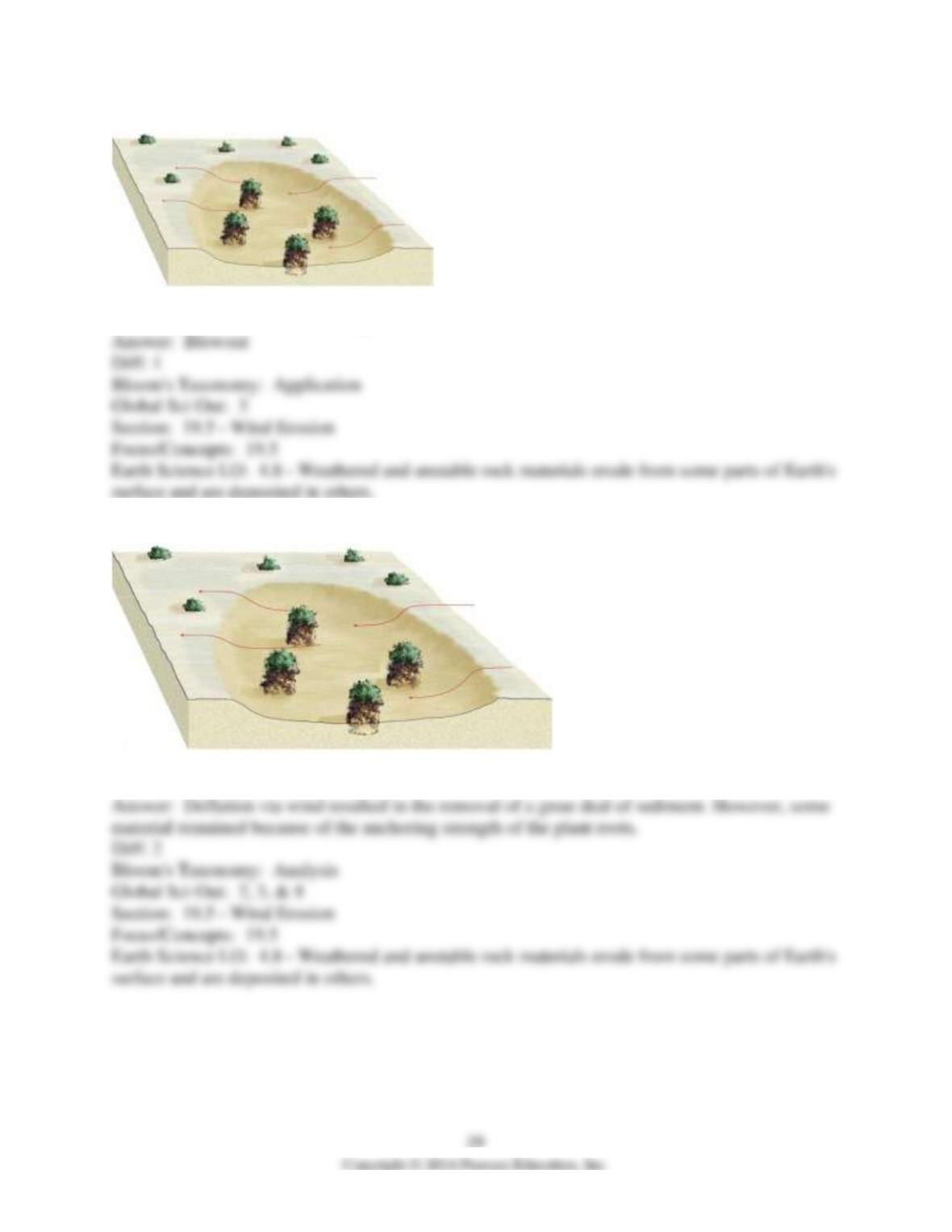
4)
What feature is visible in this image?
5)
Explain what happened in this figure.
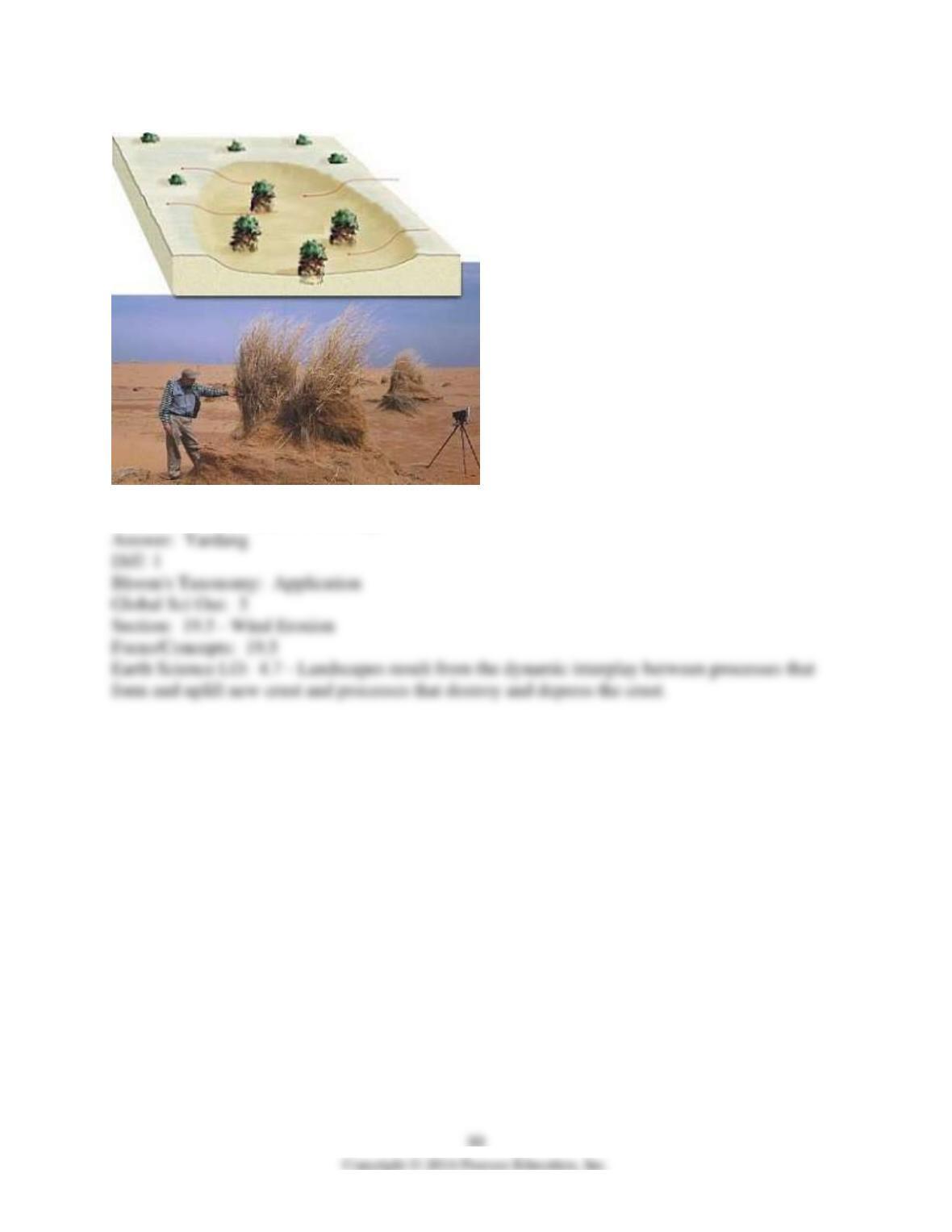
6)
What feature is present in this image?
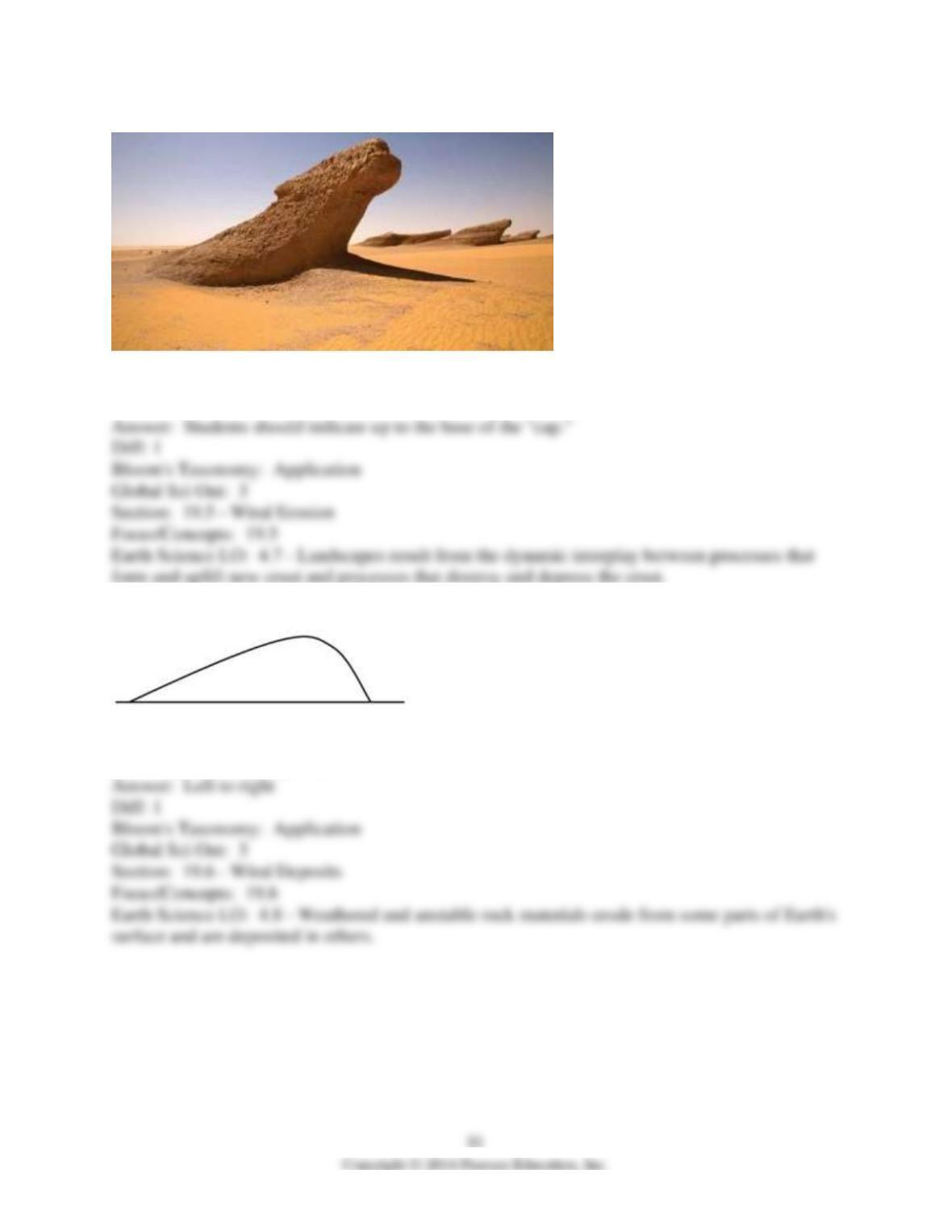
7)
Using this image, indicate the height to which wind was transporting sediment to abrade
Mushroom Rock.
8)
The figure above is a cross-section of a dune. Based on the shape of the dune, which way was the
prevailing wind coming from?