3) The Laurentide Ice Sheet is an example of ________ glaciation.
4) What factor(s) might lead glaciers to a basal surge?
5) Arêtes, horns, and hanging valleys are evidence of ________ glaciation.
6) How does the formation of a hanging valley differ from the formation of the main glacial
trough?
7) Read the following excerpt from The Works of John Playfair (1822). Based on the excerpt,
what glacial landform is being described?
“…For the moving of large masses of rock, the most powerful engines without doubt that nature
employs are the glaciers…[Rock] fragments they gradually transport to their utmost boundaries,
where a formidable wall ascertains the magnitude, and attests the force, of the great engine by
which it was erected.”
8) Lateral and medial moraines are found in connection with ________ glaciation.
9) ________ are former river valleys that were oriented parallel to the direction of ice flow and
were scoured deeper by advancing glacial ice.
10) North American glaciations used to be described in four episodes. However, two of those
episode names, the Kansan and Nebraskan, are no longer used. What evidence did scientists use
to redefine the glacial history on the North American continent?

18.4 Matching Questions
Match the type of glacier with the correct definition.
A) A small, round glacier at the heads of valleys
B) A broad lobe that exists a mountain valley to flow on an open plain
C) A long, narrow glacier that flows downslope
D) A large, massive glacier that moves independently of the topography
1) Valley glacier
Diff: 1
Bloom’s Taxonomy: Knowledge
Global Sci Out: 7
Section: 18.1 – Glaciers: A Part of Two Basic Cycles
Focus/Concepts: 18.1
Earth Science LO: 5.8 – Fresh water is less than 3% of the water at the Earth’s surface.
2) Cirque
Diff: 1
Bloom’s Taxonomy: Knowledge
Global Sci Out: 7
Section: 18.1 – Glaciers: A Part of Two Basic Cycles
Focus/Concepts: 18.1
Earth Science LO: 5.8 – Fresh water is less than 3% of the water at the Earth’s surface.
3) Piedmont glacier
Diff: 1
Bloom’s Taxonomy: Knowledge
Global Sci Out: 7
Section: 18.1 – Glaciers: A Part of Two Basic Cycles
Focus/Concepts: 18.1
Earth Science LO: 5.8 – Fresh water is less than 3% of the water at the Earth’s surface.
4) Ice sheet
Diff: 1
Bloom’s Taxonomy: Knowledge
Global Sci Out: 7
Section: 18.1 – Glaciers: A Part of Two Basic Cycles
Focus/Concepts: 18.1
Earth Science LO: 5.8 – Fresh water is less than 3% of the water at the Earth’s surface.
Match the state of the glacier to the correct glacial budget.
A) Incoming ice < ablation
B) Incoming ice > ablation
C) Incoming ice = ablation
5) Glacial stagnation
Diff: 1
Bloom’s Taxonomy: Knowledge
Global Sci Out: 7
Section: 18.2 – Formation and Movement of Glacial Ice
Focus/Concepts: 18.2
Earth Science LO: 5.5 – Earth’s water cycles among the reservoirs of the atmosphere, streams,
lakes, ocean, glaciers, groundwater, and deep interior of the planet.
6) Glacial advance
Diff: 1
Bloom’s Taxonomy: Knowledge
Global Sci Out: 7
Section: 18.2 – Formation and Movement of Glacial Ice
Focus/Concepts: 18.2
Earth Science LO: 5.5 – Earth’s water cycles among the reservoirs of the atmosphere, streams,
lakes, ocean, glaciers, groundwater, and deep interior of the planet.
7) Glacial retreat
Diff: 1
Bloom’s Taxonomy: Knowledge
Global Sci Out: 7
Section: 18.2 – Formation and Movement of Glacial Ice
Focus/Concepts: 18.2
Earth Science LO: 5.7 – Ice is an especially powerful agent of weathering and erosion.
26
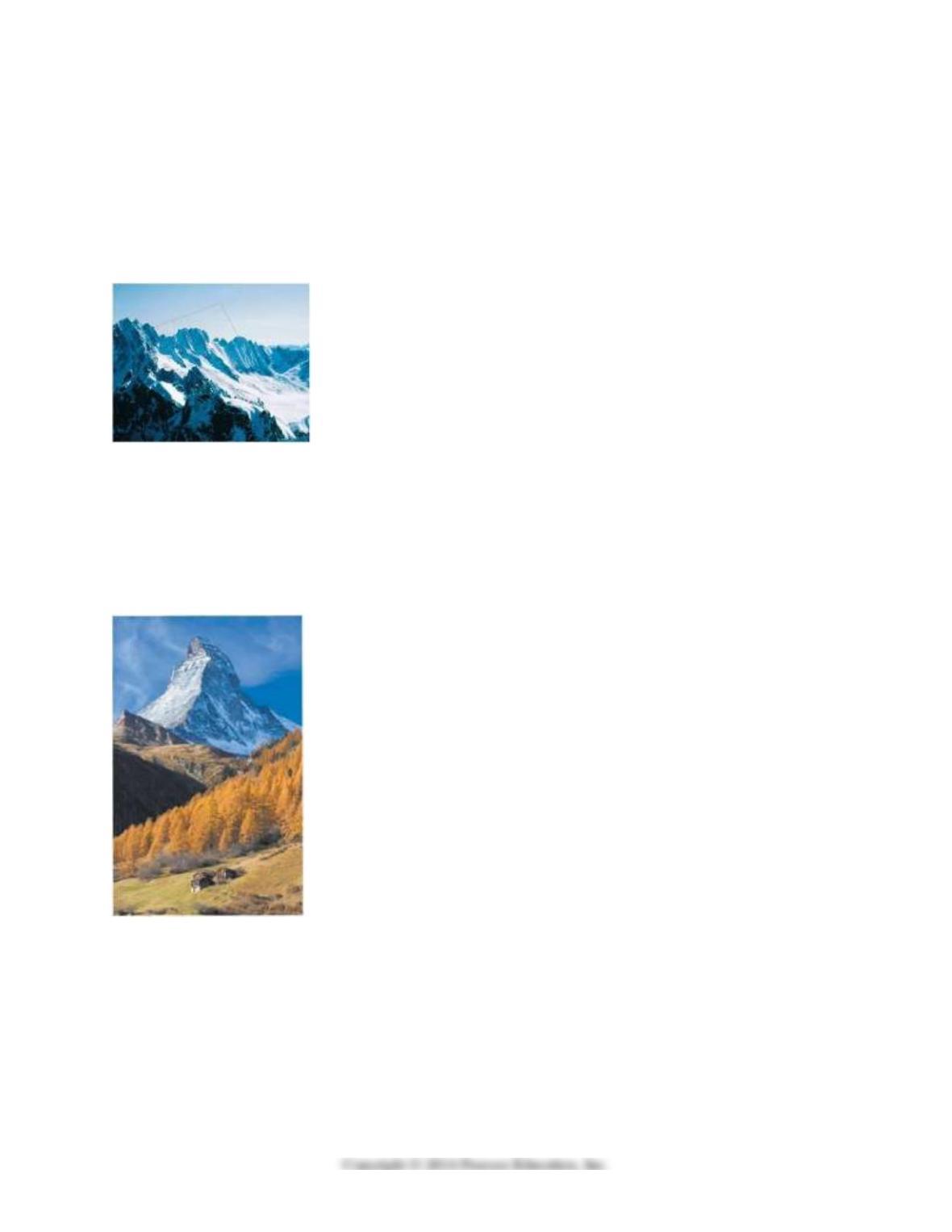
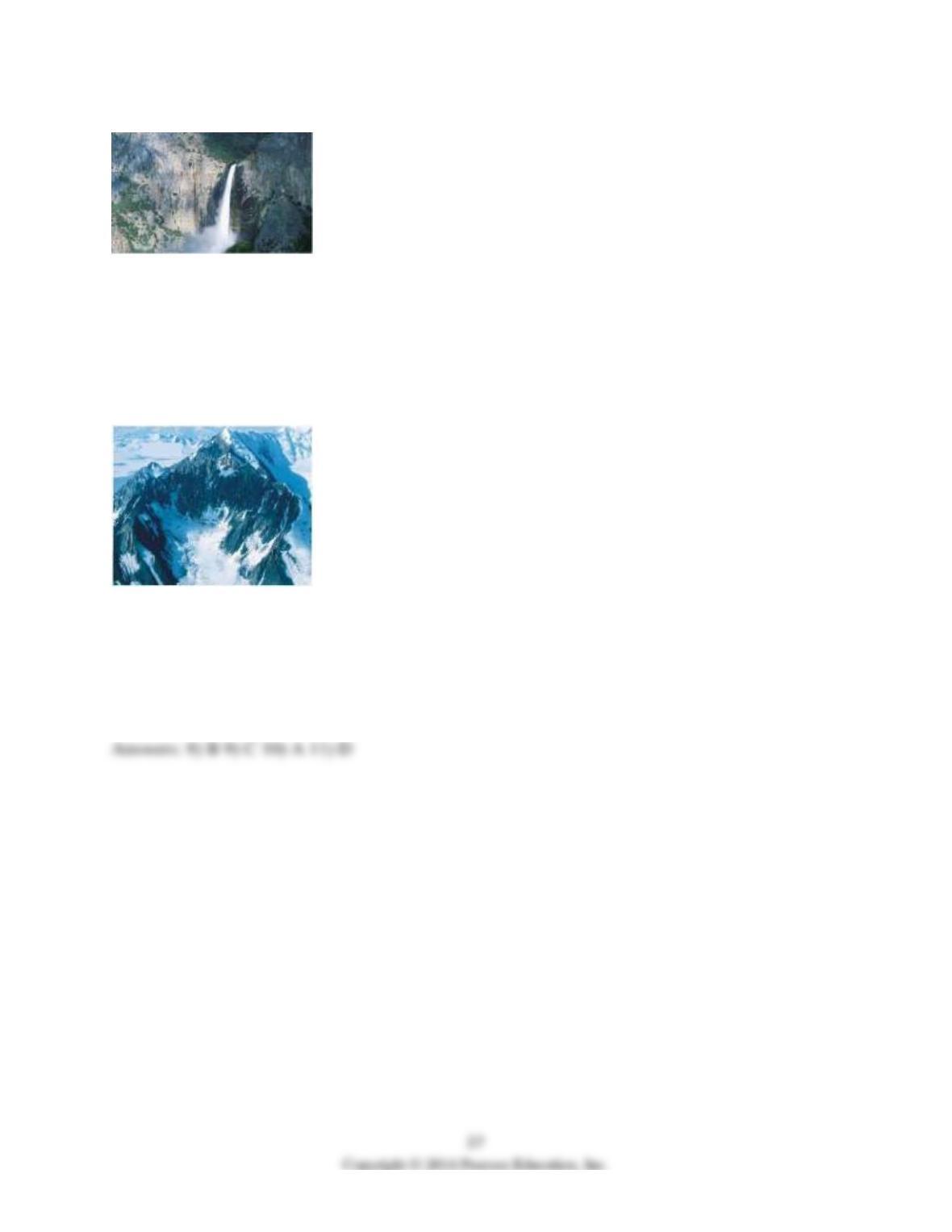
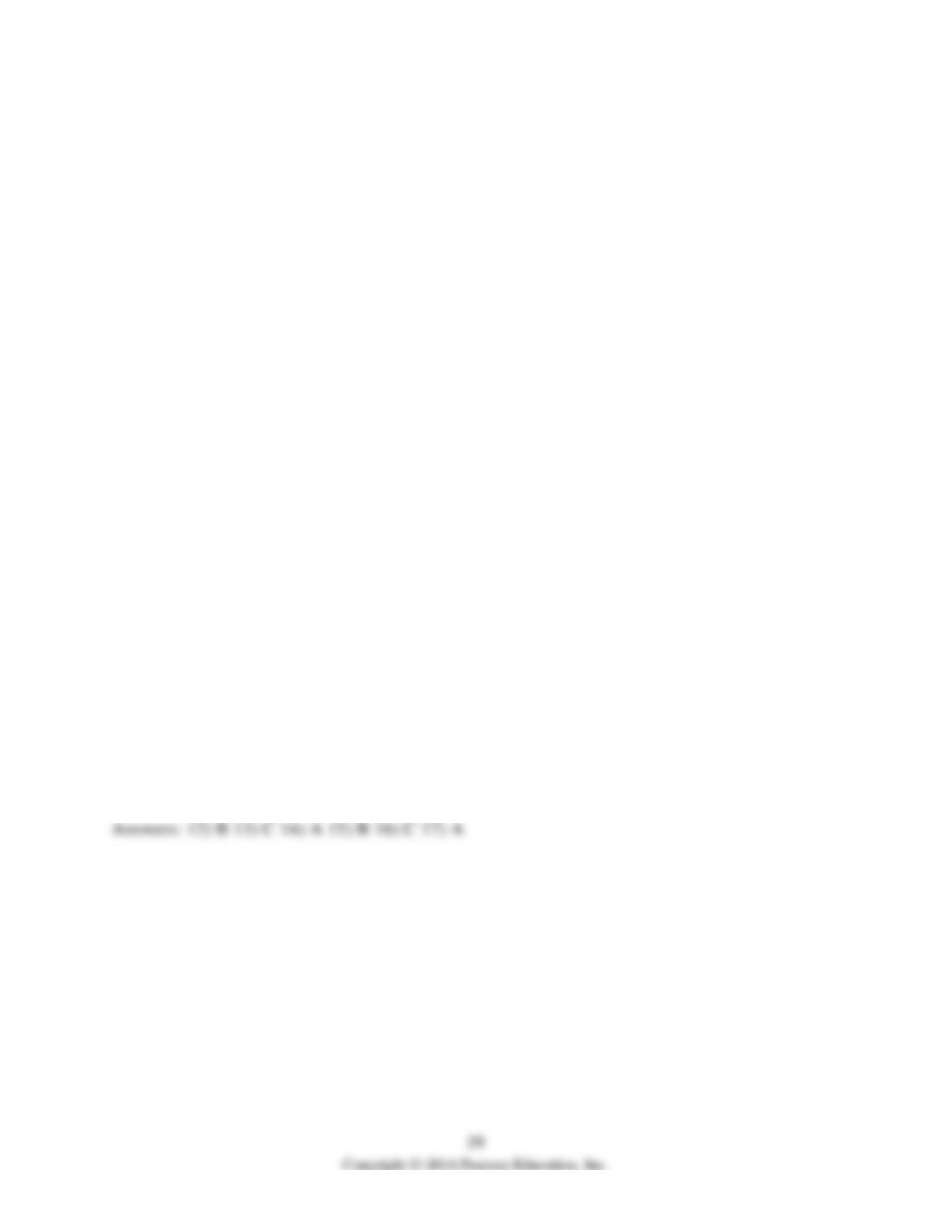
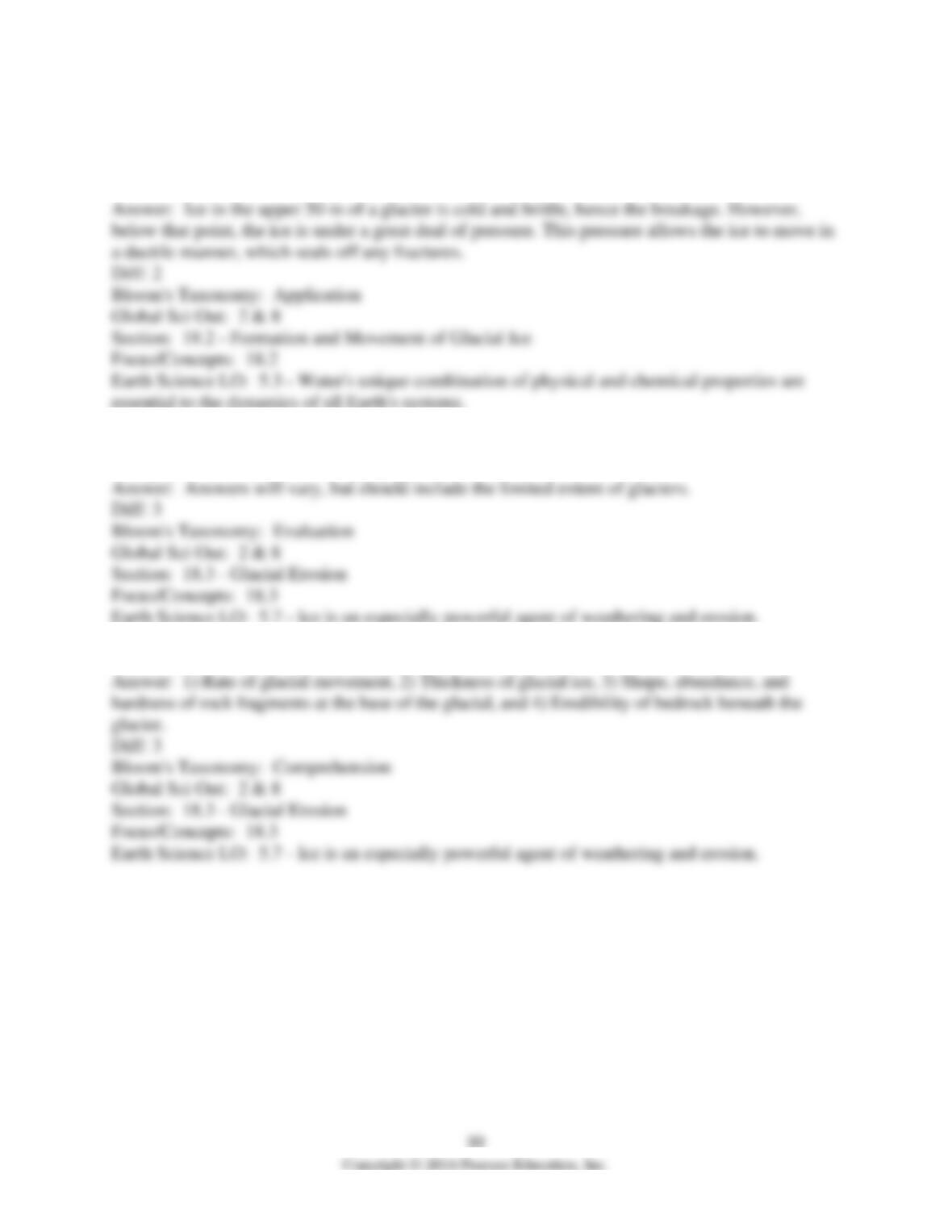
Match the image with the correct glacial erosional term.
A) Hanging Valley
B) Arête
C) Horn
D) Cirque
8)
Diff: 1
Bloom’s Taxonomy: Application
Global Sci Out: 3
Section: 18.4 – Landforms Created by Glacial Erosion
Focus/Concepts: 18.4
Earth Science LO: 5.7 – Ice is an especially powerful agent of weathering and erosion.
9)
Diff: 1
Bloom’s Taxonomy: Application
Global Sci Out: 3
Section: 18.4 – Landforms Created by Glacial Erosion
Focus/Concepts: 18.4
Earth Science LO: 5.7 – Ice is an especially powerful agent of weathering and erosion.
10)
Diff: 1
Bloom’s Taxonomy: Application
Global Sci Out: 3
Section: 18.4 – Landforms Created by Glacial Erosion
Focus/Concepts: 18.4
Earth Science LO: 5.7 – Ice is an especially powerful agent of weathering and erosion.
11)
Diff: 1
Bloom’s Taxonomy: Application
Global Sci Out: 3
Section: 18.4 – Landforms Created by Glacial Erosion
Focus/Concepts: 18.4
Earth Science LO: 5.7 – Ice is an especially powerful agent of weathering and erosion.

28
Match the glacial landform with the material it is made of. (Note: Some answers will be used
more than once.)
A) Solid Rock
B) Sands and Gravels
C) Till
12) Outwash Plain
Diff: 1
Bloom’s Taxonomy: Knowledge
Global Sci Out: 7
Section: 18.4 – Landforms Created by Glacial Erosion, 18.5 – Glacial Deposits, & 18.6 –
Landforms Made of Till
Focus/Concepts: 18.4, 18.5, & 18.6
Earth Science LO: 4.8 – Weathered and unstable rock materials erode from some parts of Earth’s
surface and are deposited in others, 5.6 – Water shapes landscapes, & 5.7 – Ice is an especially
powerful agent of weathering and erosion.
13) End Moraine
Diff: 1
Bloom’s Taxonomy: Knowledge
Global Sci Out: 7
Section: 18.4 – Landforms Created by Glacial Erosion, 18.5 – Glacial Deposits, & 18.6 –
Landforms Made of Till
Focus/Concepts: 18.4, 18.5, & 18.6
Earth Science LO: 4.8 – Weathered and unstable rock materials erode from some parts of Earth’s
surface and are deposited in others, 5.6 – Water shapes landscapes, & 5.7 – Ice is an especially
powerful agent of weathering and erosion.
14) Erratic
Diff: 1
Bloom’s Taxonomy: Knowledge
Global Sci Out: 7
Section: 18.4 – Landforms Created by Glacial Erosion, 18.5 – Glacial Deposits, & 18.6 –
Landforms Made of Till
Focus/Concepts: 18.4, 18.5, & 18.6
Earth Science LO: 4.8 – Weathered and unstable rock materials erode from some parts of Earth’s
surface and are deposited in others, 5.6 – Water shapes landscapes, & 5.7 – Ice is an especially
powerful agent of weathering and erosion.
15) Esker
Diff: 1
Bloom’s Taxonomy: Knowledge
Global Sci Out: 7
Section: 18.4 – Landforms Created by Glacial Erosion, 18.5 – Glacial Deposits, & 18.6 –
Landforms Made of Till
Focus/Concepts: 18.4, 18.5, & 18.6
Earth Science LO: 4.8 – Weathered and unstable rock materials erode from some parts of Earth’s
surface and are deposited in others, 5.6 – Water shapes landscapes, & 5.7 – Ice is an especially
powerful agent of weathering and erosion.
16) Drumlin
Diff: 1
Bloom’s Taxonomy: Knowledge
Global Sci Out: 7
Section: 18.4 – Landforms Created by Glacial Erosion, 18.5 – Glacial Deposits, & 18.6 –
Landforms Made of Till
Focus/Concepts: 18.4, 18.5, & 18.6
Earth Science LO: 4.8 – Weathered and unstable rock materials erode from some parts of Earth’s
surface and are deposited in others, 5.6 – Water shapes landscapes, & 5.7 – Ice is an especially
powerful agent of weathering and erosion.
17) Arête
Diff: 1
Bloom’s Taxonomy: Knowledge
Global Sci Out: 7
Section: 18.4 – Landforms Created by Glacial Erosion, 18.5 – Glacial Deposits, & 18.6 –
Landforms Made of Till
Focus/Concepts: 18.4, 18.5, & 18.6
Earth Science LO: 4.8 – Weathered and unstable rock materials erode from some parts of Earth’s
surface and are deposited in others, 5.6 – Water shapes landscapes, & 5.7 – Ice is an especially
powerful agent of weathering and erosion.
18.5 Essay Questions
1) The Zone of Fracture in a glacier is found in the uppermost 50 m of glacial ice. Explain why
ice will fracture above this depth, but not below.
2) Discuss the effectiveness of glaciers as an agent of erosion. You discussion should include
both physical effectiveness and geographical.
3) What factors will influence the rate of glacial erosion?
4) Evaluate the following statement: “Continental ice sheets generally subdue their landscapes
whereas alpine glaciers accentuate them.”
5) How does a glacial fjord form? What does it tell us about climate change after glaciation?
6) How does ground moraine form? Relate the formation of ground moraine to changes in
climate.
7) How is isostatic rebound affecting the Lake Michigan Basin?
8) During the Wisconsin Episode Glaciation, a glacial forebulge formed just off the coast of
British Columbia in the vicinity of Queen Charlotte Island. What is a glacial forebulge and how
did this one form?
9) The Mississippi River currently makes up the western boundary of the state of Illinois.
However, the Ancient Mississippi River Valley once flowed through the center of the state,
cutting off 1/4 of the state from its modern boundaries. How did the Mississippi River shift from
its ancestral location to its present one? How did it end up staying in its current location?
Explain.
10) Glacial Lake Agassiz went through many periods of catastrophic drainage starting at 13,000
years ago. Some of these periods of catastrophic change have been linked to periods of cooling
climate, particularly when the lake drained through the St. Lawrence Seaway and into the North
Atlantic. How would the drainage of Lake Agassiz affect the climate to such a degree that
cooling would result?
11) Compare and contrast proglacial lakes and pluvial lakes. Make sure to give an example of
each.
12) Explain how the presence of glaciers on the planet will affect the albedo of the land surface.
How is the albedo going to change as glaciers melt? What will this mean for the climate?
18.6 Visual
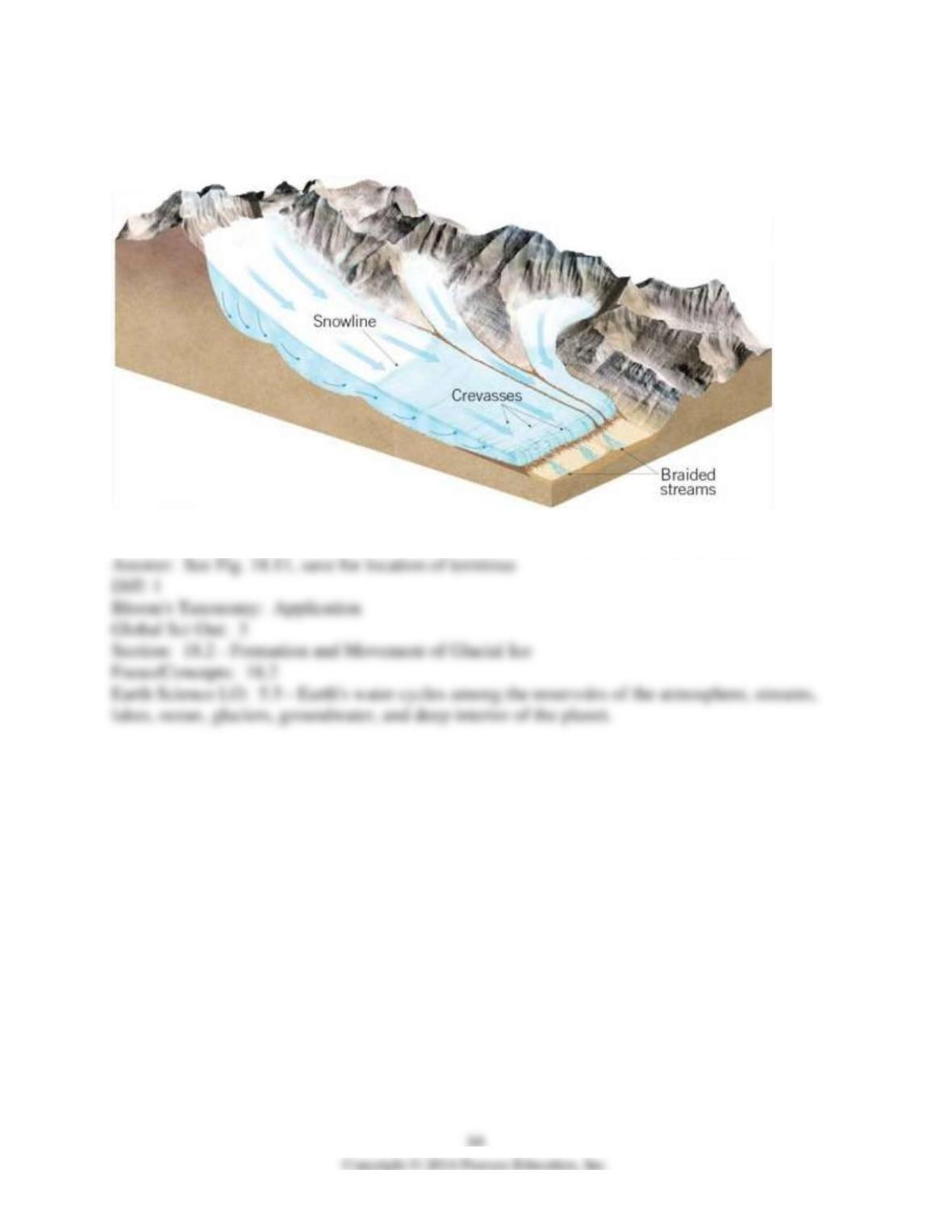
1)
Using this image, label the Zone of Accumulation, Zone of Ablation, and the terminus.
2)
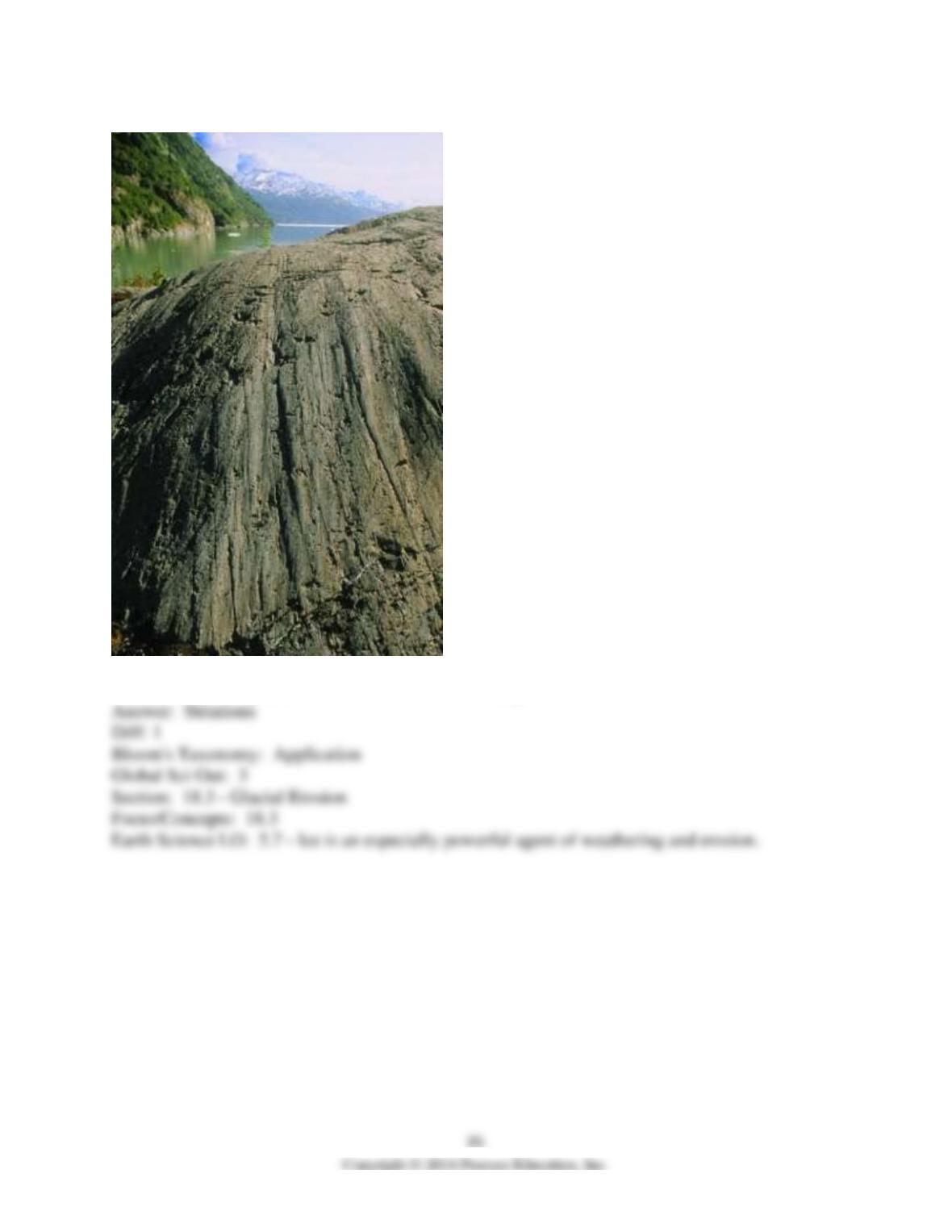
What evidence of glacial erosion is visible in this image?
3)
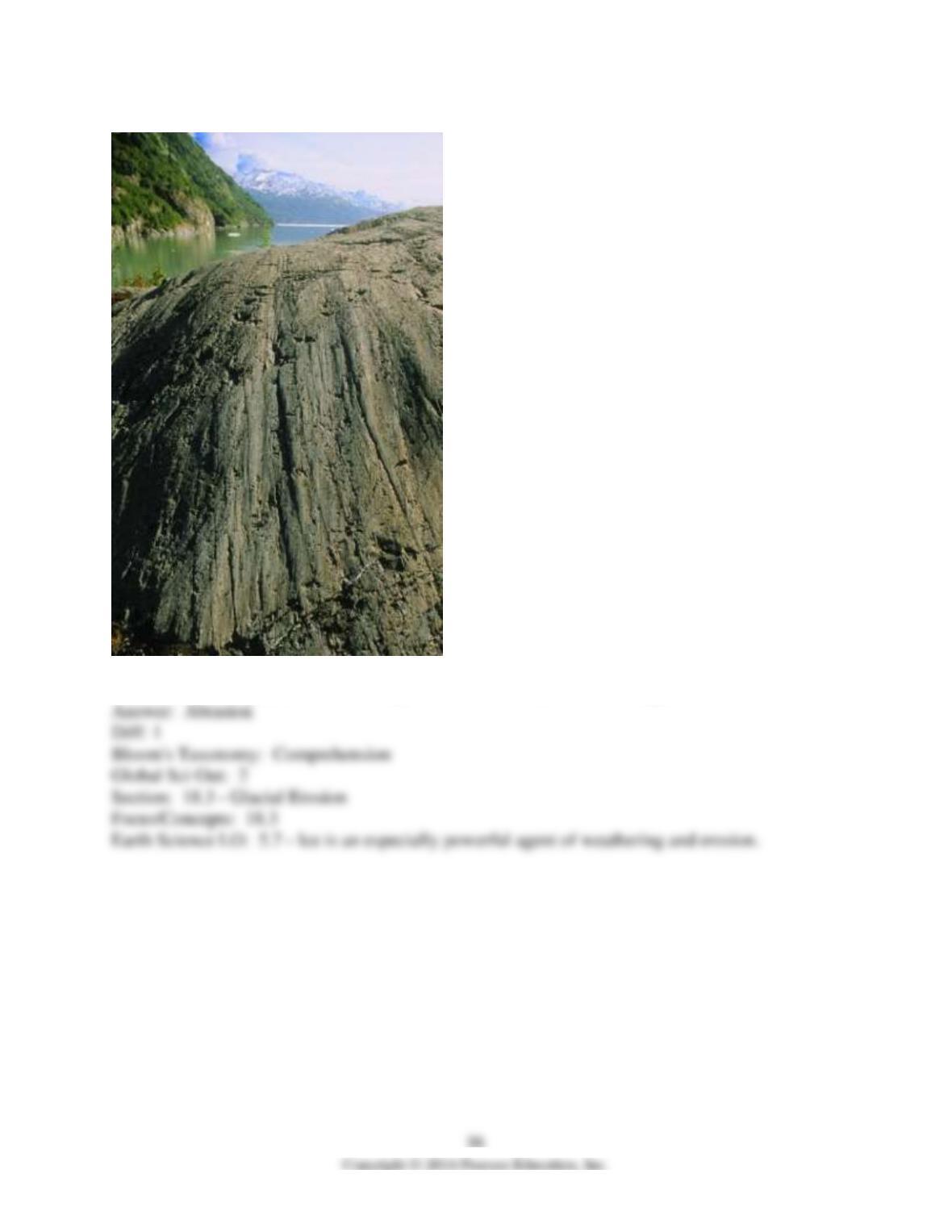
Which method of glacial erosion is responsible for the marks in this image?
4)
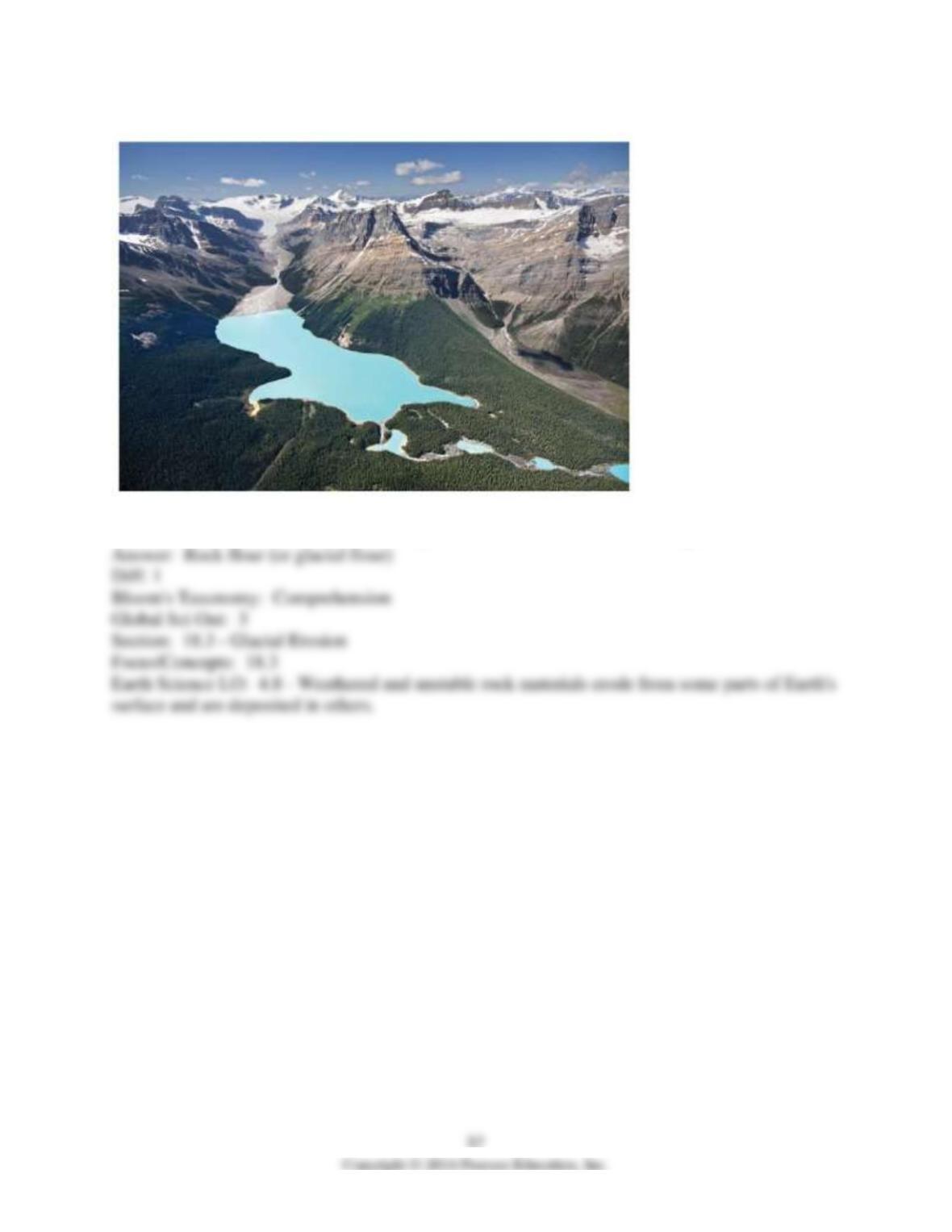
What substance is responsible for the turquoise color of the water in this image?
5)
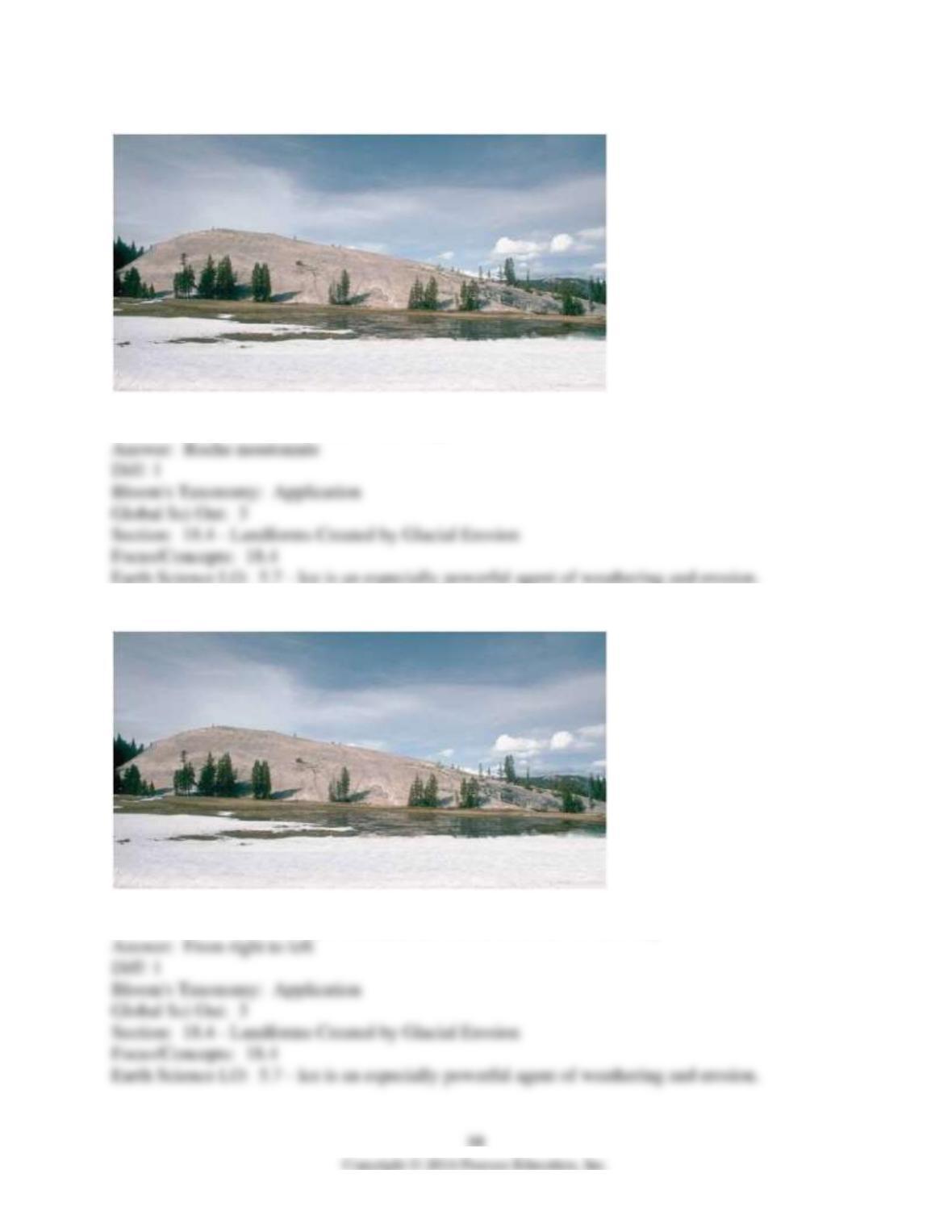
What erosional feature is visible in this image?
6)
Draw an arrow on this image to indicate the direction the ice was flowing.
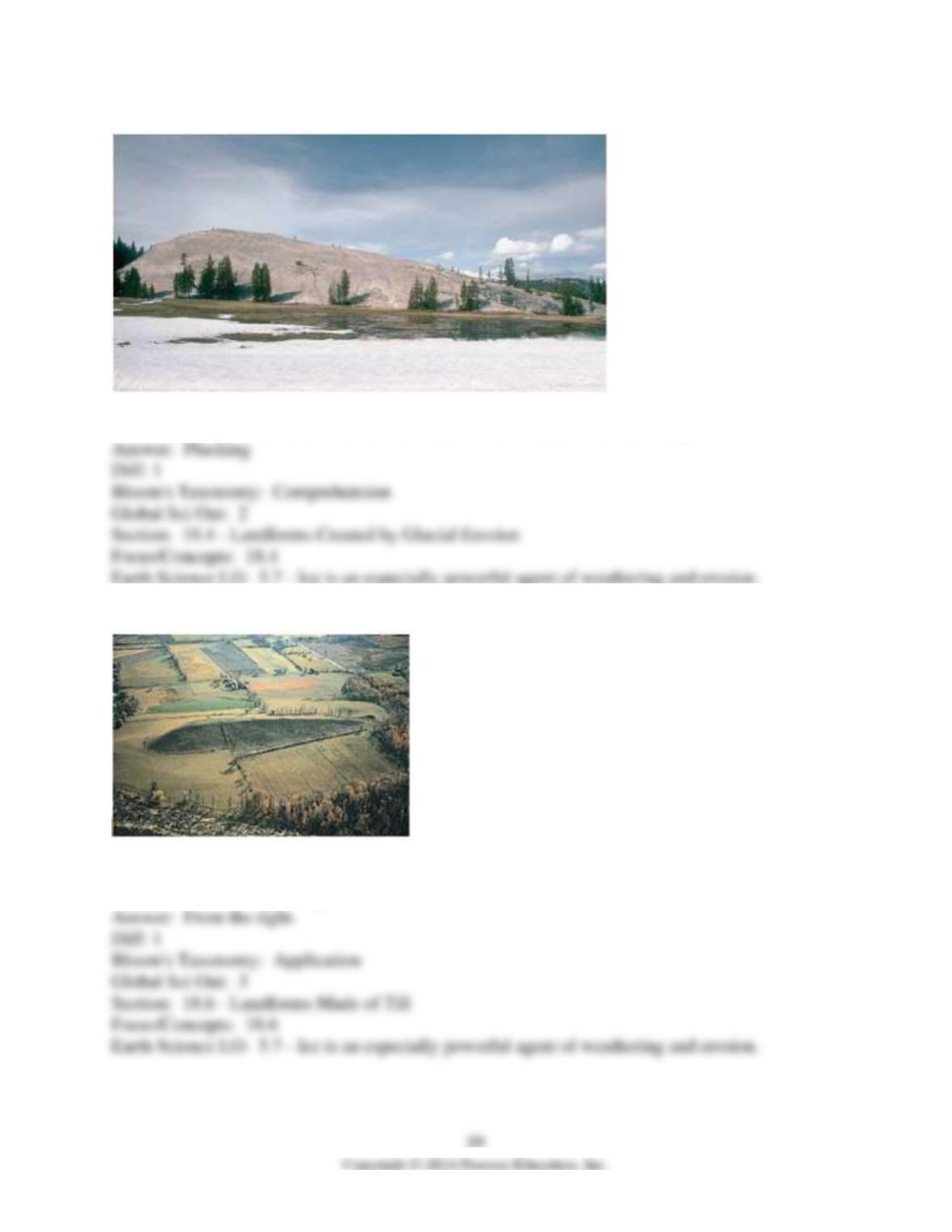
7)
What was the main method of erosion that created the steep face on this image?
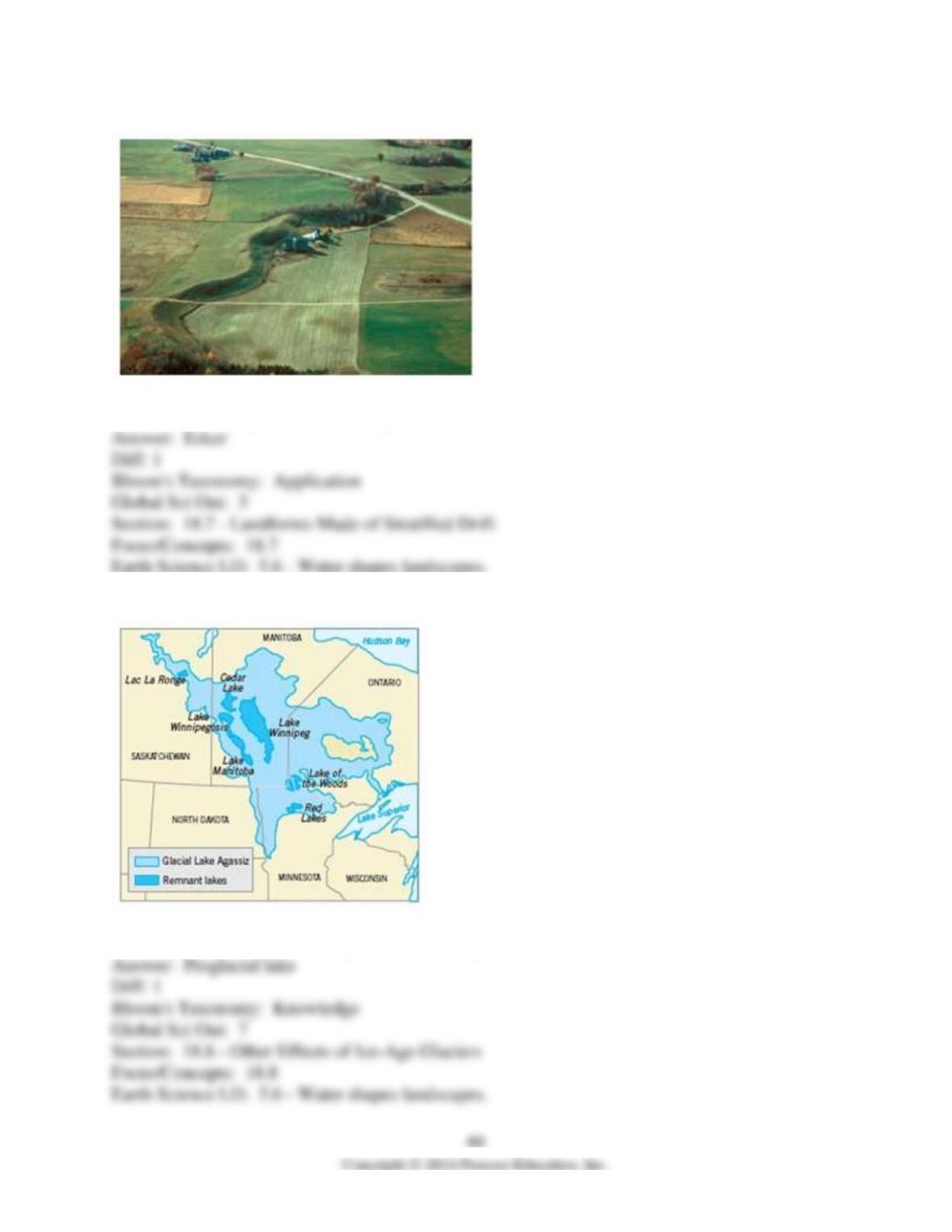
8)
The landform visible in this image is a drumlin. Based on the shape of the drumlin, which
direction was the ice coming from?
9)
What landform is present in this image?
10)
What kind of lake was Lake Agassiz in this image?