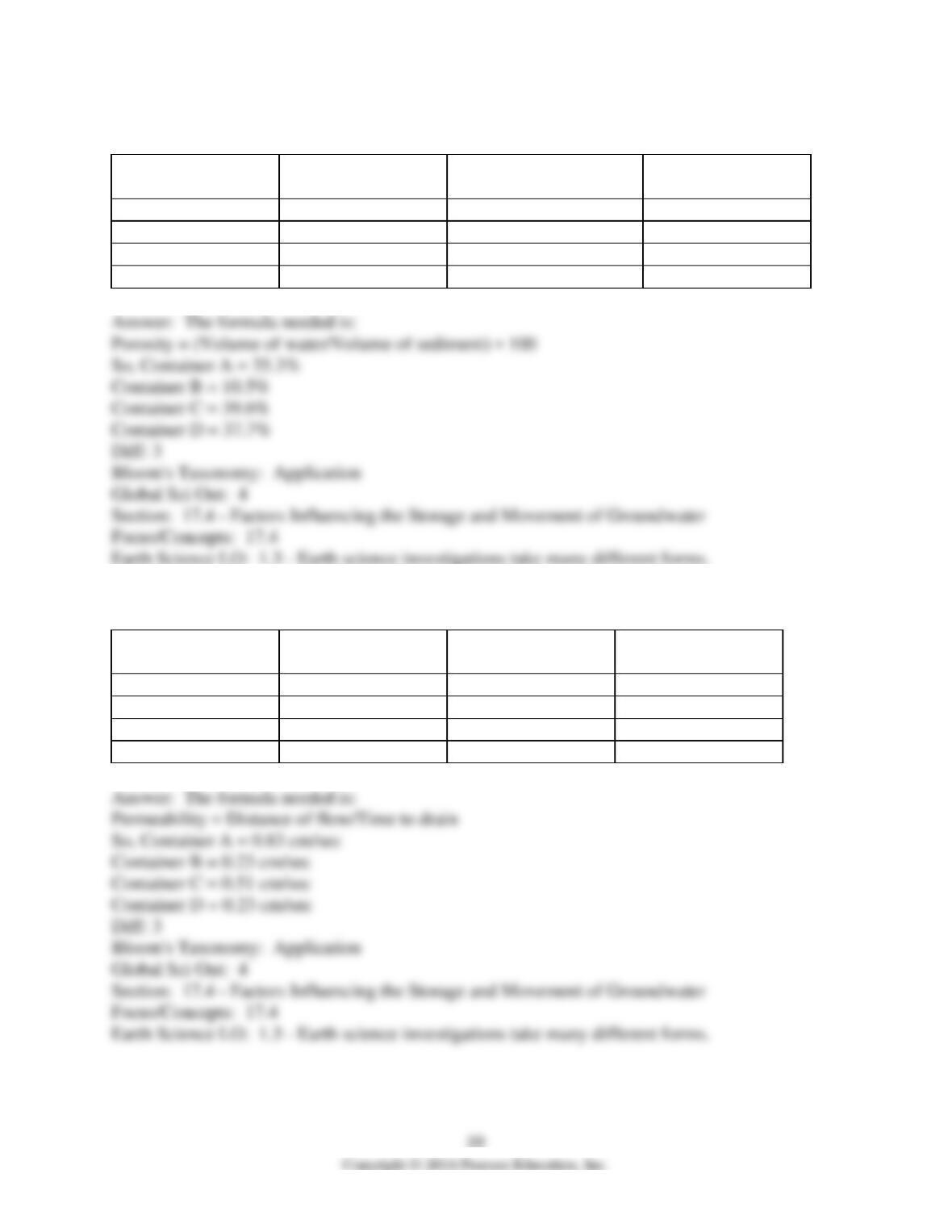
8) Using the information below, calculate the porosity for each of the four containers.
Container
Volume of Water
(mL)
Volume of Sediment
(mL)
Porosity (%)
A
53
150
B
21
200
C
99
250
D
113
300
9) Using the information below, calculate the permeability for each of the four containers.
Container
Distance (cm)
Time to Drain (sec)
Permeability
(cm/sec)
A
10
12
B
15
65
C
17
33
D
20
87

10) Which would have a higher porosity: sand or sandstone? Why?
11) Igneous and metamorphic rocks do not form with voids or pore spaces where groundwater
can reside. However, these rocks can often both store and transport groundwater. What voids
would make up the secondary porosity of igneous and metamorphic rocks?
12) Karst features like caves and sinkholes are an example of ________ porosity.
13) ________ is when groundwater is being replenished. ________ is when groundwater is
flowing back toward the surface.

14) What is different about mineral deposits at Mammoth Hot Springs compared to other
geothermal features in Yellowstone National Park? From which rock were these mineral deposits
derived?
15) Name three other countries/regions outside of the U.S. that are famous for their geothermal
activity.
16) What physical features are evidence of a karst landscape?

23
17.4 Matching Questions
Match the correct label to the type of gaining/losing stream.
A) Losing Stream (Disconnected)
B) Losing Stream (Connected)
C) Gaining Stream
1)
Diff: 1
Bloom’s Taxonomy: Knowledge
Global Sci Out: 7
Section: 17.3 – The Water Table
Focus/Concepts: 17.3
Earth Science LO: 5.5 – Earth’s water cycles among the reservoirs of the atmosphere, streams,
lakes, ocean, glaciers, groundwater, and deep interior of the planet.
2)
Diff: 1
Bloom’s Taxonomy: Knowledge
Global Sci Out: 7
Section: 17.3 – The Water Table
Focus/Concepts: 17.3
Earth Science LO: 5.5 – Earth’s water cycles among the reservoirs of the atmosphere, streams,
lakes, ocean, glaciers, groundwater, and deep interior of the planet.
3)
Diff: 1
Bloom’s Taxonomy: Knowledge
Global Sci Out: 7
Section: 17.3 – The Water Table
Focus/Concepts: 17.3
Earth Science LO: 5.5 – Earth’s water cycles among the reservoirs of the atmosphere, streams,
lakes, ocean, glaciers, groundwater, and deep interior of the planet.

Answers: 1) C 2) B 3) A
Match the word with the correct definition.
A) Impermeable layer that prevents flow
B) Rock or regolith that can store and transmit water, but it contained between two impermeable
layers
C) Rock or regolith that can store and transmit water and receives its recharge directly from the
atmosphere
4) Aquitard
Diff: 1
Bloom’s Taxonomy: Knowledge
Global Sci Out: 7
Section: 17.4 – Factors Influencing the Storage and Movement of Groundwater
Focus/Concepts: 17.4
Earth Science LO: 5.1 – Water is found everywhere on Earth, from the heights of the atmosphere
to the depths of the mantle.
5) Confined Aquifer
Diff: 1
Bloom’s Taxonomy: Knowledge
Global Sci Out: 7
Section: 17.4 – Factors Influencing the Storage and Movement of Groundwater
Focus/Concepts: 17.4
Earth Science LO: 5.1 – Water is found everywhere on Earth, from the heights of the atmosphere
to the depths of the mantle.
6) Unconfined Aquifer
Diff: 1
Bloom’s Taxonomy: Knowledge
Global Sci Out: 7
Section: 17.4 – Factors Influencing the Storage and Movement of Groundwater
Focus/Concepts: 17.4
Earth Science LO: 5.1 – Water is found everywhere on Earth, from the heights of the atmosphere
to the depths of the mantle.

Match the geothermal feature with the correct definition.
A) Type of hot spring that contains boiling mud
B) Water in a basin that is 6-9° C warmer than the mean annual temperature of the location
C) Intermittent hot springs that periodically eject water into the air with great force
D) Vent in the ground that emits steam
7) Geyser
Diff: 1
Bloom’s Taxonomy: Knowledge
Global Sci Out: 7
Section: 17.8 – Springs, Hot Springs, and Geysers
Focus/Concepts: 17.8
Earth Science LO: 5.1 – Water is found everywhere on Earth, from the heights of the atmosphere
to the depths of the mantle.
8) Mudpot
Diff: 1
Bloom’s Taxonomy: Knowledge
Global Sci Out: 7
Section: 17.8 – Springs, Hot Springs, and Geysers
Focus/Concepts: 17.8
Earth Science LO: 5.1 – Water is found everywhere on Earth, from the heights of the atmosphere
to the depths of the mantle.
9) Hot Spring
Diff: 1
Bloom’s Taxonomy: Knowledge
Global Sci Out: 7
Section: 17.8 – Springs, Hot Springs, and Geysers
Focus/Concepts: 17.8
Earth Science LO: 5.1 – Water is found everywhere on Earth, from the heights of the atmosphere
to the depths of the mantle.
10) Fumarole
Diff: 1
Bloom’s Taxonomy: Knowledge
Global Sci Out: 7
Section: 17.8 – Springs, Hot Springs, and Geysers
Focus/Concepts: 17.8
Earth Science LO: 5.1 – Water is found everywhere on Earth, from the heights of the atmosphere
to the depths of the mantle.
17.5 Essay Questions
1) Explain how groundwater can sustain streams even during a long drought.
2) A severe drought in 2012 devastated much of the United States, causing crop failure, stream
levels to lower, and the drying and cracking of the ground. Obviously, a great deal of water was
needed to end this drought. At the end of August of that year, Hurricane Isaac made landfall
along the Gulf Coast of Louisiana and Mississippi and proceeded to move up the Mississippi
River and across central and northern Illinois by August 31 and September 1, precipitating large
volumes of rain as it moved. How did the transit of Hurricane Isaac affect the drought (Did it end
the drought)? How would groundwater levels change? Explain your answers.
3) You are working for the city planner’s office and need to recommend a site to locate a new
well for the city. What characteristics or factors would you want to consider to find the right
location? What things would you want to avoid?
4) Explain how an artesian well is created. Your explanation should include a discussion on how
they get recharged.
5) What is the difference between a flowing artesian well and a nonflowing artesian well?
6) Some bottled water companies advertise that their product is clean and pure because it comes
from an artesian well. Discuss the validity of this statement.
7) How does a geyser erupt groundwater? Also, compare and contrast a geyser and a hot spring.
8) Major coastal cities such as Charleston, South Carolina have to find a delicate balance
between supplying enough water for a healthy, growing city and preventing contamination of
their groundwater supplies with saltwater due to overpumping. What steps could be taken to
counteract the effects of saltwater contamination without abandoning the well? Explain.
9) Explain the process of cave formation.
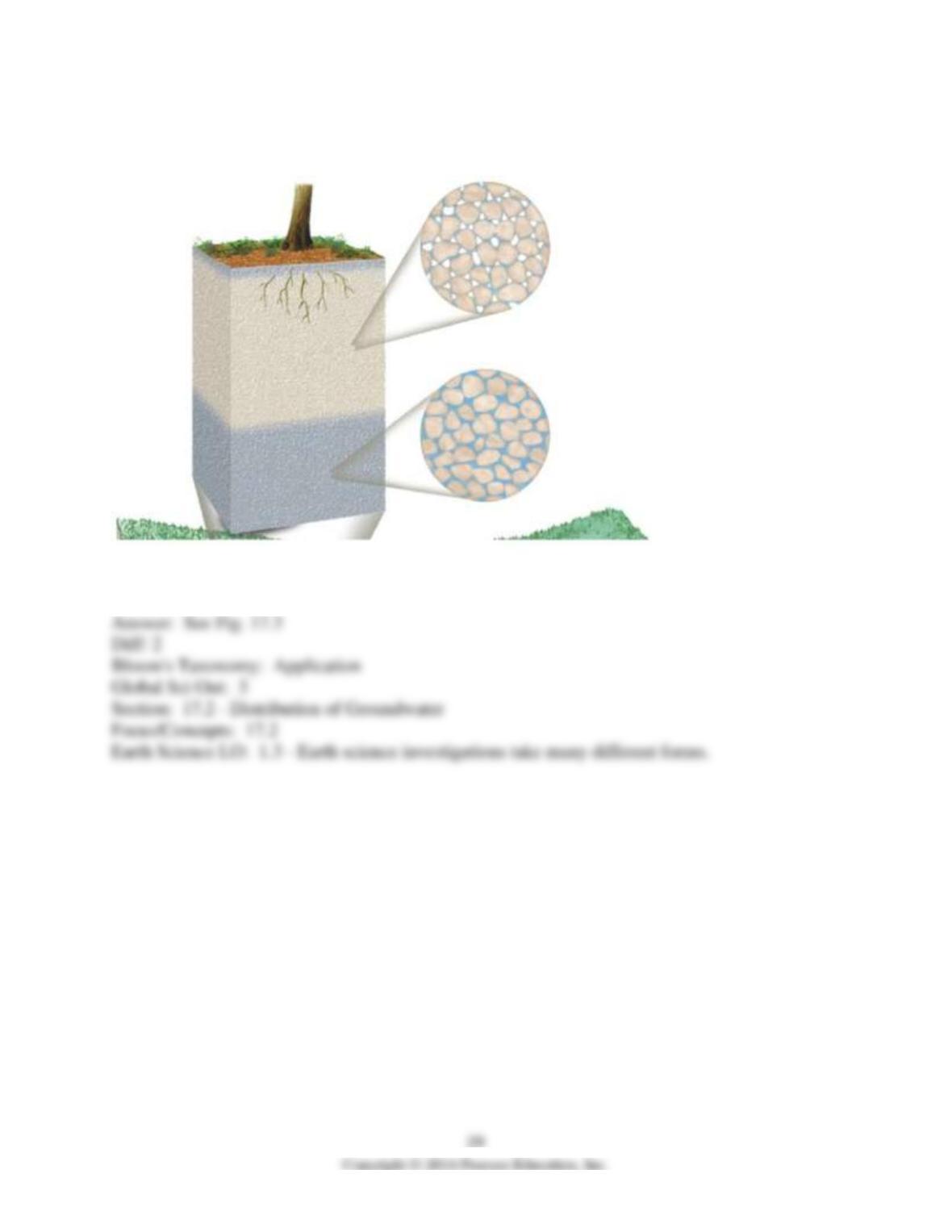
17.6 Visual
1)
Using this image, label the unsaturated zone, zone of saturation, capillary fringe, and the water
table.
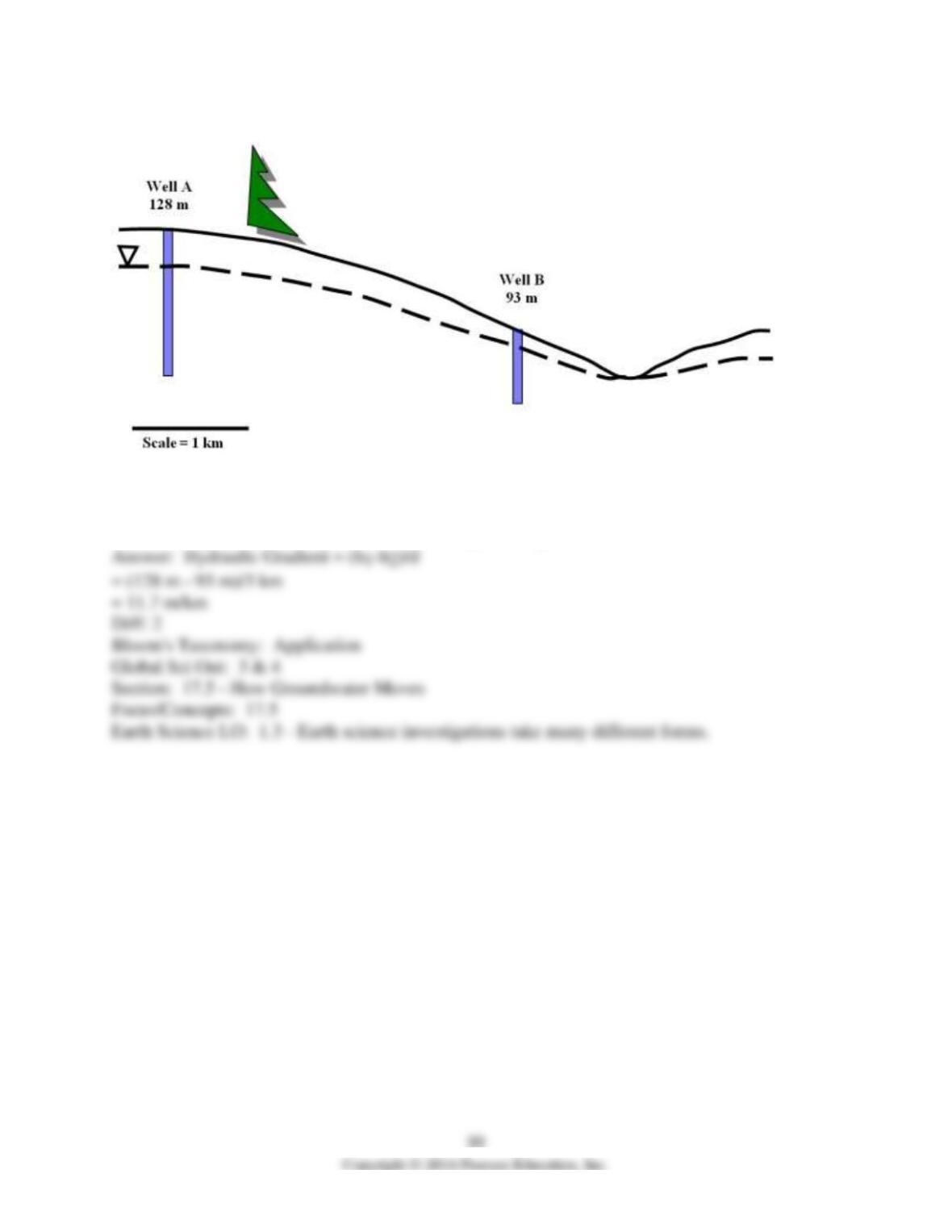
2)
This image shows the gradient of the water table between Well A and Well B. Please note that
the label for each well also displays the elevation of the water table in that well. Using the
information present in the figure, calculate the hydraulic gradient of this cross-section.
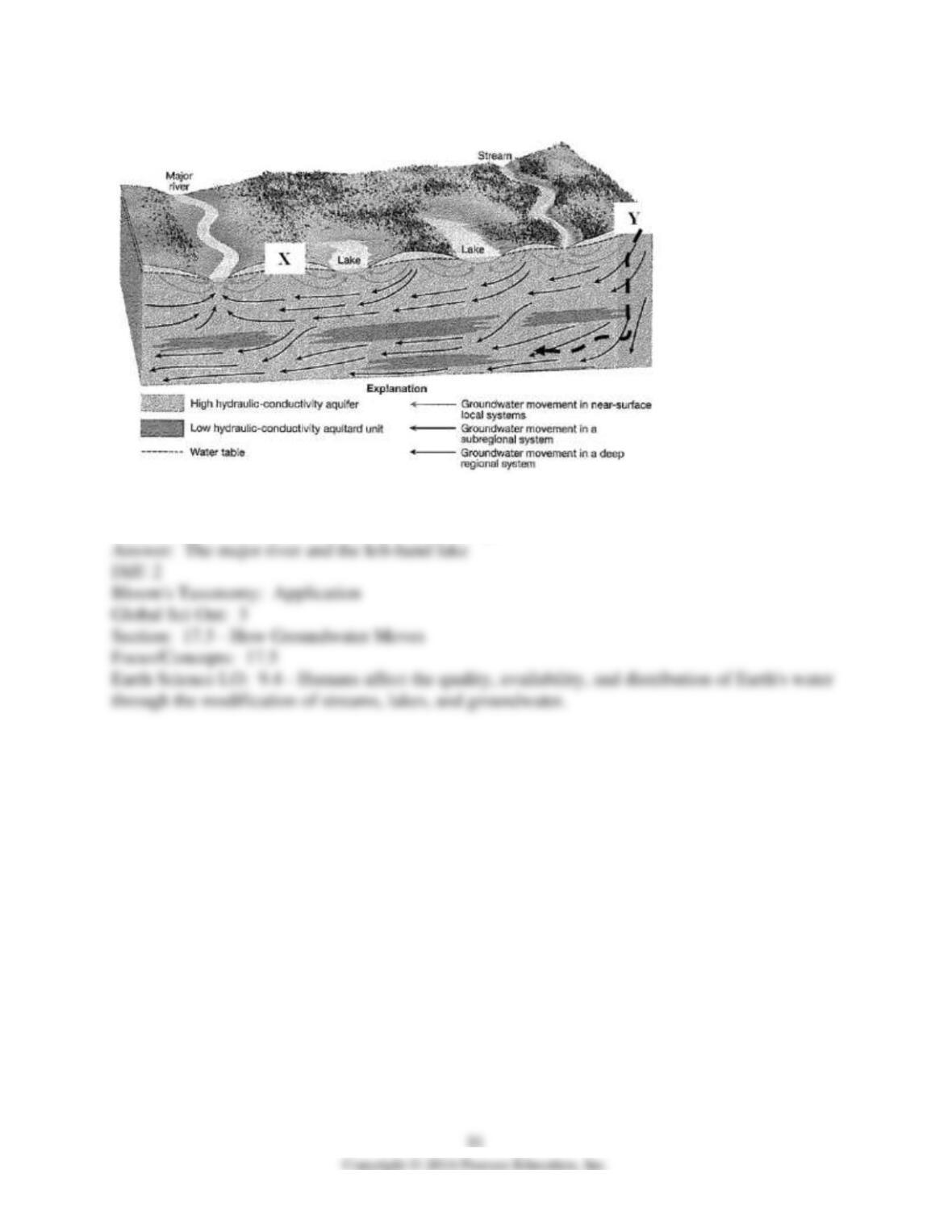
3)
Examine the groundwater flow patterns around Point X. Into which bodies of water (if any) will
water that infiltrates at Point X eventually discharge?
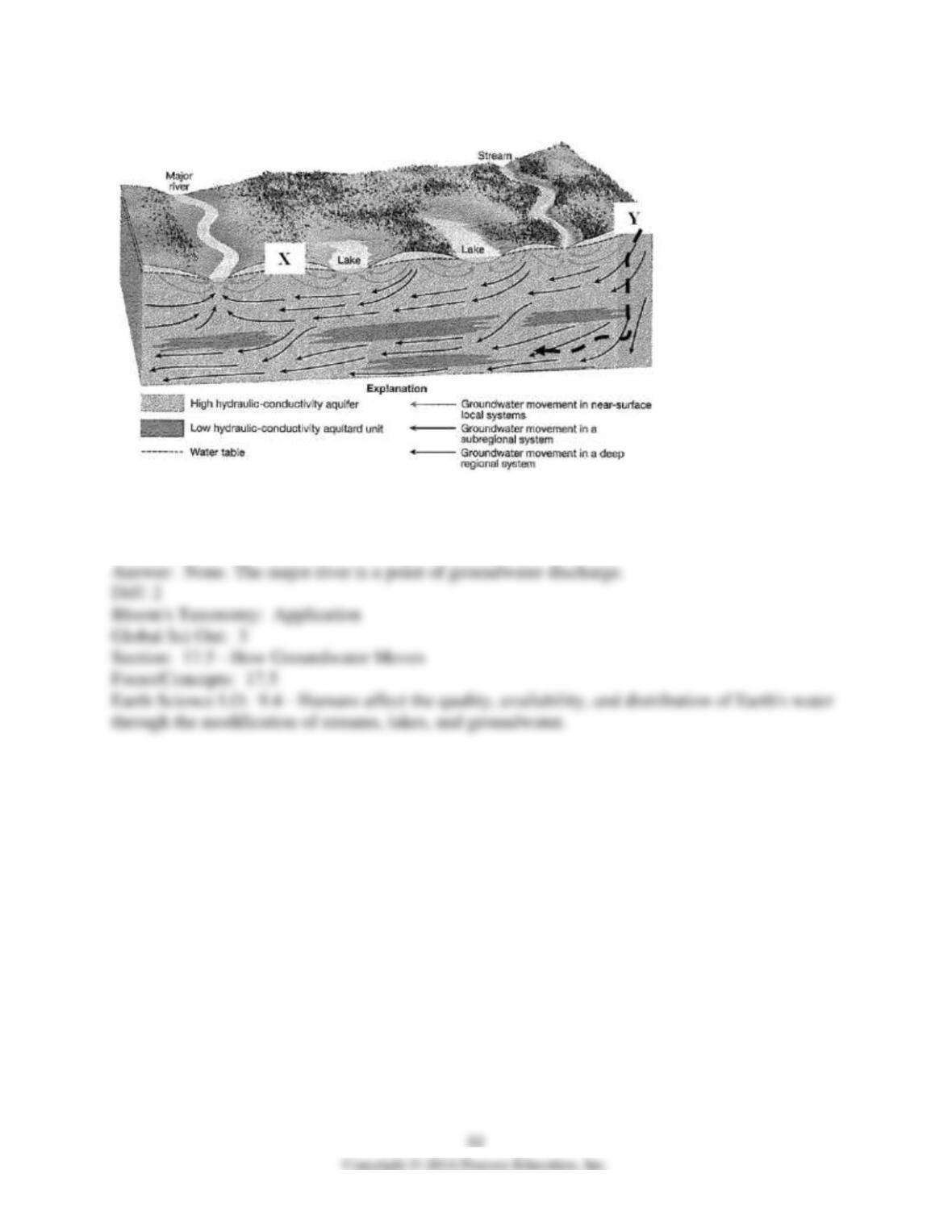
4)
Assume that chemical pollutants have been illegally dumped in the major river on the left side of
this image. Will those pollutants infiltrate and contaminate any other bodies of water? If so,
which ones?
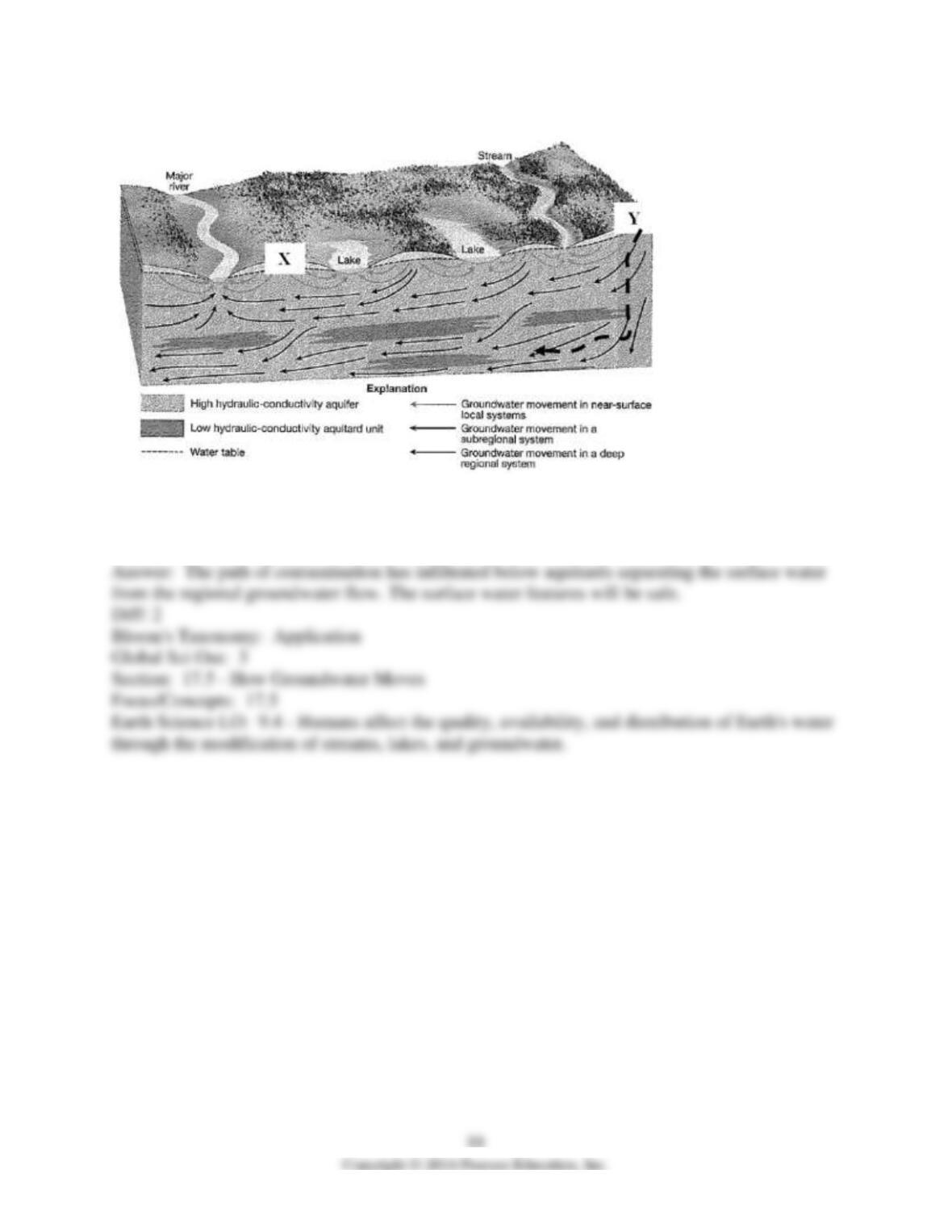
5)
Assume that chemical pollutants have been buried at Point Y. The heavy dashed arrow shows the
path of infiltration the pollutants followed. Which other bodies of water will be contaminated by
these pollutants? Explain.
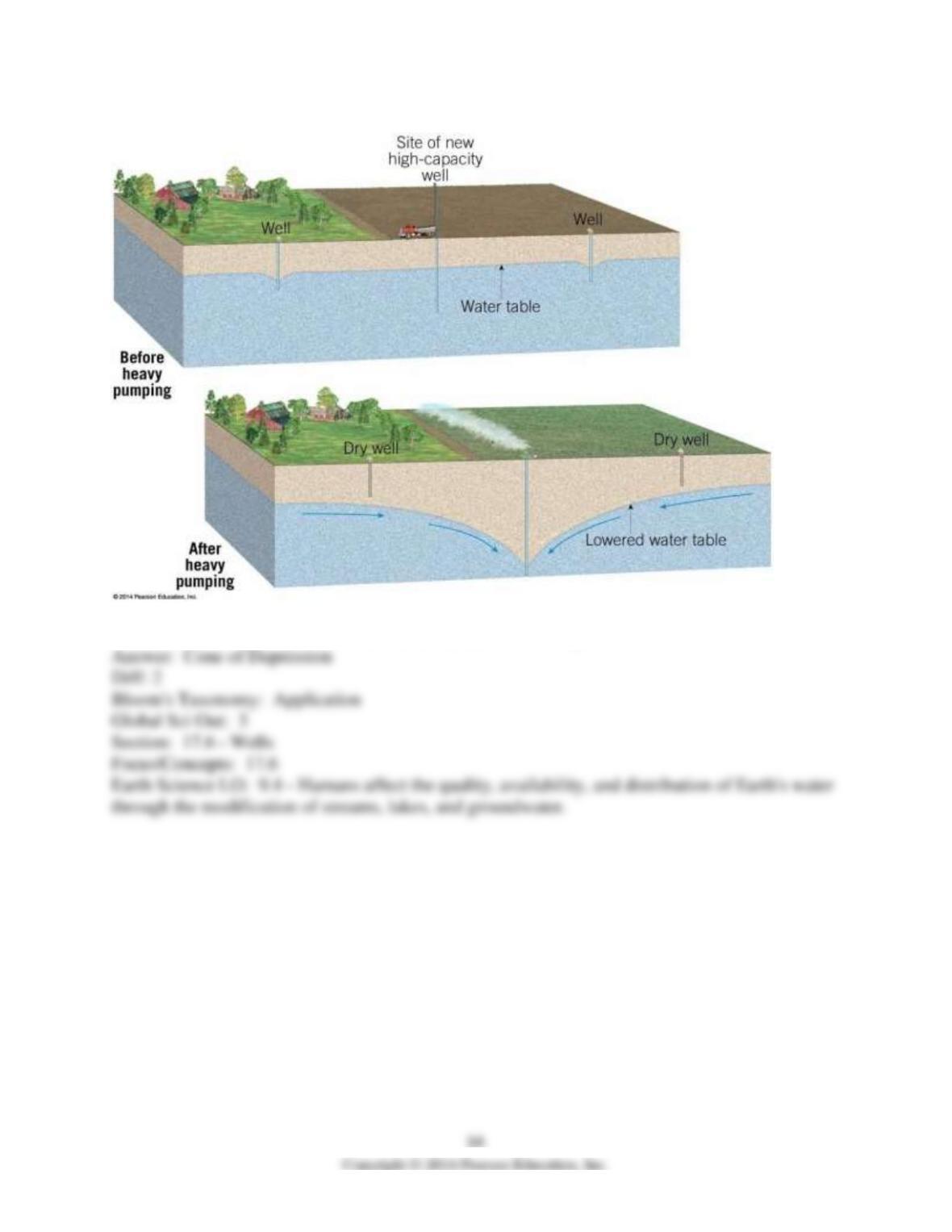
6)
What localized lowering of the water table is present in this figure?
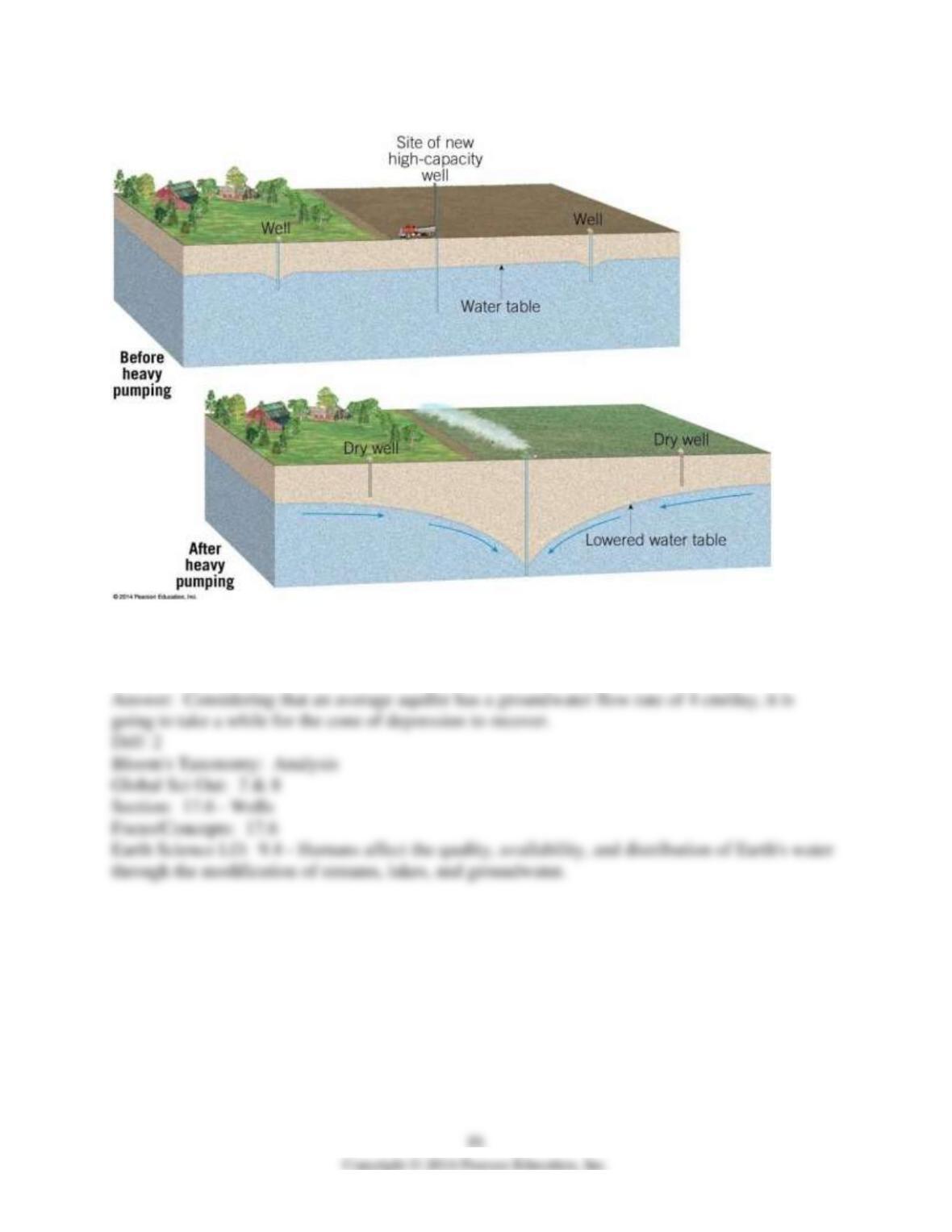
7)
Assume that the irrigation well in the middle of this image was installed by a seed corn company
and not by the farmers who own the local wells on either side. If irrigation were stopped
immediately, would this localized lowering recover immediately? Why or why not?
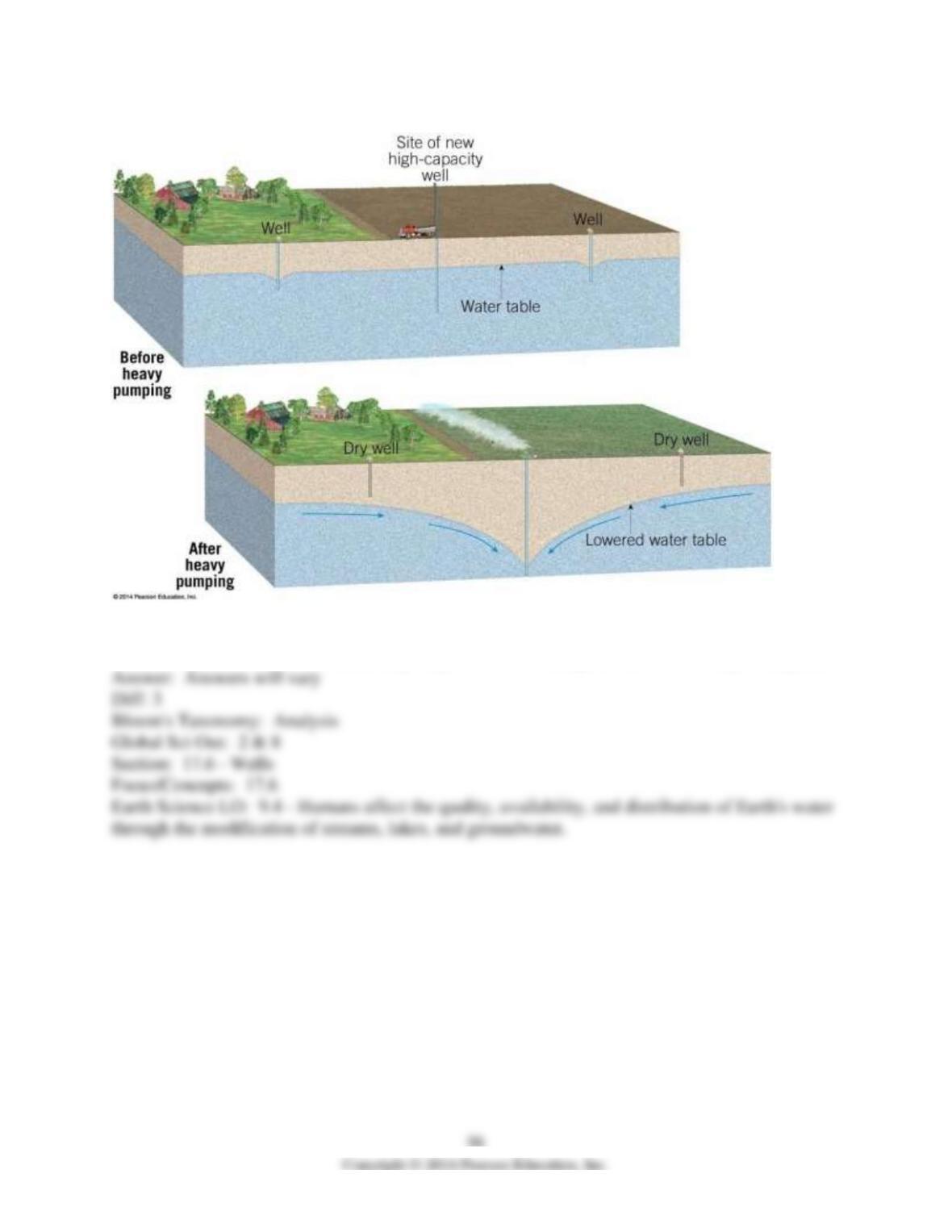
8)
Again using the assumption that a seed corn company installed the irrigation well in the middle
of this image, who should be financially responsible for drilling the farm wells deeper? Explain.
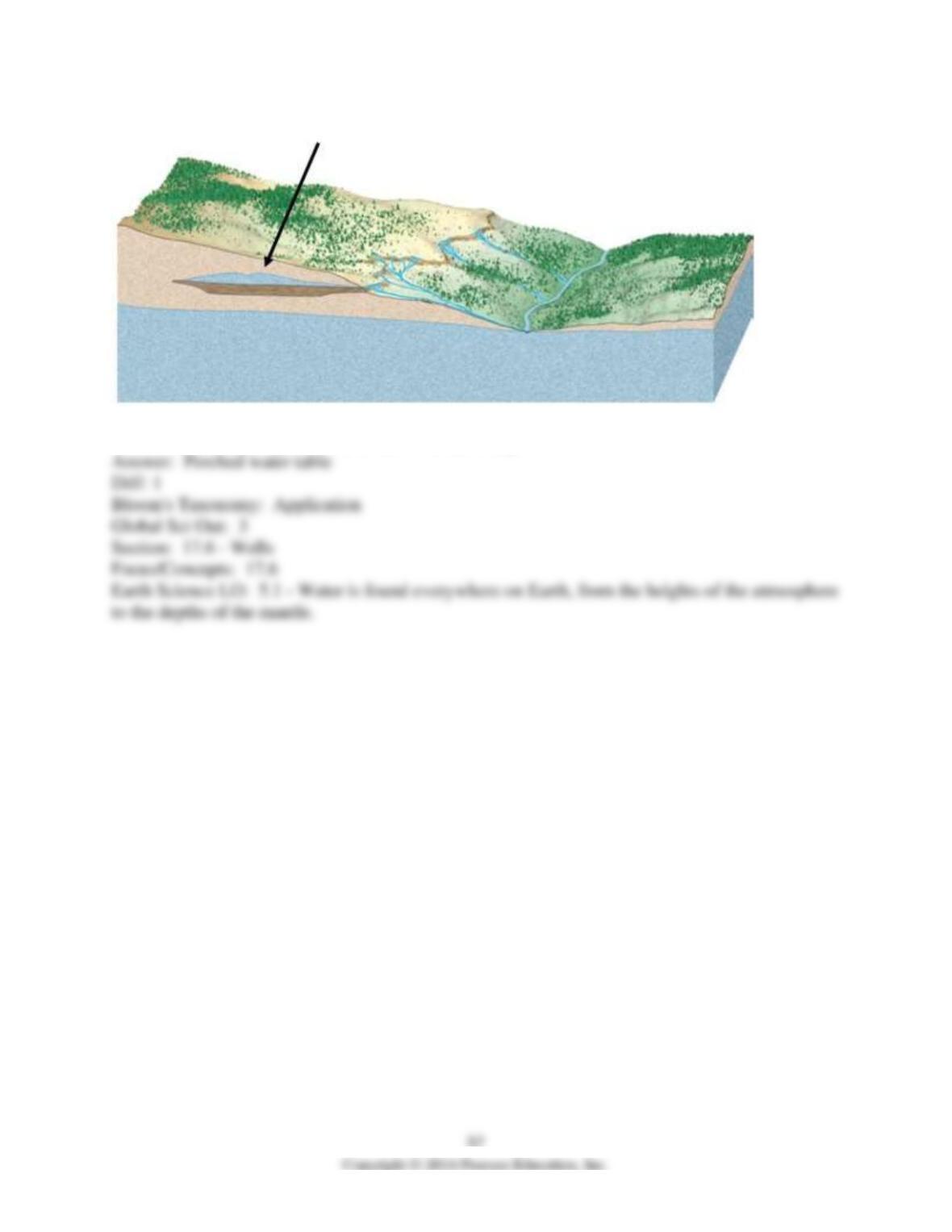
9)
What feature is highlighted with an arrow in this image?
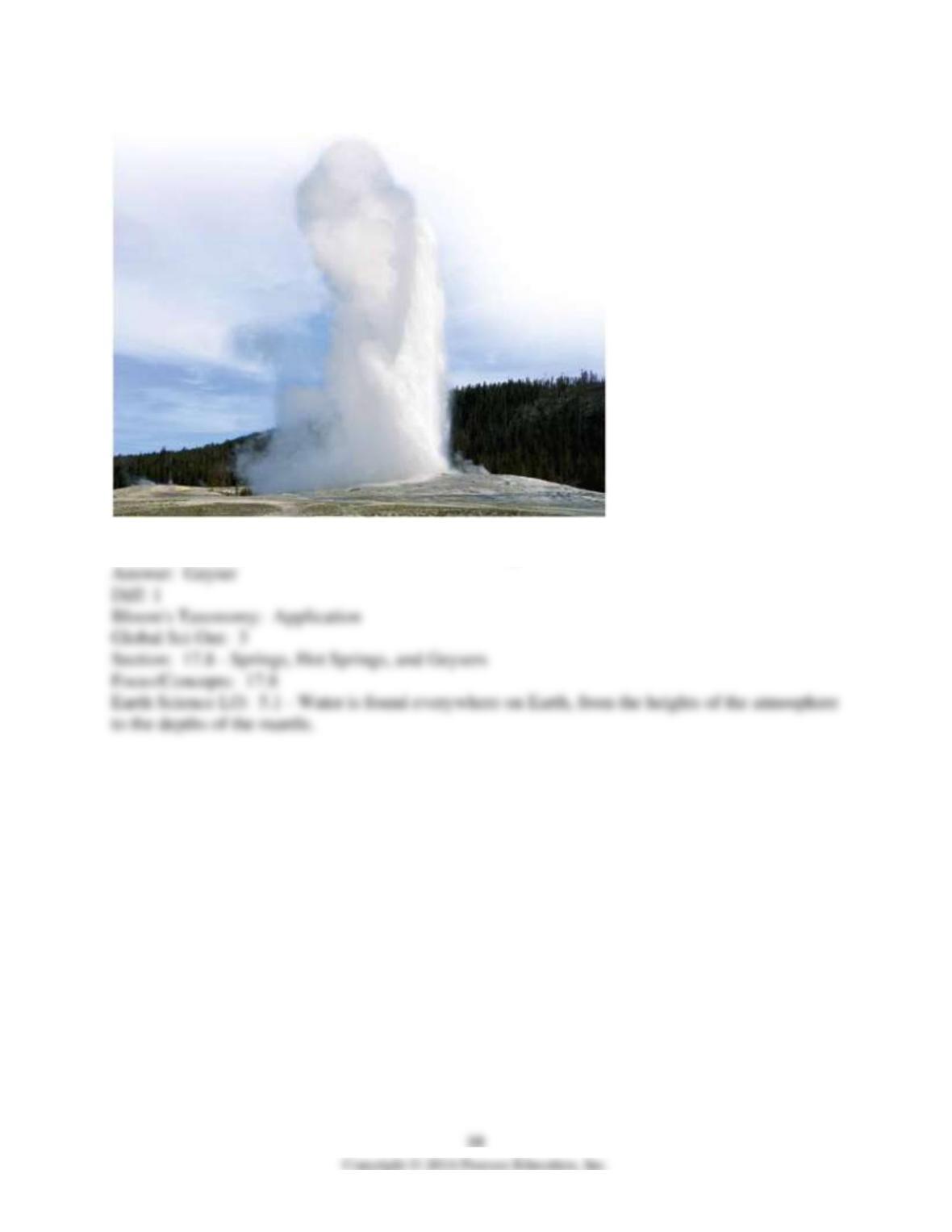
10)
What kind of geothermal feature is visible in this image?