13) What is the definition of a dipolar field?
14) Circle the Correct Answer: The magnetic north pole is currently moving (toward / away)
from the geographic north pole and the magnetic south pole is currently moving (toward / away)
from the geographic south pole.

12.4 Matching Questions
Put the layers of the Earth in order from the surface (First Layer) to the center (Fourth Layer).
A) Mantle
B) Crust
C) Inner Core
D) Outer Core
1) First Layer
Diff: 1
Bloom’s Taxonomy: Knowledge
Global Sci Out: 7
Section: 12.1 – Earth’s Internal Structure
Focus/Concepts: 12.1
Earth Science LO: 2.3 – Earth formed from the accumulation of dust and gas, and multiple
collisions of smaller planetary bodies.
2) Second Layer
Diff: 1
Bloom’s Taxonomy: Knowledge
Global Sci Out: 7
Section: 12.1 – Earth’s Internal Structure
Focus/Concepts: 12.1
Earth Science LO: 2.3 – Earth formed from the accumulation of dust and gas, and multiple
collisions of smaller planetary bodies.
3) Third Layer
Diff: 1
Bloom’s Taxonomy: Knowledge
Global Sci Out: 7
Section: 12.1 – Earth’s Internal Structure
Focus/Concepts: 12.1
Earth Science LO: 2.3 – Earth formed from the accumulation of dust and gas, and multiple
collisions of smaller planetary bodies.
4) Fourth Layer
Diff: 1
Bloom’s Taxonomy: Knowledge
Global Sci Out: 7
Section: 12.1 – Earth’s Internal Structure
Focus/Concepts: 12.1
Earth Science LO: 2.3 – Earth formed from the accumulation of dust and gas, and multiple
collisions of smaller planetary bodies.

18
Match the layer of the Earth to the correct definition.
A) Liquid nickel and iron
B) Basaltic material composing the outermost layer
C) Ferromagnesian silicates mostly in a ductile state
D) Solid nickel and iron
E) Granitic material composing the outermost layer
5) Mantle
Diff: 1
Bloom’s Taxonomy: Knowledge
Global Sci Out: 7
Section: 12.3 – Earth’s Layers
Focus/Concepts: 12.3
Earth Science LO: 2.3 – Earth formed from the accumulation of dust and gas, and multiple
collisions of smaller planetary bodies.
6) Inner Core
Diff: 1
Bloom’s Taxonomy: Knowledge
Global Sci Out: 7
Section: 12.3 – Earth’s Layers
Focus/Concepts: 12.3
Earth Science LO: 2.3 – Earth formed from the accumulation of dust and gas, and multiple
collisions of smaller planetary bodies.
7) Continental Crust
Diff: 1
Bloom’s Taxonomy: Knowledge
Global Sci Out: 7
Section: 12.3 – Earth’s Layers
Focus/Concepts: 12.3
Earth Science LO: 2.3 – Earth formed from the accumulation of dust and gas, and multiple
collisions of smaller planetary bodies.
8) Outer Core
Diff: 1
Bloom’s Taxonomy: Knowledge
Global Sci Out: 7
Section: 12.3 – Earth’s Layers
Focus/Concepts: 12.3
Earth Science LO: 2.3 – Earth formed from the accumulation of dust and gas, and multiple
collisions of smaller planetary bodies.

9) Oceanic Crust
Diff: 1
Bloom’s Taxonomy: Knowledge
Global Sci Out: 7
Section: 12.3 – Earth’s Layers
Focus/Concepts: 12.3
Earth Science LO: 2.3 – Earth formed from the accumulation of dust and gas, and multiple
collisions of smaller planetary bodies.

Match the heat transfer mechanisms to the correct description of how heat is transported in or
from the Earth.
A) Heat is transported away from Earth and into outer space
B) Warm, low-density materials rise and cool, high-density materials sink
C) Heat flows between two materials in contact with each other
10) Convection
Diff: 1
Bloom’s Taxonomy: Knowledge
Global Sci Out: 7
Section: 12.4 – Earth’s Temperature
Focus/Concepts: 12.4
Earth Science LO: 4.2 – Earth, like other planets, is still cooling, though radioactive decay
continuously generates heat & 4.3 – Earth’s interior is in constant motion through the process of
convection, with important consequences for the surface.
11) Conduction
Diff: 1
Bloom’s Taxonomy: Knowledge
Global Sci Out: 7
Section: 12.4 – Earth’s Temperature
Focus/Concepts: 12.4
Earth Science LO: 4.2 – Earth, like other planets, is still cooling, though radioactive decay
continuously generates heat & 4.3 – Earth’s interior is in constant motion through the process of
convection, with important consequences for the surface.
12) Radiation
Diff: 1
Bloom’s Taxonomy: Knowledge
Global Sci Out: 7
Section: 12.4 – Earth’s Temperature
Focus/Concepts: 12.4
Earth Science LO: 4.2 – Earth, like other planets, is still cooling, though radioactive decay
continuously generates heat & 4.3 – Earth’s interior is in constant motion through the process of
convection, with important consequences for the surface.
12.5 Essay Questions
1) Explain why S-waves are unable to pass through the Outer Core. Be specific and thorough
with your explanation.
2) Explain why a P-wave shadow will form.
3) Scientists have subdivided the upper mantle into three sections based on environmental and
compositional differences. What are these three subdivisions and how do they compare to each
other?
4) The inner core has not always existed, but formed over time. Explain how conditions in the
Earth changed over time to create an inner core.
5) What is chemical convection and how does it affect the outer core?
6) Is the force of gravity the same over the Earth’s surface? Explain why or why not.
12.6 Visual
1)
This image shows the direction a seismic wave will move as it is passing through a low-density
material. Draw a corresponding arrow in the high-density material showing how the wave would
refract as is moves from one density to another.
2)
What seismic shadowing is visible in this image?
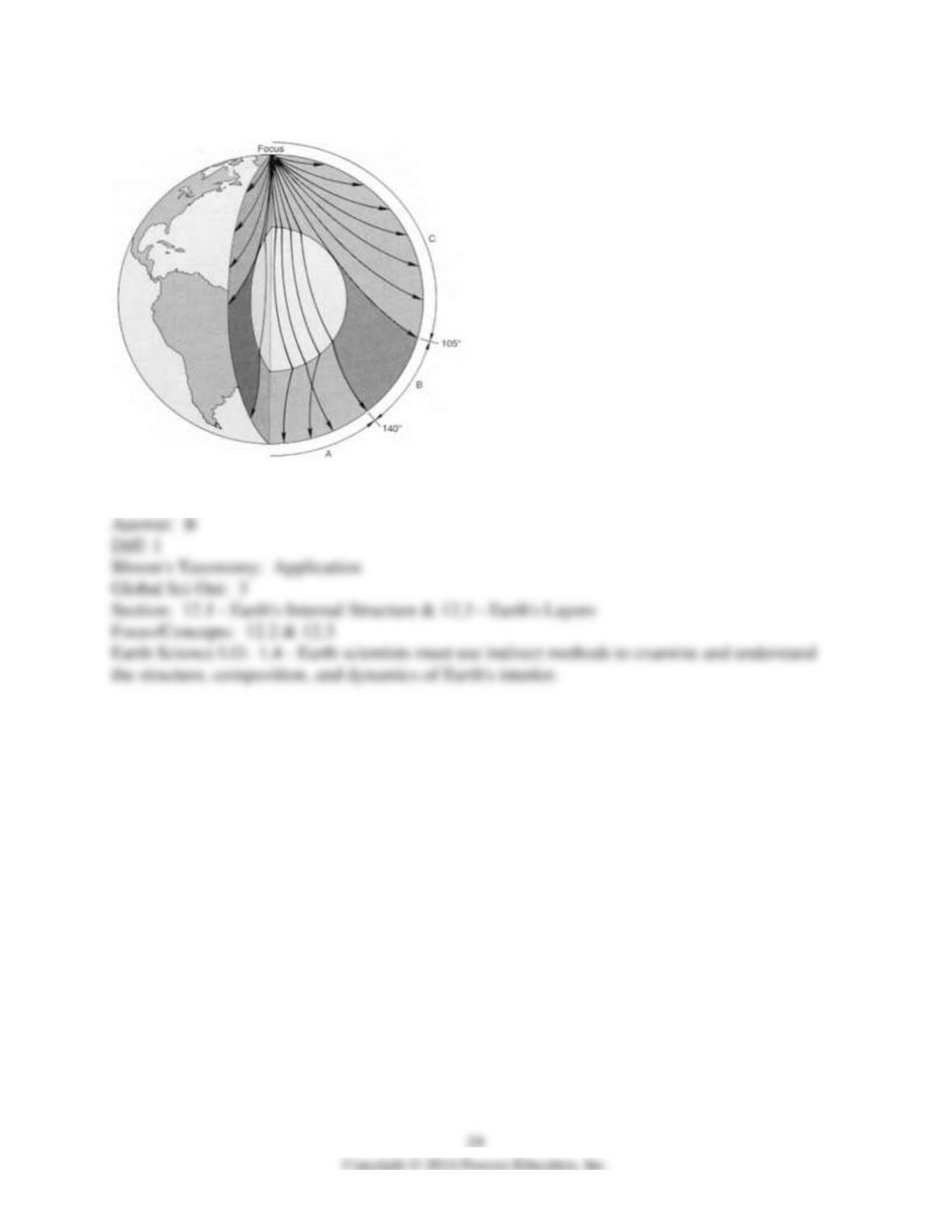
3)
Which section (A, B, or C) shows the seismic shadow?
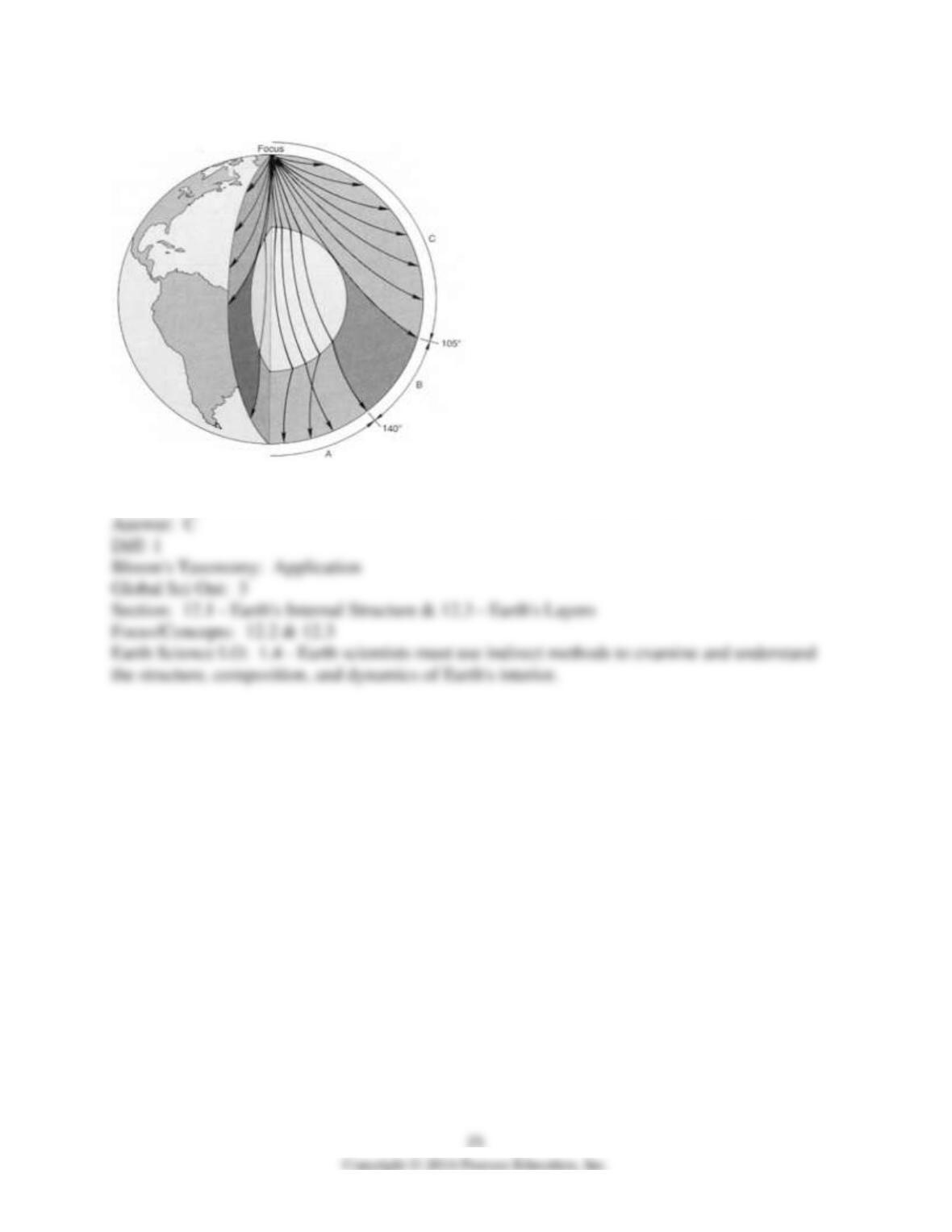
4)
Which section (A, B, or C) indicates the zone where direct seismic waves are received?
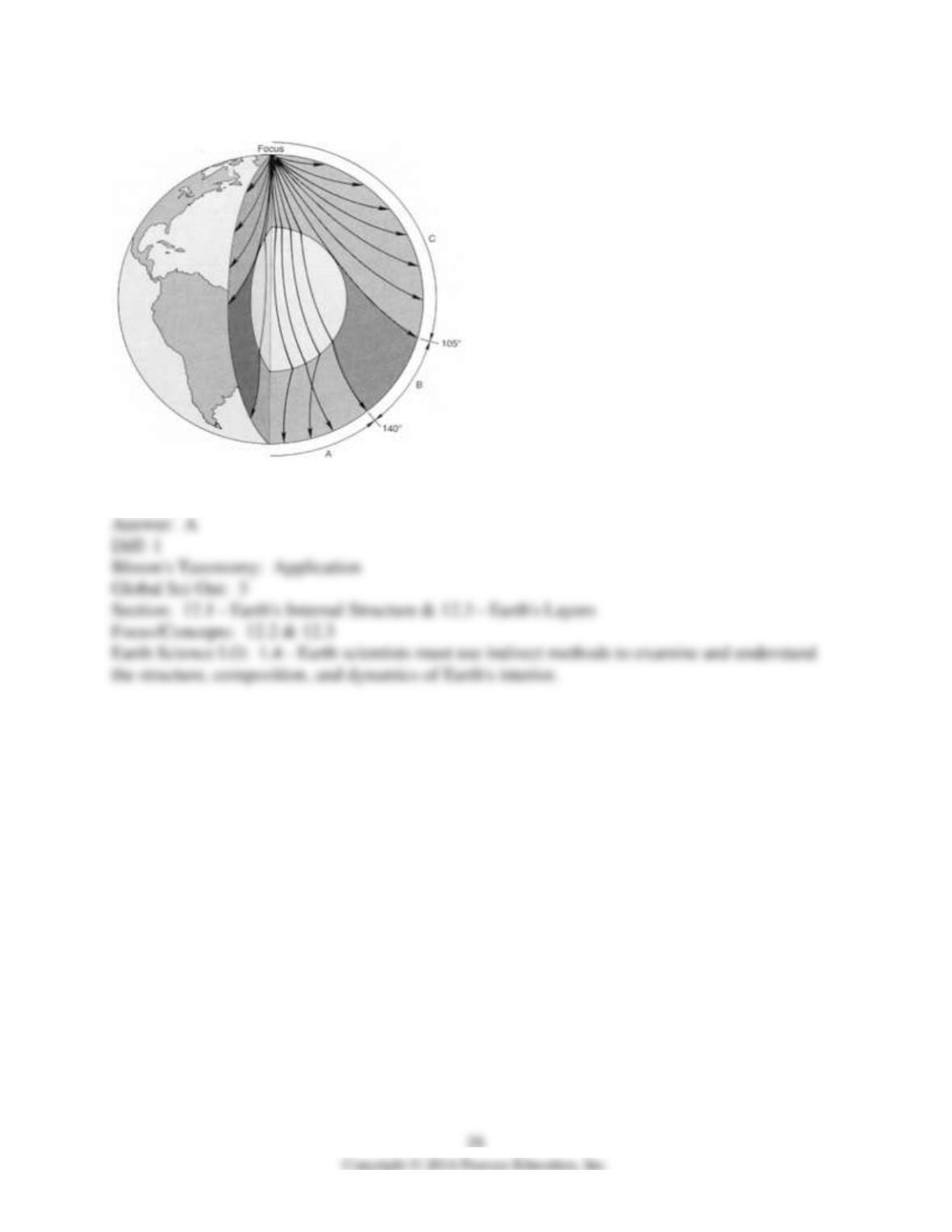
5)
Which section (A, B, or C) indicates the zone where refracted seismic waves are received?
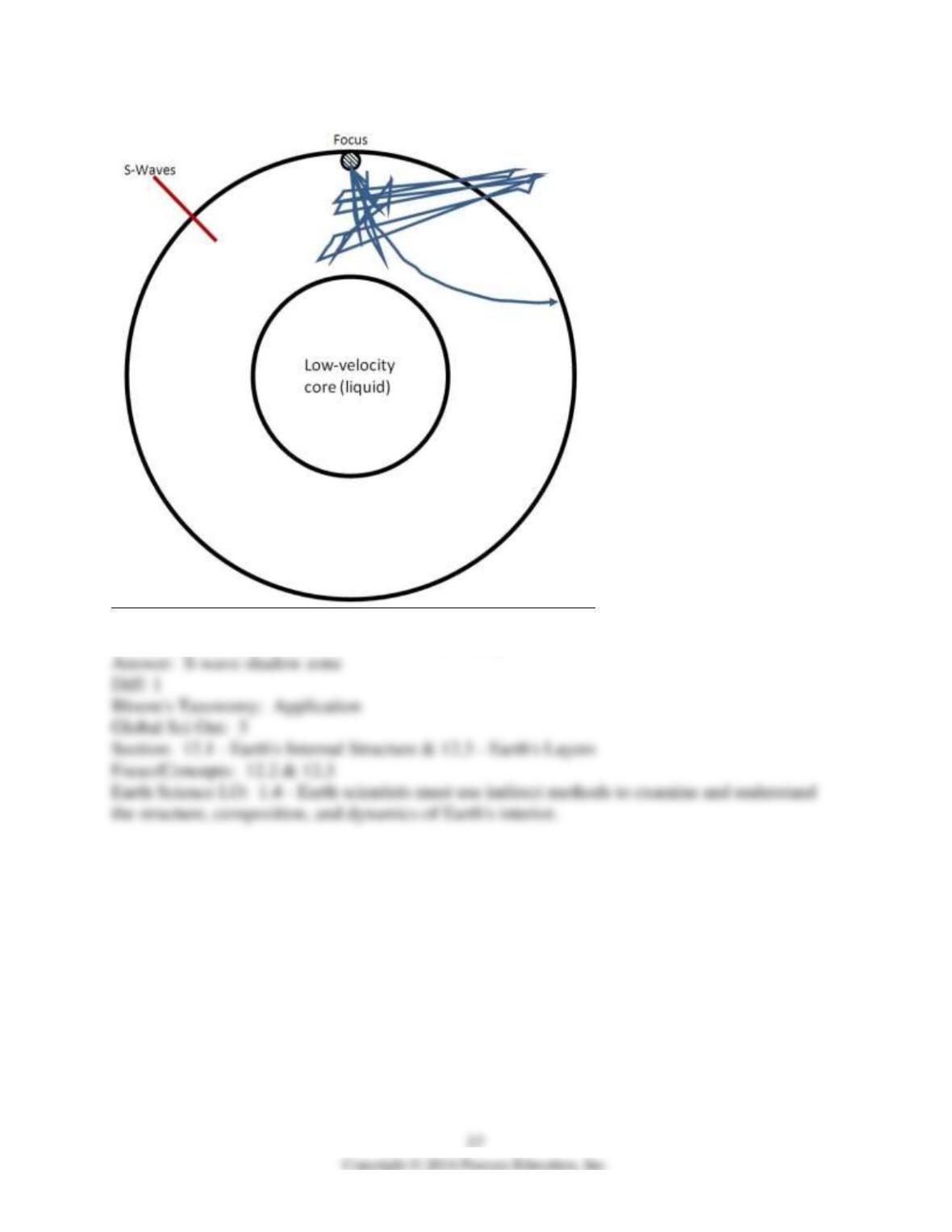
6)
What seismic shadowing zone is visible in this image?
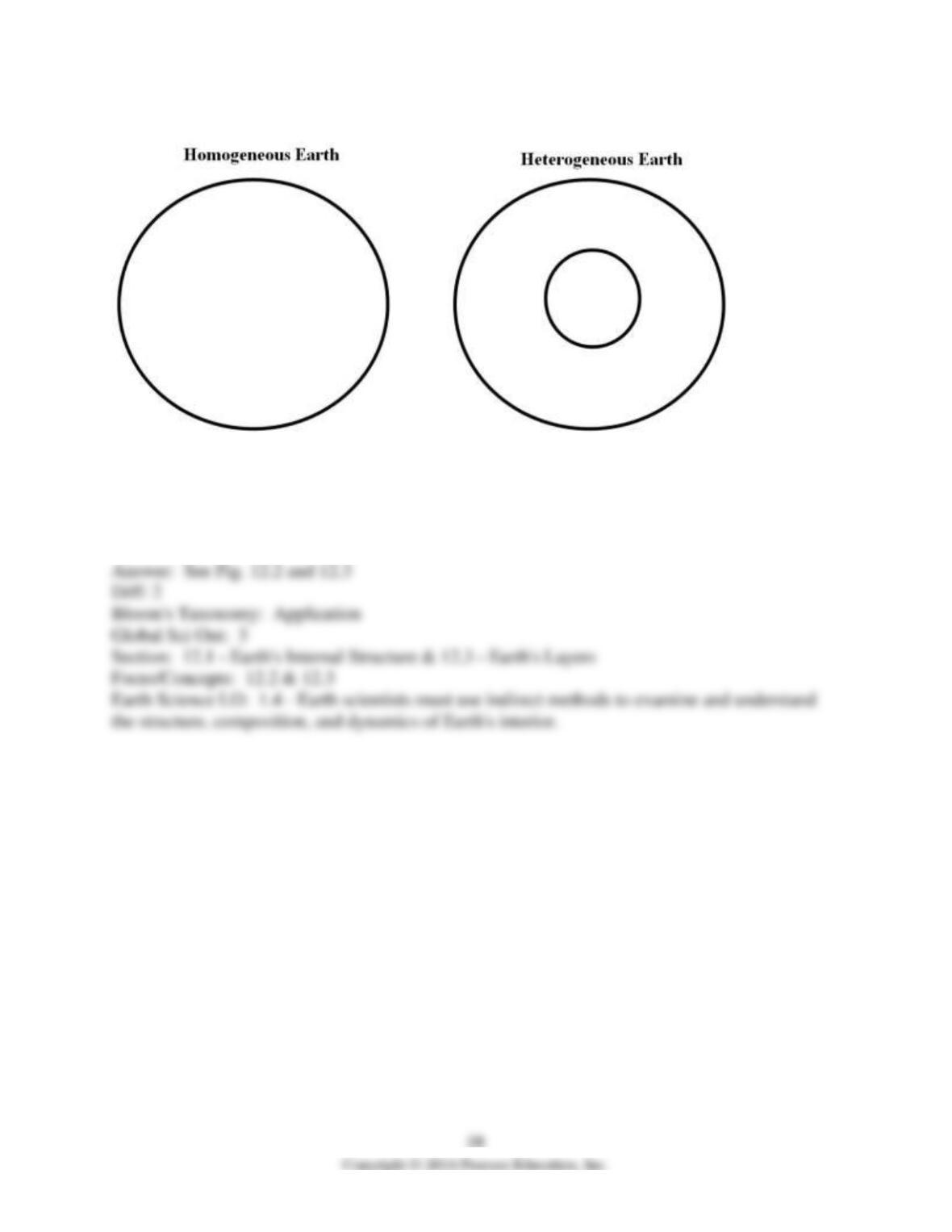
7)
This image shows two versions of the Earth. The one on the left is a homogeneous Earth, or what
the Earth would look like if there were no layers. The one on the right is a heterogeneous Earth,
or one with layers as we have today. (Assume the interior circle represents the Core.) Using both
versions of the Earth, draw the path P-waves would travel in both a homogeneous Earth and a
layered Earth.
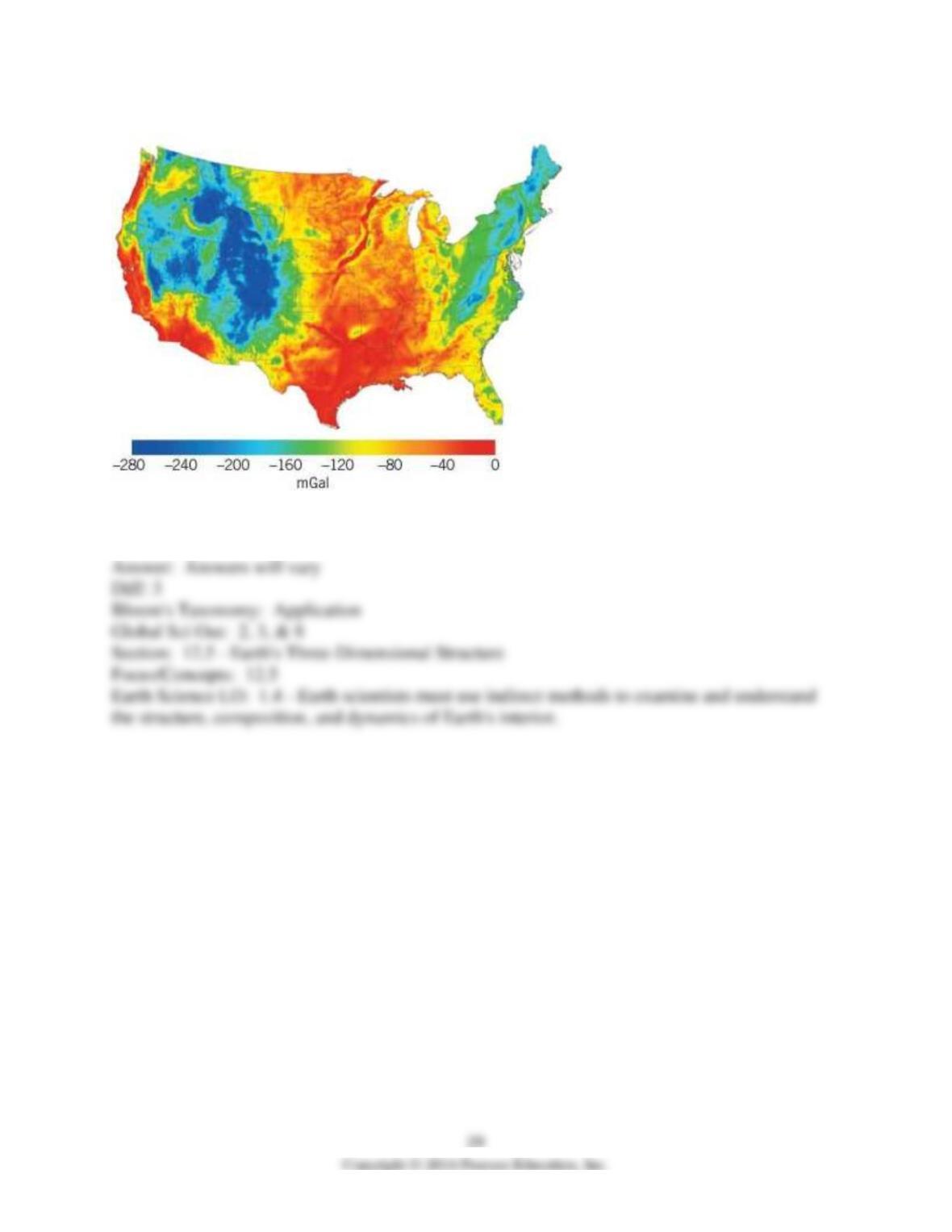
8)
Locate a positive gravity anomaly on the map and explain the geologic history that resulted in
the anomaly.