5) New Madrid
Diff: 1
Bloom’s Taxonomy: Knowledge
Global Sci Out: 7
Section: 11.6 – Earthquake Belts and Plate Boundaries
Focus/Concepts: 11.6
Earth Science LO: 8.1 – Natural hazards result from natural Earth processes.
6) Anchorage
Diff: 1
Bloom’s Taxonomy: Knowledge
Global Sci Out: 7
Section: 11.6 – Earthquake Belts and Plate Boundaries
Focus/Concepts: 11.6
Earth Science LO: 8.1 – Natural hazards result from natural Earth processes.

Match the choices below to the correct description.
A) R-waves
B) S-waves
C) P-waves
D) L-waves
7) This body wave is a compressional wave.
Diff: 1
Bloom’s Taxonomy: Knowledge
Global Sci Out: 7
Section: 11.3 – Seismology: The Study of Earthquake Waves
Focus/Concepts: 11.3
Earth Science LO: 1.4 – Earth scientists must use indirect methods to examine and understand
the structure, composition, and dynamics of Earth’s interior.
8) This body wave is a shear wave.
Diff: 1
Bloom’s Taxonomy: Knowledge
Global Sci Out: 7
Section: 11.3 – Seismology: The Study of Earthquake Waves
Focus/Concepts: 11.3
Earth Science LO: 1.4 – Earth scientists must use indirect methods to examine and understand
the structure, composition, and dynamics of Earth’s interior.
9) This surface wave moves from side to side.
Diff: 1
Bloom’s Taxonomy: Knowledge
Global Sci Out: 7
Section: 11.3 – Seismology: The Study of Earthquake Waves
Focus/Concepts: 11.3
Earth Science LO: 1.4 – Earth scientists must use indirect methods to examine and understand
the structure, composition, and dynamics of Earth’s interior.
10) This surface wave moves up and down.
Diff: 1
Bloom’s Taxonomy: Knowledge
Global Sci Out: 7
Section: 11.3 – Seismology: The Study of Earthquake Waves
Focus/Concepts: 11.3
Earth Science LO: 1.4 – Earth scientists must use indirect methods to examine and understand
the structure, composition, and dynamics of Earth’s interior.

20
Match the seismic hazard with the correct definition.
A) Rhythmic sloshing of water in lakes and enclosed basins
B) Seismic energy transforms stable soil into mobile material incapable of supporting buildings
C) Large ocean waves generated
D) Mass movement of material downslope, shaken loose by seismic events
E) Collapse and lowering of the land surface
11) Liquefaction
Diff: 1
Bloom’s Taxonomy: Knowledge
Global Sci Out: 7
Section: 11.5 – Earthquake Destruction
Focus/Concepts: 11.5
Earth Science LO: 8.1 – Natural hazards result from natural Earth processes.
12) Landslide
Diff: 1
Bloom’s Taxonomy: Knowledge
Global Sci Out: 7
Section: 11.5 – Earthquake Destruction
Focus/Concepts: 11.5
Earth Science LO: 8.1 – Natural hazards result from natural Earth processes.
13) Seiche
Diff: 1
Bloom’s Taxonomy: Knowledge
Global Sci Out: 7
Section: 11.5 – Earthquake Destruction
Focus/Concepts: 11.5
Earth Science LO: 8.1 – Natural hazards result from natural Earth processes.
14) Tsunami
Diff: 1
Bloom’s Taxonomy: Knowledge
Global Sci Out: 7
Section: 11.5 – Earthquake Destruction
Focus/Concepts: 11.5
Earth Science LO: 8.1 – Natural hazards result from natural Earth processes.
15) Subsidence
Diff: 1
Bloom’s Taxonomy: Knowledge
Global Sci Out: 7
Section: 11.5 – Earthquake Destruction
Focus/Concepts: 11.5
Earth Science LO: 8.1 – Natural hazards result from natural Earth processes.
Below is a list of cities that were all struck by earthquakes. However, in the case of these
disasters, hazards associated with earthquakes accounted for more deaths than the earthquake
itself. Match the event with the hazard it is most associated with.
A) Subsidence
B) Liquefaction
C) Tsunami
D) Fire
16) Tokyo, Japan (1923)
Diff: 1
Bloom’s Taxonomy: Knowledge
Global Sci Out: 7
Section: 11.5 – Earthquake Destruction
Focus/Concepts: 11.5
Earth Science LO: 8.1 – Natural hazards result from natural Earth processes.
17) Port Royale, Jamaica (1692)
Diff: 1
Bloom’s Taxonomy: Knowledge
Global Sci Out: 7
Section: 11.5 – Earthquake Destruction
Focus/Concepts: 11.5
Earth Science LO: 8.1 – Natural hazards result from natural Earth processes.
18) Mexico City, Mexico (1985)
Diff: 1
Bloom’s Taxonomy: Knowledge
Global Sci Out: 7
Section: 11.5 – Earthquake Destruction
Focus/Concepts: 11.5
Earth Science LO: 8.1 – Natural hazards result from natural Earth processes.
19) Hilo, Hawaii (1946)
Diff: 1
Bloom’s Taxonomy: Knowledge
Global Sci Out: 7
Section: 11.5 – Earthquake Destruction
Focus/Concepts: 11.5
Earth Science LO: 8.1 – Natural hazards result from natural Earth processes.

22
Match the earthquake with the type of fault or plate boundary that generated it. (Note: Some
choices may be used more than once.)
A) Convergent Boundary
B) Intraplate Fault
C) Transform Boundary
20) Japan (2011)
Diff: 1
Bloom’s Taxonomy: Knowledge
Global Sci Out: 7
Section: 11.6 – Earthquake Belts and Plate Boundaries
Focus/Concepts: 11.6
Earth Science LO: 4.5 – Many active geologic processes occur at plate boundaries.
21) Loma Prieta, CA (1989)
Diff: 1
Bloom’s Taxonomy: Knowledge
Global Sci Out: 7
Section: 11.6 – Earthquake Belts and Plate Boundaries
Focus/Concepts: 11.6
Earth Science LO: 4.5 – Many active geologic processes occur at plate boundaries.
22) Mineral, Virginia (2011)
Diff: 1
Bloom’s Taxonomy: Knowledge
Global Sci Out: 7
Section: 11.6 – Earthquake Belts and Plate Boundaries
Focus/Concepts: 11.6
Earth Science LO: 4.5 – Many active geologic processes occur at plate boundaries.
23) Turkey (1999)
Diff: 1
Bloom’s Taxonomy: Knowledge
Global Sci Out: 7
Section: 11.6 – Earthquake Belts and Plate Boundaries
Focus/Concepts: 11.6
Earth Science LO: 4.5 – Many active geologic processes occur at plate boundaries.
24) Lisbon, Portugal (1755)
Diff: 1
Bloom’s Taxonomy: Knowledge
Global Sci Out: 7
Section: 11.6 – Earthquake Belts and Plate Boundaries
Focus/Concepts: 11.6
Earth Science LO: 4.5 – Many active geologic processes occur at plate boundaries.
11.5 Essay Questions
1) Explain the mechanics behind elastic rebound.
2) Evaluate the following statement: “Faults that do not experience fault creep may be
considered safe.”
3) Explain how a seismograph works.
4) Compare and contrast an earthquake’s magnitude and intensity.
5) Explain why using intensity alone as a measurement of seismic power can pose problems for
truly understanding the energy released by the earthquake.
6) The New Madrid earthquakes of the early 19th century were some of the largest in American
history. At their greatest, they caused buildings and bluffs to collapse, caused land subsidence,
and displaced parts of the Mississippi River. Could another earthquake of this magnitude happen
near New Madrid again? Explain how the earthquake devastation today would compare to that of
the early 19th century.
7) On January 12, 2010, the country of Haiti was rocked by a violent M 7.0 earthquake. This
quake had caused widespread devastation and resulted in the death of over 300,000 people. A
month later, a M 8.8 earthquake rocked central Chile, where over 80% of the country’s
population was concentrated. However, only 525 people were reported as dead for this disaster.
Why would Chile’s earthquake, with a higher magnitude, have a lower death toll than Haiti?
8) The year 2010 was a big one for major earthquakes: Haiti (M 7.0), Chile (M 8.8), Turkey (M
6.1), and New Zealand (M 7.1). With so many major earthquakes in a short time, many people
began to wonder about the status of the planet. One major author (name withheld for privacy)
even got on TV and stated that these earthquakes were related and were triggering each other. Is
this author correct? Why or why not?
9) There is an urban legend that states that all it would take is one good, strong earthquake and
California will fall off into the sea. Is this true? Explain why this may or may not be the case.
10) How might climate change predictions of sea level in the next century affect the severity of
future tsunamis?
11) Assume a major earthquake struck your region today. Outside of fire, which seismic
hazard(s) would your region be likely to expect? Why?
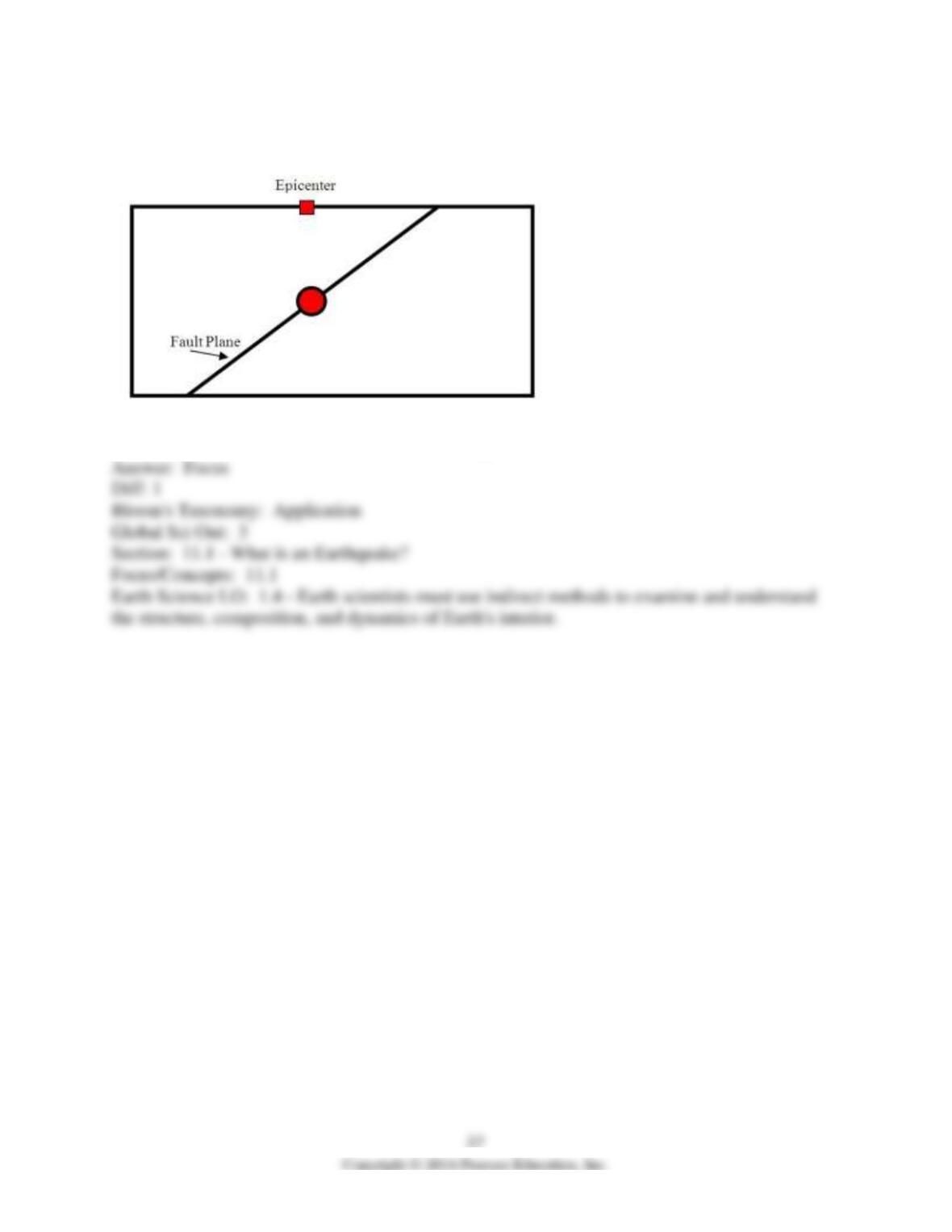
11.6 Visual
1)
What feature is marked with the circle in this image?
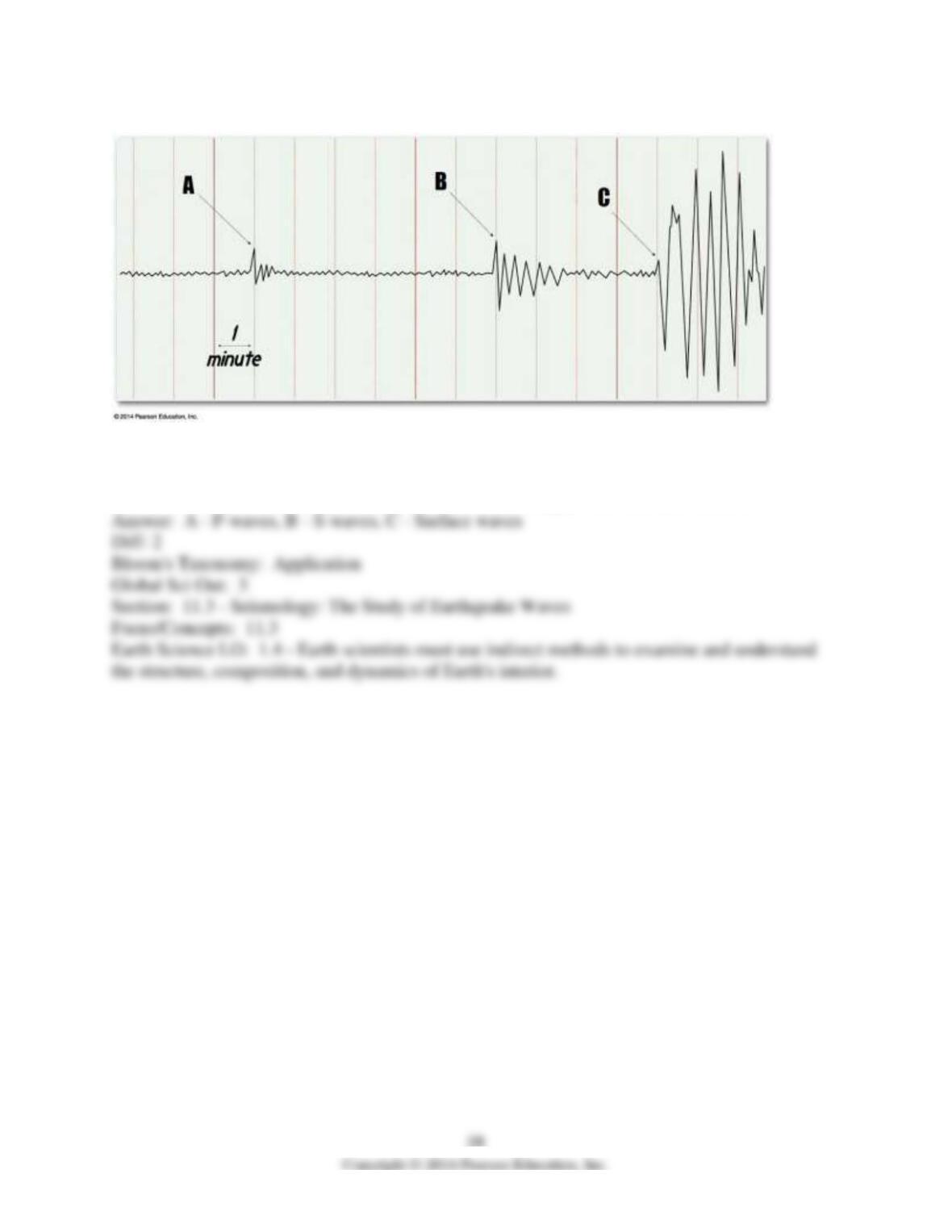
2)
Note the three arrows on this image, marked A-C, that illustrate three seismic waves on the chart
above. Indicate the name of the seismic wave marked by each letter. (Note: Surface waves are
not differentiated on this diagram and can be described simply with “surface waves.”)
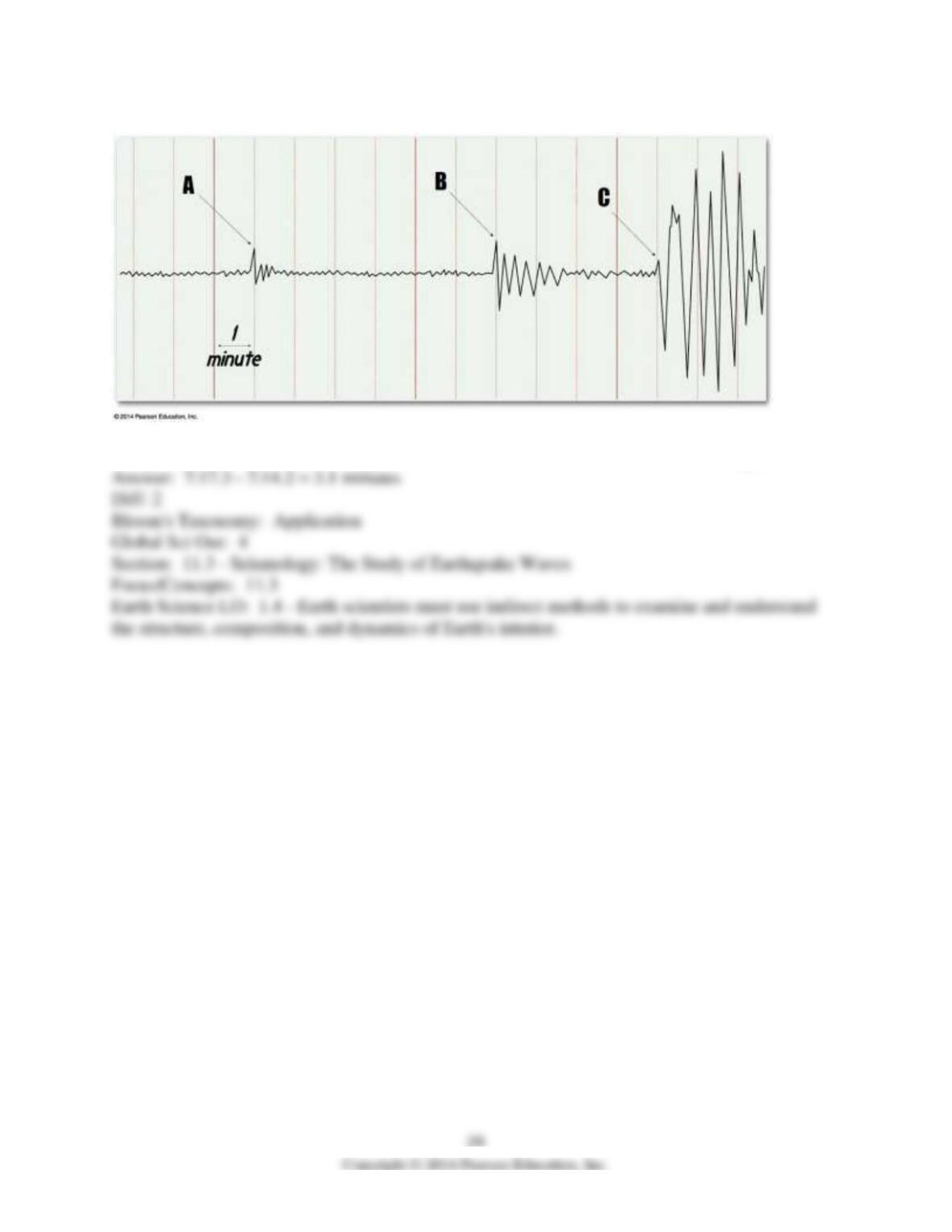
3)
Using the arrival times in this image, determine the S-minus-P interval for this earthquake.
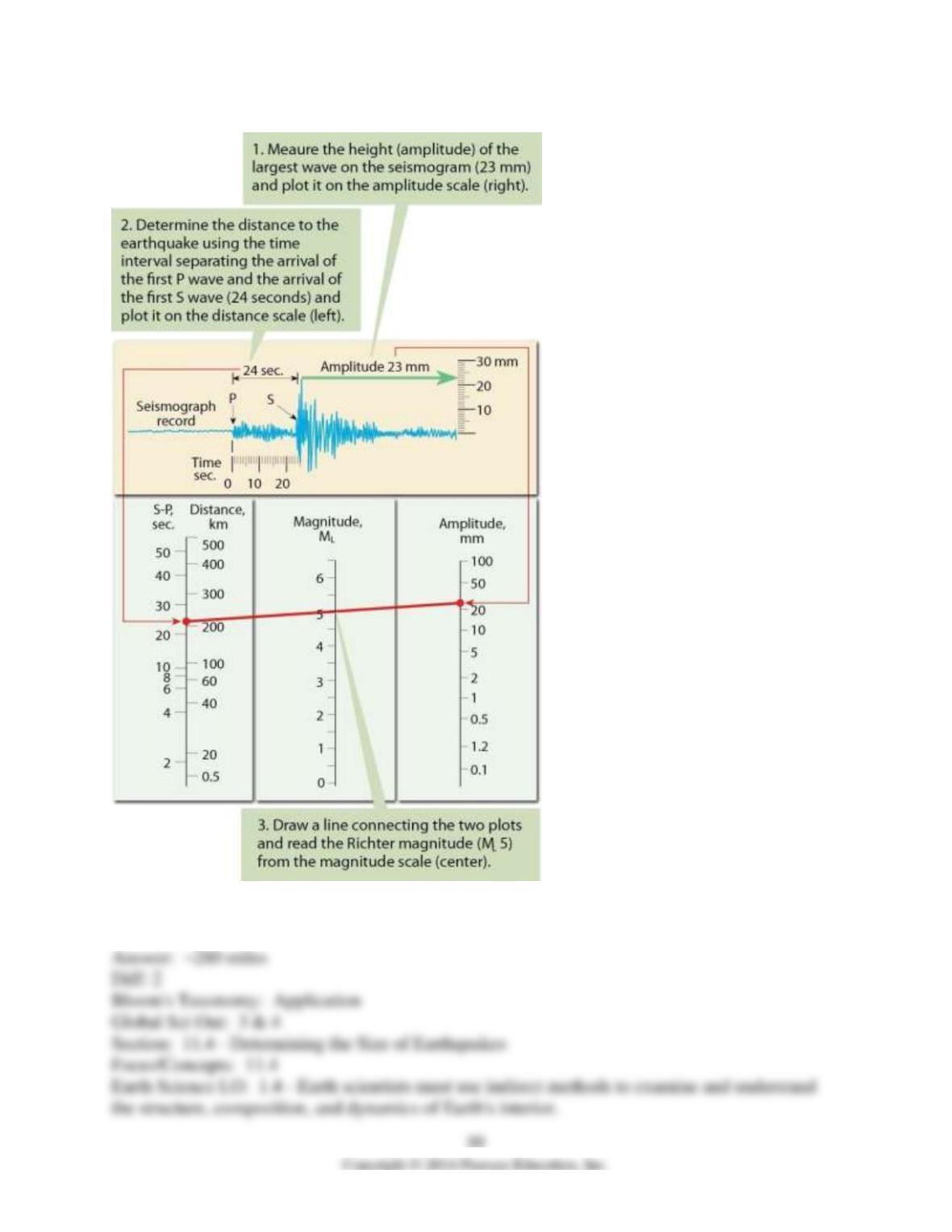
4)
Assuming your S-P interval was 0.5 minutes, what is the distance (in km) to the epicenter of the
earthquake?”
5)
I
Not felt except by a very few under especially favorable circumstances.
II
Felt only by a few persons at rest, especially on upper floors of buildings.
III
Felt quite noticeably indoors, especially on upper floors of buildings, but many
people do not recognize it as an earthquake.
IV
During the day felt indoors by many, outdoors by few. Sensation like heavy truck
striking building.
V
Felt by nearly everyone, many awakened. Disturbances of trees, poles, and other tall
objects sometimes noticed.
VI
Felt by all; many frightened and run outdoors. Some heavy furniture moved; few
instances of fallen plaster or damaged chimneys. Damage slight.
VII
Everybody runs outdoors. Damage negligible in buildings of good design and
construction; slight-to-moderate in well-built ordinary structures; considerable in
poorly built or badly designed structures.
VIII
Damage slight in specially designed structures; considerable in ordinary substantial
buildings with partial collapse; great in poorly built structures. (Fall of chimneys,
factory stacks, columns, monuments, walls.)
IX
Damage considerable in specially designed structures. Buildings shifted off
foundations. Ground cracked conspicuously.
X
Some well-built wooden structures destroyed. Most masonry and frame structures
destroyed. Ground badly cracked.
XII
Few, if any, (masonry) structures remain standing. Bridges destroyed. Broad fissures
in ground.
XIII
Damage total. Waves seen on ground surfaces. Objects thrown upward into air.
This table is an abridged copy of the Mercalli Intensity Scale. Use the following eyewitness
account to determine the damage inflicted by this seismic event:
“I was driving home when the earthquake hit. It’s a good thing I wasn’t far from home, because I
had to pull over to the side of the road. The entrance to my neighborhood was blocked because
of fallen trees and telephone polls. Although the school survived with a few cracks in the walls,
most of the houses in the neighborhood had significant damage. The bricks from my chimney
were all over the driveway. I had to crawl in through a window because I couldn’t get the door
open. Once I was in, I saw that it was blocked by one of my bookcases that had fallen over.”
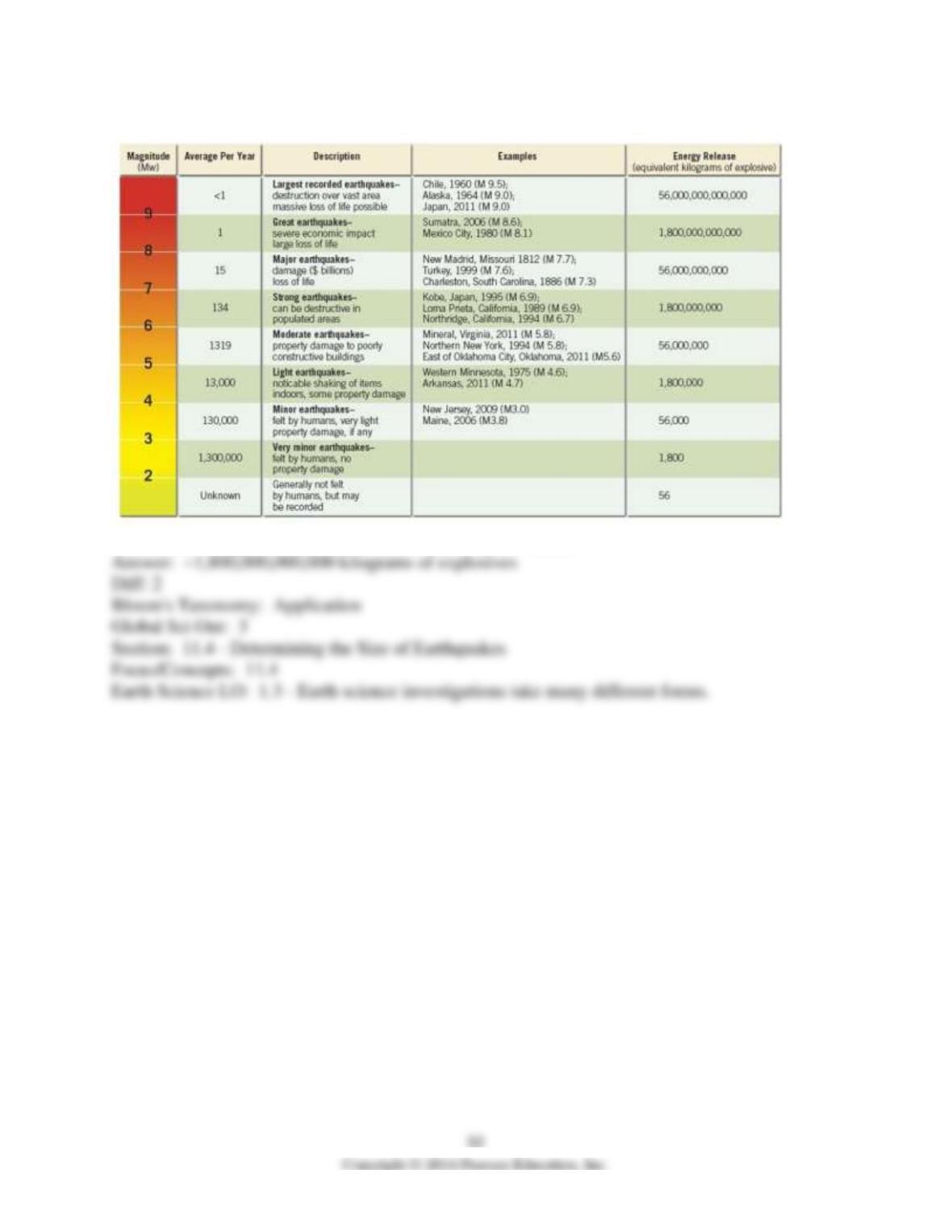
6)
How much energy was released in the Mexico City Earthquake in 1980?
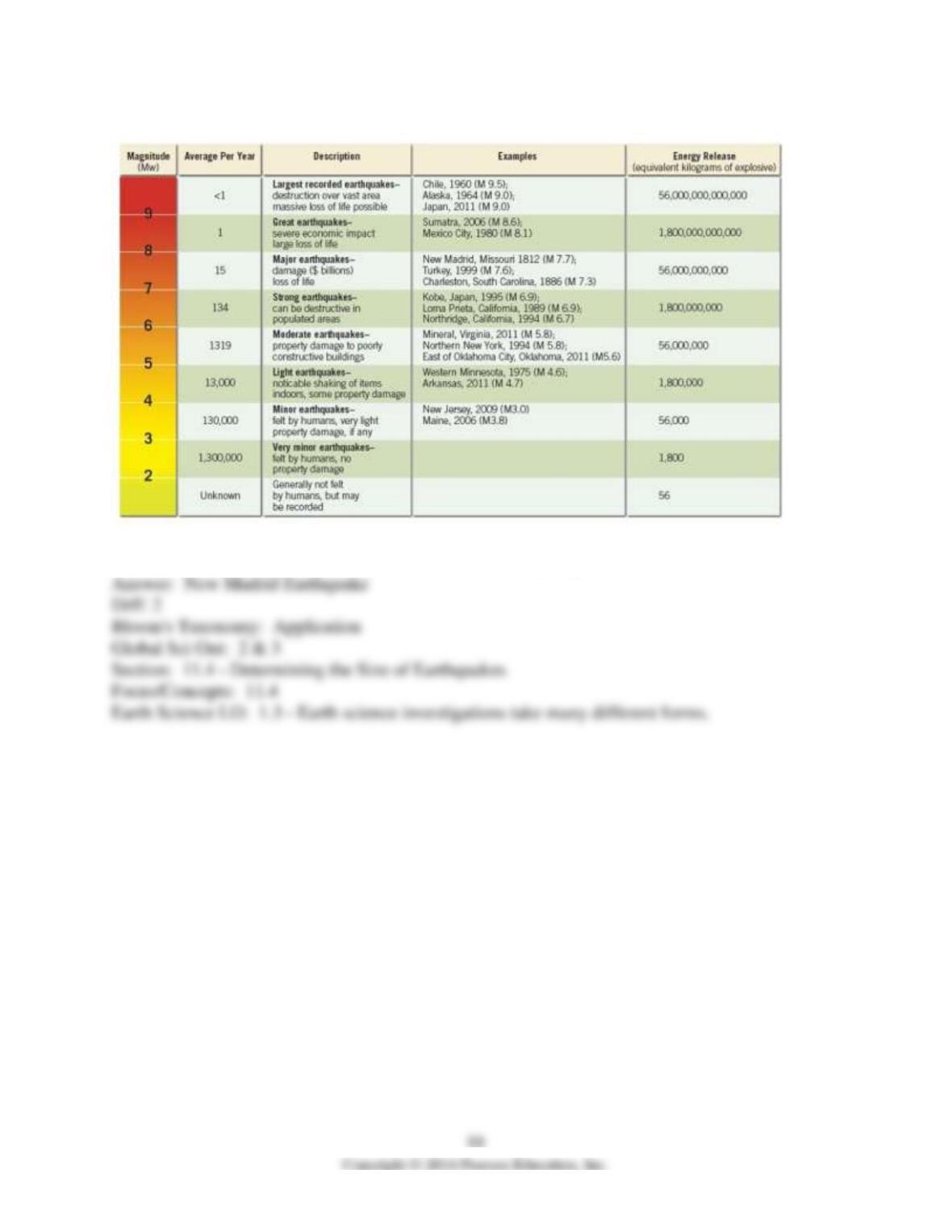
7)
Which of the following events had more energy: the Northern New York Earthquake of 1994,
the Charleston Earthquake of 1886, or the New Madrid Earthquake of 1812