Earth: An Introduction to Physical Geology, 11e (Tarbuck)
Chapter 10 Crustal Deformation
10.1 Multiple-Choice Questions
1) ________ refers to the changes in shape or position of a rock body in response to differential
stress.
A) Stress
B) Deformation
C) Compression
D) Brittle Failure
2) Which of the following is the best description for structural geology?
A) Study of intergrown mineral crystals in igneous rocks
B) Study of sequences of sedimentary rocks and how their environments of deposition dictate
how sediments are laid down
C) Study of earthquakes and how they move through the Earth’s interior
D) Study of rock deformation in response to tectonic forces
3) How will compressional force change a rock body?
A) Stretch and thin the rock
B) Fracture the rock and grind the pieces along side each other
C) Shorten and thicken the rock
D) The rock will not change
4) How will tensional force change a rock body?
A) Stretch and thin the rock
B) Fracture the rock and grind the pieces along side each other
C) Shorten and thicken the rock
D) The rock will not change
5) Which tectonic boundary is associated with compressional stress?
A) Convergent
B) Divergent
C) Transform
D) Dip-Slip
6) A rubber band being stretched in preparation to fire across the room is an example of what
kind of deformation?
A) Brittle deformation
B) Ductile deformation
C) Elastic deformation
D) Shear deformation
7) Unbending a paperclip wire is an example of what kind of deformation?
A) Brittle deformation
B) Ductile deformation
C) Elastic deformation
D) Shear deformation
8) What is a fault?
A) A fracture in a rock along which motion has occurred
B) A stress fracture created by rocks stretching and pulling apart near the surface
C) A solution pathway created by carbonic acid
D) Foliation in a rock that acts as a plane of weakness
9) Folds form in ________ temperature – ________ pressure environments.
A) Low; low
B) High; high
C) High; low
D) Low; high
10) Faults form in ________ temperature – ________ pressure environments.
A) Low; low
B) High; high
C) High; low
D) Low; high
11) A ________ is a circular fold where the youngest layers are in the middle and the oldest
layers are on the outside.
A) Syncline
B) Monocline
C) Dome
D) Basin
12) You are sitting in class when your professor begins talking about a dome with the inner
layers dating back to the Tertiary and its outer layers dating back to the Permian. You
immediately know this professor is wrong. What is your evidence?
A) Domes don’t have layers
B) Domes have the oldest layers in the middle, not the youngest
C) Now that we know the age of the layers, we would call it a syncline
D) Domes didn’t exist back then
13) How many hinge lines does a monocline have?
A) One
B) Two
C) Three
D) Four
14) How will the outcrop pattern of an anticline be oriented in the case of a plunging syncline?
A) The layers will close to a point in the direction of plunge
B) The layers will be oriented parallel to each other
C) The layers will intersect at right angles
D) The layers will open up in the direction of plunge
15) A(n) ________ fold has limbs that are tilted beyond the vertical to the point that the axial
plane is horizontal.
A) Recumbent
B) Overturned
C) Plunging
D) Inverted
16) Which tectonic boundary would have many normal faults associated with it?
A) Convergent
B) Divergent
C) Transform
17) A ________ fault is created when the hanging wall moves up relative to the footwall.
A) Strike-Slip
B) Normal
C) Reverse
D) Graben
18) Faults that exhibit both dip-slip and strike slip movement are called ________ faults.
A) Thrust
B) Horst
C) Normal
D) Oblique-slip
19) A ________ fault has a vertical fault plane and shows movement parallel to the orientation of
the fault.
A) Reverse
B) Strike-Slip
C) Thrust
D) Normal
20) Which type of fault was responsible for the devastation associated with the 1906 earthquake
in San Francisco?
A) Transform
B) Normal
C) Reverse
D) Thrust
21) ________ is the compass direction of the line produced by the intersection of an inclined
rock layer with a horizontal plane.
A) Dip
B) Angle
C) Strike
D) Plunge
22) ________ is the angle of inclination of the surface of a rock unit measured from a horizontal
plane.
A) Dip
B) Faulting
C) Strike
D) Plunge
23) How will strike and dip marks be oriented on the geologic map of a nonplunging syncline?
A) Parallel dips with strikes pointing away from the center of the fold
B) Strikes ringing the fold with the dips pointing toward the center
C) Strikes intersecting, but no dips because of horizontal layering
D) Parallel strikes with dips pointing away from the center of the fold
24) Which of the following best describes the age relationship of the layers in an anticline?
A) Oldest on the outside of the fold, youngest on the inside
B) Oldest on the inside of the fold, youngest on the outside
C) Oldest materials thrust up on top of younger layers
D) Horizontal bedding with the youngest layers on the top
10.2 True/False Questions
1) A joint is a wave-like undulation of rock layers in response to stress.
2) Strained bodies lose their original configuration during deformation.
3) Shear stress is a type of confining pressure.
4) Rocks subjected to heat will be more likely to go through brittle deformation when stressed
because the minerals become crystallized.
5) Shearing produced fault zones in the deep crust and folding in the upper crust.
6) A synform is a downfold in rock where the youngest layers are in the middle of the fold and
the youngest are on the outside.
7) The geological structures of a region will influence the topography of a region.
8) Detachment faults are low-angle reverse faults.
9) Some strike-slip faults are big enough to accommodate movement between two tectonic
plates.
10) Joints are fractures in a rock created by tension and will demonstrate significant
displacement.
11) Dip will always be 90° away from strike.
12) Dips on inclined rock beds can never be greater than 90°.
10.3 Short Answer Questions
1) Explain how stress is different from strain.
2) How will rock salt likely respond when put under stress?
3) How do joints form in tectonic environments?
4) Compare rock deformation in near surface environments to that deep within the Earth’s crust.
5) Explain the difference between an antiform and an anticline.
6) Movements along normal faults can produce alternating upthrown and down-dropped fault
blocks. What are the names associated with these blocks?
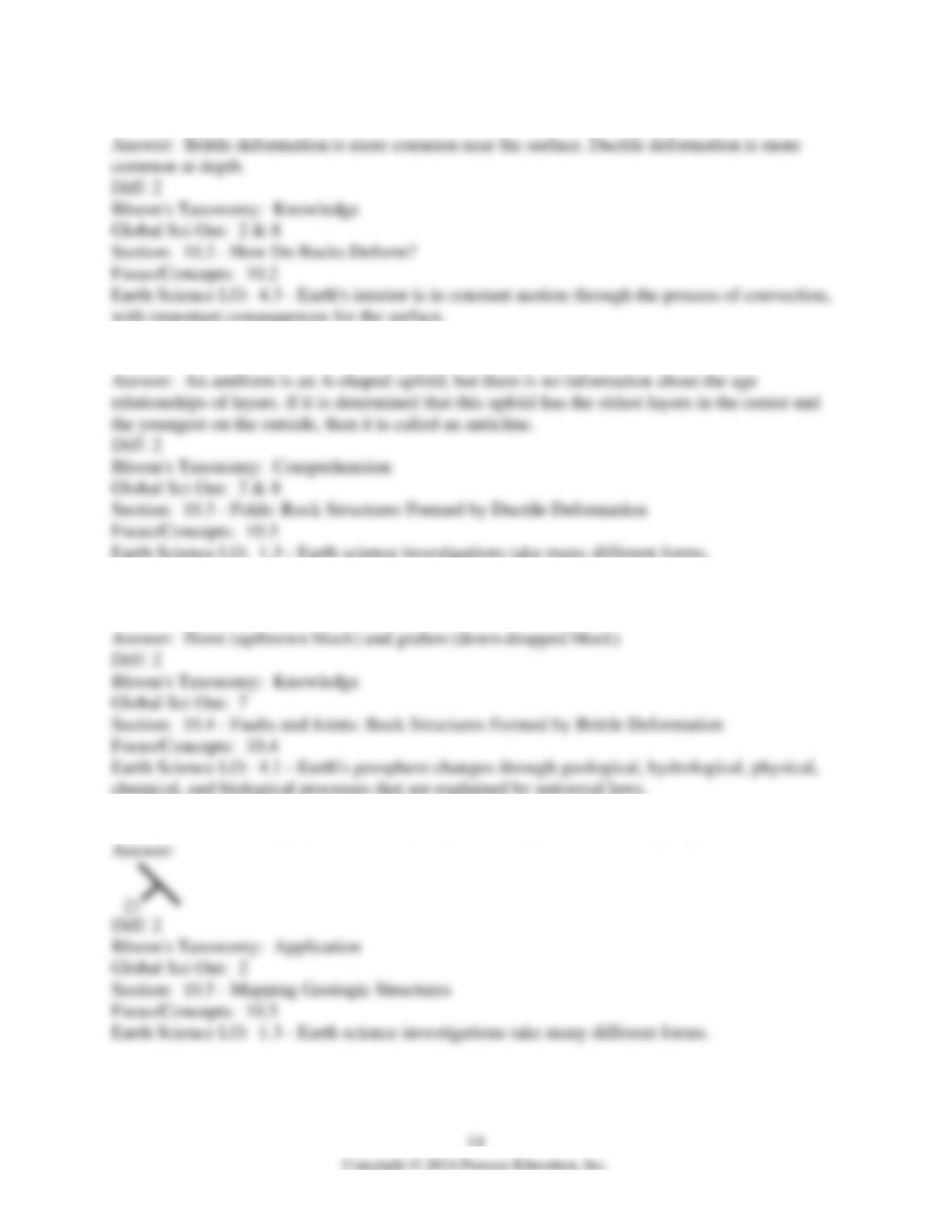
7) Draw a strike and dip symbol for a rock layer trending N 45 W and dipping 23° SW.
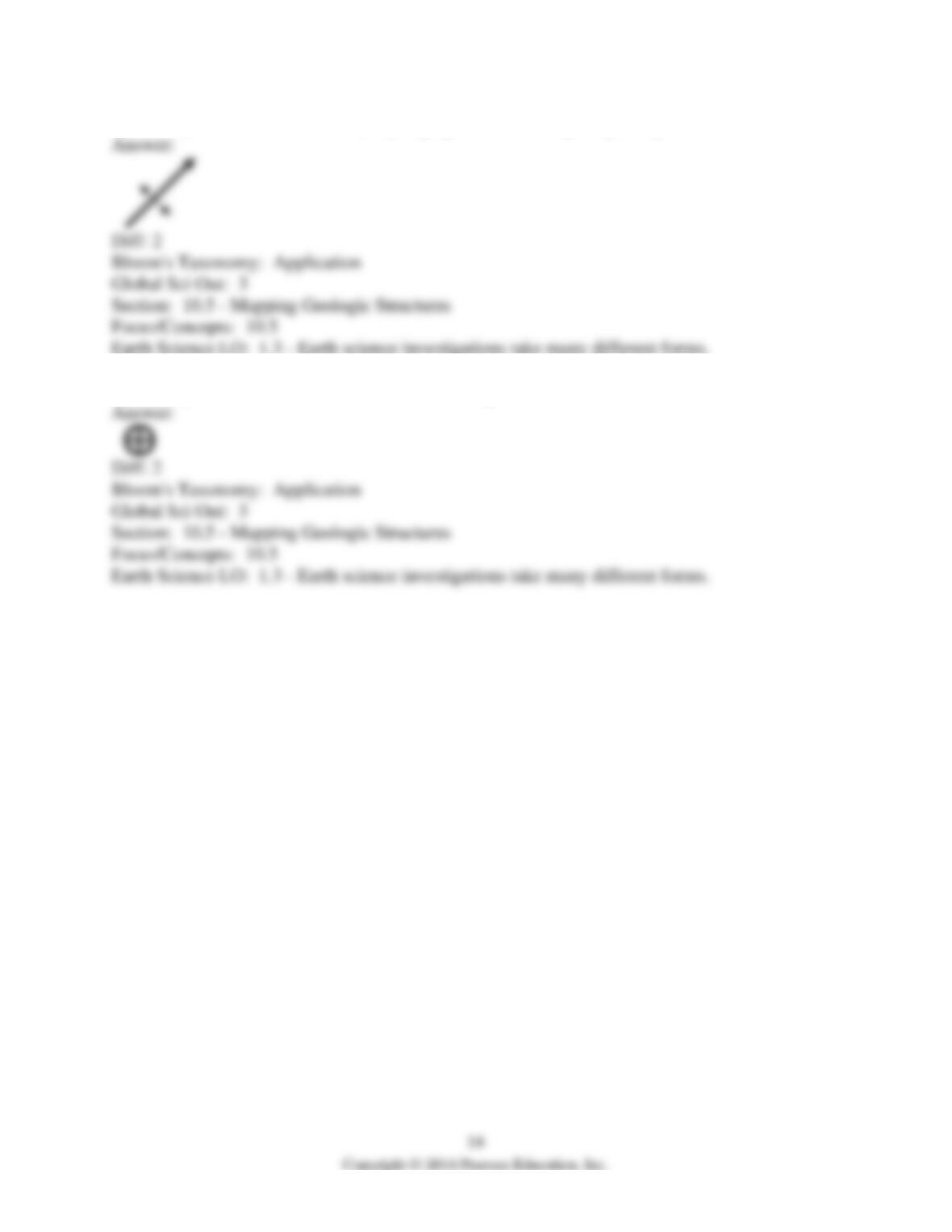
8) What symbol is used to identify a plunging anticline on a geologic map?
9) What symbol is used to mark horizontal bedding?

10.4 Matching Questions
Match the type of stress to the correct definition.
A) Forces move toward each other
B) Forces slide past each other
C) Forces pull apart from each other
1) Tension
Diff: 1
Bloom’s Taxonomy: Knowledge
Global Sci Out: 7
Section: 10.1 – What Causes Rock to Deform?
Focus/Concepts: 10.1
Earth Science LO: 1.2 – Earth scientists use a large variety of scientific principles to understand
how our planet works.
2) Compression
Diff: 1
Bloom’s Taxonomy: Knowledge
Global Sci Out: 7
Section: 10.1 – What Causes Rock to Deform?
Focus/Concepts: 10.1
Earth Science LO: 1.2 – Earth scientists use a large variety of scientific principles to understand
how our planet works.
3) Shear
Diff: 1
Bloom’s Taxonomy: Knowledge
Global Sci Out: 7
Section: 10.1 – What Causes Rock to Deform?
Focus/Concepts: 10.1
Earth Science LO: 1.2 – Earth scientists use a large variety of scientific principles to understand
how our planet works.

16
Determine the type of stress necessary to produce each of the following geologic
regions/features. (Note: Some choices will be used more than once.)
A) Tension
B) Shear
C) Compression
4) Basin and Range Province
Diff: 1
Bloom’s Taxonomy: Comprehension
Global Sci Out: 2
Section: 10.1 – What Causes Rock to Deform?
Focus/Concepts: 10.1
Earth Science LO: 1.2 – Earth scientists use a large variety of scientific principles to understand
how our planet works.
5) San Andreas Fault
Diff: 1
Bloom’s Taxonomy: Comprehension
Global Sci Out: 2
Section: 10.1 – What Causes Rock to Deform?
Focus/Concepts: 10.1
Earth Science LO: 1.2 – Earth scientists use a large variety of scientific principles to understand
how our planet works.
6) Grand Teton Mountains
Diff: 1
Bloom’s Taxonomy: Comprehension
Global Sci Out: 2
Section: 10.1 – What Causes Rock to Deform?
Focus/Concepts: 10.1
Earth Science LO: 1.2 – Earth scientists use a large variety of scientific principles to understand
how our planet works.
7) Appalachian Mountains
Diff: 1
Bloom’s Taxonomy: Comprehension
Global Sci Out: 2
Section: 10.1 – What Causes Rock to Deform?
Focus/Concepts: 10.1
Earth Science LO: 1.2 – Earth scientists use a large variety of scientific principles to understand
how our planet works.