
15
1.4 Matching Questions
Put the steps of the Scientific Method in order from first to last.
A) Observations and experiments are developed to test the hypothesis
B) Data is collected that relates to the question
C) A question is proposed about the natural world
D) Hypotheses are rejected, modified, or accepted
E) Questions are posed and a hypothesis is developed
F) Results are shared with the scientific community
1) First
Diff: 2
Bloom’s Taxonomy: Comprehension
Global Sci Out: 1
Section: 1.3 – The Nature of Scientific Inquiry
Focus/Concepts: 1.3
Earth Science LO: 1.3 – Earth science investigations take many different forms.
2) Second
Diff: 2
Bloom’s Taxonomy: Comprehension
Global Sci Out: 1
Section: 1.3 – The Nature of Scientific Inquiry
Focus/Concepts: 1.3
Earth Science LO: 1.3 – Earth science investigations take many different forms.
3) Third
Diff: 2
Bloom’s Taxonomy: Comprehension
Global Sci Out: 1
Section: 1.3 – The Nature of Scientific Inquiry
Focus/Concepts: 1.3
Earth Science LO: 1.3 – Earth science investigations take many different forms.
4) Fourth
Diff: 2
Bloom’s Taxonomy: Comprehension
Global Sci Out: 1
Section: 1.3 – The Nature of Scientific Inquiry
Focus/Concepts: 1.3
Earth Science LO: 1.3 – Earth science investigations take many different forms.

5) Fifth
Diff: 2
Bloom’s Taxonomy: Comprehension
Global Sci Out: 1
Section: 1.3 – The Nature of Scientific Inquiry
Focus/Concepts: 1.3
Earth Science LO: 1.3 – Earth science investigations take many different forms.
6) Sixth
Diff: 2
Bloom’s Taxonomy: Comprehension
Global Sci Out: 1
Section: 1.3 – The Nature of Scientific Inquiry
Focus/Concepts: 1.3
Earth Science LO: 1.3 – Earth science investigations take many different forms.

Match the sphere of the Earth with the correct definition.
A) All life on the planet
The solid Earth
B) Gaseous envelope around the planet
The solid Earth
C) Water portion of the planet
The solid Earth
D) The solid Earth
7) Hydrosphere
Diff: 1
Bloom’s Taxonomy: Comprehension
Global Sci Out: 7
Section: 1.4 – Earth’s Spheres
Focus/Concepts: 1.4
Earth Science LO: 3.1 – The four major systems of Earth are the geosphere, hydrosphere,
atmosphere, and biosphere.
8) Biosphere
Diff: 1
Bloom’s Taxonomy: Comprehension
Global Sci Out: 7
Section: 1.4 – Earth’s Spheres
Focus/Concepts: 1.4
Earth Science LO: 3.1 – The four major systems of Earth are the geosphere, hydrosphere,
atmosphere, and biosphere.
9) Atmosphere
Diff: 1
Bloom’s Taxonomy: Comprehension
Global Sci Out: 7
Section: 1.4 – Earth’s Spheres
Focus/Concepts: 1.4
Earth Science LO: 3.1 – The four major systems of Earth are the geosphere, hydrosphere,
atmosphere, and biosphere.
10) Geosphere
Diff: 1
Bloom’s Taxonomy: Comprehension
Global Sci Out: 7
Section: 1.4 – Earth’s Spheres
Focus/Concepts: 1.4
Earth Science LO: 3.1 – The four major systems of Earth are the geosphere, hydrosphere,
atmosphere, and biosphere.

Put the events leading up to the formation of the early Earth in order.
A) Rapid expansion of stellar matter
B) Formation of solar nebula
C) Nuclear fission lights up Sun
D) Formation of proto-planets
11) First
Diff: 1
Bloom’s Taxonomy: Knowledge
Global Sci Out: 7
Section: 1.6 – Early Evolution of Earth
Focus/Concepts: 1.6
Earth Science LO: 2.2 – Our Solar System formed from a vast cloud of gas and dust 4.6 billion
years ago.
12) Second
Diff: 1
Bloom’s Taxonomy: Knowledge
Global Sci Out: 7
Section: 1.6 – Early Evolution of Earth
Focus/Concepts: 1.6
Earth Science LO: 2.2 – Our Solar System formed from a vast cloud of gas and dust 4.6 billion
years ago.
13) Third
Diff: 1
Bloom’s Taxonomy: Knowledge
Global Sci Out: 7
Section: 1.6 – Early Evolution of Earth
Focus/Concepts: 1.6
Earth Science LO: 2.2 – Our Solar System formed from a vast cloud of gas and dust 4.6 billion
years ago.
14) Fourth
Diff: 1
Bloom’s Taxonomy: Knowledge
Global Sci Out: 7
Section: 1.6 – Early Evolution of Earth
Focus/Concepts: 1.6
Earth Science LO: 2.2 – Our Solar System formed from a vast cloud of gas and dust 4.6 billion
years ago.

Sort the collection of rocks below into the three categories of rocks.
A) Slate, Schist, Quartzite, Phyllite
B) Granite, Gabbro, Rhyolite, Basalt
C) Limestone, Conglomerate, Arkose, Dolomite
15) Igneous Rocks
Diff: 2
Bloom’s Taxonomy: Analysis
Global Sci Out: 2
Section: 1.8 – Rocks and the Rock Cycle
Focus/Concepts: 1.8
Earth Science LO: 4.6 – Earth materials take many different forms as they cycle through the
geosphere.
16) Sedimentary Rocks
Diff: 2
Bloom’s Taxonomy: Analysis
Global Sci Out: 2
Section: 1.8 – Rocks and the Rock Cycle
Focus/Concepts: 1.8
Earth Science LO: 4.6 – Earth materials take many different forms as they cycle through the
geosphere.
17) Metamorphic Rocks
Diff: 2
Bloom’s Taxonomy: Analysis
Global Sci Out: 2
Section: 1.8 – Rocks and the Rock Cycle
Focus/Concepts: 1.8
Earth Science LO: 4.6 – Earth materials take many different forms as they cycle through the
geosphere.

Match the rock type with the correct definition.
A) Rocks that form when a pre-existing rock is altered due to heat and pressure
B) Rocks that form from pre-existing materials going through lithification
C) Rocks that form from the crystallization of molten material
18) Igneous
Diff: 1
Bloom’s Taxonomy: Knowledge
Global Sci Out: 7
Section: 1.8 – Rocks and the Rock Cycle
Focus/Concepts: 1.8
Earth Science LO: 4.6 – Earth materials take many different forms as they cycle through the
geosphere.
19) Sedimentary
Diff: 1
Bloom’s Taxonomy: Knowledge
Global Sci Out: 7
Section: 1.8 – Rocks and the Rock Cycle
Focus/Concepts: 1.8
Earth Science LO: 4.6 – Earth materials take many different forms as they cycle through the
geosphere.
20) Metamorphic
Diff: 1
Bloom’s Taxonomy: Knowledge
Global Sci Out: 7
Section: 1.8 – Rocks and the Rock Cycle
Focus/Concepts: 1.8
Earth Science LO: 4.6 – Earth materials take many different forms as they cycle through the
geosphere.
1.5 Essay Questions
1) Explain how increased urbanization makes people more vulnerable to natural disasters?
2) In the 16th and 17th centuries, the doctrine of Catastrophism was used to describe how the
Earth had been shaped quickly by fast, violent catastrophes and was therefore very young. In the
18th century, James Hutton developed the Principle of Uniformitarianism, which stated that the
Earth was shaped by small, gradual changes occurring over a long period of time, making the
Earth much older. Which side (if any) is correct and why?
3) Explain how a scientific theory differs from the way most non-scientists use the word theory
in everyday language.
4) Explain the difference between a scientific hypothesis and a scientific theory.
5) Changes in one part of the Earth System can influence processes in other parts of the system.
Sometimes these changes can be minor, but sometimes they can be severe. Which part of the
Earth System do you think exerts the most power over the other three? Why do you believe this
is the case? Support your position with evidence.
6) On May 18, 1980, the volcano Mt. St. Helens in Washington State erupted, devastating life
and landscape for over 200 mi2 through ash falls, lahars, and other pyroclastic deposits. A few
days later, President Jimmy Carter flew surveyed the devastated area and stated it looked more
desolate than a moonscape. How did the volcanic eruption affect the hydrologic, biologic, and
atmospheric parts of the Earth System? And, after the eruption, how did those same parts of the
Earth System affect the volcanic deposits?
7) Compare and contrast ocean basins and continents.
8) In the 17th century, Archbishop James Ussher of Ireland used the Bible to calculate that the
Earth was created in 4004 B.C. Imagine you could take Archbishop Ussher to Niagara Falls.
Although Niagara Falls is located on the border between the United States and Canada today, it
was located several km to the north at the Niagara Escarpment and is eroding southward. Let’s
assume the rate of erosion is 50 cm/yr. Assuming the distance from the Niagara Escarpment to
Niagara Falls is 11 km, calculate how long, calculate how long it would have taken to erode from
the Escarpment to the current location of the Falls. How would this affect Archbishop Ussher’s
assessment of the age of the Earth?
1.6 Visual
1) Draw the hydrologic cycle to illustrate the processes of the hydrologic sphere.
2) Using the illustration you made of the hydrologic cycle, identify three locations where the
hydrologic sphere is interacting with one of the other three spheres. Make sure to list the names
of the spheres interacting at those locations.
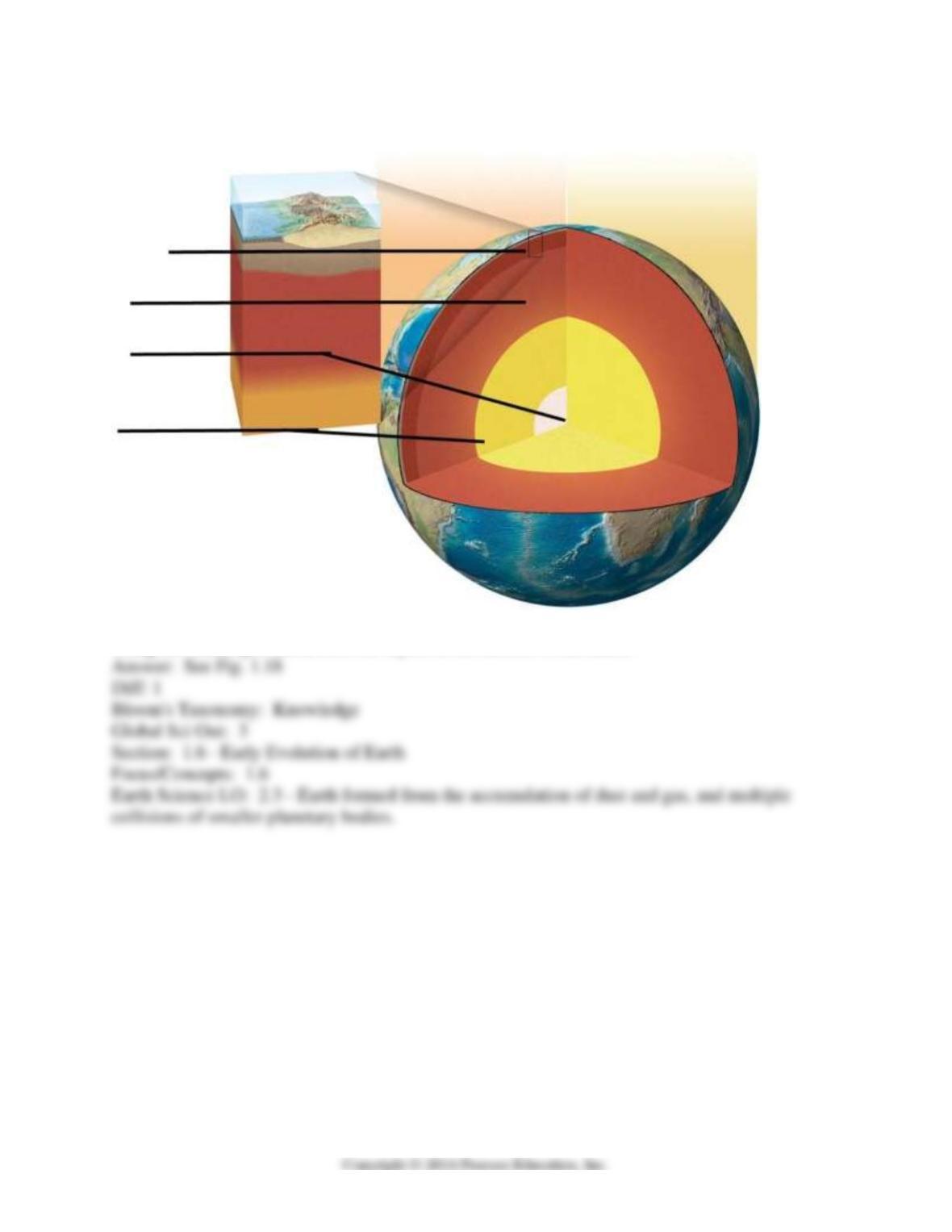
25
3)
Using the blanks provided, label the layers in the interior of the Earth.
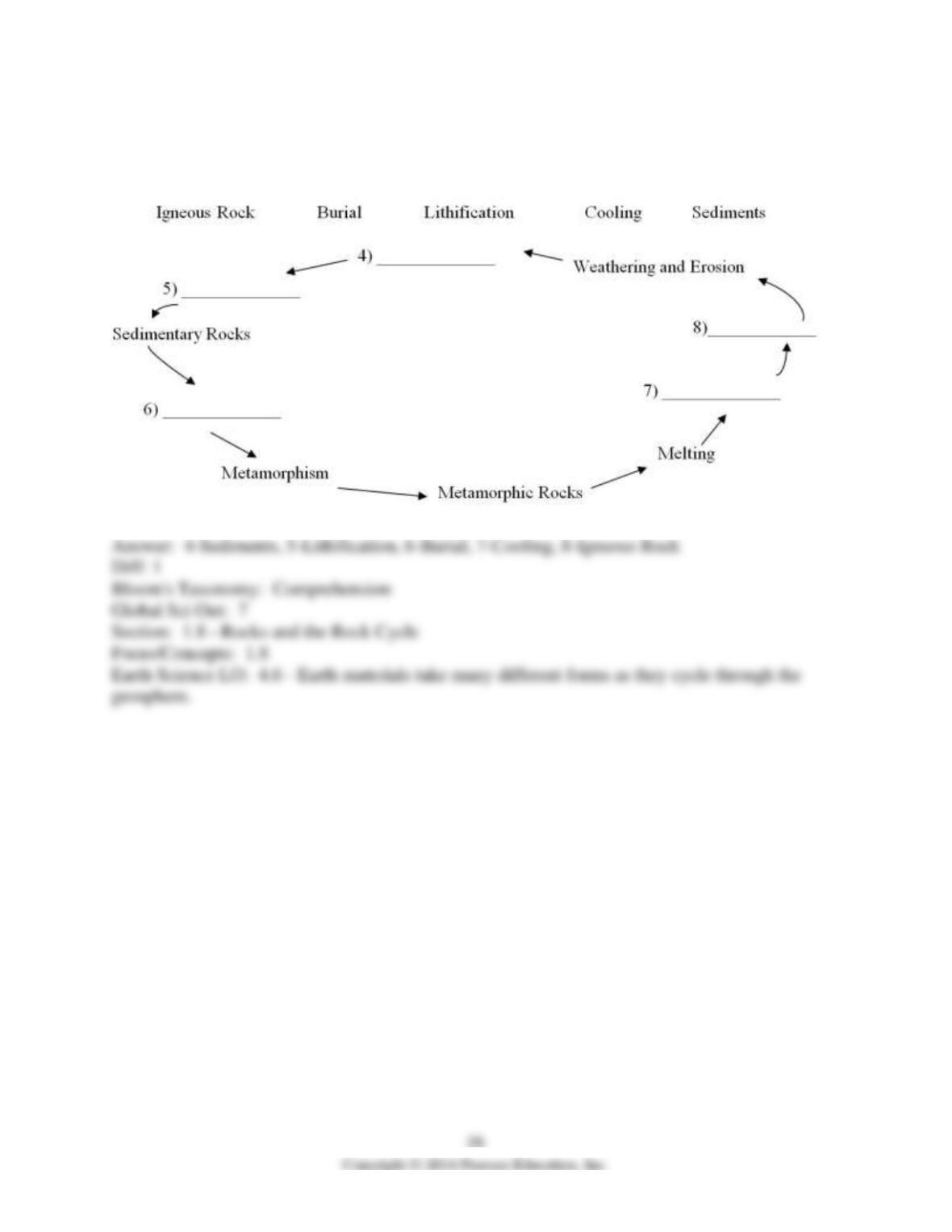
4) Geologic Rock Cycle
Below is a partially completed geologic rock cycle. Using the choices provided, match the
correct word with the correct blank in the rock cycle.
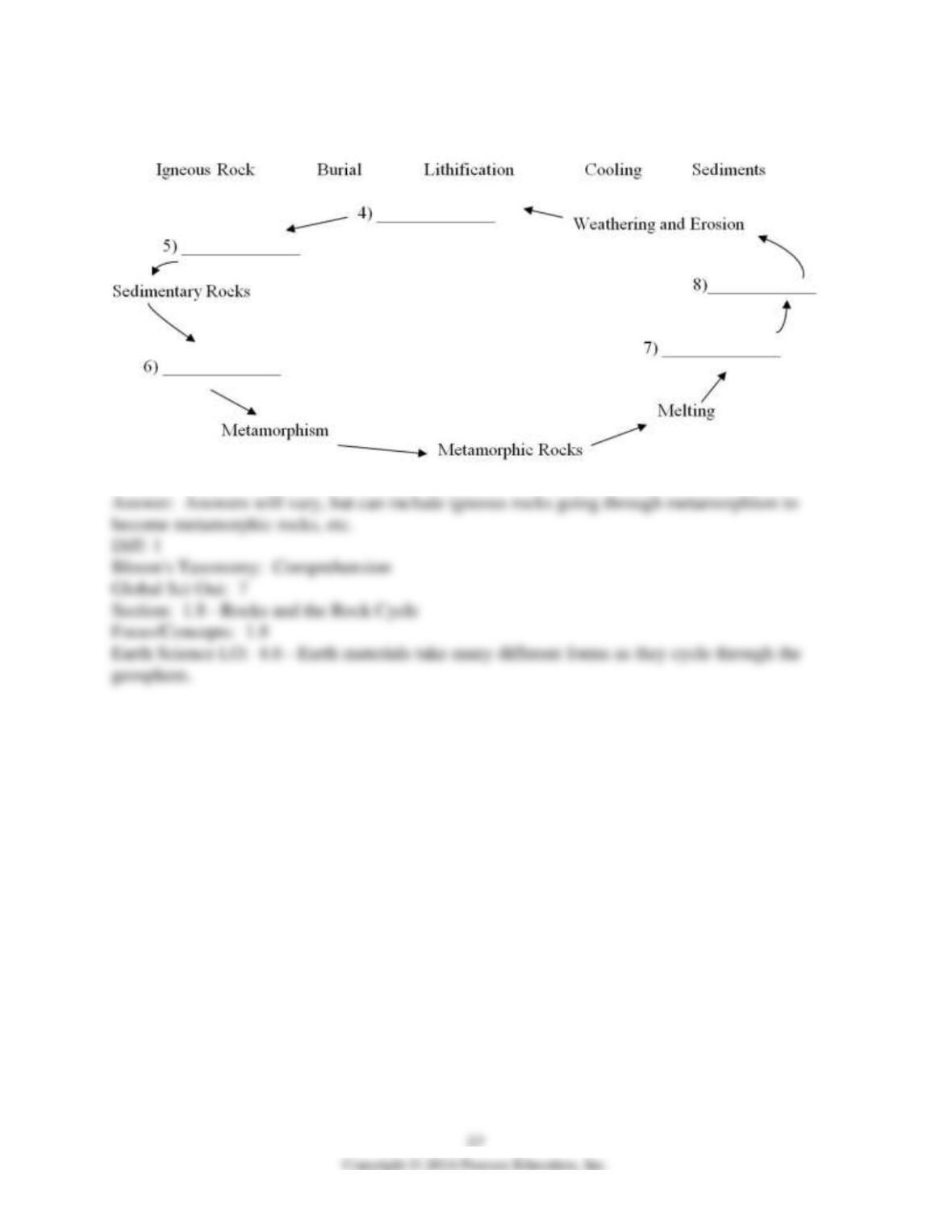
5) Using the Rock Cycle, draw alternate paths between the rock types.
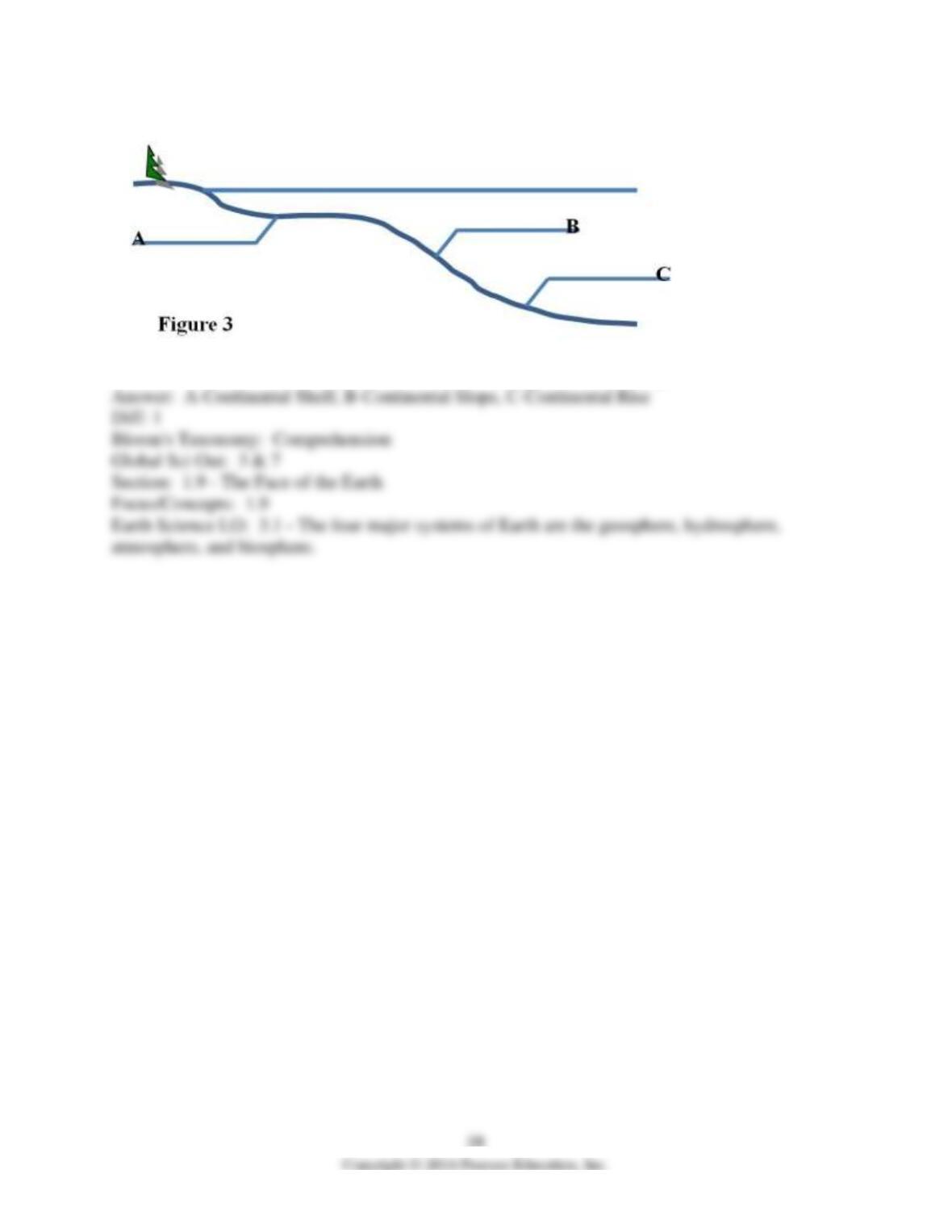
6)
Label the correct feature for each blank on the seafloor profile in the image above.