
A home appliance is rated at 250. watts ic connected to 120. V.
(a) What current does it draw?
(b) What is its resistance?
(c) How many kw-h does it use in one 24-hour day?
When the engine of your car heats up, the spark plug gap will
A) increase.
B) decrease.
C) remain unchanged.
D) decrease at first and then increase later, so that the two effects cancel once the
engine reaches operating temperature.
FIGURE 17-1

Fig. 17-1 is a symbol for which of the following?
A) battery
B) resistor
C) galvanometer
D) capacitor
E) fuse
An electron is an example of
A) a lepton.
B) a hadron.
C) a baryon.
D) a meson.
FIGURE 3-5
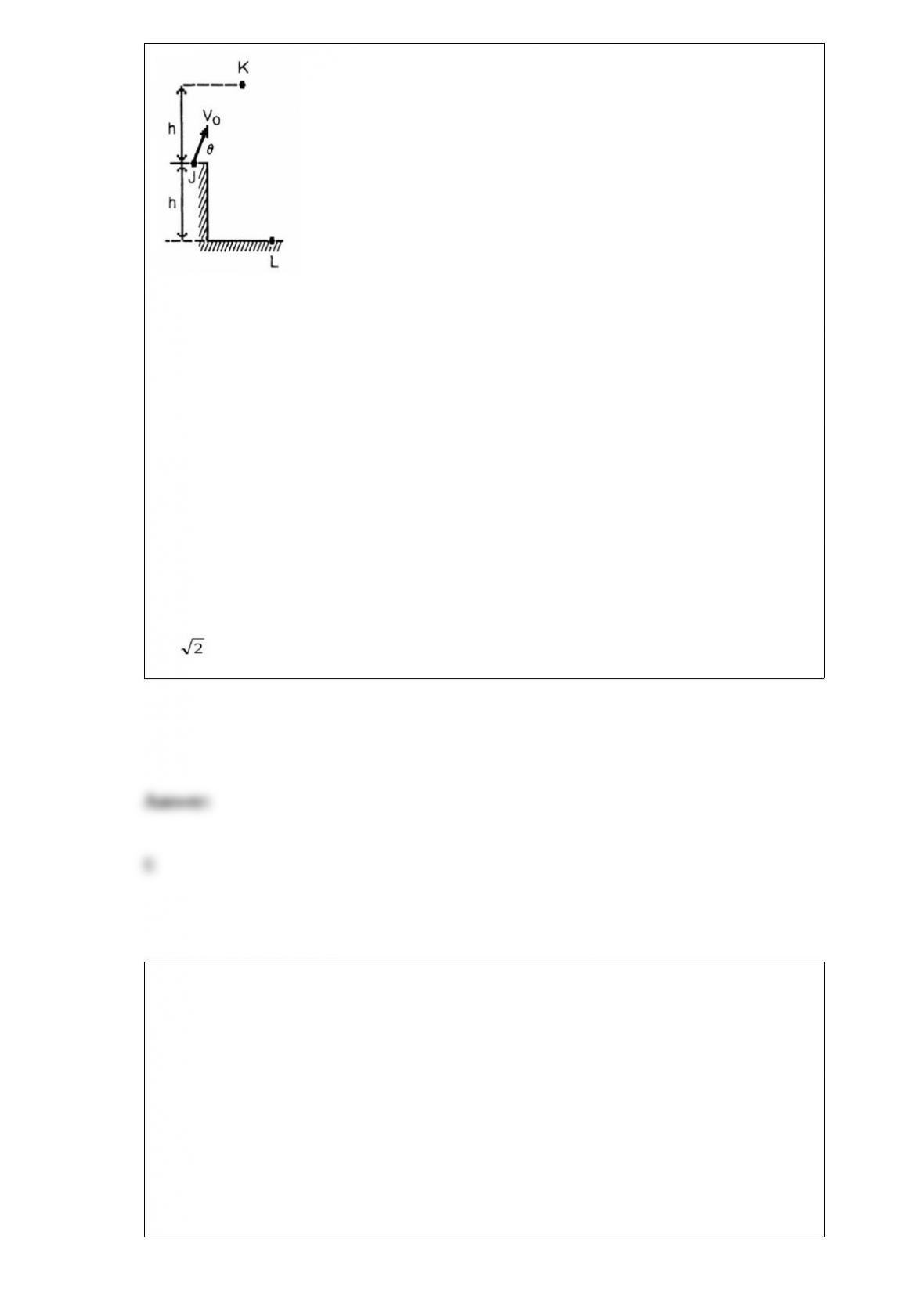
You throw a pebble upward as shown, with a velocity vo at an angle θ, from a roof (at
point J) h ft above the ground, as shown in Fig. 3-5. If the pebble rises upward to h ft
above the roof (to point K), then falls to the ground below (to point L), its speed when it
hits the ground is
A) greater than 2vo
B) between vo and 2vo
C) 2vo
D) vo
E) vo
If 40 kcal of heat is added to 2.0 kg of water, what is the resulting temperature change?
A) 80°C
B) 60°C
C) 40°C
D) 20°C
E) 0.05°C

A potential difference (V) is applied to the ends of an object causing a current (I) to
flow through it. If the object obeys Ohm’s law we can obtain the resistance by
A) multiplying current by voltage.
B) dividing current by voltage.
C) calculating I2V.
D) dividing voltage by current.
Consider an oil film (n = 1.50) on water (n = 1.33) and 600. nm incident light. The
minimum film thickness for constructive interference is
A) 100. nm.
B) 200. nm.
C) 113 nm.
D) 50.0 nm.
E) 150. nm.

The temperature of triple point of water is equivalent to which of the following?
A) 459.F
B) 373.16 K
C) 273.16 K
D) 0.F
E) 100.C
An ideal gas is expanded isothermally from 20 L to 30 L. During this process, 6 J of
energy is expended by the external mechanism that expanded the gas. Which of the
following statements is correct?
A) 6 J of energy flow from surroundings into the gas.
B) 6 J of energy flow from the gas into the surroundings.
C) No energy flows into or from the gas since this process is isothermal.
D) None of the above statements is correct.

One 20-year-old twin brother takes a space trip with a speed of 0.80c for 30 years
according to a clock on the spaceship. Upon returning to the Earth, what is his own age
and the age of the Earth-based twin brother?
A) 20; 30
B) 30; 50
C) 40; 60
D) 50; 70
E) 70; 90
Which one of the following volumes is largest?
A) 500. cm3
B) liter
C) quart
D) cc
E) cubic inch

FIGURE 15-7
As shown in Fig. 15-7, a point charge of +Q is placed at the center of a square, and a
second point charge of -Q is placed at the upper-left corner. It is observed that an
electrostatic force of 2 N acts on the positive charge at the center. What is the
magnitude of the force that acts on the center charge if a third charge of -Q is placed at
the lower-left corner?
A) zero
B) 2 N
C) 4 N
D) 2/ N
An object moves in a direction parallel to its length with a velocity that approaches the
velocity of light. The mass of this object as measured by a stationary observer
A) approaches infinity.
B) approaches zero.
C) increases slightly.
D) does not change.
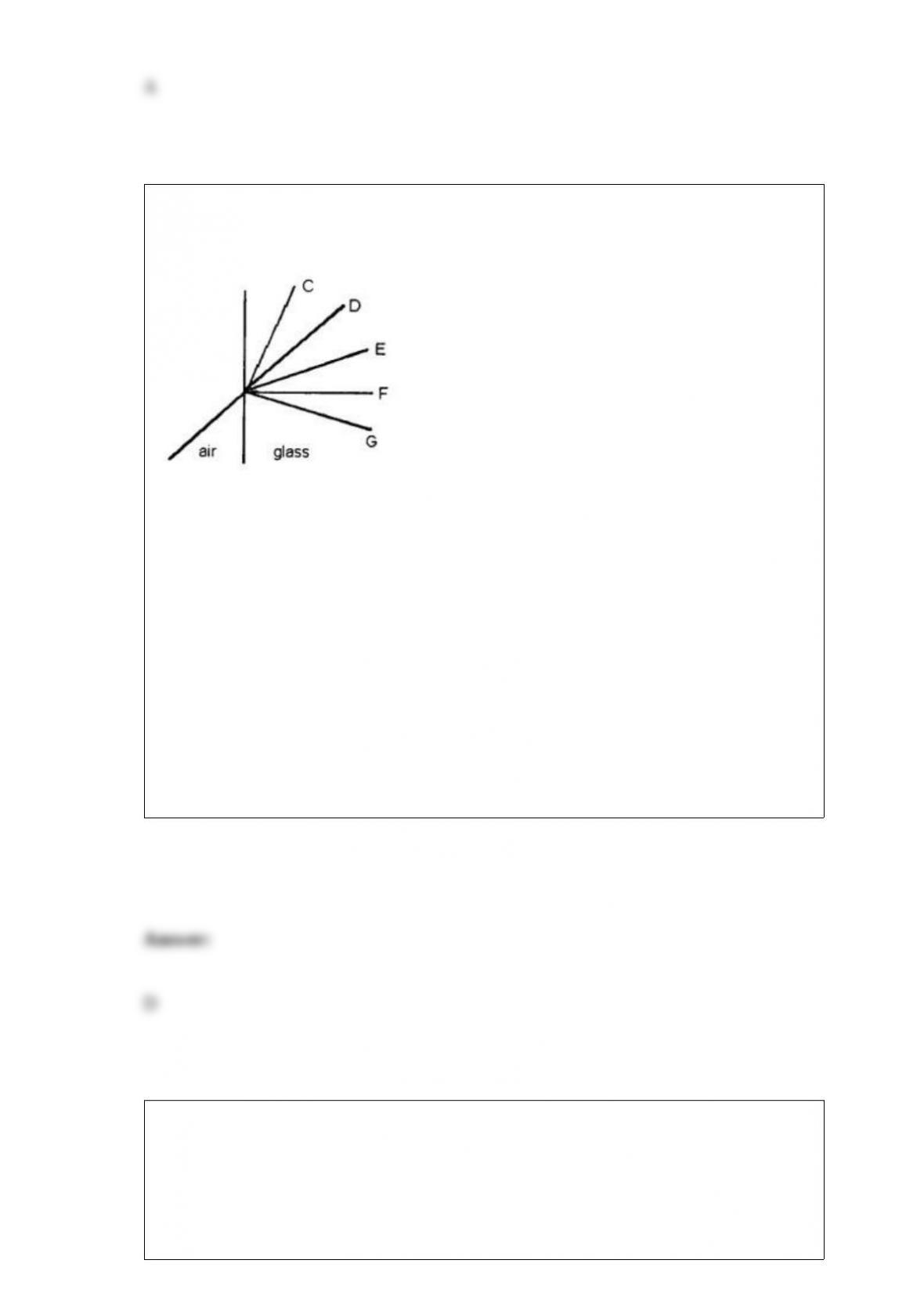
FIGURE 22-1
Shown here in Fig. 22-1 are some possible paths that a light ray can follow in going
either from glass to air or from air into glass. In the drawing you are not told whether
the light is going from left to right or from right to left. Which path did the light follow?
A) path C
B) path G
C) path F
D) path E
E) path D
The focal lengths of the objective and the eyepiece in a microscope are 0.29 cm and 2.5
cm, respectively. An object is placed 0.3 cm from the objective. The image of this
object is viewed with the eyepiece adjusted for minimum eyestrain. What is the distance
between the objective and the eyepiece?
A) 9.85 cm

B) 10.1 cm
C) 10.4 cm
D) 11.2 cm
E) 11.5 cm
In a series RLC circuit the total impedance
A) equals R + XL + XC.
B) never exceeds R.
C) always exceeds R.
D) never is less than R.
A bicycle is moving 4.0 m/s. What is the angular speed of a wheel if its radius is 30.cm?
A) 4.8 rad/s
B) 7.6 rad/s
C) 0.36 rad/s

D) 1.2 rad/s
E) 13. rad/s
A parallel-plate capacitor has a capacitance of 10 mF and is charged with a 20 V power
supply. The power supply is then removed and a dielectric of dielectric constant 4 is
used to fill the space between the plates. The voltage now across the capacitor is
A) zero.
B) 20 V.
C) 5 V.
D) 10 V.
E) 80 V.
In Einstein’s famous equation E = m ∙ c2, describing the relationship between matter
and energy, the units for E are
(given that m kg, c m/s, N = kg ∙ m/ s2)⇒ ⇒
A) m/N
B) kg m/ s2

C) m2/ s2
D) N/m
E) N∙ m
Total constructive interference occurs when two waves with similar frequency and
wavelength
A) are completely out of phase.
B) are completely in phase.
C) have 45 degrees phase difference.
D) have 90 degrees phase difference.
E) have a phase difference of -90 degrees.
Polonium-216 decays to lead-212 by emitting what kind of nuclear radiation?
A) Alpha
B) Beta minus
C) Beta plus

D) Gamma
E) X-rays.
An arrow is shot, from a bow, at an original speed of vo. When it returns to the same
horizontal level, its speed will be
A) 9.8 vo.
B) vo.
C) 2 vo.
D) 1/2 vo.
E) 4 vo.
A 6.0 Ω and a 12. Ω resistor are connected in parallel to a 36. V battery. What power is
dissipated by the 6.0 Ω resistor?
A) 48. W
B) 12. W
C) 486. W

D) 24. W
E) 216.W
In a single slit diffraction experiment, the width of the slit is 3.1 x 10⁻⁵ m and the
distance from the slit to the screen is 2.2 m. If the beam of light of wavelength 600 nm
passes through the slit and forms a diffraction pattern on the screen, what is the linear
distance on the screen from the center of the diffraction pattern to the second dark
fringe?
A) 3.9 cm
B) 4.2 cm
C) 6.3 cm
D) 2.1 cm
E) 8.5 cm
If the newly discovered planet of Krypton has 100. times the mass of the Earth and 100.
times the diameter of the Earth, what would be the period of a “low” orbiting satellite
around Krypton?
A) 1.5 hours

B) 1.5 103 hours
C) 15. hours
D) 1.5 102 hours
E) 0.15 hours
In an RLC circuit, the resistance is 10. ohms, the capacitive reactance is 30. ohms, and
the inductive reactance is 50. ohms. What is the circuit impedance?
A) 10. Ω
B) 22. Ω
C) 90. Ω
D) 63. Ω
E) 81. Ω
The Compton effect importantly demonstrated which property of electromagnetic
radiation?
A) energy content
B) momenta

C) particle nature
D) its wavelength
A thermally isolated system is made up of a hot piece of aluminum and a cold piece of
copper; the aluminum and the copper are in thermal contact. The specific heat capacity
of aluminum is more than double that of copper. Which object experiences the greater
magnitude gain or loss of heat during the time the system takes to reach thermal
equilibrium?
A) the aluminum
B) the copper
C) Neither; both experience the same size gain or loss of heat.
D) It is impossible to tell without knowing the masses.
A double-slit experiment uses light of wavelength 633. nm with a slit separation of
0.100 mm and a screen placed 2.0 m away.
(a) What is the linear width of the central fringe?
(b) What is the lateral distance between 1st and 2nd order fringes?
(c) What is the angular separation between the central maximum and the 1st order

maximum?
Several electrons are placed on a hollow metal sphere. They
A) clump together on the sphere’s inner surface.
B) clump together on the sphere’s outer surface.
C) become uniformly distributed on the sphere’s outer surface.
D) become uniformly distributed on the sphere’s inner surface.
Aluminum has a positive coefficient of thermal expansion. Consider a round hole that
has been drilled in a large sheet of aluminum. As the temperature increases and the
surrounding metal expands, the hole diameter will
A) increase.
B) decrease.
C) remain constant.
D) depends how much metal surrounds the hole
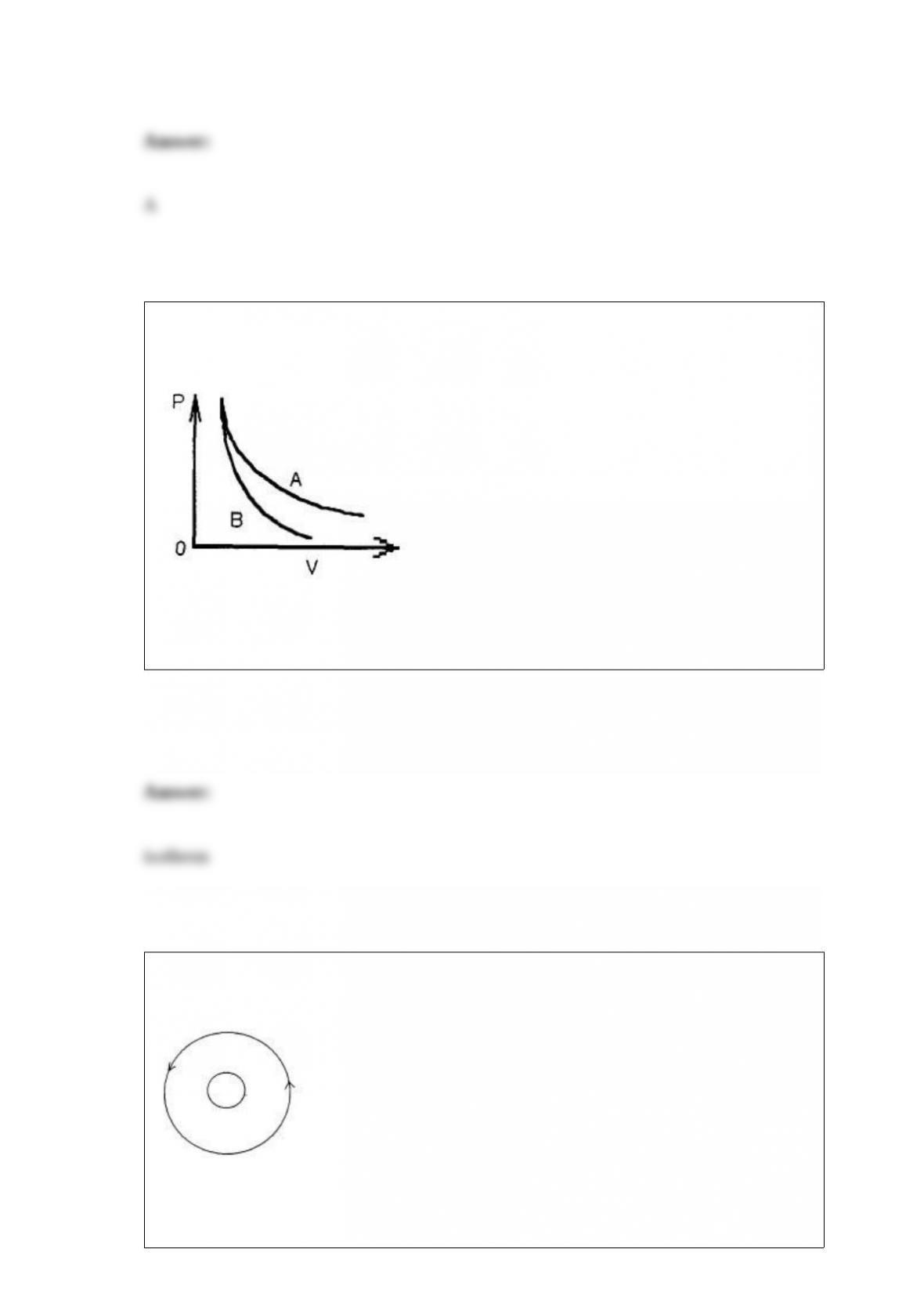
FIGURE 12-1
Two processes are shown on the p-V graph in Fig. 12-1; one is an adiabat and the other
is an isotherm. Is the process represented by the upper curve an adiabat or an isotherm?
FIGURE 20-2
Consider an outer loop of wire surrounding an inner loop of wire, as shown in Fig.
20-2. Suppose the current in the outer loop is counterclockwise and decreasing. What is

the direction of the induced current in the inner loop?
One of the most efficient engines built so far has the following characteristics:
combustion chamber temperature = 1900°C; exhaust temperature = 430°C. 7 x 10⁹ cal
of fuel produces 1.4 x 10¹⁰ J of work in one hour. What is the power output, in hp, of
this engine?
The human eye can just detect green light of wavelength 500. nm, which arrives at the
retina at the rate of 2 x 10-18 W. How many photons arrive each second?
An electron is known to be confined to a region of width 0.10 nm. What is an
approximate expression for the least kinetic energy it could have, expressed in eV?

What is the maximum depth from which a pump on the surface can “suck” up water?
Distinguish between heat, internal energy, and temperature.
A 55-kg box rests on a horizontal surface. The coefficient of static friction between the
box and the surface is 0.30. A 140-N force is applied to the box. What is the frictional
force on the box?

A piece of metal at 80C is placed in 1.2 L of water at 72°C. The system is thermally
isolated and reaches a final temperature of 75°C. Estimate the approximate change in
entropy for this process.
Consider a 1000. Gauss magnetic field along the z axis and a proton moving with an
instantaneous velocity of = 3 + 4 km/s (note its speed is 5. km/s composed of
3. km/s along the x axis and 4. km/s along the z axis). Determine the radius of its
spiraling orbit.
[proton: 1.67 10-27 kg and 1.6 10-19 Coulomb]
How fast should a moving clock travel if it is to be observed by a stationary observer as
running at one-half its normal rate?

A heavy bus bar is 20. cm long and of rectangular cross-section, 1.0 cm 2.0 cm. What is
the voltage drop along its length when it carries 4000. A? (The resistivity of copper is
1.69 x 10⁻⁸ Ω-m.)
An organ pipe open at both ends has a length of 0.800 m. If the velocity of sound in air
is what are the frequencies of the second and third harmonics?
What is the gauge pressure at a depth of 100 m. in water?
How does the thickness of a lens relate to it being converging or diverging?

If a transparent material has an index of refraction of 1.67, what is the speed of light in
the material?
Why aren’t houses wired with outlets in series instead of in parallel?