
An airplane increases its speed from 100 m/s to 160 m/s, at the average rate of 15 m/s2.
How much time does it take for the complete increase in speed?
A) 0.25 s
B) 4.0 s
C) 0.0577 s
D) 17.3 s
E) 8.0 s
In each element of a series LRC circuit
A) the currents are not in phase.
B) the currents and voltages are not in phase.
C) the voltages are in phase.
D) the currents are in phase.
E) the currents and voltages are in phase.
Consider a sound intensity of 16. x 10-8 W/m2.

(a) What is the sound intensity level?
(b) At twice the distance from the source, what would be the intensity level?
(c) At how many times the original distance would the intensity level decrease by 12.
db?
A bar magnet is dropped, N pole down, so it falls through a horizontal loop of wire. As
it approaches the loop, the induced current (viewed from above) is:
A) clockwise
B) counterclockwise
C) zero
An object is placed 9.5 cm from a lens of focal length 24 cm.
(a) Where is the image formed?
(b) What is the magnification?

A 30. kg child stands at one end of a floating 20. kg canoe that is 10. ft long. The child
walks to the other end of the canoe. How far does the canoe move in the water
assuming water friction is negligible?
A) 10. ft
B) 4.0 ft
C) 6.0 ft
D) 8.0 ft
E) 2.0 ft
If a reactor produces an average power of 1000 MW for a year, how much 235U is used
up assuming 200 MeV are released per fission?
A) 0.35 kg
B) 1.75 kg
C) 384 kg
D) 1.1 108 kg
E) 3.3 108 kg

A brick and a feather fall to the Earth at their respective terminal velocities. Which
object experiences the greater force of air friction?
A) Neither, both experience the same amount of air friction force.
B) the brick
C) the feather
An object moves in a direction parallel to its length with a velocity that approaches the
velocity of light. The width of this object as measured by a stationary observer
A) does not change.
B) approaches infinity.
C) approaches zero.
D) increases slightly.
E) approaches “gamma”.

The image of the rare stamp you see through a magnifying glass is
A) always the same orientation as the stamp.
B) always upside-down compared to the stamp.
C) either the same orientation or upside-down, depending on how close the stamp is to
the glass.
D) either the same orientation or upside-down, depending on the thickness of the glass
used.
The most efficient engine possible is the
A) Joule cycle.
B) Wright cycle.
C) Kelvin cycle.
D) Carnot cycle.
E) Otto cycle.
A beam of light of two different wavelengths enters a pane of glass 3.00 mm thick at an

angle of incidence of 56. The indices of refraction for the two different colors are 1.514
and 1.528. Because of dispersion, the colored beams, although parallel, are separated by
a small distance. How far apart are they?
A) 0.057 mm
B) 0.0083 mm
C) 0.025 mm
D) 0.014 mm
E) 0.0062 mm
Two masses, A and B, are attached to different springs. Mass A vibrates with an
amplitude of 8 cm at a frequency of 10 Hz and mass B vibrates with an amplitude of 5
cm at a frequency of 16 Hz. How does the maximum speed of A compare to the
maximum speed of B?
A) Mass A has the greater maximum speed.
B) Mass B has the greater maximum speed.
C) They are equal.
A narrow tube is placed vertically in a pan of water, and the water rises in the tube to 4
cm above the level of the pan. The surface tension in the liquid is lowered to one-half

its original value by the addition of some soap. What happens to the height of the liquid
column in the tube?
A) It drops to 2 cm.
B) It drops to 1 cm.
C) It remains at the same height.
D) It drops or rises, but the height cannot be calculated from the information given.
An RBE
A) is an effective dose of 1 Gy.
B) is equivalent to 3.70 x 10¹⁰ decays/s in radium.
C) is 10-2 J/kg.
D) when multiplied into dosage, yields the effective dose.
E) is an SI unit of absorbed dose = 1 J/kg = 100 rad.
A foul ball is hit straight up into the air with a speed of 30.0 m/s.
(a.) Calculate the time required for the ball to rise to its maximum height.
(b.) Calculate the maximum height reached by the ball.
(c.) Determine the time at which the ball pass a point 25.0 m above the point of contact
between the bat and ball.
(d.) Explain why there are two answers to part c.
Nuclear Magnetic Resonance, NMR, is more commonly referred to as
A) MRI.
B) NRA.
C) CT-scan.
D) MRT.
E) CAT.

Angular momentum cannot be conserved if
A) the angular displacement changes.
B) the angular velocity changes.
C) there is a net force on the system.
D) the moment of inertia changes.
E) there is net torque on the system.
A galvanometer with a coil resistance of 40. Ω deflects full scale for a current of 2.0
mA. What series resistance should be used with this galvanometer in order to construct
a voltmeter that deflects full scale for 50. V?
A bullet moving horizontally with a speed of 500 m/s strikes a sandbag and penetrates a
distance of 10 cm.
(a) What is the average acceleration of the bullet?
(b) How long does it take to come to rest?

A small galvanometer coil of resistance R = 20 Ω and full-scale deflection at 1 mA is
connected in series with a 4980 Ω resistance to build an analog voltmeter. What is the
maximum voltage that this voltmeter can read?
A) 3 V
B) 1 V
C) 50 V
D) 5 V
E) 10 V
A 0.30-kg mass is suspended on a spring. In equilibrium the mass stretches the spring
2.0 cm downward. The mass is then pulled an additional distance of 1.0 cm down and
released from rest. Write down its equation of motion.
A) y = (0.01 m) cos (22.1 t)
B) y = (0.01 m) sin (22.1 t)
C) y = (0.03 m) cos (22.1 t)
D) y = (0.03 m) sin (22.1 t)

If both the mass and the velocity of a ball are tripled, the kinetic energy is increased by
a factor of
A) 18.
B) 81.
C) 6.
D) 9.
E) 27.
What is the de Broglie wavelength of an electron whose kinetic energy is 1.0 eV?
A) 520 nm
B) 8.2 nm
C) 0.64 nm
D) 52 nm
E) 1.2 nm

Two point charges of + 40.0 μC and – 10.0 μC are separated by a distance of 20.0 cm. A
+7.00 μC charge is placed midway between these two charges. What is the electric
force acting on this charge because of the other two charges?
A) 0.453 N directed towards the negative charge
B) 3.15 N directed towards the negative charge
C) 3.15 N directed towards the positive charge
D) 315 N directed towards the positive charge
E) 315 N directed towards the negative charge
A 13000 N vehicle is to be lifted by a 25 cm diameter hydraulic piston. What force
needs to be applied to a 5.0 cm diameter piston to accomplish this?
A) 260 N
B) 520 N
C) 2600 N
D) 5200 N
E) 13000 N

A long solenoid produces a field at its center. An identical solenoid is placed end to end
with the first (common axis). The magnetic field at the center of the 1st solenoid is now
A) zero.
B) the same.
C) double.
D) four times the original magnitude.
E) half what it was.
A horizontal metal bar rotates at a constant angular velocity w about a vertical axis
through one of its ends while in a constant magnetic field B that is directed down. The
emf induced between the two ends of the bar is
A) constant and proportional to the product B ω.
B) constant and proportional to the product B ω2.
C) constant and proportional to the product B2 ω2.
D) variable with a maximum of B ω.
E) variable with a maximum of B ω2.
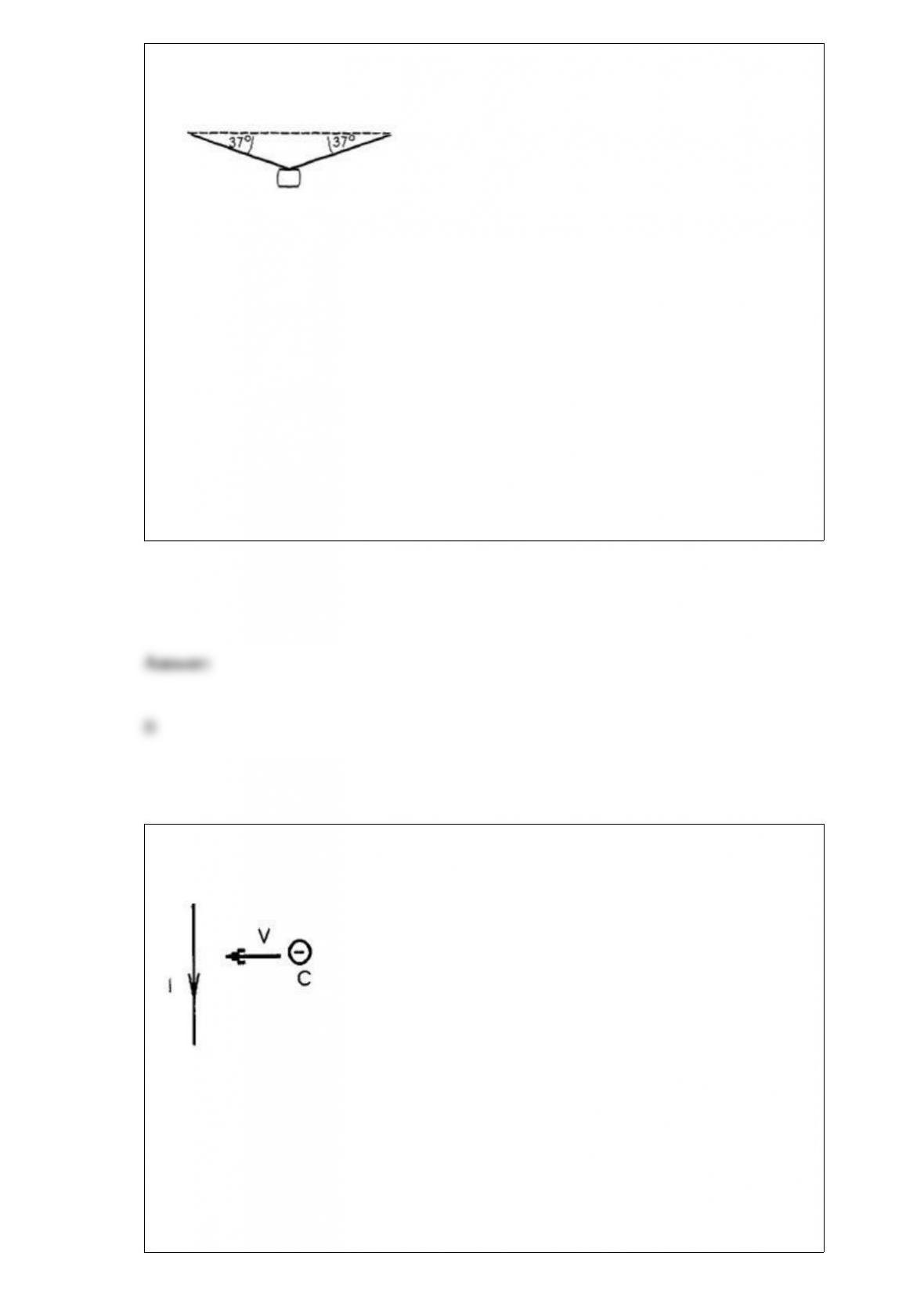
FIGURE 4-12
A 1300. N gondola car, at a ski lift, is temporarily suspended at the halfway point,
causing the wire to sag by 37.0 below the horizontal, as shown in Fig. 4-12. The tension
in the cable is
A) 2.16 103 N
B) 1.08 103 N
C) 8.14 102 N
D) 1.63 103 N
E) 4.32 103 N
FIGURE 19-3
A wire lying in the plane of the page carries a current toward the bottom of the page, as
shown in Fig. 19-3. What is the direction of the magnetic force it produces on an
electron that is moving perpendicularly toward the wire, also in the plane of the page,
from your right?
A) perpendicular to the page and away from you

B) zero
C) perpendicular to the page and towards you
D) toward the top of the page
E) toward the bottom of the page
If a red filter were placed in front of blue dungarees, you would see
A) white.
B) green.
C) blue.
D) red.
E) black.
FIGURE 12-2
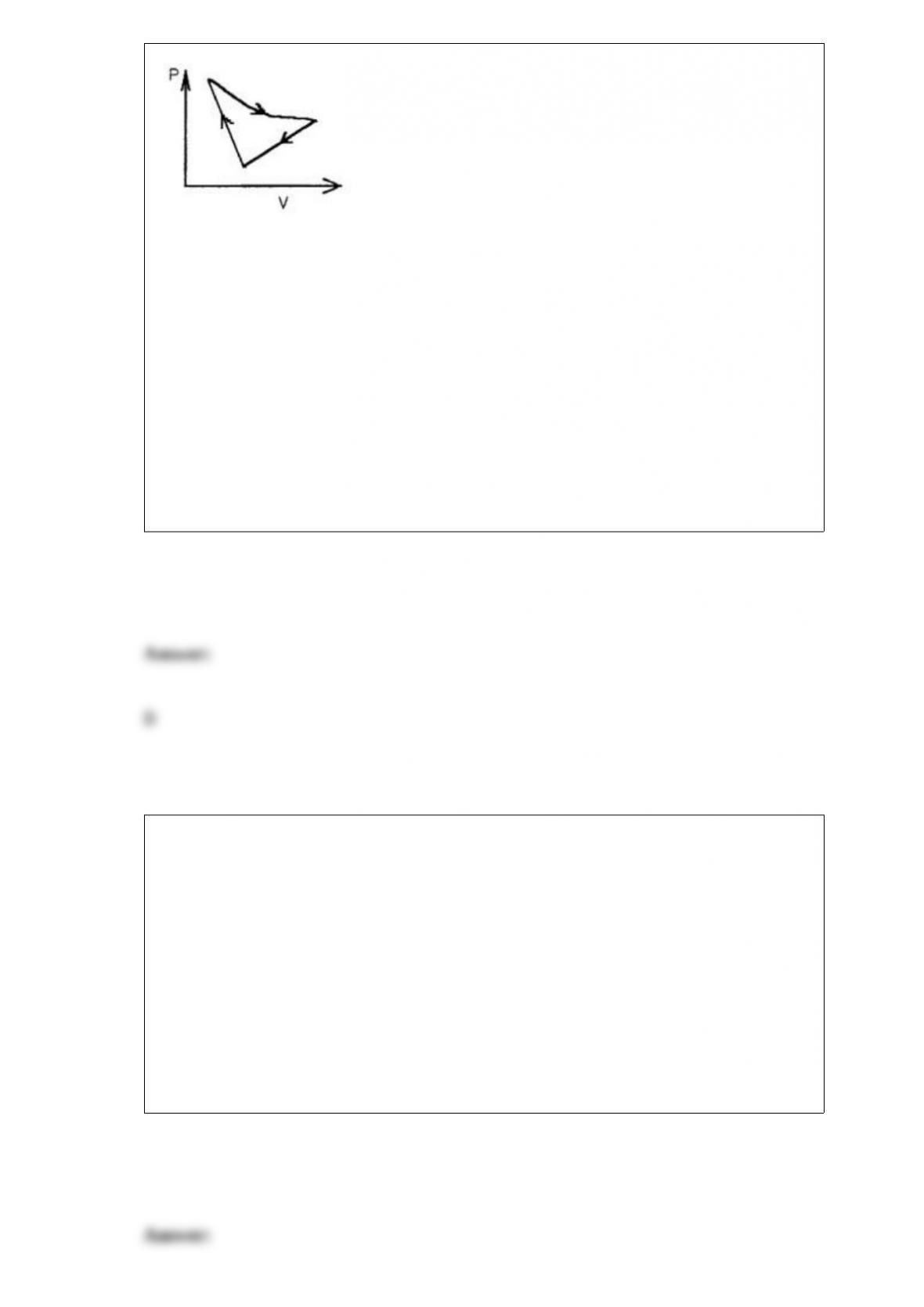
A cyclic process is carried out on an ideal gas such that it returns to its initial state at the
end of a cycle. If the process was carried out in a clockwise sense around the enclosed
area, as shown on the p-V diagram in Fig. 12-2, then the change of internal energy over
the full cycle
A) is positive.
B) is zero.
C) cannot be determined from the information given.
D) is negative.
A 2.0 μF capacitor is charged through a 50,000. Ω resistor. How long does it take for
the capacitor to reach 90% of full charge?
A) 2.19 s
B) 0.23 s
C) 0.9 s
D) 9.1 s
E) 2.3 s

When red light illuminates a grating with 7000. lines per centimeter, its second
maximum is at 62.4. What is the wavelength of the light?
The weight of an object on the Moon is what fraction of the weight of the same object
on Earth?
Match cornea to the best description above.
A metal sphere of radius 2.0 cm carries a charge of 3.0 μC. What is the electric field 6.0

cm from the center of the sphere?
Glass has more than three times larger thermal conductivity than air. Yet glass-wool
(glass fibers and air) is preferable to insulate wall spaces rather than leaving “empty” air
spaces. Why is glass-wool better although glass has larger conductivity than air?
What different resistances can be obtained by using two 2. Ω resistors and
one 4. Ω resistor?
What is the audible range of sound frequencies?

Why don’t we use “efficiency” for rating refrigerators, like we rate engines, instead of
the Coefficient of Performance?
Is it possible for heat to travel from a cold object to a hotter object?
State Boyle’s law.

A metal sphere of radius 80. mm is charged to a potential of -0.50 kV. With what
velocity must an electron be fired toward the sphere if it is to just barely reach the
sphere when started from a position 15. cm from the center of the sphere?
If someone were to suggest that possibly half of the galaxies in the universe are
composed of antiparticles (“anti-galaxies”), what argument(s) might you present to
refute this hypothesis? (Remember, atoms made of antiparticles have the same chemical
and spectroscopic properties that our “ordinary” matter has.)
The current in a coil increases from 2.0 A to 12. A in 50. ms. Calculate the voltage
induced in the coil if its self-inductance is 0.120 H.

Is it realistic to apply the conservation of momentum to real world collisions where
external forces act?
A metallic surface has a work function of 2.50 eV. What is the longest wavelength that
will eject electrons from the surface of this metal?
In a diffraction experiment, light of 600. nm wavelength produces a first-order
maximum 0.350 mm from the central maximum on a distant screen. A second
monochromatic source produces a third-order maximum 0.870 mm from the central
maximum when it passes through the same diffraction grating. What is the wavelength
of the light from the second source?

Aliens on Krypton build a spacecraft 472. teef long. In their units the speed of light is
22.2 million teef/ces. How fast (teef/ces) must it travel to appear to be 66.6 teefs long?
An electron slowing from 0.998c to 0.500c loses how much momentum? (express the
answer in MeV/c as well as N-s)
Usually one can touch the terminals of a battery (e.g., 1.5 volts) with no dire
consequences. Why do hospital intensive care rooms go to great effort and expense to
attach “ground wires” to equipment in order to guard against the presence of low
potentials? (i.e., why are low voltages hazardous in hospitals?)